seats HYUNDAI TUCSON 2014 User Guide
[x] Cancel search | Manufacturer: HYUNDAI, Model Year: 2014, Model line: TUCSON, Model: HYUNDAI TUCSON 2014Pages: 542, PDF Size: 7.59 MB
Page 33 of 542
2-16
Safety system of your vehicle
Front seat headrest
The driver’s and front passenger’s
seats are equipped with adjustable
headrests for the passengers safety
and comfort.
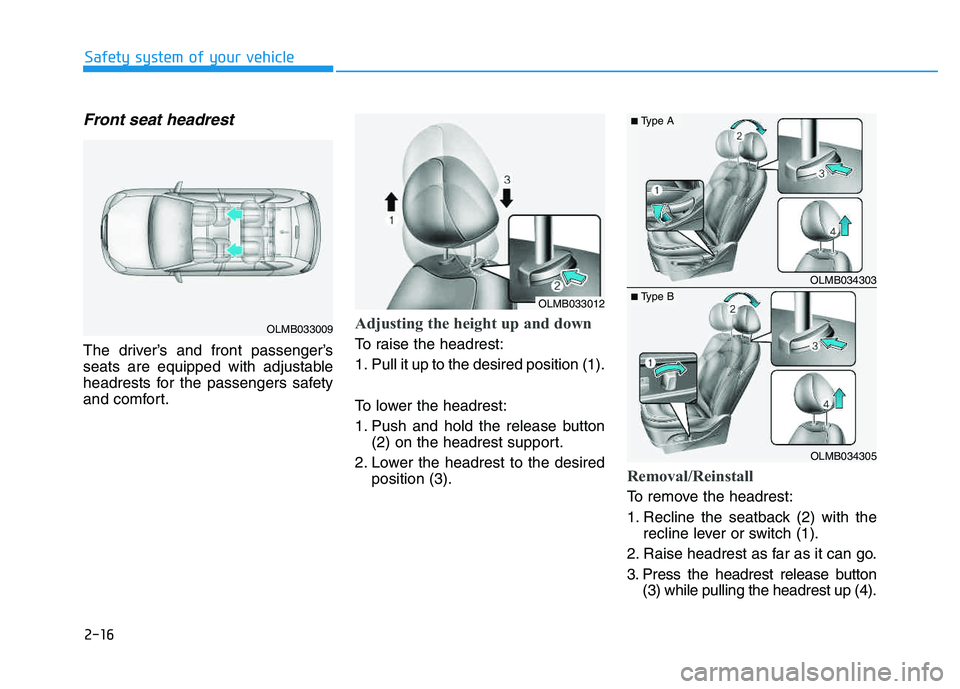
Adjusting the height up and down
To raise the headrest:
1. Pull it up to the desired position (1).
To lower the headrest:
1. Push and hold the release button(2) on the headrest support.
2. Lower the headrest to the desired position (3).
Removal/Reinstall
To remove the headrest:
1. Recline the seatback (2) with therecline lever or switch (1).
2. Raise headrest as far as it can go.
3. Press the headrest release button (3) while pulling the headrest up (4).
OLMB033009
OLMB033012
OLMB034303
OLMB034305
■Type A
■ Type B
Page 35 of 542
2-18
Safety system of your vehicle
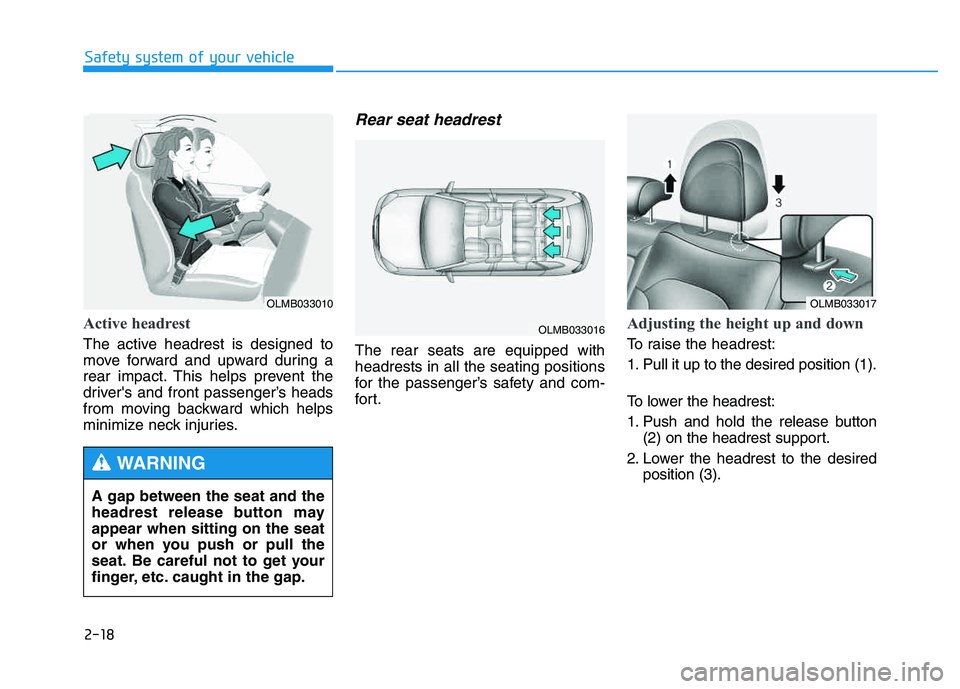
Active headrest
The active headrest is designed to
move forward and upward during a
rear impact. This helps prevent the
driver's and front passenger’s heads
from moving backward which helps
minimize neck injuries.
Rear seat headrest
The rear seats are equipped withheadrests in all the seating positions
for the passenger’s safety and com-
for t.
Adjusting the height up and down
To raise the headrest:
1. Pull it up to the desired position (1).
To lower the headrest:
1. Push and hold the release button(2) on the headrest support.
2. Lower the headrest to the desired position (3).
OLMB033017
OLMB033016
OLMB033010
A gap between the seat and the
headrest release button mayappear when sitting on the seat
or when you push or pull the
seat. Be careful not to get your
finger, etc. caught in the gap.
WARNING
Page 36 of 542
2-19
Safety system of your vehicle
2
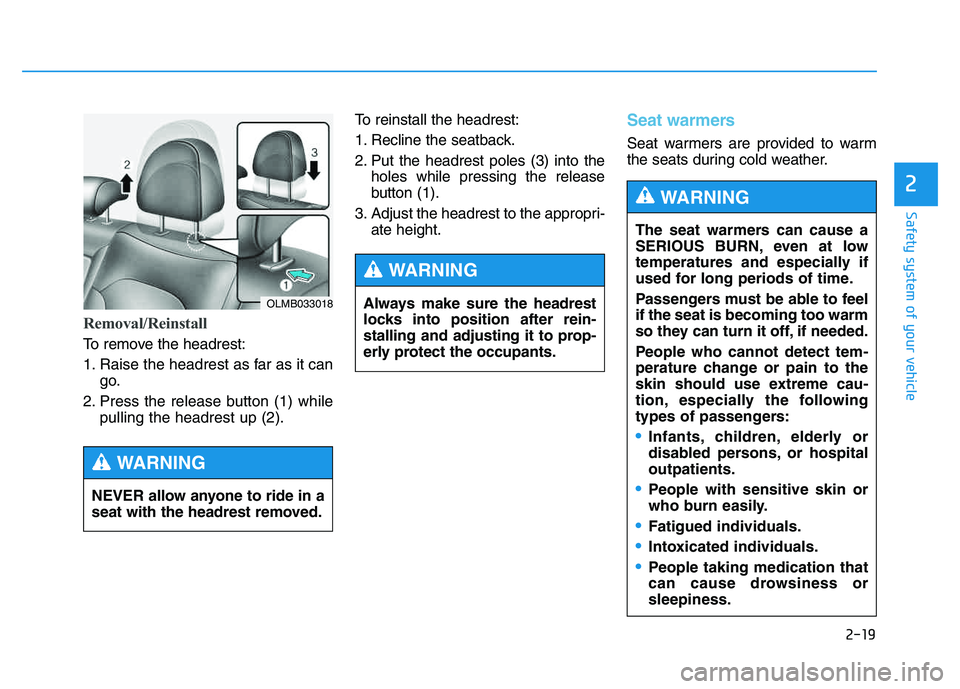
Removal/Reinstall
To remove the headrest:
1. Raise the headrest as far as it cango.
2. Press the release button (1) while pulling the headrest up (2). To reinstall the headrest:
1. Recline the seatback.
2. Put the headrest poles (3) into the
holes while pressing the release
button (1).
3. Adjust the headrest to the appropri- ate height.
Seat warmers
Seat warmers are provided to warm
the seats during cold weather.
Always make sure the headrest
locks into position after rein-
stalling and adjusting it to prop-
erly protect the occupants.
WARNING
The seat warmers can cause a
SERIOUS BURN, even at low
temperatures and especially if
used for long periods of time.
Passengers must be able to feel if the seat is becoming too warm
so they can turn it off, if needed.
People who cannot detect tem-
perature change or pain to the
skin should use extreme cau-
tion, especially the following
types of passengers:
Infants, children, elderly or
disabled persons, or hospitaloutpatients.
People with sensitive skin or
who burn easily.
Fatigued individuals.
Intoxicated individuals.
People taking medication that
can cause drowsiness orsleepiness.
WARNING
OLMB033018
NEVER allow anyone to ride in a
seat with the headrest removed.
WARNING
Page 37 of 542
2-20
Safety system of your vehicle
Front seat warmers (if equipped)
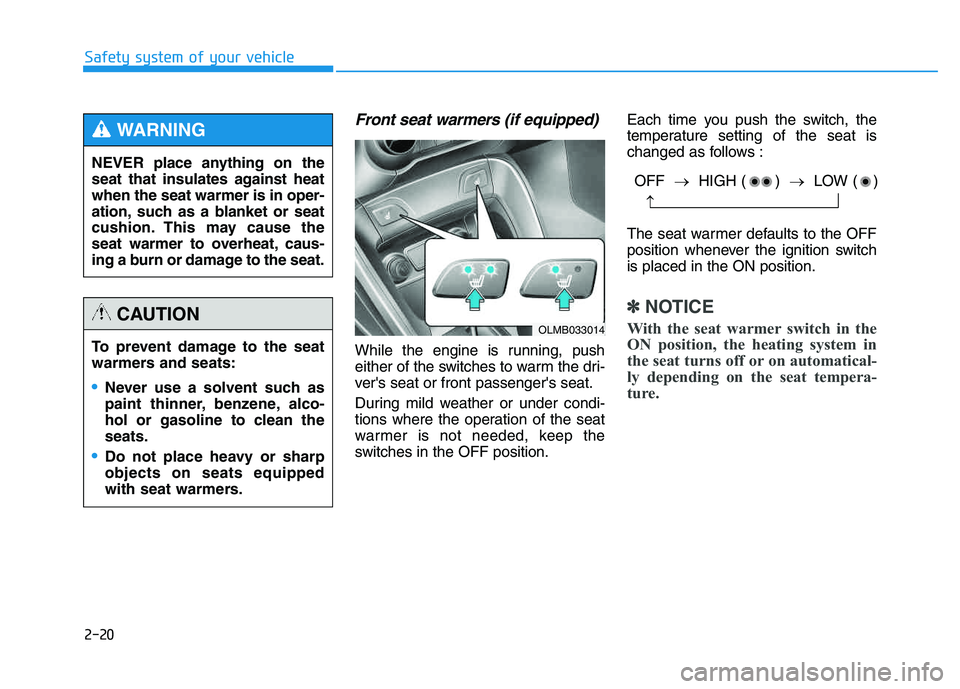
While the engine is running, push
either of the switches to warm the dri-
ver's seat or front passenger's seat.
During mild weather or under condi-
tions where the operation of the seat
warmer is not needed, keep the
switches in the OFF position.Each time you push the switch, the
temperature setting of the seat is
changed as follows :
The seat warmer defaults to the OFF
position whenever the ignition switchis placed in the ON position.
✽✽
NOTICE
With the seat warmer switch in the
ON position, the heating system in
the seat turns off or on automatical-
ly depending on the seat tempera-
ture.
OLMB033014
OFF HIGH ( ) LOW ( )
NEVER place anything on the
seat that insulates against heatwhen the seat warmer is in oper-
ation, such as a blanket or seat
cushion. This may cause the
seat warmer to overheat, caus-
ing a burn or damage to the seat.
WARNING
To prevent damage to the seat
warmers and seats:
Never use a solvent such as
paint thinner, benzene, alco-
hol or gasoline to clean theseats.
Do not place heavy or sharp objects on seats equipped
with seat warmers.
CAUTION
Page 38 of 542
2-21
Safety system of your vehicle
2
This section describes how to use the
seat belts properly. It also describessome of the things not to do when
using seat belts.
Seat belt safety precautions
Always fasten your seat belt and
make sure all passengers have fas-
tened their seat belts before starting
any trip. Air bags are designed tosupplement the seat belt as an addi-
tional safety device, but they are not a
substitute. Most states require all
occupants of a vehicle to wear seat
belts.
SSEE AA TT BB EELLTT SS
Seat belts must be used by ALL
passengers whenever the vehi-
cle is moving. Take the followingprecautions when adjusting andwearing seat belts:
ALWAYS properly restrain
children under age 13 in therear seats.
NEVER allow children to ride
in the front passenger seat. If
a child age 13 or older must be
seated in the front seat, move
the seat as far back as possi-
ble and properly restrain themin the seat belt.
NEVER allow an infant or child
to be carried on an occupant’slap.
NEVER ride with the seatback
reclined when the vehicle is
moving.
Do not allow children to share a seat or seat belt.
Do not wear the shoulder belt
under your arm or behind your
back.
(Continued)
WARNING (Continued)
Do not use the seat belt if it is
twisted. A twisted seat belt
will not protect you properlyin an accident.
Do not use a seat belt if the
webbing or hardware is dam-
aged.
Do not latch the seat belt into
the buckles of other seats.
NEVER unfasten the seat belt
while driving. This may cause
loss of vehicle control result-ing in an accident.
Make sure there is nothing in
the buckle interfering with the
seat belt latch mechanism.
This may prevent the seat belt
from fastening securely.
No modifications or additions
should be made by the user
which will either prevent the
seat belt adjusting devices
from operating to remove
slack, or prevent the seat belt
assembly from being adjusted
to remove slack.
Page 48 of 542
2-31
Safety system of your vehicle
2
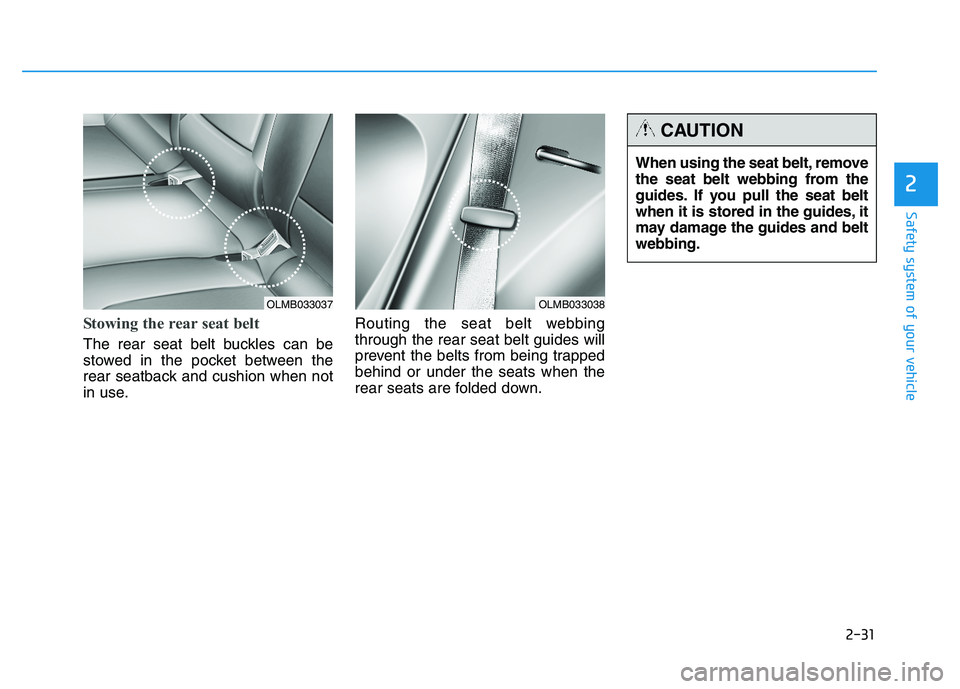
Stowing the rear seat belt
The rear seat belt buckles can be
stowed in the pocket between the
rear seatback and cushion when not
in use.Routing the seat belt webbingthrough the rear seat belt guides will
prevent the belts from being trappedbehind or under the seats when the
rear seats are folded down. When using the seat belt, remove
the seat belt webbing from the
guides. If you pull the seat belt
when it is stored in the guides, it
may damage the guides and beltwebbing.
CAUTION
OLMB033038OLMB033037
Page 49 of 542
2-32
Safety system of your vehicle
Additional seat belt safety pre- cautions
Seat belt use during pregnancy
The seat belt should always be used
during pregnancy. The best way to
protect your unborn child is to protect
yourself by always wearing the seatbelt.
Pregnant women should always wear
a lap-shoulder seat belt. Place the
shoulder belt across your chest, rout-
ed between your breasts and away
from your neck. Place the shoulder
belt across the chest, routed away
from the neck. Place the lap belt below
the belt line so that it fits snugly and as
low as possible across the hips, notacross the abdomen.
Seat belt use and children
Infant and small children
All 50 states have child restraint laws
which require children to travel in
approved child restraint devices,
including booster seats. The age atwhich seat belts can be used instead
of child restraints differs among
states, so you should be aware of the
specific requirements in your state,
and where you are travelling. Infant
and child restraints must be properlyplaced and installed in a rear seat.
For more information refer to the
“Child Restraint Systems” in this
chapter.
To reduce the risk of serious
injury or death to an unborn
child during an accident, preg-
nant women should NEVER
place the lap portion of the seat
belt above or over the area ofthe abdomen where the unborn
child is located.
WARNING
ALWAYS properly restrain infants
and small children in a child
restraint appropriate for the
child’s height and weight.
To reduce the risk of serious
injury or death to a child and
other passengers, NEVER hold a
child in your lap or arms when
the vehicle is moving. The violent
forces created during an acci-
dent will tear the child from your
arms and throw the child against
the interior of the vehicle.
WARNING
Page 51 of 542
2-34
Safety system of your vehicle
Transporting an injured person
A seat belt should be used when an
injured person is being transported.
Consult a physician for specific rec-
ommendations.
One person per belt
Two people (including children) should
never attempt to use a single seat belt.
This could increase the severity of
injuries in case of an accident.
Do not lie down
Sitting in a reclined position when
the vehicle is in motion can be dan-
gerous. Even when buckled up, the
protections of your restraint system
(seat belts and air bags) is greatly
reduced by reclining your seatback.
To reduce the chance of injuries in
the event of an accident and to
achieve the maximum effectiveness
of the restraint system, all passen-gers should be sitting up and thefront and rear seats should be in an
upright position when the car is mov-
ing. A seat belt cannot provide prop-er protection if the person is lying
down in the rear seat or if the front orrear seats are in a reclined position.
NEVER ride with a reclined
seatback when the vehicle is
moving.
Riding with a reclined seatback
increases your chance of seri-
ous or fatal injuries in the event
of a collision or sudden stop.
Drivers and passengers should
always sit well back in their
seats, properly belted, and with
the seatbacks upright.
WARNING
Page 53 of 542
2-36
Safety system of your vehicle
Children under age 13 must always
ride in the rear seats and must
always be properly restrained to min-
imize the risk of injury in an accident,
sudden stop or sudden maneuver.
According to accident statistics, chil-
dren are safer when properly
restrained in the rear seats than inthe front seat.Even with air bags,
children can be seriously injuredor killed. Children too large for a
child restraint must use the seat belts
provided.
All 50 states have child restraint laws
which require children to travel in
approved child restraint devices. The
laws governing the age or
height/weight restrictions at whichseat belts can be used instead of
child restraints differs among states,
so you should be aware of the spe-
cific requirements in your state, and
where you are travelling. Child restraint systems must be
properly placed and installed in the
rear seat. You must use a commer-
cially available child restraint systemthat meets the requirements of the
Federal Motor Vehicle SafetyStandards (FMVSS).
Child restraint systems are generally
designed to be secured in a vehicle
seat by lap belt portion of a
lap/shoulder belt, or by a LATCH sys-
tem in the rear seats of the vehicle.
CC
HH IILL DD RR EESSTT RR AA IINN TT SS YY SSTT EEMM (( CC RR SS))
Always properly restrain chil- dren in the rear seats of the
vehicle.
Children of all ages are safer when restrained in the rear seat.
A child riding in the front pas-
senger seat can be forcefully
struck by an inflating air bag
resulting in SERIOUS INJURY
or DEATH.
WARNING
Page 55 of 542
2-38
Safety system of your vehicle
Child restraint system types
There are three main types of child
restraint systems: rear-facing seats,
forward-facing seats, and booster
seats. They are classified according
to the child’s age, height and weight.
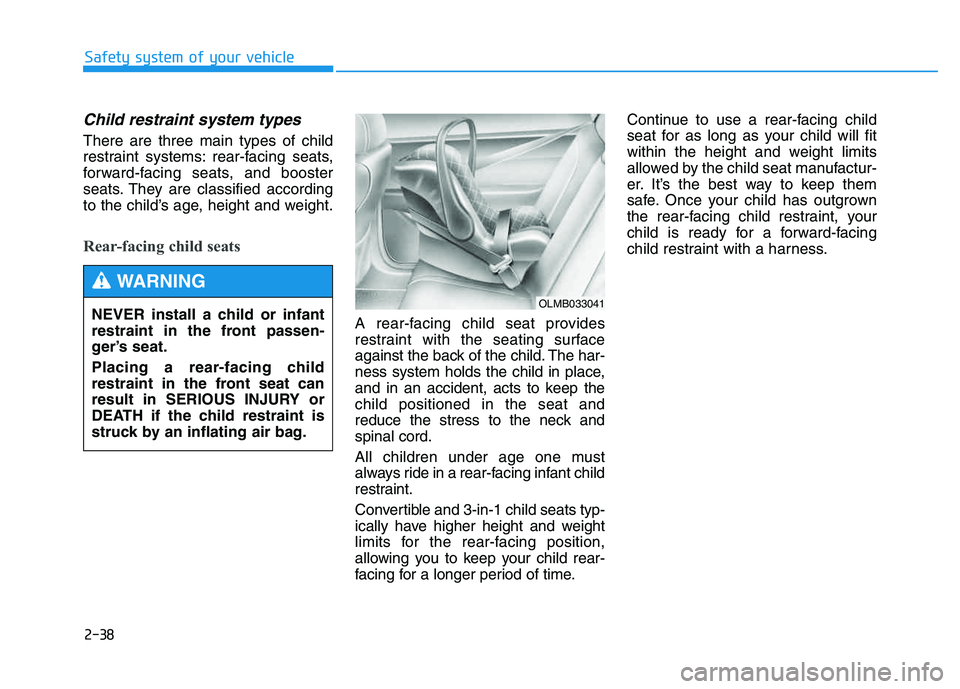
Rear-facing child seats
A rear-facing child seat provides
restraint with the seating surface
against the back of the child. The har-
ness system holds the child in place,
and in an accident, acts to keep thechild positioned in the seat and
reduce the stress to the neck andspinal cord.
All children under age one must
always ride in a rear-facing infant child
restraint.
Convertible and 3-in-1 child seats typ-
ically have higher height and weight
limits for the rear-facing position,
allowing you to keep your child rear-
facing for a longer period of time.Continue to use a rear-facing child
seat for as long as your child will fit
within the height and weight limits
allowed by the child seat manufactur-
er. It’s the best way to keep them
safe. Once your child has outgrown
the rear-facing child restraint, your
child is ready for a forward-facing
child restraint with a harness.
OLMB033041NEVER install a child or infant
restraint in the front passen-
ger’s seat.
Placing a rear-facing child
restraint in the front seat can
result in SERIOUS INJURY or
DEATH if the child restraint is
struck by an inflating air bag.
WARNING