spare wheel HYUNDAI TUCSON 2014 User Guide
[x] Cancel search | Manufacturer: HYUNDAI, Model Year: 2014, Model line: TUCSON, Model: HYUNDAI TUCSON 2014Pages: 542, PDF Size: 7.59 MB
Page 479 of 542
7-49
7
Maintenance
Check tire inflation pressure
Check your tires, including the spare
tire, once a month or more.
How to check
Use a good quality tire pressure
gauge to check tire pressure. You
can not tell if your tires are properly
inflated simply by looking at them.
Radial tires may look properly inflat-
ed when they are under-inflated.
Remove the valve cap from the tire
valve stem. Press the tire gauge firm-
ly onto the valve to get a pressure
measurement. If the cold tire inflationpressure matches the recommendedpressure on the tire and loading
information label, no further adjust-
ment is necessary. If the pressure is
low, add air until you reach the rec-
ommended pressure. to put the valve
caps back on the valve stems.
Without the valve cap, dirt or mois-
ture could get into the valve core and
cause air leakage. If a valve cap is
missing, install a new one as soon as
possible If you overfill the tire, release air bypushing on the metal stem in the
center of the tire valve. Recheck the
tire pressure with the tire gauge. Be
sure to put the valve caps back on
the valve stems. Without the valve
cap, dirt or moisture could get into
the valve core and cause air leakage.
If a valve cap is missing, install a new
one as soon as possible.
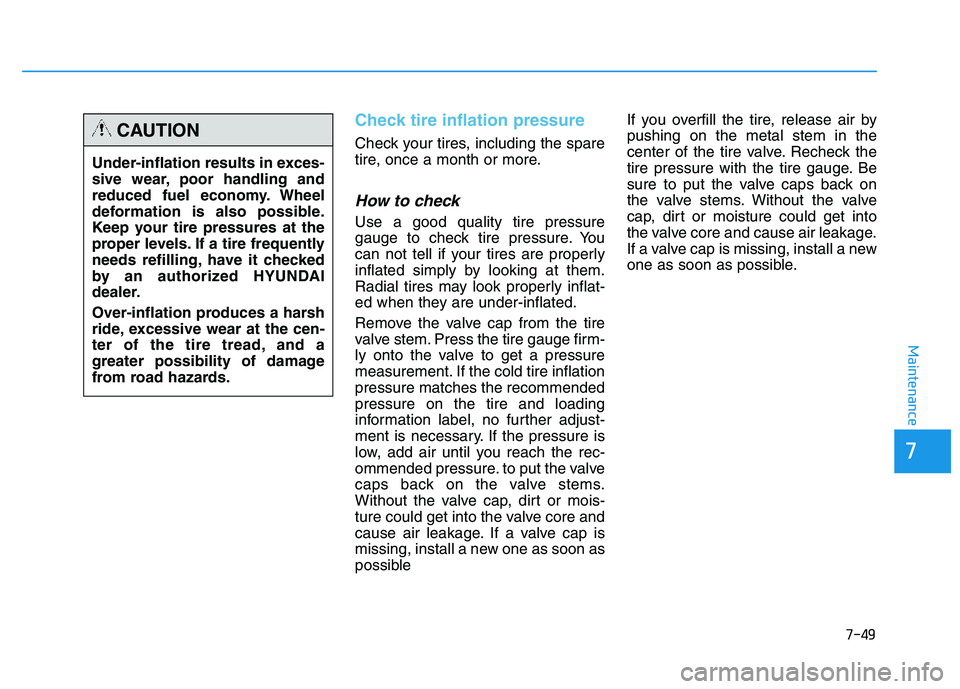
Under-inflation results in exces-
sive wear, poor handling and
reduced fuel economy. Wheel
deformation is also possible.
Keep your tire pressures at the
proper levels. If a tire frequently
needs refilling, have it checked
by an authorized HYUNDAI
dealer.
Over-inflation produces a harsh
ride, excessive wear at the cen-
ter of the tire tread, and a
greater possibility of damage
from road hazards.
CAUTION
Page 480 of 542
7-50
Maintenance
Tire rotation
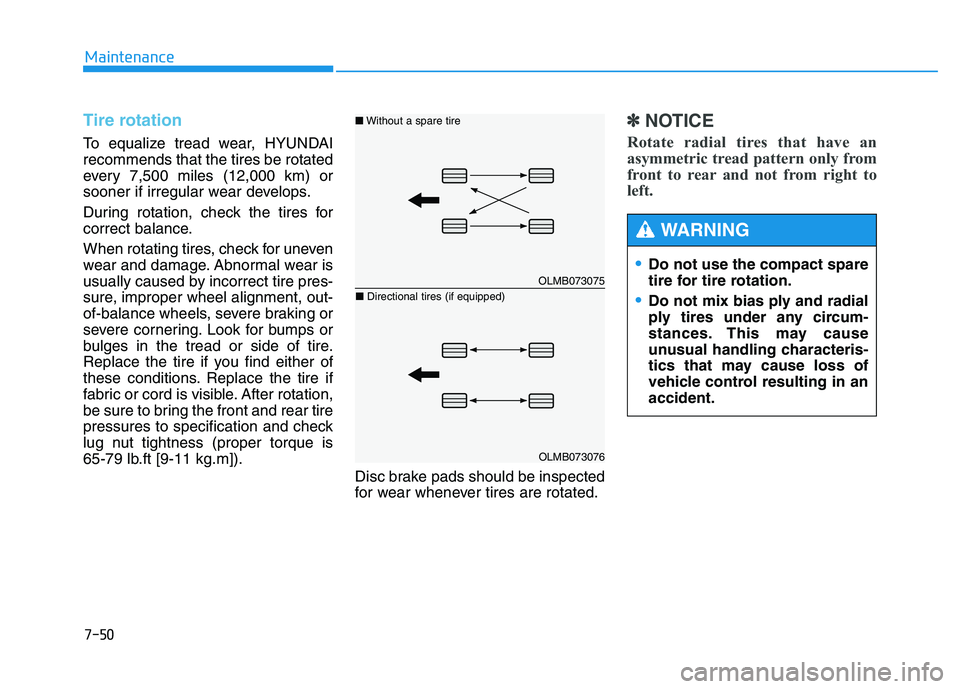
To equalize tread wear, HYUNDAI recommends that the tires be rotated
every 7,500 miles (12,000 km) or
sooner if irregular wear develops.
During rotation, check the tires for
correct balance.
When rotating tires, check for uneven
wear and damage. Abnormal wear is
usually caused by incorrect tire pres-
sure, improper wheel alignment, out-
of-balance wheels, severe braking or
severe cornering. Look for bumps or
bulges in the tread or side of tire.
Replace the tire if you find either of
these conditions. Replace the tire if
fabric or cord is visible. After rotation,
be sure to bring the front and rear tire
pressures to specification and check
lug nut tightness (proper torque is
65-79 lb.ft [9-11 kg.m]).Disc brake pads should be inspected
for wear whenever tires are rotated.
✽✽NOTICE
Rotate radial tires that have an
asymmetric tread pattern only from
front to rear and not from right to
left.
Do not use the compact spare
tire for tire rotation.
Do not mix bias ply and radial
ply tires under any circum-
stances. This may cause
unusual handling characteris-
tics that may cause loss of
vehicle control resulting in anaccident.
WARNING
OLMB073075
OLMB073076
■ Without a spare tire
■ Directional tires (if equipped)
Page 482 of 542
7-52
Maintenance
Compact spare tire replacement
A compact spare tire has a shorter
tread life than a regular size tire.
Replace it when you can see the
tread wear indicator bars on the tire.The replacement compact spare tire
should be the same size and design
tire as the one provided with your
new vehicle and should be mountedon the same compact spare tire
wheel. The compact spare tire is notdesigned to be mounted on a regular
size wheel, and the compact spare
tire wheel is not designed for mount-
ing a regular size tire.
Wheel replacement
When replacing the metal wheels for
any reason, make sure the new
wheels are equivalent to the original
factory units in diameter, rim widthand offset.
Tire traction
Tire traction can be reduced if you
drive on worn tires, tires that are
improperly inflated or on slippery
road surfaces. Tires should be
replaced when tread wear indicators
appear. To reduce the possibility of
losing control, slow down whenever
there is rain, snow or ice on the road.
(Continued)
Heat caused by hot climates or frequent high loading condi-
tions can accelerate the aging
process. Failure to follow this
warning may cause sudden tire
failure, which could lead to a
loss of vehicle control resultingin an accident.
The original tire should be repaired or replaced as soon as
possible to avoid failure of the
spare and loss of vehicle con-
trol resulting in an accident. The
compact spare tire is for emer-
gency use only. Do not operate
your vehicle over 50 mph (80km/h) when using the compact
spare tire.
WARNING
Page 484 of 542
7-54
Maintenance
Wheel size designation
Wheels are also marked with impor-
tant information that you need if you
ever have to replace one. The follow-
ing explains what the letters and
numbers in the wheel size designa-tion mean.
Example wheel size designation:6.5JX18
6.5 - Rim width in inches.J - Rim contour designation.
18 - Rim diameter in inches.
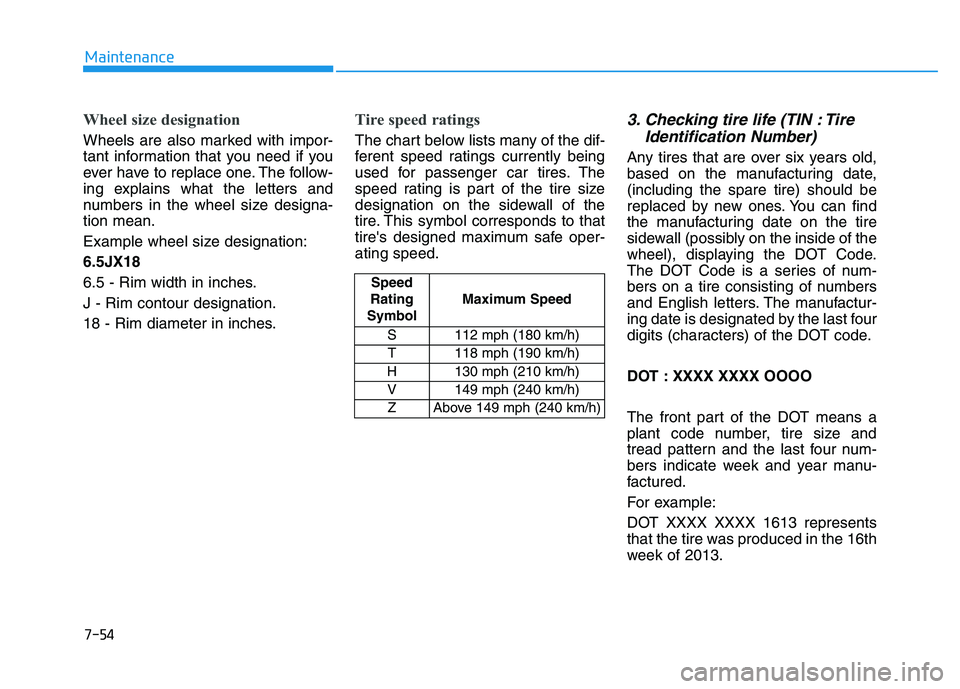
Tire speed ratings
The chart below lists many of the dif-
ferent speed ratings currently being
used for passenger car tires. The
speed rating is part of the tire size
designation on the sidewall of the
tire. This symbol corresponds to that
tire's designed maximum safe oper-ating speed.
3. Checking tire life (TIN : TireIdentification Number)
Any tires that are over six years old,
based on the manufacturing date,(including the spare tire) should be
replaced by new ones. You can find
the manufacturing date on the tire
sidewall (possibly on the inside of the
wheel), displaying the DOT Code.
The DOT Code is a series of num-
bers on a tire consisting of numbers
and English letters. The manufactur-
ing date is designated by the last four
digits (characters) of the DOT code.
DOT : XXXX XXXX OOOO
The front part of the DOT means a
plant code number, tire size and
tread pattern and the last four num-
bers indicate week and year manu-
factured.
For example:
DOT XXXX XXXX 1613 represents
that the tire was produced in the 16th
week of 2013.
Speed
Rating
Symbol Maximum Speed
S 112 mph (180 km/h) T 118 mph (190 km/h)
H 130 mph (210 km/h) V 149 mph (240 km/h) Z Above 149 mph (240 km/h)
Page 527 of 542
TTIIRR EESS AA NN DD WW HHEEEELLSS
8-3
88
Specifications, Consumer information and Reporting safety defects
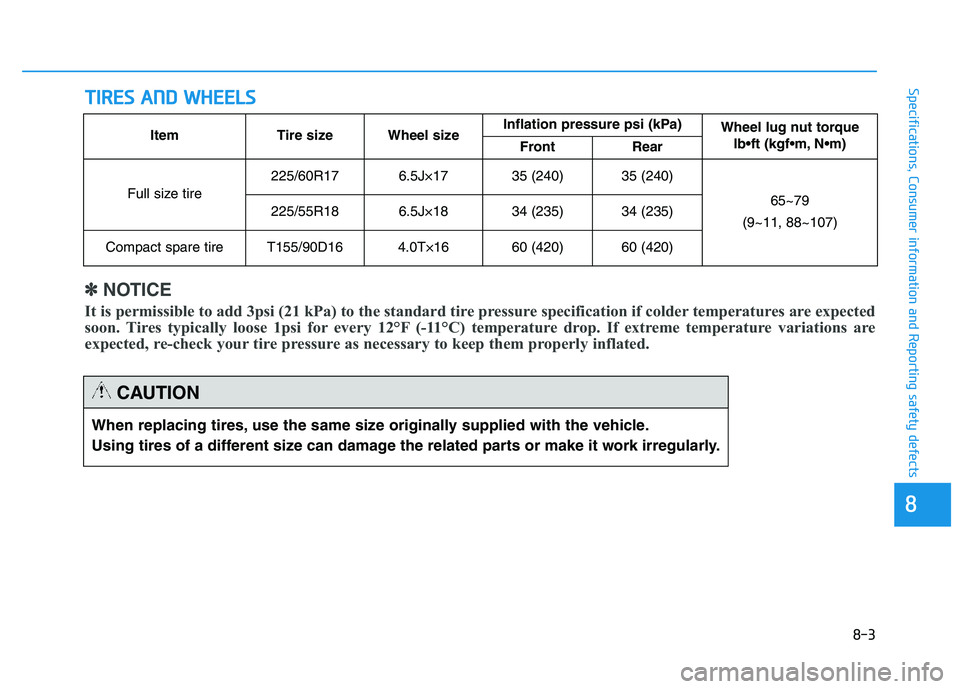
Item Tire size Wheel size Inflation pressure psi (kPa)
Wheel lug nut torque
Front Rear
Full size tire 225/60R17 6.5J×17 35 (240) 35 (240)
65~79
(9~11, 88~107)
225/55R18 6.5J×18 34 (235) 34 (235)
Compact spare tire T155/90D16 4.0T×16 60 (420) 60 (420)
When replacing tires, use the same size originally supplied with the vehicle.
Using tires of a different size can damage the related parts or make it work irregularly.
CAUTION
✽✽ NOTICE
It is permissible to add 3psi (21 kPa) to the standard tire pressure specification if cold er temperatures are expected
soon. Tires typically loose 1psi for every 12°F (-11°C) temperature drop. If extreme temperature var iations are
expected, re-check your tire pressure as necessary to keep them properly inflated .
Page 541 of 542
I-8
Seats ..................................................................................2-4Safety precautions ........................................................2-5
Front seat ......................................................................2-6
Rear seat .....................................................................2-12
Headrest ......................................................................2-15
Seat warmers ..............................................................2-19
Shift lock system.............................................................5-17
Smart key ..........................................................................3-6
Smooth cornering............................................................5-52
Snow tires .......................................................................5-55
Spare tire Compact spare tire replacement .................................7-52
Special driving conditions ..............................................5-51 Hazardous driving conditions ....................................5-51
Reducing the risk of a rollover...................................5-51
Rocking the vehicle ....................................................5-51
Smooth cornering .......................................................5-52
Driving at night ..........................................................5-52
Driving in the rain ......................................................5-53
Driving in flooded areas .............................................5-54
Speedometer....................................................................3-21
Sports mode ....................................................................5-16
Starting difficulties, see engine will not start ...................6-4
Steering wheel.................................................................3-40 Electric power steering ...............................................3-40
Tilt steering.................................................................3-40
Driver selectable steering mode .................................3-41
Horn ............................................................................3-43 Steering wheel audio control ............................................4-3
Storage compartment ....................................................3-116
Center console storage..............................................3-116
Glove box .................................................................3-117
Sunglass holder.........................................................3-117
Sun visor .......................................................................3-119
Sunglass holder .............................................................3-117
Sunroof, see panorama sunroof ......................................3-67
Tachometer ......................................................................3-22
Tailgate ............................................................................3-73
Theft alarm system .........................................................3-19
Tilt steering .....................................................................3-40
Tire chains .......................................................................5-56
Tire pressure monitoring system (TPMS) ......................6-10 Changing a Tire with TPMS ......................................6-10
Tire rotation ....................................................................7-50
Tire specification and pressure label ................................8-7
Tires and wheels ......................................................7-47, 8-3
Recommended cold tire inflation pressures ...............7-48
Tire care ......................................................................7-47
Check tire inflation pressure ......................................7-49
Tire rotation ................................................................7-50
Wheel alignment and tire balance ..............................7-51
Tire replacement .........................................................7-51
Compact spare tire replacement .................................7-52
Wheel replacement .....................................................7-52
Index
T