engine coolant HYUNDAI TUCSON 2016 Owner's Manual
[x] Cancel search | Manufacturer: HYUNDAI, Model Year: 2016, Model line: TUCSON, Model: HYUNDAI TUCSON 2016Pages: 642, PDF Size: 9.78 MB
Page 545 of 642
7-32
Maintenance
EENN GGIINN EE CC OO OOLLAA NN TT
The high-pressure cooling system
has a reservoir filled with year-round
antifreeze coolant. The reservoir is
filled at the factory.
Check the antifreeze protection and
coolant level at least once a year, atthe beginning of the winter season
and before traveling to a colder cli-
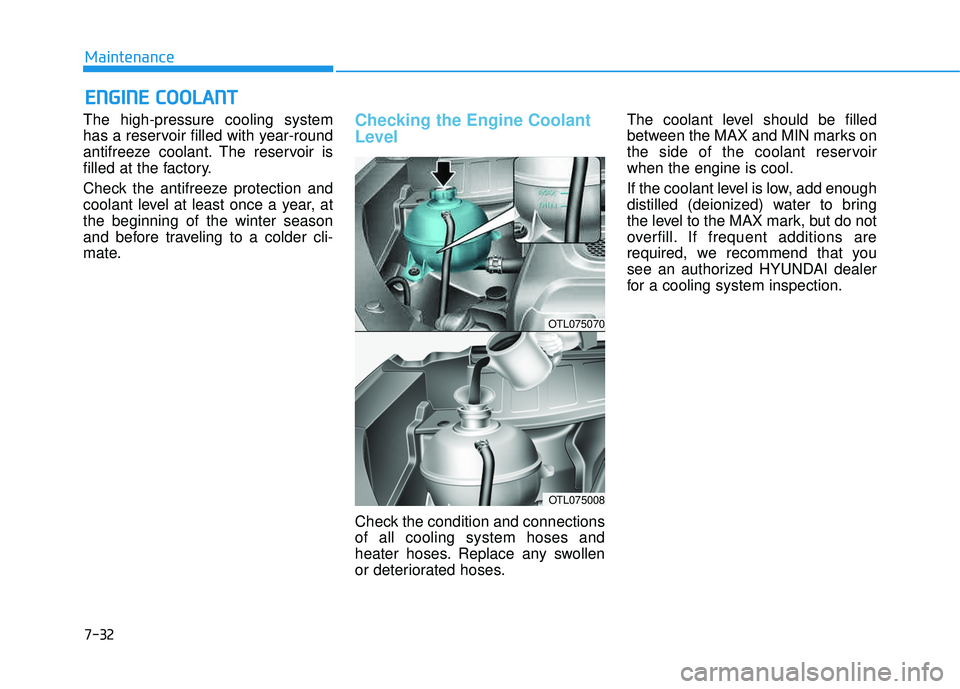
mate.Checking the Engine Coolant
Level
Check the condition and connections of all cooling system hoses and
heater hoses. Replace any swollen
or deteriorated hoses. The coolant level should be filled
between the MAX and MIN marks on
the side of the coolant reservoirwhen the engine is cool.
If the coolant level is low, add enough
distilled (deionized) water to bring
the level to the MAX mark, but do not
overfill. If frequent additions are
required, we recommend that you
see an authorized HYUNDAI dealer
for a cooling system inspection.
OTL075070
OTL075008
Page 546 of 642
7-33
7
MaintenanceThe electric motor for the cooling fan
is controlled by engine coolant tem-
perature, refrigerant pressure and
vehicle speed. As the engine coolant
temperature decreases, the electric
motor will automatically shut off. This
is a normal condition. If your vehicle
is equipped with GDI, the electric
motor for the cooling fan may begin
to operate at any time and continue
to operate until you disconnect the
negative battery cable.
Never remove the
coolant cap or thedrain plug while theengine and radiator
are hot. Hot coolant
and steam may blow out under
pressure, causing serious
injury.
Turn the engine off and wait
until the engine cools down.
Use extreme care when remov-
ing the coolant cap. Wrap a
thick towel around it, and turn it
counterclockwise slowly to the
first stop. Step back while the
pressure is released from the
cooling system. When you aresure all the pressure has been
released, press down on the
cap, using a thick towel, and
continue turning counterclock-
wise to remove it.
WARNING
The electric motor for
the cooling fan may
continue to operate
or start up when theengine is not running
and can cause serious injury.
Keep hands, clothing and tools
away from the rotating fan
blades of the cooling fan.
WARNING
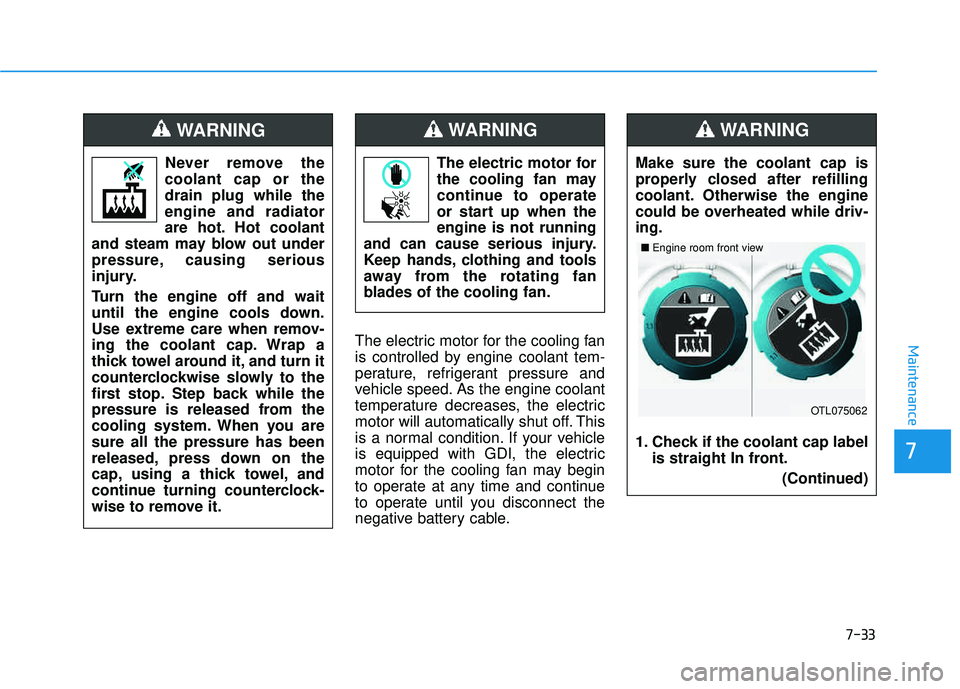
Make sure the coolant cap is
properly closed after refilling
coolant. Otherwise the engine
could be overheated while driv-ing.
1. Check if the coolant cap label is straight In front.
(Continued)
WARNING
OTL075062
■Engine room front view
Page 547 of 642
7-34
Maintenance
Recommended engine coolant
When adding coolant, use onlydeionized water, distilled water or
soft water for your vehicle and
never mix hard water in the coolant
filled at the factory.
An improper coolant mixture can result in severe malfunction or
engine damage.
The engine in your vehicle has alu- minum engine parts and must be
protected by an phosphate-based
ethylene glycol coolant to preventcorrosion and freezing.
Do not use alcohol or methanol coolant or mix them with the spec-ified coolant.
Do not use a solution that contains more than 60% antifreeze or less
than 35% antifreeze, which would
reduce the effectiveness of thesolution. For mixing percentage, refer to the
following table:
Information
If in doubt about the mix ratio, a 50%
water and 50% antifreeze mix is the
easiest to mix together as it will be the
same quantity of each.
It is suitable to use for most tempera-
ture ranges of -31°F and higher.
i
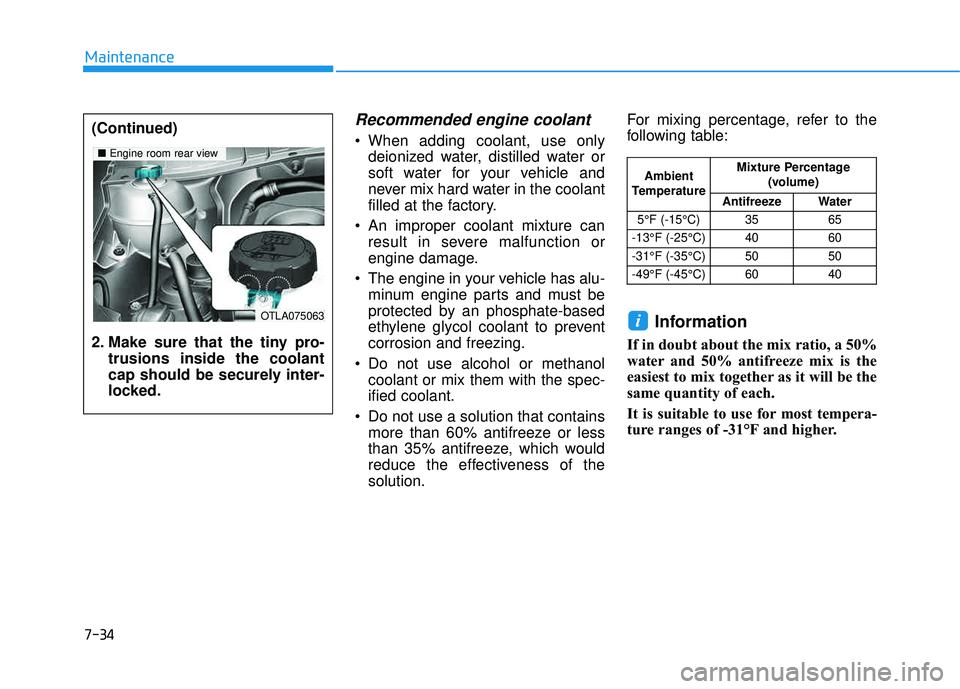
(Continued)
2. Make sure that the tiny pro-
trusions inside the coolant
cap should be securely inter-
locked.
OTLA075063
■Engine room rear view
Ambient
Temperature Mixture Percentage
(volume)
Antifreeze Water
5°F (-15°C) 35 65
-13°F (-25°C) 40 60
-31°F (-35°C) 50 50
-49°F (-45°C) 60 40
Page 548 of 642
7-35
7
Maintenance
Changing Engine Coolant
Have coolant changed by an author-
ized HYUNDAI dealer according tothe Maintenance Schedule at the
beginning of this chapter.To prevent damage to engine
parts, put a thick towel around the
coolant cap before refilling the
coolant to prevent the coolant
from overflowing into engine
parts, such as the generator.
NOTICE
Do not use engine coolant or
antifreeze in the washer fluid
reservoir.
Engine coolant can severely
obscure visibility when sprayed
on the windshield and may
cause loss of vehicle controlresulting in an accident.
Engine coolant may also cause
damage to paint and body trim.
WARNING
Page 550 of 642
7-37
7
Maintenance
WWAASSHH EERR FF LLUU IIDD
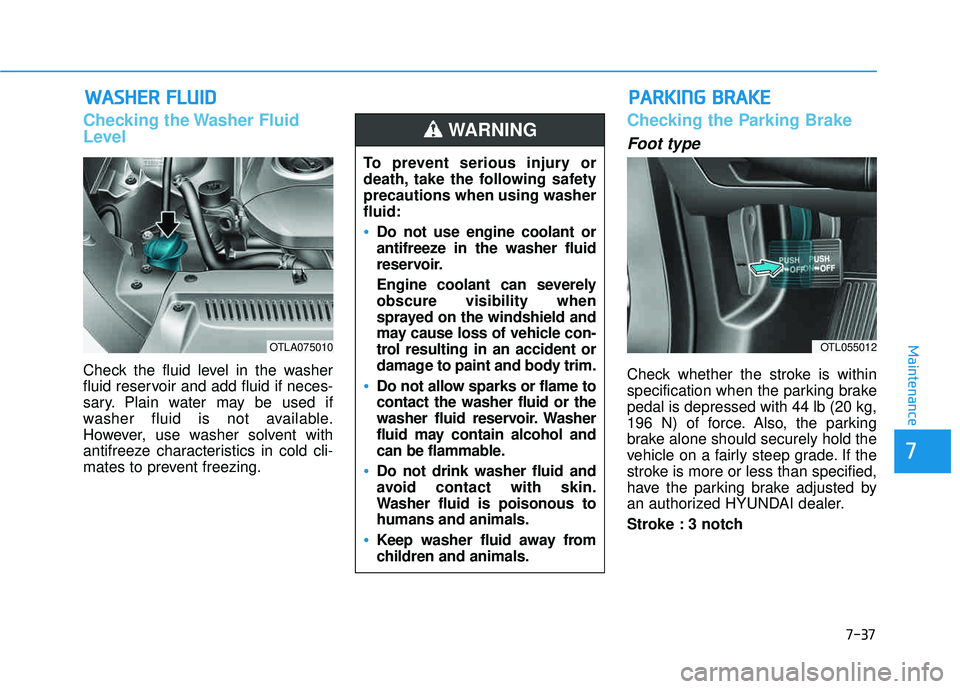
Checking the Washer Fluid
Level
Check the fluid level in the washer
fluid reservoir and add fluid if neces-
sary. Plain water may be used if
washer fluid is not available.
However, use washer solvent with
antifreeze characteristics in cold cli-
mates to prevent freezing.
Checking the Parking Brake
Foot type
Check whether the stroke is within
specification when the parking brakepedal is depressed with 44 lb (20 kg,
196 N) of force. Also, the parking
brake alone should securely hold the
vehicle on a fairly steep grade. If the
stroke is more or less than specified,
have the parking brake adjusted by
an authorized HYUNDAI dealer.
Stroke : 3 notch
OTLA075010OTL055012
PP AA RRKK IINN GG BB RRAA KKEE
To prevent serious injury or
death, take the following safetyprecautions when using washerfluid:
Do not use engine coolant or
antifreeze in the washer fluid
reservoir.
Engine coolant can severely obscure visibility when
sprayed on the windshield and
may cause loss of vehicle con-
trol resulting in an accident or
damage to paint and body trim.
Do not allow sparks or flame to contact the washer fluid or the
washer fluid reservoir. Washer
fluid may contain alcohol and
can be flammable.
Do not drink washer fluid and
avoid contact with skin.
Washer fluid is poisonous tohumans and animals.
Keep washer fluid away from
children and animals.
WARNING
Page 615 of 642
7-102
Maintenance
Canister
Fuel vapors generated inside the fuel tank are absorbed and stored in the
onboard canister. When the engine is
running, the fuel vapors absorbed in
the canister are drawn into the surgetank through the purge control sole-
noid valve.
Purge Control Solenoid Valve(PCSV)
The purge control solenoid valve is
controlled by the Engine Control
Module (ECM); when the engine
coolant temperature is low during
idling, the PCSV closes so that evap-
orated fuel is not taken into the
engine. After the engine warms-up
during ordinary driving, the PCSV
opens to introduce evaporated fuel to
the engine.
3. Exhaust Emission Control System
The Exhaust Emission Control
System is a highly effective system
which controls exhaust emissions
while maintaining good vehicle per-
formance.
When the engine starts or fails to
start, excessive attempts to restart
the engine may cause damage to theemission system.
Vehicle modifications
This vehicle should not be modi-fied. Modification of your vehicle
could affect its performance, safety
or durability and may even violate
governmental safety and emis-
sions regulations.
In addition, damage or performance
problems resulting from any modifi-
cation may not be covered under
warranty.
If you use unauthorized electronic devices, it may cause the vehicle to
operate abnormally, wire damage,
battery discharge and fire. For your
safety, do not use unauthorized
electronic devices.
Engine exhaust (carbon monox-
ide) precautions
Carbon monoxide can be present with other exhaust fumes. If you
smell exhaust fumes of any kind in
your vehicle, drive with all the win-
dows fully open. Have your vehicle
checked and repaired immediately.
Engine exhaust gases contain
carbon monoxide (CO). Though
colorless and odorless, it is
dangerous and could be lethal if
inhaled. Follow the instructions
on this page to avoid CO poi-soning.
WARNING
Page 625 of 642
8-7
88
Specifications, Consumer information and Reporting safety defects
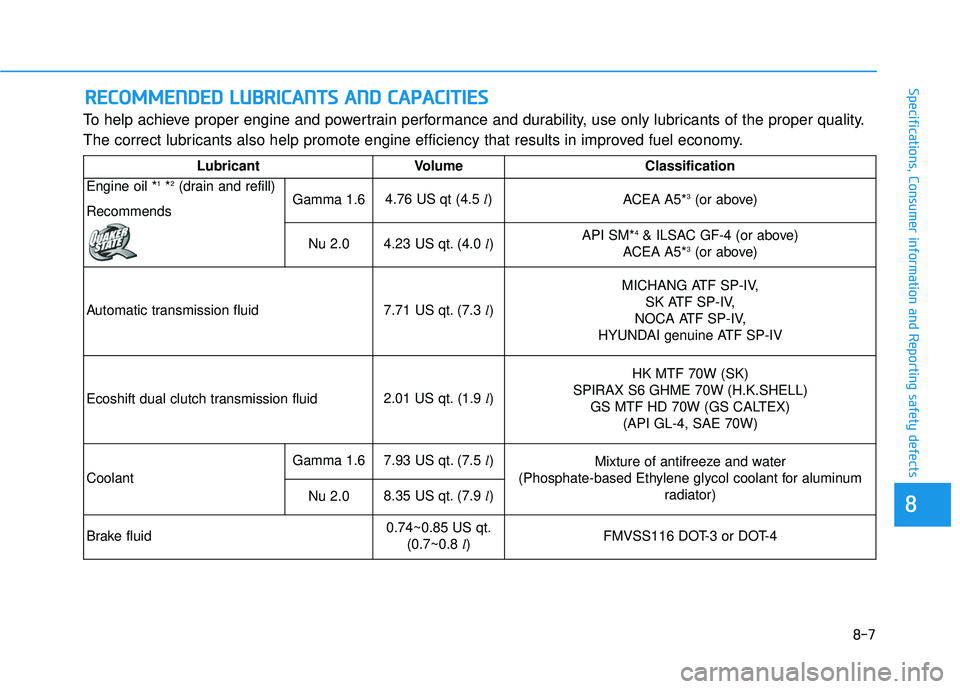
To help achieve proper engine and powertrain performance and durability, use only lubricants of the proper quality.
The correct lubricants also help promote engine efficiency that results in improved fuel economy.
RREECCOO MM MMEENN DDEEDD LL UU BBRRIICC AA NN TTSS AA NN DD CC AA PPAA CCIITT IIEE SS
Lubricant Volume Classification
Engine oil * 1
*2
(drain and refill)
Recommends Gamma 1.6
4.76 US qt (4.5
l)
ACEA A5*3
(or above)
Nu 2.0 4.23 US qt. (4.0
l) API SM*
4
& ILSAC GF-4 (or above)
ACEA A5* 3
(or above)
Automatic transmission fluid 7.71 US qt. (7.3
l) MICHANG ATF SP-IV,
SK ATF SP-IV,
NOCA ATF SP-IV,
HYUNDAI genuine ATF SP-IV
Ecoshift dual clutch transmission fluid 2.01 US qt. (1.9
l) HK MTF 70W (SK)
SPIRAX S6 GHME 70W (H.K.SHELL) GS MTF HD 70W (GS CALTEX) (API GL-4, SAE 70W)
Coolant Gamma 1.6
7.93 US qt. (7.5
l)
Mixture of antifreeze and water
(Phosphate-based Ethylene glycol coolant for aluminum radiator)
Nu 2.08.35 US qt. (7.9 l)
Brake fluid 0.74~0.85 US qt.
(0.7~0.8 l) FMVSS116 DOT-3 or DOT-4
Page 634 of 642
I-3
California perchlorate notice ........................................7-105
Capacities (Lubricants) .....................................................8-6
CareExterior care ...............................................................7-94
Interior care ................................................................7-99
Tire care ......................................................................7-48
Cargo security screen ....................................................3-161
Center console storage ..................................................3-153
Central door lock switch .................................................3-16
Certification label ...........................................................8-10
Chains Tire chains ..................................................................5-85
Checking tire inflation pressure ......................................7-50
Child restraint system (CRS) ..........................................2-37 Children always in the rear ........................................2-37
Installing a Child Restraint System (CRS) ................2-40
Selecting a Child Restraint System (CRS).................2-38
Child-protector rear door lock ........................................3-18
Climate control air filter ......................................3-135, 7-40
Clock .............................................................................3-157
Clothes hanger ..............................................................3-159
Combined instrument, see instrument cluster ................3-63
Compact spare tire ..........................................................6-20
Compass with Electric chromic mirror...........................3-28
Consumer information ....................................................8-12 Coolant ............................................................................7-32
Cooling fluid, see engine coolant ...................................7-32
Crankcase emission control system ..............................7-101
Cruise control system .....................................................5-75
Cup holder.....................................................................3-155
Dashboard illumination, see instrument panel
illumination..................................................................3-64
Dashboard, see instrument cluster ..................................3-63
Day/night rearview mirror ..............................................3-23
Daytime running light ...................................................3-112
Defogging (Windshield) ...............................................3-149
Defroster (Rear window) ..............................................3-126
Defrosting (Windshield) ...............................................3-149
Dimensions .......................................................................8-2
Display illumination, see instrument panel illumination..................................................................3-64
Displays, see instrument cluster .....................................3-63
Do not install a child restraint on the front passenger seat ..............................................................2-63
Door locks .......................................................................3-14 Central door lock switch ............................................3-16
Child-protector rear door lock....................................3-18
Downhill brake control (DBC) .......................................5-39
Drinks holders, see cup holders ....................................3-155
Drive mode integrated control system ............................5-49
I
Index
C
D
Page 635 of 642
I-4
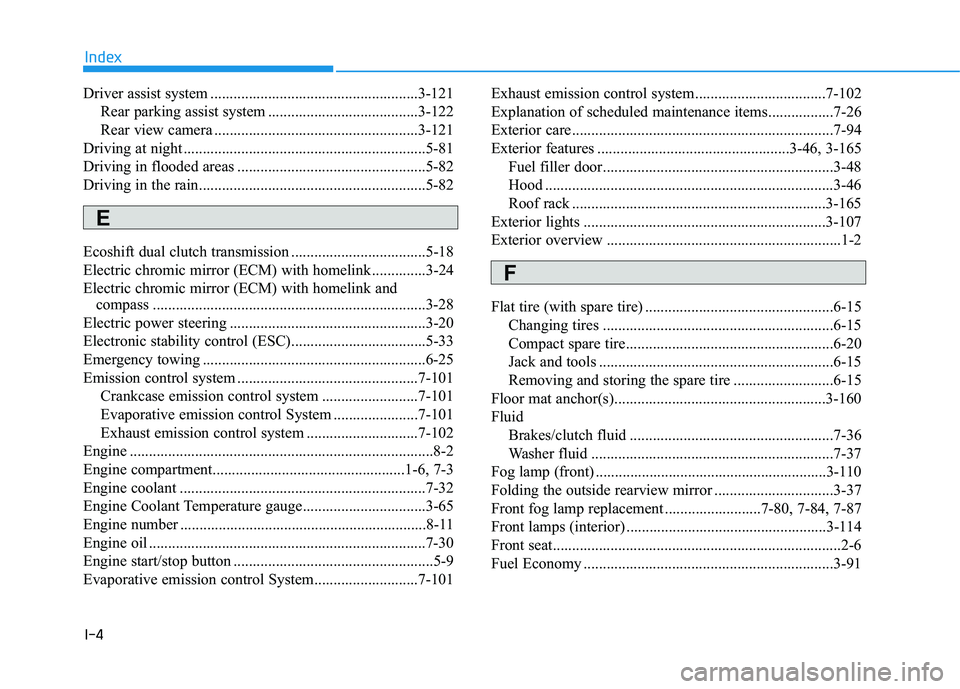
Driver assist system ......................................................3-121Rear parking assist system .......................................3-122
Rear view camera .....................................................3-121
Driving at night ...............................................................5-81
Driving in flooded areas .................................................5-82
Driving in the rain...........................................................5-82
Ecoshift dual clutch transmission ...................................5-18
Electric chromic mirror (ECM) with homelink ..............3-24
Electric chromic mirror (ECM) with homelink and compass .......................................................................3-28
Electric power steering ...................................................3-20
Electronic stability control (ESC)...................................5-33
Emergency towing ..........................................................6-25
Emission control system ...............................................7-101
Crankcase emission control system .........................7-101
Evaporative emission control System ......................7-101
Exhaust emission control system .............................7-102
Engine ...............................................................................8-2
Engine compartment..................................................1-6, 7-3
Engine coolant ................................................................7-32
Engine Coolant Temperature gauge................................3-65
Engine number ................................................................8-11
Engine oil ........................................................................7-30
Engine start/stop button ....................................................5-9
Evaporative emission control System...........................7-101 Exhaust emission control system..................................7-102
Explanation of scheduled maintenance items.................7-26
Exterior care....................................................................7-94
Exterior features ..................................................3-46, 3-165
Fuel filler door............................................................3-48
Hood ...........................................................................3-46
Roof rack ..................................................................3-165
Exterior lights ...............................................................3-107
Exterior overview .............................................................1-2
Flat tire (with spare tire) .................................................6-15 Changing tires ............................................................6-15
Compact spare tire......................................................6-20
Jack and tools .............................................................6-15
Removing and storing the spare tire ..........................6-15
Floor mat anchor(s).......................................................3-160
Fluid
Brakes/clutch fluid .....................................................7-36
Washer fluid ...............................................................7-37
Fog lamp (front) ............................................................3-110
Folding the outside rearview mirror ...............................3-37
Front fog lamp replacement .........................7-80, 7-84, 7-87
Front lamps (interior) ....................................................3-114
Front seat...........................................................................2-6
Fuel Economy .................................................................3-91
Index
E
F