weight HYUNDAI TUCSON 2016 Owner's Guide
[x] Cancel search | Manufacturer: HYUNDAI, Model Year: 2016, Model line: TUCSON, Model: HYUNDAI TUCSON 2016Pages: 642, PDF Size: 9.78 MB
Page 573 of 642
7-60
Maintenance
Pneumatic tire
A mechanical device made of rubber,
chemicals, fabric and steel or other
materials, that, when mounted on an
automotive wheel provides the trac-tion and contains the gas or fluid thatsustains the load.
Pneumatic options weight
The combined weight of installed
regular production options weighing
over 5 lb. (2.3 kg) in excess of the
standard items which they replace,
not previously considered in curb
weight or accessory weight, includ-
ing heavy duty breaks, ride levelers,
roof rack, heavy duty battery, and
special trim.
Recommended InflationPressure
Vehicle manufacturer’s recommend-
ed tire inflation pressure as shownon the tire placard.
Radial Ply Tire
A pneumatic tire in which the ply
cords that extend to the beads are
laid at 90 degrees to the centerline ofthe tread.
Rim
A metal support for a tire and uponwhich the tire beads are seated.
Sidewall
The portion of a tire between thetread and the bead.
Speed Rating
An alphanumeric code assigned to a
tire indicating the maximum speed at
which a tire can operate.
Traction
The friction between the tire and the
road surface. The amount of grip pro-vided.
Tread
The portion of a tire that comes intocontact with the road.
Treadwear Indicators
Narrow bands, sometimes called
"wear bars", that show across thetread of a tire when only 1/16 inch of
tread remains.
UTQGS
Uniform Tire Quality Grading
Standards is a tire information sys-
tem that provides consumers with
ratings for a tire’s traction, tempera-
ture and treadwear. Ratings are
determined by tire manufacturers
using government testing proce-
dures. The ratings are molded into
the sidewall of the tire.
Vehicle Capacity Weight
The number of designated seating
positions multiplied by 150 lbs. (68
kg) plus the rated cargo and luggageload.
Page 574 of 642
7-61
7
Maintenance
Vehicle Maximum Load on theTire
Load on an individual tire due to curb
and accessory weight plus maximum
occupant and cargo weight.
Vehicle Normal Load on the Tire
Load on an individual tire that is
determined by distributing to each
axle its share of the curb weight,
accessory weight, and normal occu-
pant weight and dividing by 2.
Vehicle Placard
A label permanently attached to a
vehicle showing the original equip-
ment tire size and recommended
inflation pressure.
All Season Tires
HYUNDAI specifies all season tires
on some models to provide good
performance for use all year round,
including snowy and icy road condi-
tions. All season tires are identified
by ALL SEASON and/or M+S (Mud
and Snow) on the tire sidewall. Snow
tires have better snow traction than
all season tires and may be more
appropriate in some areas.
Summer Tires
HYUNDAI specifies summer tires on
some models to provide superior
performance on dry roads. Summer
tire performance is substantially
reduced in snow and ice. Summer
tires do not have the tire traction rat-
ing M+S (Mud and Snow) on the tire
side wall. If you plan to operate your
vehicle in snowy or icy conditions,
HYUNDAI recommends the use of
snow tires or all season tires on all
four wheels.
Snow Tires
If you equip your car with snow tires,
they should be the same size and
have the same load capacity as the
original tires. Snow tires should be
installed on all four wheels; other-
wise, poor handling may result. Snow
tires should carry 4 psi (28 kPa)more air pressure than the pressure
recommended for the standard tires
on the tire label on the driver’s side of
the center pillar, or up to the maxi-
mum pressure shown on the tire
sidewall, whichever is less. Do not
drive faster than 75 mph (120 km/h)
when your vehicle is equipped with
snow tires.
Page 619 of 642
Specifications, Consumer information and Reporting safety defects
8
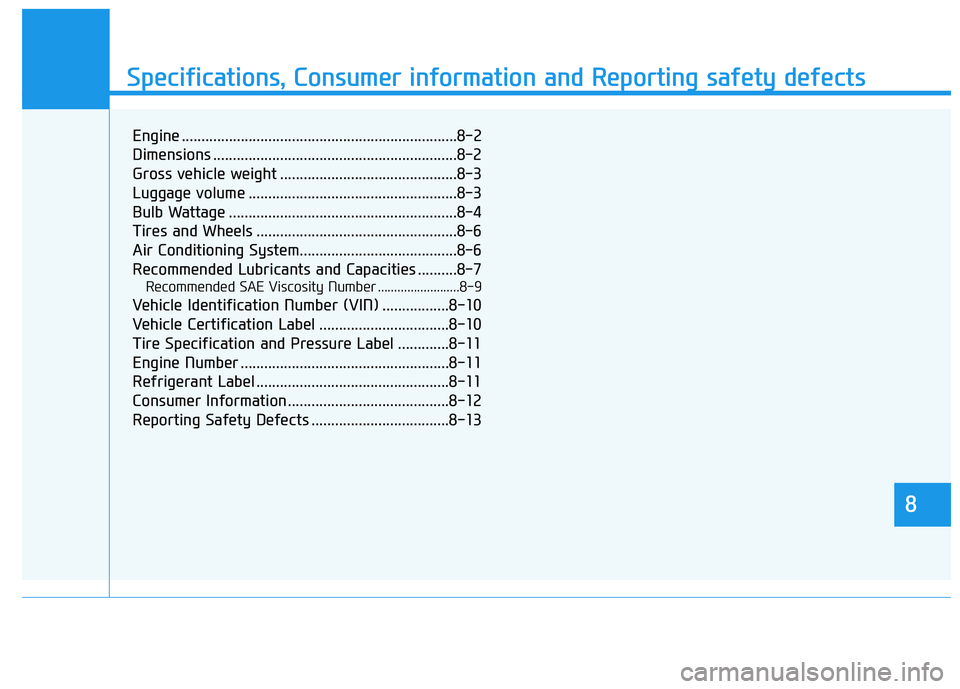
Engine ......................................................................8-2
Dimensions ..............................................................8-2
Gross vehicle weight .............................................8-3
Luggage volume .....................................................8-3
Bulb Wattage ..........................................................8-4
Tires and Wheels ...................................................8-6
Air Conditioning System........................................8-6
Recommended Lubricants and Capacities ..........8-7
Recommended SAE Viscosity Number .........................8-9
Vehicle Identification Number (VIN) .................8-10
Vehicle Certification Label .................................8-10
Tire Specification and Pressure Label .............8-11
Engine Number .....................................................8-11
Refrigerant Label .................................................8-11
Consumer Information .........................................8-12
Reporting Safety Defects ...................................8-13
Page 624 of 642
8-6
Specifications, Consumer information and Reporting safety defects
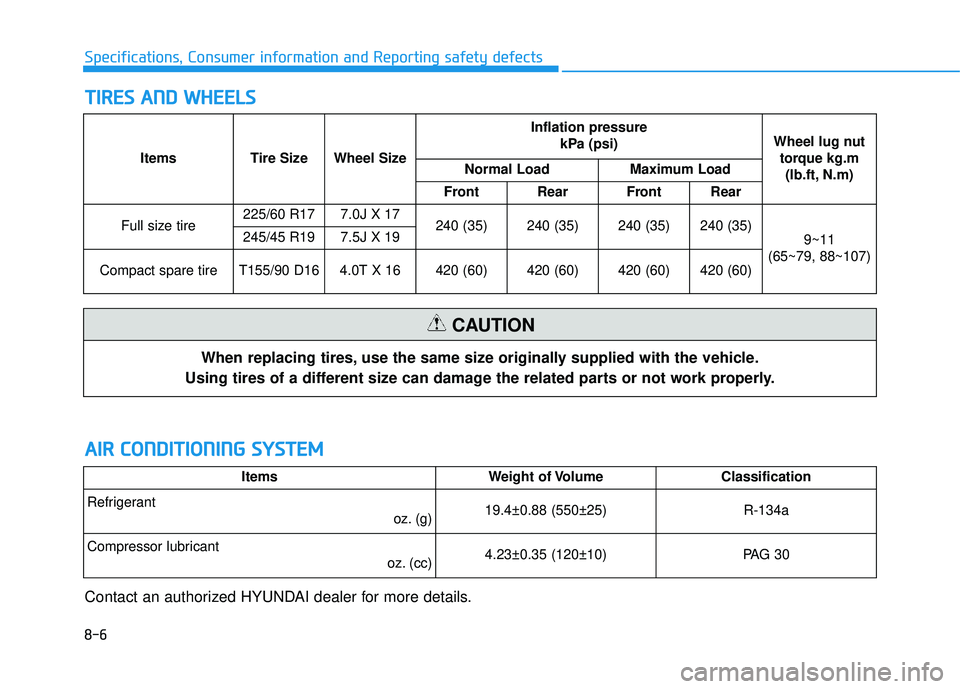
AAIIRR CC OO NNDDIITT IIOO NNIINN GG SS YY SSTT EEMM
Contact an authorized HYUNDAI dealer for more details.
ItemsWeight of VolumeClassification
Refrigerant
oz. (g) 19.4±0.88 (550±25)R-134a
Compressor lubricantoz. (cc) 4.23±0.35 (120±10)PAG 30
TTIIRR EESS AA NN DD WW HHEEEELLSS
When replacing tires, use the same size originally supplied with the vehicle.
Using tires of a different size can damage the related parts or not work properly.
CAUTION
Items Tire SizeWheel Size
Inflation pressure kPa (psi)Wheel lug nuttorque kg.m (lb.ft, N.m)
Normal LoadMaximum Load
FrontRearFrontRear
Full size tire225/60 R177.0J X 17240 (35)240 (35)240 (35)240 (35)9~11
(65~79, 88~107)245/45 R197.5J X 19
Compact spare tireT155/90 D164.0T X 16420 (60)420 (60)420 (60)420 (60)
Page 636 of 642
I-5
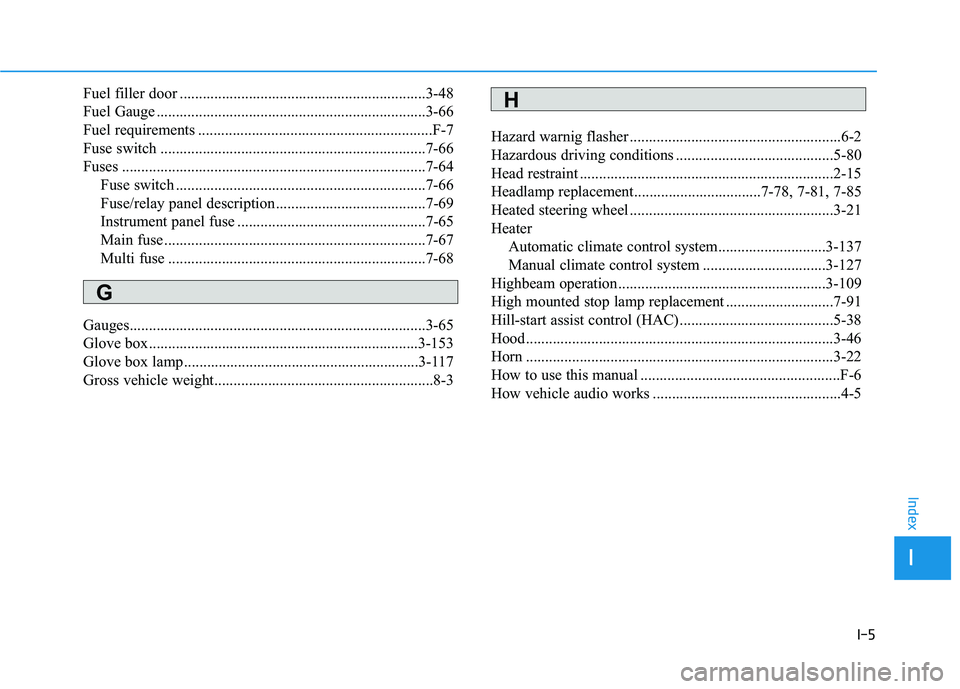
Fuel filler door ................................................................3-48
Fuel Gauge ......................................................................3-66
Fuel requirements .............................................................F-7
Fuse switch .....................................................................7-66
Fuses ...............................................................................7-64Fuse switch .................................................................7-66
Fuse/relay panel description .......................................7-69
Instrument panel fuse .................................................7-65
Main fuse ....................................................................7-67
Multi fuse ...................................................................7-68
Gauges.............................................................................3-65
Glove box......................................................................3-153
Glove box lamp .............................................................3-117
Gross vehicle weight.........................................................8-3 Hazard warnig flasher .......................................................6-2
Hazardous driving conditions .........................................5-80
Head restraint ..................................................................2-15
Headlamp replacement.................................7-78, 7-81, 7-85
Heated steering wheel .....................................................3-21
Heater
Automatic climate control system............................3-137
Manual climate control system ................................3-127
Highbeam operation......................................................3-109
High mounted stop lamp replacement ............................7-91
Hill-start assist control (HAC)........................................5-38
Hood................................................................................3-46
Horn ................................................................................3-22
How to use this manual ....................................................F-6
How vehicle audio works .................................................4-5
I
Index
G
H