8-6
Specifications, Consumer information and Reporting safety defects
T TI
IR
RE
ES
S
A
AN
ND
D
W
WH
HE
EE
EL
LS
S
When replacing tires, use the same size originally supplied with the vehicle.
Using tires of a different size can damage the related parts or not work properly.
CAUTION
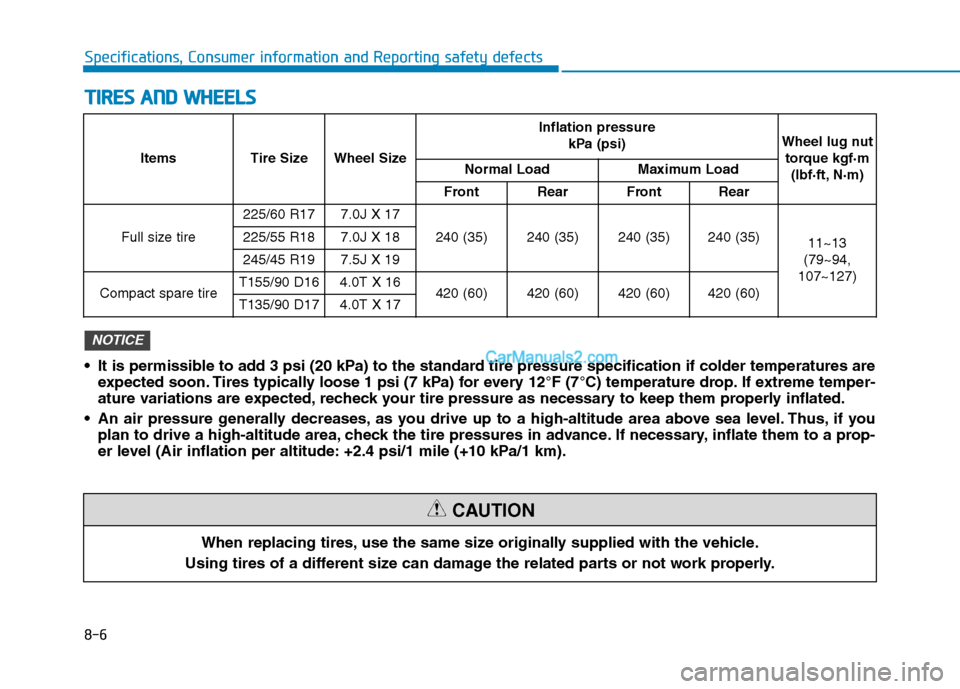
Items Tire SizeWheel Size
Inflation pressure
kPa (psi)Wheel lug nut
torque kgf·m
(lbf·ft, N·m)
Normal LoadMaximum Load
FrontRearFrontRear
Full size tire
225/60 R177.0J X 17
240 (35)240 (35)240 (35)240 (35)11~13
(79~94,
107~127)225/55 R187.0J X 18
245/45 R197.5J X 19
Compact spare tireT155/90 D164.0T X 16420 (60)420 (60)420 (60)420 (60)T135/90 D174.0T X 17
It is permissible to add 3 psi (20 kPa) to the standard tire pressure specification if colder temperatures are
expected soon. Tires typically loose 1 psi (7 kPa) for every 12°F (7°C) temperature drop. If extreme temper-
ature variations are expected, recheck your tire pressure as necessary to keep them properly inflated.
An air pressure generally decreases, as you drive up to a high-altitude area above sea level. Thus, if you
plan to drive a high-altitude area, check the tire pressures in advance. If necessary, inflate them to a prop-
er level (Air inflation per altitude: +2.4 psi/1 mile (+10 kPa/1 km).
NOTICE
8-10
Specifications, Consumer information and Reporting safety defects
Recommended SAE Viscosity
Number
Always be sure to clean the area
around any filler plug, drain
plug, or dipstick before check-
ing or draining any lubricant.
This is especially important in
dusty or sandy areas and when
the vehicle is used on unpaved
roads. Cleaning the plug and
dipstick areas will prevent dirt
and grit from entering the
engine and other mechanisms
that could be damaged.
CAUTION
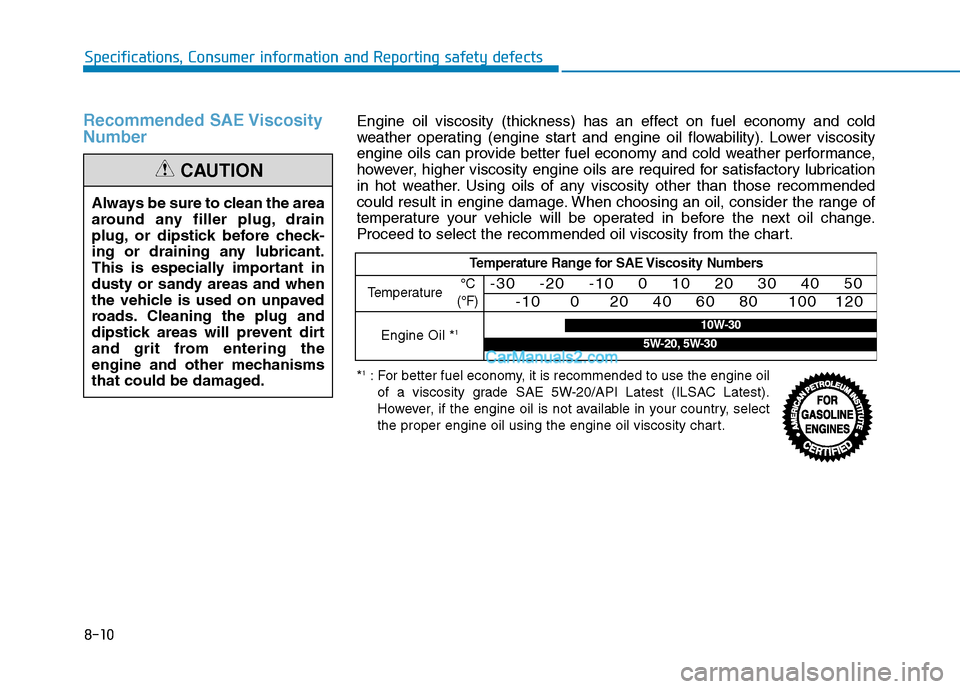
Engine oil viscosity (thickness) has an effect on fuel economy and cold
weather operating (engine start and engine oil flowability). Lower viscosity
engine oils can provide better fuel economy and cold weather performance,
however, higher viscosity engine oils are required for satisfactory lubrication
in hot weather. Using oils of any viscosity other than those recommended
could result in engine damage. When choosing an oil, consider the range of
temperature your vehicle will be operated in before the next oil change.
Proceed to select the recommended oil viscosity from the chart.
Temperature Range for SAE Viscosity Numbers
Temperature -30 -20 -10 0 10 20 30 40 50
-10 0 20 40 60 80 100 120
Engine Oil *110W-30
5W-20, 5W-30
°C
(°F)
*1: For better fuel economy, it is recommended to use the engine oil
of a viscosity grade SAE 5W-20/API Latest (ILSAC Latest).
However, if the engine oil is not available in your country, select
the proper engine oil using the engine oil viscosity chart.