Maintenance HYUNDAI TUCSON 2022 Workshop Manual
[x] Cancel search | Manufacturer: HYUNDAI, Model Year: 2022, Model line: TUCSON, Model: HYUNDAI TUCSON 2022Pages: 638, PDF Size: 82.3 MB
Page 592 of 638
Maintenance
9-42
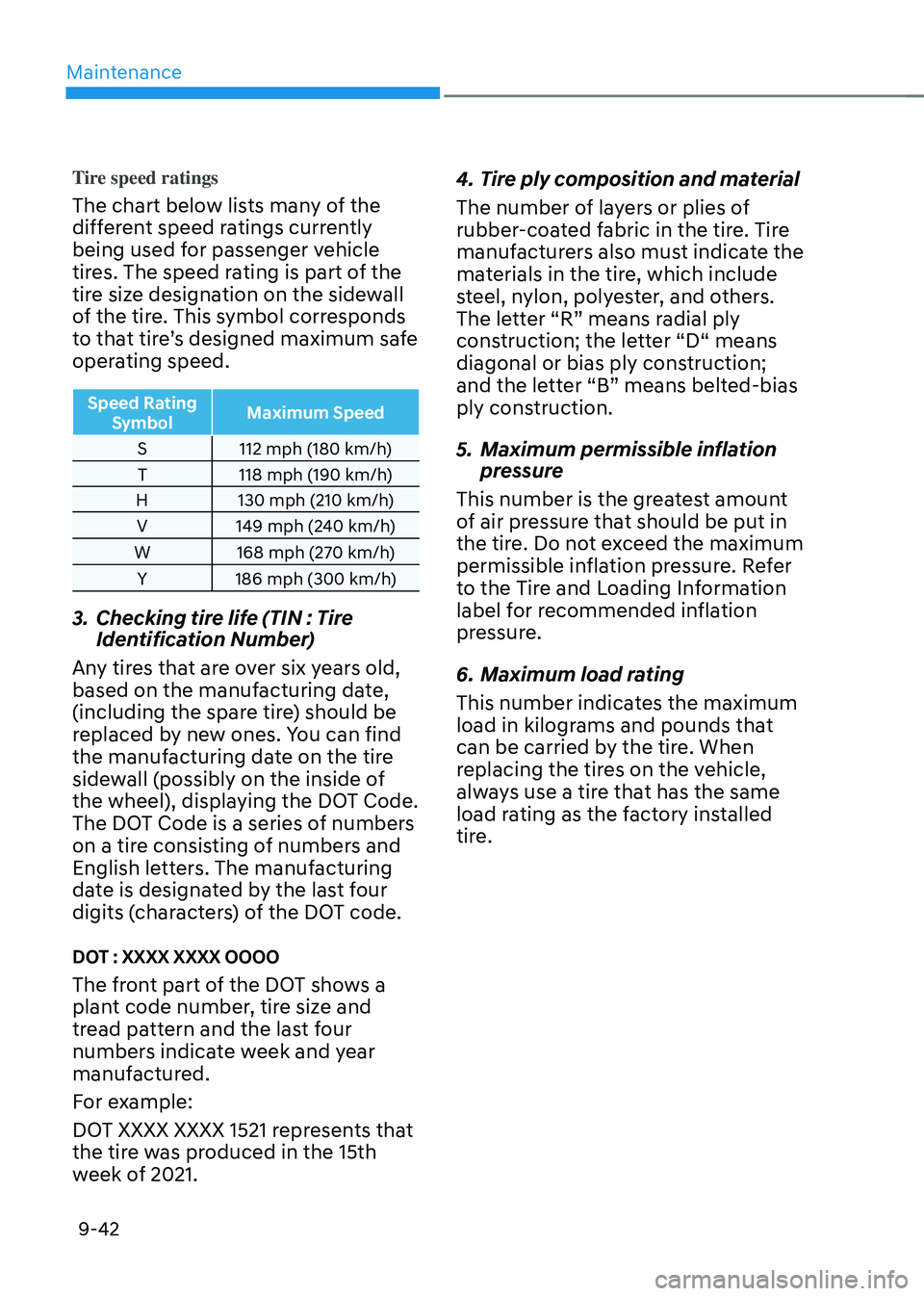
Tire speed ratings
The chart below lists many of the
different speed ratings currently
being used for passenger vehicle
tires. The speed rating is part of the
tire size designation on the sidewall
of the tire. This symbol corresponds
to that tire’s designed maximum safe
operating speed.
Speed Rating Symbol Maximum Speed
S 112 mph (180 km/h)
T 118 mph (190 km/h)
H 130 mph (210 km/h)
V 149 mph (240 km/h)
W 168 mph (270 km/h)
Y 186 mph (300 km/h)
3. Checking tire life (TIN : Tire
Identification Number)
Any tires that are over six years old,
based on the manufacturing date,
(including the spare tire) should be
replaced by new ones. You can find
the manufacturing date on the tire
sidewall (possibly on the inside of
the wheel), displaying the DOT Code.
The DOT Code is a series of numbers
on a tire consisting of numbers and
English letters. The manufacturing
date is designated by the last four
digits (characters) of the DOT code.
DOT : XXXX XXXX OOOO
The front part of the DOT shows a
plant code number, tire size and
tread pattern and the last four
numbers indicate week and year
manufactured.
For example:
DOT XXXX XXXX 1521 represents that
the tire was produced in the 15th
week of 2021.
4. Tire ply composition and material
The number of layers or plies of
rubber-coated fabric in the tire. Tire
manufacturers also must indicate the
materials in the tire, which include
steel, nylon, polyester, and others.
The letter “R” means radial ply
construction; the letter “D“ means
diagonal or bias ply construction;
and the letter “B” means belted-bias
ply construction.
5. Maximum permissible inflation
pressure
This number is the greatest amount
of air pressure that should be put in
the tire. Do not exceed the maximum
permissible inflation pressure. Refer
to the Tire and Loading Information
label for recommended inflation
pressure.
6. Maximum load rating
This number indicates the maximum
load in kilograms and pounds that
can be carried by the tire. When
replacing the tires on the vehicle,
always use a tire that has the same
load rating as the factory installed
tire.
Page 594 of 638
Maintenance
9-44
WARNING
The temperature grade for this
tire is established for a tire that
is properly inflated and not
overloaded. Excessive speed,
under-inflation, over-inflation, or
excessive loading, either separately
or in combination, can cause heat
build-up and possible sudden
tire failure. This may cause loss
of vehicle control resulting in an
accident.
Low aspect ratio tires
(if equipped)
The aspect ratio is lower than 50 on
low aspect ratio tires.
Because low aspect ratio tires are
optimized for handling and braking,
their sidewall is a little stiffer than
a standard tire. Also low aspect
ratio tires tend to be wider and
consequently have a greater contact
patch with the road surface. In some
instances they may generate more
road noise compared with standard
tires.
CAUTION
The side wall of a low aspect ratio
tire is shorter than the normal one.
Thus, the low-aspect wheel and
tire are easily damaged. Follow the
below instructions.
• When driving on a rough road or
driving off a road, be careful not
to damage the tires and wheels.
After driving, inspect the tires
and wheels.
• When passing over a pothole,
speed bump, manhole, or curb
stone, drive the vehicle slowly so
as not to damage the tires and
wheels.
• When there is an impact on a tire,
inspect the tire condition. Or,
you can contact an authorized
HYUNDAI dealer.
• Inspect the tire condition and
pressure every 8,000 miles
(13,000 km) to prevent tire
damage.
• It is difficult to recognize a tire
damage only with your eyes.
When there is a slight hint of a
tire damage, check and replace
the tire to prevent the damage
caused by air leakage.
• When a tire is damaged while
driving on a rough road, off a
road, or over obstacles, such as a
pothole, manhole, or curb stone,
your warranty does not cover the
damage.
• The tire information is specified
on the tire side wall.
Page 596 of 638
Maintenance
9-46
Instrument panel fuse
replacement
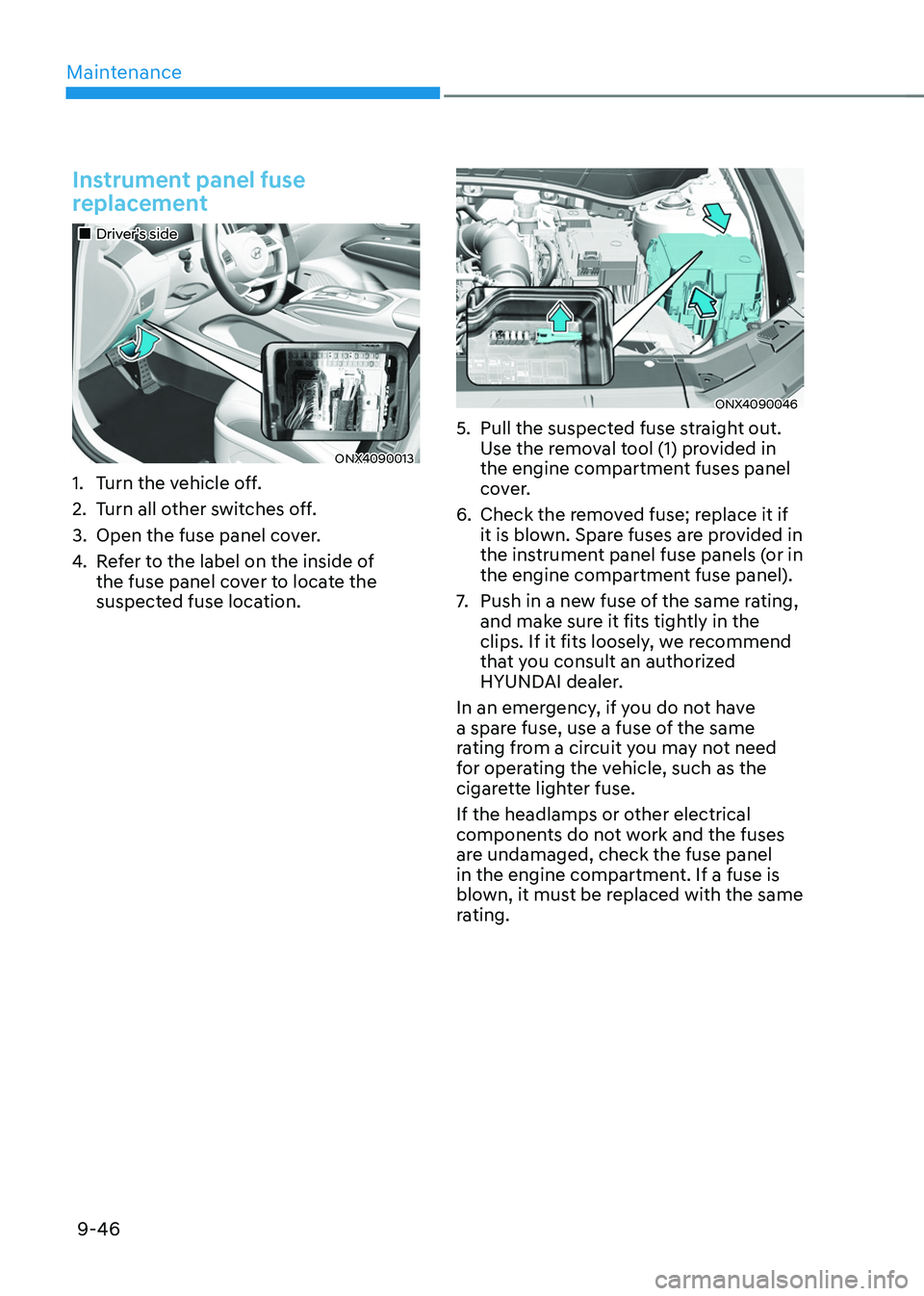
„„Driver’s side
ONX4090013
1. Turn the vehicle off.
2. Turn all other switches off.
3. Open the fuse panel cover.
4. Refer to the label on the inside of
the fuse panel cover to locate the
suspected fuse location.
ONX4090046
5. Pull the suspected fuse straight out.
Use the removal tool (1) provided in
the engine compartment fuses panel
cover.
6. Check the removed fuse; replace it if
it is blown. Spare fuses are provided in
the instrument panel fuse panels (or in
the engine compartment fuse panel).
7. Push in a new fuse of the same rating,
and make sure it fits tightly in the
clips. If it fits loosely, we recommend
that you consult an authorized
HYUNDAI dealer.
In an emergency, if you do not have
a spare fuse, use a fuse of the same
rating from a circuit you may not need
for operating the vehicle, such as the
cigarette lighter fuse.
If the headlamps or other electrical
components do not work and the fuses
are undamaged, check the fuse panel
in the engine compartment. If a fuse is
blown, it must be replaced with the same
rating.
Page 598 of 638
Maintenance
9-48
Fuse/relay panel description
Instrument panel fuse panel
ONX4090019
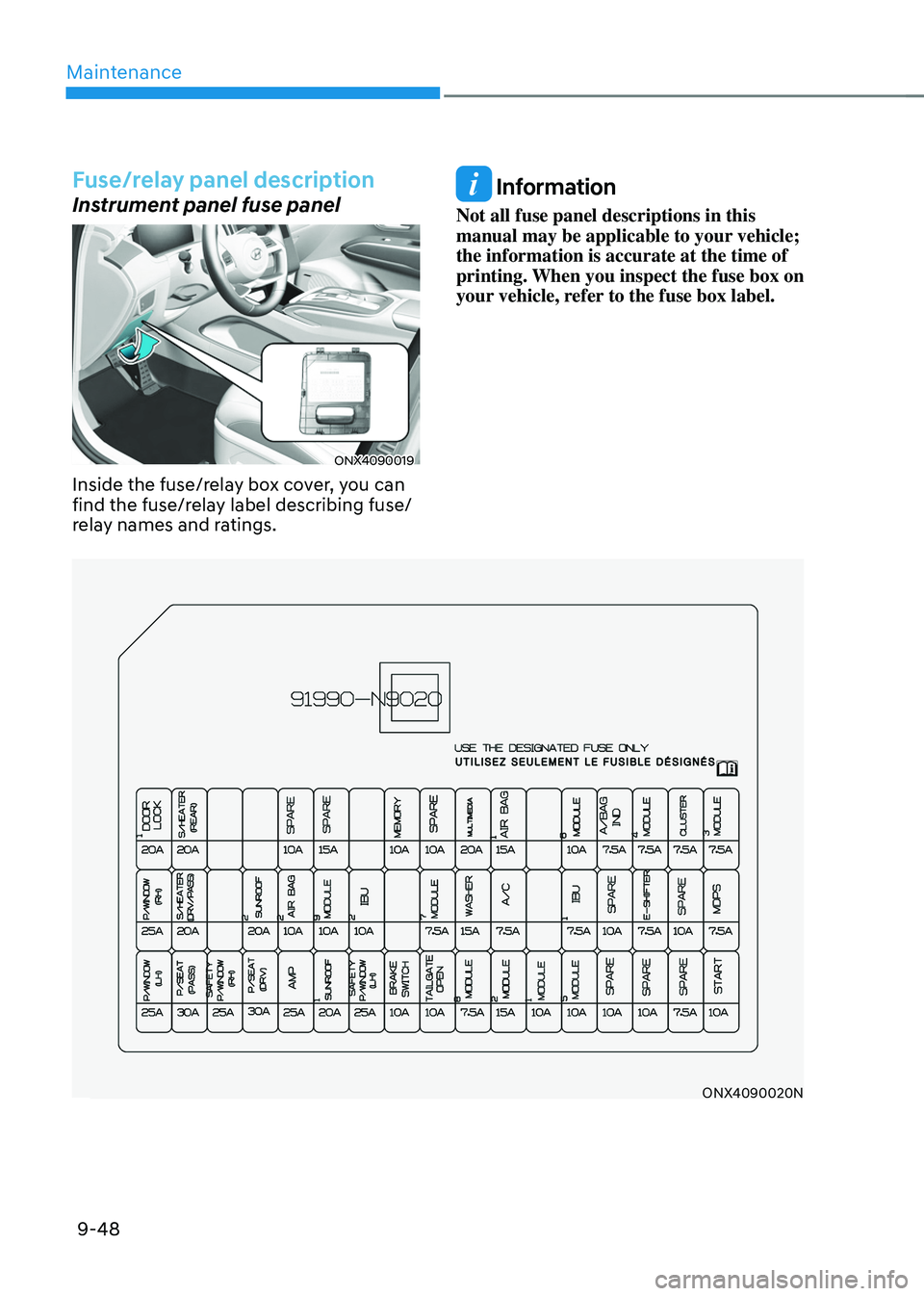
Inside the fuse/relay box cover, you can
find the fuse/relay label describing fuse/
relay names and ratings.
Information
Not all fuse panel descriptions in this
manual may be applicable to your vehicle;
the information is accurate at the time of
printing. When you inspect the fuse box on
your vehicle, refer to the fuse box label.
ONX4090020N
Page 600 of 638
Maintenance
9-50
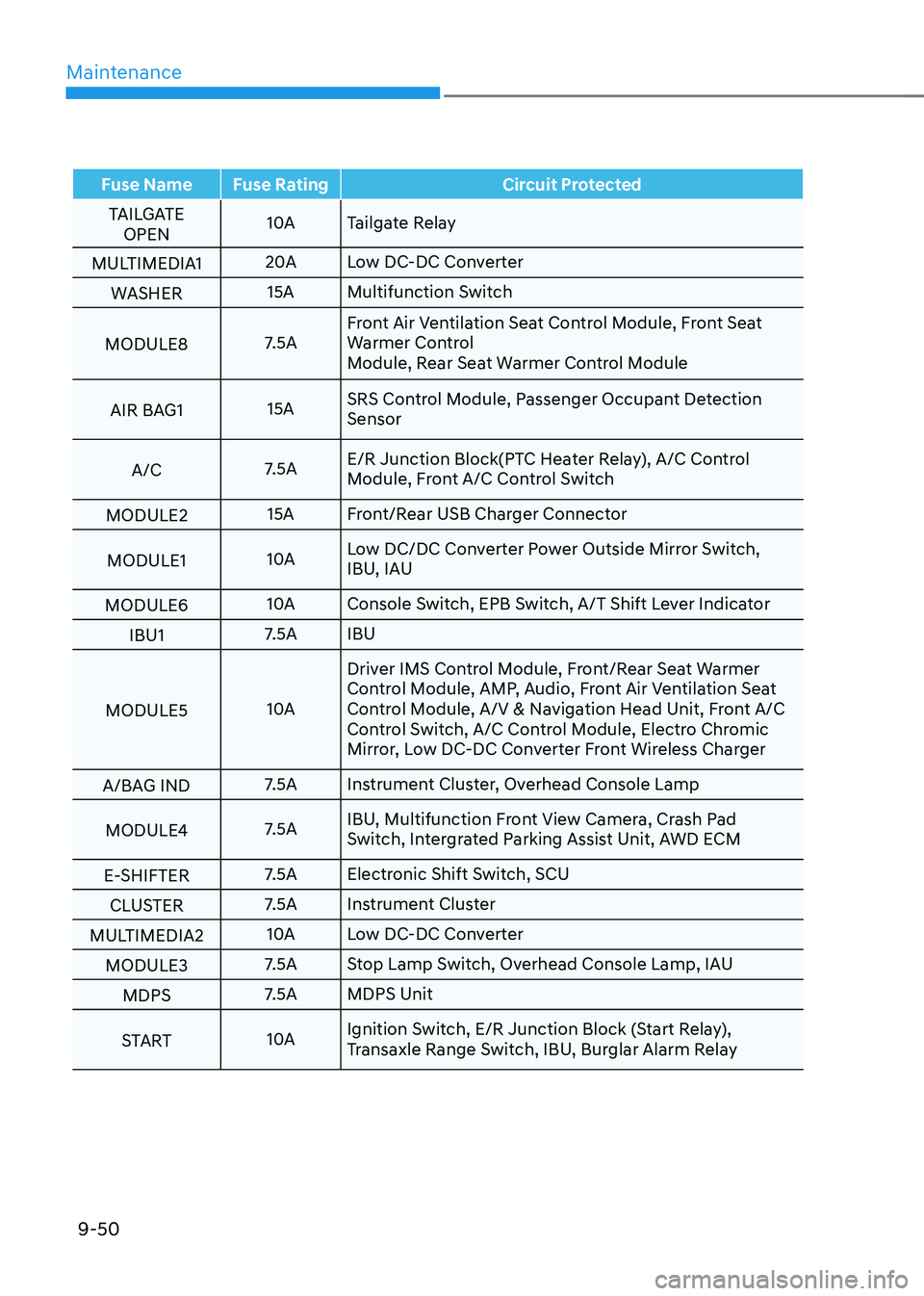
Fuse NameFuse Rating Circuit Protected
TAILGATE OPEN 10A
Tailgate Relay
MULTIMEDIA1 20A
Low DC-DC Converter
WASHER 15A
Multifunction Switch
MODULE8 7.5AFront Air Ventilation Seat Control Module, Front Seat
Warmer Control
Module, Rear Seat Warmer Control Module
AIR BAG1 15ASRS Control Module, Passenger Occupant Detection
Sensor
A/C 7.5AE/R Junction Block(PTC Heater Relay), A/C Control
Module, Front A/C Control Switch
MODULE2 15A
Front/Rear USB Charger Connector
MODULE1 10ALow DC/DC Converter Power Outside Mirror Switch,
IBU, IAU
MODULE6 10A
Console Switch, EPB Switch, A/T Shift Lever Indicator
IBU1 7.5A
IBU
MODULE5 10ADriver IMS Control Module, Front/Rear Seat Warmer
Control Module, AMP, Audio, Front Air Ventilation Seat
Control Module, A/V & Navigation Head Unit, Front A/C
Control Switch, A/C Control Module, Electro Chromic
Mirror, Low DC-DC Converter Front Wireless Charger
A/BAG IND 7.5A
Instrument Cluster, Overhead Console Lamp
MODULE4 7.5AIBU, Multifunction Front View Camera, Crash Pad
Switch, Intergrated Parking Assist Unit, AWD ECM
E-SHIFTER 7.5A
Electronic Shift Switch, SCU
CLUSTER 7.5A
Instrument Cluster
MULTIMEDIA2 10A
Low DC-DC Converter
MODULE3 7.5A
Stop Lamp Switch, Overhead Console Lamp, IAU
MDPS 7.5A
MDPS Unit
START 10AIgnition Switch, E/R Junction Block (Start Relay),
Transaxle Range Switch, IBU, Burglar Alarm Relay
Page 602 of 638
Maintenance
9-52
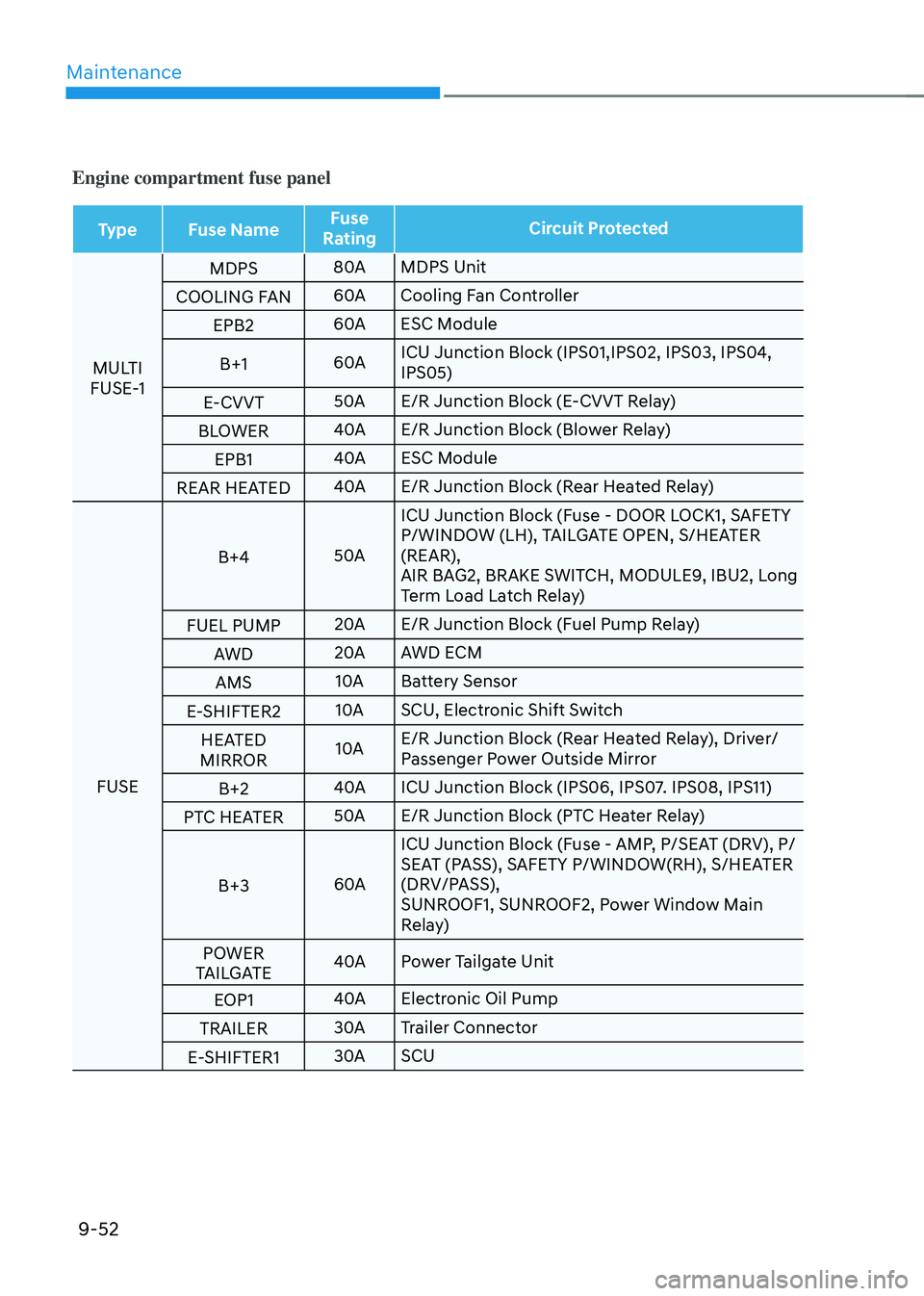
Engine compartment fuse panel
TypeFuse Name Fuse
Rating Circuit Protected
MULTI
FUSE-1 MDPS
80A
MDPS Unit
COOLING FAN 60A
Cooling Fan Controller
EPB2 60A
ESC Module
B+1 60AICU Junction Block (IPS01,IPS02, IPS03, IPS04,
IPS05)
E-CVVT 50A
E/R Junction Block (E-CVVT Relay)
BLOWER 40A
E/R Junction Block (Blower Relay)
EPB1 40A
ESC Module
REAR HEATED 40A
E/R Junction Block (Rear Heated Relay)
FUSE B+4
50AICU Junction Block (Fuse - DOOR LOCK1, SAFETY
P/WINDOW (LH), TAILGATE OPEN, S/HEATER
(REAR),
AIR BAG2, BRAKE SWITCH, MODULE9, IBU2, Long
Term Load Latch Relay)
FUEL PUMP 20A
E/R Junction Block (Fuel Pump Relay)
AWD 20A
AWD ECM
AMS 10A
Battery Sensor
E-SHIFTER2 10A
SCU, Electronic Shift Switch
HEATED
MIRROR 10A
E/R Junction Block (Rear Heated Relay), Driver/
Passenger Power Outside Mirror
B+2 40A
ICU Junction Block (IPS06, IPS07. IPS08, IPS11)
PTC HEATER 50A
E/R Junction Block (PTC Heater Relay)
B+3 60AICU Junction Block (Fuse - AMP, P/SEAT (DRV), P/
SEAT (PASS), SAFETY P/WINDOW(RH), S/HEATER
(DRV/PASS),
SUNROOF1, SUNROOF2, Power Window Main
Relay)
POWER
TAILGATE 40A
Power Tailgate Unit
EOP1 40A
Electronic Oil Pump
TRAILER 30A
Trailer Connector
E-SHIFTER1 30A
SCU
Page 604 of 638
Maintenance
9-54
We recommend that you consult an
authorized HYUNDAI dealer to replace
most vehicle light bulbs. It is difficult
to replace vehicle light bulbs because
other parts of the vehicle must be
removed before you can get to the bulb.
This is especially true for removing the
headlamp assembly to get to the bulb(s).
Removing/installing the headlamp
assembly can result in damage to the
vehicle.
WARNING
• Prior to working on a light, depress
the foot brake, shift to P (Park), apply
the parking brake, press the Engine
Start/Stop button to the OFF position
and take the key with you when
leaving the vehicle to avoid sudden
movement of the vehicle and to
prevent possible electric shock.
• Be aware the bulbs may be hot and
may burn your fingers.
NOTICE
Be sure to replace the burned-out bulb
with one of the same wattage rating.
Otherwise, it may cause damage to the
fuse or electrical wiring system.
NOTICE
To prevent damage, do not clean the
headlamp lens with chemical solvents
or strong detergents.
Information - Headlamp
desiccant (if equipped)
This vehicle is equipped with desiccant to
reduce fogging inside the headlamp due
to moisture. The desiccant is consumable
and its performance may change based on
the used period or environment. If fogging
inside the headlamp due to moisture
continues for a long time, we recommend
that you consult an authorized HYUNDAI
dealer.
Information
The headlamp and tail lamp lenses could
appear frosty if the vehicle is washed after
driving or the vehicle is driven at night
in wet weather. This condition is caused
by temperature difference between the
lamp inside and outside and, it does not
indicate a problem with your vehicle.
When moisture condenses in the lamp,
it will be removed after driving with the
headlamp on. The removable level may
differ depending on lamp size, lamp
position and environmental condition.
However, if moisture is not removed, we
recommend that your vehicle is inspected
by an authorized HYUNDAI dealer.
LIGHT BULBS
Page 606 of 638
Maintenance
9-56
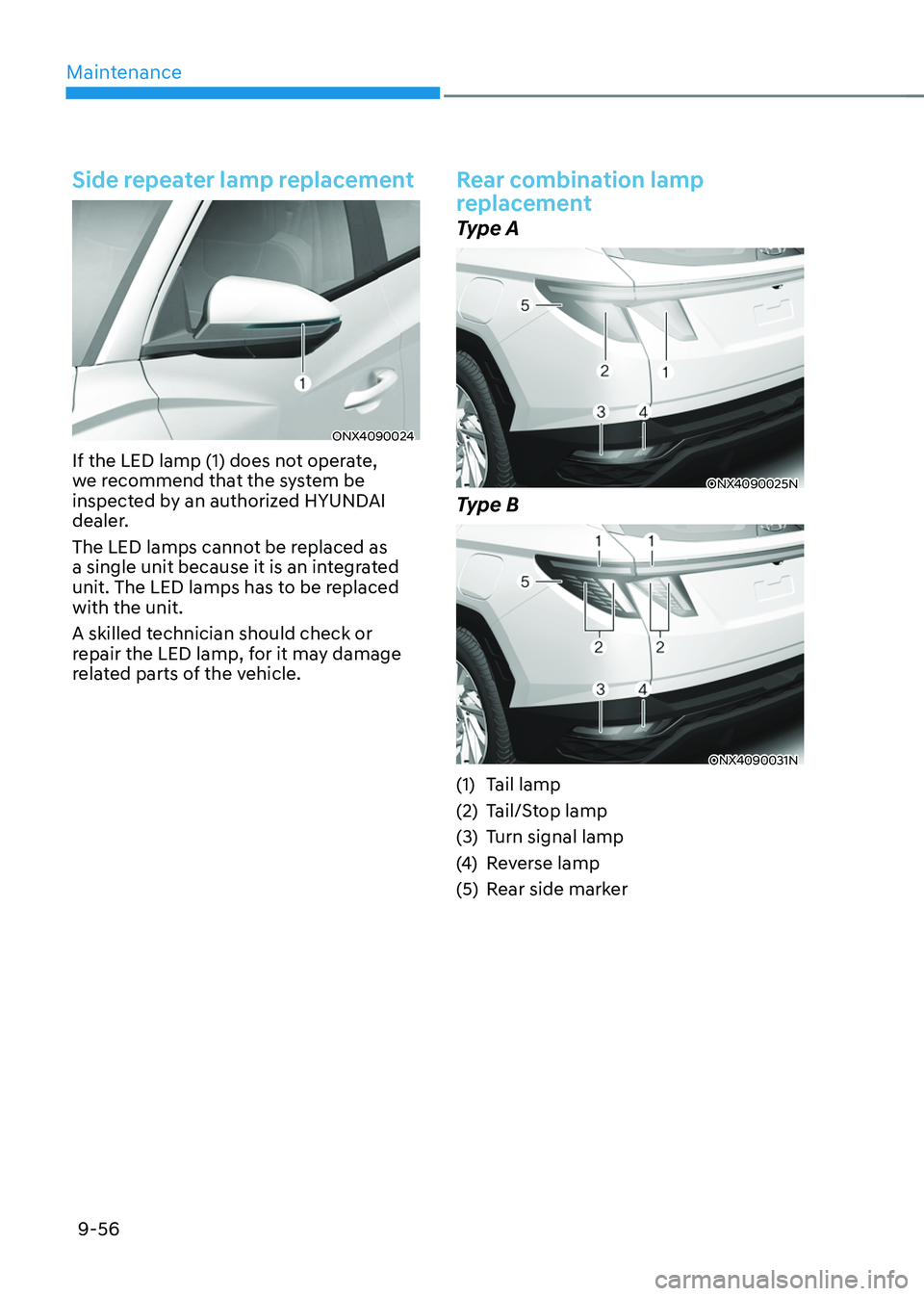
Side repeater lamp replacement
ONX4090024
If the LED lamp (1) does not operate,
we recommend that the system be
inspected by an authorized HYUNDAI
dealer.
The LED lamps cannot be replaced as
a single unit because it is an integrated
unit. The LED lamps has to be replaced
with the unit.
A skilled technician should check or
repair the LED lamp, for it may damage
related parts of the vehicle.
Rear combination lamp
replacement
Type A
ONX4090025N
Type B
ONX4090031N
(1) Tail lamp
(2) Tail/Stop lamp
(3) Turn signal lamp
(4) Reverse lamp
(5) Rear side marker
Page 608 of 638
Maintenance
9-58
ONX4090027
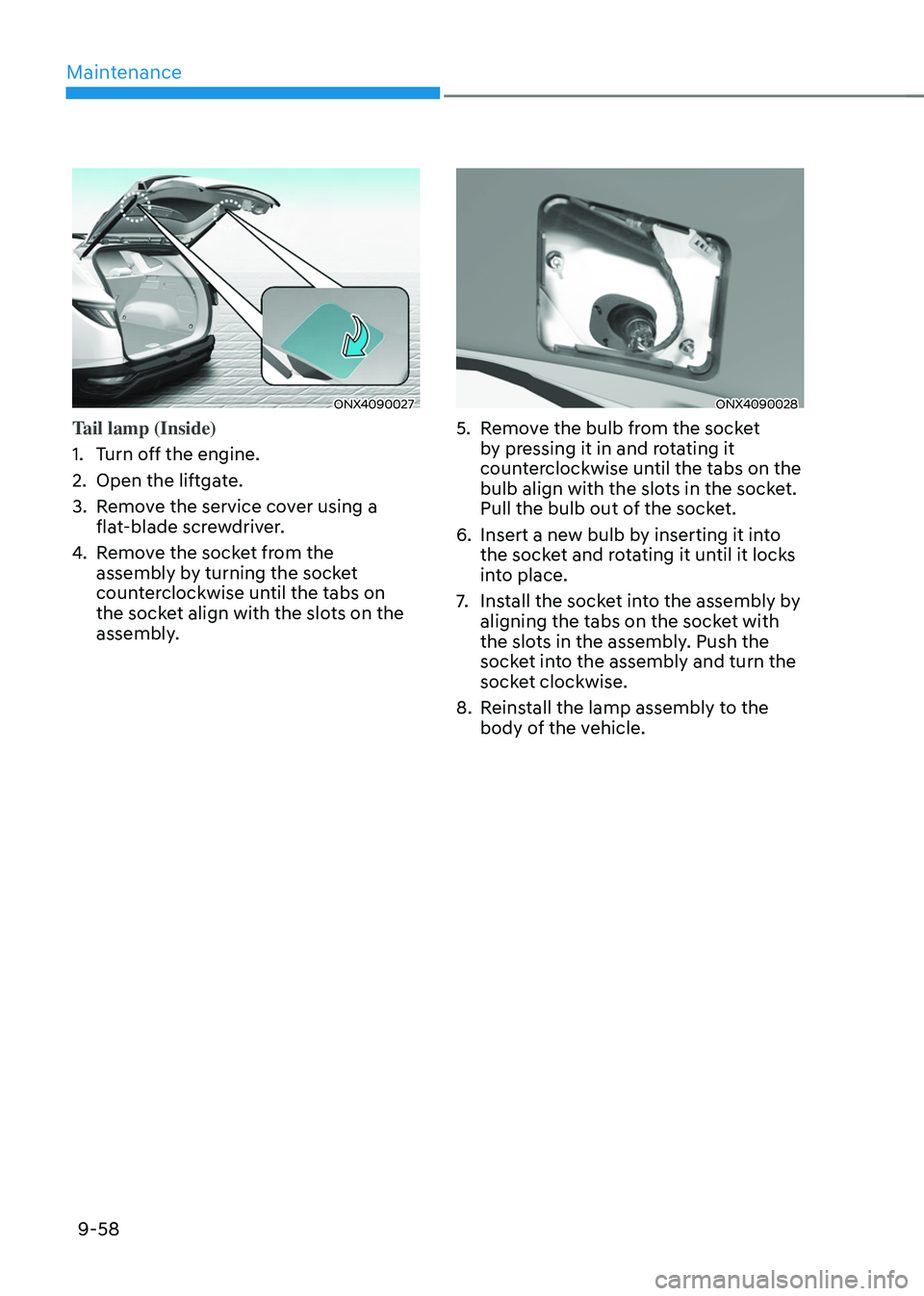
Tail lamp (Inside)
1. Turn off the engine.
2. Open the liftgate.
3. Remove the service cover using a
flat-blade screwdriver.
4. Remove the socket from the
assembly by turning the socket
counterclockwise until the tabs on
the socket align with the slots on the
assembly.
ONX4090028
5. Remove the bulb from the socket
by pressing it in and rotating it
counterclockwise until the tabs on the
bulb align with the slots in the socket.
Pull the bulb out of the socket.
6. Insert a new bulb by inserting it into
the socket and rotating it until it locks
into place.
7. Install the socket into the assembly by
aligning the tabs on the socket with
the slots in the assembly. Push the
socket into the assembly and turn the
socket clockwise.
8. Reinstall the lamp assembly to the
body of the vehicle.
Page 610 of 638
Maintenance
9-60
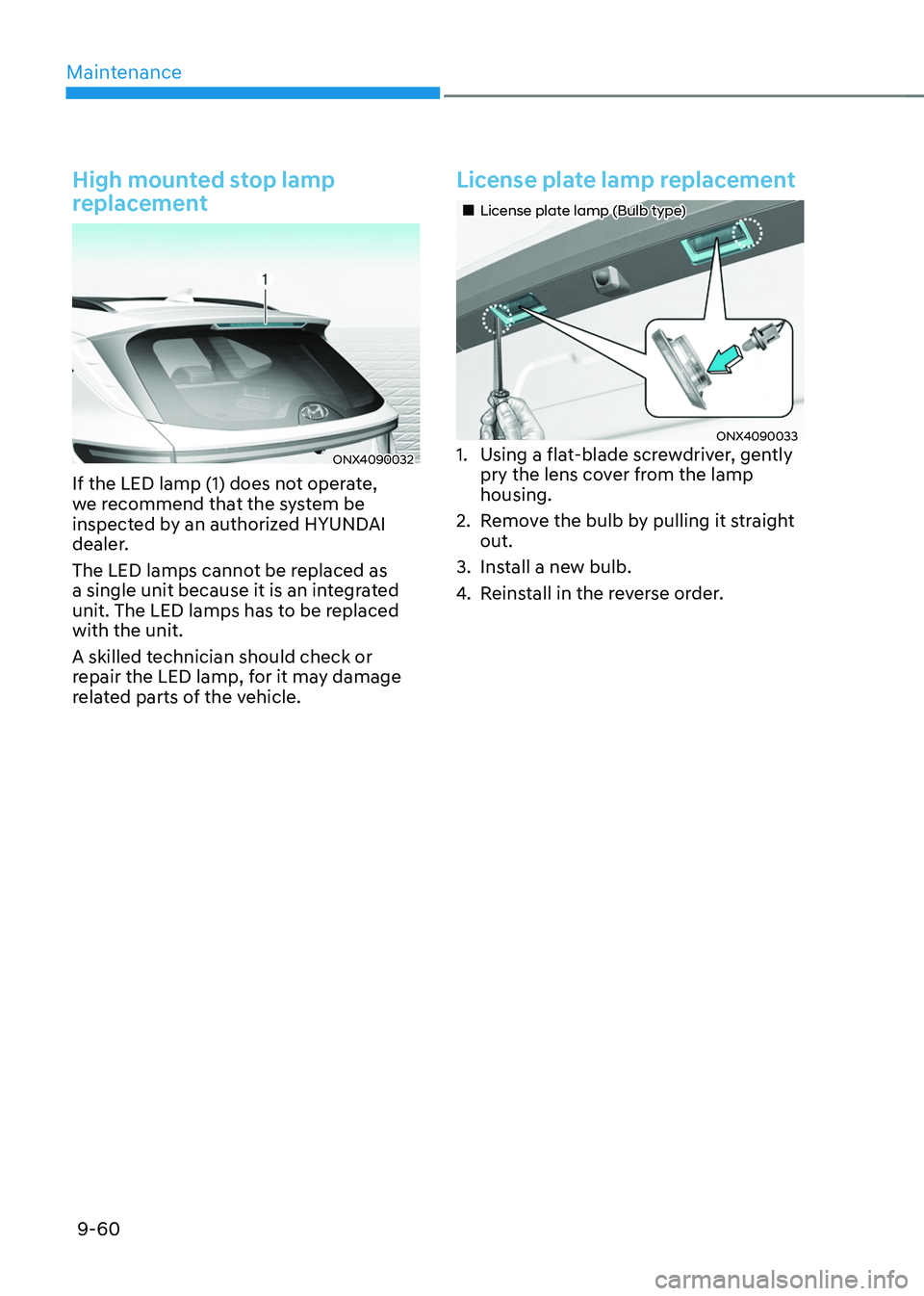
High mounted stop lamp
replacement
ONX4090032
If the LED lamp (1) does not operate,
we recommend that the system be
inspected by an authorized HYUNDAI
dealer.
The LED lamps cannot be replaced as
a single unit because it is an integrated
unit. The LED lamps has to be replaced
with the unit.
A skilled technician should check or
repair the LED lamp, for it may damage
related parts of the vehicle.
License plate lamp replacement
„„License plate lamp (Bulb type)
ONX40900331. Using a flat-blade screwdriver, gently
pry the lens cover from the lamp
housing.
2. Remove the bulb by pulling it straight
out.
3. Install a new bulb.
4. Reinstall in the reverse order.