engine HYUNDAI TUCSON HYBRID 2021 Owners Manual
[x] Cancel search | Manufacturer: HYUNDAI, Model Year: 2021, Model line: TUCSON HYBRID, Model: HYUNDAI TUCSON HYBRID 2021Pages: 630, PDF Size: 77.98 MB
Page 588 of 630
09
9-41
WARNING
NEVER replace a fuse with anything but
another fuse of the same rating.
• A higher capacity fuse could cause
damage and possibly cause a fire.
• Do not install a wire or aluminum
foil instead of the proper fuse -
even as a temporary repair. It may
cause extensive wiring damage and
possibly a fire.
NOTICE
Do not use a screwdriver or any other
metal object to remove fuses because
it may cause a short circuit and damage
the system.
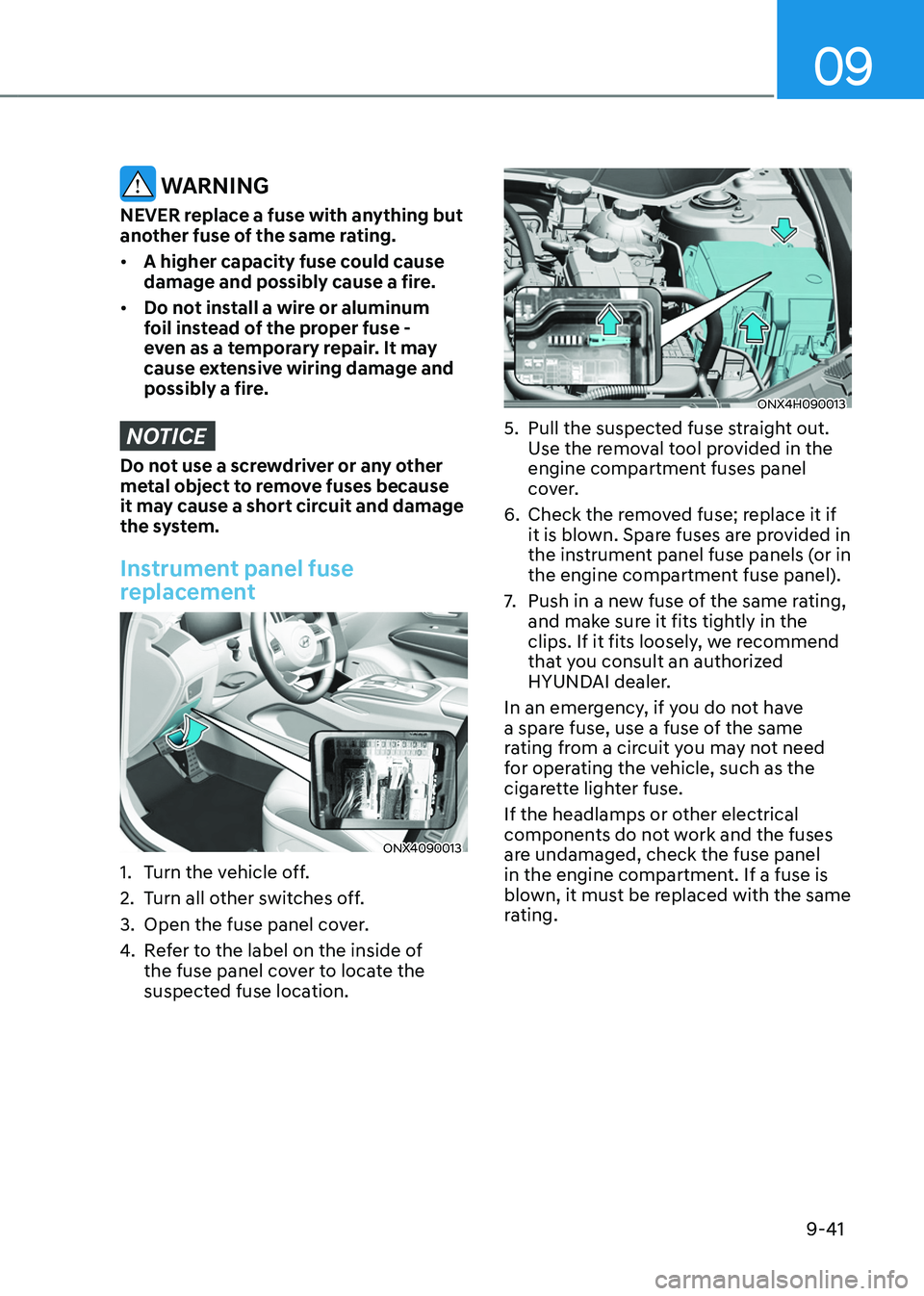
Instrument panel fuse
replacement
ONX4090013
1. Turn the vehicle off.
2.
Turn all o
ther switches off.
3.
Open the fuse panel cov
er.
4.
Re
fer to the label on the inside of
the fuse panel cover to locate the
suspected fuse location.
ONX4H090013
5. Pull the suspected fuse s traight out.
Use the removal tool provided in the
engine compartment fuses panel
cover.
6.
Check the remo
ved fuse; replace it if
it is blown. Spare fuses are provided in
the instrument panel fuse panels (or in
the engine compartment fuse panel).
7.
Push in a new fuse o
f the same rating,
and make sure it fits tightly in the
clips. If it fits loosely, we recommend
that you consult an authorized
HYUNDAI dealer.
In an emergency, if you do not have
a spare fuse, use a fuse of the same
rating from a circuit you may not need
for operating the vehicle, such as the
cigarette lighter fuse.
If the headlamps or other electrical
components do not work and the fuses
are undamaged, check the fuse panel
in the engine compartment. If a fuse is
blown, it must be replaced with the same
rating.
Page 589 of 630
Maintenance
9-42
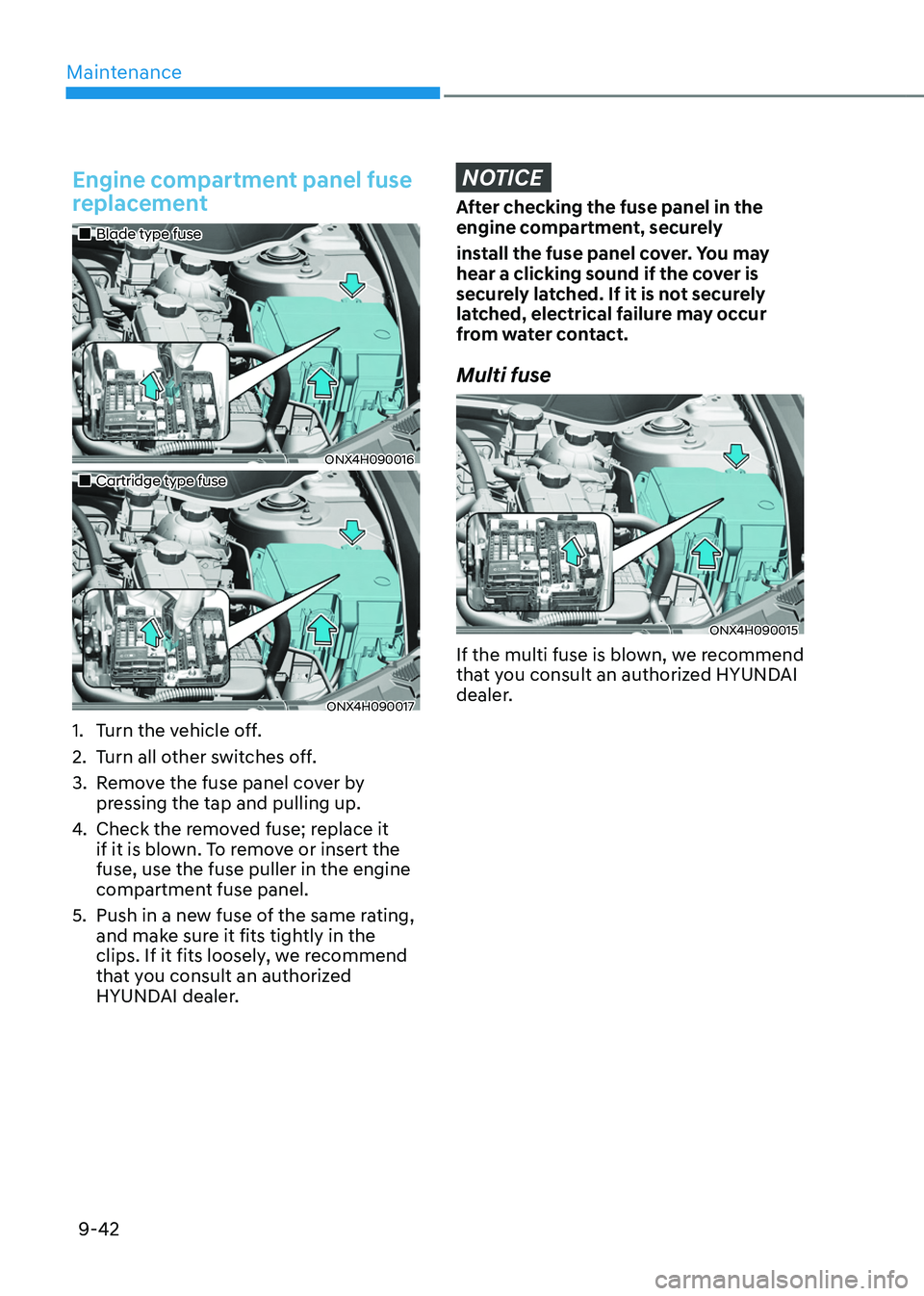
Engine compartment panel fuse
replacement
„„Blade type fuse
ONX4H090016
„„Cartridge type fuse
ONX4H090017
1. Turn the vehicle off.
2.
Turn all o
ther switches off.
3.
Remo
ve the fuse panel cover by
pressing the tap and pulling up.
4.
Check the remo
ved fuse; replace it
if it is blown. To remove or insert the
fuse, use the fuse puller in the engine
compartment fuse panel.
5.
Push in a new fuse o
f the same rating,
and make sure it fits tightly in the
clips. If it fits loosely, we recommend
that you consult an authorized
HYUNDAI dealer.
NOTICE
After checking the fuse panel in the
engine compartment, securely
install the fuse panel cover. You may
hear a clicking sound if the cover is
securely latched. If it is not securely
latched, electrical failure may occur
from water contact.
Multi fuse
ONX4H090015
If the multi fuse is blown, we recommend
that you consult an authorized HYUNDAI
dealer.
Page 594 of 630
09
9-47
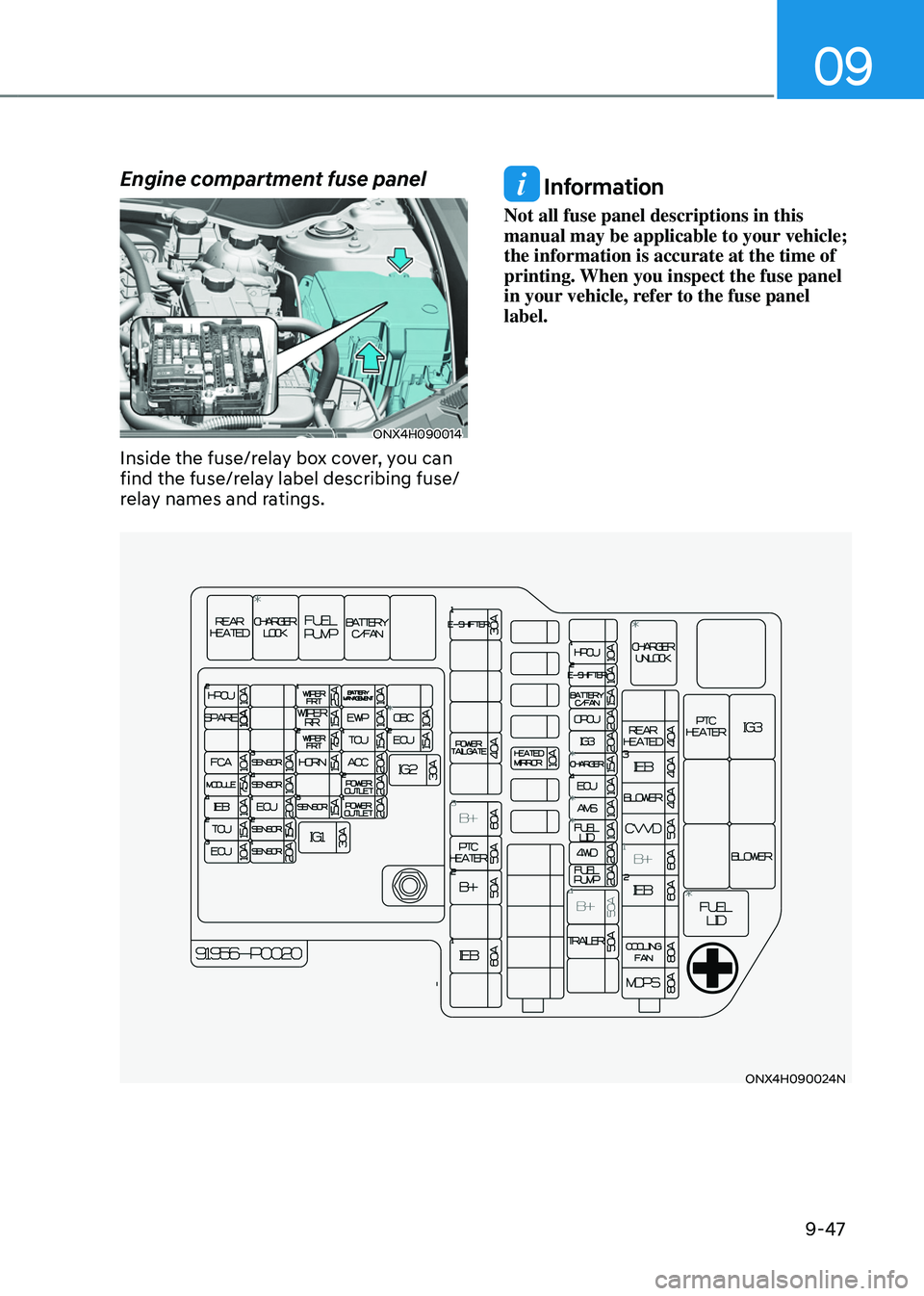
Engine compartment fuse panel
ONX4H090014
Inside the fuse/relay box cover, you can
find the fuse/relay label describing fuse/
relay names and ratings.
Information
Not all fuse panel descriptions in this
manual may be applicable to your vehicle;
the information is accurate at the time of
printing. When you inspect the fuse panel
in your vehicle, refer to the fuse panel
label.
ONX4H090024N
Page 595 of 630
Maintenance
9-48
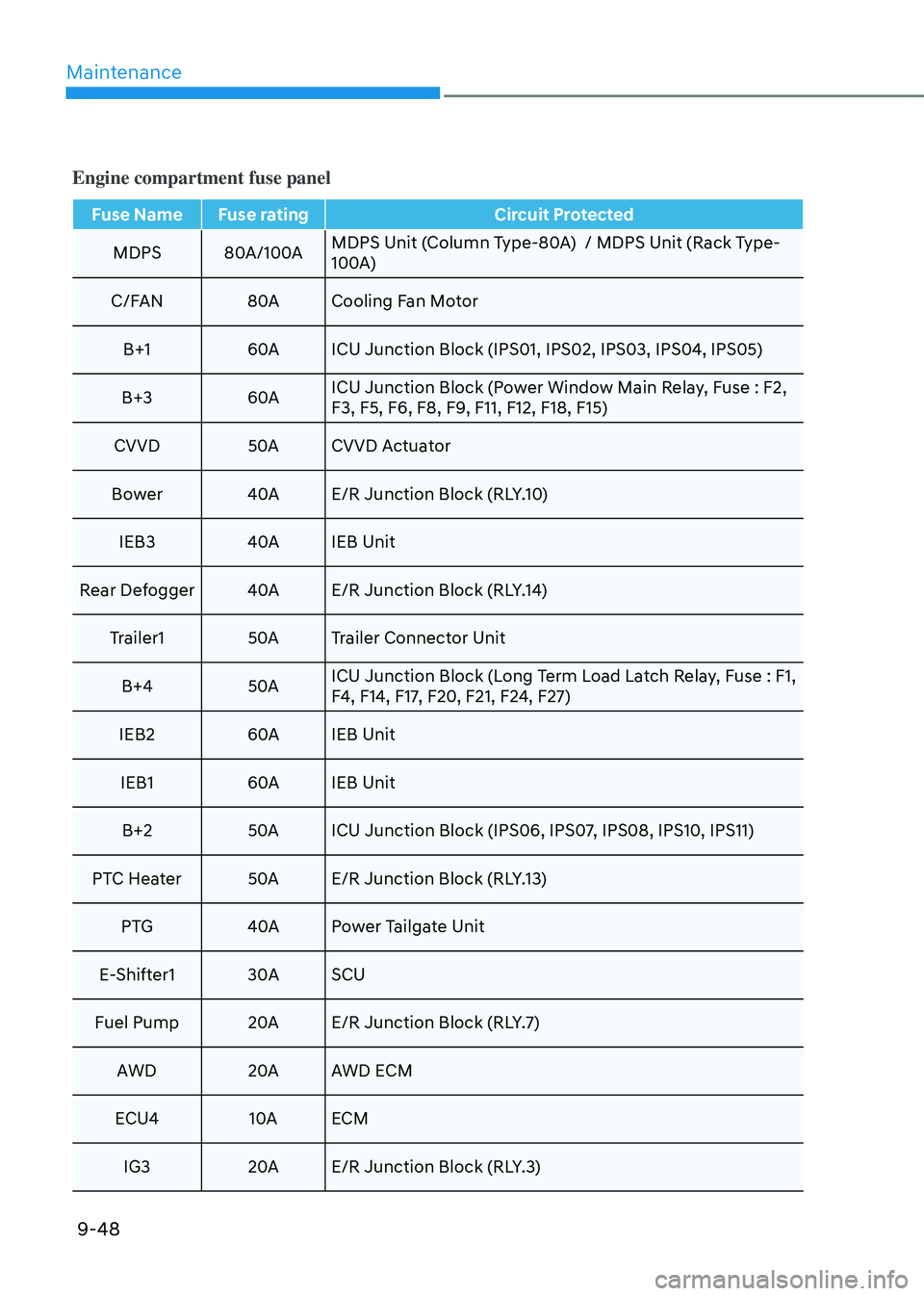
Engine compartment fuse panel
Fuse Name Fuse ratingCircuit Protected
MDPS 80A/100A MDPS Unit (Column Type-80A) / MDPS Unit (Rack Type-
100A)
C/FAN 80ACooling Fan Motor
B+1 60AICU Junction Block (IPS01, IPS02, IPS03, IPS04, IPS05)
B+3 60AICU Junction Block (Power Window Main Relay, Fuse : F2,
F3, F5, F6, F8, F9, F11, F12, F18, F15)
CVVD 50ACVVD Actuator
Bower 40AE/R Junction Block (RLY.10)
IEB3 40AIEB Unit
Rear Defogger 40AE/R Junction Block (RLY.14)
Trailer1 50ATrailer Connector Unit
B+4 50AICU Junction Block (Long Term Load Latch Relay, Fuse : F1,
F4, F14, F17, F20, F21, F24, F27)
IEB2 60AIEB Unit
IEB1 60AIEB Unit
B+2 50AICU Junction Block (IPS06, IPS07, IPS08, IPS10, IPS11)
PTC Heater 50AE/R Junction Block (RLY.13)
PTG 40APower Tailgate Unit
E-Shifter1 30ASCU
Fuel Pump 20AE/R Junction Block (RLY.7)
AWD 20AAWD ECM
ECU4 10AECM
IG3 20AE/R Junction Block (RLY.3)
Page 596 of 630
09
9-49
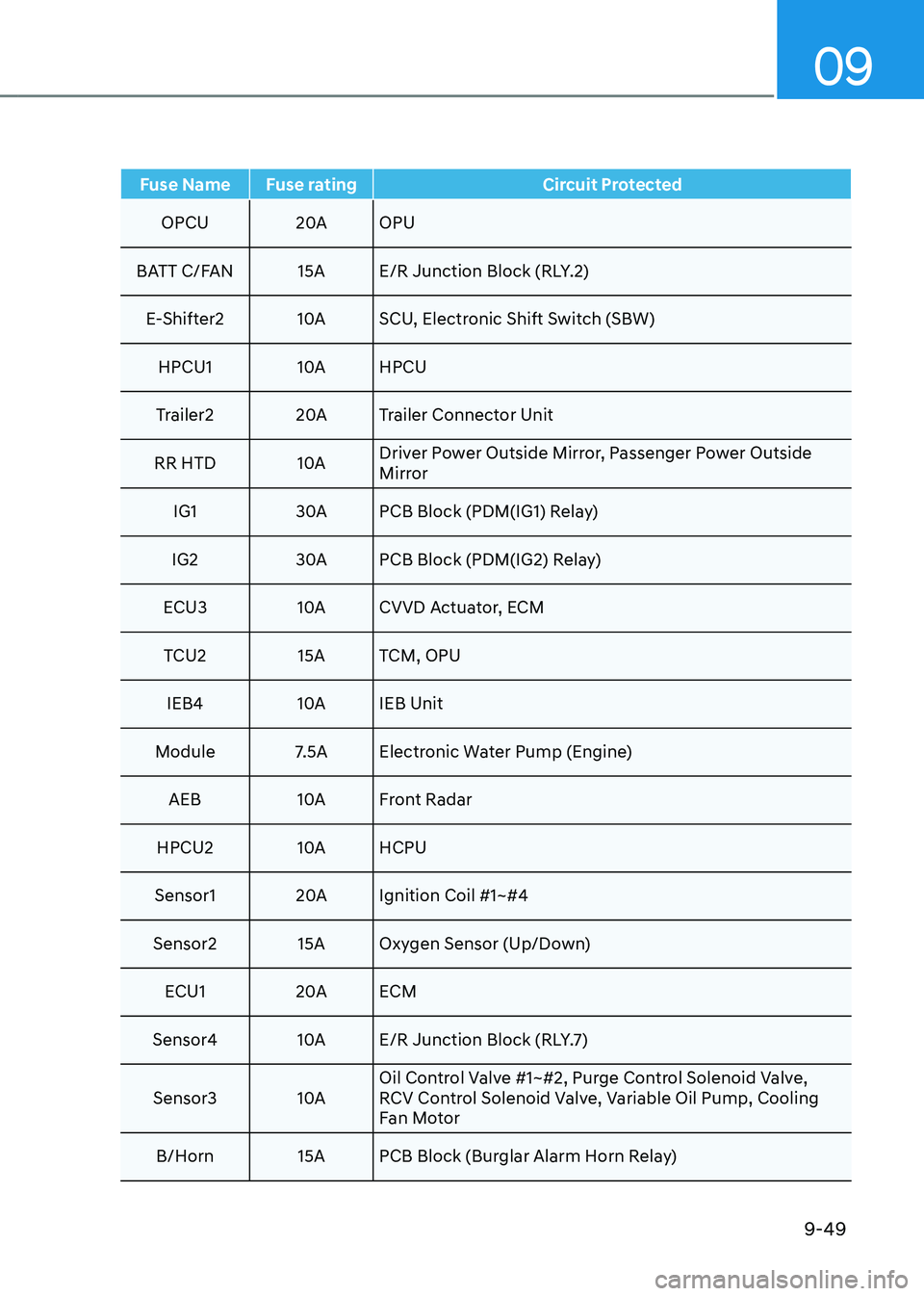
Fuse Name Fuse ratingCircuit Protected
OPCU 20AOPU
BATT C/FAN 15A E/R Junction Block (RLY.2) E-Shifter2 10ASCU, Electronic Shift Switch (SBW)
HPCU1 10AHPCU
Trailer2 20ATrailer Connector Unit
RR HTD 10ADriver Power Outside Mirror, Passenger Power Outside
Mirror
IG1 30APCB Block (PDM(IG1) Relay)
IG2 30APCB Block (PDM(IG2) Relay)
ECU3 10ACVVD Actuator, ECM
TCU2 15A TCM, OPU
IEB4 10AIEB Unit
Module 7.5A Electronic Water Pump (Engine) AEB 10AFront Radar
HPCU2 10AHCPU
Sensor1 20AIgnition Coil #1~#4
Sensor2 15A Oxygen Sensor (Up/Down) ECU1 20AECM
Sensor4 10AE/R Junction Block (RLY.7)
Sensor3 10AOil Control Valve #1~#2, Purge Control Solenoid Valve,
RCV Control Solenoid Valve, Variable Oil Pump, Cooling
Fan Motor
B/Horn 15A PCB Block (Burglar Alarm Horn Relay)
Page 597 of 630
Maintenance
9-50
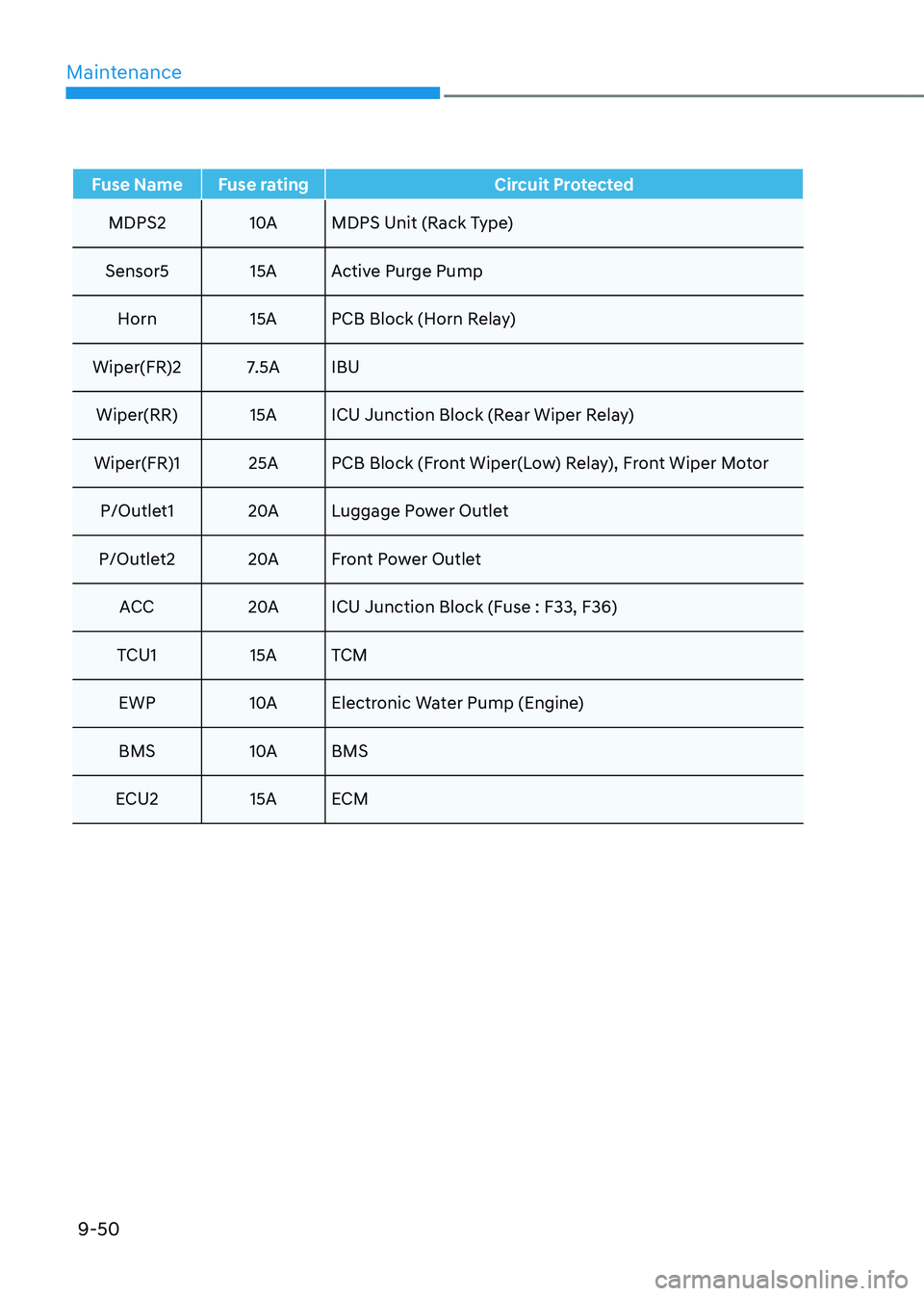
Fuse Name Fuse ratingCircuit Protected
MDPS2 10AMDPS Unit (Rack Type)
Sensor5 15A Active Purge Pump Horn 15A PCB Block (Horn Relay)
Wiper(FR)2 7.5A IBU Wiper(RR) 15A ICU Junction Block (Rear Wiper Relay)
Wiper(FR)1 25A PCB Block (Front Wiper(Low) Relay), Front Wiper Motor P/Outlet1 20ALuggage Power Outlet
P/Outlet2 20AFront Power Outlet
ACC 20AICU Junction Block (Fuse : F33, F36)
TCU1 15ATCM
EWP 10AElectronic Water Pump (Engine)
BMS 10ABMS
ECU2 15AECM
Page 600 of 630
09
9-53
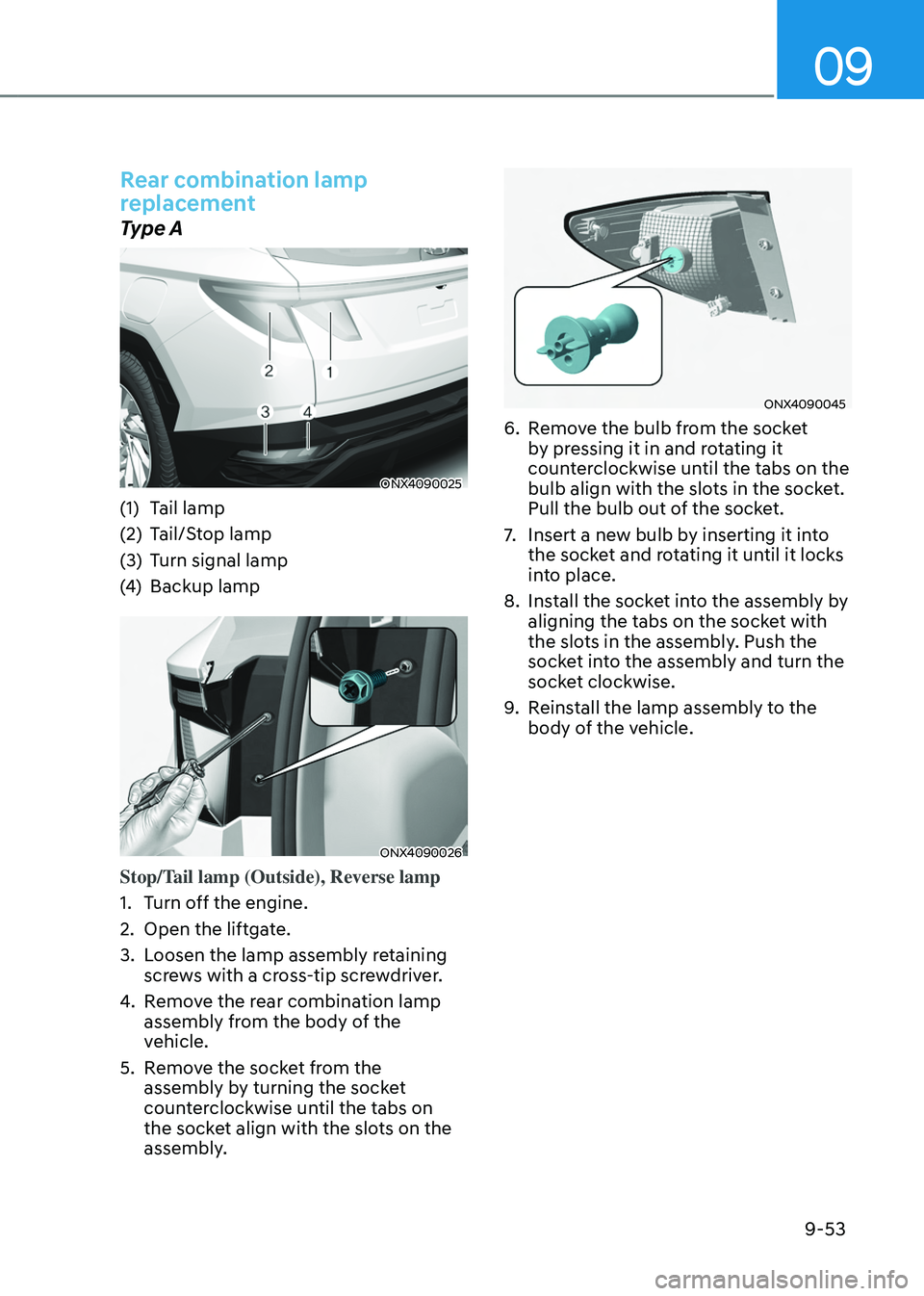
Rear combination lamp
replacement
Type A
ONX4090025
(1) Tail lamp
(2)
Tail/S
top lamp
(3)
Turn signal lamp
(4
)
Backup lamp
ONX4090026
Stop/Tail lamp (Outside), Reverse lamp
1.
Turn o
ff the engine.
2.
Open the liftga
te.
3.
Loosen the lamp assembly r
etaining
screws with a cross-tip screwdriver.
4.
Remo
ve the rear combination lamp
assembly from the body of the
vehicle.
5.
Remo
ve the socket from the
assembly by turning the socket
counterclockwise until the tabs on
the socket align with the slots on the
assembly.
ONX4090045
6. Remove the bulb from the socket
b y pressing it in and rotating it
counterclockwise until the tabs on the
bulb align with the slots in the socket.
Pull the bulb out of the socket.
7.
Insert a new bulb b
y inserting it into
the socket and rotating it until it locks
into place.
8.
Install the sock
et into the assembly by
aligning the tabs on the socket with
the slots in the assembly. Push the
socket into the assembly and turn the
socket clockwise.
9.
Reins
tall the lamp assembly to the
body of the vehicle.
Page 601 of 630
Maintenance
9-54
ONX4090027
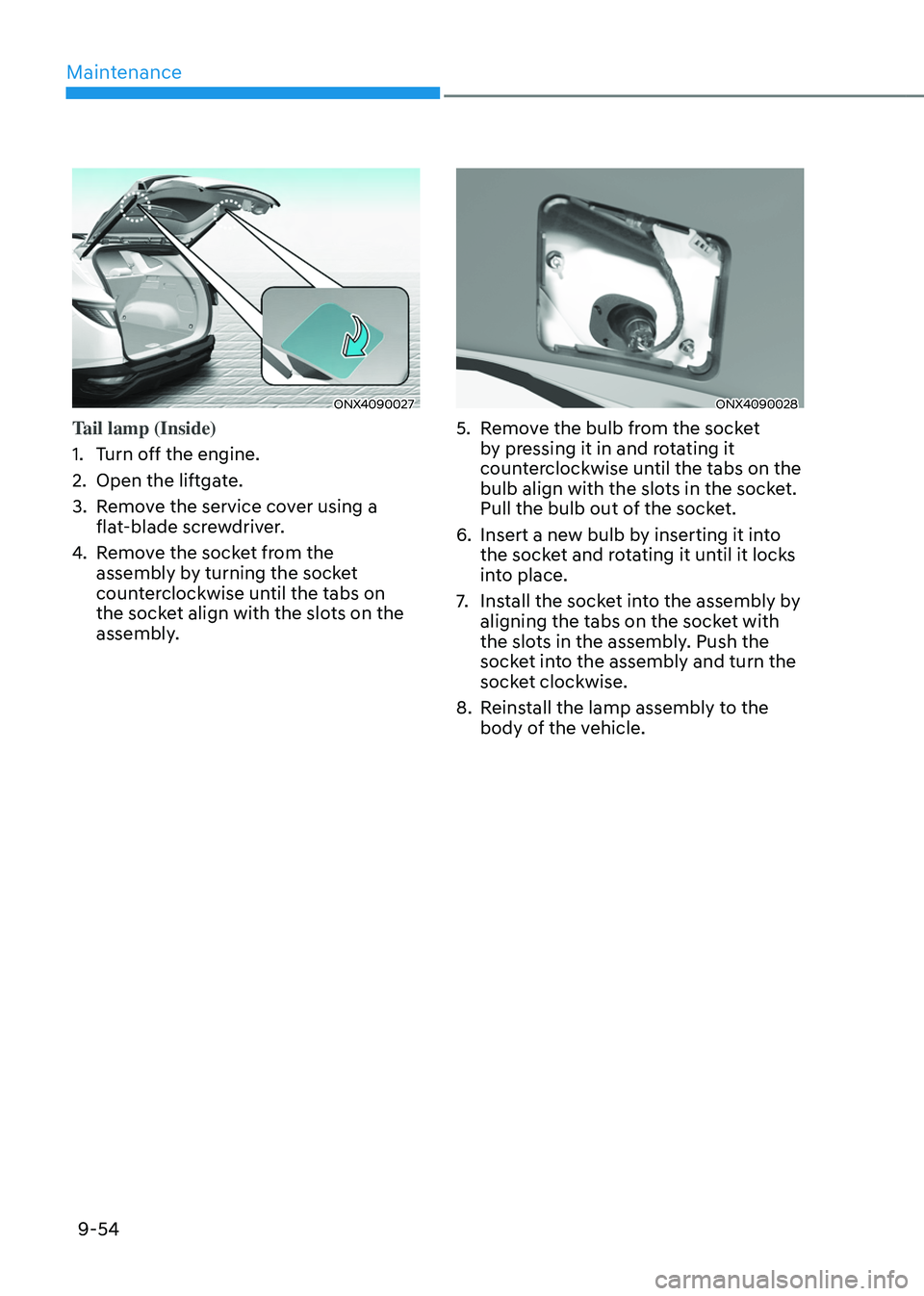
Tail lamp (Inside)
1.
Turn o
ff the engine.
2.
Open the liftga
te.
3.
Remo
ve the service cover using a
flat-blade screwdriver.
4.
Remo
ve the socket from the
assembly by turning the socket
counterclockwise until the tabs on
the socket align with the slots on the
assembly.
ONX4090028
5. Remove the bulb from the socket
b y pressing it in and rotating it
counterclockwise until the tabs on the
bulb align with the slots in the socket.
Pull the bulb out of the socket.
6.
Insert a new bulb b
y inserting it into
the socket and rotating it until it locks
into place.
7.
Install the sock
et into the assembly by
aligning the tabs on the socket with
the slots in the assembly. Push the
socket into the assembly and turn the
socket clockwise.
8.
Reins
tall the lamp assembly to the
body of the vehicle.
Page 607 of 630
Maintenance
9-60
NOTICE
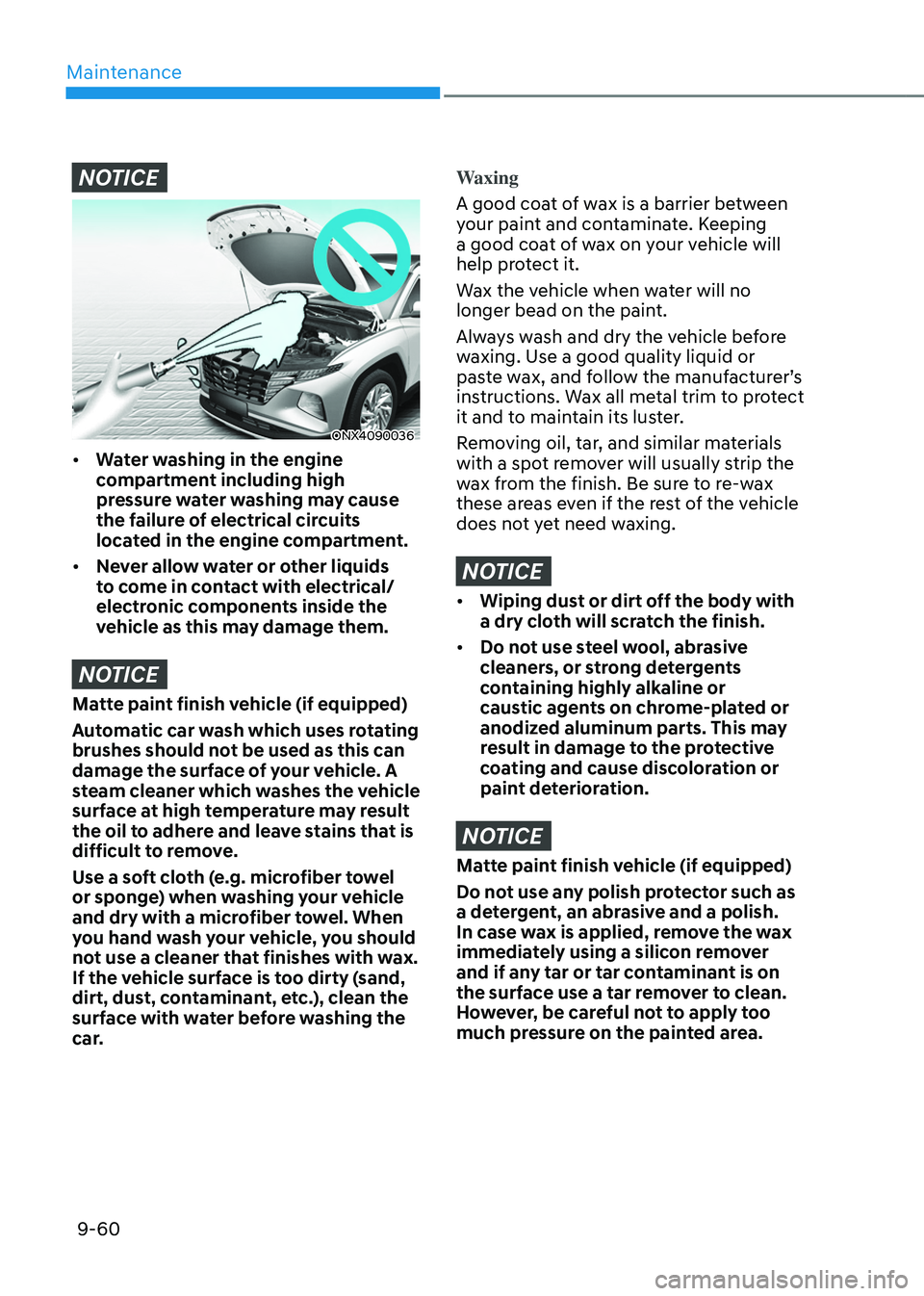
ONX4090036
• Water washing in the engine
compartment including high
pressure water washing may cause
the failure of electrical circuits
located in the engine compartment.
• Never allow water or other liquids
to come in contact with electrical/
electronic components inside the
vehicle as this may damage them.
NOTICE
Matte paint finish vehicle (if equipped)
Automatic car wash which uses rotating
brushes should not be used as this can
damage the surface of your vehicle. A
steam cleaner which washes the vehicle
surface at high temperature may result
the oil to adhere and leave stains that is
difficult to remove.
Use a soft cloth (e.g. microfiber towel
or sponge) when washing your vehicle
and dry with a microfiber towel. When
you hand wash your vehicle, you should
not use a cleaner that finishes with wax.
If the vehicle surface is too dirty (sand,
dirt, dust, contaminant, etc.), clean the
surface with water before washing the
car.
Waxing
A good coat of wax is a barrier between
your paint and contaminate. Keeping
a good coat of wax on your vehicle will
help protect it.
Wax the vehicle when water will no
longer bead on the paint.
Always wash and dry the vehicle before
waxing. Use a good quality liquid or
paste wax, and follow the manufacturer’s
instructions. Wax all metal trim to protect
it and to maintain its luster.
Removing oil, tar, and similar materials
with a spot remover will usually strip the
wax from the finish. Be sure to re-wax
these areas even if the rest of the vehicle
does not yet need waxing.
NOTICE
• Wiping dust or dirt off the body with
a dry cloth will scratch the finish.
• Do not use steel wool, abrasive
cleaners, or strong detergents
containing highly alkaline or
caustic agents on chrome-plated or
anodized aluminum parts. This may
result in damage to the protective
coating and cause discoloration or
paint deterioration.
NOTICE
Matte paint finish vehicle (if equipped)
Do not use any polish protector such as
a detergent, an abrasive and a polish.
In case wax is applied, remove the wax
immediately using a silicon remover
and if any tar or tar contaminant is on
the surface use a tar remover to clean.
However, be careful not to apply too
much pressure on the painted area.
Page 613 of 630
Maintenance
9-66
Emission control systEm
The emission control system of your
vehicle is covered by a written limited
warranty. Please see the warranty
information contained in the Service
Passport in your vehicle.
Your vehicle is equipped with an
emission control system to meet all
applicable emission regulations. There
are three emission control systems, as
follows.
(1)
Crank
case emission control system
(2)
Ev
aporative emission control system
(3)
Exhaust emission con
trol system
In order to ensure the proper function
of the emission control systems, it
is recommended that you have your
vehicle inspected and maintained
by an authorized HYUNDAI dealer in
accordance with the maintenance
schedule in this manual.
NOTICE
For the Inspection and Maintenance
Test (with Electronic Stability Control
(ESC) system)
• To prevent the vehicle from misfiring
during dynamometer testing, turn
the Electronic Stability Control
(ESC) system off by pressing the ESC
switch (ESC OFF light illuminated).
• After dynamometer testing is
completed, turn the ESC system back
on by pressing the ESC switch again.
1. Crankcase emission control
sy
stem
The positive crankcase ventilation system
is employed to prevent air pollution
caused by blow-by gases being emitted
from the crankcase. This system supplies
fresh filtered air to the crankcase through
the air intake hose. Inside the crankcase,
the fresh air mixes with blow-by gases,
which then pass through the PCV valve
into the induction system.
2. Evaporative emission control
system
The Evaporative Emission Control System
is designed to prevent fuel vapors from
escaping into the atmosphere.
Canister
Fuel vapors generated inside the fuel
tank are absorbed and stored in the
onboard canister. When the engine is
running, the fuel vapors absorbed in the
canister are drawn into the surge tank
through the purge control solenoid valve.
Purge Control Solenoid Valve (PCSV)
The purge control solenoid valve
is controlled by the Engine Control
Module (ECM); when the engine coolant
temperature is low during idling, the
PCSV closes so that evaporated fuel
is not taken into the engine. After the
engine warms-up during ordinary
driving, the PCSV opens to introduce
evaporated fuel to the engine.