light HYUNDAI TUCSON HYBRID 2021 Owners Manual
[x] Cancel search | Manufacturer: HYUNDAI, Model Year: 2021, Model line: TUCSON HYBRID, Model: HYUNDAI TUCSON HYBRID 2021Pages: 630, PDF Size: 77.98 MB
Page 14 of 630
Foreword / Hybrid System Overview
1-10
Starting the vehicle
Vehicles with smart key system
1. Carry the smart key or leave it inside
the vehicle.
2. Make sure the parking brake is firmly
applied.
3. Make sure the shift button is in P
(Park). With the shift button in N
(Neutral), you cannot start the vehicle.
4. Depress the brake pedal.
5. Press the Engine Start/Stop button.
If the hybrid system starts, the “”
indicator will come on.
Whether the engine is cold or warm, it
should be started without depressing
the accelerator.
After following the start procedures,
“
” indicator on the instrument
cluster will turn on. For more details,
please check chapter 6.
ECONOMICAL and SAFE OPERATION of
Hybrid system
• Drive smoothly. Accelerate at a
moderate rate and maintain a steady
cruising speed. Do not make “jack-
rabbit” starts. Do not race between
stoplights.
Avoid heavy traffic whenever possible.
Always maintain a safe distance
from other vehicles so you can
avoid unnecessary braking. This also
reduces brake wear out.
• The regenerative brake generates
energy when the vehicle decelerates.
• When the hybrid battery power is
low, the hybrid system automatically
recharges the hybrid battery.
• When the engine is running with the
shift button in N (Neutral), the hybrid
system cannot generate electricity.
The hybrid battery cannot recharge
with the shift button in N (Neutral).
Information
In the hybrid system, the engine
automatically runs and stops. When
the hybrid system operates, the “
”
indicator is illuminated.
In the following situation, the engine may
operate automatically.
- When the engine is ready to run
-When the hybrid battery is being
charged
-Depending on the temperature
condition of the hybrid battery
Special features
Hybrid vehicles sound different than
gasoline engine vehicles. When the
hybrid system operates, you may
hear a sound from the hybrid battery
system under the floor. If you apply
the accelerator pedal rapidly, you may
hear an unconventional sound. When
you apply the brake pedal, you may
hear a sound from the regenerative
brake system. When the hybrid system
is turned off or on, you may hear a
sound in the engine compartment. If
you depress the brake pedal repeatedly
when the hybrid system is turned on,
you may hear a sound in the engine
compartment. None of these sounds
indicate a problem. These are normal
characteristics of hybrid vehicles.
If any of following occur, it’s a normal
condition if you hear a motor sound in
the engine compartment:
-After turning off the hybrid system,
the brake pedal is released.
-When the hybrid system is turned off,
the brake pedal is applied.
-When the driver door is opened.
DRIVING THE HYBRID VEHICLE
Page 17 of 630
01
1-13
Warning and indicator lights
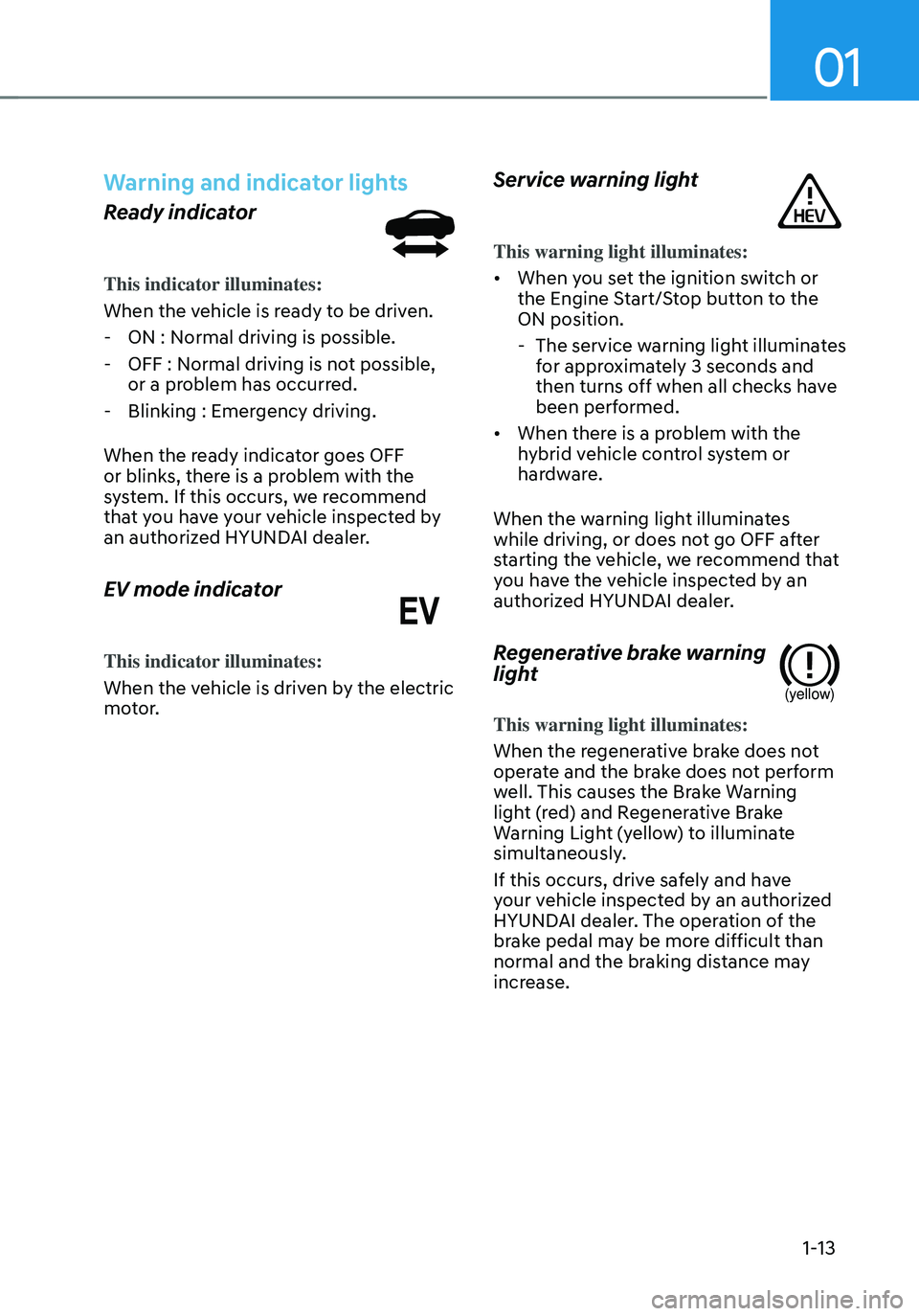
Ready indicator
This indicator illuminates:
When the vehicle is ready to be driven.
-ON : Normal driving is possible.
-OFF : Normal driving is not possible,
or a problem has occurred.
-Blinking : Emergency driving.
When the ready indicator goes OFF
or blinks, there is a problem with the
system. If this occurs, we recommend
that you have your vehicle inspected by
an authorized HYUNDAI dealer.
EV mode indicator
This indicator illuminates:
When the vehicle is driven by the electric
motor.
Service warning light
This warning light illuminates:
• When you set the ignition switch or
the Engine Start/Stop button to the
ON position.
-The service warning light illuminates
for approximately 3 seconds and
then turns off when all checks have
been performed.
• When there is a problem with the
hybrid vehicle control system or
hardware.
When the warning light illuminates
while driving, or does not go OFF after
starting the vehicle, we recommend that
you have the vehicle inspected by an
authorized HYUNDAI dealer.
Regenerative brake warning
light
(yellow)
This warning light illuminates:
When the regenerative brake does not
operate and the brake does not perform
well. This causes the Brake Warning
light (red) and Regenerative Brake
Warning Light (yellow) to illuminate
simultaneously.
If this occurs, drive safely and have
your vehicle inspected by an authorized
HYUNDAI dealer. The operation of the
brake pedal may be more difficult than
normal and the braking distance may
increase.
Page 24 of 630
Foreword / Hybrid System Overview
1-20
e-Handling (Electrically Assisted
Handling Performance)/e-EHA
(Electrically Evasive Handling
Assist)
e-Handling controls the electric motor
while turning around to improve the
handling performance, driving safety,
convenience and ride comfort.
e-EHA connects FCA (Forward Collision
Avoidance Assist) and the electric motor
to provide assists to avoid collision
so that prompt collision avoidance is
available while FCA warning appears.
Ãe-Handling stands for Electrically
Assisted Handling Performance.
Ãe-EHA means Electrically Evasive
Handling Assist.
Operation condition
e-Handling starts to work by identifying
enter or exit condition if the driver
operates the steering wheel over a
certain level when the vehicle speed is
between 40km/h and 120km/h.
e-EHA operates if there is urgent steering
wheel operation while FCA (Forward
Collision Avoidance Assist) warning
appears
Operation cancel
-When ESC operates
-When ABS works
CAUTION
The system does not work under the
following conditions.
-When the ESC operation stop light
is on
-When it does not work due to a
malfunction of electronic device
-When the manual transmission mode
is set
-The gear shift is not in D (Drive)
Information
Please refer to the chapter 6 “Paddle shift
(manual transmission mode) of automatic
transmission (electronic transmission
button)”
HYBRID DRIVING SYSTEM
Page 35 of 630
2-6
Vehicle Information, Consumer Information and Reporting Safety Defects
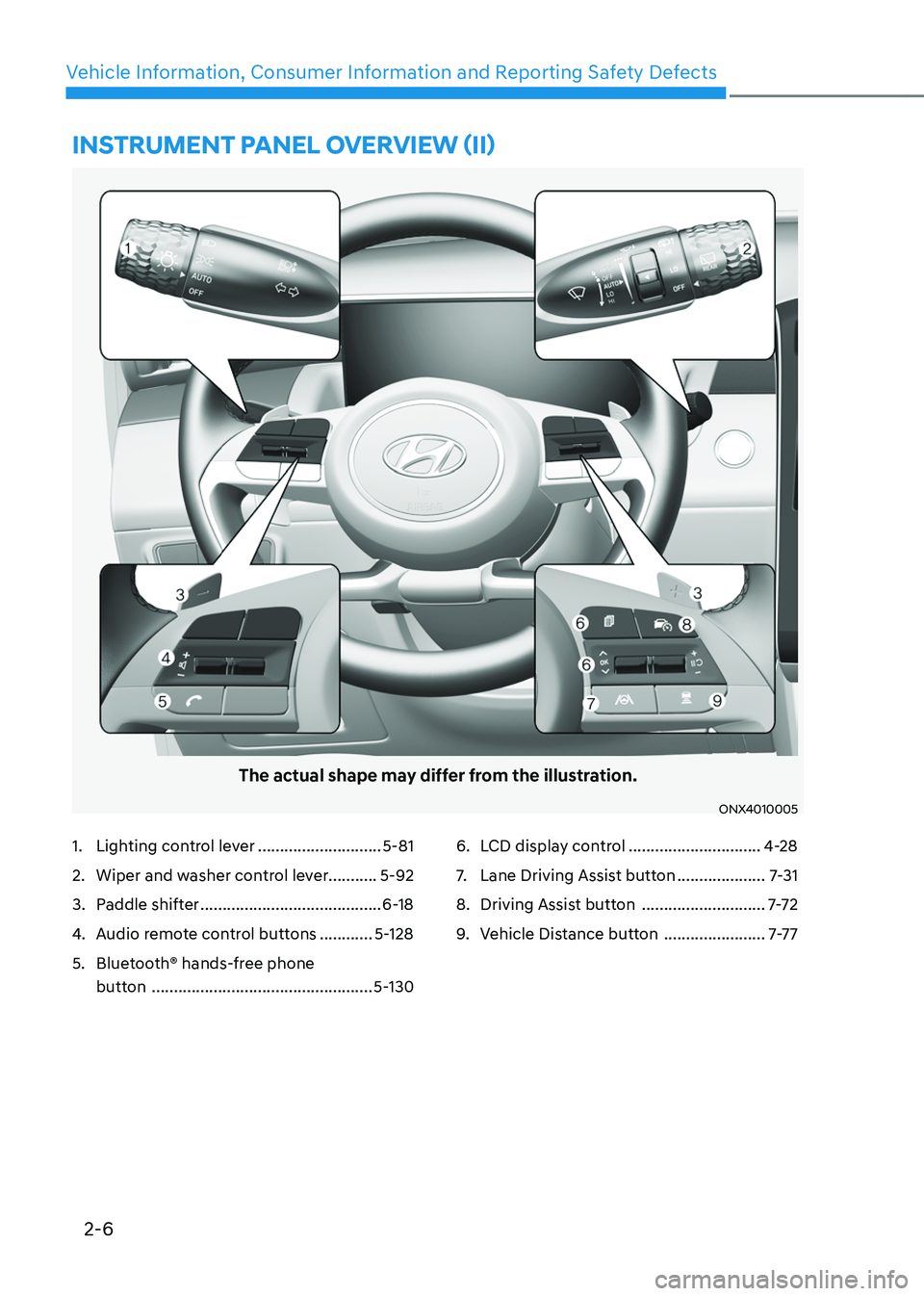
1. Lighting control lever ............................5-81
2. Wiper and washer control lever...........5-92
3. Paddle shifter .........................................6-18
4. Audio remote control buttons ............5-128
5. Bluetooth® hands-free phone
button
..................................................5-130
6. LCD display control ..............................4-28
7. Lane Driving Assist button ....................7-31
8. Driving Assist button ............................7-7 2
9. Vehicle Distance button .......................7-7 7
INSTRUMENT PANEL OVERVIEW (II)
The actual shape may differ from the illustration.
ONX4010005
Page 38 of 630
02
2-9
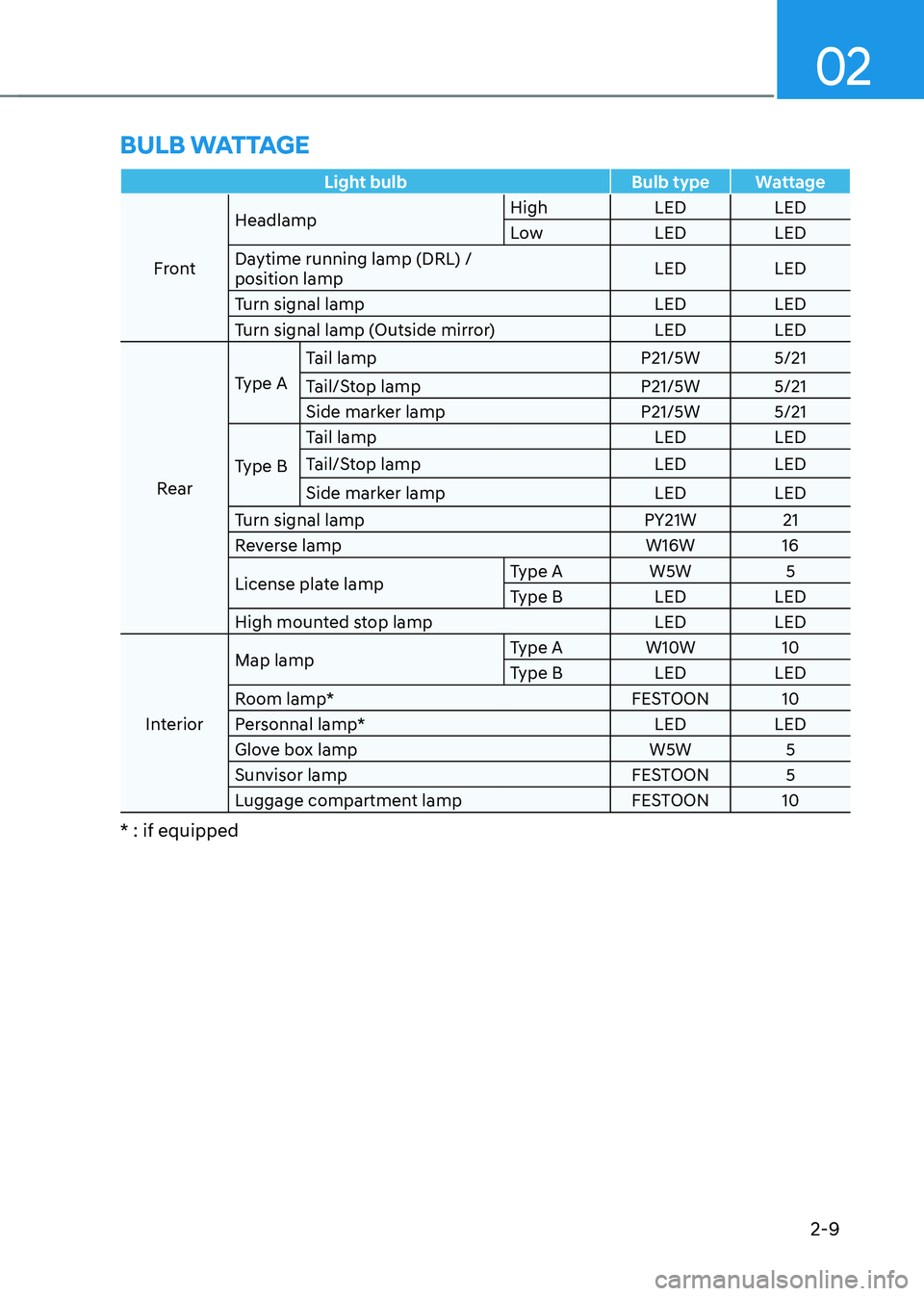
Light bulbBulb typeWattage
Front Headlamp
High
LEDLED
Low LEDLED
Daytime running lamp (DRL) /
position lamp LED
LED
Turn signal lamp LEDLED
Turn signal lamp (Outside mirror) LEDLED
Rear Type A
Tail lamp
P21/5W5/21
Tail/Stop lamp P21/5W5/21
Side marker lamp P21/5W5/21
Type B Tail lamp
LEDLED
Tail/Stop lamp LEDLED
Side marker lamp LEDLED
Turn signal lamp PY21W21
Reverse lamp W16W16
License plate lamp Type A
W5W5
Type B LEDLED
High mounted stop lamp LEDLED
Interior Map lamp
Type A
W10W 10
Type B LEDLED
Room lamp* FESTOON10
Personnal lamp* LEDLED
Glove box lamp W5W5
Sunvisor lamp FESTOON5
Luggage compartment lamp FESTOON10
* : if equipped
BULB WATTAGE
Page 47 of 630

Seats & Safety System
3. Seats & Safety System
Important safety precautions ........................................................................\
... 3-2Always wear your seat belt ........................................................................\
.................. 3-2
R estrain all children ........................................................................\
.............................. 3
-2
Air bag hazards
........................................................................\
..................................... 3
-2
Driver distraction
........................................................................\
.................................. 3
-2
Control your speed
........................................................................\
............................... 3
-2
Keep your vehicle in safe condition
........................................................................\
.... 3-2
Seats ........................................................................\
.......................................... 3-3Safety precautions ........................................................................\
...............................3-4
Fr ont seats ........................................................................\
..................................... .......3-5
Rear seats
........................................................................\
............................................ 3-
11
Head restraint
........................................................................\
..................................... 3-
14
Seat warmers
........................................................................\
.....................................
.3-18
Air ventilation seat........................................................................\
..............................3-20 Rear Occupant Alert (ROA)
........................................................................\
................ 3-21
Seat belts ........................................................................\
................................. 3-23Seat belt safety precautions ........................................................................\
..............3-23
Sea t belt warning light ........................................................................\
....................... 3
-24
Seat belt restraint system
........................................................................\
.................. 3-
25
Additional seat belt safety precautions
.................................................................... 3-
30
Care of seat belts........................................................................\
................................ 3-32
Child Restraint System (CRS) ........................................................................\
. 3-33Our recommendation: Children always in the rear ..................................................3-33
Selecting a Child R estraint System (CRS) ................................................................. 3-
34
Installing a Child Restraint System (CRS)
................................................................. 3-
36
Air bag - supplemental restraint system .......................................................3-44Where are the air bags? ........................................................................\
.................... 3-46
Ho w does the air bags system operate? .................................................................. 3-50
Wha
t to expect after an air bag inflates
................................................................... 3-53
Occupan
t Classification System (OCS)
..................................................................... 3-54
Wh
y didn’t my air bag go off in a collision?
............................................................. 3-60
SRS car
e
........................................................................\
.....................................
.........3-65
Additional safety precautions........................................................................\
........... 3-66
Air bag warning labels...........................................................\
.................................... 3-66
This chapter provides you with important information about how to protect yourself and your
passengers. It explains how to properly use your seats and seat belts, and how your air bags work.
Additionally, this chapter explains how to properly restrain infants and children in your vehicle.
3
Page 51 of 630
03
3-5
Seat belts
Always fasten your seat belt before
starting any trip. At all times, passengers
should sit upright and be properly
restrained. Infants and small children
must be restrained in appropriate Child
Restraint Systems. Children who have
outgrown a booster seat and adults must
be restrained using the seat belts.
WARNING
Take the following precautions when
adjusting your seat belt:
• NEVER use one seat belt for more
than one occupant.
• Always position the seatback upright
with the lap portion of the seat belt
snug and low across the hips.
• NEVER allow children or small infants
to ride on a passenger’s lap.
• Do not route the seat belt across your
neck, across sharp edges, or reroute
the shoulder strap away from your
body.
• Do not allow the seat belt to become
caught or jammed.
Front seats
WARNING
Take the following precautions when
adjusting your seat:
• NEVER attempt to adjust the seat
while the vehicle is moving. The seat
could respond with unexpected
movement and may cause loss
of vehicle control resulting in an
accident.
• Do not place anything under the
front seats. Loose objects in the
driver’s foot area could interfere
with the operation of the foot pedals,
causing an accident.
• Do not allow anything to interfere
with the normal position and proper
locking of the seatback.
• Do not place a cigarette lighter on
the floor or seat. When you operate
the seat, gas may exit out of the
lighter causing a fire.
• Use extreme caution when picking
up small objects trapped under the
seats or between the seat and the
center console. Your hands might be
cut or injured by the sharp edges of
the seat mechanism.
• If there are occupants in the rear
seats, be careful while adjusting the
front seat position.
• Make sure that the seat is locked in
place after the adjustment. If not,
the seat might move unexpectedly
resulting in an accident.
CAUTION
To prevent injury:
• Do not adjust your seat while
wearing your seat belt. Moving the
seat cushion forward may cause
strong pressure on your abdomen.
• Do not allow your hands or fingers to
get caught in the seat mechanisms
while the seat is moving.
Page 52 of 630
Seats & Safety System
3-6
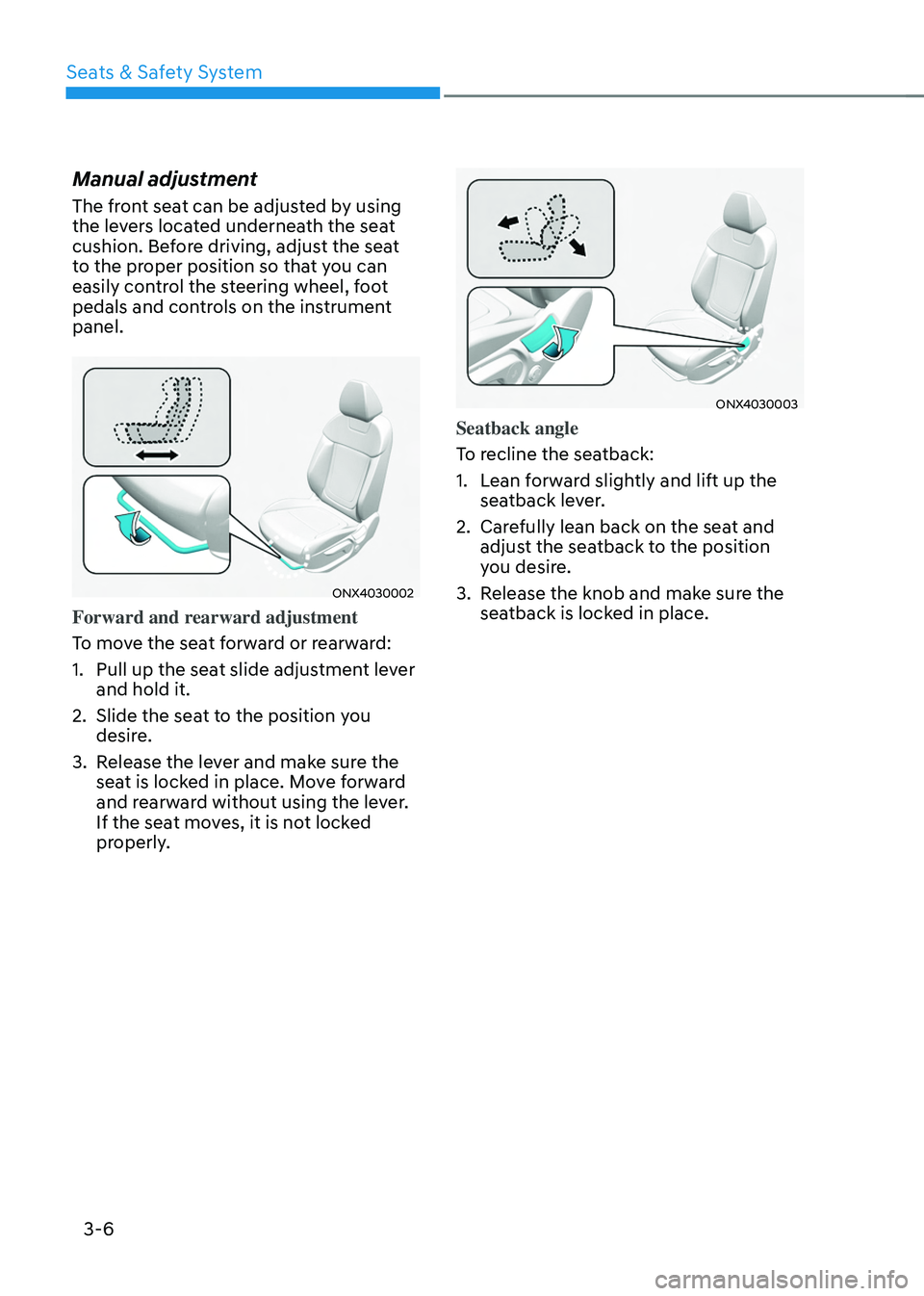
Manual adjustment
The front seat can be adjusted by using
the levers located underneath the seat
cushion. Before driving, adjust the seat
to the proper position so that you can
easily control the steering wheel, foot
pedals and controls on the instrument
panel.
ONX4030002
Forward and rearward adjustment
To move the seat forward or rearward:
1.
Pull up the seat slide adjus
tment lever
and hold it.
2.
Slide the seat t
o the position you
desire.
3.
Release the le
ver and make sure the
seat is locked in place. Move forward
and rearward without using the lever.
If the seat moves, it is not locked
properly.
ONX4030003
Seatback angle
To recline the seatback:
1.
Lean f
orward slightly and lift up the
seatback lever.
2.
Care
fully lean back on the seat and
adjust the seatback to the position
you desire.
3.
Release the knob and mak
e sure the
seatback is locked in place.
Page 70 of 630
Seats & Safety System
3-24
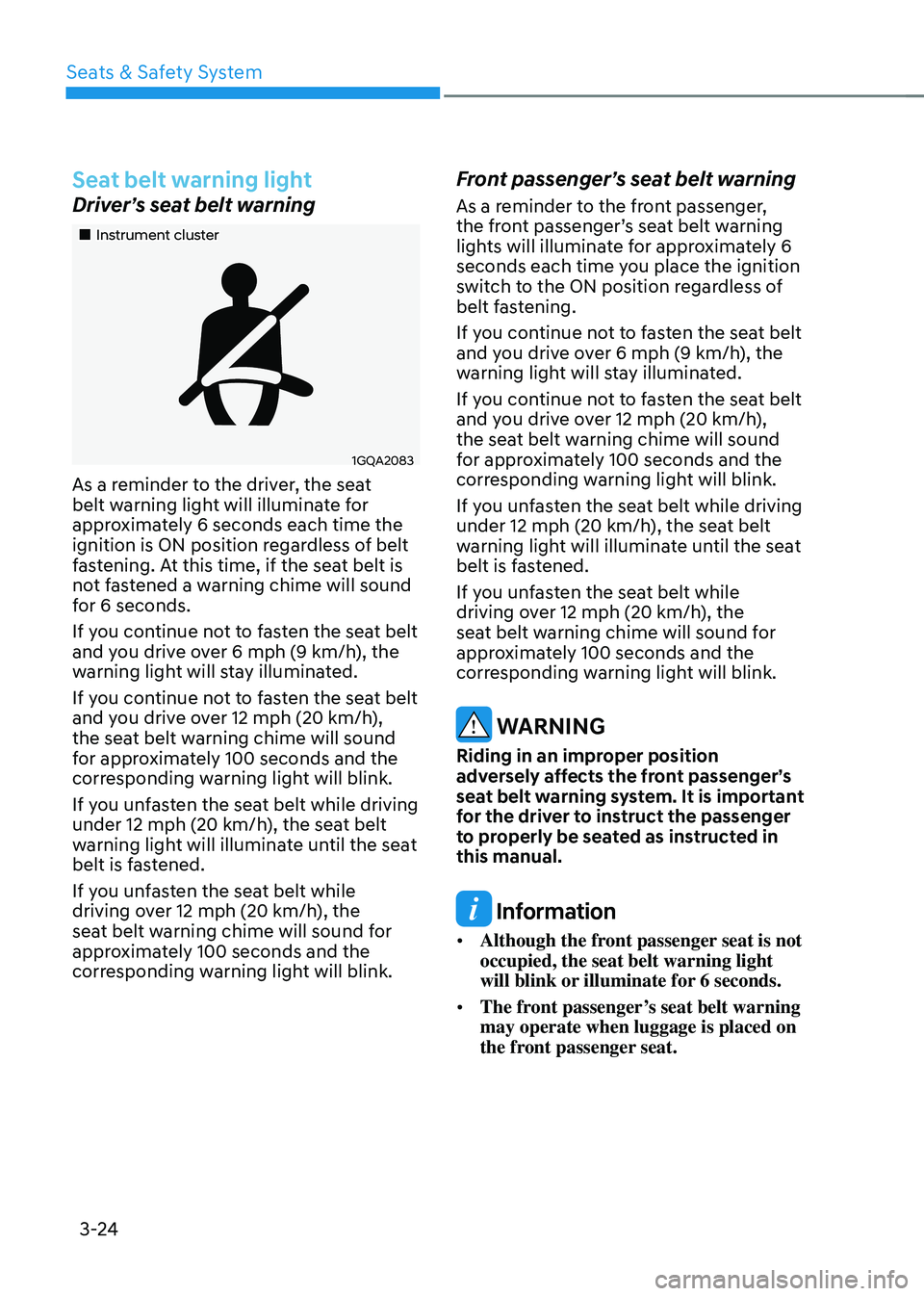
Seat belt warning light
Driver’s seat belt warning
„„Instrument cluster
1GQA2083
As a reminder to the driver, the seat
belt warning light will illuminate for
approximately 6 seconds each time the
ignition is ON position regardless of belt
fastening. At this time, if the seat belt is
not fastened a warning chime will sound
for 6 seconds.
If you continue not to fasten the seat belt
and you drive over 6 mph (9 km/h), the
warning light will stay illuminated.
If you continue not to fasten the seat belt
and you drive over 12 mph (20 km/h),
the seat belt warning chime will sound
for approximately 100 seconds and the
corresponding warning light will blink.
If you unfasten the seat belt while driving
under 12 mph (20 km/h), the seat belt
warning light will illuminate until the seat
belt is fastened.
If you unfasten the seat belt while
driving over 12 mph (20 km/h), the
seat belt warning chime will sound for
approximately 100 seconds and the
corresponding warning light will blink.
Front passenger’s seat belt warning
As a reminder to the front passenger,
the front passenger’s seat belt warning
lights will illuminate for approximately 6
seconds each time you place the ignition
switch to the ON position regardless of
belt fastening.
If you continue not to fasten the seat belt
and you drive over 6 mph (9 km/h), the
warning light will stay illuminated.
If you continue not to fasten the seat belt
and you drive over 12 mph (20 km/h),
the seat belt warning chime will sound
for approximately 100 seconds and the
corresponding warning light will blink.
If you unfasten the seat belt while driving
under 12 mph (20 km/h), the seat belt
warning light will illuminate until the seat
belt is fastened.
If you unfasten the seat belt while
driving over 12 mph (20 km/h), the
seat belt warning chime will sound for
approximately 100 seconds and the
corresponding warning light will blink.
WARNING
Riding in an improper position
adversely affects the front passenger’s
seat belt warning system. It is important
for the driver to instruct the passenger
to properly be seated as instructed in
this manual.
Information
• Although the front passenger seat is not
occupied, the seat belt warning light
will blink or illuminate for 6 seconds.
• The front passenger’s seat belt warning
may operate when luggage is placed on
the front passenger seat.
Page 75 of 630
03
3-29
OLMB033040
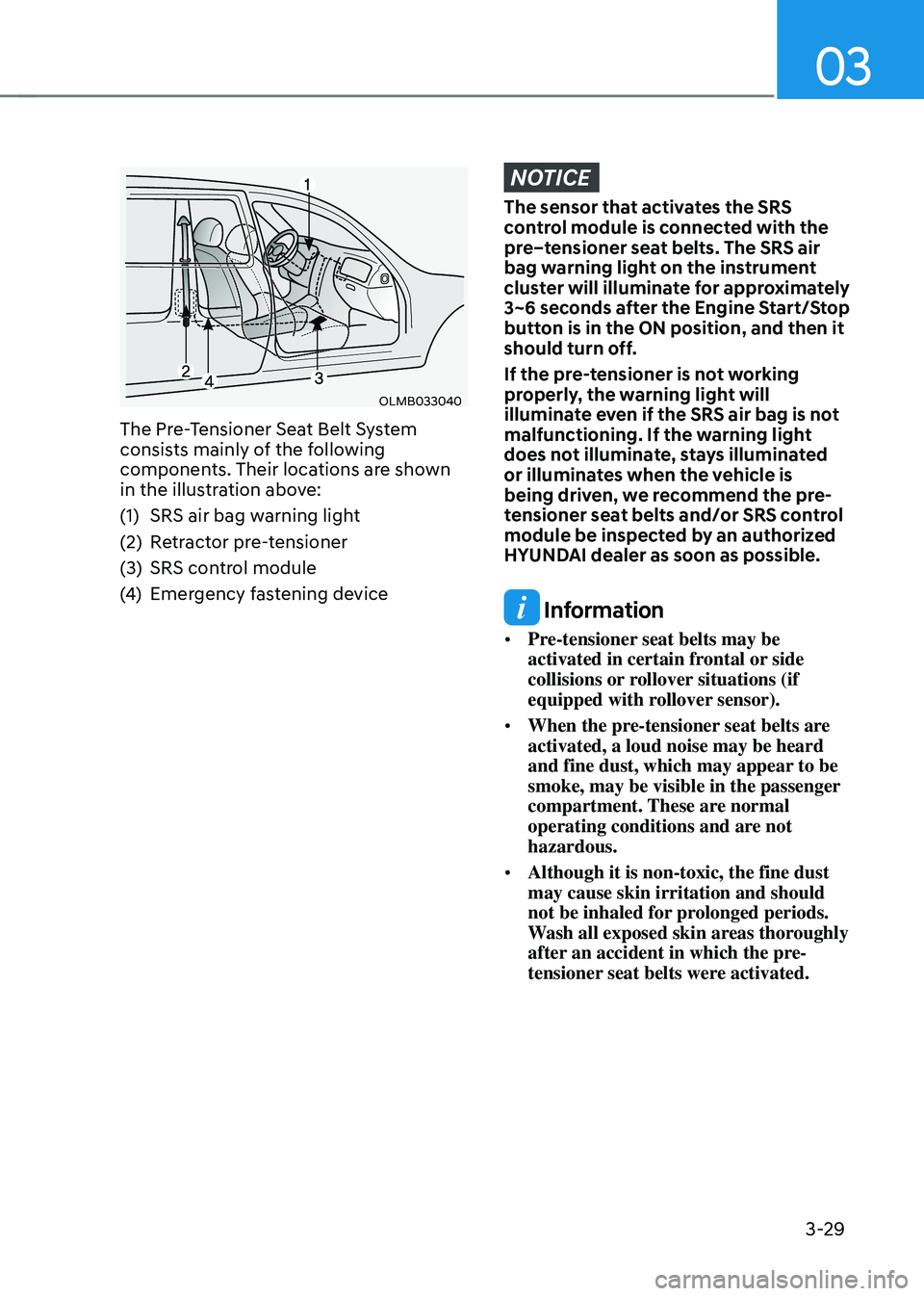
The Pre-Tensioner Seat Belt System
consists mainly of the following
components. Their locations are shown
in the illustration above:
(1)
SRS air bag warning ligh
t
(2)
Re
tractor pre-tensioner
(3)
SRS contr
ol module
(4)
Emer
gency fastening device
NOTICE
The sensor that activates the SRS
control module is connected with the
pre–tensioner seat belts. The SRS air
bag warning light on the instrument
cluster will illuminate for approximately
3~6 seconds after the Engine Start/Stop
button is in the ON position, and then it
should turn off.
If the pre-tensioner is not working
properly, the warning light will
illuminate even if the SRS air bag is not
malfunctioning. If the warning light
does not illuminate, stays illuminated
or illuminates when the vehicle is
being driven, we recommend the pre-
tensioner seat belts and/or SRS control
module be inspected by an authorized
HYUNDAI dealer as soon as possible.
Information
• Pre-tensioner seat belts may be
activated in certain frontal or side
collisions or rollover situations (if
equipped with rollover sensor).
• When the pre-tensioner seat belts are
activated, a loud noise may be heard
and fine dust, which may appear to be
smoke, may be visible in the passenger
compartment. These are normal
operating conditions and are not
hazardous.
• Although it is non-toxic, the fine dust
may cause skin irritation and should
not be inhaled for prolonged periods.
Wash all exposed skin areas thoroughly
after an accident in which the pre-
tensioner seat belts were activated.