gas cap HYUNDAI TUCSON LIMITED 2017 Owners Manual
[x] Cancel search | Manufacturer: HYUNDAI, Model Year: 2017, Model line: TUCSON LIMITED, Model: HYUNDAI TUCSON LIMITED 2017Pages: 642, PDF Size: 9.78 MB
Page 7 of 642
F7
Introduction
FFUU EELL RR EEQQ UUIIRR EEMM EENN TTSS
NOTICE indicates a situation
which, if not avoided, could result
in vehicle damage. Your new vehicle is designed to
obtain maximum performance with
UNLEADED FUEL, as well as mini-
mize exhaust emissions and spark
plug fouling.
Your new vehicle is designed to use
only unleaded fuel having an octane
number ((R+M)/2) of 87 (Research
Octane Number 91) or higher. (Do not
use methanol blended fuels)
To prevent damage to the engine
and engine components, never
add any fuel system cleaning
agents to the fuel tank other thanwhat has been specified.
Consult an authorized HYUNDAI
dealer for additional information.
Gasoline containing alcohol or
methanol
Gasohol, a mixture of gasoline and
ethanol (also known as grain alco-
hol) are being marketed along with orinstead of leaded or unleaded gaso-
line. Do not use gasohol containing more than 10% ethanol, and do not use
gasoline or gasohol containing any
methanol. Either of these fuels may
cause drivability problems and dam-age to the fuel system, engine con-trol system and emission control sys-tem.
Discontinue using gasohol of any
kind if drivability problems occur.
NOTICE
NOTICE
CAUTION indicates a hazardous
situation which, if not avoided,could result in minor or moder-
ate injury.
CAUTION
Do not "top off" after the noz-
zle automatically shuts offwhen refueling.
Always check that the fuel cap
is installed securely to pre-
vent fuel spillage in the eventof an accident.
WARNING
Page 147 of 642
3-49
Convenient features of your vehicle
3
Closing the fuel filler door
1. To install the fuel tank cap, turn itclockwise until it "clicks" one time.
2. Close the fuel filler door until it is latched securely. (Continued)Do not get back into a vehicle
once you have begun refuel-
ing. You can generate a build-
up of static electricity by
touching, rubbing or sliding
against any item or fabric
capable of producing static
electricity. Static electricity
discharge can ignite fuel
vapors causing a fire. If you
must re-enter the vehicle, you
should once again eliminate
potentially dangerous static
electricity discharge by touch-
ing a metal part of the vehicle,
away from the fuel filler neck,nozzle or other gasoline
source, with your bare hand.
When using an approved
portable fuel container, besure to place the container on
the ground prior to refueling.
Static electricity discharge
from the container can ignite
fuel vapors causing a fire.
(Continued)
Gasoline is highly flammable
and explosive. Failure to follow
these guidelines may result in
SERIOUS INJURY or DEATH:
Read and follow all warnings posted at the gas station.
Before refueling, note the
location of the Emergency
Gasoline Shut-Off, if available,at the gas station.
Before touching the fuel noz-
zle, you should eliminate the
potential build-up of static
electricity by touching a metal
part of the vehicle, a safe dis-
tance away from the fuel filler
neck, nozzle, or other gas
source, with your bare hand.
Do not use cellular phones
while refueling. Electric cur-
rent and/or electronic interfer-
ence from cellular phones can
potentially ignite fuel vapors
and cause a fire.(Continued)
WARNING
Page 148 of 642
3-50
Convenient features of your vehicle
Information
Make sure to refuel your vehicle
according to the "Fuel Requirements"
suggested in the Introduction chapter.
Do not spill fuel on the exteriorsurfaces of the vehicle. Any type of fuel spilled on painted sur-
faces may damage the paint.
If the fuel filler cap requires replacement, use only a genuine
HYUNDAI cap or the equivalent
specified for your vehicle. Anincorrect fuel filler cap canresult in a serious malfunctionof the fuel system or emission
control system.
NOTICE
i(Continued)
Once refueling has begun,
contact between your bare
hand and the vehicle shouldbe maintained until the filling
is complete.
Use only approved portable
plastic fuel containers designed
to carry and store gasoline.
When refueling, always move
the shift lever to the P (Park)
position, set the parking
brake, and place the ignition
switch to the LOCK/OFF posi-
tion. Sparks produced byelectrical components relatedto the engine can ignite fuel
vapors causing a fire.
Do not use matches or a lighter and do not smoke or
leave a lit cigarette in your
vehicle while at a gas station,
especially during refueling.
Do not over-fill or top-off your
vehicle tank, which can cause
gasoline spillage. (Continued)
(Continued)
If a fire breaks out during refu-
eling, leave the vicinity of the
vehicle, and immediately con-
tact the manager of the gasstation and then contact the
local fire department. Follow
any safety instructions they
provide.
If pressurized fuel sprays out,
it can cover your clothes or
skin and thus subject you to
the risk of fire and burns.
Always remove the fuel cap
carefully and slowly. If the cap
is venting fuel or if you hear a
hissing sound, wait until the
condition stops before com-
pletely removing the cap.
Always check that the fuel cap
is installed securely to pre-
vent fuel spillage in the eventof an accident.
Page 409 of 642
5-25
Driving your vehicle
5
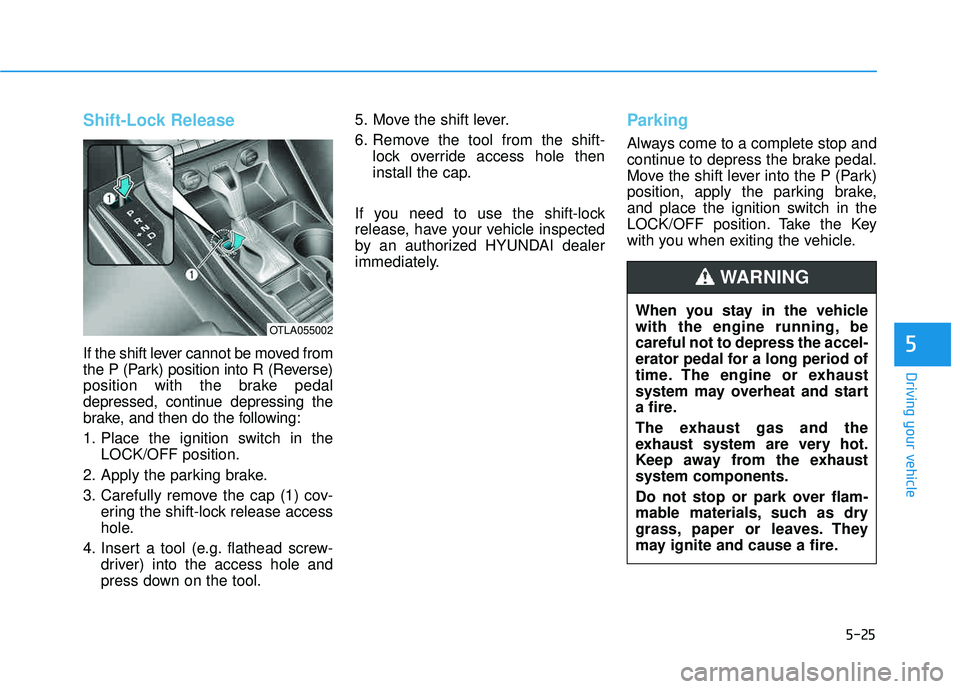
Shift-Lock Release
If the shift lever cannot be moved from
the P (Park) position into R (Reverse)
position with the brake pedal
depressed, continue depressing the
brake, and then do the following:
1. Place the ignition switch in theLOCK/OFF position.
2. Apply the parking brake.
3. Carefully remove the cap (1) cov- ering the shift-lock release access
hole.
4. Insert a tool (e.g. flathead screw- driver) into the access hole and
press down on the tool. 5. Move the shift lever.
6. Remove the tool from the shift-
lock override access hole then
install the cap.
If you need to use the shift-lock
release, have your vehicle inspected
by an authorized HYUNDAI dealer
immediately.
Parking
Always come to a complete stop and
continue to depress the brake pedal.
Move the shift lever into the P (Park)
position, apply the parking brake,
and place the ignition switch in the
LOCK/OFF position. Take the Key
with you when exiting the vehicle.
OTLA055002
When you stay in the vehicle
with the engine running, becareful not to depress the accel-
erator pedal for a long period of
time. The engine or exhaust
system may overheat and start
a fire.
The exhaust gas and the
exhaust system are very hot.
Keep away from the exhaustsystem components.
Do not stop or park over flam-
mable materials, such as dry
grass, paper or leaves. They
may ignite and cause a fire.
WARNING
Page 523 of 642
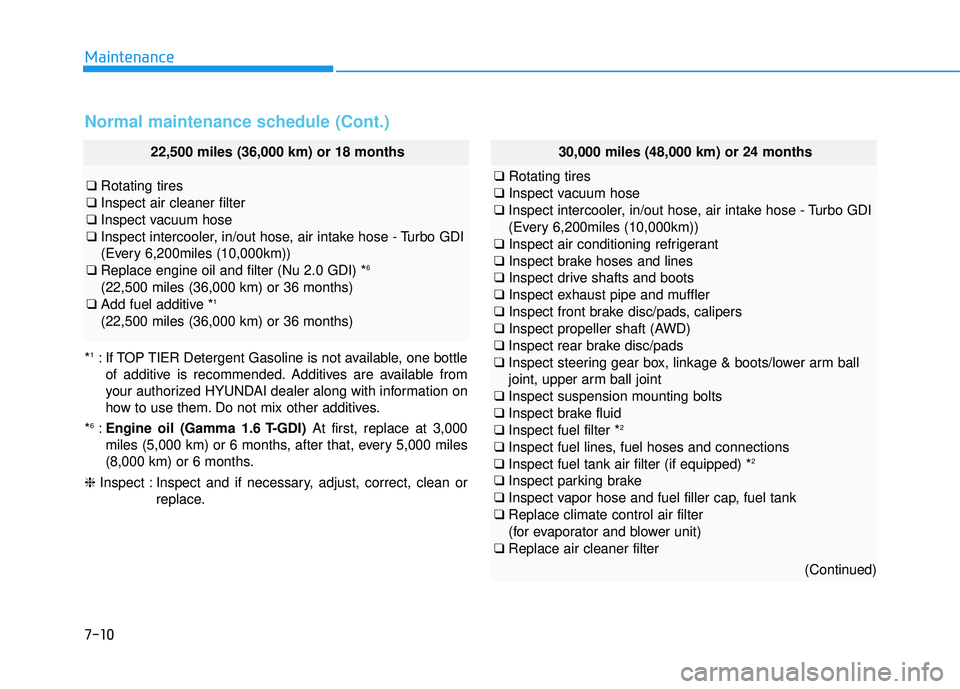
7-10
Maintenance
Normal maintenance schedule (Cont.)
22,500 miles (36,000 km) or 18 months
❑Rotating tires
❑ Inspect air cleaner filter
❑ Inspect vacuum hose
❑ Inspect intercooler, in/out hose, air intake hose - Turbo GDI
(Every 6,200miles (10,000km))
❑ Replace engine oil and filter (Nu 2.0 GDI) * 6
(22,500 miles (36,000 km) or 36 months)
❑ Add fuel additive * 1
(22,500 miles (36,000 km) or 36 months)
* 1
: If TOP TIER Detergent Gasoline is not available, one bottle
of additive is recommended. Additives are available from
your authorized HYUNDAI dealer along with information on
how to use them. Do not mix other additives.
* 6
:Engine oil (Gamma 1.6 T-GDI) At first, replace at 3,000
miles (5,000 km) or 6 months, after that, every 5,000 miles
(8,000 km) or 6 months.
❈ Inspect : Inspect and if necessary, adjust, correct, clean or
replace.
30,000 miles (48,000 km) or 24 months
❑Rotating tires
❑ Inspect vacuum hose
❑ Inspect intercooler, in/out hose, air intake hose - Turbo GDI
(Every 6,200miles (10,000km))
❑ Inspect air conditioning refrigerant
❑ Inspect brake hoses and lines
❑ Inspect drive shafts and boots
❑ Inspect exhaust pipe and muffler
❑ Inspect front brake disc/pads, calipers
❑ Inspect propeller shaft (AWD)
❑ Inspect rear brake disc/pads
❑ Inspect steering gear box, linkage & boots/lower arm ball
joint, upper arm ball joint
❑ Inspect suspension mounting bolts
❑ Inspect brake fluid
❑ Inspect fuel filter * 2
❑ Inspect fuel lines, fuel hoses and connections
❑ Inspect fuel tank air filter (if equipped) * 2
❑ Inspect parking brake
❑ Inspect vapor hose and fuel filler cap, fuel tank
❑ Replace climate control air filter
(for evaporator and blower unit)
❑ Replace air cleaner filter
(Continued)
Page 526 of 642
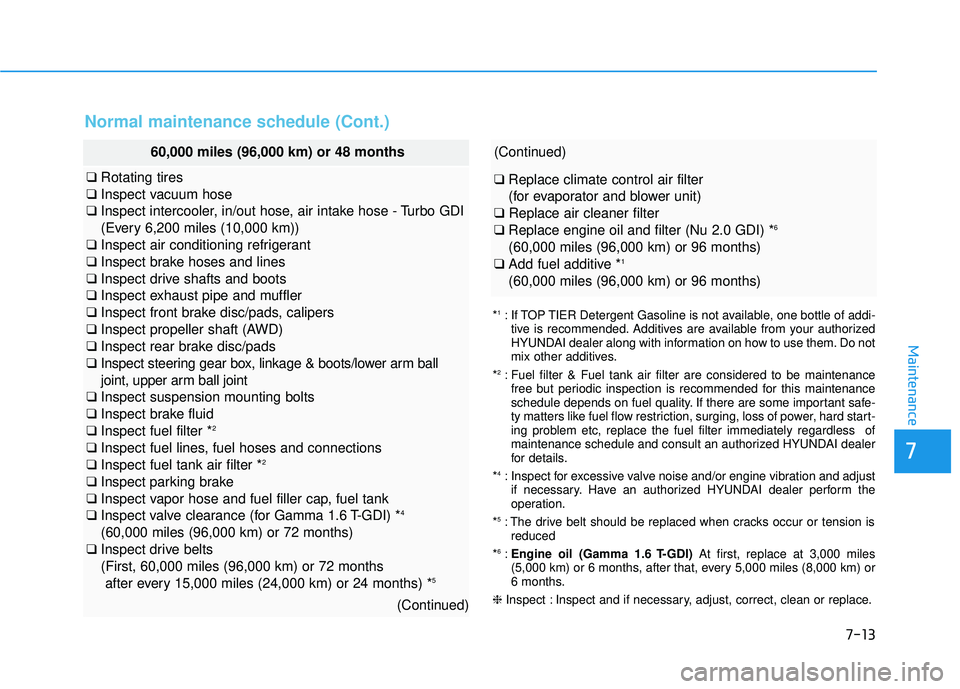
7-13
7
Maintenance
60,000 miles (96,000 km) or 48 months
❑Rotating tires
❑ Inspect vacuum hose
❑ Inspect intercooler, in/out hose, air intake hose - Turbo GDI
(Every 6,200 miles (10,000 km))
❑ Inspect air conditioning refrigerant
❑ Inspect brake hoses and lines
❑ Inspect drive shafts and boots
❑ Inspect exhaust pipe and muffler
❑ Inspect front brake disc/pads, calipers
❑ Inspect propeller shaft (AWD)
❑ Inspect rear brake disc/pads
❑ Inspect steering gear box, linkage & boots/lower arm ball
joint, upper arm ball joint
❑ Inspect suspension mounting bolts
❑ Inspect brake fluid
❑ Inspect fuel filter * 2
❑ Inspect fuel lines, fuel hoses and connections
❑ Inspect fuel tank air filter * 2
❑ Inspect parking brake
❑ Inspect vapor hose and fuel filler cap, fuel tank
❑ Inspect valve clearance (for Gamma 1.6 T-GDI) * 4
(60,000 miles (96,000 km) or 72 months)
❑ Inspect drive belts(First, 60,000 miles (96,000 km) or 72 months
after every 15,000 miles (24,000 km) or 24 months) * 5
(Continued)
(Continued)
❑
Replace climate control air filter
(for evaporator and blower unit)
❑ Replace air cleaner filter
❑ Replace engine oil and filter (Nu 2.0 GDI) * 6
(60,000 miles (96,000 km) or 96 months)
❑ Add fuel additive * 1
(60,000 miles (96,000 km) or 96 months)
Normal maintenance schedule (Cont.)
* 1
: If TOP TIER Detergent Gasoline is not available, one bottle of addi-
tive is recommended. Additives are available from your authorized
HYUNDAI dealer along with information on how to use them. Do not
mix other additives.
* 2
: Fuel filter & Fuel tank air filter are considered to be maintenance
free but periodic inspection is recommended for this maintenance
schedule depends on fuel quality. If there are some important safe-
ty matters like fuel flow restriction, surging, loss of power, hard start-
ing problem etc, replace the fuel filter immediately regardless of
maintenance schedule and consult an authorized HYUNDAI dealer
for details.
* 4
: Inspect for excessive valve noise and/or engine vibration and adjust
if necessary. Have an authorized HYUNDAI dealer perform the
operation.
* 5
: The drive belt should be replaced when cracks occur or tension is
reduced
* 6
:Engine oil (Gamma 1.6 T-GDI) At first, replace at 3,000 miles
(5,000 km) or 6 months, after that, every 5,000 miles (8,000 km) or
6 months.
❈ Inspect : Inspect and if necessary, adjust, correct, clean or replace.
Page 529 of 642
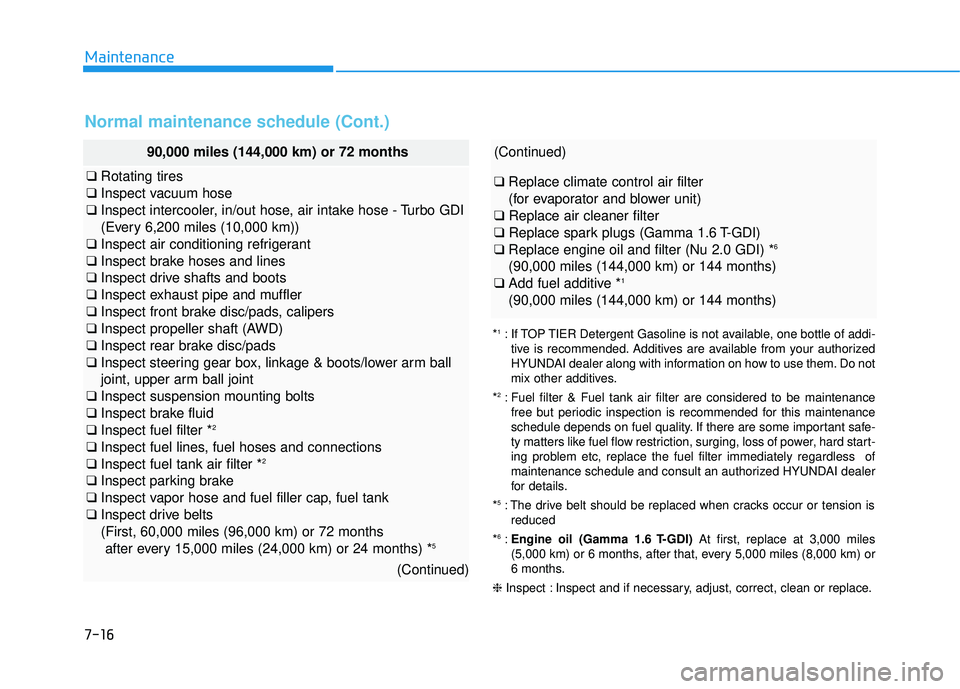
7-16
Maintenance
Normal maintenance schedule (Cont.)
90,000 miles (144,000 km) or 72 months
❑Rotating tires
❑ Inspect vacuum hose
❑ Inspect intercooler, in/out hose, air intake hose - Turbo GDI
(Every 6,200 miles (10,000 km))
❑ Inspect air conditioning refrigerant
❑ Inspect brake hoses and lines
❑ Inspect drive shafts and boots
❑ Inspect exhaust pipe and muffler
❑ Inspect front brake disc/pads, calipers
❑ Inspect propeller shaft (AWD)
❑ Inspect rear brake disc/pads
❑ Inspect steering gear box, linkage & boots/lower arm ball
joint, upper arm ball joint
❑ Inspect suspension mounting bolts
❑ Inspect brake fluid
❑ Inspect fuel filter * 2
❑ Inspect fuel lines, fuel hoses and connections
❑ Inspect fuel tank air filter * 2
❑ Inspect parking brake
❑ Inspect vapor hose and fuel filler cap, fuel tank
❑ Inspect drive belts(First, 60,000 miles (96,000 km) or 72 months
after every 15,000 miles (24,000 km) or 24 months) * 5
(Continued)
(Continued)
❑
Replace climate control air filter
(for evaporator and blower unit)
❑ Replace air cleaner filter
❑ Replace spark plugs (Gamma 1.6 T-GDI)
❑ Replace engine oil and filter (Nu 2.0 GDI) * 6
(90,000 miles (144,000 km) or 144 months)
❑ Add fuel additive * 1
(90,000 miles (144,000 km) or 144 months)
* 1
: If TOP TIER Detergent Gasoline is not available, one bottle of addi-
tive is recommended. Additives are available from your authorized
HYUNDAI dealer along with information on how to use them. Do not
mix other additives.
* 2
: Fuel filter & Fuel tank air filter are considered to be maintenance
free but periodic inspection is recommended for this maintenance
schedule depends on fuel quality. If there are some important safe-
ty matters like fuel flow restriction, surging, loss of power, hard start-
ing problem etc, replace the fuel filter immediately regardless of
maintenance schedule and consult an authorized HYUNDAI dealer
for details.
* 5
: The drive belt should be replaced when cracks occur or tension is
reduced
* 6
:Engine oil (Gamma 1.6 T-GDI) At first, replace at 3,000 miles
(5,000 km) or 6 months, after that, every 5,000 miles (8,000 km) or
6 months.
❈ Inspect : Inspect and if necessary, adjust, correct, clean or replace.
Page 532 of 642
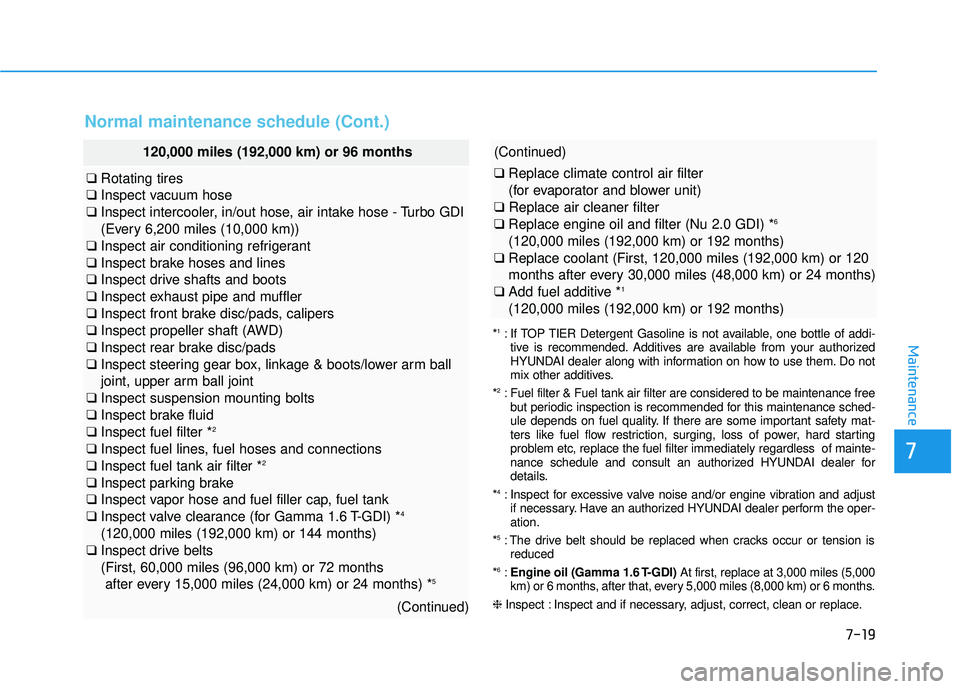
7-19
7
Maintenance
(Continued)
❑Replace climate control air filter
(for evaporator and blower unit)
❑ Replace air cleaner filter
❑ Replace engine oil and filter (Nu 2.0 GDI) * 6
(120,000 miles (192,000 km) or 192 months)
❑ Replace coolant (First, 120,000 miles (192,000 km) or 120
months after every 30,000 miles (48,000 km) or 24 months)
❑ Add fuel additive * 1
(120,000 miles (192,000 km) or 192 months)
Normal maintenance schedule (Cont.)
120,000 miles (192,000 km) or 96 months
❑ Rotating tires
❑ Inspect vacuum hose
❑ Inspect intercooler, in/out hose, air intake hose - Turbo GDI
(Every 6,200 miles (10,000 km))
❑ Inspect air conditioning refrigerant
❑ Inspect brake hoses and lines
❑ Inspect drive shafts and boots
❑ Inspect exhaust pipe and muffler
❑ Inspect front brake disc/pads, calipers
❑ Inspect propeller shaft (AWD)
❑ Inspect rear brake disc/pads
❑ Inspect steering gear box, linkage & boots/lower arm ball
joint, upper arm ball joint
❑ Inspect suspension mounting bolts
❑ Inspect brake fluid
❑ Inspect fuel filter * 2
❑ Inspect fuel lines, fuel hoses and connections
❑ Inspect fuel tank air filter * 2
❑ Inspect parking brake
❑ Inspect vapor hose and fuel filler cap, fuel tank
❑ Inspect valve clearance (for Gamma 1.6 T-GDI) * 4
(120,000 miles (192,000 km) or 144 months)
❑ Inspect drive belts(First, 60,000 miles (96,000 km) or 72 months
after every 15,000 miles (24,000 km) or 24 months) * 5
(Continued)
*
1
: If TOP TIER Detergent Gasoline is not available, one bottle of addi-
tive is recommended. Additives are available from your authorized
HYUNDAI dealer along with information on how to use them. Do not
mix other additives.
* 2
: Fuel filter & Fuel tank air filter are considered to be maintenance free
but periodic inspection is recommended for this maintenance sched-
ule depends on fuel quality. If there are some important safety mat-
ters like fuel flow restriction, surging, loss of power, hard starting
problem etc, replace the fuel filter immediately regardless of mainte-
nance schedule and consult an authorized HYUNDAI dealer for
details.
* 4
: Inspect for excessive valve noise and/or engine vibration and adjust
if necessary. Have an authorized HYUNDAI dealer perform the oper-ation.
* 5
: The drive belt should be replaced when cracks occur or tension is
reduced
* 6
:Engine oil (Gamma 1.6 T-GDI) At first, replace at 3,000 miles (5,000
km) or 6 months, after that, every 5,000 miles (8,000 km) or 6 months.
❈ Inspect : Inspect and if necessary, adjust, correct, clean or replace.
Page 535 of 642
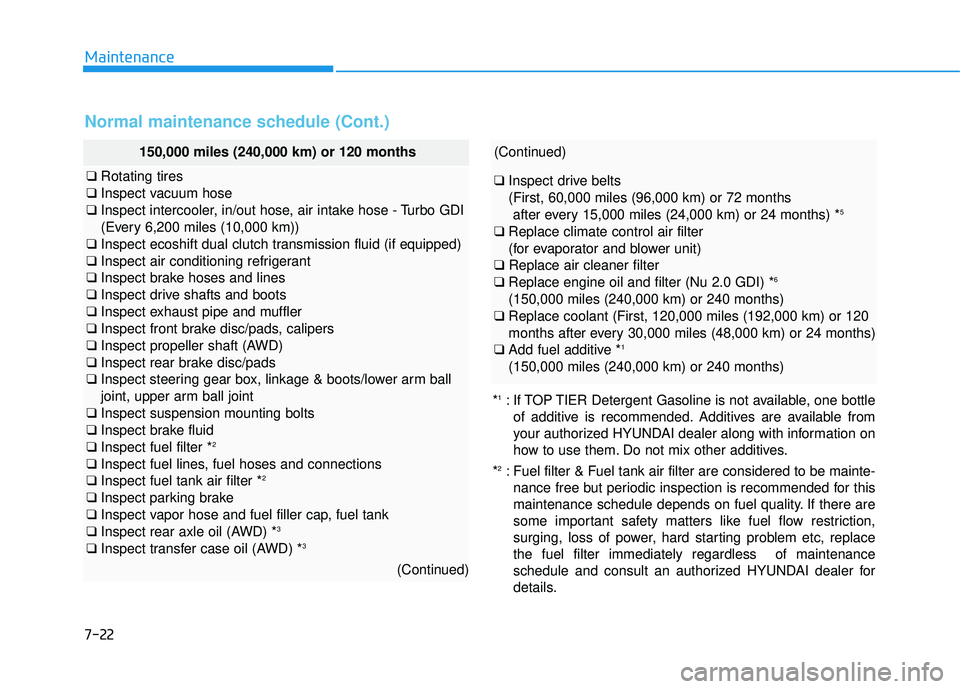
7-22
Maintenance
150,000 miles (240,000 km) or 120 months
❑Rotating tires
❑ Inspect vacuum hose
❑ Inspect intercooler, in/out hose, air intake hose - Turbo GDI
(Every 6,200 miles (10,000 km))
❑ Inspect ecoshift dual clutch transmission fluid (if equipped)
❑ Inspect air conditioning refrigerant
❑ Inspect brake hoses and lines
❑ Inspect drive shafts and boots
❑ Inspect exhaust pipe and muffler
❑ Inspect front brake disc/pads, calipers
❑ Inspect propeller shaft (AWD)
❑ Inspect rear brake disc/pads
❑ Inspect steering gear box, linkage & boots/lower arm ball
joint, upper arm ball joint
❑ Inspect suspension mounting bolts
❑ Inspect brake fluid
❑ Inspect fuel filter * 2
❑ Inspect fuel lines, fuel hoses and connections
❑ Inspect fuel tank air filter * 2
❑ Inspect parking brake
❑ Inspect vapor hose and fuel filler cap, fuel tank
❑ Inspect rear axle oil (AWD) * 3
❑ Inspect transfer case oil (AWD) * 3
(Continued)
(Continued)
❑
Inspect drive belts (First, 60,000 miles (96,000 km) or 72 months
after every 15,000 miles (24,000 km) or 24 months) * 5
❑ Replace climate control air filter
(for evaporator and blower unit)
❑ Replace air cleaner filter
❑ Replace engine oil and filter (Nu 2.0 GDI) * 6
(150,000 miles (240,000 km) or 240 months)
❑ Replace coolant (First, 120,000 miles (192,000 km) or 120
months after every 30,000 miles (48,000 km) or 24 months)
❑ Add fuel additive * 1
(150,000 miles (240,000 km) or 240 months)
* 1
: If TOP TIER Detergent Gasoline is not available, one bottle
of additive is recommended. Additives are available from
your authorized HYUNDAI dealer along with information on
how to use them. Do not mix other additives.
* 2
: Fuel filter & Fuel tank air filter are considered to be mainte-
nance free but periodic inspection is recommended for this
maintenance schedule depends on fuel quality. If there are
some important safety matters like fuel flow restriction,
surging, loss of power, hard starting problem etc, replacethe fuel filter immediately regardless of maintenance
schedule and consult an authorized HYUNDAI dealer for
details.
Normal maintenance schedule (Cont.)
Page 573 of 642
7-60
Maintenance
Pneumatic tire
A mechanical device made of rubber,
chemicals, fabric and steel or other
materials, that, when mounted on an
automotive wheel provides the trac-tion and contains the gas or fluid thatsustains the load.
Pneumatic options weight
The combined weight of installed
regular production options weighing
over 5 lb. (2.3 kg) in excess of the
standard items which they replace,
not previously considered in curb
weight or accessory weight, includ-
ing heavy duty breaks, ride levelers,
roof rack, heavy duty battery, and
special trim.
Recommended InflationPressure
Vehicle manufacturer’s recommend-
ed tire inflation pressure as shownon the tire placard.
Radial Ply Tire
A pneumatic tire in which the ply
cords that extend to the beads are
laid at 90 degrees to the centerline ofthe tread.
Rim
A metal support for a tire and uponwhich the tire beads are seated.
Sidewall
The portion of a tire between thetread and the bead.
Speed Rating
An alphanumeric code assigned to a
tire indicating the maximum speed at
which a tire can operate.
Traction
The friction between the tire and the
road surface. The amount of grip pro-vided.
Tread
The portion of a tire that comes intocontact with the road.
Treadwear Indicators
Narrow bands, sometimes called
"wear bars", that show across thetread of a tire when only 1/16 inch of
tread remains.
UTQGS
Uniform Tire Quality Grading
Standards is a tire information sys-
tem that provides consumers with
ratings for a tire’s traction, tempera-
ture and treadwear. Ratings are
determined by tire manufacturers
using government testing proce-
dures. The ratings are molded into
the sidewall of the tire.
Vehicle Capacity Weight
The number of designated seating
positions multiplied by 150 lbs. (68
kg) plus the rated cargo and luggageload.