parking brake HYUNDAI VELOSTER 2011 Owner's Guide
[x] Cancel search | Manufacturer: HYUNDAI, Model Year: 2011, Model line: VELOSTER, Model: HYUNDAI VELOSTER 2011Pages: 386, PDF Size: 7.79 MB
Page 270 of 386
What to do in an emergency
10 6
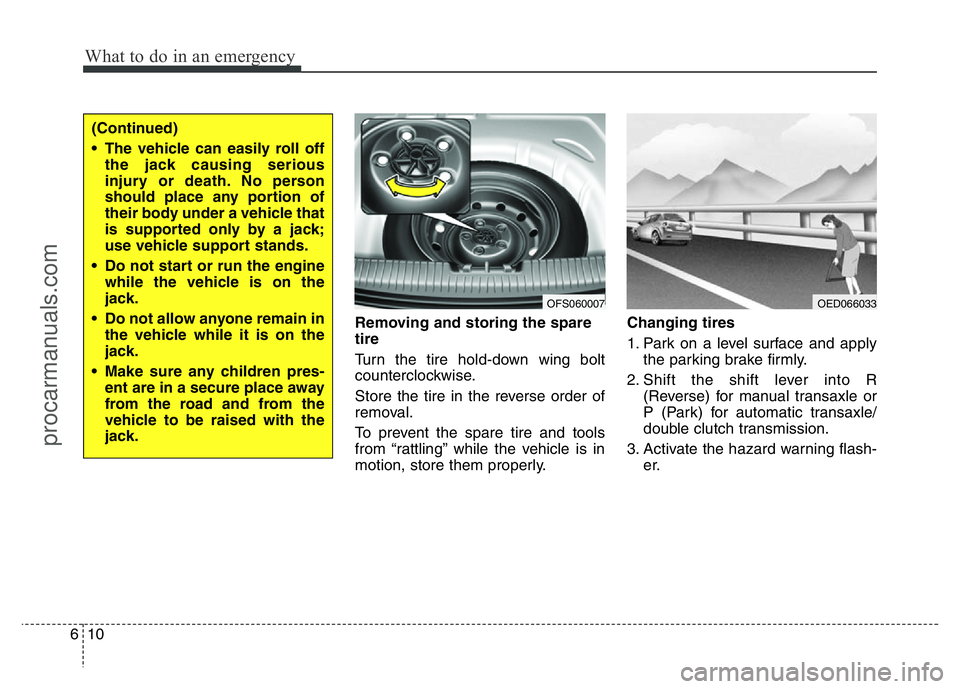
Removing and storing the spare
tire
Turn the tire hold-down wing bolt
counterclockwise.
Store the tire in the reverse order of
removal.
To prevent the spare tire and tools
from “rattling” while the vehicle is in
motion, store them properly.Changing tires
1. Park on a level surface and apply
the parking brake firmly.
2. Shift the shift lever into R
(Reverse) for manual transaxle or
P (Park) for automatic transaxle/
double clutch transmission.
3. Activate the hazard warning flash-
er.
(Continued)
• The vehicle can easily roll off
the jack causing serious
injury or death. No person
should place any portion of
their body under a vehicle that
is supported only by a jack;
use vehicle support stands.
• Do not start or run the engine
while the vehicle is on the
jack.
• Do not allow anyone remain in
the vehicle while it is on the
jack.
• Make sure any children pres-
ent are in a secure place away
from the road and from the
vehicle to be raised with the
jack.
OFS060007OED066033
procarmanuals.com
Page 271 of 386
611
What to do in an emergency
4. Remove the wheel lug nut wrench,
jack, jack handle, and spare tire
from the vehicle.
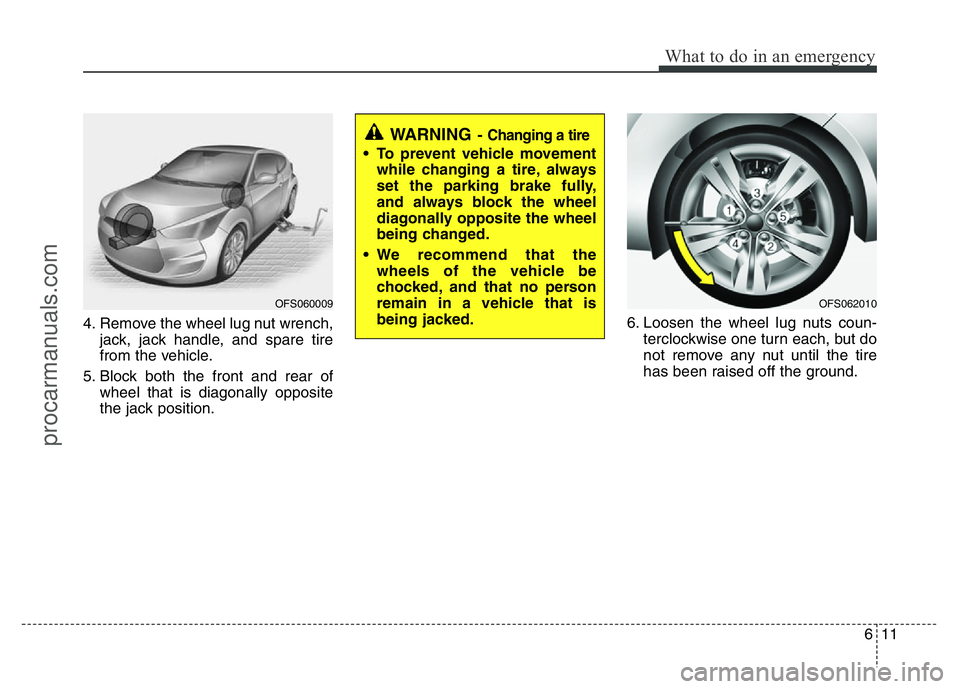
5. Block both the front and rear of
wheel that is diagonally opposite
the jack position.6. Loosen the wheel lug nuts coun-
terclockwise one turn each, but do
not remove any nut until the tire
has been raised off the ground.
WARNING- Changing a tire
• To prevent vehicle movement
while changing a tire, always
set the parking brake fully,
and always block the wheel
diagonally opposite the wheel
being changed.
• We recommend that the
wheels of the vehicle be
chocked, and that no person
remain in a vehicle that is
being jacked.
OFS060009OFS062010
procarmanuals.com
Page 288 of 386
What to do in an emergency
28 6
When towing your vehicle in an emer-
gency without wheel dollies :
1. Set the ignition switch in the ACC posi-
tion.
2. Place the transaxle shift lever in N
(Neutral).
3. Release the parking brake.
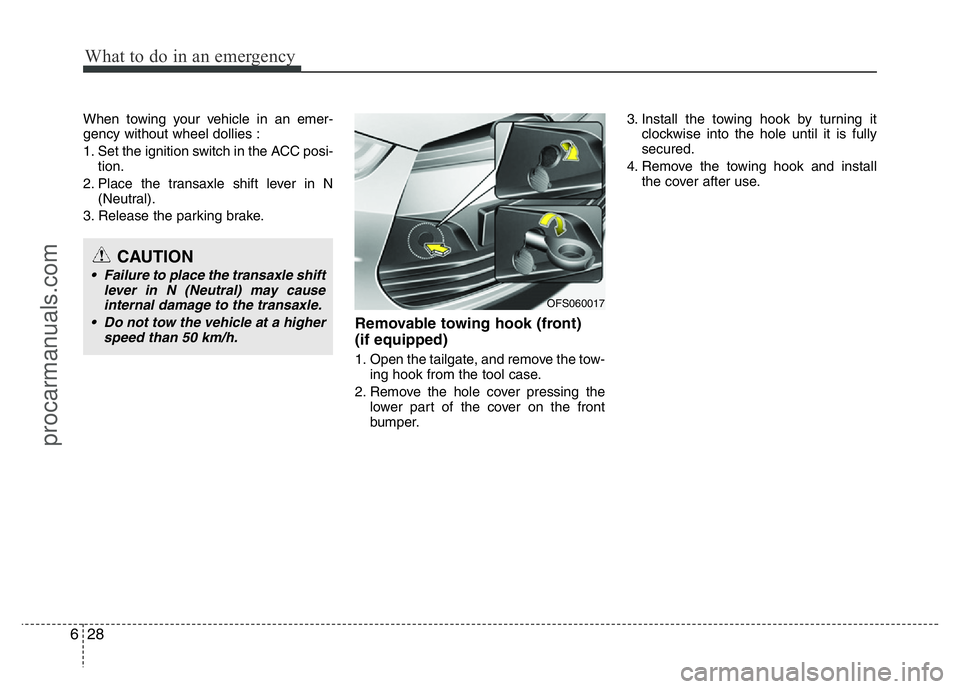
Removable towing hook (front)
(if equipped)
1. Open the tailgate, and remove the tow-
ing hook from the tool case.
2. Remove the hole cover pressing the
lower part of the cover on the front
bumper.3. Install the towing hook by turning it
clockwise into the hole until it is fully
secured.
4. Remove the towing hook and install
the cover after use.
CAUTION
• Failure to place the transaxle shift
lever in N (Neutral) may cause
internal damage to the transaxle.
• Do not tow the vehicle at a higher
speed than 50 km/h.
OFS060017
procarmanuals.com
Page 290 of 386
What to do in an emergency
30 6
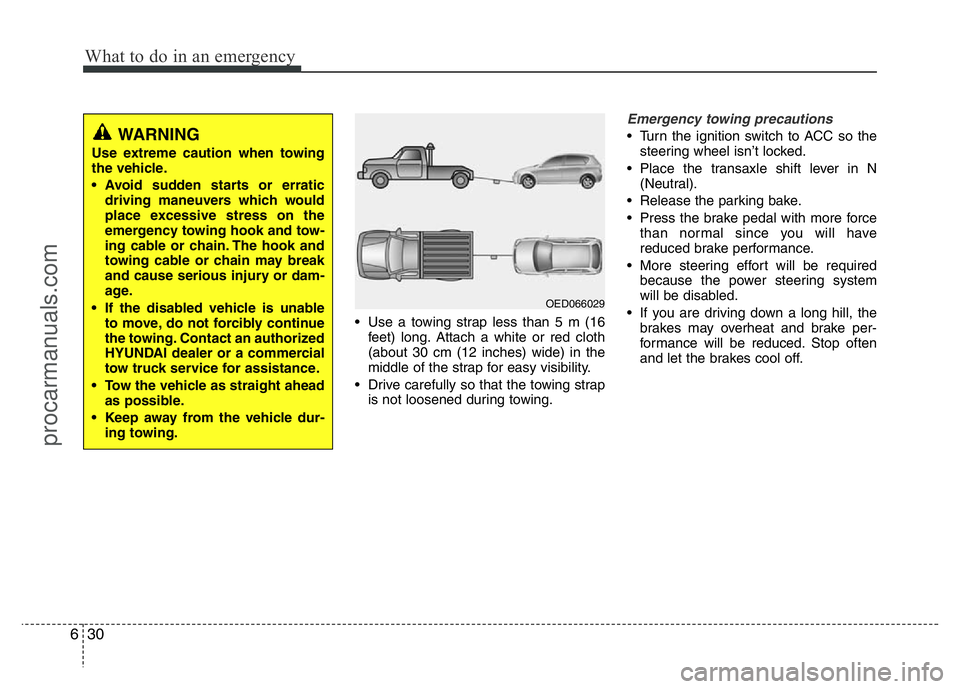
• Use a towing strap less than 5 m (16
feet) long. Attach a white or red cloth
(about 30 cm (12 inches) wide) in the
middle of the strap for easy visibility.
• Drive carefully so that the towing strap
is not loosened during towing.
Emergency towing precautions
• Turn the ignition switch to ACC so the
steering wheel isn’t locked.
• Place the transaxle shift lever in N
(Neutral).
• Release the parking bake.
• Press the brake pedal with more force
than normal since you will have
reduced brake performance.
• More steering effort will be required
because the power steering system
will be disabled.
• If you are driving down a long hill, the
brakes may overheat and brake per-
formance will be reduced. Stop often
and let the brakes cool off.WARNING
Use extreme caution when towing
the vehicle.
• Avoid sudden starts or erratic
driving maneuvers which would
place excessive stress on the
emergency towing hook and tow-
ing cable or chain. The hook and
towing cable or chain may break
and cause serious injury or dam-
age.
• If the disabled vehicle is unable
to move, do not forcibly continue
the towing. Contact an authorized
HYUNDAI dealer or a commercial
tow truck service for assistance.
• Tow the vehicle as straight ahead
as possible.
• Keep away from the vehicle dur-
ing towing.
OED066029
procarmanuals.com
Page 293 of 386
7
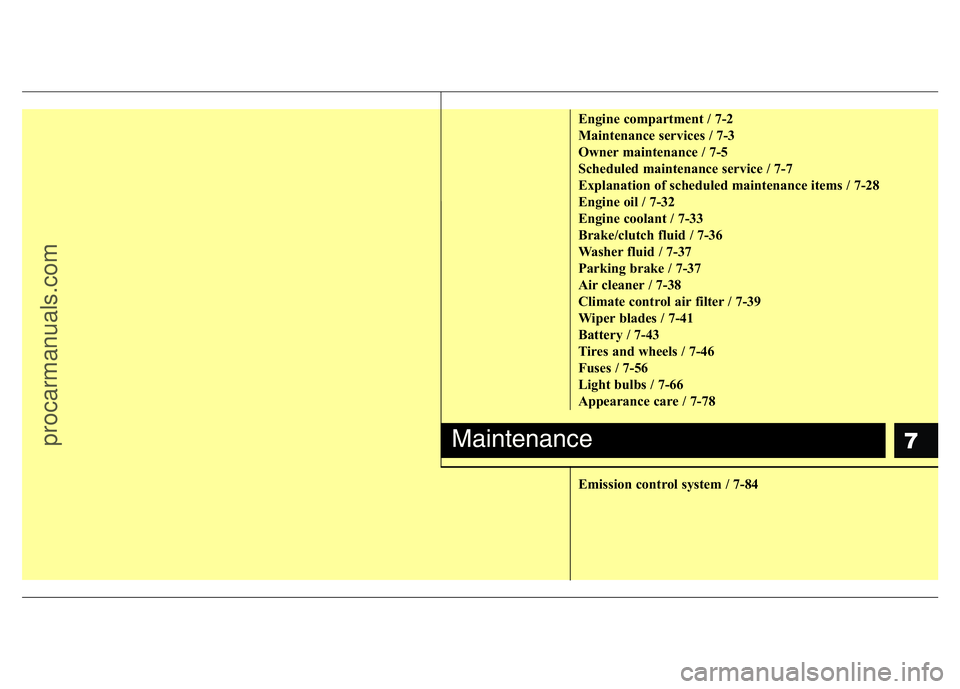
Engine compartment / 7-2
Maintenance services / 7-3
Owner maintenance / 7-5
Scheduled maintenance service / 7-7
Explanation of scheduled maintenance items / 7-28
Engine oil / 7-32
Engine coolant / 7-33
Brake/clutch fluid / 7-36
Washer fluid / 7-37
Parking brake / 7-37
Air cleaner / 7-38
Climate control air filter / 7-39
Wiper blades / 7-41
Battery / 7-43
Tires and wheels / 7-46
Fuses / 7-56
Light bulbs / 7-66
Appearance care / 7-78
Emission control system / 7-84
Maintenance
procarmanuals.com
Page 297 of 386
75
Maintenance
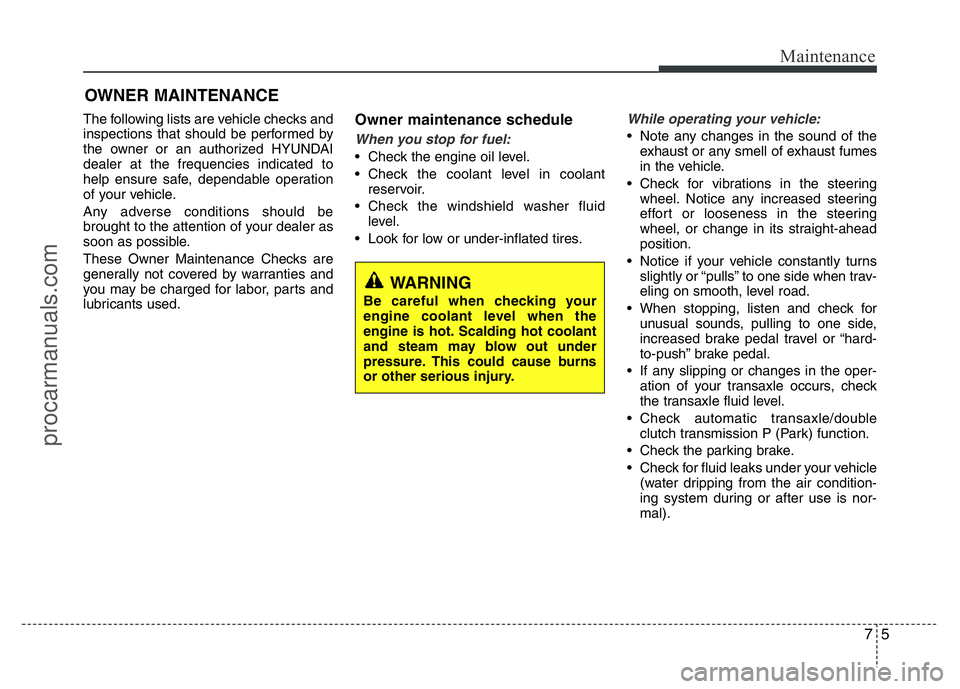
OWNER MAINTENANCE
The following lists are vehicle checks and
inspections that should be performed by
the owner or an authorized HYUNDAI
dealer at the frequencies indicated to
help ensure safe, dependable operation
of your vehicle.
Any adverse conditions should be
brought to the attention of your dealer as
soon as possible.
These Owner Maintenance Checks are
generally not covered by warranties and
you may be charged for labor, parts and
lubricants used.Owner maintenance schedule
When you stop for fuel:
• Check the engine oil level.
• Check the coolant level in coolant
reservoir.
• Check the windshield washer fluid
level.
• Look for low or under-inflated tires.
While operating your vehicle:
• Note any changes in the sound of the
exhaust or any smell of exhaust fumes
in the vehicle.
• Check for vibrations in the steering
wheel. Notice any increased steering
effort or looseness in the steering
wheel, or change in its straight-ahead
position.
• Notice if your vehicle constantly turns
slightly or “pulls” to one side when trav-
eling on smooth, level road.
• When stopping, listen and check for
unusual sounds, pulling to one side,
increased brake pedal travel or “hard-
to-push” brake pedal.
• If any slipping or changes in the oper-
ation of your transaxle occurs, check
the transaxle fluid level.
• Check automatic transaxle/double
clutch transmission P (Park) function.
• Check the parking brake.
• Check for fluid leaks under your vehicle
(water dripping from the air condition-
ing system during or after use is nor-
mal).
WARNING
Be careful when checking your
engine coolant level when the
engine is hot. Scalding hot coolant
and steam may blow out under
pressure. This could cause burns
or other serious injury.
procarmanuals.com
Page 301 of 386
79
Maintenance
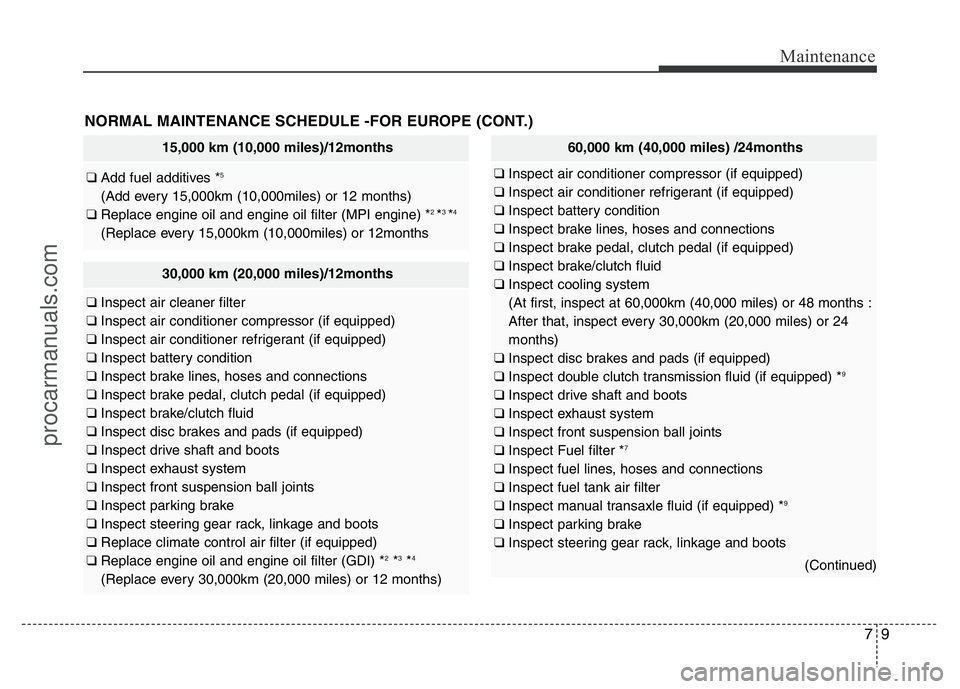
NORMAL MAINTENANCE SCHEDULE -FOR EUROPE (CONT.)
15,000 km (10,000 miles)/12months
❑ Add fuel additives *5
(Add every 15,000km (10,000miles) or 12 months)
❑ Replace engine oil and engine oil filter (MPI engine) *2 *3 *4
(Replace every 15,000km (10,000miles) or 12months
30,000 km (20,000 miles)/12months
❑ Inspect air cleaner filter
❑ Inspect air conditioner compressor (if equipped)
❑ Inspect air conditioner refrigerant (if equipped)
❑ Inspect battery condition
❑ Inspect brake lines, hoses and connections
❑ Inspect brake pedal, clutch pedal (if equipped)
❑ Inspect brake/clutch fluid
❑ Inspect disc brakes and pads (if equipped)
❑ Inspect drive shaft and boots
❑ Inspect exhaust system
❑ Inspect front suspension ball joints
❑ Inspect parking brake
❑ Inspect steering gear rack, linkage and boots
❑ Replace climate control air filter (if equipped)
❑ Replace engine oil and engine oil filter (GDI) *
2*3*4
(Replace every 30,000km (20,000 miles) or 12 months)
60,000 km (40,000 miles) /24months
❑ Inspect air conditioner compressor (if equipped)
❑ Inspect air conditioner refrigerant (if equipped)
❑ Inspect battery condition
❑ Inspect brake lines, hoses and connections
❑ Inspect brake pedal, clutch pedal (if equipped)
❑ Inspect brake/clutch fluid
❑ Inspect cooling system
(At first, inspect at 60,000km (40,000 miles) or 48 months :
After that, inspect every 30,000km (20,000 miles) or 24
months)
❑ Inspect disc brakes and pads (if equipped)
❑ Inspect double clutch transmission fluid (if equipped) *
9
❑ Inspect drive shaft and boots
❑ Inspect exhaust system
❑ Inspect front suspension ball joints
❑ Inspect Fuel filter *
7
❑ Inspect fuel lines, hoses and connections
❑ Inspect fuel tank air filter
❑ Inspect manual transaxle fluid (if equipped) *
9
❑ Inspect parking brake
❑ Inspect steering gear rack, linkage and boots
(Continued)
procarmanuals.com
Page 302 of 386
Maintenance
10 7
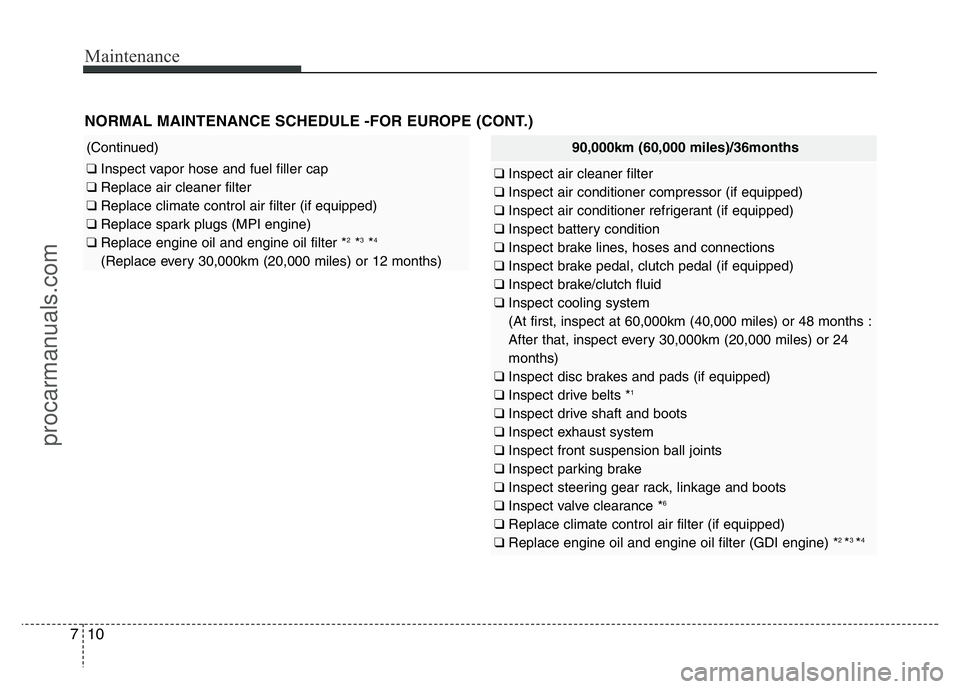
NORMAL MAINTENANCE SCHEDULE -FOR EUROPE (CONT.)
90,000km (60,000 miles)/36months
❑ Inspect air cleaner filter
❑ Inspect air conditioner compressor (if equipped)
❑ Inspect air conditioner refrigerant (if equipped)
❑ Inspect battery condition
❑ Inspect brake lines, hoses and connections
❑ Inspect brake pedal, clutch pedal (if equipped)
❑ Inspect brake/clutch fluid
❑ Inspect cooling system
(At first, inspect at 60,000km (40,000 miles) or 48 months :
After that, inspect every 30,000km (20,000 miles) or 24
months)
❑ Inspect disc brakes and pads (if equipped)
❑ Inspect drive belts *
1
❑ Inspect drive shaft and boots
❑ Inspect exhaust system
❑ Inspect front suspension ball joints
❑ Inspect parking brake
❑ Inspect steering gear rack, linkage and boots
❑ Inspect valve clearance *
6
❑ Replace climate control air filter (if equipped)
❑ Replace engine oil and engine oil filter (GDI engine) *2 *3 *4
(Continued)
❑ Inspect vapor hose and fuel filler cap
❑ Replace air cleaner filter
❑ Replace climate control air filter (if equipped)
❑ Replace spark plugs (MPI engine)
❑ Replace engine oil and engine oil filter *
2*3*4
(Replace every 30,000km (20,000 miles) or 12 months)
procarmanuals.com
Page 303 of 386
711
Maintenance
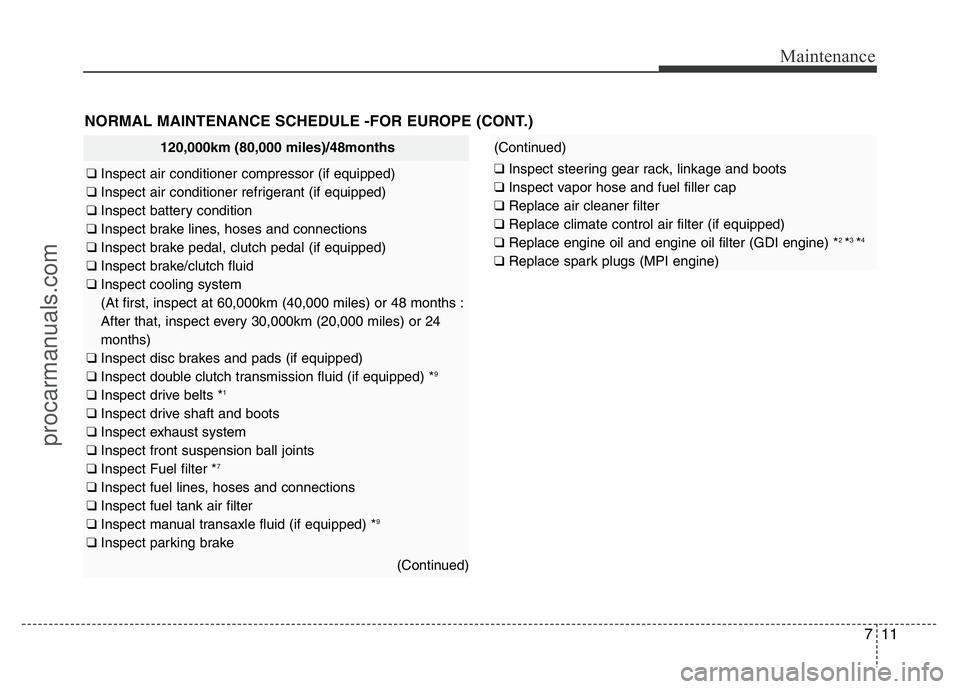
NORMAL MAINTENANCE SCHEDULE -FOR EUROPE (CONT.)
120,000km (80,000 miles)/48months
❑ Inspect air conditioner compressor (if equipped)
❑ Inspect air conditioner refrigerant (if equipped)
❑ Inspect battery condition
❑ Inspect brake lines, hoses and connections
❑ Inspect brake pedal, clutch pedal (if equipped)
❑ Inspect brake/clutch fluid
❑ Inspect cooling system
(At first, inspect at 60,000km (40,000 miles) or 48 months :
After that, inspect every 30,000km (20,000 miles) or 24
months)
❑ Inspect disc brakes and pads (if equipped)
❑ Inspect double clutch transmission fluid (if equipped) *
9
❑ Inspect drive belts *1
❑ Inspect drive shaft and boots
❑ Inspect exhaust system
❑ Inspect front suspension ball joints
❑ Inspect Fuel filter *
7
❑ Inspect fuel lines, hoses and connections
❑ Inspect fuel tank air filter
❑ Inspect manual transaxle fluid (if equipped) *
9
❑ Inspect parking brake
(Continued)
(Continued)
❑ Inspect steering gear rack, linkage and boots
❑ Inspect vapor hose and fuel filler cap
❑ Replace air cleaner filter
❑ Replace climate control air filter (if equipped)
❑ Replace engine oil and engine oil filter (GDI engine) *
2 *3 *4
❑ Replace spark plugs (MPI engine)
procarmanuals.com
Page 304 of 386
Maintenance
12 7
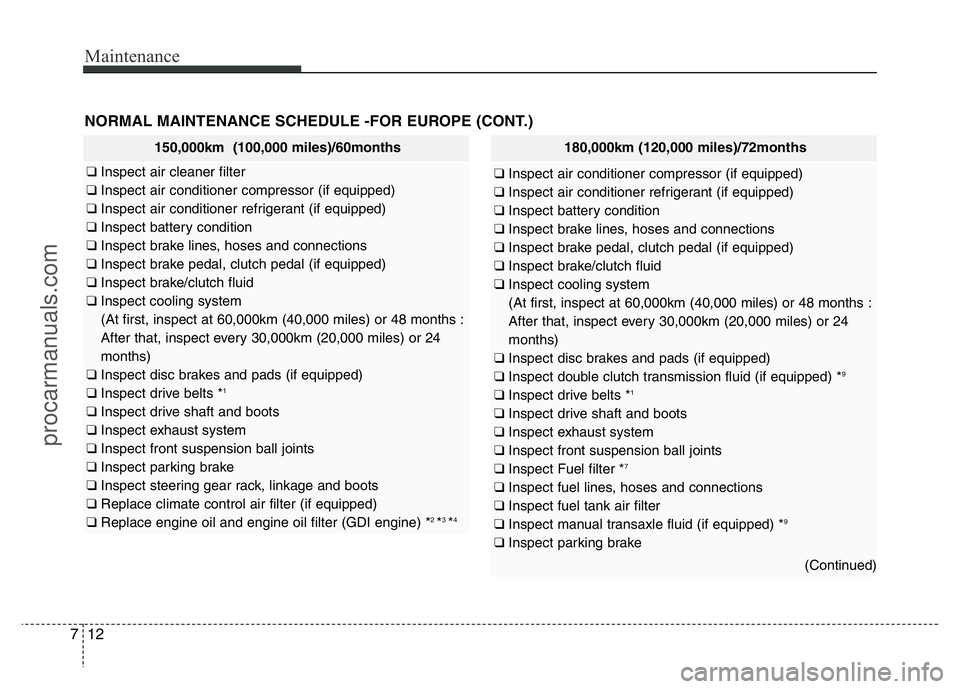
NORMAL MAINTENANCE SCHEDULE -FOR EUROPE (CONT.)
150,000km (100,000 miles)/60months
❑ Inspect air cleaner filter
❑ Inspect air conditioner compressor (if equipped)
❑ Inspect air conditioner refrigerant (if equipped)
❑ Inspect battery condition
❑ Inspect brake lines, hoses and connections
❑ Inspect brake pedal, clutch pedal (if equipped)
❑ Inspect brake/clutch fluid
❑ Inspect cooling system
(At first, inspect at 60,000km (40,000 miles) or 48 months :
After that, inspect every 30,000km (20,000 miles) or 24
months)
❑ Inspect disc brakes and pads (if equipped)
❑ Inspect drive belts *
1
❑ Inspect drive shaft and boots
❑ Inspect exhaust system
❑ Inspect front suspension ball joints
❑ Inspect parking brake
❑ Inspect steering gear rack, linkage and boots
❑ Replace climate control air filter (if equipped)
❑ Replace engine oil and engine oil filter (GDI engine) *
2 *3 *4
180,000km (120,000 miles)/72months
❑ Inspect air conditioner compressor (if equipped)
❑ Inspect air conditioner refrigerant (if equipped)
❑ Inspect battery condition
❑ Inspect brake lines, hoses and connections
❑ Inspect brake pedal, clutch pedal (if equipped)
❑ Inspect brake/clutch fluid
❑ Inspect cooling system
(At first, inspect at 60,000km (40,000 miles) or 48 months :
After that, inspect every 30,000km (20,000 miles) or 24
months)
❑ Inspect disc brakes and pads (if equipped)
❑ Inspect double clutch transmission fluid (if equipped) *
9
❑ Inspect drive belts *1
❑ Inspect drive shaft and boots
❑ Inspect exhaust system
❑ Inspect front suspension ball joints
❑ Inspect Fuel filter *
7
❑ Inspect fuel lines, hoses and connections
❑ Inspect fuel tank air filter
❑ Inspect manual transaxle fluid (if equipped) *
9
❑ Inspect parking brake
(Continued)
procarmanuals.com