alarm HYUNDAI VELOSTER 2019 User Guide
[x] Cancel search | Manufacturer: HYUNDAI, Model Year: 2019, Model line: VELOSTER, Model: HYUNDAI VELOSTER 2019Pages: 491, PDF Size: 15.17 MB
Page 290 of 491
5-78
Driving your vehicle
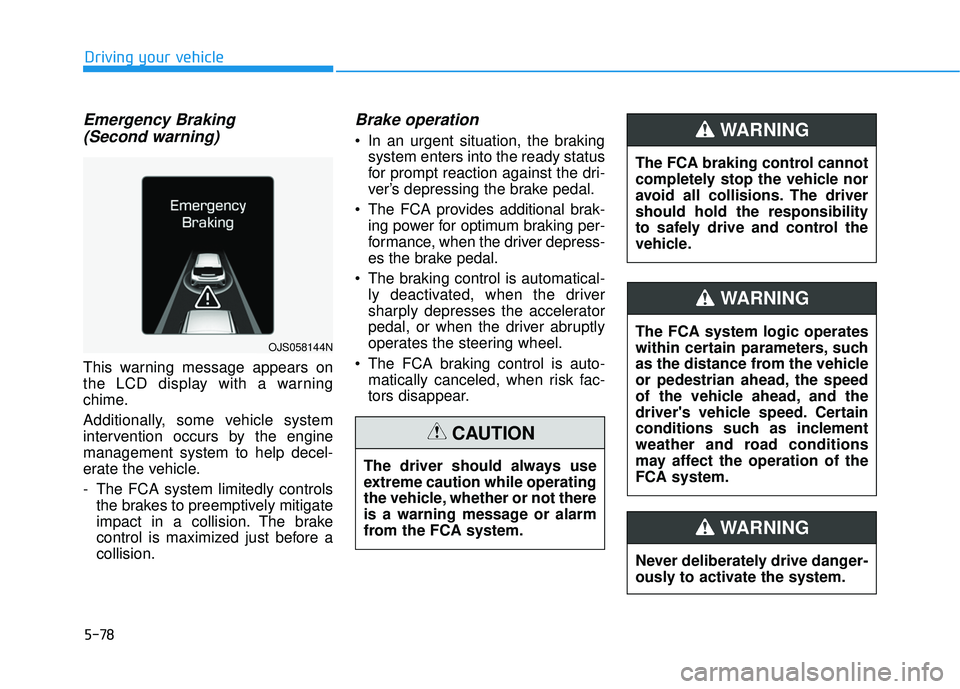
Emergency Braking(Second warning)
This warning message appears on
the LCD display with a warning
chime.
Additionally, some vehicle system
intervention occurs by the engine
management system to help decel-
erate the vehicle.
- The FCA system limitedly controls
the brakes to preemptively mitigate
impact in a collision. The brake
control is maximized just before a
collision.
Brake operation
In an urgent situation, the brakingsystem enters into the ready status
for prompt reaction against the dri-
ver’s depressing the brake pedal.
The FCA provides additional brak- ing power for optimum braking per-
formance, when the driver depress-
es the brake pedal.
The braking control is automatical- ly deactivated, when the driver
sharply depresses the accelerator
pedal, or when the driver abruptly
operates the steering wheel.
The FCA braking control is auto- matically canceled, when risk fac-
tors disappear.
OJS058144N
The driver should always use
extreme caution while operating
the vehicle, whether or not there
is a warning message or alarm
from the FCA system.
CAUTION
The FCA system logic operates
within certain parameters, such
as the distance from the vehicle
or pedestrian ahead, the speed
of the vehicle ahead, and the
driver's vehicle speed. Certain
conditions such as inclement
weather and road conditions
may affect the operation of the
FCA system.
WARNING
The FCA braking control cannot
completely stop the vehicle nor
avoid all collisions. The driver
should hold the responsibility
to safely drive and control the
vehicle.
WARNING
Never deliberately drive danger-
ously to activate the system.
WARNING
Page 295 of 491
5-83
Driving your vehicle
5
The outside brightness changessuddenly, for example when enter-
ing or exiting a tunnel
Light coming from a street light or an oncoming vehicle is reflected on
a wet road surface such as a pud-
dle in the road
The field of view in front is obstructed by sun glare
The windshield glass is fogged up; a clear view of the road is obstruct-
ed
The vehicle in front is driving errat- ically
The vehicle drives through a con- struction area, on an unpaved
road, or above metal materials,
such as a railway
The vehicle drives inside a building, such as a basement parking lot
The adverse road conditions cause excessive vehicle vibrations while
driving
The vehicle in front is moving verti- cally to the driving direction
The vehicle in front is stopped ver- tically
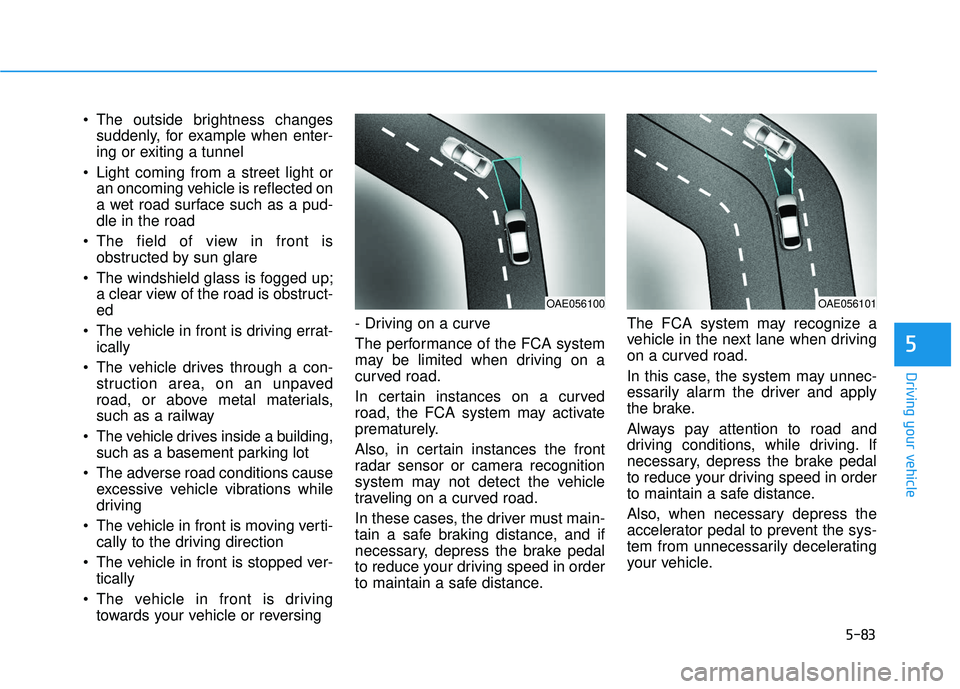
The vehicle in front is driving towards your vehicle or reversing - Driving on a curve
The performance of the FCA system
may be limited when driving on a
curved road.
In certain instances on a curved
road, the FCA system may activate
prematurely.
Also, in certain instances the front
radar sensor or camera recognition
system may not detect the vehicle
traveling on a curved road.
In these cases, the driver must main-
tain a safe braking distance, and if
necessary, depress the brake pedal
to reduce your driving speed in order
to maintain a safe distance.
The FCA system may recognize a
vehicle in the next lane when driving
on a curved road.
In this case, the system may unnec-
essarily alarm the driver and apply
the brake.
Always pay attention to road and
driving conditions, while driving. If
necessary, depress the brake pedal
to reduce your driving speed in order
to maintain a safe distance.
Also, when necessary depress the
accelerator pedal to prevent the sys-
tem from unnecessarily decelerating
your vehicle.
OAE056100OAE056101
Page 296 of 491
5-84
Driving your vehicle
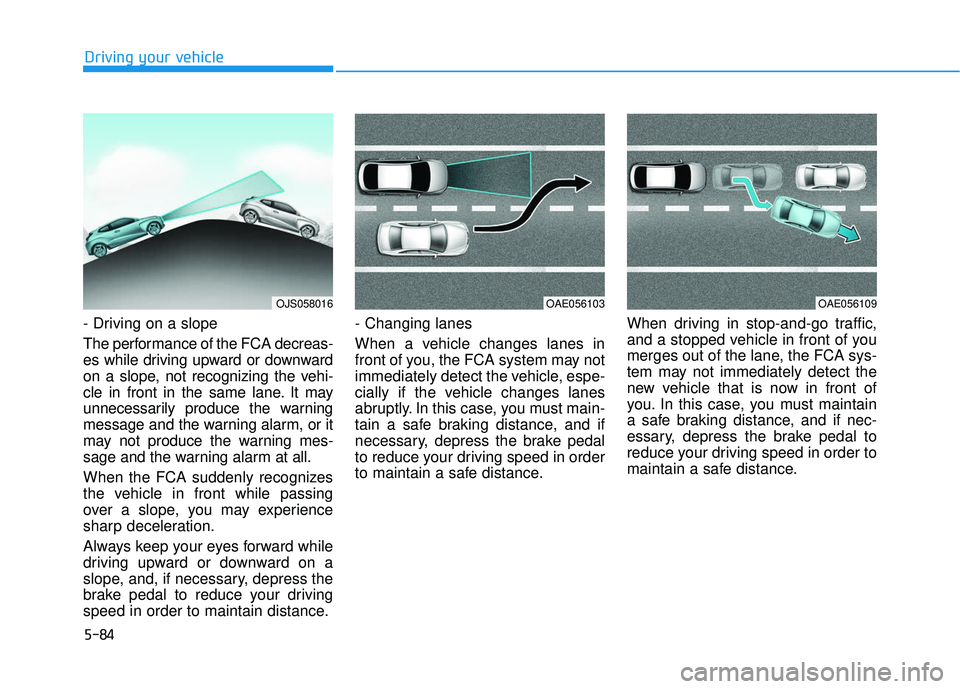
- Driving on a slope
The performance of the FCA decreas-
es while driving upward or downward
on a slope, not recognizing the vehi-
cle in front in the same lane. It may
unnecessarily produce the warning
message and the warning alarm, or it
may not produce the warning mes-
sage and the warning alarm at all.
When the FCA suddenly recognizes
the vehicle in front while passing
over a slope, you may experience
sharp deceleration.
Always keep your eyes forward while
driving upward or downward on a
slope, and, if necessary, depress the
brake pedal to reduce your driving
speed in order to maintain distance. - Changing lanes
When a vehicle changes lanes in
front of you, the FCA system may not
immediately detect the vehicle, espe-
cially if the vehicle changes lanes
abruptly. In this case, you must main-
tain a safe braking distance, and if
necessary, depress the brake pedal
to reduce your driving speed in order
to maintain a safe distance.
When driving in stop-and-go traffic,
and a stopped vehicle in front of you
merges out of the lane, the FCA sys-
tem may not immediately detect the
new vehicle that is now in front of
you. In this case, you must maintain
a safe braking distance, and if nec-
essary, depress the brake pedal to
reduce your driving speed in order to
maintain a safe distance.
OAE056103OJS058016OAE056109
Page 300 of 491
5-88
Driving your vehicle
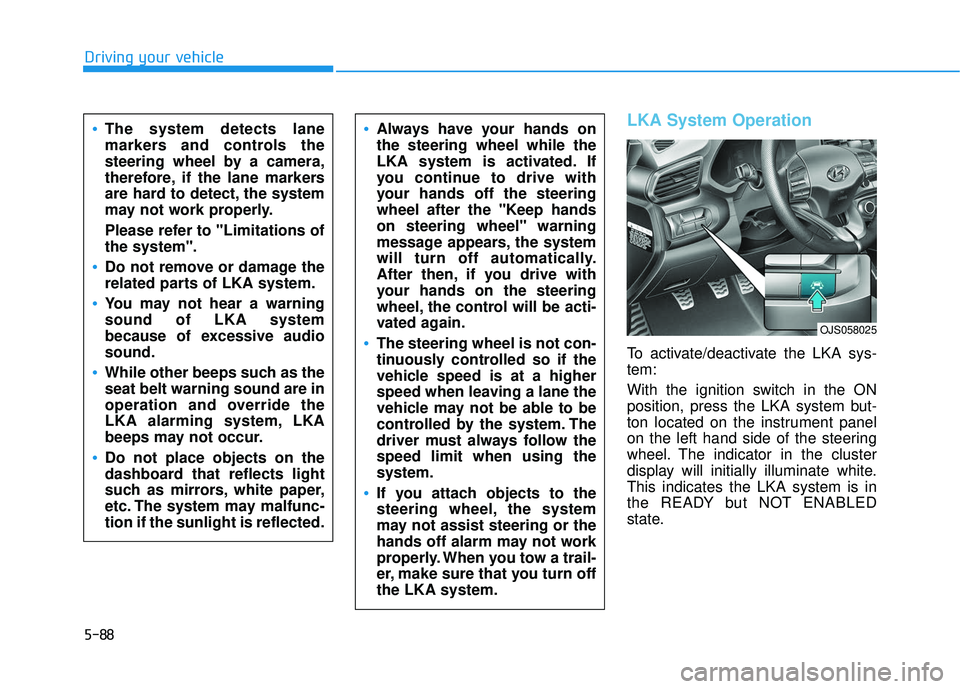
LKA System Operation
To activate/deactivate the LKA sys-
tem:
With the ignition switch in the ON
position, press the LKA system but-
ton located on the instrument panel
on the left hand side of the steering
wheel. The indicator in the cluster
display will initially illuminate white.
This indicates the LKA system is in
the READY but NOT ENABLED
state.
Always have your hands on
the steering wheel while the
LKA system is activated. If
you continue to drive with
your hands off the steering
wheel after the "Keep hands
on steering wheel" warning
message appears, the system
will turn off automatically.
After then, if you drive with
your hands on the steering
wheel, the control will be acti-
vated again.
The steering wheel is not con-
tinuously controlled so if the
vehicle speed is at a higher
speed when leaving a lane the
vehicle may not be able to be
controlled by the system. The
driver must always follow the
speed limit when using the
system.
If you attach objects to the
steering wheel, the system
may not assist steering or the
hands off alarm may not work
properly. When you tow a trail-
er, make sure that you turn off
the LKA system.
OJS058025
The system detects lane
markers and controls the
steering wheel by a camera,
therefore, if the lane markers
are hard to detect, the system
may not work properly.
Please refer to "Limitations of
the system".
Do not remove or damage the
related parts of LKA system.
You may not hear a warning
sound of LKA system
because of excessive audio
sound.
While other beeps such as the
seat belt warning sound are in
operation and override the
LKA alarming system, LKA
beeps may not occur.
Do not place objects on the
dashboard that reflects light
such as mirrors, white paper,
etc. The system may malfunc-
tion if the sunlight is reflected.
Page 306 of 491
5-94
Driving your vehicle
There is a boundary structure in the roadway such as a concrete
barrier, guardrail and reflector post
that is inadvertently being detected
by the camera.
When light coming from a street light or an oncoming vehicle is
reflected on a wet road surface
such as a puddle in the road.
Road surface is not evenness.
The field of view in front is obstructed by sun glare.
There is not enough distance between you and the vehicle in
front to be able to detect the lane
line or the vehicle ahead is driving
on the lane line.
Driving on a steep grade, over a hill, or when driving on a curved
road.
The adverse road conditions cause excessive vehicle vibrations while
driving.
The surrounding of the inside rear view mirror temperature is high
due to direct sunlight and etc. When front visibility is poor
The windshield or the LKA system
camera lens is blocked with dirt or
debris.
The windshield glass is fogged up; a clear view of the road is obstruct-
ed.
Placing objects on the dashboard, etc.
LKA system Function Change
The driver can change LKA to Lane
Departure Warning (LDW) system or
change the LKA system mode
between Standard LKA and Active
LKA from the LCD display. Go to the
'User Settings → Driver Assistance →
Lane Keeping Assist → Lane
Departure Warning/Standard
LKA/Active LKA'.
Lane Departure Warning
LDW system alerts the driver with a
visual warning and a warning alarm
when the system detects the vehicle
departing the lane. The steering
wheel will not be controlled.
Standard LKA
The Standard LKA mode guides the
driver to help keep the vehicle within
the lanes. It rarely controls the steer-
ing wheel, when the vehicle drives
well inside the lanes. However, it
starts to control the steering wheel,
when the vehicle is about to deviate
out of the lanes.
Active LKA
The Active LKA mode provides more
frequent steering wheel control in
comparison with the Standard LKA
mode. Active LKA can help reduce
the driver's fatigue to assist the
steering for maintaining the vehicle
in the middle of the lane.
Page 433 of 491
7-59
7
Maintenance
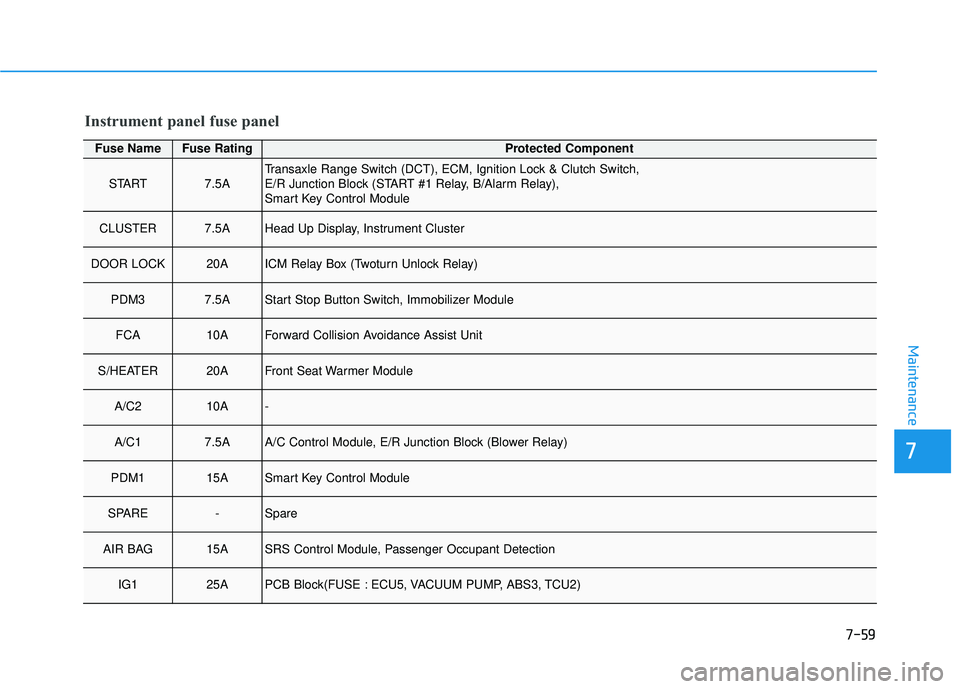
Fuse NameFuse RatingProtected Component
START7.5ATransaxle Range Switch (DCT), ECM, Ignition Lock & Clutch Switch,
E/R Junction Block (START #1 Relay, B/Alarm Relay),
Smart Key Control Module
CLUSTER7.5AHead Up Display, Instrument Cluster
DOOR LOCK20AICM Relay Box (Twoturn Unlock Relay)
PDM37.5AStart Stop Button Switch, Immobilizer Module
FCA10AForward Collision Avoidance Assist Unit
S/HEATER20AFront Seat Warmer Module
A/C210A-
A/C17.5AA/C Control Module, E/R Junction Block (Blower Relay)
PDM115ASmart Key Control Module
SPARE-Spare
AIR BAG15ASRS Control Module, Passenger Occupant Detection
IG125APCB Block(FUSE : ECU5, VACUUM PUMP, ABS3, TCU2)
Instrument panel fuse panel
Page 436 of 491
7-62
Maintenance
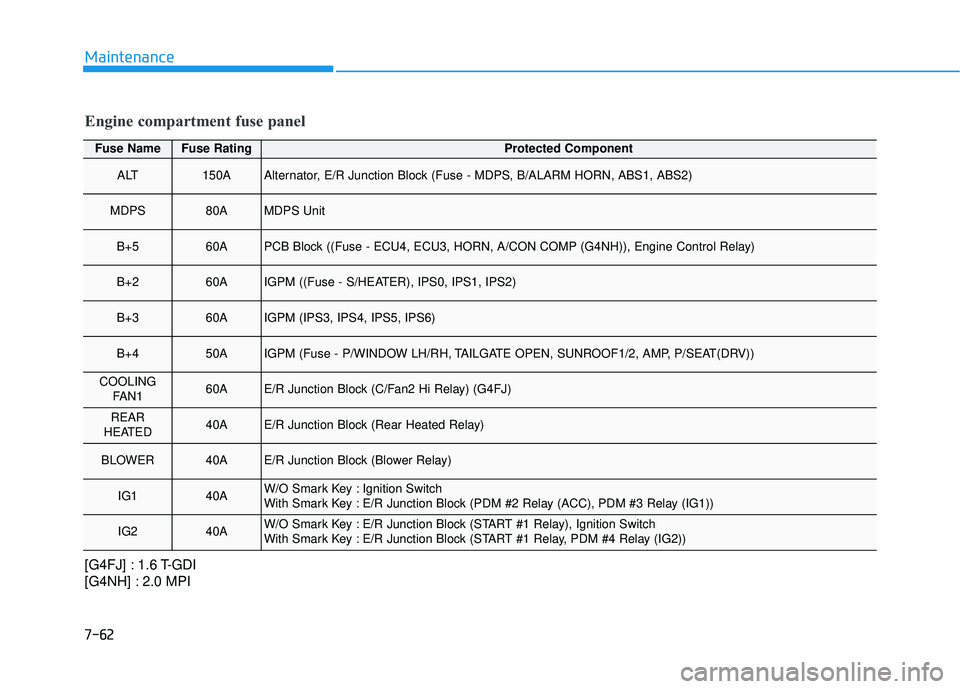
Engine compartment fuse panel
Fuse NameFuse RatingProtected Component
ALT150AAlternator, E/R Junction Block (Fuse - MDPS, B/ALARM HORN, ABS1, ABS2)
MDPS80AMDPS Unit
B+560APCB Block ((Fuse - ECU4, ECU3, HORN, A/CON COMP (G4NH)), Engine Control Rel\
ay)
B+260AIGPM ((Fuse - S/HEATER), IPS0, IPS1, IPS2)
B+360AIGPM (IPS3, IPS4, IPS5, IPS6)
B+450AIGPM (Fuse - P/WINDOW LH/RH, TAILGATE OPEN, SUNROOF1/2, AMP, P/SEAT(DRV))
COOLINGFAN160AE/R Junction Block (C/Fan2 Hi Relay) (G4FJ)
REAR
HEATED40AE/R Junction Block (Rear Heated Relay)
BLOWER40AE/R Junction Block (Blower Relay)
IG140AW/O Smark Key : Ignition Switch
With Smark Key : E/R Junction Block (PDM #2 Relay (ACC), PDM #3 Relay (IG1))
IG240AW/O Smark Key : E/R Junction Block (START #1 Relay), Ignition Switch
With Smark Key : E/R Junction Block (START #1 Relay, PDM #4 Relay (IG2))
[G4FJ] : 1.6 T-GDI
[G4NH] : 2.0 MPI
Page 437 of 491
7-63
7
Maintenance
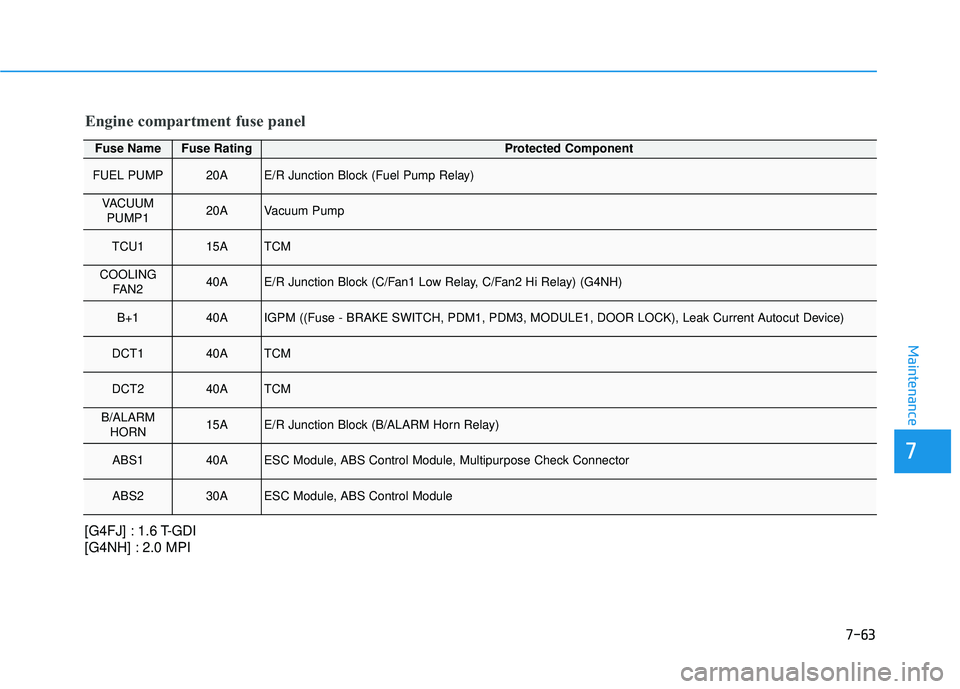
Engine compartment fuse panel
Fuse NameFuse RatingProtected Component
FUEL PUMP20AE/R Junction Block (Fuel Pump Relay)
VACUUMPUMP120AVacuum Pump
TCU115ATCM
COOLING FAN240AE/R Junction Block (C/Fan1 Low Relay, C/Fan2 Hi Relay) (G4NH)
B+140AIGPM ((Fuse - BRAKE SWITCH, PDM1, PDM3, MODULE1, DOOR LOCK), Leak Cur\
rent Autocut Device)
DCT140ATCM
DCT240ATCM
B/ALARMHORN15AE/R Junction Block (B/ALARM Horn Relay)
ABS140AESC Module, ABS Control Module, Multipurpose Check Connector
ABS230AESC Module, ABS Control Module
[G4FJ] : 1.6 T-GDI
[G4NH] : 2.0 MPI
Page 489 of 491

I-12
Tachometer ......................................................................3-\
41
Theft-alarm system .........................................................3-18
Tilt steering/Telescope steering ......................................3-20
Tire chains .....................................................................5-1\
23
Tire Mobility Kit (TMK) ................................................6-20
Tire pressure monitoring system (TPMS) ........................6-8
Tire rotation ....................................................................7-39\
Tire specification and pressure label ..............................8-11
Tires and wheels .............................................................7-37Tire care ..............................................................7-37, 8-4
Recommended cold tire inflation pressures ...............7-38
Check tire inflation pressure ......................................7-39
Tire rotation ................................................................7-39
Wheel alignment and tire balance ..............................7-40
Tire replacement .........................................................7-41
Compact spare tire replacement .................................7-41
Wheel replacement .....................................................7-42
Tire maintenance ........................................................7-42
Tire traction ................................................................7-42
Tire sidewall labeling .................................................7-42
Tire terminology and definitions ................................7-46
All Season Tires .........................................................7-49
Summer Tires .............................................................7-49
Snow Tires ..................................................................7-50
Radial-Ply Tires ..........................................................7-50
Low Aspect Ratio Tires ..............................................7-50 Towing ........................................................................\
....6-27
Trailer towing................................................................5-132
Trip computer..................................................................3-73
Average fuel economy................................................3-73
Instant fuel economy ..................................................3-73
Accumulated Info display ..........................................3-73
Driving Info display ...................................................3-75
Digital speedometer....................................................3-76
Smart shift ..................................................................3-76
Transmission temperature ..........................................3-76
Turn signals.....................................................................3-8\
5
USB charger ..................................................................3-123
User settings mode..........................................................3-66
Vanity mirror lamp..........................................................3-89
Vehicle break-in process ...................................................F-9
Vehicle certification label ...............................................8-10
Vehicle identification number (VIN) ..............................8-10
Vehicle load limit ..........................................................5-127 Tire loading information label..................................5-128
Vehicle modification .........................................................F-9
Vehicle Stability Management (VSM)............................5-47
Vehicle weight and luggage volume .................................8-6
Index
T
U
V