brakes HYUNDAI VELOSTER 2019 Owner's Guide
[x] Cancel search | Manufacturer: HYUNDAI, Model Year: 2019, Model line: VELOSTER, Model: HYUNDAI VELOSTER 2019Pages: 491, PDF Size: 15.17 MB
Page 357 of 491
6-13
What to do in an emergency
6
You may not be able identify a tire
with low pressure by simply looking
at it. Always use a good quality tire
pressure gage to measure the tire's
inflation pressure. Please note that a
tire that is hot (from being driven) will
have a higher pressure measure-
ment than a tire that is cold.
A cold tire means the vehicle has
been sitting for 3 hours and driven for
less than 1 mile (1.6 km) in that 3
hour period.
Allow the tire to cool before measur-
ing the inflation pressure. Always be
sure the tire is cold before inflating to
the recommended pressure.Information
This device complies with Part 15 of
the FCC rules.
Operation is subject to the following
three conditions:
1. This device may not cause harmfulinterference.
2. This device must accept any inter- ference received, including interfer-
ence that may cause undesired
operation.
3. Changes or modifications not expressly approved by the party
responsible for compliance could
void the user's authority to operate
the equipment.
i
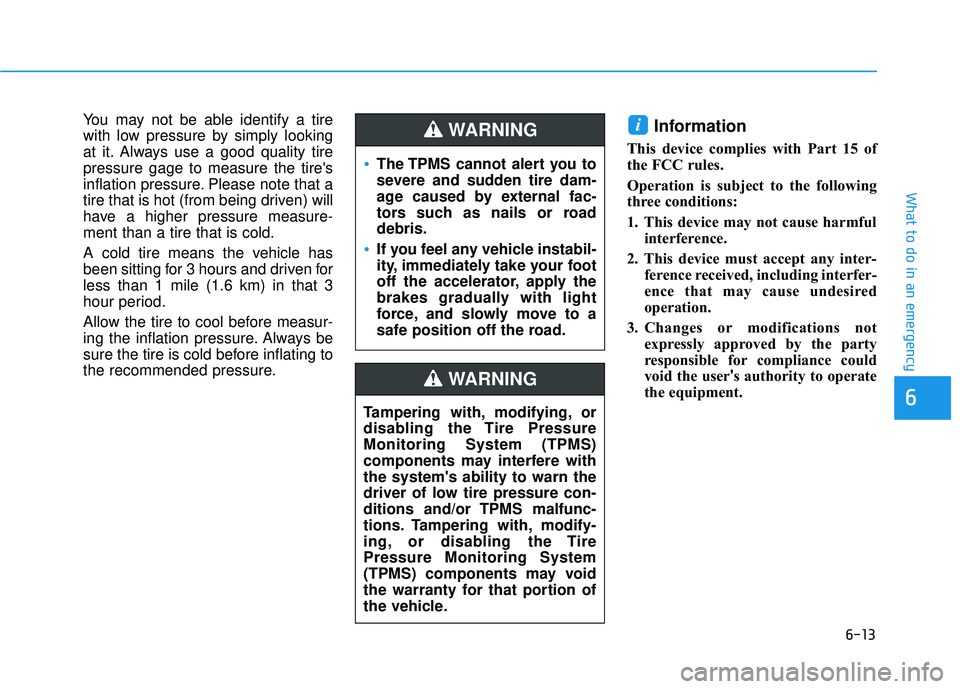
The TPMS cannot alert you to
severe and sudden tire dam-
age caused by external fac-
tors such as nails or road
debris.
If you feel any vehicle instabil-
ity, immediately take your foot
off the accelerator, apply the
brakes gradually with light
force, and slowly move to a
safe position off the road.
WARNING
Tampering with, modifying, or
disabling the Tire Pressure
Monitoring System (TPMS)
components may interfere with
the system's ability to warn the
driver of low tire pressure con-
ditions and/or TPMS malfunc-
tions. Tampering with, modify-
ing, or disabling the Tire
Pressure Monitoring System
(TPMS) components may void
the warranty for that portion of
the vehicle.
WARNING
Page 373 of 491
6-29
What to do in an emergency
6
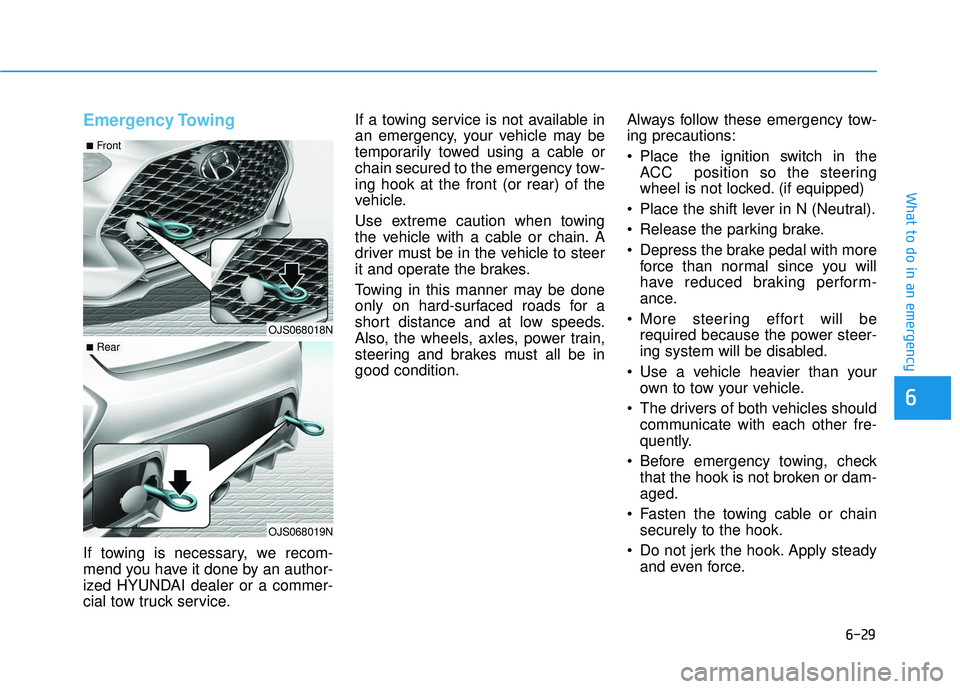
Emergency Towing
If towing is necessary, we recom-
mend you have it done by an author-
ized HYUNDAI dealer or a commer-
cial tow truck service.If a towing service is not available in
an emergency, your vehicle may be
temporarily towed using a cable or
chain secured to the emergency tow-
ing hook at the front (or rear) of the
vehicle.
Use extreme caution when towing
the vehicle with a cable or chain. A
driver must be in the vehicle to steer
it and operate the brakes.
Towing in this manner may be done
only on hard-surfaced roads for a
short distance and at low speeds.
Also, the wheels, axles, power train,
steering and brakes must all be in
good condition.
Always follow these emergency tow-
ing precautions:
Place the ignition switch in the
ACC position so the steering
wheel is not locked. (if equipped)
Place the shift lever in N (Neutral).
Release the parking brake.
Depress the brake pedal with more force than normal since you will
have reduced braking perform-
ance.
More steering effort will be required because the power steer-
ing system will be disabled.
Use a vehicle heavier than your own to tow your vehicle.
The drivers of both vehicles should communicate with each other fre-
quently.
Before emergency towing, check that the hook is not broken or dam-
aged.
Fasten the towing cable or chain securely to the hook.
Do not jerk the hook. Apply steady and even force.
OJS068018N
OJS068019N
■Front
■Rear
Page 381 of 491
7-7
7
Maintenance
At least twice a year:(i.e., every Spring and Autumn)
Check radiator, heater and air con-
ditioning hoses for leaks or dam-
age.
Check windshield washer spray and wiper operation. Clean wiper
blades with a clean cloth damp-
ened with washer a fluid.
Check headlamp alignment.
Check muffler, exhaust pipes, shields and clamps.
Check the seat belts for wear and function.
At least once a year:
Clean body and door drain holes.
Lubricate door hinges and hoodhinges.
Lubricate door and hood locks and latches.
Lubricate door rubber weather strips.
Lubricate door checker.
Check the air conditioning system.
Inspect and lubricate automatic transmission linkage and controls.
Clean the battery and terminals.
Check the brake fluid level. Follow Normal Maintenance Schedule
if the vehicle is usually operated where
none of the following conditions apply.
If any of the following conditions apply,
you must follow the Maintenance
Under Severe Usage Conditions.
Repeated short distance driving.
Driving in dusty conditions or
sandy areas.
Extensive use of brakes.
Driving in areas where salt or other corrosive materials are used.
Driving on rough or muddy roads.
Driving in mountainous areas.
Extended periods of idling or low speed operation.
Driving for a prolonged period in cold temperatures and/or extreme-
ly humid climates.
More than 50% driving in heavy city traffic during hot weather
above 90°F (32°C).
For additional information or assis-
tance see your authorized HYUNDAI
dealer.
S S C
C H
H E
ED
D U
U L
LE
E D
D
M
M A
AI
IN
N T
TE
EN
N A
AN
N C
CE
E
S
S E
E R
R V
V I
IC
C E
E S
S
Page 383 of 491
7-9
7
Maintenance
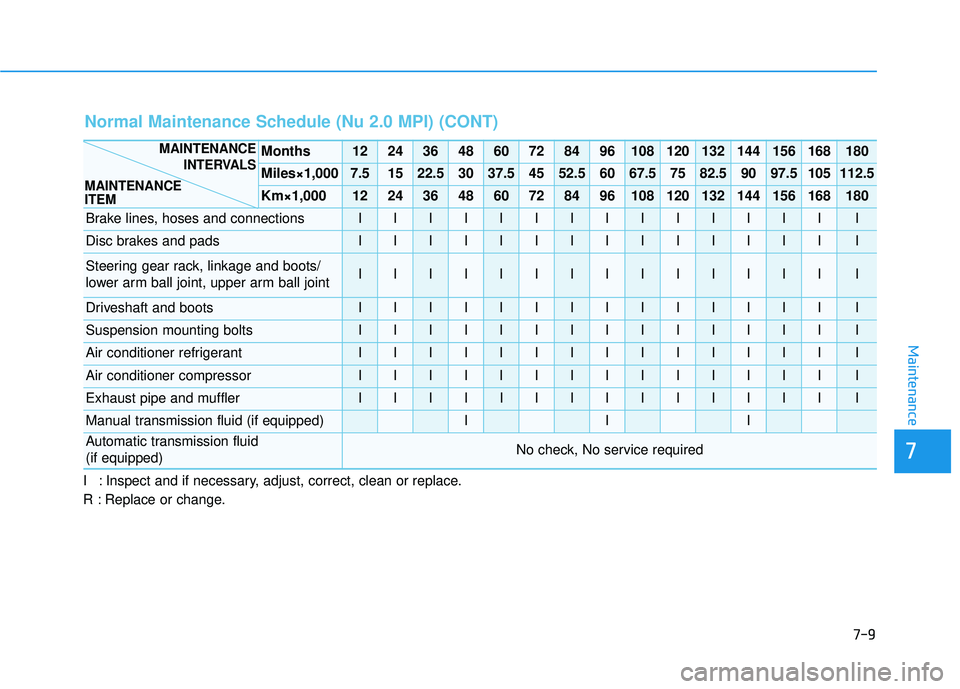
I : Inspect and if necessary, adjust, correct, clean or replace.
R : Replace or change.
Normal Maintenance Schedule (Nu 2.0 MPI) (CONT)
Months1224364860728496108120132144156168180
Miles×1,0007.51522.53037.54552.56067.57582.59097.5105112.5
Km×1,0001224364860728496108120132144156168180
Brake lines, hoses and connectionsIIIIIIIIIIIIIII
Disc brakes and padsIIIIIIIIIIIIIII
Steering gear rack, linkage and boots/
lower arm ball joint, upper arm ball jointIIIIIIIIIIIIIII
Driveshaft and bootsIIIIIIIIIIIIIII
Suspension mounting boltsIIIIIIIIIIIIIII
Air conditioner refrigerantIIIIIIIIIIIIIII
Air conditioner compressorIIIIIIIIIIIIIII
Exhaust pipe and mufflerIIIIIIIIIIIIIII
Manual transmission fluid (if equipped)III
Automatic transmission fluid
(if equipped)No check, No service required
MAINTENANCEINTERVALS
MAINTENANCE
ITEM
Page 388 of 491
7-14
Maintenance
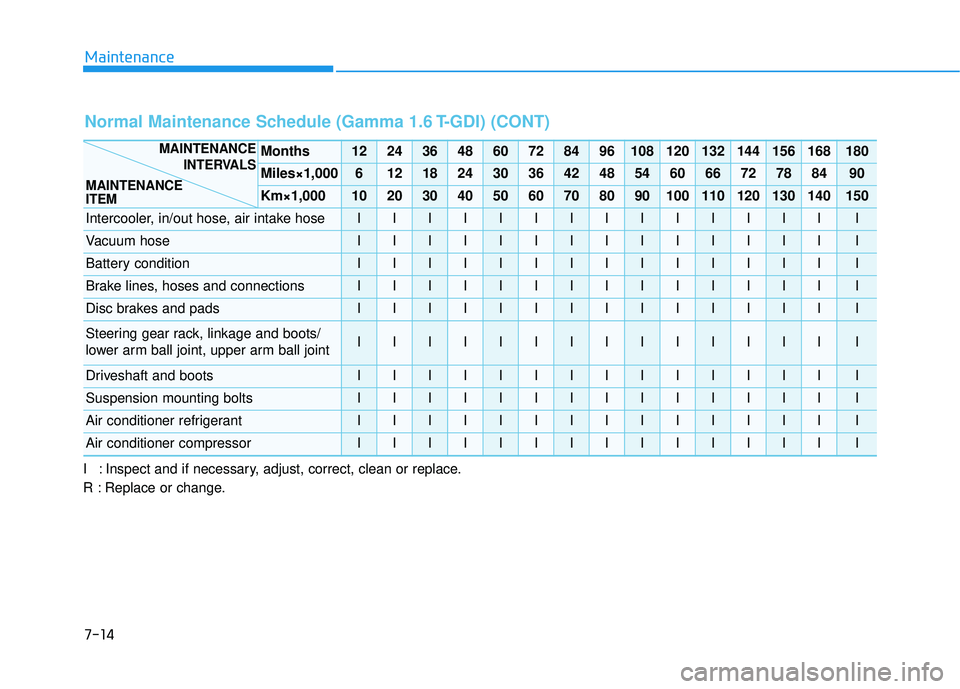
I : Inspect and if necessary, adjust, correct, clean or replace.
R : Replace or change.
Normal Maintenance Schedule (Gamma 1.6 T-GDI) (CONT)
Months1224364860728496108120132144156168180
Miles×1,00061218243036424854606672788490
Km×1,000102030405060708090100110120130140150
Intercooler, in/out hose, air intake hoseIIIIIIIIIIIIIII
Vacuum hoseIIIIIIIIIIIIIII
Battery conditionIIIIIIIIIIIIIII
Brake lines, hoses and connectionsIIIIIIIIIIIIIII
Disc brakes and padsIIIIIIIIIIIIIII
Steering gear rack, linkage and boots/
lower arm ball joint, upper arm ball jointIIIIIIIIIIIIIII
Driveshaft and bootsIIIIIIIIIIIIIII
Suspension mounting boltsIIIIIIIIIIIIIII
Air conditioner refrigerantIIIIIIIIIIIIIII
Air conditioner compressorIIIIIIIIIIIIIII
MAINTENANCEINTERVALS
MAINTENANCE
ITEM
Page 452 of 491
7-78
Maintenance
A
AP
PP
PE
EA
A R
RA
A N
N C
CE
E
C
C A
A R
RE
E
Exterior Care
Exterior general caution
It is very important to follow the label
directions when using any chemical
cleaner or polish. Read all warning
and caution statements that appear
on the label.
Protecting your vehicle's finish
Washing
To help protect your vehicle's finish
from rust and deterioration, wash it
thoroughly and frequently at least
once a month with lukewarm or cold
water.
If you use your vehicle for off-road
driving, you should wash it after each
off-road trip. Pay special attention to
the removal of any accumulation of
salt, dirt, mud, and other foreign
materials. Make sure the drain holes
in the lower edges of the doors and
rocker panels are kept clear and
clean.
Insects, tar, tree sap, bird droppings,
industrial pollution and similar
deposits can damage your vehicle's
finish if not removed immediately. Even prompt washing with plain
water may not completely remove all
these deposits. A mild soap, safe for
use on painted surfaces, should be
used.
After washing, rinse the vehicle thor-
oughly with lukewarm or cold water.
Do not allow soap to dry on the fin-
ish.
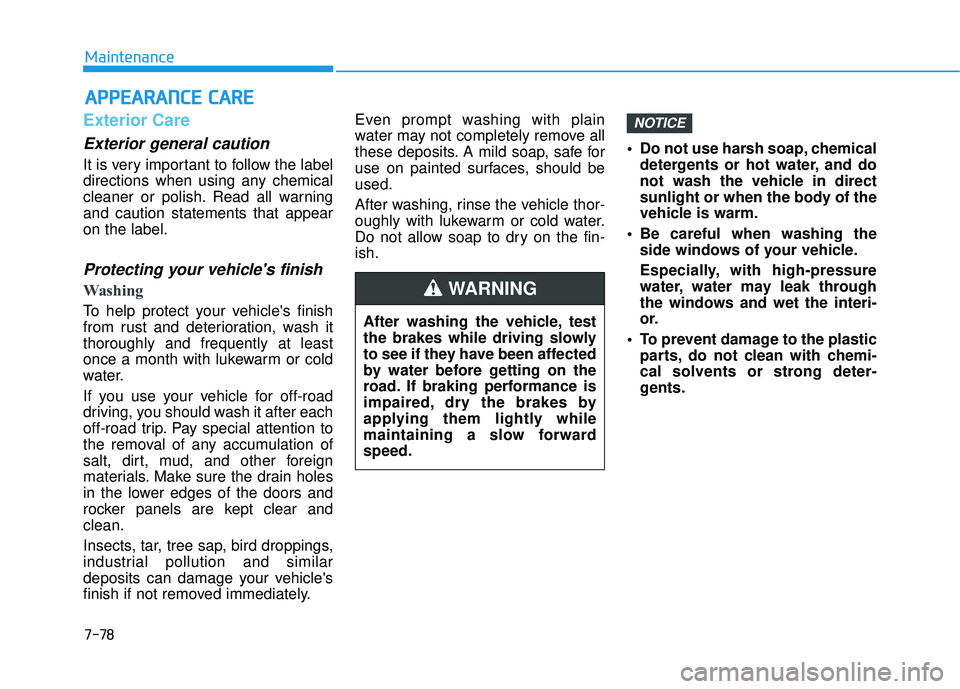
Do not use harsh soap, chemical
detergents or hot water, and do
not wash the vehicle in direct
sunlight or when the body of the
vehicle is warm.
Be careful when washing the side windows of your vehicle.
Especially, with high-pressure
water, water may leak through
the windows and wet the interi-
or.
To prevent damage to the plastic parts, do not clean with chemi-
cal solvents or strong deter-
gents.
NOTICE
After washing the vehicle, test
the brakes while driving slowly
to see if they have been affected
by water before getting on the
road. If braking performance is
impaired, dry the brakes by
applying them lightly while
maintaining a slow forward
speed.
WARNING
Page 455 of 491
7-81
7
Maintenance
Underbody maintenance
Corrosive materials used for ice and
snow removal and dust control may
collect on the underbody. If these
materials are not removed, acceler-
ated rusting can occur on underbody
parts such as the fuel lines, frame,
floor pan and exhaust system, even
though they have been treated with
rust protection.
Thoroughly flush the vehicle under-
body and wheel openings with luke-
warm or cold water once a month,
after off-road driving and at the end
of each winter. Pay special attention
to these areas because it is difficult
to see all the mud and dirt. It will do
more harm than good to wet down
the road grime without removing it.
The lower edges of doors, rocker
panels, and frame members have
drain holes that should not be
allowed to clog with dirt; trapped
water in these areas can cause rust-
ing.
Aluminum wheel maintenance
The aluminum wheels are coated
with a clear protective finish.
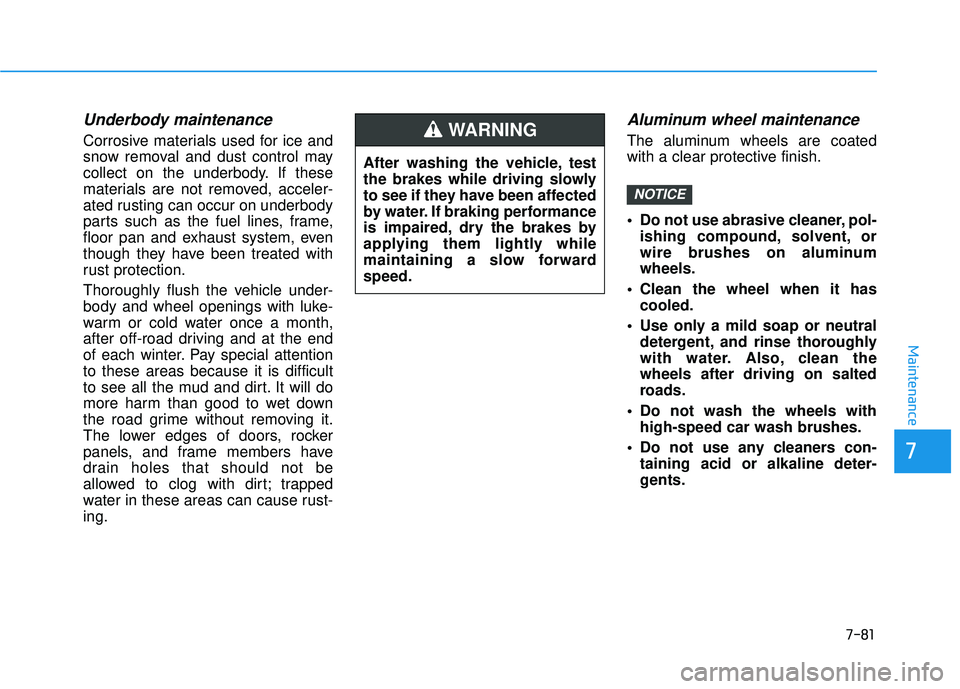
Do not use abrasive cleaner, pol-ishing compound, solvent, or
wire brushes on aluminum
wheels.
Clean the wheel when it has cooled.
Use only a mild soap or neutral detergent, and rinse thoroughly
with water. Also, clean the
wheels after driving on salted
roads.
Do not wash the wheels with high-speed car wash brushes.
Do not use any cleaners con- taining acid or alkaline deter-
gents.
NOTICE
After washing the vehicle, test
the brakes while driving slowly
to see if they have been affected
by water. If braking performance
is impaired, dry the brakes by
applying them lightly while
maintaining a slow forward
speed.
WARNING
Page 480 of 491

I-3
Battery ........................................................................\
.....7-34Battery recharging ......................................................7-35
Battery saver function .....................................................3-86
Before driving ...................................................................5-4
Blade type fuse ...............................................................7-54
Blind spot mirror.............................................................3-23
Blind-Spot Collision Warning (BCW) system ...............5-55
Blue Link
®center ...........................................................3-22
Bluetooth®Wireless Technology hands-free ....................4-4
Brake fluid ......................................................................7-\
27
Brake system ...................................................................5-40 Power brakes ..............................................................5-40
Disc brakes wear indicator .........................................5-41
Parking brake..............................................................5-41
Anti-lock Brake System (ABS)..................................5-43
Electronic Stability Control (ESC).............................5-45
Vehicle Stability Management (VSM) .......................5-47
Good braking practices ..............................................5-49 Bulb replacement ............................................................7-67
Headlamp....................................................................7-68\
Front position lamp ....................................................7-68
Front turn signal lamp ................................................7-68
Daytime running light (DRL) ....................................7-68
Side marker ................................................................7-68
Side repeater lamp ......................................................7-72
Rear combination light bulb .......................................7-73
High mounted stop lamp ............................................7-76
License plate light ......................................................7-76
Interior light................................................................7-77
Bulb wattage .....................................................................8-3\
Capacities (Lubricants) .....................................................3-7
Care Tire care ......................................................................7-\
37
Exterior care ...............................................................7-78
Interior care ................................................................7-83
Cargo area cover ...........................................................3-128
Cartridge type fuse..........................................................7-54
Center console storage ..................................................3-119
Central door lock/unlock switch .....................................3-15
Certification label ...........................................................8-10
I
Index
B
C
Page 487 of 491
I-10
Paddle shifter .........................................................5-25, 5-36
Parking lamp position .....................................................3-81
Passenger's front air bag .................................................2-43
Power brakes ...................................................................5-40
Power outlet ..................................................................3-122
Power window lock switch .............................................3-28
Pre-tensioner seat belt .....................................................2-23Retractor pretensioner ................................................2-24
Emergency fastening device.......................................2-24
Range ........................................................................\
......3-43
Rear seat adjustment .........................................................2-8 Folding the rear seat .....................................................2-8
Rear seat head restraints .................................................2-13 Adjusting the height up and down .............................2-14
Removal/Reinstallation ..............................................2-14
Rear view monitor ..........................................................3-95
Rear window wiper and washer .....................................3-94
Recommended cold tire inflation pressures ...................7-38
Recommended lubricants and capacities ..........................8-7
Refrigerant label..............................................................8-11 Remote key .......................................................................3\
-3
Locking........................................................................\
.3-3
Unlocking .....................................................................3-4\
Liftgate unlocking ........................................................3-4
Mechanical key ............................................................3-5
Battery replacement......................................................3-6
Removable towing hook .................................................6-28
Rocking the vehicle ......................................................5-120
Rotation (Tire) ................................................................7-39
Safety messages ................................................................F-6
Scheduled maintenance services.......................................7-7
Seat belt warning light Driver's seat ................................................................2-18
Front passenger's seat .................................................2-19
Seat belts ........................................................................\
.2-17 Seat belt safety precautions ........................................2-17
Seat belt warning light ...............................................2-18
Emergency locking retractor ......................................2-20
Shoulder belt extension guide ....................................2-22
Convertible locking retractor .....................................2-22
Pre-tensioner seat belt ................................................2-23
Additional seat belt safety precautions ......................2-26
Seat belt use during pregnancy ..................................2-26
Seat belt use and children...........................................2-2\
7
Transporting an injured person ..................................2-28
One person per belt ....................................................2-28
Index
P
R
S