service HYUNDAI VELOSTER 2020 Owner's Manual
[x] Cancel search | Manufacturer: HYUNDAI, Model Year: 2020, Model line: VELOSTER, Model: HYUNDAI VELOSTER 2020Pages: 480, PDF Size: 6.16 MB
Page 380 of 480
7-11
7
Maintenance
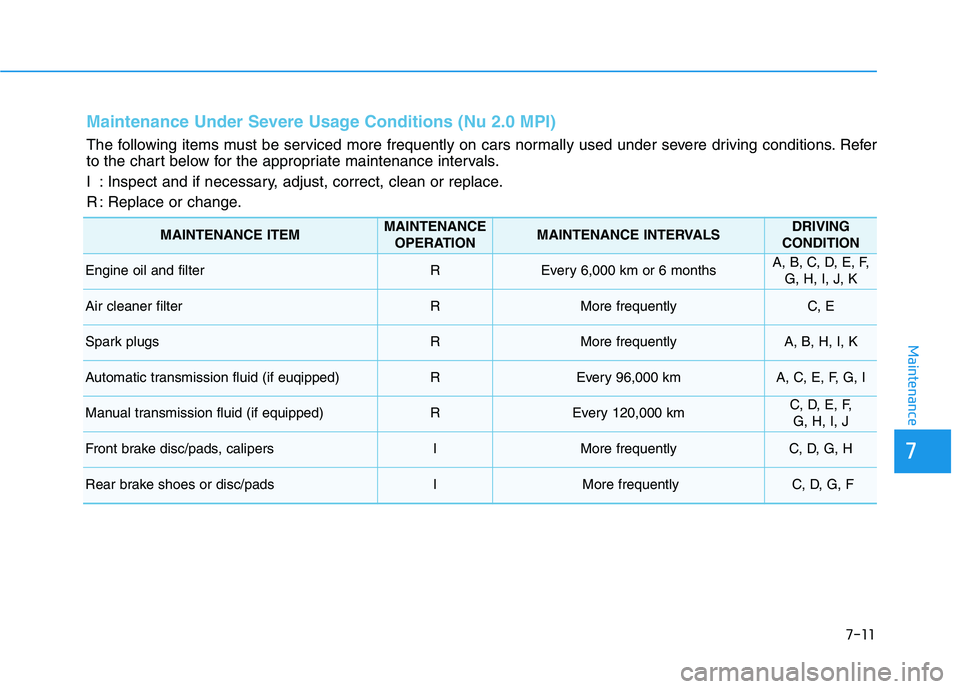
Maintenance Under Severe Usage Conditions (Nu 2.0 MPI)
The following items must be serviced more frequently on cars normally used under severe driving conditions. Refer
to the chart below for the appropriate maintenance intervals.
I : Inspect and if necessary, adjust, correct, clean or replace.
R : Replace or change.
MAINTENANCE ITEMMAINTENANCE
OPERATIONMAINTENANCE INTERVALSDRIVING
CONDITION
Engine oil and filterREvery 6,000 km or 6 monthsA, B, C, D, E, F,
G, H, I, J, K
Air cleaner filterRMore frequentlyC, E
Spark plugsRMore frequentlyA, B, H, I, K
Automatic transmission fluid (if euqipped)REvery 96,000 kmA, C, E, F, G, I
Manual transmission fluid (if equipped)REvery 120,000 kmC, D, E, F,
G, H, I, J
Front brake disc/pads, calipersIMore frequentlyC, D, G, H
Rear brake shoes or disc/padsIMore frequentlyC, D, G, F
Page 385 of 480
7-16
Maintenance
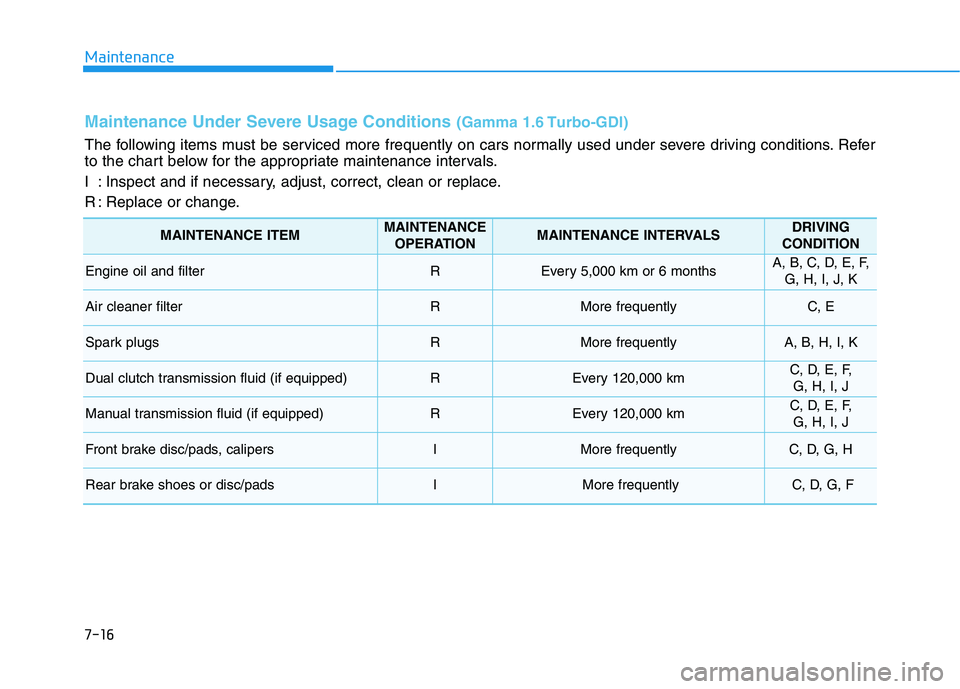
Maintenance Under Severe Usage Conditions (Gamma 1.6 Turbo-GDI)
The following items must be serviced more frequently on cars normally used under severe driving conditions. Refer
to the chart below for the appropriate maintenance intervals.
I : Inspect and if necessary, adjust, correct, clean or replace.
R : Replace or change.
MAINTENANCE ITEMMAINTENANCE
OPERATIONMAINTENANCE INTERVALSDRIVING
CONDITION
Engine oil and filterREvery 5,000 km or 6 monthsA, B, C, D, E, F,
G, H, I, J, K
Air cleaner filterRMore frequentlyC, E
Spark plugsRMore frequentlyA, B, H, I, K
Dual clutch transmission fluid (if equipped)REvery 120,000 kmC, D, E, F,
G, H, I, J
Manual transmission fluid (if equipped)REvery 120,000 kmC, D, E, F,
G, H, I, J
Front brake disc/pads, calipersIMore frequentlyC, D, G, H
Rear brake shoes or disc/padsIMore frequentlyC, D, G, F
Page 401 of 480
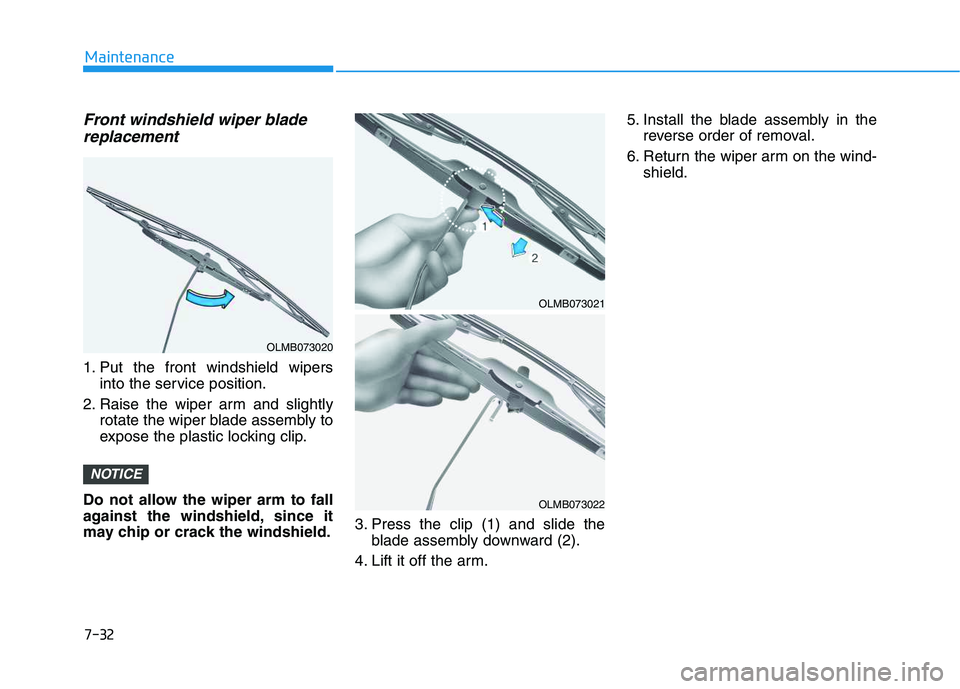
Front windshield wiper blade
replacement
1. Put the front windshield wipers
into the service position.
2. Raise the wiper arm and slightly
rotate the wiper blade assembly to
expose the plastic locking clip.
Do not allow the wiper arm to fall
against the windshield, since it
may chip or crack the windshield.3. Press the clip (1) and slide the
blade assembly downward (2).
4. Lift it off the arm.5. Install the blade assembly in the
reverse order of removal.
6. Return the wiper arm on the wind-
shield.
NOTICE
7-32
Maintenance
OLMB073020
OLMB073022OLMB073021
Page 404 of 480
7-35
7
Maintenance
When you do not use the vehicle
for a long time in a low tempera-
ture area, disconnect the battery
and keep it indoors.
Always charge the battery fully
to prevent battery case damage
in low temperature areas.
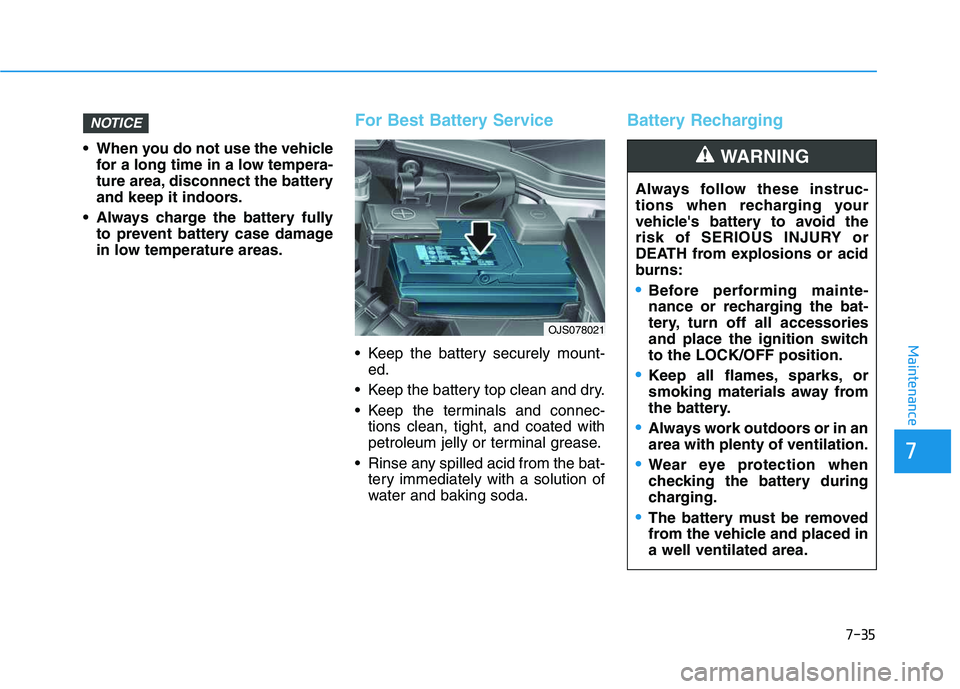
For Best Battery Service
Keep the battery securely mount-
ed.
Keep the battery top clean and dry.
Keep the terminals and connec-
tions clean, tight, and coated with
petroleum jelly or terminal grease.
Rinse any spilled acid from the bat-
tery immediately with a solution of
water and baking soda.
Battery RechargingNOTICE
Always follow these instruc-
tions when recharging your
vehicle's battery to avoid the
risk of SERIOUS INJURY or
DEATH from explosions or acid
burns:
Before performing mainte-
nance or recharging the bat-
tery, turn off all accessories
and place the ignition switch
to the LOCK/OFF position.
Keep all flames, sparks, or
smoking materials away from
the battery.
Always work outdoors or in an
area with plenty of ventilation.
Wear eye protection when
checking the battery during
charging.
The battery must be removed
from the vehicle and placed in
a well ventilated area.
WARNING
OJS078021
Page 410 of 480

7-41
7
Maintenance
Tire Replacement
If the tire is worn evenly, a tread wear
indicator will appear as a solid band
across the tread. This shows there is
less than 1.6 mm (2/32 inch) of tread
left on the tire. Replace the tire when
this happens.
Do not wait for the tread surface to
become level with the tread wear
indicators before replacing the tire.
OLMB073027
Tread wear indicatorTo reduce the risk of DEATH or
SERIOUS INJURY:
Replace tires that are worn,
show uneven wear, or are
damaged. Worn tires can
cause loss of braking effec-
tiveness, steering control, and
traction.
Always replace tires with the
same size as each tire that
was originally supplied with
this vehicle. Using tires and
wheels other than the recom-
mended sizes could cause
unusual handling characteris-
tics, poor vehicle control, or
negatively affect your vehi-
cle's Anti-Lock Brake System
(ABS) resulting in a serious
accident.
WARNING Tires degrade over time, even
when they are not being used.
Regardless of the remaining
tread, HYUNDAI recommends
that tires be replaced after six
(6) years of normal service.
When replacing tires (or
wheels), it is recommended to
replace the two front or two
rear tires (or wheels) as a pair.
Replacing just one tire can
seriously affect your vehicle's
handling. If only replacing one
pair of tires, it is recommend-
ed to install the pair of new
tires on the rear axle.
Heat caused by hot climates
or frequent high loading con-
ditions can accelerate the
aging process. Failure to fol-
low this warning may cause
sudden tire failure, which
could lead to a loss of vehicle
control resulting in an acci-
dent.
Page 414 of 480
7-45
7
Maintenance
6. Maximum load rating
This number indicates the maximum
load in kilograms and pounds that
can be carried by the tire. When
replacing the tires on the vehicle,
always use a tire that has the same
load rating as the factory installed
tire.
7. Uniform tire quality grading
Quality grades can be found where
applicable on the tire sidewall
between tread shoulder and maxi-
mum section width.
For example:
TREAD WEAR 200
TRACTION AA
TEMPERATURE A
Tread wear
The tread wear grade is a compara-
tive rating based on the wear rate of
the tire when tested under controlled
conditions on a specified govern-
ment test course. For example, a tire
graded 150 would wear one-and-a-
half times (1½) as well on the gov-
ernment course as a tire graded 100.
The relative performance of tires
depends upon the actual conditions
of their use, however, and may
depart significantly from the norm
due to variations in driving habits,
service practices and differences in
road characteristics and climate.
These grades are molded on the
sidewalls of passenger vehicle tires.
The tires available as standard or
optional equipment on your vehicle
may vary with respect to grade.
Traction - AA, A, B & C
The traction grades, from highest to
lowest, are AA, A, B and C. Those
grades represent the tire's ability to
stop on wet pavement as measured
under controlled conditions on spec-
ified government test surfaces of
asphalt and concrete. A tire marked
C may have poor traction perform-
ance.
The traction grade assigned to
this tire is based on straight-
ahead braking traction tests,
and does not include accelera-
tion, cornering, hydroplaning,
or peak traction characteristics.
WARNING
Page 443 of 480
![HYUNDAI VELOSTER 2020 Owners Manual 7-74
Maintenance
[A] : Stop/Tail lamp [B] : Turn signal lamp
6. Remove the bulb from the socket
by pressing it in and rotating it
counterclockwise until the tabs on
the bulb align with the slots in th](/img/35/58890/w960_58890-442.png "HYUNDAI VELOSTER 2020 Owners Manual 7-74
Maintenance
[A] : Stop/Tail lamp [B] : Turn signal lamp
6. Remove the bulb from the socket
by pressing it in and rotating it
counterclockwise until the tabs on
the bulb align with the slots in th")
7-74
Maintenance
[A] : Stop/Tail lamp [B] : Turn signal lamp
6. Remove the bulb from the socket
by pressing it in and rotating it
counterclockwise until the tabs on
the bulb align with the slots in the
socket. Pull the bulb out of the
socket.7. Insert a new bulb by inserting it
into the socket and rotating it until
it locks into place.
8. Install the socket into the assem-
bly by aligning the tabs on the
socket with the slots in the assem-
bly. Push the socket into the
assembly and turn the socket
clockwise.
9. Reinstall the lamp assembly to the
body of the vehicle.
Tail lamp and backup lamp
1. Turn off the engine.
2. Open the tailgate.
3. Remove the service cover using a
flat-blade screwdriver.
OJS078034OJS078035L
■Type A
OJS078036L
■Type B
Page 444 of 480
![HYUNDAI VELOSTER 2020 Owners Manual 7-75
7
Maintenance
[A] : Tail lamp [B] : Backup lamp
4. Remove the socket from the
assembly by turning the socket
counterclockwise until the tabs on
the socket align with the slots on
the assembly.5.](/img/35/58890/w960_58890-443.png "HYUNDAI VELOSTER 2020 Owners Manual 7-75
7
Maintenance
[A] : Tail lamp [B] : Backup lamp
4. Remove the socket from the
assembly by turning the socket
counterclockwise until the tabs on
the socket align with the slots on
the assembly.5.")
7-75
7
Maintenance
[A] : Tail lamp [B] : Backup lamp
4. Remove the socket from the
assembly by turning the socket
counterclockwise until the tabs on
the socket align with the slots on
the assembly.5. Remove the bulb from the socket
by pressing it in and rotating it
counterclockwise until the tabs on
the bulb align with the slots in the
socket. Pull the bulb out of the
socket.
6. Insert a new bulb by inserting it
into the socket and rotating it until
it locks into place.
7. Install the socket into the assem-
bly by aligning the tabs on the
socket with the slots in the assem-
bly. Push the socket into the
assembly and turn the socket
clockwise.
8. Reinstall the lamp assembly to the
body of the vehicle.
Side marker
1. Turn off the engine.
2. Open the tailgate.
3. Remove the service cover using a
flat-blade screwdriver.
4. Remove the rear combination light
assembly from the body of the
vehicle.
5. Remove the socket from the
assembly by turning the socket
counterclock wise until the tabs on
the socket align with the slots on
the assembly.
OJS078037L
■Type A
OJS078038L
■Type B
OJS078071N
Page 455 of 480
7-86
Maintenance
The emission control system of your
vehicle is covered by a written limited
warranty. Please see the warranty
information contained in the Service
Passport in your vehicle.
Your vehicle is equipped with an
emission control system to meet all
applicable emission regulations.
There are three emission control
systems, as follows.
(1) Crankcase emission control sys-
tem
(2) Evaporative emission control sys-
tem
(3) Exhaust emission control system
In order to ensure the proper func-
tion of the emission control systems,
it is recommended that you have
your vehicle inspected and main-
tained by an authorized HYUNDAI
dealer in accordance with the main-
tenance schedule in this manual.For the Inspection and
Maintenance Test (with Electronic
Stability Control (ESC) system)
To prevent the vehicle from mis-
firing during dynamometer test-
ing, turn the Electronic Stability
Control (ESC) system off by
pressing the ESC switch (ESC
OFF light illuminated).
After dynamometer testing is
completed, turn the ESC system
back on by pressing the ESC
switch again.
1. Crankcase Emission Control
System
The positive crankcase ventilation
system is employed to prevent air
pollution caused by blow-by gases
being emitted from the crankcase.
This system supplies fresh filtered air
to the crankcase through the air
intake hose. Inside the crankcase,
the fresh air mixes with blow-by
gases, which then pass through the
PCV valve into the induction system.
2. Evaporative Emission Control
System Including Onboard
Refueling Vapor Recovery
(ORVR)
The Evaporative Emission Control
System is designed to prevent fuel
vapors from escaping into the atmos-
phere. The ORVR system is
designed to allow the vapors from
the fuel tank to be loaded into a can-
ister while refueling at the gas sta-
tion, preventing the escape of fuel
vapors into the atmosphere.
NOTICE
E EM
MI
IS
SS
SI
IO
ON
N
C
CO
ON
NT
TR
RO
OL
L
S
SY
YS
ST
TE
EM
M
Page 466 of 480
8-8
Specifications
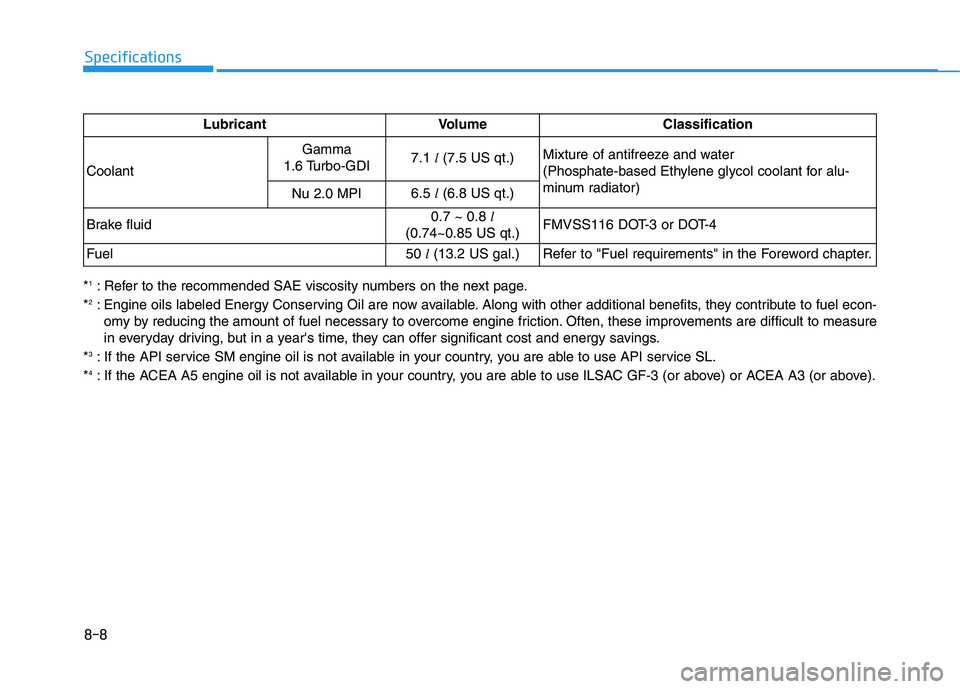
*1: Refer to the recommended SAE viscosity numbers on the next page.
*2: Engine oils labeled Energy Conserving Oil are now available. Along with other additional benefits, they contribute to fuel econ-
omy by reducing the amount of fuel necessary to overcome engine friction. Often, these improvements are difficult to measure
in everyday driving, but in a year's time, they can offer significant cost and energy savings.
*
3: If the API service SM engine oil is not available in your country, you are able to use API service SL.
*4: If the ACEA A5 engine oil is not available in your country, you are able to use ILSAC GF-3 (or above) or ACEA A3 (or above).Lubricant
Volume Classification
CoolantGamma
1.6 Turbo-GDI
7.1 l(7.5 US qt.)Mixture of antifreeze and water
(Phosphate-based Ethylene glycol coolant for alu-
minum radiator)
Nu 2.0 MPI
6.5 l(6.8 US qt.)
Brake fluid
0.7 ~ 0.8 l
(0.74~0.85 US qt.)FMVSS116 DOT-3 or DOT-4
Fuel50 l(13.2 US gal.)Refer to "Fuel requirements" in the Foreword chapter.