height HYUNDAI VELOSTER 2021 Owner's Manual
[x] Cancel search | Manufacturer: HYUNDAI, Model Year: 2021, Model line: VELOSTER, Model: HYUNDAI VELOSTER 2021Pages: 482, PDF Size: 37.54 MB
Page 277 of 482
5-61
Driving your vehicle
5
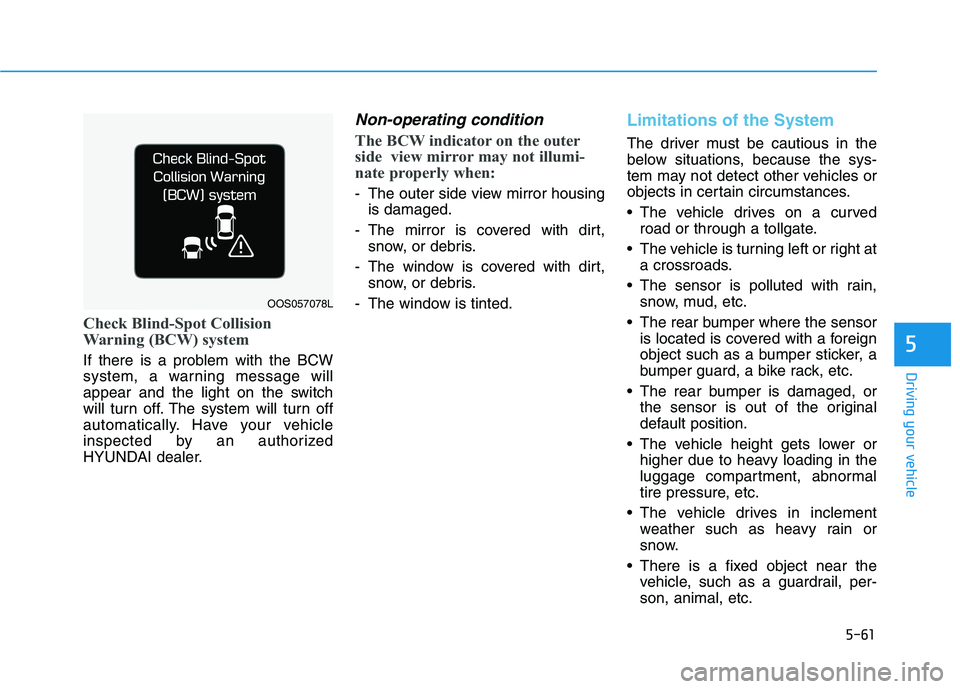
Check Blind-Spot Collision
Warning (BCW) system
If there is a problem with the BCW
system, a warning message will
appear and the light on the switch
will turn off. The system will turn off
automatically. Have your vehicle
inspected by an authorized
HYUNDAI dealer.
Non-operating condition
The BCW indicator on the outer
side view mirror may not illumi-
nate properly when:
- The outer side view mirror housing
is damaged.
- The mirror is covered with dirt,
snow, or debris.
- The window is covered with dirt,
snow, or debris.
- The window is tinted.
Limitations of the System
The driver must be cautious in the
below situations, because the sys-
tem may not detect other vehicles or
objects in certain circumstances.
The vehicle drives on a curved
road or through a tollgate.
The vehicle is turning left or right at
a crossroads.
The sensor is polluted with rain,
snow, mud, etc.
The rear bumper where the sensor
is located is covered with a foreign
object such as a bumper sticker, a
bumper guard, a bike rack, etc.
The rear bumper is damaged, or
the sensor is out of the original
default position.
The vehicle height gets lower or
higher due to heavy loading in the
luggage compartment, abnormal
tire pressure, etc.
The vehicle drives in inclement
weather such as heavy rain or
snow.
There is a fixed object near the
vehicle, such as a guardrail, per-
son, animal, etc.
OOS057078L
Page 278 of 482
5-62
Driving your vehicle
The vehicle is driven near areas
containing metal substances such
as a construction zone, railroad,
etc.
A big vehicle is near such as a bus
or truck.
A motorcycle or bicycle is near.
A flat trailer is near.
If the vehicle has started at the
same time as the vehicle next to
you and has accelerated.
When the other vehicle passes at a
very fast speed.
While changing lanes.
While going down or up a steep
road where the height of the lane is
different.
When the other vehicle approach-
es very close.
When the temperature near the
rear bumper area is high or low.
When the sensors are blocked by
other vehicles, walls or parking-lot
pillars. When the detected vehicle also
moves back, as your vehicle drives
back.
If there are small objects in the
detecting area such as a shopping
cart or a baby stroller.
If there is a low height vehicle such
as a sports car.
When other vehicles are close to
your vehicle.
When the vehicle in the next lane
moves two lanes away from you
OR when the vehicle two lanes
away moves to the next lane to
you.
When driving through a narrow
road with many trees or bushes.
When driving through a large area
with few vehicles or structures
around, such as a desert, rural
area, etc.
When driving on wet surfaces.
Information
This device complies with Part 15 of
the FCC rules.
Operation is subject to the following
two conditions:
1. This device may not cause harmful
interference.
2. This device must accept any inter-
ference received, including interfer-
ence that may cause undesired
operation.
i
Page 334 of 482
5-118
Driving your vehicle
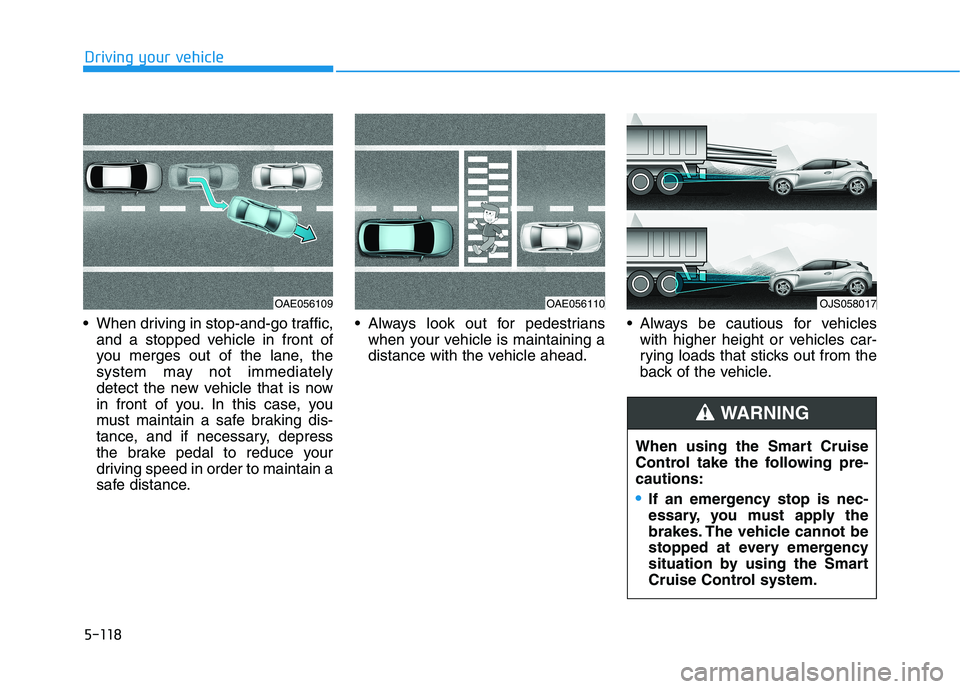
When driving in stop-and-go traffic,
and a stopped vehicle in front of
you merges out of the lane, the
system may not immediately
detect the new vehicle that is now
in front of you. In this case, you
must maintain a safe braking dis-
tance, and if necessary, depress
the brake pedal to reduce your
driving speed in order to maintain a
safe distance. Always look out for pedestrians
when your vehicle is maintaining a
distance with the vehicle ahead. Always be cautious for vehicles
with higher height or vehicles car-
rying loads that sticks out from the
back of the vehicle.
OAE056110OJS058017
When using the Smart Cruise
Control take the following pre-
cautions:
If an emergency stop is nec-
essary, you must apply the
brakes. The vehicle cannot be
stopped at every emergency
situation by using the Smart
Cruise Control system.
WARNING
OAE056109
Page 422 of 482
7-43
7
Maintenance
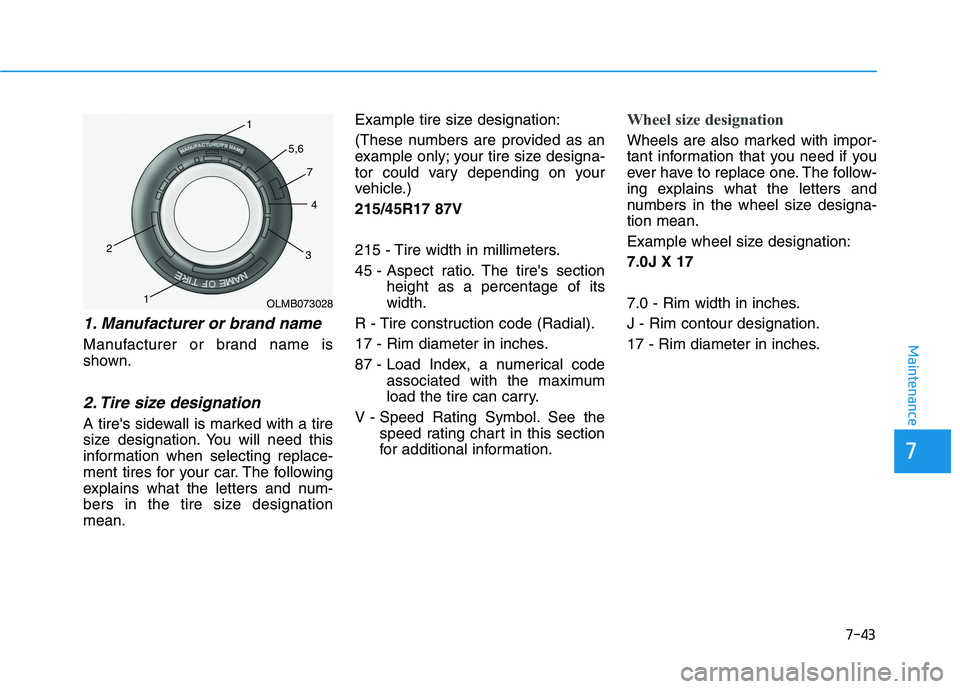
1. Manufacturer or brand name
Manufacturer or brand name is
shown.
2. Tire size designation
A tire's sidewall is marked with a tire
size designation. You will need this
information when selecting replace-
ment tires for your car. The following
explains what the letters and num-
bers in the tire size designation
mean.Example tire size designation:
(These numbers are provided as an
example only; your tire size designa-
tor could vary depending on your
vehicle.)
215/45R17 87V
215 - Tire width in millimeters.
45 - Aspect ratio. The tire's section
height as a percentage of its
width.
R - Tire construction code (Radial).
17 - Rim diameter in inches.
87 - Load Index, a numerical code
associated with the maximum
load the tire can carry.
V - Speed Rating Symbol. See the
speed rating chart in this section
for additional information.
Wheel size designation
Wheels are also marked with impor-
tant information that you need if you
ever have to replace one. The follow-
ing explains what the letters and
numbers in the wheel size designa-
tion mean.
Example wheel size designation:
7.0J X 17
7.0 - Rim width in inches.
J - Rim contour designation.
17 - Rim diameter in inches.
OLMB073028 1
1 2
34 5,6
7
Page 425 of 482
7-46
Maintenance
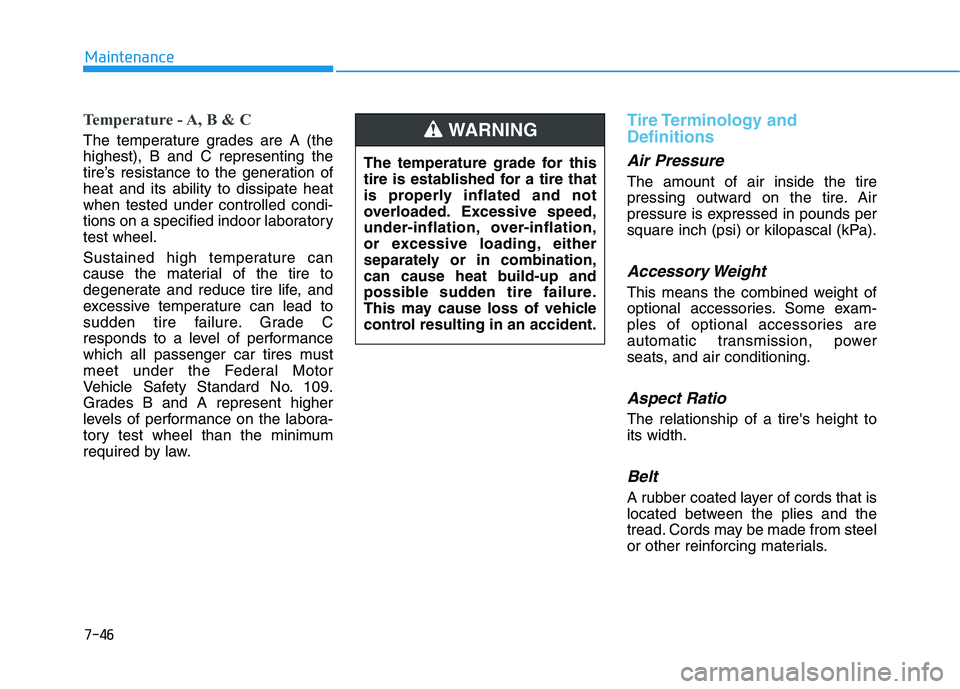
Temperature - A, B & C
The temperature grades are A (the
highest), B and C representing the
tire’s resistance to the generation of
heat and its ability to dissipate heat
when tested under controlled condi-
tions on a specified indoor laboratory
test wheel.
Sustained high temperature can
cause the material of the tire to
degenerate and reduce tire life, and
excessive temperature can lead to
sudden tire failure. Grade C
responds to a level of performance
which all passenger car tires must
meet under the Federal Motor
Vehicle Safety Standard No. 109.
Grades B and A represent higher
levels of performance on the labora-
tory test wheel than the minimum
required by law.
Tire Terminology and
Definitions
Air Pressure
The amount of air inside the tire
pressing outward on the tire. Air
pressure is expressed in pounds per
square inch (psi) or kilopascal (kPa).
Accessory Weight
This means the combined weight of
optional accessories. Some exam-
ples of optional accessories are
automatic transmission, power
seats, and air conditioning.
Aspect Ratio
The relationship of a tire's height to
its width.
Belt
A rubber coated layer of cords that is
located between the plies and the
tread. Cords may be made from steel
or other reinforcing materials. The temperature grade for this
tire is established for a tire that
is properly inflated and not
overloaded. Excessive speed,
under-inflation, over-inflation,
or excessive loading, either
separately or in combination,
can cause heat build-up and
possible sudden tire failure.
This may cause loss of vehicle
control resulting in an accident.
WARNING
Page 471 of 482
D DI
IM
ME
EN
NS
SI
IO
ON
NS
S
8-2
Specifications, Consumer information and Reporting safety defects
E
EN
NG
GI
IN
NE
E
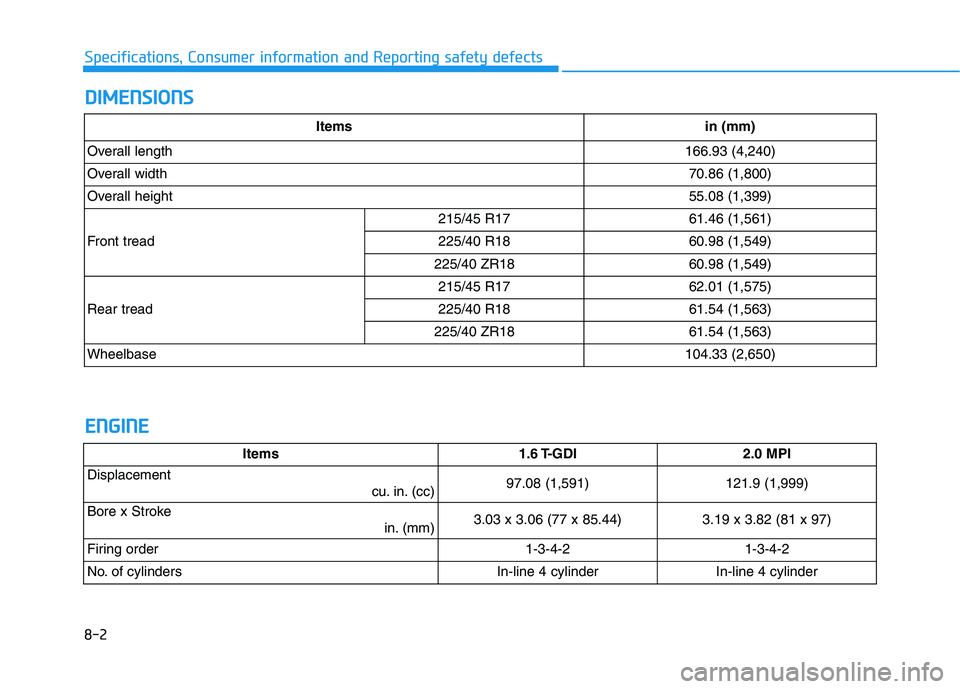
Items 1.6 T-GDI2.0 MPI
Displacement
cu. in. (cc)97.08 (1,591)121.9 (1,999)
Bore x Stroke
in. (mm)3.03 x 3.06 (77 x 85.44)3.19 x 3.82 (81 x 97)
Firing order1-3-4-21-3-4-2
No. of cylindersIn-line 4 cylinderIn-line 4 cylinder
Itemsin (mm)
Overall length166.93 (4,240)
Overall width70.86 (1,800)
Overall height55.08 (1,399)
Front tread
215/45 R1761.46 (1,561)
225/40 R1860.98 (1,549)
225/40 ZR1860.98 (1,549)
Rear tread
215/45 R1762.01 (1,575)
225/40 R1861.54 (1,563)
225/40 ZR1861.54 (1,563)
Wheelbase104.33 (2,650)