headlamp HYUNDAI VELOSTER 2022 User Guide
[x] Cancel search | Manufacturer: HYUNDAI, Model Year: 2022, Model line: VELOSTER, Model: HYUNDAI VELOSTER 2022Pages: 446, PDF Size: 7.37 MB
Page 265 of 446
5-71
Driving your vehicle
5
Limitations of the system
Forward Collision-Avoidance Assist
may not operate normally, or the sys-
tem may operate unexpectedly
under the following circumstances:
• The detecting sensor or the sur-
roundings are contaminated or
damaged
• The temperature around the front
view camera is high or low
• The camera lens is contaminated
due to tinted, filmed or coated
windshield, damaged glass, or
stuck of foreign material (sticker,
bug, etc.) on the glass
• Moisture is not removed or frozen
on the windshield
• Washer fluid is continuously
sprayed, or the wiper is on
• Driving in heavy rain or snow, or
thick fog
• The field of view of the front view
camera is obstructed by sun glare
• Street light or light from an oncom-
ing vehicle is reflected on the wet
road surface, such as a puddle on
the road• An object is placed on the dash-
board
• Your vehicle is being towed
• The surrounding is very bright
• The surrounding is very dark, such
as in a tunnel, etc.
• The brightness changes suddenly,
for example when entering or exit-
ing a tunnel
• The brightness outside is low, and
the headlamps are not on or are
not bright
• Driving through steam, smoke or
shadow
• Only part of the vehicle, pedestrian
is detected
• The vehicle in front is a bus, heavy
truck, truck with a unusually
shaped luggage, trailer, etc.
• The vehicle in front has no tail
lights, tail lights are located unusu-
ally, etc.
• The brightness outside is low, and
the tail lamps are not on or are not
bright • The rear of the front vehicle is
small or the vehicle does not look
normal, such as when the vehicle
is tilted, overturned, or the side of
the vehicle is visble, etc.
• The front vehicle’s ground clear-
ance is low or high
• A vehicle, pedestrian suddenly
cuts in front
• The vehicle in front is detected late
• The vehicle in front is suddenly
blocked by a obstacle
• The vehicle in front suddenly
changes lane or suddenly reduces
speed
• The vehicle in front is bent out of
shape
• The front vehicle’s speed is fast or
slow
• The vehicle in front steers in the
opposite direction of your vehicle
to avoid a collision
• With a vehicle in front, your vehicle
changes lane at low speed
• The vehicle in front is covered with
snow
Page 315 of 446
5-121
Driving your vehicle
5
Information
The ESC system must be turned OFF
before rocking the vehicle.
If you are still stuck after rocking
the vehicle a few times, have the
vehicle pulled out by a tow vehicle
to avoid engine overheating, pos-
sible damage to the transmission,
and tire damage. See "Towing" in
chapter 6.
Smooth Cornering
Avoid braking or gear changing in
corners, especially when roads are
wet. Ideally, corners should always
be taken under gentle acceleration.
Driving at Night
Night driving presents more hazards
than driving in the daylight. Here are
some important tips to remember:
• Slow down and keep more dis-
tance between you and other vehi-
cles, as it may be more difficult to
see at night, especially in areas
where there may not be any street
lights.
• Adjust your mirrors to reduce the
glare from other driver's head-
lamps.
• Keep your headlamps clean and
properly aimed. Dirty or improperly
aimed headlamps will make it
much more difficult to see at night.
• Avoid staring directly at the head-
lamps of oncoming vehicles. You
could be temporarily blinded, and it
will take several seconds for your
eyes to readjust to the darkness.
Driving in the Rain
Rain and wet roads can make driving
dangerous. Here are a few things to
consider when driving in the rain or
on slick pavement:
• Slow down and allow extra follow-
ing distance. A heavy rainfall
makes it harder to see and increas-
es the distance needed to stop
your vehicle.
• Turn OFF your Cruise Control.
• Replace your windshield wiper
blades when they show signs of
streaking or missing areas on the
windshield.
• Tires should be properly main-
tained with at least 2/32nds of an
inch of tread depth. If your tires do
not have enough tread, making a
quick stop on wet pavement can
cause a skid and possibly lead to
an accident.See "Tire
Replacement" in chapter 7.
• Turn on your headlamps to make it
easier for others to see you.
NOTICE
i
Page 354 of 446
7
Tire Terminology and Definitions................................7-41
All Season Tires ...............................................................7-44
Summer Tires ...................................................................7-44
Snow Tires ........................................................................7-45
Radial-Ply Tires ...............................................................7-45
Low Aspect Ratio Tires..................................................7-45
Fuses ......................................................................7-47
Instrument Panel Fuse Replacement..........................7-48
Engine Compartment Panel Fuse Replacement.......7-49
Fuse/Relay Panel Description ......................................7-51
Light Bulbs ............................................................7-61
Headlamp, Parking lamp, Daytime Running Light,
Turn signal lamp and Side marker ..............................7-62
Side Repeater Lamp Replacement ..............................7-65
Rear Combination Light Bulb Replacement ..............7-65
High Mounted Stop Lamp Replacement ....................7-68
License Plate Light Bulb Replacement ......................7-68
Interior Light Bulb Replacement .................................7-68
Appearance Care..................................................7-70
Exterior Care ....................................................................7-70
Interior Care .....................................................................7-75
Emission Control System ....................................7-78
Crankcase Emission Control System ..........................7-78
Evaporative Emission Control System
Including Onboard Refueling Vapor Recovery
(ORVR)................................................................................7-78
Exhaust Emission Control System ..............................7-79
California Perchlorate Notice.............................7-82
Page 358 of 446
7-6
Maintenance
Owner Maintenance Schedule
When you stop for fuel:
• Check the coolant level in the
engine coolant reservoir.
• Check the windshield washer fluid
level.
• Check the for low or under-inflated
tires.
While operating your vehicle:
• Note any changes in the sound of
the exhaust or any smell of
exhaust fumes in the vehicle.
• Check for vibrations in the steering
wheel. Notice if there is any
increased steering effort or loose-
ness in the steering wheel, or
change in its straight-ahead posi-
tion.
• Notice if your vehicle constantly
turns slightly or "pulls" to one side
when traveling on smooth, level
road.
• When stopping, listen and check
for unusual sounds, pulling to one
side, increased brake pedal travel
or "hard-to-push" brake pedal.
• If any slipping or changes in the
operation of your transmission
occurs, check the transmission
fluid level.
• Check the parking brake.
• Check for fluid leaks under your
vehicle (water dripping from the air
conditioning system during or after
use is normal).
At least monthly:
• Check coolant level in the engine
coolant reservoir.
• Check the operation of all exterior
lights, including the brake lights,
turn signals and hazard warning
flashers.
• Check the inflation pressures of all
tires including the spare for tires
that are worn, show uneven wear,
or are damaged.
• Check for loose wheel lug nuts.
At least twice a year:
(i.e., every Spring and Autumn)
• Check radiator, heater and air con-
ditioning hoses for leaks or dam-
age.
• Check windshield washer spray
and wiper operation. Clean wiper
blades with a clean cloth damp-
ened with washer a fluid.
• Check headlamp alignment.
• Check muffler, exhaust pipes,
shields and clamps.
• Check the seat belts for wear and
function. Be careful when checking your
engine coolant level when the
engine is hot. This may result in
coolant being blown out of the
opening and cause serious
burns and other injuries.
WARNING
Page 400 of 446
7-48
Maintenance
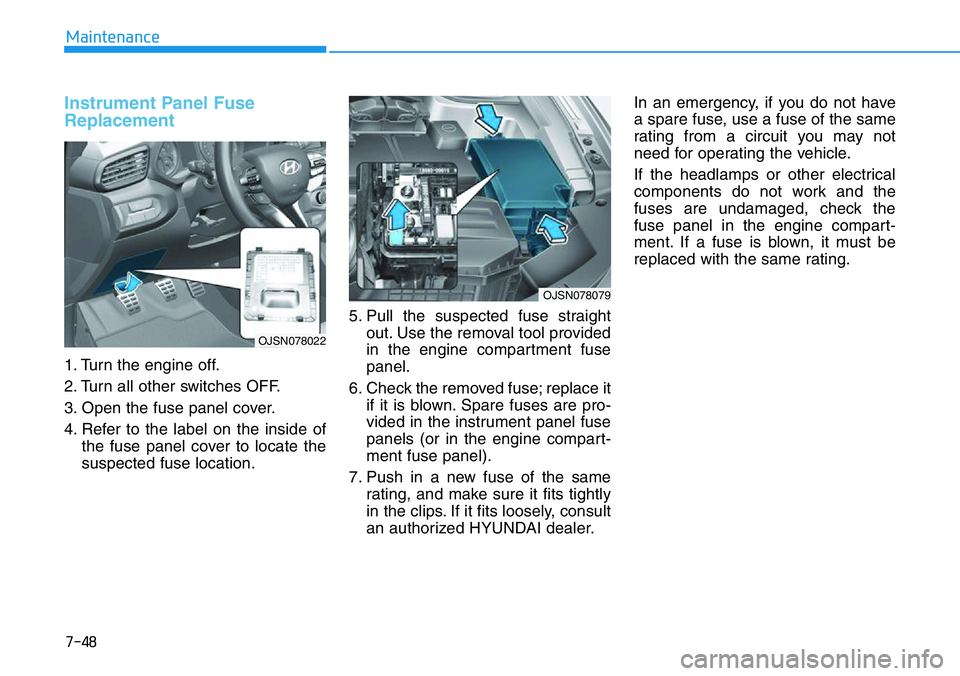
Instrument Panel Fuse
Replacement
1. Turn the engine off.
2. Turn all other switches OFF.
3. Open the fuse panel cover.
4. Refer to the label on the inside of
the fuse panel cover to locate the
suspected fuse location.5. Pull the suspected fuse straight
out. Use the removal tool provided
in the engine compartment fuse
panel.
6. Check the removed fuse; replace it
if it is blown. Spare fuses are pro-
vided in the instrument panel fuse
panels (or in the engine compart-
ment fuse panel).
7. Push in a new fuse of the same
rating, and make sure it fits tightly
in the clips. If it fits loosely, consult
an authorized HYUNDAI dealer.In an emergency, if you do not have
a spare fuse, use a fuse of the same
rating from a circuit you may not
need for operating the vehicle.
If the headlamps or other electrical
components do not work and the
fuses are undamaged, check the
fuse panel in the engine compart-
ment. If a fuse is blown, it must be
replaced with the same rating.
OJSN078079
OJSN078022
Page 413 of 446
7-61
7
Maintenance
LIGHT BULBS
Consult an authorized HYUNDAI
dealer to replace most vehicle light
bulbs. It is difficult to replace vehicle
light bulbs because other parts of the
vehicle must be removed before you
can get to the bulb. This is especially
true for removing the headlamp
assembly to get to the bulb(s).
Removing/installing the headlamp
assembly can result in damage to
the vehicle.
Information
The headlamp and tail lamp lenses
could appear frosty if the vehicle is
washed after driving or the vehicle is
driven at night in wet weather. This
condition is caused by temperature
difference between the lamp inside
and outside and, it does not indicate a
problem with your vehicle. When
moisture condenses in the lamp, it will
be removed after driving with the
headlamp on. The removable level
may differ depending on lamp size,
lamp position and environmental con-
dition. However, if moisture is not
removed, we recommend that your
vehicle is inspected by an authorized
HYUNDAI dealer.
Information - Desiccant
(if equipped)
This vehicle is equipped with desic-
cant to reduce fogging inside the head-
lamp due to moisture.
The desiccant is consumable and its
performance may change based on the
used period or environment.
If fogging inside the headlamp due to
moisture continues for a long time,
have your vehicle checked by an
authorized HYUNDAI dealer. Light replacement
Be sure to replace the burned out
bulb with one of the same wattage
rating. Otherwise, it may cause
damage to the fuse or electric
wiring system.
Headlamp lens
To prevent damage, do not clean
the headlamp lens with chemical
solvents or strong detergents.
NOTICE
NOTICEi
i
Page 414 of 446
7-62
Maintenance
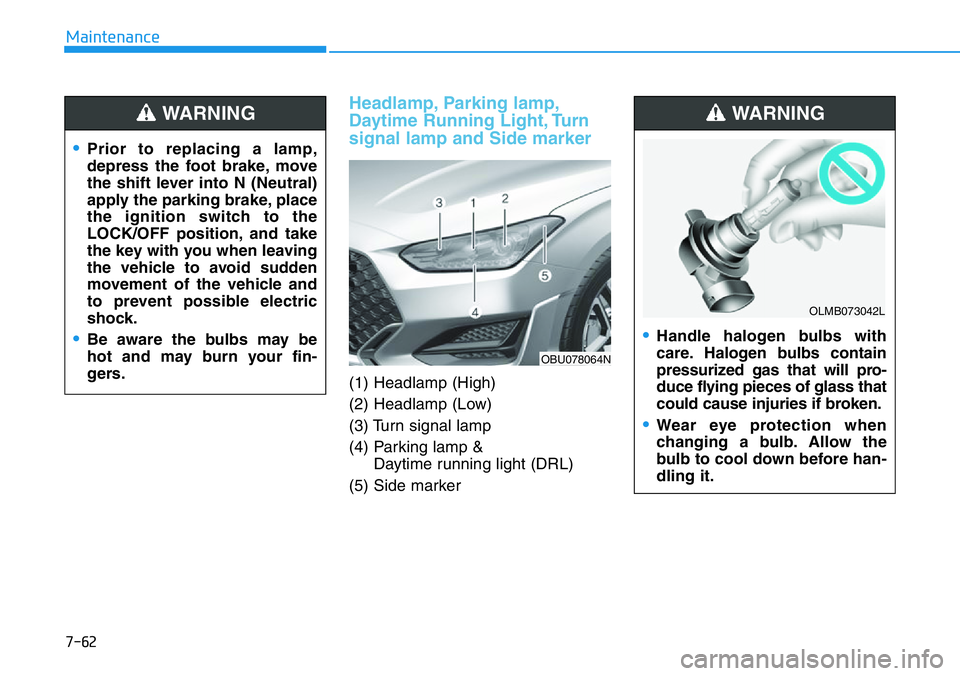
Headlamp, Parking lamp,
Daytime Running Light, Turn
signal lamp and Side marker
(1) Headlamp (High)
(2) Headlamp (Low)
(3) Turn signal lamp
(4) Parking lamp &
Daytime running light (DRL)
(5) Side marker
OBU078064N
•Handle halogen bulbs with
care. Halogen bulbs contain
pressurized gas that will pro-
duce flying pieces of glass that
could cause injuries if broken.
•Wear eye protection when
changing a bulb. Allow the
bulb to cool down before han-
dling it.
WARNING
OLMB073042L
•Prior to replacing a lamp,
depress the foot brake, move
the shift lever into N (Neutral)
apply the parking brake, place
the ignition switch to the
LOCK/OFF position, and take
the key with you when leaving
the vehicle to avoid sudden
movement of the vehicle and
to prevent possible electric
shock.
•Be aware the bulbs may be
hot and may burn your fin-
gers.
WARNING
Page 415 of 446
7-63
7
Maintenance
• Always handle them carefully, and
avoid scratches and abrasions. If
the bulbs are lit, avoid contact with
liquids.
• Never touch the glass with bare
hands. Residual oil may cause the
bulb to overheat and burst when lit.
• A bulb should be operated only
when installed in a headlamp.
• If a bulb becomes damaged or
cracked, replace it immediately
and carefully dispose of it.Headlamp (Low beam), side mark-
er, parking lamp and daytime run-
ning light
If the LED lamp does not operate,
have the system be checked by an
authorized HYUNDAI dealer.
The LED lamps cannot be replaced
as a single unit because it is an inte-
grated unit. The LED lamps has to be
replaced with the unit.
A skilled technician should check or
repair the LED lamp, for it may dam-
age related parts of the vehicle.
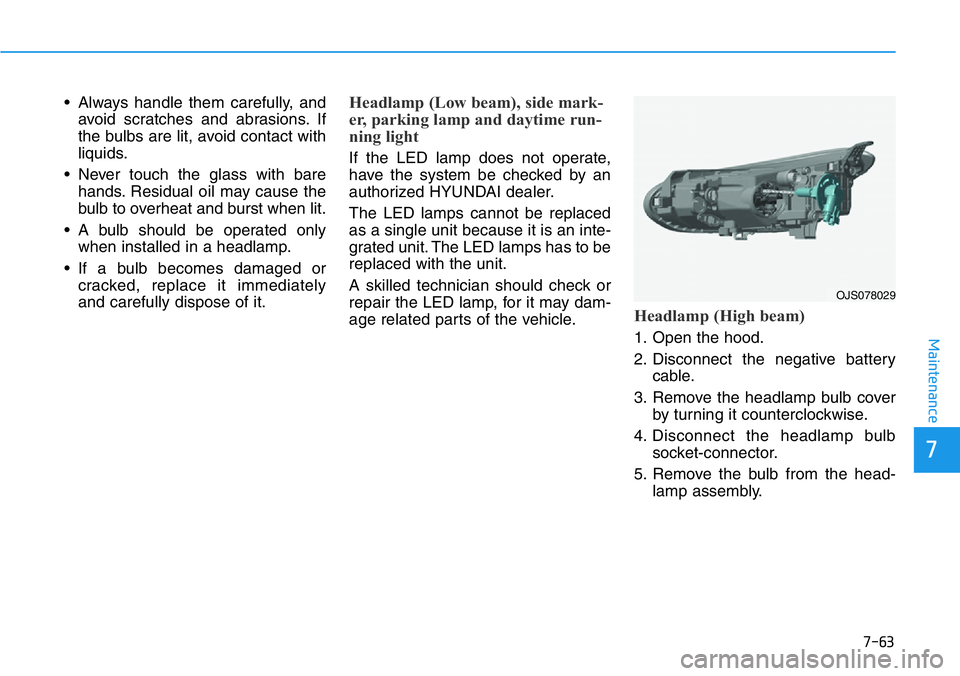
Headlamp (High beam)
1. Open the hood.
2. Disconnect the negative battery
cable.
3. Remove the headlamp bulb cover
by turning it counterclockwise.
4. Disconnect the headlamp bulb
socket-connector.
5. Remove the bulb from the head-
lamp assembly.
OJS078029
Page 416 of 446
7-64
Maintenance
6. Install a new headlamp bulb and
snap the headlamp bulb retaining
wire into position by aligning the
wire with the groove on the bulb.
7. Connect the headlamp bulb sock-
et-connector.
8. Install the headlamp bulb cover by
turning it clockwise.
Information
The headlamp aiming should be
adjusted after an accident or after the
headlamp assembly is reinstalled at an
authorized HYUNDAI dealer.
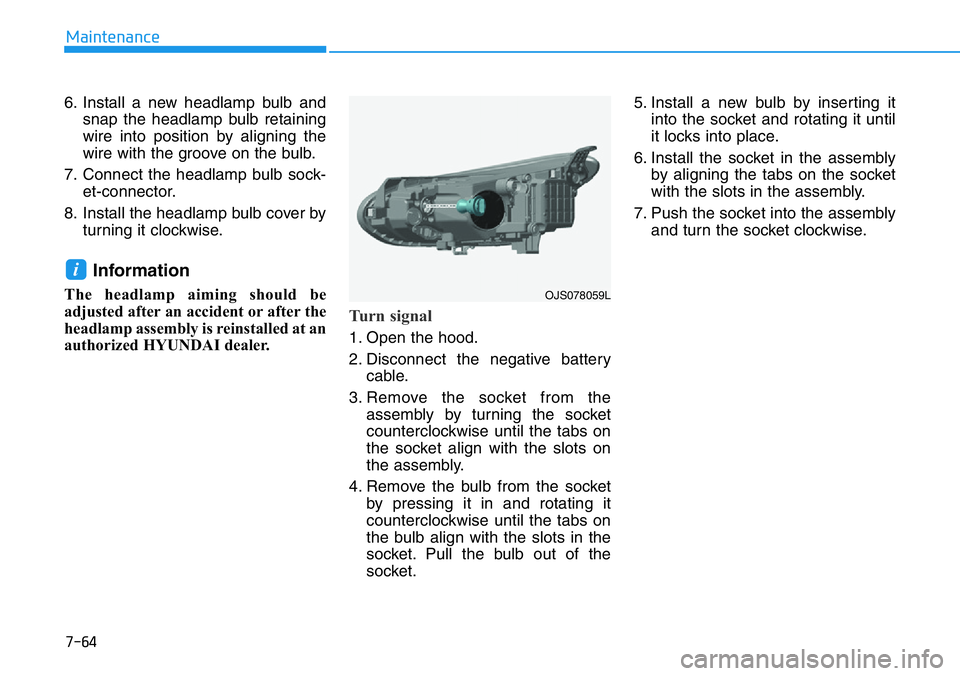
Turn signal
1. Open the hood.
2. Disconnect the negative battery
cable.
3. Remove the socket from the
assembly by turning the socket
counterclockwise until the tabs on
the socket align with the slots on
the assembly.
4. Remove the bulb from the socket
by pressing it in and rotating it
counterclockwise until the tabs on
the bulb align with the slots in the
socket. Pull the bulb out of the
socket.5. Install a new bulb by inserting it
into the socket and rotating it until
it locks into place.
6. Install the socket in the assembly
by aligning the tabs on the socket
with the slots in the assembly.
7. Push the socket into the assembly
and turn the socket clockwise.
i
OJS078059L
Page 437 of 446
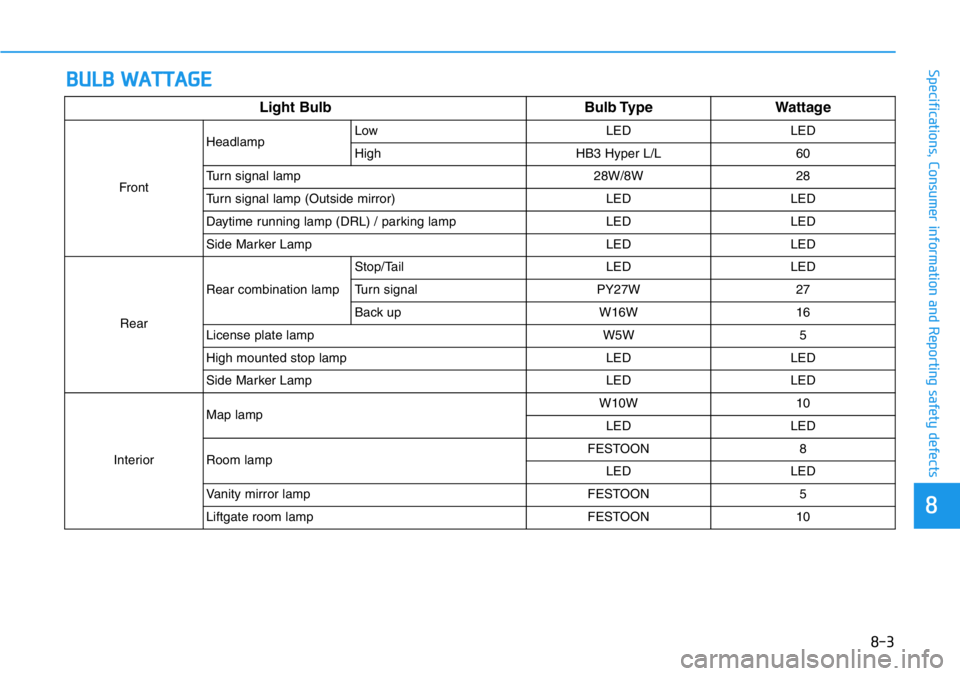
BULB WATTAGE
88
Specifications, Consumer information and Reporting safety defects
8-3 Light Bulb Bulb Type Wattage
FrontHeadlampLow LED LED
High HB3 Hyper L/L 60
Turn signal lamp 28W/8W 28
Turn signal lamp (Outside mirror) LED LED
Daytime running lamp (DRL) / parking lamp LED LED
Side Marker Lamp LED LED
RearRear combination lampStop/Tail LED LED
Turn signal PY27W 27
Back up W16W 16
License plate lamp W5W 5
High mounted stop lamp LED LED
Side Marker Lamp LED LED
InteriorMap lampW10W 10
LED LED
Room lampFESTOON 8
LED LED
Vanity mirror lamp FESTOON 5
Liftgate room lamp FESTOON 10