seats HYUNDAI VERACRUZ 2007 Owner's Manual
[x] Cancel search | Manufacturer: HYUNDAI, Model Year: 2007, Model line: VERACRUZ, Model: HYUNDAI VERACRUZ 2007Pages: 441, PDF Size: 7.99 MB
Page 69 of 441
349
Safety features of your vehicle
The driver's seat track position sensor,
which is installed on the seat track, deter-
mines if the seat is fore or aft of a refer-
ence position. The seat belt buckle sen-
sors determine if the driver and front pas-
senger's seat belts are fastened. These
sensors provide the ability to control the
SRS deployment based on how close the
driver's seat is to the steering wheel,
whether or not the seat belts are fas-
tened, and how severe the impact is.
The advanced SRS offers the ability to
control the air bag inflation with two lev-
els. A first stage level is provided for
moderate-severity impacts. A second
stage level is provided for more severe
impacts.
According to the impact severity, seating
position and seat belt usage, the SRSCM
(SRS Control Module) controls the air
bag inflation. Failure to properly wear
seat belts can increase the risk or sever-
ity of injury in an accident.Additionally, your vehicle is equipped
with an occupant classification system in
the front passenger's seat. The occupant
classification system detects the pres-
ence of a passenger in the front passen-
ger's seat and will turn off the front pas-
senger's air bag under certain condi-
tions. For more detail, see "Occupant
classification system" in this section.
WARNING
If a seat track position sensor or an
occupant classification system is
not working properly, the SRS air
bag warning light on the instru-
ment panel will illuminate because
the SRS air bag warning light is
connected with the seat track posi-
tion sensor and the occupant clas-
sification system. If the SRS air bag
warning light does not illuminate
when the ignition switch is turned
to the ON position, remains illumi-
nated after approximately 6 sec-
onds when the ignition switch is
turned to the ON position, or if it
illuminates while the vehicle is
being driven, have an authorized
HYUNDAI dealer inspect the
advanced SRS air bag system as
soon as possible.
AIR
BAG
WARNING
Modification to the seat structure
can adversely affect the seat
track position sensor and cause
the air bag to deploy at a different
level than should be provided.
Do not place any objects under-
neath the front seats as they
could damage the seat track
position sensor or interfere with
the occupant classification sys-
tem.
Do not place any objects that may
cause magnetic fields near the
front seat. These may cause a
malfunction of the seat track
position sensor.
EN hma 3.qxd 11/27/2006 5:18 PM Page 49
procarmanuals.com
Page 70 of 441
Safety features of your vehicle50 3✽
✽
NOTICE• Be sure to read information about the
SRS on the labels provided on the sun
visor and in the glove box.
• Advanced air bags are combined with
pre-tensioner seat belts to help pro-
vide enhanced occupant protection in
frontal crashes. Front air bags are not
intended to deploy in collisions in
which protection can be provided by
the pre-tensioner seat belt.
(Continued)
Move your seat as far back as
practical from the front air bags,
while still maintaining control of
the vehicle.
You and your passengers should
never sit or lean unnecessarily
close to the air bags. Improperly
positioned driver and passengers
can be severely injured by inflat-
ing air bags.
Never lean against the door or
center console – always sit in an
upright position.
Do not allow a passenger to ride
in the front seat when the “PAS-
SENGER AIR BAG OFF” indicator
is illuminated, because the air
bag will not deploy in the event of
a moderate or severe frontal
crash.
(Continued)
WARNING
Always use seat belts and child
restraints – every trip, every time,
everyone! Air bags inflate with con-
siderable force and in the blink of
an eye. Seat belts help keep occu-
pants in proper position to obtain
maximum benefit from the air bag.
Even with advanced air bags,
improperly and unbelted occupants
can be severely injured when the
air bag inflates. Always follow the
precautions about seat belts, air
bags and occupant safety con-
tained in this manual.
To reduce the chance of serious or
fatal injuries and receive the maxi-
mum safety benefit from your
restraint system:
Never place a child in any child or
booster seat in the front seat.
ABC – Always Buckle Children in
the back seat. It is the safest
place for children of any age to
ride.
Front and side air bags can injure
occupants improperly positioned
in the front seats.
(Continued)
WARNING
If you are considering modification
of your vehicle due to a disability,
please contact the Hyundai
Customer Assistance Center at 1-
800-633-5151.
EN hma 3.qxd 11/27/2006 5:18 PM Page 50
procarmanuals.com
Page 74 of 441
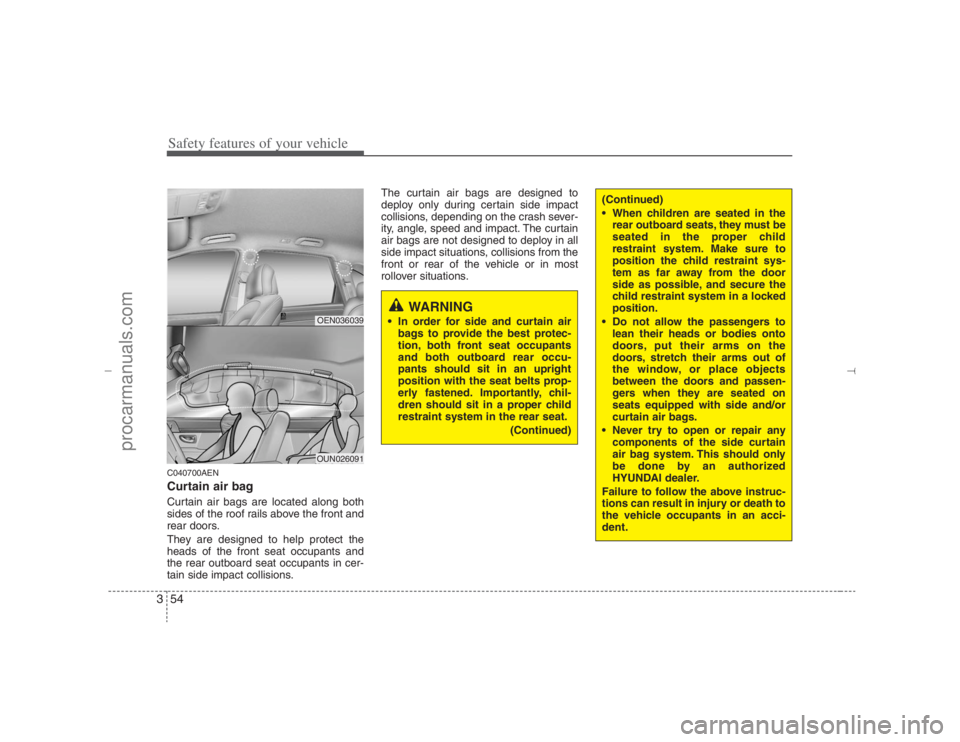
Safety features of your vehicle54 3C040700AENCurtain air bagCurtain air bags are located along both
sides of the roof rails above the front and
rear doors.
They are designed to help protect the
heads of the front seat occupants and
the rear outboard seat occupants in cer-
tain side impact collisions.The curtain air bags are designed to
deploy only during certain side impact
collisions, depending on the crash sever-
ity, angle, speed and impact. The curtain
air bags are not designed to deploy in all
side impact situations, collisions from the
front or rear of the vehicle or in most
rollover situations.
WARNING
In order for side and curtain air
bags to provide the best protec-
tion, both front seat occupants
and both outboard rear occu-
pants should sit in an upright
position with the seat belts prop-
erly fastened. Importantly, chil-
dren should sit in a proper child
restraint system in the rear seat.
(Continued)
(Continued)
When children are seated in the
rear outboard seats, they must be
seated in the proper child
restraint system. Make sure to
position the child restraint sys-
tem as far away from the door
side as possible, and secure the
child restraint system in a locked
position.
Do not allow the passengers to
lean their heads or bodies onto
doors, put their arms on the
doors, stretch their arms out of
the window, or place objects
between the doors and passen-
gers when they are seated on
seats equipped with side and/or
curtain air bags.
Never try to open or repair any
components of the side curtain
air bag system. This should only
be done by an authorized
HYUNDAI dealer.
Failure to follow the above instruc-
tions can result in injury or death to
the vehicle occupants in an acci-
dent.
OEN036039OUN026091
EN hma 3.qxd 11/27/2006 5:18 PM Page 54
procarmanuals.com
Page 81 of 441
361
Safety features of your vehicle
C041300AUNAdditional safety precautionsNever let passengers ride in the
cargo area or on top of a folded-
down back seat.All occupants should
sit upright, fully back in their seats with
their seat belts on and their feet on the
floor.
Passengers should not move out of
or change seats while the vehicle is
moving.A passenger who is not wear-
ing a seat belt during a crash or emer-
gency stop can be thrown against the
inside of the vehicle, against other
occupants, or out of the vehicle.
Each seat belt is designed to
restrain one occupant.If more than
one person uses the same seat belt,
they could be seriously injured or killed
in a collision.
Do not use any accessories on seat
belts.Devices claiming to improve
occupant comfort or reposition the seat
belt can reduce the protection provided
by the seat belt and increase the
chance of serious injury in a crash.
Passengers should not place hard
or sharp objects between them-
selves and the air bags.Carrying
hard or sharp objects on your lap or in
your mouth can result in injuries if an
air bag inflates.Keep occupants away from the air
bag covers.All occupants should sit
upright, fully back in their seats with
their seat belts on and their feet on the
floor. If occupants are too close to the
air bag covers, they could be injured if
the air bags inflate.
Do not attach or place objects on or
near the air bag covers.Any object
attached to or placed on the front or
side air bag covers could interfere with
the proper operation of the air bags.
Do not modify the front seats.
Modification of the front seats could
interfere with the operation of the sup-
plemental restraint system sensing
components or side air bags.
Do not place items under the front
seats.Placing items under the front
seats could interfere with the operation
of the supplemental restraint system
sensing components and wiring har-
nesses.
Never hold an infant or child on your
lap.The infant or child could be seri-
ously injured or killed in the event of a
crash. All infants and children should
be properly restrained in appropriate
child safety seats or seat belts in the
rear seat.
C041400AUNAdding equipment to or modifying
your air bag-equipped vehicleIf you modify your vehicle by changing
your vehicle's frame, bumper system,
front end or side sheet metal or ride
height, this may affect the operation of
your vehicle's air bag system.
WARNING
Sitting improperly or out of posi-
tion can cause occupants to be
shifted too close to a deploying
air bag, strike the interior struc-
ture or be thrown from the vehicle
resulting in serious injury or
death.
Always sit upright with the seat-
back in an upright position, cen-
tered on the seat cushion with
your seat belt on, legs comfort-
ably extended and your feet on
the floor.
EN hma 3.qxd 11/27/2006 5:18 PM Page 61
procarmanuals.com
Page 250 of 441
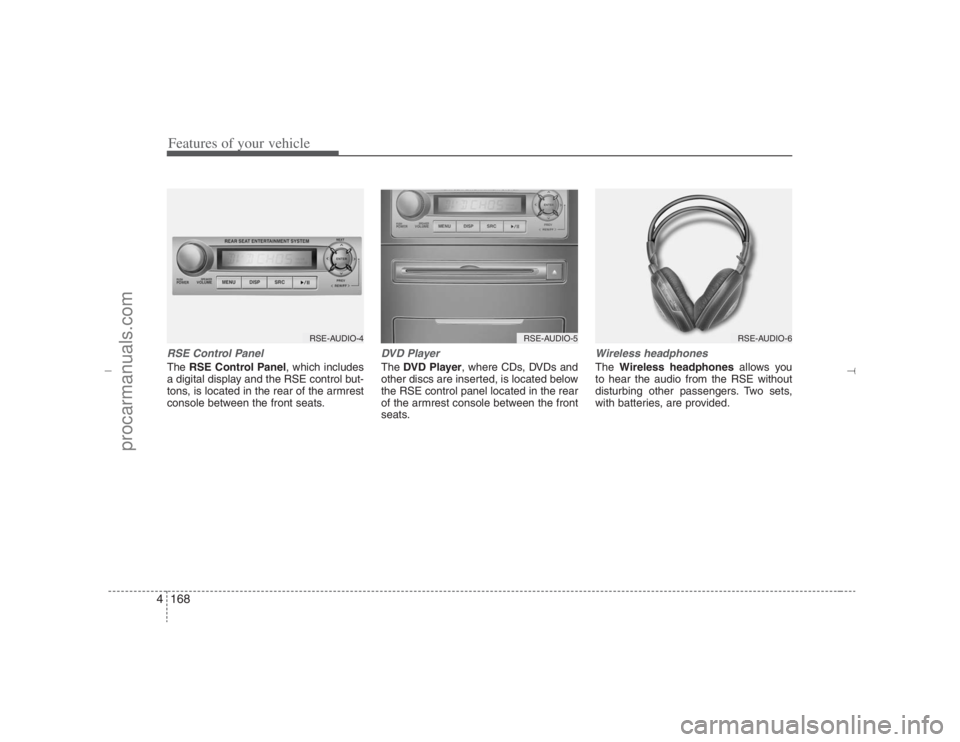
Features of your vehicle168 4RSE Control PanelThe RSE Control Panel, which includes
a digital display and the RSE control but-
tons, is located in the rear of the armrest
console between the front seats.
DVD PlayerThe DVD Player, where CDs, DVDs and
other discs are inserted, is located below
the RSE control panel located in the rear
of the armrest console between the front
seats.
Wireless headphonesThe Wireless headphonesallows you
to hear the audio from the RSE without
disturbing other passengers. Two sets,
with batteries, are provided.
RSE-AUDIO-4
RSE-AUDIO-5
RSE-AUDIO-6
EN hma 4-121~(Audio).qxd 11/28/2006 3:10 PM Page 168
procarmanuals.com
Page 328 of 441
557
Driving your vehicle
The label will help you decide how
much cargo and installed equipment
your vehicle can carry.
If you carry items inside your vehicle
- like suitcases, tools, packages, or
anything else - they are moving as
fast as the vehicle. If you have to stop
or turn quickly, or if there is a crash,
the items will keep going and can
cause an injury if they strike the driv-
er or a passenger.(Continued)
Do not load your vehicle any
heavier than the GVWR, either
the maximum front or rear
GAWR and vehicle capacity
weight. If you do, parts,
including tires on your vehicle
can break, and it can change
the way your vehicle handles
and braking ability. This could
cause you to lose control and
crash. Also, overloading can
shorten the life of your vehi-
cle.
WARNING
Overloading your vehicle can
cause heat buildup in your
vehicle's tires and possible
tire failure that could lead to a
crash.
Overloading your vehicle can
cause increased stopping dis-
tances that could lead to a
crash.
A crash resulting from poor
handling vehicle damage, tire
failure, or increased stopping
distances could result in seri-
ous injury or death.
WARNING
- Loose cargo
Items you carry inside your
vehicle can strike and injure
occupants in a sudden stop or
turn, or in a crash.
Put items in the cargo area of
your vehicle. Try to spread the
weight evenly.
Never stack items, like suit-
cases, inside the vehicle
above the tops of the seats.
Do not leave an unsecured
child restraint in your vehicle.
When you carry something
inside the vehicle, secure it.
Do not drive with a seat folded
down unless necessary.
CAUTION
Overloading your vehicle may
cause damage. Repairs would
not be covered by your warran-
ty. Do not overload your vehicle.
Using heavier suspension com-
ponents to get added durability
might not change your weight
ratings. Ask your dealer to help
you load your vehicle the right
way.
EN hma 5.qxd 11/28/2006 3:02 PM Page 57
procarmanuals.com
Page 393 of 441
739
Maintenance
Temperature -A, B & C The temperature grades are A (the
highest), B and C representing the
tire’s resistance to the generation of
heat and its ability to dissipate heat
when tested under controlled condi-
tions on a specified indoor laboratory
test wheel.
Sustained high temperature can
cause the material of the tire to
degenerate and reduce tire life, and
excessive temperature can lead to
sudden tire failure. The grade C cor-
responds to a level of performance
which all passenger car tires must
meet under the Federal Motor
Vehicle Safety Standard No. 109.
Grades B and A represent higher
levels of performance on the labora-
tory test wheel than the minimum
required by law.
G201100AENTire terminology and definitions
Air Pressure: The amount of air
inside the tire pressing outward on
the tire. Air pressure is expressed in
pounds per square inch (psi) or kilo-
pascal (kPa).
Accessory Weight: This means the
combined weight of optional acces-
sories. Some examples of optional
accessories are, automatic transmis-
sion, power seats, and air condition-
ing.
Aspect Ratio: The relationship of a
tire's height to its width.
Belt:A rubber coated layer of cords
that is located between the plies and
the tread. Cords may be made from
steel or other reinforcing materials.
Bead: The tire bead contains steel
wires wrapped by steel cords that
hold the tire onto the rim.
Bias Ply Tire: A pneumatic tire in
which the plies are laid at alternate
angles less than 90 degrees to the
centerline of the tread.
WARNING - Tire
temperature
The temperature grade for this
tire is established for a tire that
is properly inflated and not
overloaded. Excessive speed,
underinflation, or excessive
loading, either separately or in
combination, can cause heat
build-up and possible sudden
tire failure. This can cause loss
of vehicle control and serious
injury or death.
WARNING
The temperature grade for this
tire is established for a tire that
is properly inflated and not
overloaded. Excessive speed,
underinflation, or excessive
loading, either separately or in
combination, can cause heat
build-up and possible tire fail-
ure.
EN hma 7.qxd 11/28/2006 3:45 PM Page 39
procarmanuals.com
Page 437 of 441
I5
Index
Parking brake ·································································7-20
Power adjustable pedals·················································4-39
Power steering fluid ·······················································7-19
Rear parking assist system·············································4-69
Rear seat entertainment system (RSE) ························4-166
Recommended lubricants and capacities ·························9-4
Recommended SAE viscosity number ··························9-5
Remote keyless entry ·····················································4-10
Reporting safety defects ··················································8-5
Road warning ···································································6-2
Scheduled maintenance service ·······································7-6
Normal maintenance schedule·······································7-7
Maintenance under severe usage conditions ···············7-10
Seat belts ········································································3-18
Pre-tensioner seat belt ·················································3-23
Seat belt - Driver's 3-point system with
emergency locking retractor·····································3-19
Seat belts - Front passenger and rear seat
3-point system with combination locking retractor ··3-21
Seat belt warning ·························································3-19
Seats ·················································································3-2
Armrest ········································································3-13Headrest ·······························································3-5, 3-12
Folding the rear seat ····················································3-14
Front seat adjustment - manual ·····································3-4
Front seat adjustment - power ·······································3-9
Lumbar support ····················································3-7, 3-11
Rear seat adjustment ····················································3-11
Seatback pocket ·····························································3-9
Seat warmer ···································································3-7
Walk-in seat ·································································3-14
Special driving conditions ·············································5-37
Driving at night ···························································5-38
Driving in flooded areas ··············································5-39
Driving in the rain ·······················································5-39
Hazardous driving conditions······································5-37
Highway driving ··························································5-40
Reducing the risk of a rollover····································5-41
Rocking the vehicle ·····················································5-37
Smooth cornering ························································5-38
Starting the engine ···························································5-6
Steering wheel································································4-40
Easy access function····················································4-41
Horn ·············································································4-42
Power steering ·····························································4-40
Tilt steering ··································································4-40
Storage compartment ···················································4-109
Center console storage···············································4-109
Glove box ··································································4-109
Multi box ···································································4-110PRS
EN hma Index.qxd 11/28/2006 1:23 PM Page 5
procarmanuals.com