door HYUNDAI VERACRUZ 2009 Owners Manual
[x] Cancel search | Manufacturer: HYUNDAI, Model Year: 2009, Model line: VERACRUZ, Model: HYUNDAI VERACRUZ 2009Pages: 425, PDF Size: 7.96 MB
Page 15 of 425
17
Introduction
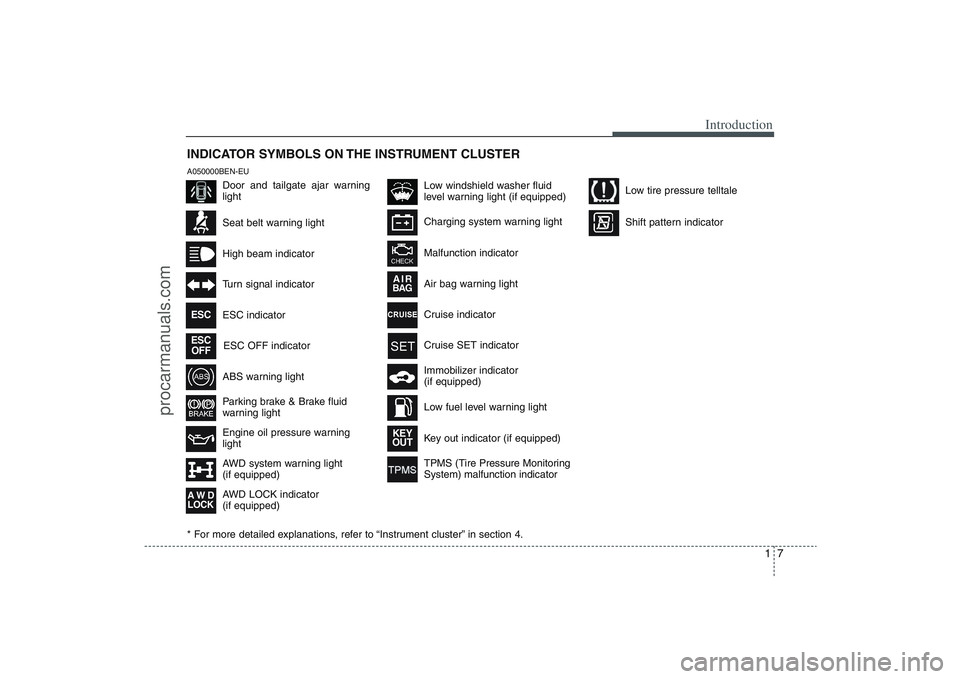
INDICATOR SYMBOLS ON THE INSTRUMENT CLUSTER
Seat belt warning lightHigh beam indicatorTurn signal indicatorABS warning lightParking brake & Brake fluid
warning lightEngine oil pressure warning
lightAWD system warning light
(if equipped)
AWD LOCK indicator
(if equipped) ESC indicator
ESC OFF indicator
Malfunction indicator
Air bag warning lightCruise indicator Cruise SET indicatorImmobilizer indicator
(if equipped) Low fuel level warning light
* For more detailed explanations, refer to “Instrument cluster” in section 4.Charging system warning light
Shift pattern indicator
Low windshield washer fluid
level warning light (if equipped)
A050000BEN-EU
Door and tailgate ajar warning
light
Key out indicator (if equipped)
KEY
OUT
AW D
LOCK
AIRBAG
ESCESC
OFF
TPMS (Tire Pressure Monitoring
System) malfunction indicator
Low tire pressure telltale
procarmanuals.com
Page 17 of 425
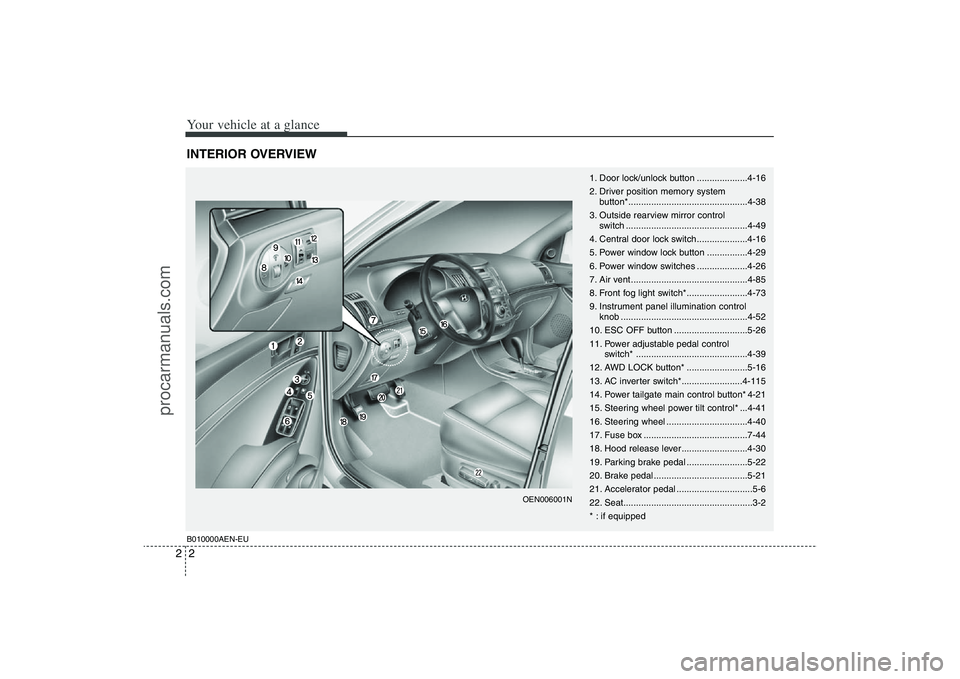
Your vehicle at a glance2 2INTERIOR OVERVIEW
1. Door lock/unlock button ....................4-16
2. Driver position memory system
button*...............................................4-38
3. Outside rearview mirror control
switch ................................................4-49
4. Central door lock switch....................4-16
5. Power window lock button ................4-29
6. Power window switches ....................4-26
7. Air vent ..............................................4-85
8. Front fog light switch*........................4-73
9. Instrument panel illumination control
knob ..................................................4-52
10. ESC OFF button .............................5-26
11. Power adjustable pedal control
switch* ............................................4-39
12. AWD LOCK button* ........................5-16
13. AC inverter switch*........................4-115
14. Power tailgate main control button* 4-21
15. Steering wheel power tilt control* ...4-41
16. Steering wheel ................................4-40
17. Fuse box .........................................7-44
18. Hood release lever ..........................4-30
19. Parking brake pedal ........................5-22
20. Brake pedal .....................................5-21
21. Accelerator pedal ..............................5-6
22. Seat...................................................3-2
* : if equipped
B010000AEN-EUOEN006001N
procarmanuals.com
Page 38 of 425
319
Safety features of your vehicle
C020102BEN-EUSeat belt - Driver's 3-point system
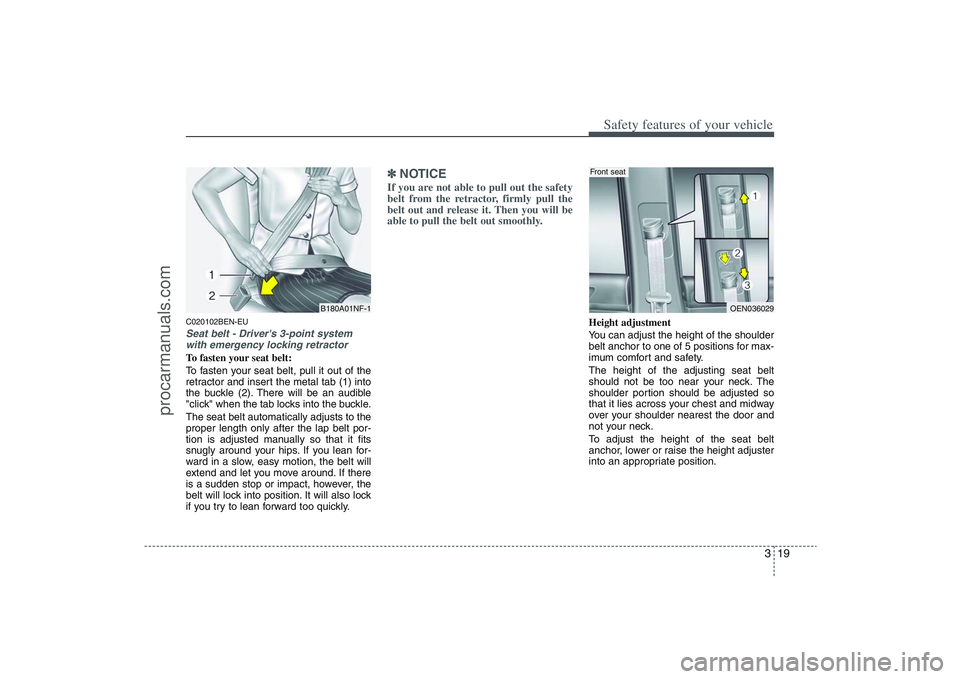
with emergency locking retractorTo fasten your seat belt:
To fasten your seat belt, pull it out of the
retractor and insert the metal tab (1) into
the buckle (2). There will be an audible
"click" when the tab locks into the buckle.
The seat belt automatically adjusts to the
proper length only after the lap belt por-
tion is adjusted manually so that it fits
snugly around your hips. If you lean for-
ward in a slow, easy motion, the belt will
extend and let you move around. If there
is a sudden stop or impact, however, the
belt will lock into position. It will also lock
if you try to lean forward too quickly.
✽ ✽
NOTICEIf you are not able to pull out the safety
belt from the retractor, firmly pull the
belt out and release it. Then you will be
able to pull the belt out smoothly.
Height adjustment
You can adjust the height of the shoulder
belt anchor to one of 5 positions for max-
imum comfort and safety.
The height of the adjusting seat belt
should not be too near your neck. The
shoulder portion should be adjusted so
that it lies across your chest and midway
over your shoulder nearest the door and
not your neck.
To adjust the height of the seat belt
anchor, lower or raise the height adjuster
into an appropriate position.
B180A01NF-1
OEN036029
Front seat
procarmanuals.com
Page 39 of 425
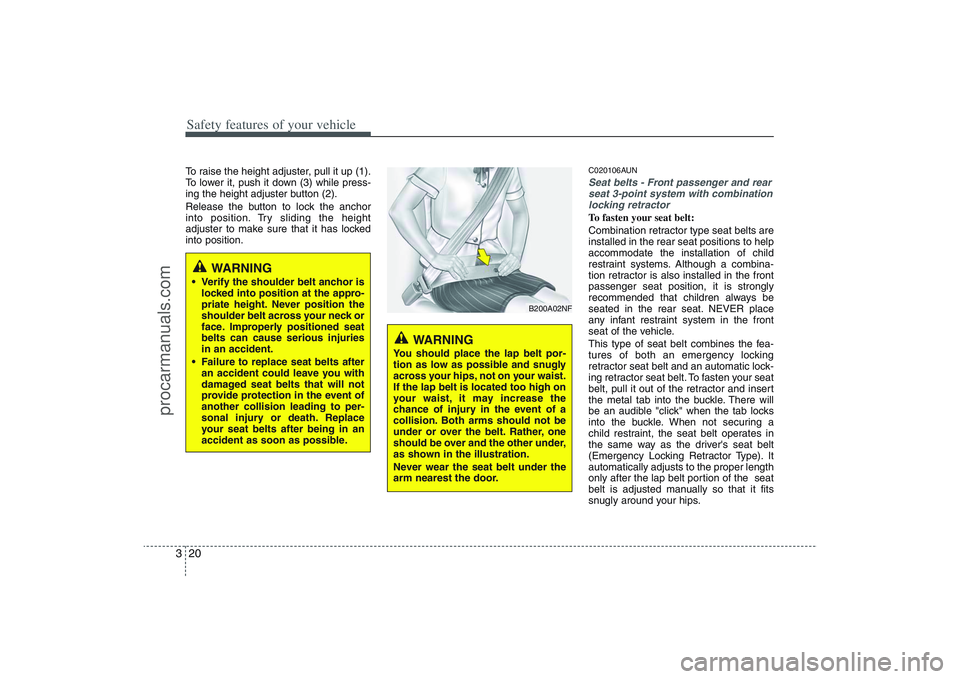
Safety features of your vehicle20 3To raise the height adjuster, pull it up (1).
To lower it, push it down (3) while press-
ing the height adjuster button (2).
Release the button to lock the anchor
into position. Try sliding the height
adjuster to make sure that it has locked
into position.
C020106AUNSeat belts - Front passenger and rear
seat 3-point system with combination
locking retractorTo fasten your seat belt:
Combination retractor type seat belts are
installed in the rear seat positions to help
accommodate the installation of child
restraint systems. Although a combina-
tion retractor is also installed in the front
passenger seat position, it is strongly
recommended that children always be
seated in the rear seat. NEVER place
any infant restraint system in the front
seat of the vehicle.
This type of seat belt combines the fea-
tures of both an emergency locking
retractor seat belt and an automatic lock-
ing retractor seat belt. To fasten your seat
belt, pull it out of the retractor and insert
the metal tab into the buckle. There will
be an audible "click" when the tab locks
into the buckle. When not securing a
child restraint, the seat belt operates in
the same way as the driver's seat belt
(Emergency Locking Retractor Type). It
automatically adjusts to the proper length
only after the lap belt portion of the seat
belt is adjusted manually so that it fits
snugly around your hips.
B200A02NF
WARNING
Verify the shoulder belt anchor is
locked into position at the appro-
priate height. Never position the
shoulder belt across your neck or
face. Improperly positioned seat
belts can cause serious injuries
in an accident.
Failure to replace seat belts after
an accident could leave you with
damaged seat belts that will not
provide protection in the event of
another collision leading to per-
sonal injury or death. Replace
your seat belts after being in an
accident as soon as possible.
WARNING
You should place the lap belt por-
tion as low as possible and snugly
across your hips, not on your waist.
If the lap belt is located too high on
your waist, it may increase the
chance of injury in the event of a
collision. Both arms should not be
under or over the belt. Rather, one
should be over and the other under,
as shown in the illustration.
Never wear the seat belt under the
arm nearest the door.
procarmanuals.com
Page 47 of 425
Safety features of your vehicle28 3
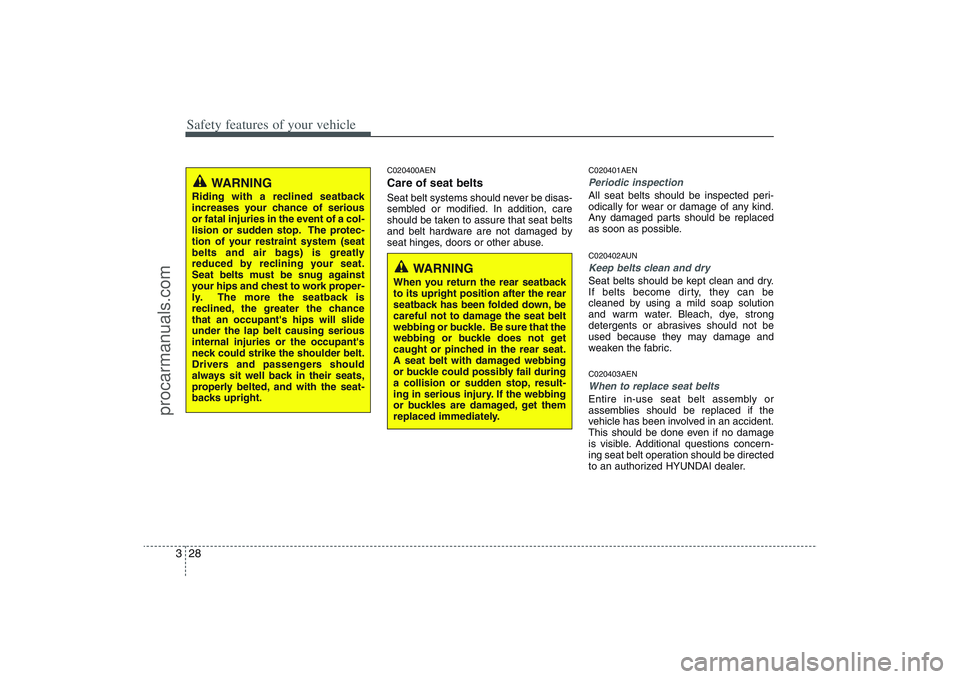
C020400AENCare of seat beltsSeat belt systems should never be disas-
sembled or modified. In addition, care
should be taken to assure that seat belts
and belt hardware are not damaged by
seat hinges, doors or other abuse.
C020401AENPeriodic inspectionAll seat belts should be inspected peri-
odically for wear or damage of any kind.
Any damaged parts should be replaced
as soon as possible.C020402AUNKeep belts clean and drySeat belts should be kept clean and dry.
If belts become dirty, they can be
cleaned by using a mild soap solution
and warm water. Bleach, dye, strong
detergents or abrasives should not be
used because they may damage and
weaken the fabric.C020403AENWhen to replace seat beltsEntire in-use seat belt assembly or
assemblies should be replaced if the
vehicle has been involved in an accident.
This should be done even if no damage
is visible. Additional questions concern-
ing seat belt operation should be directed
to an authorized HYUNDAI dealer.
WARNING
When you return the rear seatback
to its upright position after the rear
seatback has been folded down, be
careful not to damage the seat belt
webbing or buckle. Be sure that the
webbing or buckle does not get
caught or pinched in the rear seat.
A seat belt with damaged webbing
or buckle could possibly fail during
a collision or sudden stop, result-
ing in serious injury. If the webbing
or buckles are damaged, get them
replaced immediately.
WARNING
Riding with a reclined seatback
increases your chance of serious
or fatal injuries in the event of a col-
lision or sudden stop. The protec-
tion of your restraint system (seat
belts and air bags) is greatly
reduced by reclining your seat.
Seat belts must be snug against
your hips and chest to work proper-
ly. The more the seatback is
reclined, the greater the chance
that an occupant's hips will slide
under the lap belt causing serious
internal injuries or the occupant's
neck could strike the shoulder belt.
Drivers and passengers should
always sit well back in their seats,
properly belted, and with the seat-
backs upright.
procarmanuals.com
Page 58 of 425
339
Safety features of your vehicle
C040902AENNoise and smokeWhen the air bags inflate, they make a
loud noise and they leave smoke and
powder in the air inside of the vehicle.
This is normal and is a result of the igni-
tion of the air bag inflator. After the air
bag inflates, you may feel substantial dis-
comfort in breathing due to the contact of
your chest with both the seat belt and the
air bag, as well as from breathing the
smoke and powder.Open your doors
and/or windows as soon as possible
after impact in order to reduce dis-
comfort and prevent prolonged expo-
sure to the smoke and powder.
Though the smoke and powder are non-
toxic, they may cause irritation to the skin
(eyes, nose and throat, etc). If this is the
case, wash and rinse with cold water
immediately and consult a doctor if the
symptom persists.
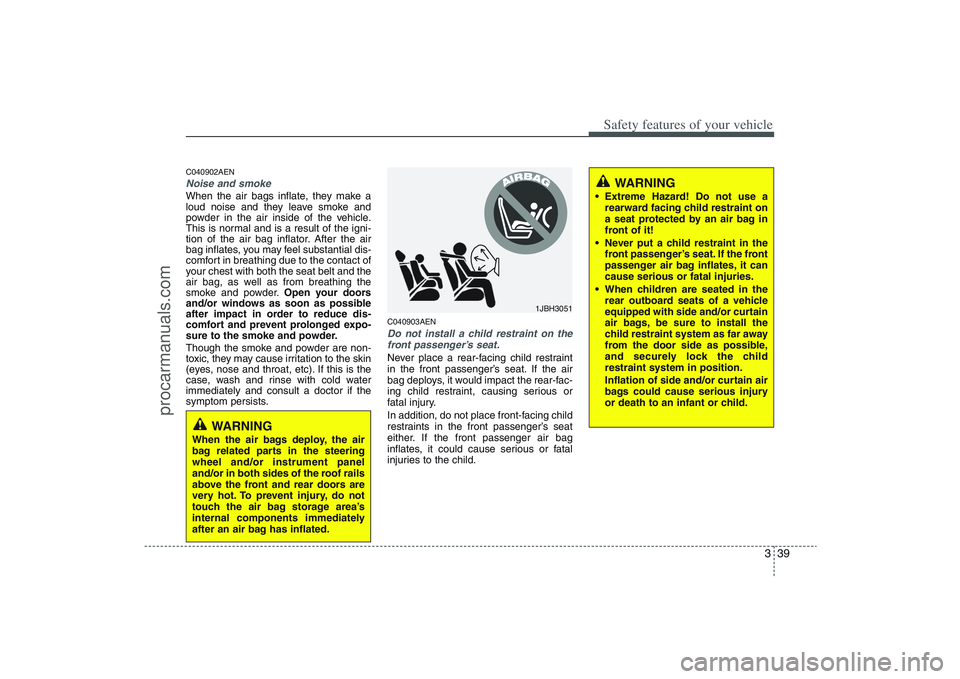
C040903AENDo not install a child restraint on the
front passenger’s seat.Never place a rear-facing child restraint
in the front passenger’s seat. If the air
bag deploys, it would impact the rear-fac-
ing child restraint, causing serious or
fatal injury.
In addition, do not place front-facing child
restraints in the front passenger’s seat
either. If the front passenger air bag
inflates, it could cause serious or fatal
injuries to the child.
1JBH3051
WARNING
When the air bags deploy, the air
bag related parts in the steering
wheel and/or instrument panel
and/or in both sides of the roof rails
above the front and rear doors are
very hot. To prevent injury, do not
touch the air bag storage area’s
internal components immediately
after an air bag has inflated.
WARNING
Extreme Hazard! Do not use a
rearward facing child restraint on
a seat protected by an air bag in
front of it!
Never put a child restraint in the
front passenger’s seat. If the front
passenger air bag inflates, it can
cause serious or fatal injuries.
When children are seated in the
rear outboard seats of a vehicle
equipped with side and/or curtain
air bags, be sure to install the
child restraint system as far away
from the door side as possible,
and securely lock the child
restraint system in position.
Inflation of side and/or curtain air
bags could cause serious injury
or death to an infant or child.
procarmanuals.com
Page 63 of 425
Safety features of your vehicle44 3Always be sure that you and all vehicle
occupants are seated and restrained
properly (sitting upright with the seat in
an upright position, centered on the seat
cushion, with the person's legs comfort-
ably extended, feet on the floor, and
wearing the safety belt properly) for the
most effective protection by the air bag
and the safety belt.
The OCS may not function properly if
the passenger takes actions which can
defect the detection system. These
include:
(1) Failing to sit in an upright position.
(2) Leaning against the door or center
console.
(3) Sitting towards the sides or the
front of the seat.
(4) Putting legs on the dashboard or
resting them on other locations
which reduce the passenger weight
on the front seat.
(5) Improperly wearing the safety belt.
(6) Reclining the seat back.
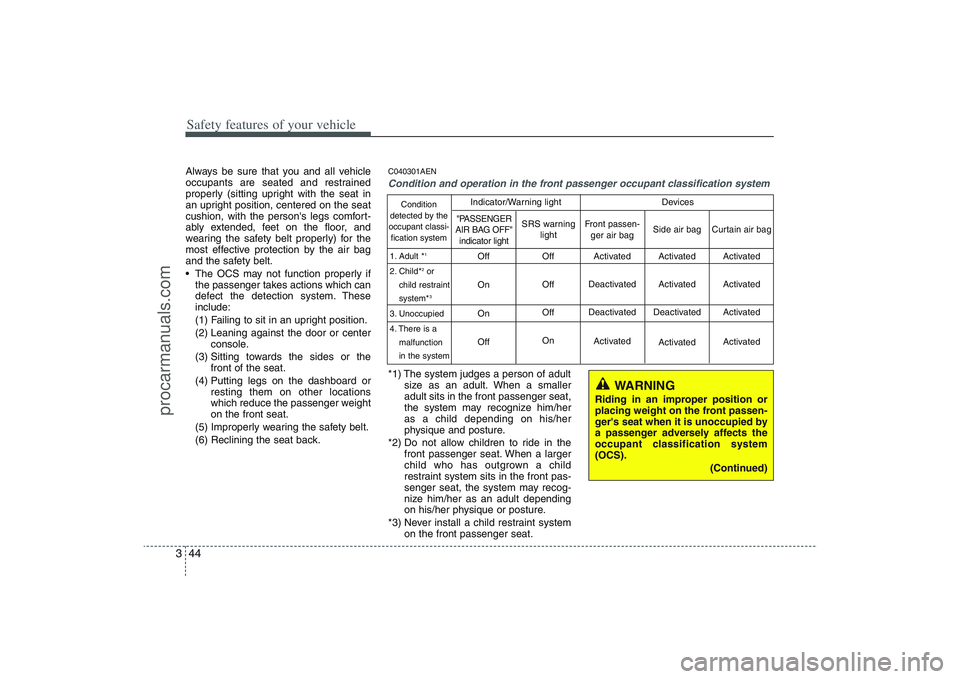
C040301AENCondition and operation in the front passenger occupant classification system*1) The system judges a person of adult
size as an adult. When a smaller
adult sits in the front passenger seat,
the system may recognize him/her
as a child depending on his/her
physique and posture.
*2) Do not allow children to ride in the
front passenger seat. When a larger
child who has outgrown a child
restraint system sits in the front pas-
senger seat, the system may recog-
nize him/her as an adult depending
on his/her physique or posture.
*3) Never install a child restraint system
on the front passenger seat.
WARNING
Riding in an improper position or
placing weight on the front passen-
ger's seat when it is unoccupied by
a passenger adversely affects the
occupant classification system
(OCS).
(Continued)
Condition
detected by the
occupant classi-
fication system
1. Adult *
1
2. Child*
2or
child restraint
system*3
3. Unoccupied
4. There is a
malfunction
in the system
Off
On
On
OffOff
Off
Off
OnActivated
Deactivated
Deactivated
Activated
"PASSENGER
AIR BAG OFF"
indicator light
SRS warning
light
Front passen-
ger air bag
Activated
Activated
Deactivated
ActivatedSide air bag
Activated
Activated
Activated
ActivatedCurtain air bag
Indicator/Warning light Devices
procarmanuals.com
Page 69 of 425
Safety features of your vehicle50 3✽
✽
NOTICE• Be sure to read information about the
SRS on the labels provided on the sun
visor.
• Advanced air bags are combined with
pre-tensioner seat belts to help pro-
vide enhanced occupant protection in
frontal crashes. Front air bags are not
intended to deploy in collisions in
which protection can be provided by
the pre-tensioner seat belt.
(Continued)
Move your seat as far back as
practical from the front air bags,
while still maintaining control of
the vehicle.
You and your passengers should
never sit or lean unnecessarily
close to the air bags. Improperly
positioned driver and passengers
can be severely injured by inflat-
ing air bags.
Never lean against the door or
center console – always sit in an
upright position.
Do not allow a passenger to ride
in the front seat when the “PAS-
SENGER AIR BAG OFF” indicator
is illuminated, because the air
bag will not deploy in the event of
a moderate or severe frontal
crash.
(Continued)
WARNING
Always use seat belts and child
restraints – every trip, every time,
everyone! Air bags inflate with con-
siderable force and in the blink of
an eye. Seat belts help keep occu-
pants in proper position to obtain
maximum benefit from the air bag.
Even with advanced air bags,
improperly and unbelted occupants
can be severely injured when the
air bag inflates. Always follow the
precautions about seat belts, air
bags and occupant safety con-
tained in this manual.
To reduce the chance of serious or
fatal injuries and receive the maxi-
mum safety benefit from your
restraint system:
Never place a child in any child or
booster seat in the front seat.
ABC – Always Buckle Children in
the back seat. It is the safest
place for children of any age to
ride.
Front and side air bags can injure
occupants improperly positioned
in the front seats.
(Continued)
WARNING
If you are considering modification
of your vehicle due to a disability,
please contact the Hyundai
Customer Assistance Center at 1-
800-633-5151.
procarmanuals.com
Page 72 of 425
353
Safety features of your vehicle
The side impact air bags are designed to
deploy only during certain side-impact
collisions, depending on the crash sever-
ity, angle, speed and point of impact. The
side impact air bags are not designed to
deploy in all side impact situations.
(Continued)
Do not install any accessories on
the side or near the side impact
air bag.
Do not place any objects over the
air bag or between the air bag
and yourself.
Do not place any objects (an
umbrella, bag, etc.) between the
front door and the front seat.
Such objects may become dan-
gerous projectiles and cause
injury if the supplemental side
impact air bag inflates.
To prevent unexpected deploy-
ment of the side impact air bag
that may result in personal injury,
avoid impact to the side impact
sensor when the ignition switch
is on.
If the seat or seat cover is dam-
aged, have the vehicle checked
and repaired by an authorized
HYUNDAI dealer because your
vehicle is equipped with side
impact air bags and an occupant
classification system.
WARNING
The side impact air bag is sup-
plemental to the driver's and the
passenger's seat belt systems
and is not a substitute for them.
Therefore your seat belts must be
worn at all times while the vehicle
is in motion. The air bags deploy
only in certain side impact condi-
tions severe enough to cause
significant injury to the vehicle
occupants.
For best protection from the side
impact air bag system and to
avoid being injured by the
deploying side impact air bag,
both front seat occupants should
sit in an upright position with the
seat belt properly fastened. The
driver's hands should be placed
on the steering wheel at the 9:00
and 3:00 positions. The passen-
ger's arms and hands should be
placed on their laps.
Do not use any accessory seat
covers.
Use of seat covers could reduce
or prevent the effectiveness of
the system.
(Continued)
procarmanuals.com
Page 73 of 425
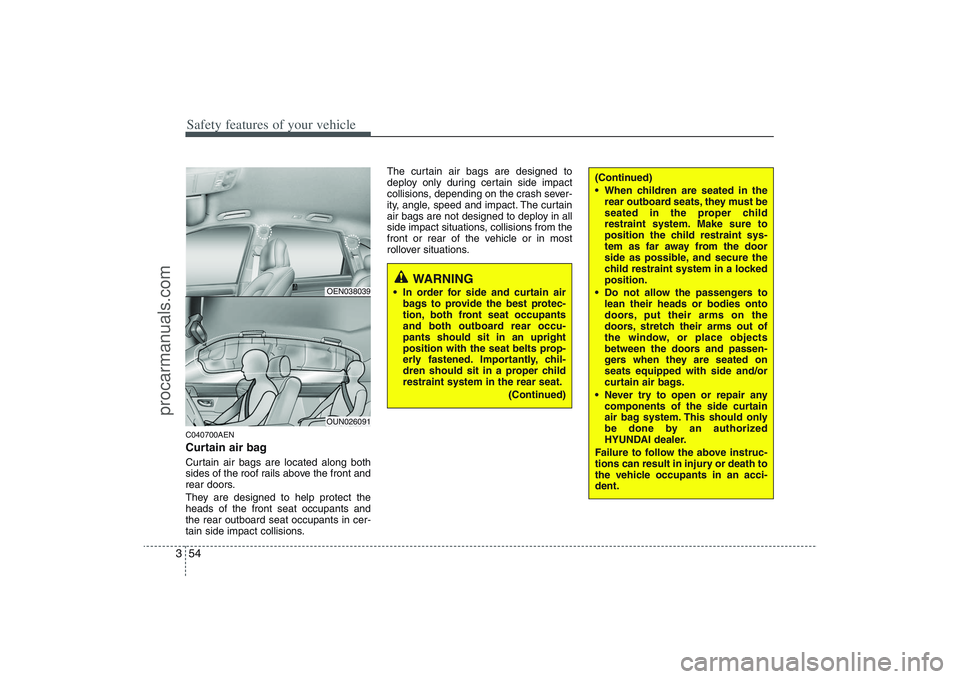
Safety features of your vehicle54 3C040700AENCurtain air bagCurtain air bags are located along both
sides of the roof rails above the front and
rear doors.
They are designed to help protect the
heads of the front seat occupants and
the rear outboard seat occupants in cer-
tain side impact collisions.The curtain air bags are designed to
deploy only during certain side impact
collisions, depending on the crash sever-
ity, angle, speed and impact. The curtain
air bags are not designed to deploy in all
side impact situations, collisions from the
front or rear of the vehicle or in most
rollover situations.
WARNING
In order for side and curtain air
bags to provide the best protec-
tion, both front seat occupants
and both outboard rear occu-
pants should sit in an upright
position with the seat belts prop-
erly fastened. Importantly, chil-
dren should sit in a proper child
restraint system in the rear seat.
(Continued)
(Continued)
When children are seated in the
rear outboard seats, they must be
seated in the proper child
restraint system. Make sure to
position the child restraint sys-
tem as far away from the door
side as possible, and secure the
child restraint system in a locked
position.
Do not allow the passengers to
lean their heads or bodies onto
doors, put their arms on the
doors, stretch their arms out of
the window, or place objects
between the doors and passen-
gers when they are seated on
seats equipped with side and/or
curtain air bags.
Never try to open or repair any
components of the side curtain
air bag system. This should only
be done by an authorized
HYUNDAI dealer.
Failure to follow the above instruc-
tions can result in injury or death to
the vehicle occupants in an acci-
dent.
OEN038039OUN026091
procarmanuals.com