engine coolant HYUNDAI VERACRUZ 2011 Owner's Manual
[x] Cancel search | Manufacturer: HYUNDAI, Model Year: 2011, Model line: VERACRUZ, Model: HYUNDAI VERACRUZ 2011Pages: 419, PDF Size: 47.93 MB
Page 340 of 419
723
Maintenance
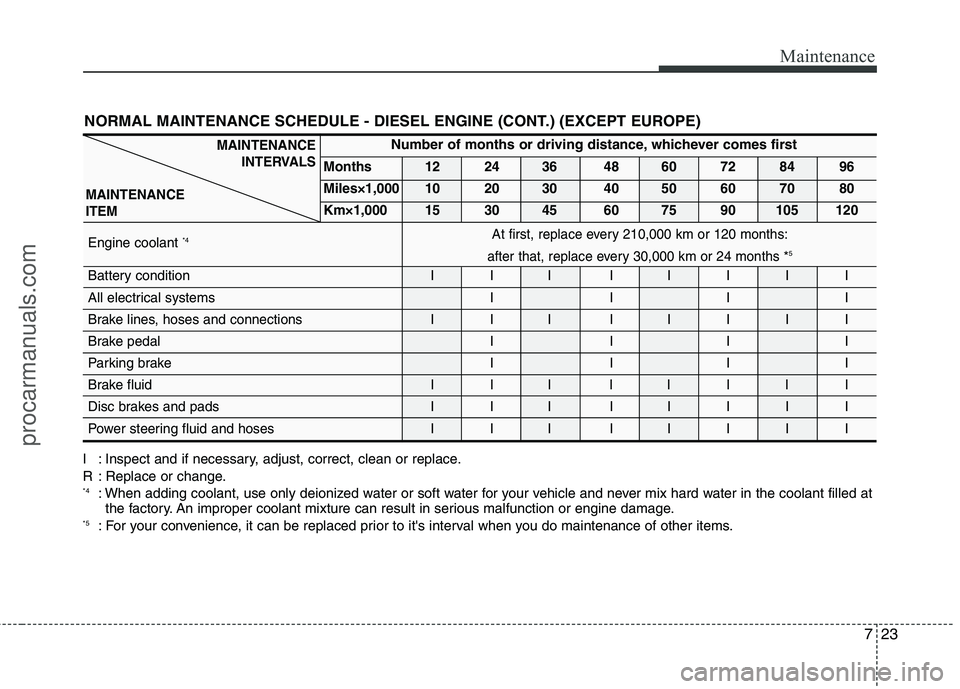
NORMAL MAINTENANCE SCHEDULE - DIESEL ENGINE (CONT.) (EXCEPT EUROPE)
I : Inspect and if necessary, adjust, correct, clean or replace.
R : Replace or change. *4: When adding coolant, use only deionized water or soft water for your vehicle and never mix hard water in the coolant filled at
the factory. An improper coolant mixture can result in serious malfunction or engine damage.
*5 : For your convenience, it can be replaced prior to it's interval when you do maintenance of other items.
MAINTENANCE
INTERVALS
MAINTENANCE ITEMNumber of months or driving distance, whichever comes first
Months 12 24 36 48 60 72 84 96
Miles×1,000 10 20 30 40 50 60 70 80
Km×1,000 15 30 45 60 75 90 105 120
Engine coolant *4
Battery condition I I I I I I I I
All electrical systems I I I I
Brake lines, hoses and connections I I I I I I I I
Brake pedal I I I I
Parking brake I I I I
Brake fluid
III IIIII
Disc brakes and pads I I I I I I I I
Power steering fluid and hoses I I I I I I I I
At first, replace every 210,000 km or 120 months:
after that, replace every 30,000 km or 24 months * 5
procarmanuals.com
Page 345 of 419
Maintenance
28
7
G050600AUN
Vapor hose and fuel filler cap
The vapor hose and fuel filler cap should
be inspected at those intervals specified
in the maintenance schedule. Make sure
that a new vapor hose or fuel filler cap iscorrectly replaced.
G050700AUN
Vacuum crankcase ventilation hoses (if equipped)
Inspect the surface of hoses for evidence
of heat and/or mechanical damage. Hard
and brittle rubber, cracking, tears, cuts,
abrasions, and excessive swelling indi-
cate deterioration. Particular attention
should be paid to examine those hose
surfaces nearest to high heat sources,
such as the exhaust manifold. Inspect the hose routing to assure that the hoses do not come in contact with
any heat source, sharp edges or movingcomponent which might cause heat dam-
age or mechanical wear. Inspect all hose
connections, such as clamps and cou-
plings, to make sure they are secure, and
that no leaks are present. Hoses should
be replaced immediately if there is any
evidence of deterioration or damage. G050800AEN
Air cleaner filter
A Genuine HYUNDAI air cleaner filter is recommended when the filter isreplaced.
G050900AUN
Spark plugs (for gasoline engine)
Make sure to install new spark plugs of
the correct heat range. G051000AEN
Valve clearance (if equipped)
Inspect excessive valve noise and/or
engine vibration and adjust if necessary.
An authorized HYUNDAI dealer should
perform the operation.
G051100AUN Cooling system
Check cooling system components, such
as radiator, coolant reservoir, hoses and
connections for leakage and damage.
Replace any damaged parts.
G051200AUN Coolant The coolant should be changed at the
intervals specified in the maintenance
schedule.
G051500AUN Brake hoses and lines
Visually check for proper installation,
chafing, cracks, deterioration and any
leakage. Replace any deteriorated or
damaged parts immediately.
G051600AUN Brake fluid
Check brake fluid level in the brake fluid
reservoir. The level should be between
“MIN” and “MAX” marks on the side of
the reservoir. Use only hydraulic brake
fluid conforming to DOT 3 or DOT 4specification.
procarmanuals.com
Page 348 of 419
731
Maintenance
G060200AEN Changing the engine oil and filter
Have engine oil and filter changed by an
authorized HYUNDAI dealer according tothe Maintenance Schedule at the begin-ning of this section.G070000AUN The high-pressure cooling system has a
reservoir filled with year-round antifreeze
coolant. The reservoir is filled at the fac-
tory.
Check the antifreeze protection and
coolant level at least once a year, at thebeginning of the winter season, and
before traveling to a colder climate. G070100AEN
Checking the coolant level
WARNING
Used engine oil may cause irrita- tion or cancer of the skin if left in
contact with the skin for prolonged
periods of time. Used engine oil
contains chemicals that have
caused cancer in laboratory ani-
mals. Always protect your skin by
washing your hands thoroughlywith soap and warm water as soon
as possible after handling used oil.
ENGINE COOLANT
WARNING - Removing
radiator cap
Never attempt to remove the radi- ator cap while the engine is oper-
ating or hot. Doing so might leadto cooling system and engine
damage and could result in seri-
ous personal injury from escap-ing hot coolant or steam.
(Continued)
(Continued)
Turn the engine off and wait untilit cools down. Use extreme care
when removing the radiator cap.
Wrap a thick towel around it, and
turn it counterclockwise slowly to
the first stop. Step back while the
pressure is released from the
cooling system. When you aresure all the pressure has been
released, press down on the cap,
using a thick towel, and continue
turning counterclockwise to
remove it.
Even if the engine is not operat- ing, do not remove the radiatorcap or the drain plug while the
engine and radiator are hot. Hot
coolant and steam may still blow
out under pressure, causing seri-
ous injury.
procarmanuals.com
Page 349 of 419
Maintenance
32
7
Check the condition and connections of all cooling system hoses and heater
hoses. Replace any swollen or deterio-
rated hoses.
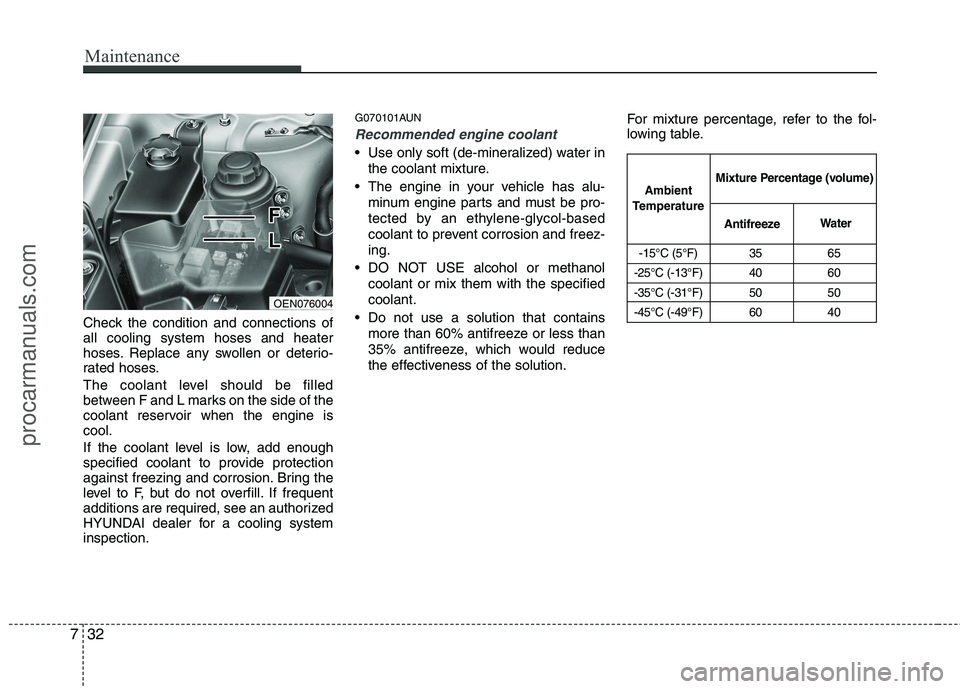
The coolant level should be filled
between F and L marks on the side of the
coolant reservoir when the engine iscool.
If the coolant level is low, add enough
specified coolant to provide protection
against freezing and corrosion. Bring the
level to F, but do not overfill. If frequent
additions are required, see an authorized
HYUNDAI dealer for a cooling systeminspection. G070101AUN
Recommended engine coolant
Use only soft (de-mineralized) water in
the coolant mixture.
The engine in your vehicle has alu- minum engine parts and must be pro-
tected by an ethylene-glycol-based
coolant to prevent corrosion and freez-ing.
DO NOT USE alcohol or methanol coolant or mix them with the specifiedcoolant.
Do not use a solution that contains more than 60% antifreeze or less than
35% antifreeze, which would reduce
the effectiveness of the solution. For mixture percentage, refer to the fol-
lowing table.
OEN076004
-15°C (5°F) 35 65
-25°C (-13°F) 40 60
-35°C (-31°F) 50 50
-45°C (-49°F) 60 40
Ambient
Temperature Mixture Percentage (volume)
Antifreeze Water
procarmanuals.com
Page 350 of 419
733
Maintenance
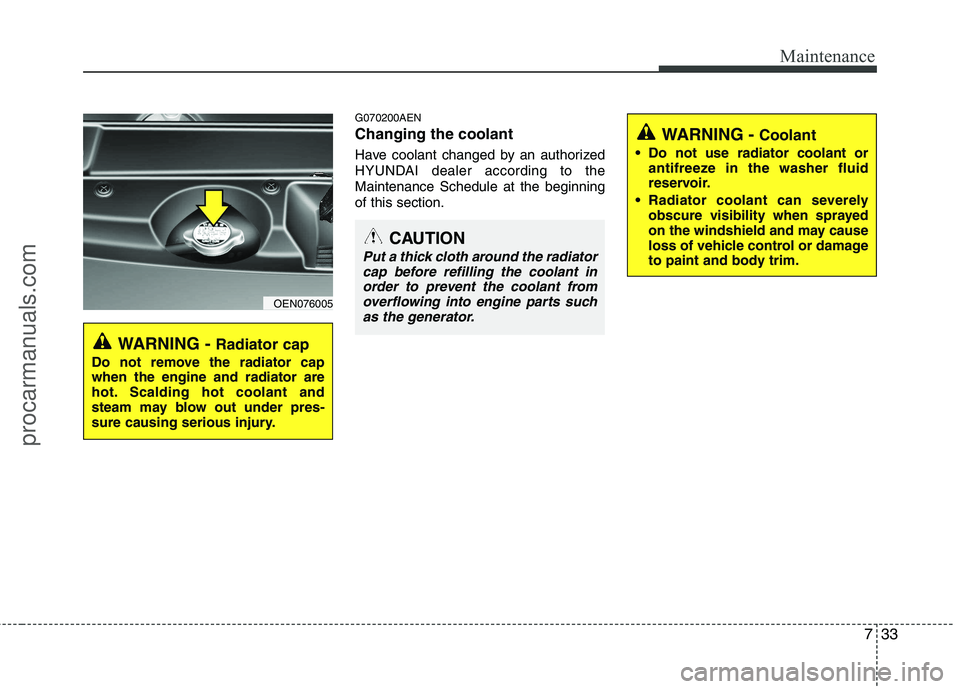
G070200AEN Changing the coolant
Have coolant changed by an authorized
HYUNDAI dealer according to theMaintenance Schedule at the beginningof this section.
WARNING - Radiator cap
Do not remove the radiator cap when the engine and radiator are
hot. Scalding hot coolant and
steam may blow out under pres-
sure causing serious injury.
OEN076005
CAUTION
Put a thick cloth around the radiator cap before refilling the coolant inorder to prevent the coolant fromoverflowing into engine parts suchas the generator.
WARNING - Coolant
Do not use radiator coolant or antifreeze in the washer fluid
reservoir.
Radiator coolant can severely obscure visibility when sprayed
on the windshield and may cause
loss of vehicle control or damage
to paint and body trim.
procarmanuals.com
Page 400 of 419
783
Maintenance
G270201AUN
Canister
Fuel vapors generated inside the fuel tank are absorbed and stored in the
onboard canister. When the engine is
running, the fuel vapors absorbed in the
canister are drawn into the surge tank
through the purge control solenoid valve.
G270202AUN
Purge Control Solenoid Valve (PCSV)
The purge control solenoid valve is con-
trolled by the Engine Control Module
(ECM); when the engine coolant temper-
ature is low during idling, the PCSV clos-
es so that evaporated fuel is not taken
into the engine. After the engine warms-
up during ordinary driving, the PCSV
opens to introduce evaporated fuel to the
engine.G270300AUN
3. Exhaust emission control
system
The Exhaust Emission Control System is
a highly effective system which controls
exhaust emissions while maintaining
good vehicle performance.
G270301AUN
Vehicle modifications
This vehicle should not be modified.
Modification of your vehicle could affect
its performance, safety or durability and
may even violate governmental safety
and emissions regulations.
In addition, damage or performance
problems resulting from any modification
may not be covered under warranty. G270302AUN
Engine exhaust gas precautions (car-
bon monoxide)
Carbon monoxide can be present with other exhaust fumes. Therefore, if you
smell exhaust fumes of any kind inside
your vehicle, have it inspected and
repaired immediately. If you ever sus-
pect exhaust fumes are coming into
your vehicle, drive it only with all the
windows fully open. Have your vehicle
checked and repaired immediately.
Do not operate the engine in confined or closed areas (such as garages) any
more than what is necessary to move
the vehicle in or out of the area.
When the vehicle is stopped in an open area for more than a short time
with the engine running, adjust the
ventilation system (as needed) to draw
outside air into the vehicle.
WARNING - Exhaust
Engine exhaust gases contain car-
bon monoxide (CO). Though color-
less and odorless, it is dangerousand could be lethal if inhaled.
Follow the instructions on this
page to avoid CO poisoning.
procarmanuals.com
Page 406 of 419
85
Specifications & Consumer information
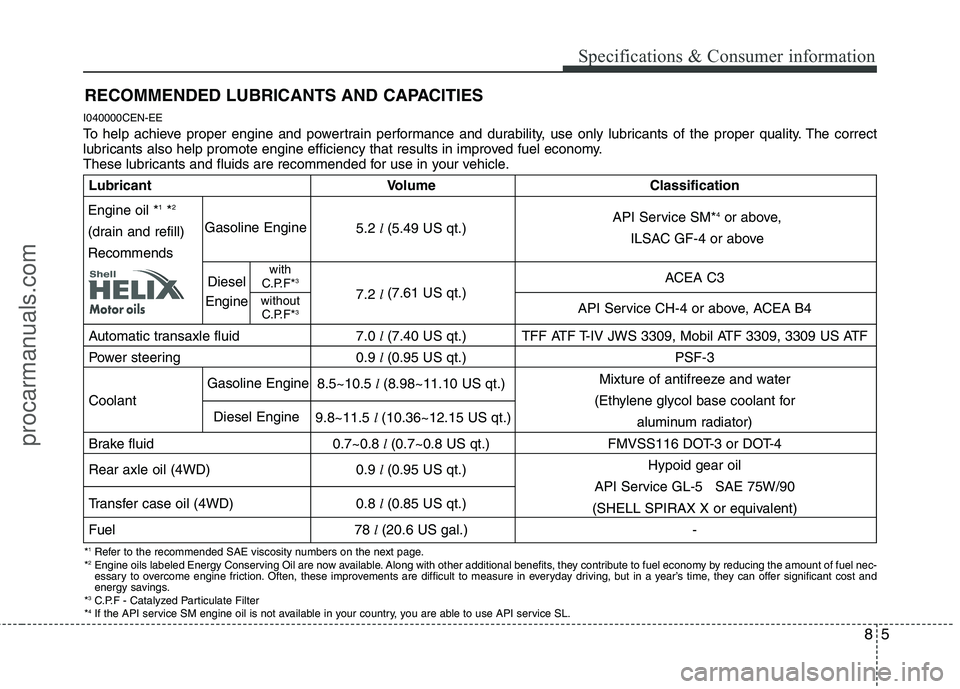
RECOMMENDED LUBRICANTS AND CAPACITIES
I040000CEN-EE
To help achieve proper engine and powertrain performance and durability, use only lubricants of the proper quality. The correct
lubricants also help promote engine efficiency that results in improved fuel economy.
These lubricants and fluids are recommended for use in your vehicle.
* 1
Refer to the recommended SAE viscosity numbers on the next page.
* 2
Engine oils labeled Energy Conserving Oil are now available. Along with other additional benefits, they contribute to fuel economy by reducing the amount of fuel nec-
essary to overcome engine friction. Often, these improvements are difficult to measure in everyday driving, but in a year’s time, they can offer significant cost and
energy savings.
* 3
C.P.F - Catalyzed Particulate Filter
* 4
If the API service SM engine oil is not available in your country, you are able to use API service SL.
Lubricant Volume Classification
5.2 l (5.49 US qt.)
ACEA C3
7.2 l (7.61 US qt.)
API Service CH-4 or above, ACEA B4
Automatic transaxle fluid 7.0 l (7.40 US qt.) TFF ATF T-IV JWS 3309, Mobil ATF 3309, 3309 US ATF
Power steering 0.9 l (0.95 US qt.) PSF-3
8.5~10.5 l (8.98~11.10 US qt.) Mixture of antifreeze and water
Coolant (Ethylene glycol base coolant for
9.8~11.5 l (10.36~12.15 US qt.)
aluminum radiator)
Brake fluid 0.7~0.8 l (0.7~0.8 US qt.) FMVSS116 DOT-3 or DOT-4
Rear axle oil (4WD) 0.9 l (0.95 US qt.) Hypoid gear oil
API Service GL-5 SAE 75W/90
Transfer case oil (4WD) 0.8 l (0.85 US qt.)
(SHELL SPIRAX X or equivalent)
Fuel 78 l (20.6 US gal.) -
Engine oil * 1
*2
(drain and refill) Recommends Gasoline Engine
Gasoline EngineDiesel
Engine with
C.P.F* 3
without C.P.F* 3
Diesel Engine API Service SM*
4
or above,
ILSAC GF-4 or above
procarmanuals.com
Page 412 of 419
I3
Index
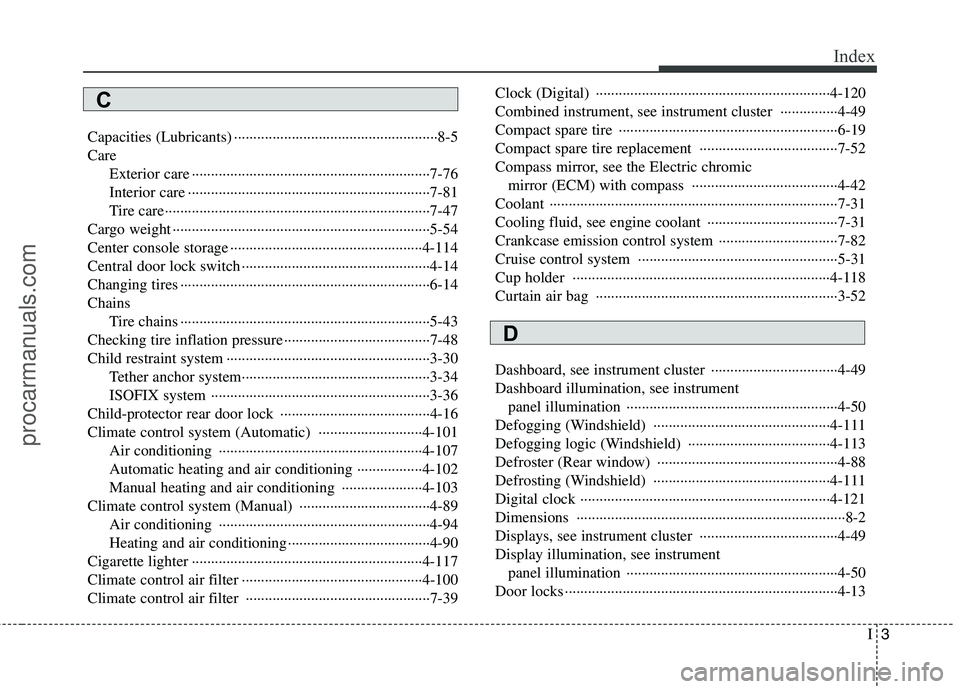
Capacities (Lubricants) ·····················································8-5 Care
Exterior care ······························································7-76
Interior care ·······························································7-81
Tire care·····································································7-47
Cargo weight ···································································5-54
Center console storage ··················································4-114
Central door lock switch ·················································4-14
Changing tires ·································································6-14Chains Tire chains ·································································5-43
Checking tire inflation pressure ······································7-48
Child restraint system ·····················································3-30 Tether anchor system·················································3-34
ISOFIX system ·························································3-36
Child-protector rear door lock ·······································4-16
Climate control system (Automatic) ···························4-101 Air conditioning ·····················································4-107Automatic heating and air conditioning ·················4-102
Manual heating and air conditioning ·····················4-103
Climate control system (Manual) ··································4-89 Air conditioning ·······················································4-94
Heating and air conditioning ·····································4-90
Cigarette lighter ····························································4-117
Climate control air filter ···············································4-100
Climate control air filter ················································7-39 Clock (Digital) ·····························································4-120
Combined instrument, see instrument cluster ···············4-49
Compact spare tire ·························································6-19
Compact spare tire replacement ····································7-52
Compass mirror, see the Electric chromic
mirror (ECM) with compass ······································4-42
Coolant ···········································································7-31
Cooling fluid, see engine coolant ··································7-31
Crankcase emission control system ·······························7-82
Cruise control system ····················································5-31
Cup holder ···································································4-118
Curtain air bag ·······························································3-52
Dashboard, see instrument cluster ·································4-49
Dashboard illumination, see instrument panel illumination ·······················································4-50
Defogging (Windshield) ··············································4-111
Defogging logic (Windshield) ·····································4-113
Defroster (Rear window) ···············································4-88
Defrosting (Windshield) ··············································4-111
Digital clock ·································································4-121Dimensions ······································································8-2
Displays, see instrument cluster ····································4-49
Display illumination, see instrument panel illumination ·······················································4-50
Door locks ·······································································4-13
C
D
procarmanuals.com
Page 413 of 419
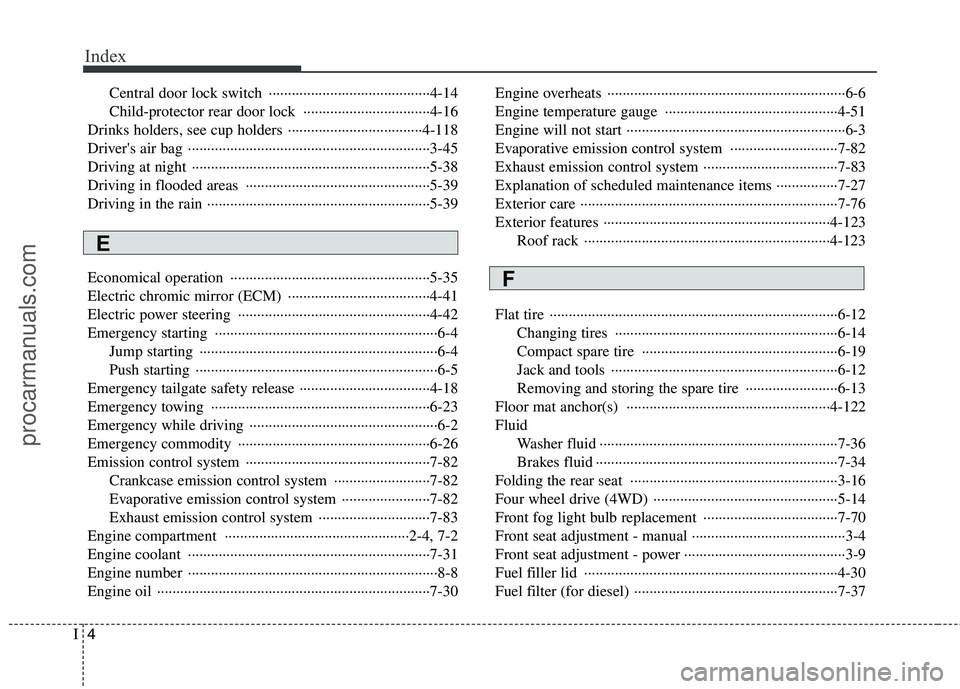
Index
4
I
Central door lock switch ··········································4-14
Child-protector rear door lock ·································4-16
Drinks holders, see cup holders ···································4-118
Driver's air bag ·······························································3-45
Driving at night ······························································5-38
Driving in flooded areas ················································5-39
Driving in the rain ··························································5-39
Economical operation ····················································5-35
Electric chromic mirror (ECM) ·····································4-41
Electric power steering ··················································4-42
Emergency starting ··························································6-4 Jump starting ······························································6-4
Push starting ·······························································6-5
Emergency tailgate safety release ··································4-18
Emergency towing ·························································6-23
Emergency while driving ·················································6-2
Emergency commodity ··················································6-26
Emission control system ················································7-82 Crankcase emission control system ·························7-82
Evaporative emission control system ·······················7-82
Exhaust emission control system ·····························7-83
Engine compartment ················································2-4, 7-2
Engine coolant ·······························································7-31
Engine number ·································································8-8
Engine oil ·······································································7-30 Engine overheats ······························································6-6
Engine temperature gauge ·············································4-51
Engine will not start ·························································6-3
Evaporative emission control system ····························7-82
Exhaust emission control system ···································7-83Explanation of scheduled maintenance items ················7-27
Exterior care ···································································7-76
Exterior features ···························································4-123
Roof rack ································································4-123
Flat tire ···········································································6-12 Changing tires ··························································6-14
Compact spare tire ···················································6-19
Jack and tools ···························································6-12
Removing and storing the spare tire ························6-13
Floor mat anchor(s) ·····················································4-122Fluid Washer fluid ······························································7-36
Brakes fluid ·······························································7-34
Folding the rear seat ······················································3-16
Four wheel drive (4WD) ················································5-14
Front fog light bulb replacement ···································7-70Front seat adjustment - manual ········································3-4
Front seat adjustment - power ··········································3-9
Fuel filler lid ··································································4-30
Fuel filter (for diesel) ·····················································7-37
E
F
procarmanuals.com