engine HYUNDAI VERACRUZ 2012 Owners Manual
[x] Cancel search | Manufacturer: HYUNDAI, Model Year: 2012, Model line: VERACRUZ, Model: HYUNDAI VERACRUZ 2012Pages: 429, PDF Size: 7.11 MB
Page 324 of 429
What to do in an emergency
66
IF THE ENGINE OVERHEATS
F050000AEN
If your temperature gauge indicates over-
heating, you experience a loss of power,
or hear loud pinging or knocking, the
engine is probably too hot. If this hap-
pens, you should:
1. Pull off the road and stop as soon as itis safe to do so.
2. Place the gear selector lever in P (auto- matic transaxle) and set the parking
brake. If the air conditioning is on, turn
it off.
3. If engine coolant is running out under the car or steam is coming out from
underneath the hood, stop the engine.
Do not open the hood until the coolant
has stopped running or the steaming
has stopped. If there is no visible loss
of engine coolant and no steam, leave
the engine running and check to be
sure the engine cooling fan is operat-
ing. If the fan is not running, turn the
engine off. 4. Check to see if the water pump drive
belt is missing. If it is not missing,
check to see that it is tight. If the drive
belt seems to be satisfactory, check for
coolant leaking from the radiator,
hoses or under the car. (If the air con-
ditioning had been in use, it is normal
for cold water to be draining from it
when you stop).
5. If the water pump drive belt is broken or engine coolant is leaking out, stop
the engine immediately and call the
nearest authorized HYUNDAI dealer
for assistance. 6. If you cannot find the cause of the
overheating, wait until the engine tem-
perature has returned to normal. Then,
if coolant has been lost, carefully add
coolant to the reservoir to bring the
fluid level in the reservoir up to the
halfway mark.
7. Proceed with caution, keeping alert for further signs of overheating. If over-
heating happens again, call an author-
ized HYUNDAI dealer for assistance.
WARNING
While the engine is running, keep
hair, hands and clothing away from
moving parts such as the fan and
drive belts to prevent injury.CAUTION
Serious loss of coolant indicates
there is a leak in the cooling systemand this should be checked as soonas possible by an authorizedHYUNDAI dealer.
WARNING
Do not remove the radiator cap
when the engine is hot. This may
result in coolant being blown out of
the opening and cause serious
burns.
procarmanuals.com
Page 326 of 429
What to do in an emergency
86
✽
✽NOTICE
If the TPMS and Low Tire Pressure
indicators do not illuminate for 3
seconds when the ignition switch is
turned to the ON position or the
engine is running, or if it remains
illuminated after coming on for
approximately 3 seconds, take your
car to your nearest authorized
HYUNDAI dealer and have the sys-
tem checked.
F060100BEN
Low tire pressure tell-
tale
When the tire pressure monitoring
system warning indicators are illumi-
nated, one or more of your tires is
significantly under-inflated.
Immediately reduce your speed,
avoid hard cornering and anticipate
increased stopping distances. You
should stop and check your tires as
soon as possible. Inflate the tires to
the proper pressure as indicated on
the vehicle’s placard or tire inflation
pressure label located on the driver’s
side center pillar outer panel. If you
cannot reach a service station or if
the tire cannot hold the newly added
air, replace the low pressure tire with
the compact spare tire.
Then the TPMS malfunction indicator
may turn on and the Low Tire
Pressure telltale still turn on after
restarting and about 20 minutes of
continuous driving before you have
the low-pressure tire repaired and
replaced on the vehicle.✽ ✽ NOTICE
The compact spare tire is not
equipped with a tire pressure sensor.
procarmanuals.com
Page 331 of 429
613
What to do in an emergency
F070200AEN
Removing and storing the spare
tire
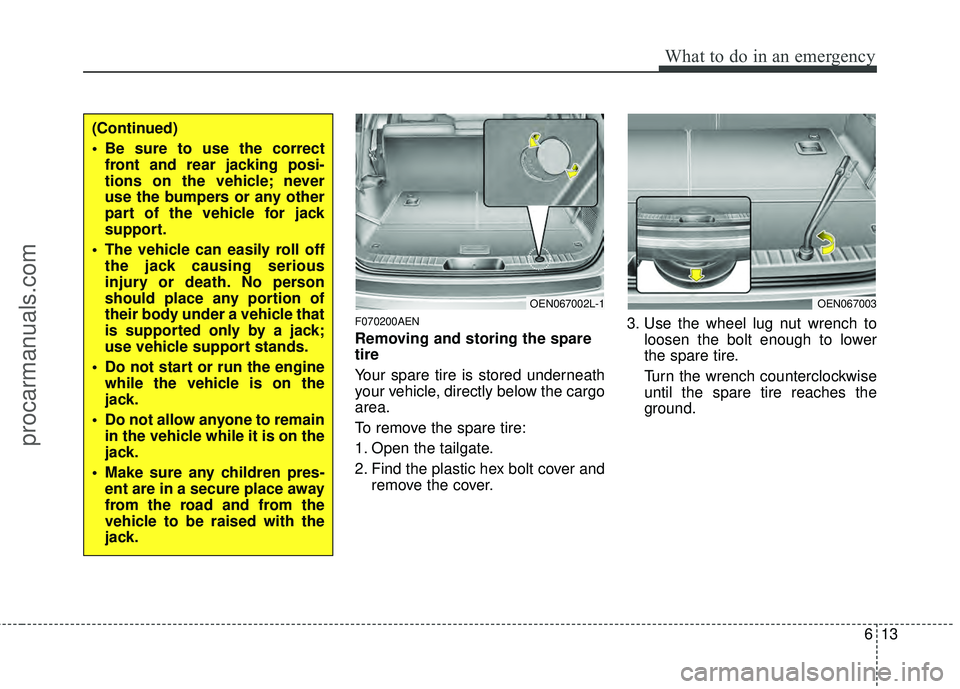
Your spare tire is stored underneath
your vehicle, directly below the cargo
area.
To remove the spare tire:
1. Open the tailgate.
2. Find the plastic hex bolt cover andremove the cover. 3. Use the wheel lug nut wrench to
loosen the bolt enough to lower
the spare tire.
Turn the wrench counterclockwise
until the spare tire reaches the
ground.
OEN067002L-1OEN067003
(Continued)
Be sure to use the correctfront and rear jacking posi-
tions on the vehicle; never
use the bumpers or any other
part of the vehicle for jack
support.
The vehicle can easily roll off the jack causing serious
injury or death. No person
should place any portion of
their body under a vehicle that
is supported only by a jack;
use vehicle support stands.
Do not start or run the engine while the vehicle is on the
jack.
Do not allow anyone to remain in the vehicle while it is on the
jack.
Make sure any children pres- ent are in a secure place away
from the road and from the
vehicle to be raised with the
jack.
procarmanuals.com
Page 344 of 429
7
Engine compartment / 7-2
Maintenance services / 7-3
Owner maintenance / 7-4
Scheduled maintenance service / 7-6
Explanation of scheduled maintenance items / 7-11
Engine oil / 7-14
Engine coolant / 7-15
Brakes fluid / 7-18
Power steering fluid / 7-19
Washer fluid / 7-20
Parking brake / 7-20
Air cleaner / 7-21
Climate control air filter / 7-22
Wiper blades / 7-24
Battery / 7-27
Tires and wheels / 7-30
Fuses / 7-43
Light bulbs / 7-52
Appearance care / 7-59
Emission control system / 7-65
California perchlorate notice / 7-68
Maintenance
procarmanuals.com
Page 345 of 429
Maintenance
27
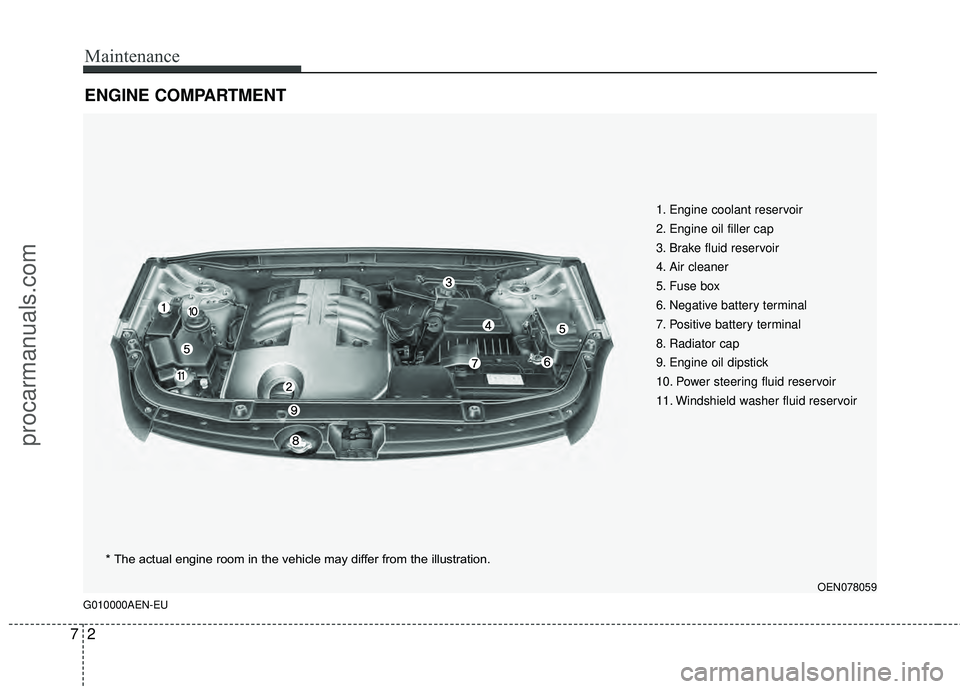
ENGINE COMPARTMENT
G010000AEN-EU
OEN078059
1. Engine coolant reservoir
2. Engine oil filler cap
3. Brake fluid reservoir
4. Air cleaner
5. Fuse box
6. Negative battery terminal
7. Positive battery terminal
8. Radiator cap
9. Engine oil dipstick
10. Power steering fluid reservoir
11. Windshield washer fluid reservoir
* The actual engine room in the vehicle may differ from the illustration.
procarmanuals.com
Page 347 of 429
Maintenance
47
WARNING
Be careful when checking your
engine coolant level when the
engine is hot. Scalding hot coolant
and steam may blow out under
pressure. This could cause burns
or other serious injury.
G030000AEN
The following lists are vehicle checks and
inspections that should be performed by
the owner or an authorized HYUNDAI
dealer at the frequencies indicated to
help ensure safe, dependable operation
of your vehicle.
Any adverse conditions should be
brought to the attention of your dealer as
soon as possible.
These Owner Maintenance Checks are
generally not covered by warranties and
you may be charged for labor, parts and
lubricants used.Owner maintenance schedule
G030101AUN
When you stop for fuel:
Check the engine oil level.
Check coolant level in coolant reser-voir.
Check the windshield washer fluid level.
Look for low or under-inflated tires.
WARNING- Maintenance work
Performing maintenance work on
a vehicle can be dangerous. You
can be seriously injured while
performing some maintenance
procedures. If you lack sufficient
knowledge and experience or the
proper tools and equipment to do
the work, have it done by an
authorized HYUNDAI dealer.
Working under the hood with the engine running is dangerous. It
becomes even more dangerous
when you wear jewelry or loose
clothing. These can become
entangled in moving parts and
result in injury. Therefore, if you
must run the engine while work-
ing under the hood, make certain
that you remove all jewelry (espe-
cially rings, bracelets, watches,
and necklaces) and all neckties,
scarves, and similar loose cloth-
ing before getting near the
engine or cooling fans.
OWNER MAINTENANCE
procarmanuals.com
Page 348 of 429
75
Maintenance
G030102AUN
While operating your vehicle:
Note any changes in the sound of theexhaust or any smell of exhaust fumes
in the vehicle.
Check for vibrations in the steering wheel. Notice any increased steering
effort or looseness in the steering
wheel, or change in its straight-ahead
position.
Notice if your vehicle constantly turns slightly or “pulls” to one side when trav-
eling on smooth, level road.
When stopping, listen and check for unusual sounds, pulling to one side,
increased brake pedal travel or “hard-
to-push” brake pedal.
If any slipping or changes in the oper- ation of your transaxle occurs, check
the transaxle fluid level.
Check automatic transaxle P (Park) function.
Check parking brake.
Check for fluid leaks under your vehicle (water dripping from the air condition-
ing system during or after use is nor-
mal).
G030103AUN
At least monthly:
Check coolant level in the enginecoolant reservoir.
Check the operation of all exterior lights, including the stoplights, turn sig-
nals and hazard warning flashers.
Check the inflation pressures of all tires including the spare.
G030104AUN
At least twice a year (i.e., every Spring and Fall):
Check radiator, heater and air condi- tioning hoses for leaks or damage.
Check windshield washer spray and wiper operation. Clean wiper blades
with clean cloth dampened with wash-
er fluid.
Check headlight alignment.
Check muffler, exhaust pipes, shields and clamps.
Check the lap/shoulder belts for wear and function.
Check for worn tires and loose wheel lug nuts.
G030105AUN-EU
At least once a year:
Clean body and door drain holes.
Lubricate door hinges and checks, andhood hinges.
Lubricate door and hood locks and latches.
Lubricate door rubber weatherstrips.
Check the air conditioning system.
Check the power steering fluid level.
Inspect and lubricate automatic transaxle linkage and controls.
Clean battery and terminals.
Check the brake fluid level.
procarmanuals.com
Page 350 of 429
77
Maintenance
G040100AEN-EU
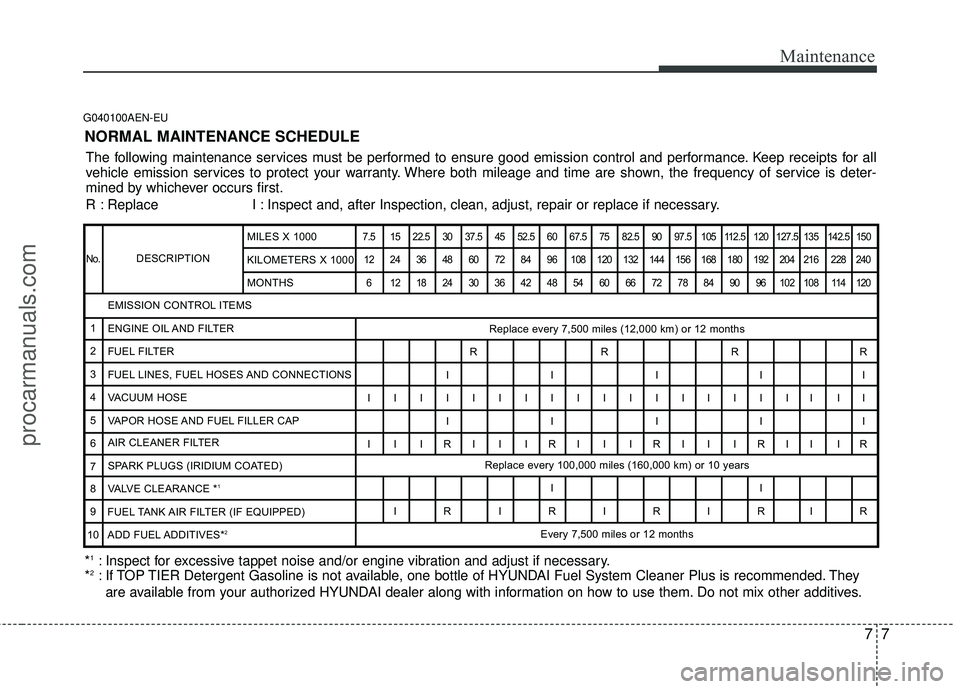
NORMAL MAINTENANCE SCHEDULE
The following maintenance services must be performed to ensure good emission control and performance. Keep receipts for all
vehicle emission services to protect your warranty. Where both mileage and time are shown, the frequency of service is deter-
mined by whichever occurs first.
R : Replace I : Inspect and, after Inspection, clean, adjust, repair or replace if neces\
sary.
*
1: Inspect for excessive tappet noise and/or engine vibration and adjust if necessary.
*2: If TOP TIER Detergent Gasoline is not available, one bottle of HYUNDAI Fuel System Cleaner Plus is recommended. They
are available from your authorized HYUNDAI dealer along with information on how to use them. Do not mix other additives.
DESCRIPTION
7.5 15 22.5 30 37.5 45 52.5 60 67.5 75 82.5 90 97.5 105 112.5 120 127.5 135 142.5 150
12 24 36 48 60 72 84 96 108 120 132 144 156 168 180 192 204 216 228 240 6 121824303642485460667278849096102108114120
Replace every 7,500 miles (12,000 km) or 12 months
RRRR
IIIII
IIIIIIIIIIIIIIIIII II IIIII
I I IRI I IRI I IRI I IRII IR Replace every 100,000 miles (160,000 km) or 10 years
II
IRIRIRIRIR Every 7,500 miles or 12 months
EMISSION CONTROL ITEMS
ENGINE OIL AND FILTER
FUEL FILTER
FUEL LINES, FUEL HOSES AND CONNECTIONS
VACUUM HOSE
VAPOR HOSE AND FUEL FILLER CAP
AIR CLEANER FILTER
SPARK PLUGS (IRIDIUM COATED)
VALVE CLEARANCE *
1
FUEL TANK AIR FILTER (IF EQUIPPED)
ADD FUEL ADDITIVES*
2
No.
1
2
3
4
5
6
7
8
9
10 MILES X 1000
KILOMETERS X 1000
MONTHS
procarmanuals.com
Page 351 of 429
Maintenance
87
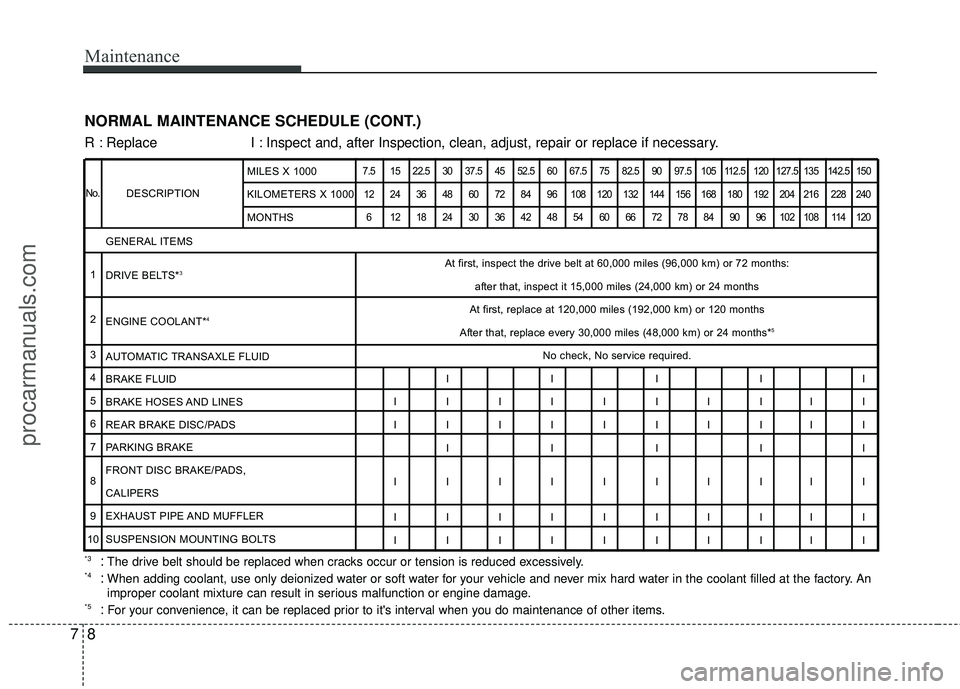
NORMAL MAINTENANCE SCHEDULE (CONT.)
DESCRIPTION
7.5 15 22.5 30 37.5 45 52.5 60 67.5 75 82.5 90 97.5 105 112.5 120 127.5 135 142.5 15012 24 36 48 60 72 84 96 108 120 132 144 156 168 180 192 204 216 228 240 6 121824303642485460667278849096102108114120
At first, inspect the drive belt at 60,000 miles (96,000 km) or 72 mon\
ths: after that, inspect it 15,000 miles (24,000 km) or 24 months
At first, replace at 120,000 miles (192,000 km) or 120 months
After that, replace every 30,000 miles (48,000 km) or 24 months*
5
No check, No service required.
IIIII
IIIIIIIIII
IIIIIIIIII IIIII
IIIIIIIIII
IIIIIIIIII
IIIIIIIIII
GENERAL ITEMS
DRIVE BELTS*
3
ENGINE COOLANT*4
AUTOMATIC TRANSAXLE FLUID
BRAKE FLUID
BRAKE HOSES AND LINES
REAR BRAKE DISC/PADS
PARKING BRAKE
FRONT DISC BRAKE/PADS,
CALIPERS
EXHAUST PIPE AND MUFFLER
SUSPENSION MOUNTING BOLTS MILES X 1000
KILOMETERS X 1000
MONTHS
R : Replace
I : Inspect and, after Inspection, clean, adjust, repair or replace if neces\
sary.
No.
1
2
3
4
5
6
7
8
9
10
*3:The drive belt should be replaced when cracks occur or tension is reduced excessively.*4:When adding coolant, use only deionized water or soft water for your vehicle and never mix hard water in the coolant filled at the factory. An
improper coolant mixture can result in serious malfunction or engine damage.
*5:For your convenience, it can be replaced prior to it's interval when you do maintenance of other items.
procarmanuals.com
Page 353 of 429
Maintenance
10
7
G040200AEN-EU
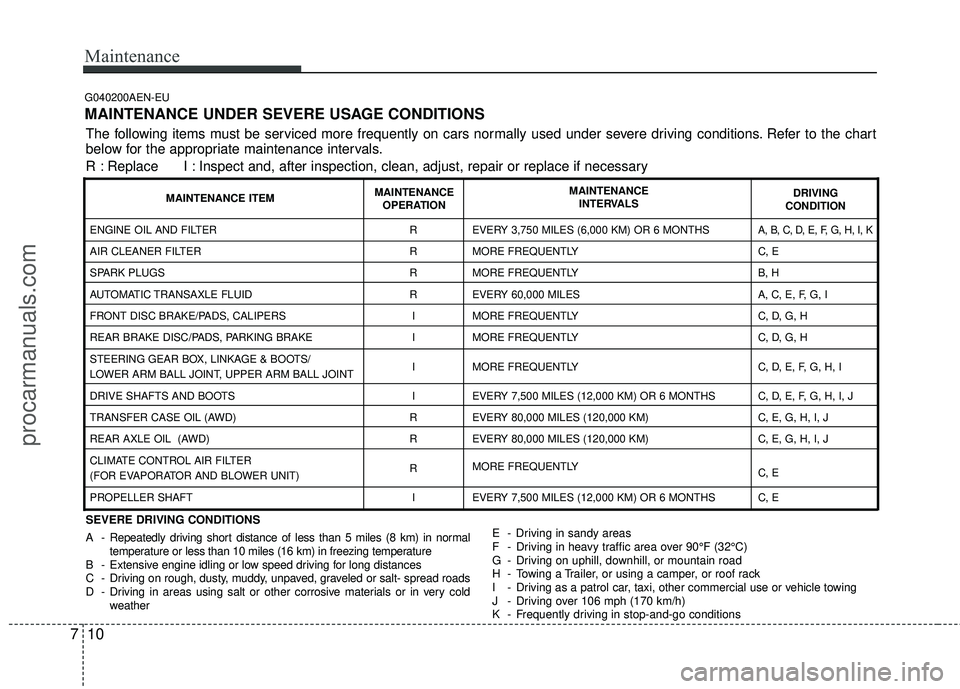
MAINTENANCE UNDER SEVERE USAGE CONDITIONS
SEVERE DRIVING CONDITIONS
A - Repeatedly driving short distance of less than 5 miles (8 km) in normal
temperature or less than 10 miles (16 km) in freezing temperature
B - Extensive engine idling or low speed driving for long distances
C - Driving on rough, dusty, muddy, unpaved, graveled or salt- spread roads
D - Driving in areas using salt or other corrosive materials or in very cold weather E - Driving in sandy areas
F - Driving in heavy traffic area over 90°F (32°C)
G - Driving on uphill, downhill, or mountain road
H - Towing a Trailer, or using a camper, or roof rack
I - Driving as a patrol car, taxi, other commercial use or vehicle towing
J - Driving over 106 mph (170 km/h)
K - Frequently driving in stop-and-go conditions
ENGINE OIL AND FILTER
AIR CLEANER FILTER
SPARK PLUGS
AUTOMATIC TRANSAXLE FLUID
FRONT DISC BRAKE/PADS, CALIPERS
REAR BRAKE DISC/PADS, PARKING BRAKE
STEERING GEAR BOX, LINKAGE & BOOTS/
LOWER ARM BALL JOINT, UPPER ARM BALL JOINT
DRIVE SHAFTS AND BOOTS
TRANSFER CASE OIL (AWD)
REAR AXLE OIL (AWD)
CLIMATE CONTROL AIR FILTER
(FOR EVAPORATOR AND BLOWER UNIT)
PROPELLER SHAFTR
R
R
R
I
I
I
I
R
R
R
I EVERY 3,750 MILES (6,000 KM) OR 6 MONTHS
MORE FREQUENTLY
MORE FREQUENTLY
EVERY 60,000 MILES
MORE FREQUENTLY
MORE FREQUENTLY
MORE FREQUENTLY
EVERY 7,500 MILES (12,000 KM) OR 6 MONTHS
EVERY 80,000 MILES (120,000 KM)
EVERY 80,000 MILES (120,000 KM)
MORE FREQUENTLY
EVERY 7,500 MILES (12,000 KM) OR 6 MONTHSA, B, C, D, E, F, G, H, I, K
C, E
B, H
A, C, E, F, G, I
C, D, G, H
C, D, G, H
C, D, E, F, G, H, I
C, D, E, F, G, H, I, J
C, E, G, H, I, J
C, E, G, H, I, J
C, E
C, E
MAINTENANCE ITEM
MAINTENANCE
OPERATION MAINTENANCE
INTERVALS DRIVING
CONDITION
The following items must be serviced more frequently on cars normally used under severe driving conditions. Refer to the chart
below for the appropriate maintenance intervals.
R : Replace I : Inspect and, after inspection, clean, adjust, repair or replace if neces\
sary
procarmanuals.com