brake HYUNDAI VERACRUZ 2012 Owners Manual
[x] Cancel search | Manufacturer: HYUNDAI, Model Year: 2012, Model line: VERACRUZ, Model: HYUNDAI VERACRUZ 2012Pages: 429, PDF Size: 7.11 MB
Page 12 of 429
15
Introduction
A090000AEN
As with other vehicles of this type, failure
to operate this vehicle correctly may
result in loss of control, an accident or
vehicle rollover.
Specific design characteristics (higher
ground clearance, track, etc.) give this
vehicle a higher center of gravity than
other types of vehicles. It is not designed
for cornering at the same speeds as a
conventional 2-wheel drive sedans or
sports coupe. Avoid sharp turns or abrupt
maneuvers. Again, failure to operate this
vehicle correctly may result in loss of
control, an accident or vehicle rollover.
Be sure to read the “Reducing the risk
of a rollover” driving guidelines, in
section 5 of this manual.
A030000AUN
No special break-in period is needed. By
following a few simple precautions for the
first 600 miles (1,000 km) you may add to
the performance, economy and life of
your vehicle.
Do not race the engine.
While driving, keep your engine speed(rpm, or revolutions per minute)
between 2,000 rpm and 4,000 rpm.
Do not maintain a single speed for long periods of time, either fast or slow.
Varying engine speed is needed to
properly break-in the engine.
Avoid hard stops, except in emergen- cies, to allow the brakes to seat prop-
erly.
Don't let the engine idle longer than 3 minutes at one time.
Don't tow a trailer during the first 1,200 miles (2,000 km) of operation.
VEHICLE BREAK-IN PROCESS
VEHICLE HANDLING
INSTRUCTIONS
procarmanuals.com
Page 13 of 429
Introduction
61
A040000AFD
This vehicle is equipped with an event
data recorder (EDR). The main pur-
pose of an EDR is to record, in certain
crash or near crash-like situations,
such as an air bag deployment or hit-
ting a road obstacle, data that will
assist in understanding how a vehi-
cle's systems performed. The EDR is
designed to record data related to
vehicle dynamics and safety systems
for a short period of time, typically 30
seconds or less. The EDR in this vehi-
cle is designed to record such data
as:
were operating;
senger safety belts were
buckled/fastened;
depressing the accelerator and / or
brake pedal; and,
These data can help provide a better
understanding of the circumstances
in which crashes and injuries occur.
NOTE: EDR data are recorded by your
vehicle only if a nontrivial crash situa-
tion occurs; no data are recorded by
the EDR under normal driving condi-
tions and no personal data (e.g.,
name, gender, age, and crash loca-
tion) are recorded. However, other
parties, such as law enforcement,
could combine the EDR data with the
type of personally identifying data
routinely acquired during a crash
investigation.
To read data recorded by an EDR, spe-
cial equipment is required, and
access to the vehicle or the EDR is
needed.
In addition to the vehicle manufactur-
er, other parties, such as law enforce-
ment, that have the special equip-
ment, can read the information if they
have access to the vehicle or the EDR.
VEHICLE DATA COLLECTION AND EVENT DATA RECORDERS
procarmanuals.com
Page 14 of 429
17
Introduction
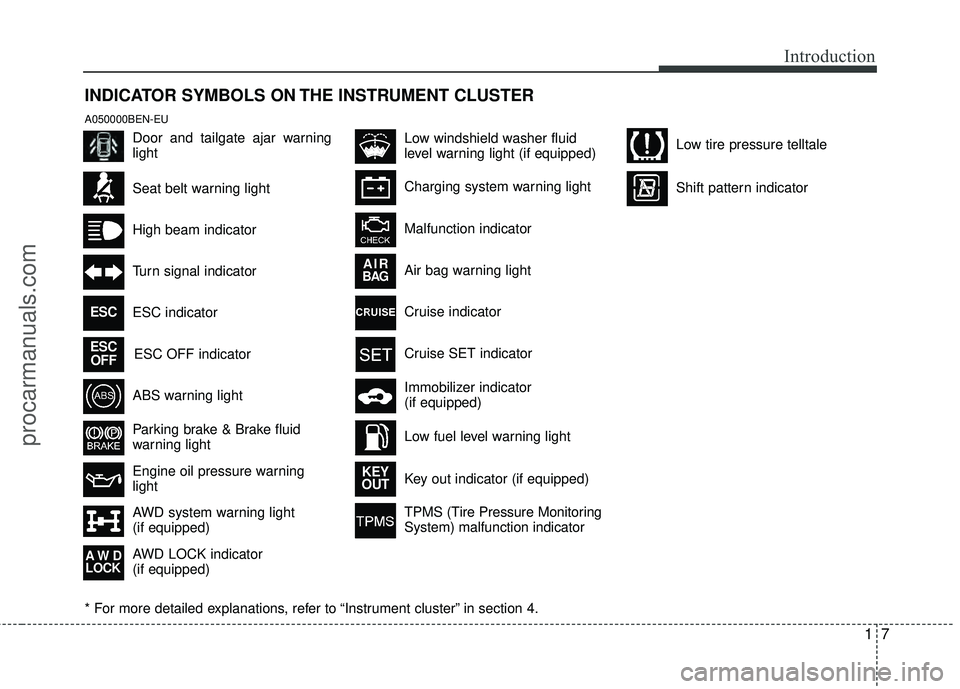
INDICATOR SYMBOLS ON THE INSTRUMENT CLUSTER
Seat belt warning light
High beam indicator
Turn signal indicator
ABS warning light
Parking brake & Brake fluid
warning light
Engine oil pressure warning
light
AWD system warning light
(if equipped)
AWD LOCK indicator
(if equipped) ESC indicatorESC OFF indicator
Malfunction indicator
Air bag warning light
Cruise indicator
Cruise SET indicator
Immobilizer indicator
(if equipped)
Low fuel level warning light
* For more detailed explanations, refer to “Instrument cluster” in section 4.
Charging system warning lightShift pattern indicator
Low windshield washer fluid
level warning light (if equipped)
A050000BEN-EU
Door and tailgate ajar warning
light
Key out indicator (if equipped)
KEY
OUT
AW D
LOCK
AIRBAG
ESC
ESC
OFF
TPMS (Tire Pressure Monitoring
System) malfunction indicator
Low tire pressure telltale
procarmanuals.com
Page 16 of 429
Your vehicle at a glance
22
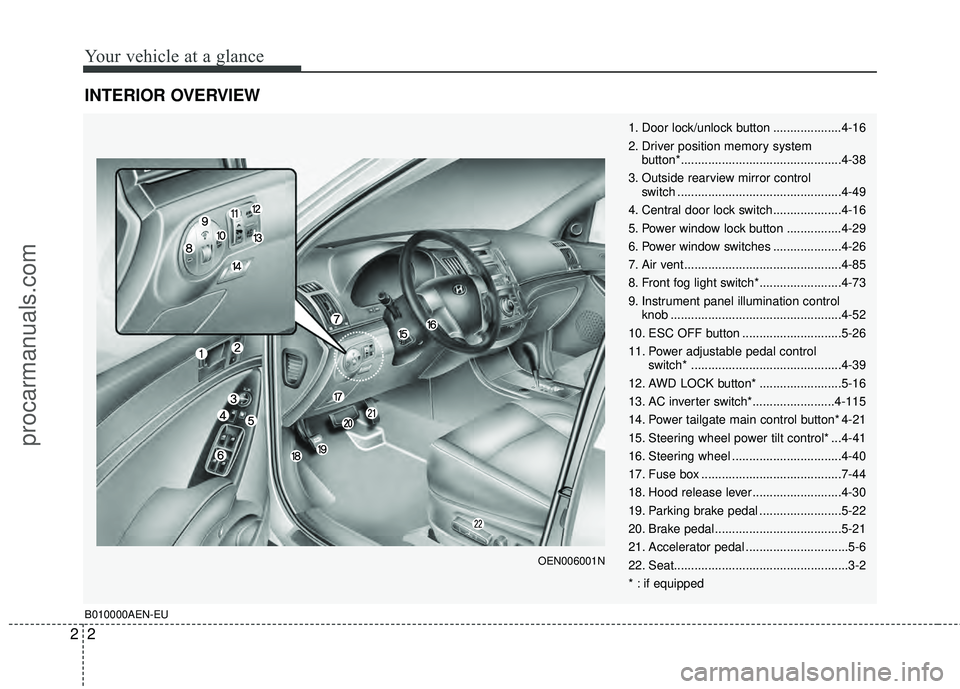
INTERIOR OVERVIEW
1. Door lock/unlock button ....................4-16
2. Driver position memory system button*...............................................4-38
3. Outside rearview mirror control switch ................................................4-49
4. Central door lock switch....................4-16
5. Power window lock button ................4-29
6. Power window switches ....................4-26
7. Air vent ..............................................4-85
8. Front fog light switch*........................4-73
9. Instrument panel illumination control knob ..................................................4-52
10. ESC OFF button .............................5-26
11. Power adjustable pedal control switch* ............................................4-39
12. AWD LOCK button* ........................5-16
13. AC inverter switch*........................4-115
14. Power tailgate main control button* 4-21
15. Steering wheel power tilt control* ...4-41
16. Steering wheel ................................4-40
17. Fuse box .........................................7-44
18. Hood release lever ..........................4-30
19. Parking brake pedal ........................5-22
20. Brake pedal .....................................5-21
21. Accelerator pedal ..............................5-6
22. Seat...................................................3-2
* : if equipped
B010000AEN-EU OEN006001N
procarmanuals.com
Page 17 of 429
23
Your vehicle at a glance
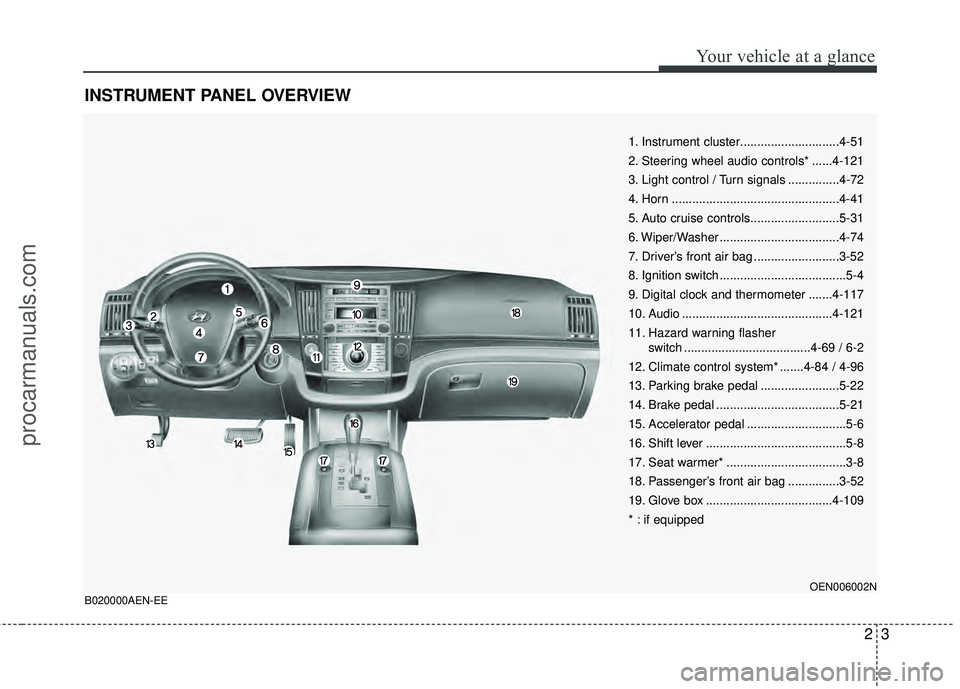
INSTRUMENT PANEL OVERVIEW
1. Instrument cluster.............................4-51
2. Steering wheel audio controls* ......4-121
3. Light control / Turn signals ...............4-72
4. Horn .................................................4-41
5. Auto cruise controls..........................5-31
6. Wiper/Washer ...................................4-74
7. Driver’s front air bag .........................3-52
8. Ignition switch .....................................5-4
9. Digital clock and thermometer .......4-117
10. Audio ............................................4-121
11. Hazard warning flasher switch .....................................4-69 / 6-2
12. Climate control system* .......4-84 / 4-96
13. Parking brake pedal .......................5-22
14. Brake pedal ....................................5-21
15. Accelerator pedal .............................5-6
16. Shift lever .........................................5-8
17. Seat warmer* ...................................3-8
18. Passenger’s front air bag ...............3-52
19. Glove box .....................................4-109
* : if equipped
OEN006002NB020000AEN-EE
procarmanuals.com
Page 18 of 429
Your vehicle at a glance
42
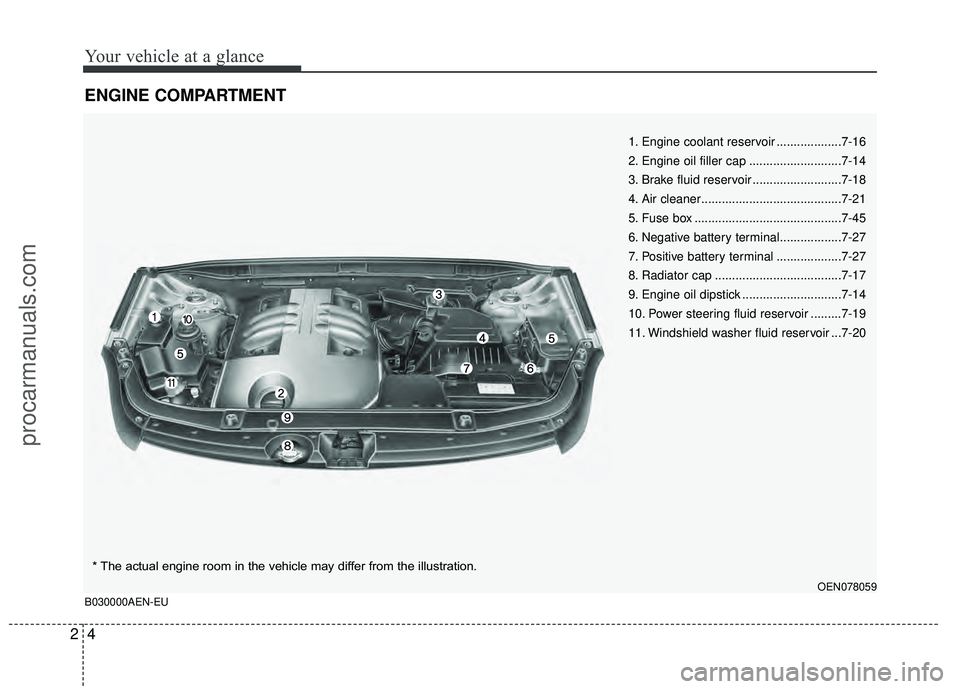
ENGINE COMPARTMENT
1. Engine coolant reservoir ...................7-16
2. Engine oil filler cap ...........................7-14
3. Brake fluid reservoir ..........................7-18
4. Air cleaner.........................................7-21
5. Fuse box ...........................................7-45
6. Negative battery terminal..................7-27
7. Positive battery terminal ...................7-27
8. Radiator cap .....................................7-17
9. Engine oil dipstick .............................7-14
10. Power steering fluid reservoir .........7-19
11. Windshield washer fluid reservoir ...7-20
OEN078059B030000AEN-EU
* The actual engine room in the vehicle may differ from the illustration.
procarmanuals.com
Page 38 of 429
Safety features of your vehicle
20
3
WARNING - Uprighting
seat
When you return the seatback to its
upright position, hold the seatback
and return it slowly. If the seatback
is returned without holding it, the
back of the seat could spring for-
ward resulting in injury caused by
being struck by the seatback.
WARNING- Cargo
Cargo should always be secured to
prevent it from being thrown about
the vehicle in a collision and caus-
ing injury to the vehicle occupants.
Do not place objects on the rear
(2nd and/or 3rd row) seats, since
they cannot be properly secured
and may hit the front seat occu-
pants in a collision.
WARNING - Cargo loading
Make sure the engine is off, the
automatic transaxle is in P (Park)
or the manual transaxle is in
reverse, and the parking brake is
securely applied whenever loading
or unloading cargo. Failure to take
these steps may allow the vehicle
to move if the shift lever is inadver-
tently moved to another position.
CAUTION- Rear seat belts
When returning the rear (2nd and/or
3rd row) seatbacks to the uprightposition, remember to return the rearshoulder belts to their proper posi-tion. Routing the seat belt webbing through the rear seat belt guides willhelp keep the belts from being trapped behind or under the seats.
CAUTION - Damaging rear
seat belt buckles
When you fold the rear (2nd and/or
3rd row) seatback, push the buckleinto the pocket in the rear cushion.Doing so can prevent the buckle frombeing damaged by the rear seatback.
procarmanuals.com
Page 81 of 429
363
Safety features of your vehicle
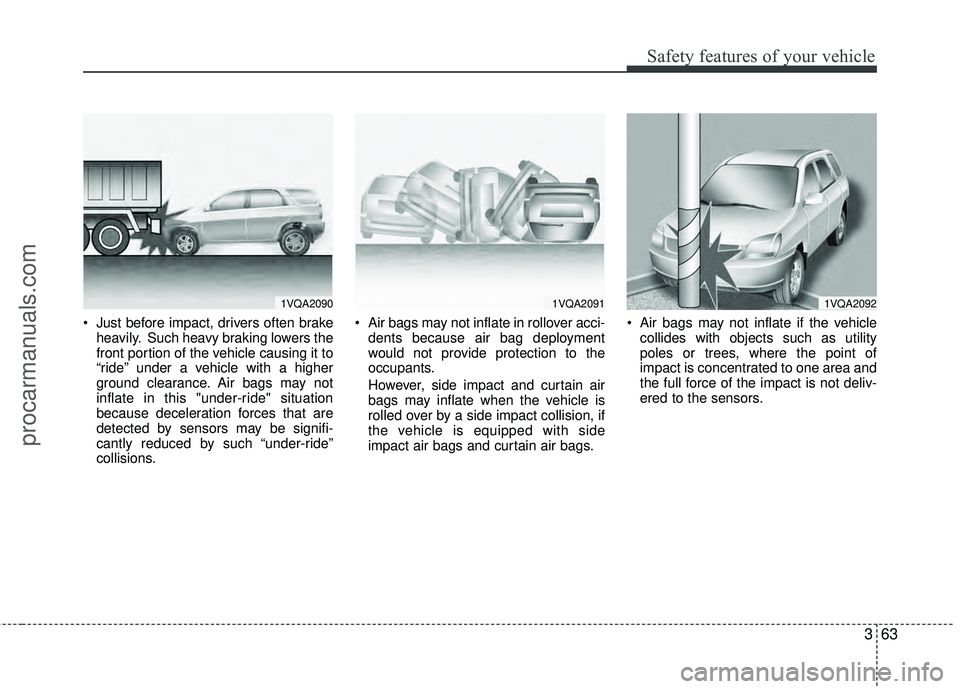
Just before impact, drivers often brakeheavily. Such heavy braking lowers the
front portion of the vehicle causing it to
“ride” under a vehicle with a higher
ground clearance. Air bags may not
inflate in this "under-ride" situation
because deceleration forces that are
detected by sensors may be signifi-
cantly reduced by such “under-ride”
collisions. Air bags may not inflate in rollover acci-
dents because air bag deployment
would not provide protection to the
occupants.
However, side impact and curtain air
bags may inflate when the vehicle is
rolled over by a side impact collision, if
the vehicle is equipped with side
impact air bags and curtain air bags. Air bags may not inflate if the vehicle
collides with objects such as utility
poles or trees, where the point of
impact is concentrated to one area and
the full force of the impact is not deliv-
ered to the sensors.
1VQA20901VQA20911VQA2092
procarmanuals.com
Page 98 of 429
Features of your vehicle
14
4
D050100AEN-EU
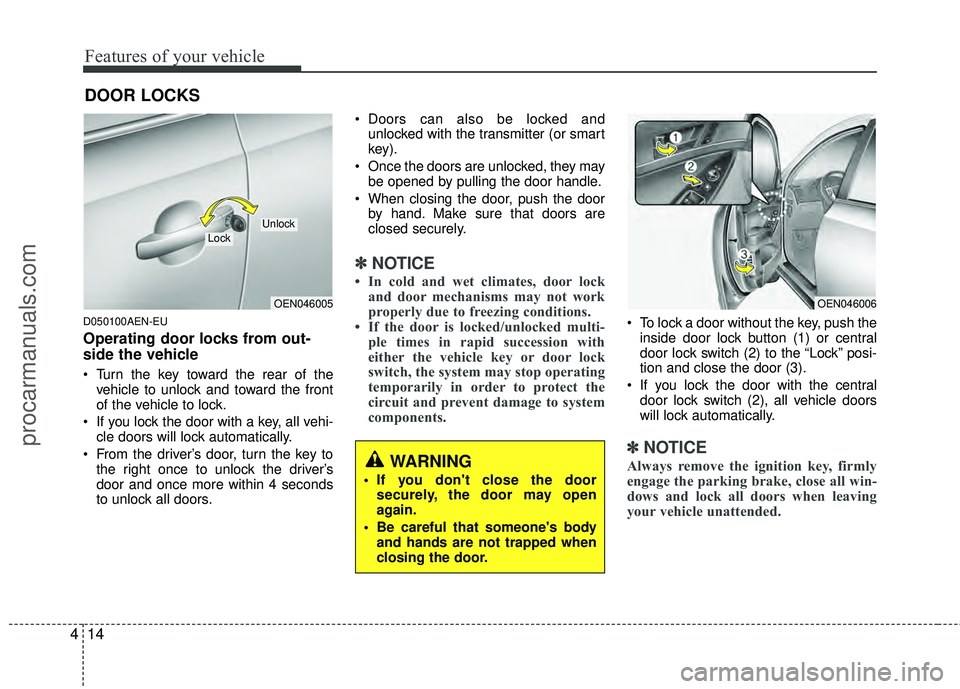
Operating door locks from out-
side the vehicle
Turn the key toward the rear of the
vehicle to unlock and toward the front
of the vehicle to lock.
If you lock the door with a key, all vehi- cle doors will lock automatically.
From the driver’s door, turn the key to the right once to unlock the driver’s
door and once more within 4 seconds
to unlock all doors. Doors can also be locked and
unlocked with the transmitter (or smart
key).
Once the doors are unlocked, they may be opened by pulling the door handle.
When closing the door, push the door by hand. Make sure that doors are
closed securely.
✽ ✽ NOTICE
• In cold and wet climates, door lock
and door mechanisms may not work
properly due to freezing conditions.
• If the door is locked/unlocked multi- ple times in rapid succession with
either the vehicle key or door lock
switch, the system may stop operating
temporarily in order to protect the
circuit and prevent damage to system
components.
To lock a door without the key, push the
inside door lock button (1) or central
door lock switch (2 ) to the “Lock” posi-
tion and close the door (3).
If you lock the door with the central door lock switch (2), all vehicle doors
will lock automatically.
✽ ✽ NOTICE
Always remove the ignition key, firmly
engage the parking brake, close all win-
dows and lock all doors when leaving
your vehicle unattended.
DOOR LOCKS
OEN046005
LockUnlock
OEN046006
WARNING
If you don't close the door
securely, the door may open
again.
Be careful that someone's body and hands are not trapped when
closing the door.
procarmanuals.com
Page 100 of 429
Features of your vehicle
16
4
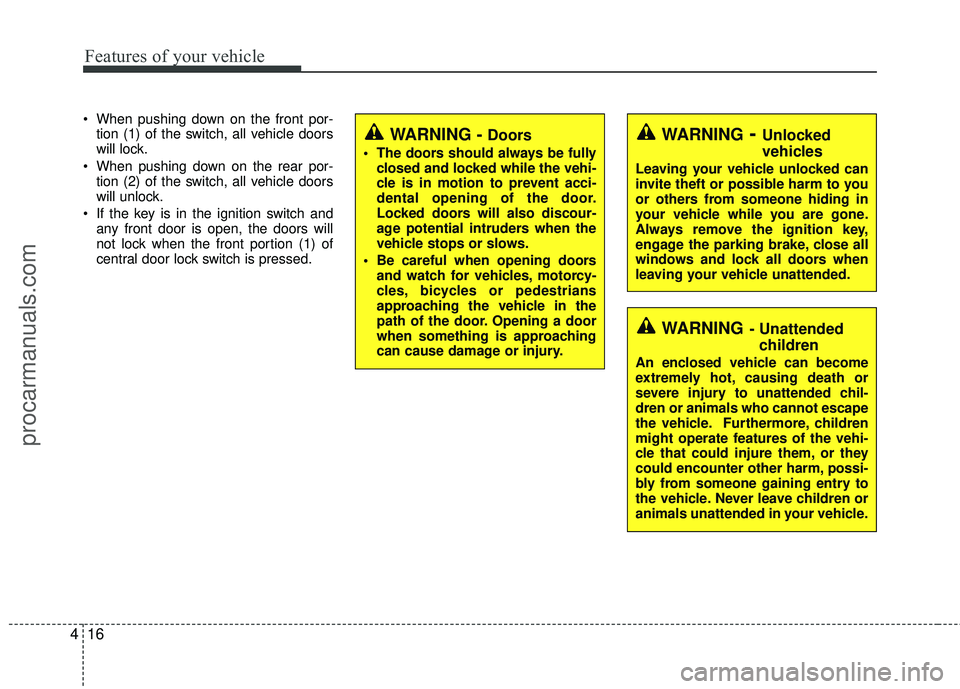
When pushing down on the front por-
tion (1) of the switch, all vehicle doors
will lock.
When pushing down on the rear por- tion (2) of the switch, all vehicle doors
will unlock.
If the key is in the ignition switch and any front door is open, the doors will
not lock when the front portion (1) of
central door lock switch is pressed.
WARNING- Unlocked
vehicles
Leaving your vehicle unlocked can
invite theft or possible harm to you
or others from someone hiding in
your vehicle while you are gone.
Always remove the ignition key,
engage the parking brake, close all
windows and lock all doors when
leaving your vehicle unattended.
WARNING- Unattendedchildren
An enclosed vehicle can become
extremely hot, causing death or
severe injury to unattended chil-
dren or animals who cannot escape
the vehicle. Furthermore, children
might operate features of the vehi-
cle that could injure them, or they
could encounter other harm, possi-
bly from someone gaining entry to
the vehicle. Never leave children or
animals unattended in your vehicle.
WARNING - Doors
The doors should always be fully
closed and locked while the vehi-
cle is in motion to prevent acci-
dental opening of the door.
Locked doors will also discour-
age potential intruders when the
vehicle stops or slows.
Be careful when opening doors and watch for vehicles, motorcy-
cles, bicycles or pedestrians
approaching the vehicle in the
path of the door. Opening a door
when something is approaching
can cause damage or injury.
procarmanuals.com