engine HYUNDAI VERACRUZ 2012 Owners Manual
[x] Cancel search | Manufacturer: HYUNDAI, Model Year: 2012, Model line: VERACRUZ, Model: HYUNDAI VERACRUZ 2012Pages: 429, PDF Size: 7.11 MB
Page 4 of 429
F4FOREWORD
Thank you for choosing Hyundai. We are pleased to welcome you to the growing number of discriminating people who drive
Hyundais. The advanced engineering and high-quality construction of each Hyundai we build is something of which we're very
proud.
Your Owner's Manual will introduce you to the features and operation of your new Hyundai. It is suggested that you read it care-
fully because the information it contains can contribute greatly to the satisfaction you receive from your new car.
The manufacturer also recommends that all service and maintenance on your car be performed by an authorized Hyundai deal-
er. Hyundai dealers are prepared to provide high-quality service, maintenance and any other assistance that may be required.
HYUNDAI MOTOR AMERICA
Note
: Because future owners will also need the information included in this manual, if you sell this Hyundai, please leave the man-
ual in the vehicle for their use. Thank you.
Copyright 2011 Hyundai Motor America. All rights reserved. No part of this publication may be reproduced, stored in any retrieva l
system or transmitted in any form or by any means without the prior written permission of Hyundai Motor America.
CAUTION
Severe engine and transaxle damage may result from the use of poor quality fuels and lubricants that do not meet Hyundai\
specifications. You must always use high quality fuels and lubricants that meet the specifications li\
sted on Page 8-4 in theVehicle Specifications section of the Owner's Manual.
procarmanuals.com
Page 10 of 429
13
Introduction
A020101BEN-EU
Your new vehicle is designed to use only
unleaded fuel having a pump octane
number ((R+M)/2) of 87 or higher.
Your new vehicle is designed to obtain
maximum performance with UNLEADED
FUEL, as well as minimize exhaust emis-
sions and spark plug fouling.
A020103AUN-EU
Gasoline containing alcohol andmethanol
Gasohol, a mixture of gasoline and
ethanol (also known as grain alcohol),
and gasoline or gasohol containing
methanol (also known as wood alcohol)
are being marketed along with or instead
of leaded or unleaded gasoline.
Do not use gasohol containing more than
10% ethanol, and do not use gasoline or
gasohol containing any methanol. Either
of these fuels may cause drivability prob-
lems and damage to the fuel system.
Discontinue using gasohol of any kind if
drivability problems occur.
Vehicle damage or drivability problems
may not be covered by the manufactur-
er’s warranty if they result from the use
of:
1. Gasohol containing more than 10% ethanol.
2. Gasoline or gasohol containing methanol.
3. Leaded fuel or leaded gasohol.
FUEL REQUIREMENTS
CAUTION
Never add any fuel system cleaning agents to the fuel tank other thanwhat has been specified. (Consultan authorized HYUNDAI dealer fordetails.)
WARNING
• Do not "top off" after the nozzle automatically shuts off when
refueling.
Tighten the cap until it clicks one time, otherwise the Check Engine light will illuminate.
Always check that the fuel cap is installed securely to prevent fuel
spillage in the event of an acci-
dent.
procarmanuals.com
Page 11 of 429
Introduction
41
"E85" fuel is an alternative fuel com-
prised of 85 percent ethanol and 15 per-
cent gasoline, and is manufactured
exclusively for use in Flexible Fuel
Vehicles. “E85” is not compatible with
your vehicle. Use of “E85” may result in
poor engine performance and damage to
your vehicle's engine and fuel system.
HYUNDAI recommends that customers
do not use fuel with an ethanol content
exceeding 10 percent.A020105AUN
Do not use methanol
Fuels containing methanol (wood alco-
hol) should not be used in your vehicle.
This type of fuel can reduce vehicle per-
formance and damage components of
the fuel system.
Fuel Additives
HYUNDAI recommends that you use
good quality gasolines treated with deter-
gent additives such as TOP TIER
Detergent Gasoline, which help prevent
deposit formation in the engine. These
gasolines will help the engine run clean-
er and enhance performance of the
Emission Control System. For more infor-
mation on TOP TIER Detergent
Gasoline, please go to the website
(www
.toptiergas.com).For customers who do not use TOP Tier
Detergent Gasoline regularly, and have
problems starting or the engine does not
run smoothly, additives that you can buy
separately may be added to the gasoline.
If TOP TIER Detergent Gasoline is not
available, one bottle of additive added to
the fuel tank at every 7,500mile or every
engine oil change is recommended.
Additives are available from your author-
ized HYUNDAI dealer along with infor-
mation on how to use them. Do not mix
other additives.
A020107AUN
Operation in foreign countries
If you are going to drive your vehicle in
another country, be sure to:
Observe all regulations regarding reg-
istration and insurance.
Determine that acceptable fuel is avail- able.
CAUTION
Your New Vehicle Limited Warrantymay not cover damage to the fuelsystem and any performance prob-lems that are caused by the use offuels containing methanol.
CAUTION
Never use gasohol which containsmethanol. Discontinue use of anygasohol product which impairs dri-vability.
CAUTION
Your New Vehicle Limited Warrantydoes not cover damage to the fuelsystem or any performance prob-lems caused by the use of “E85” fuel.
procarmanuals.com
Page 12 of 429
15
Introduction
A090000AEN
As with other vehicles of this type, failure
to operate this vehicle correctly may
result in loss of control, an accident or
vehicle rollover.
Specific design characteristics (higher
ground clearance, track, etc.) give this
vehicle a higher center of gravity than
other types of vehicles. It is not designed
for cornering at the same speeds as a
conventional 2-wheel drive sedans or
sports coupe. Avoid sharp turns or abrupt
maneuvers. Again, failure to operate this
vehicle correctly may result in loss of
control, an accident or vehicle rollover.
Be sure to read the “Reducing the risk
of a rollover” driving guidelines, in
section 5 of this manual.
A030000AUN
No special break-in period is needed. By
following a few simple precautions for the
first 600 miles (1,000 km) you may add to
the performance, economy and life of
your vehicle.
Do not race the engine.
While driving, keep your engine speed(rpm, or revolutions per minute)
between 2,000 rpm and 4,000 rpm.
Do not maintain a single speed for long periods of time, either fast or slow.
Varying engine speed is needed to
properly break-in the engine.
Avoid hard stops, except in emergen- cies, to allow the brakes to seat prop-
erly.
Don't let the engine idle longer than 3 minutes at one time.
Don't tow a trailer during the first 1,200 miles (2,000 km) of operation.
VEHICLE BREAK-IN PROCESS
VEHICLE HANDLING
INSTRUCTIONS
procarmanuals.com
Page 14 of 429
17
Introduction
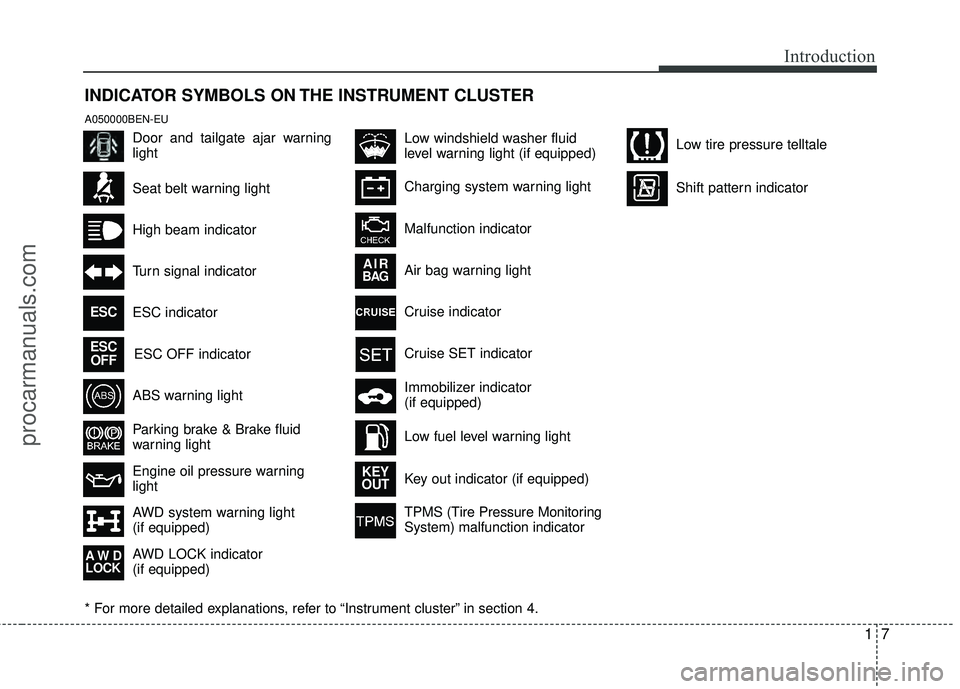
INDICATOR SYMBOLS ON THE INSTRUMENT CLUSTER
Seat belt warning light
High beam indicator
Turn signal indicator
ABS warning light
Parking brake & Brake fluid
warning light
Engine oil pressure warning
light
AWD system warning light
(if equipped)
AWD LOCK indicator
(if equipped) ESC indicatorESC OFF indicator
Malfunction indicator
Air bag warning light
Cruise indicator
Cruise SET indicator
Immobilizer indicator
(if equipped)
Low fuel level warning light
* For more detailed explanations, refer to “Instrument cluster” in section 4.
Charging system warning lightShift pattern indicator
Low windshield washer fluid
level warning light (if equipped)
A050000BEN-EU
Door and tailgate ajar warning
light
Key out indicator (if equipped)
KEY
OUT
AW D
LOCK
AIRBAG
ESC
ESC
OFF
TPMS (Tire Pressure Monitoring
System) malfunction indicator
Low tire pressure telltale
procarmanuals.com
Page 15 of 429
2
Interior overview / 2-2
Instrument panel overview / 2-3
Engine compartment / 2-4
Your vehicle at a glance
procarmanuals.com
Page 18 of 429
Your vehicle at a glance
42
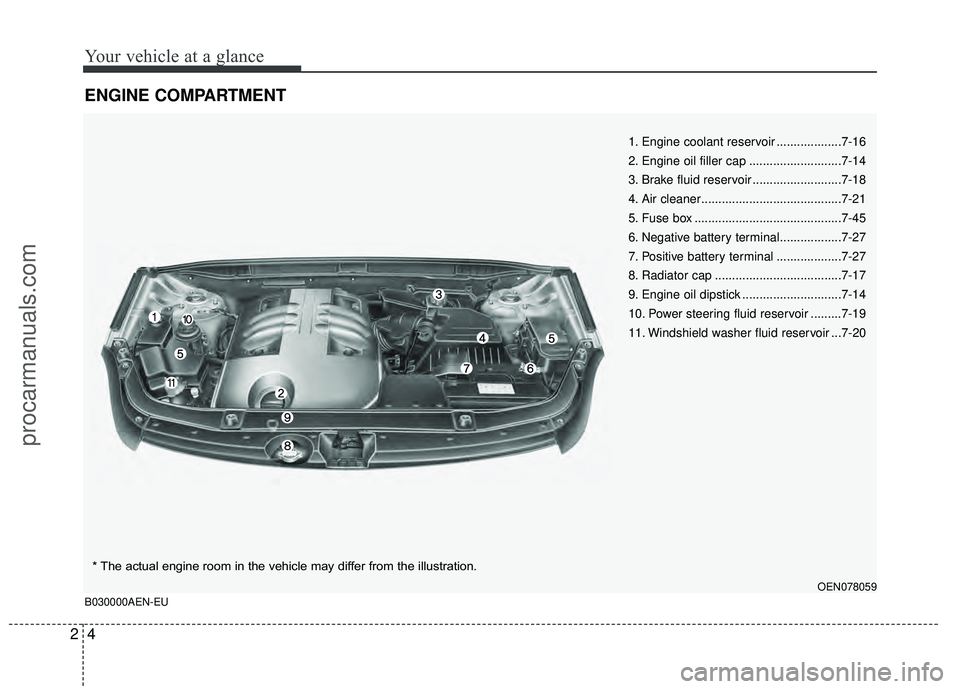
ENGINE COMPARTMENT
1. Engine coolant reservoir ...................7-16
2. Engine oil filler cap ...........................7-14
3. Brake fluid reservoir ..........................7-18
4. Air cleaner.........................................7-21
5. Fuse box ...........................................7-45
6. Negative battery terminal..................7-27
7. Positive battery terminal ...................7-27
8. Radiator cap .....................................7-17
9. Engine oil dipstick .............................7-14
10. Power steering fluid reservoir .........7-19
11. Windshield washer fluid reservoir ...7-20
OEN078059B030000AEN-EU
* The actual engine room in the vehicle may differ from the illustration.
procarmanuals.com
Page 28 of 429
Safety features of your vehicle
10
3
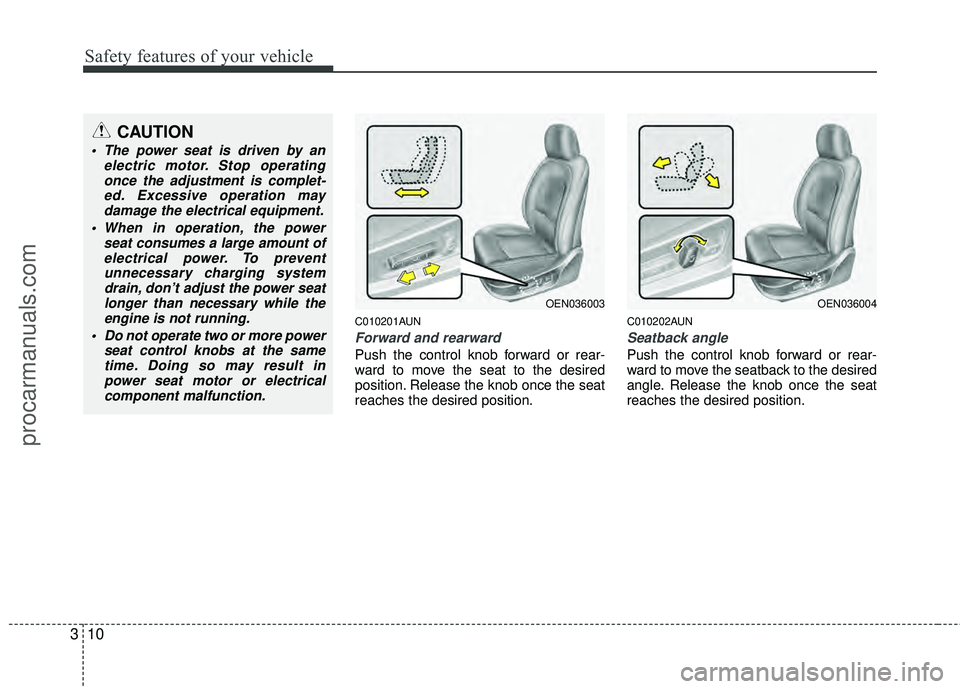
C010201AUN
Forward and rearward
Push the control knob forward or rear-
ward to move the seat to the desired
position. Release the knob once the seat
reaches the desired position.
C010202AUN
Seatback angle
Push the control knob forward or rear-
ward to move the seatback to the desired
angle. Release the knob once the seat
reaches the desired position.
OEN036003OEN036004
CAUTION
The power seat is driven by an
electric motor. Stop operatingonce the adjustment is complet-ed. Excessive operation maydamage the electrical equipment.
When in operation, the power seat consumes a large amount ofelectrical power. To preventunnecessary charging systemdrain, don’t adjust the power seatlonger than necessary while theengine is not running.
Do not operate two or more power seat control knobs at the sametime. Doing so may result inpower seat motor or electricalcomponent malfunction.
procarmanuals.com
Page 38 of 429
Safety features of your vehicle
20
3
WARNING - Uprighting
seat
When you return the seatback to its
upright position, hold the seatback
and return it slowly. If the seatback
is returned without holding it, the
back of the seat could spring for-
ward resulting in injury caused by
being struck by the seatback.
WARNING- Cargo
Cargo should always be secured to
prevent it from being thrown about
the vehicle in a collision and caus-
ing injury to the vehicle occupants.
Do not place objects on the rear
(2nd and/or 3rd row) seats, since
they cannot be properly secured
and may hit the front seat occu-
pants in a collision.
WARNING - Cargo loading
Make sure the engine is off, the
automatic transaxle is in P (Park)
or the manual transaxle is in
reverse, and the parking brake is
securely applied whenever loading
or unloading cargo. Failure to take
these steps may allow the vehicle
to move if the shift lever is inadver-
tently moved to another position.
CAUTION- Rear seat belts
When returning the rear (2nd and/or
3rd row) seatbacks to the uprightposition, remember to return the rearshoulder belts to their proper posi-tion. Routing the seat belt webbing through the rear seat belt guides willhelp keep the belts from being trapped behind or under the seats.
CAUTION - Damaging rear
seat belt buckles
When you fold the rear (2nd and/or
3rd row) seatback, push the buckleinto the pocket in the rear cushion.Doing so can prevent the buckle frombeing damaged by the rear seatback.
procarmanuals.com
Page 40 of 429
Safety features of your vehicle
22
3
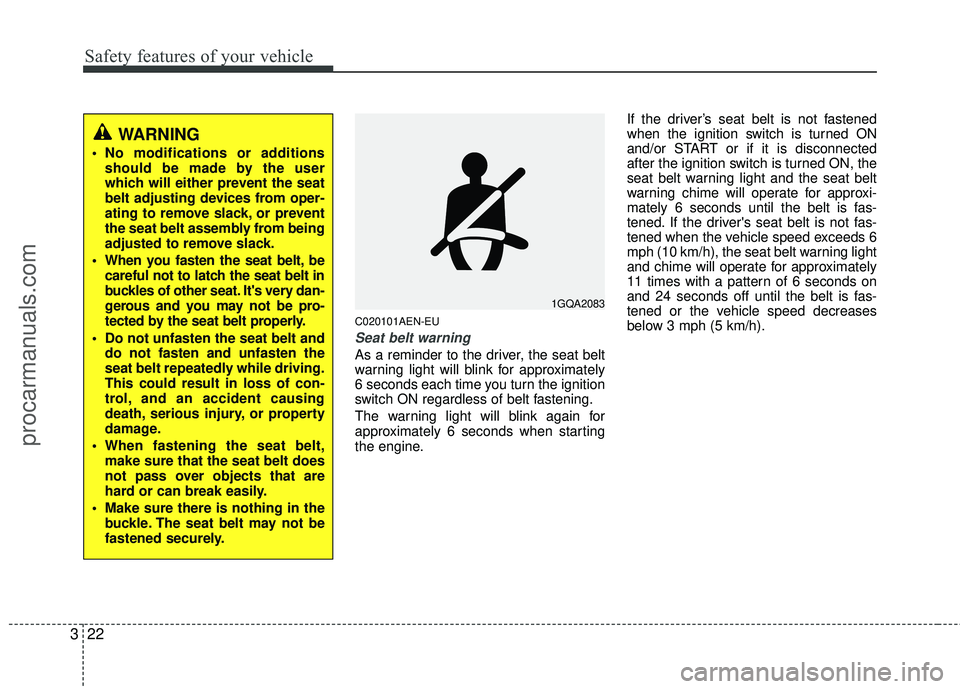
C020101AEN-EU
Seat belt warning
As a reminder to the driver, the seat belt
warning light will blink for approximately
6 seconds each time you turn the ignition
switch ON regardless of belt fastening.
The warning light will blink again for
approximately 6 seconds when starting
the engine. If the driver’s seat belt is not fastened
when the ignition switch is turned ON
and/or START or if it is disconnected
after the ignition switch is turned ON, the
seat belt warning light and the seat belt
warning chime will operate for approxi-
mately 6 seconds until the belt is fas-
tened. If the driver's seat belt is not fas-
tened when the vehicle speed exceeds 6
mph (10 km/h), the seat belt warning light
and chime will operate for approximately
11 times with a pattern of 6 seconds on
and 24 seconds off until the belt is fas-
tened or the vehicle speed decreases
below 3 mph (5 km/h).
1GQA2083
WARNING
No modifications or additions
should be made by the user
which will either prevent the seat
belt adjusting devices from oper-
ating to remove slack, or prevent
the seat belt assembly from being
adjusted to remove slack.
When you fasten the seat belt, be careful not to latch the seat belt in
buckles of other seat. It's very dan-
gerous and you may not be pro-
tected by the seat belt properly.
Do not unfasten the seat belt and do not fasten and unfasten the
seat belt repeatedly while driving.
This could result in loss of con-
trol, and an accident causing
death, serious injury, or property
damage.
When fastening the seat belt, make sure that the seat belt does
not pass over objects that are
hard or can break easily.
Make sure there is nothing in the buckle. The seat belt may not be
fastened securely.
procarmanuals.com