child restraint INFINITI EX 2012 Owner's Manual
[x] Cancel search | Manufacturer: INFINITI, Model Year: 2012, Model line: EX, Model: INFINITI EX 2012Pages: 506, PDF Size: 7.27 MB
Page 53 of 506

1-34Safety—Seats, seat belts and supplemental restraint system
SSS0641
Forward-facing —step 8
8. After attaching the child restraint, test
it before you place the child in it. Push
it from side to side while holding the
child restraint near the seat belt path.
The child restraint should not move
more than 1 inch (25 mm), from side to
side. Try to tug it forward and check to
see if the belt holds the restraint in
place. If the restraint is not secure,
tighten the seat belt as necessary, or
put the restraint in another seat and
test it again. You may need to try a
different child restraint. Not all child
restraints fit in all types of vehicles. 9. Check to make sure the child restraint
is properly secured prior to each use. If
the seat belt is not locked, repeat steps
2 through 8.
SSS0676
Forward-facing —step 10
10. If the child restraint is installed in the
front passenger seat, place the ignition
switch in the ON position. The front
passenger air bag status light
should illuminate. If this light is not
illuminated, see “Front passenger air
bag and status light” in this section.
Move the child restraint to another
seating position. Have the system
checked by an INFINITI retailer.
After the child restraint is removed and the
seat belt is fully retracted, the ALR mode
(child restraint mode) is canceled.
Page 54 of 506

WARNING
.If the cargo cover contacts the top tether
strap when it is attached to the top
tether anchor, remove the cargo cover
from the vehicle or secure it on the cargo
floor below its attachment location. If
the cargo cover is not removed, it may
damage the top tether strap during a
collision. Your child could be seriously
injured or killed in a collision if the child
restraint top tether strap is damaged.
. Do not allow cargo to contact the top
tether strap when it is attached to the
top tether anchor. Properly secure the
cargo so it does not contact the top
tether strap. Cargo that is not properly
secured or cargo that contacts the top
tether strap may damage the top tether
strap during a collision. Your child could
be seriously injured or killed in a
collision if the child restraint top tether
strap is damaged.
SSS0841
First, secure the child restraint with the
LATCH lower anchors (rear outboard seat-
ing positions only) or the seat belt, as
applicable.
1. If necessary, raise or remove the head-
rest to position the top tether strap
over the top of the seatback. If the
headrest is removed, store it in a
secure place. Be sure to reinstall the
headrest when the child restraint is
removed. See “Adjustable headrest”
earlier in this section for headrest
adjustment, removal and installation
information. 2. Secure the top tether strap to the tether
anchor point on the back of seatback
behind the child restraint.
If necessary, raise or remove the head-
rest to position the top tether strap
over the top of the seatback. If the
headrest is removed, store it in a
secure place. Be sure to reinstall the
headrest when the child restraint is
removed. See “Adjustable headrest” for
headrest adjustment, removal and in-
stallation information.
3. Refer to the appropriate child restraint installation procedure steps in this
section before tightening the tether
strap.
If you have any questions when installing
a top tether strap, consult your INFINITI
retailer for details.
Safety —Seats, seat belts and supplemental restraint system1-35
Page 55 of 506

1-36Safety—Seats, seat belts and supplemental restraint system
WARNING
If a booster seat and seat belt are not used
properly, the risk of a child being injured in
a sudden stop or collision greatly increases:
. Make sure the shoulder portion of the
belt is away from the child’s face and
neck and the lap portion of the belt does
not cross the stomach.
LRS0455
Booster seats of various sizes are offered
by several manufacturers. When selecting
any booster seat, keep the following points
in mind:
.Choose only a booster seat with a label
certifying that it complies with Federal
Motor Vehicle Safety Standard 213 or
Canadian Motor Vehicle Safety Stan-
dard 213.
LRS0453
. Check the booster seat in your vehicle
to be sure it is compatible with the
vehicle’s seat and seat belt system.
. Make sure the child’s head will be
properly supported by the booster seat
or vehicle seat. The seatback must be at
or above the center of the child’s ears.
For example, if a low back booster seat
*1is chosen, the vehicle seatback
must be at or above the center of the
child’s ears. If the seatback is lower
than the center of the child’s ears, a
high back booster seat
*2should be
used.
Page 56 of 506

LRS0464
.If the booster seat is compatible with
your vehicle, place your child in the
booster seat and check the various
adjustments to be sure the booster
seat is compatible with your child.
Always follow all recommended proce-
dures.
All U.S. states and Canadian provinces or
territories require that infants and small
children be restrained in an approved child
restraint at all times while the vehicle is
being operated.
The instructions in this section apply to
booster seat installation in the rear seats
or the front passenger seat.
Booster seat installationGUID-827C38DF-0EEF-4E3D-9BC3-066A8443028A
CAUTION
Do not use the lap/shoulder belt Automatic
Locking Retractor (ALR) mode when using a
booster seat with the seat belts.
Refer to all warnings and cautions in the
“Child safety” earlier in this section, “Child
restraints” earlier in this section and
“Booster seats” earlier in this section
before installing a booster seat.
Follow these steps to install a booster seat
in the rear seat or in the front passenger
seat:
SSS0640
1. If you must install a booster seat in the
front seat, move the seat to the rear-
most position.
2. Position the booster seat on the seat. Only place it in a forward-facing direc-
tion. Always follow the booster seat
manufacturer’s instructions.
Safety —Seats, seat belts and supplemental restraint system1-37
Page 57 of 506

1-38Safety—Seats, seat belts and supplemental restraint system
LRS0454
Front passenger position
3. The booster seat should be positioned
on the vehicle seat so that it is stable.
If necessary, adjust or remove the head
restraint or headrest to obtain the
correct booster seat fit. If the head
restraint or headrest is removed, store
it in a secure place. Be sure to reinstall
the head restraint or headrest when
the booster seat is removed. See“Head
restraints” earlier in this section or
“Adjustable headrest” earlier in this
section for head restraint or headrest
adjustment, removal and installation
information. If the seating position does not have an
adjustable head restraint or headrest
and it is interfering with the proper
booster seat fit, try another seating
position or a different booster seat.
4. Position the lap portion of the seat belt low and snug on the child’s hips. Be
sure to follow the booster seat manu-
facturer’s instructions for adjusting the
seat belt routing.
5. Pull the shoulder belt portion of the seat belt toward the retractor to take up
extra slack. Be sure the shoulder belt is
positioned across the top, middle por-
tion of the child’s shoulder. Be sure to
follow the booster seat manufacturer’s
instructions for adjusting the seat belt
routing.
6. Follow the warnings, cautions and
instructions for properly fastening a
seat belt shown in the “Seat belts”
earlier in this section.
SSS0676
7. If the booster seat is installed in the
front passenger seat, push the ignition
switch to the ON position. The front
passenger air bag status light
may
or may not illuminate depending on the
size of the child and the type of booster
seat used. (See “Front passenger air
bag and status light” later in this
section.)
Page 61 of 506

1-42Safety—Seats, seat belts and supplemental restraint system
SSS0099
SSS0100
WARNING
. Never let children ride unrestrained or
extend their hands or face out of the
window. Do not attempt to hold them in
your lap or arms. Some examples of
dangerous riding positions are shown in
the illustrations.
. Children may be severely injured or
killed when the front air bags, side air
bags or curtain air bags inflate if they
are not properly restrained. Pre-teens
and children should be properly re-
strained in the rear seat, if possible.
. Even with the INFINITI Advanced Air Bag
System, never install a rear facing child
restraint in the front seat. An inflating
front air bag could seriously injure or kill
your child. See “Child restraints” earlier
in this section for details.
SSS0832
SSS0833
Page 62 of 506

SSS0140
SSS0162
SSS0159
WARNING
Front seat-mounted side-impact supplemen-
tal air bags and roof-mounted curtain side-
impact supplemental air bags:
.The side air bags and curtain air bags
ordinarily will not inflate in the event of
a frontal impact, rear impact, rollover or
lower severity side collision. Always
wear your seat belts to help reduce the
risk or severity of injury in various kinds
of accidents.
. The seat belts, the side air bags and curtain air bags are most effective when
you are sitting well back and upright in
the seat. The side air bags and curtain
air bags inflate with great force. Do not
allow anyone to place their hand, leg or
face near the side air bags on the side of
the seatback of the front seat or near the
side roof rails. Do not allow anyone
sitting in the front seats or rear outboard
seats to extend their hand out of the
window or lean against the door. Some
examples of dangerous riding positions
are shown in the previous illustrations.
. When sitting in the rear seat, do not
hold onto the seatback of the front seat.
If the side air bags inflates, you may be
seriously injured. Be especially careful
with children, who should always be
properly restrained. Some examples of
dangerous riding positions are shown in
the illustrations.
. Do not use seat covers on the front
seatbacks. They may interfere with side
air bags inflation.
Safety —Seats, seat belts and supplemental restraint system1-43
Page 65 of 506
1-46Safety—Seats, seat belts and supplemental restraint system
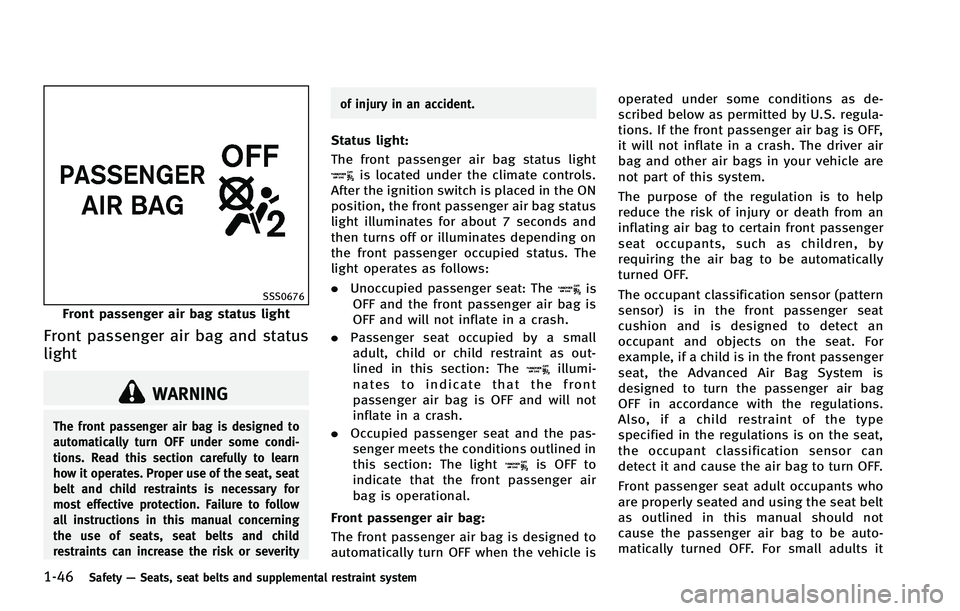
SSS0676
Front passenger air bag status light
Front passenger air bag and status
light
GUID-A696E7CA-8518-4464-B136-B31DBA766A33
WARNING
The front passenger air bag is designed to
automatically turn OFF under some condi-
tions. Read this section carefully to learn
how it operates. Proper use of the seat, seat
belt and child restraints is necessary for
most effective protection. Failure to follow
all instructions in this manual concerning
the use of seats, seat belts and child
restraints can increase the risk or severity of injury in an accident.
Status light:GUID-4D508F5D-FA8E-49D6-A9E2-6F8E76C17033
is located under the climate controls.
After the ignition switch is placed in the ON
position, the front passenger air bag status
light illuminates for about 7 seconds and
then turns off or illuminates depending on
the front passenger occupied status. The
light operates as follows:
. Unoccupied passenger seat: The
is
OFF and the front passenger air bag is
OFF and will not inflate in a crash.
. Passenger seat occupied by a small
adult, child or child restraint as out-
lined in this section: The
illumi-
nates to indicate that the front
passenger air bag is OFF and will not
inflate in a crash.
. Occupied passenger seat and the pas-
senger meets the conditions outlined in
this section: The light
is OFF to
indicate that the front passenger air
bag is operational.
Front passenger air bag:
GUID-4D508F5D-FA8E-49D6-A9E2-6F8E76C17033
Page 66 of 506

may be turned OFF, however, if the
occupant does not sit in the seat properly
(for example, by not sitting upright, by
sitting on an edge of the seat, or by
otherwise being out of position), this could
cause the sensor to turn the air bag OFF.
Always be sure to be seated and wearing
the seat belt properly for the most effective
protection by the seat belt and supple-
mental air bag.
INFINITI recommends that pre-teens and
children be properly restrained in a rear
seat. INFINITI also recommends that appro-
priate child restraints and booster seats be
properly installed in a rear seat. If this is
not possible, the occupant classification
sensor is designed to operate as described
above to turn the front passenger air bag
OFF for specified child restraints. Failing to
properly secure child restrains and to use
the ALR mode (child restraint mode) may
allow the restraint to tip or move in an
accident or sudden stop. This can also
result in the passenger air bag inflating in
a crash instead of being OFF. (See“Child
restraints” earlier in this section for proper
use and installation.)
If the front passenger seat is not occupied,
the passenger air bag is designed not to inflate in a crash. However, heavy objects
placed on the seat could result in air bag
inflation, because of the object being
detected by the occupant classification
sensor. Other conditions could also result
in air bag inflation, such as if a child is
standing on the seat, or if two children are
on the seat, contrary to the instructions in
this manual. Always be sure that you and
all vehicle occupants are seated and
restrained properly.
Using the passenger air bag status light,
you can monitor when the front passenger
air bag is automatically turned OFF with the
seat occupied. The light will not illuminate
when the front passenger seat is unoccu-
pied.
If an adult occupant is in the seat but the
passenger air bag status light is illumi-
nated (indicating that the air bag is OFF), it
could be that the person is a small adult,
or is not sitting on the seat properly.
If a child restraint must be used in the front
seat, the passenger air bag status light
may or may not be illuminated, depending
on the size of the child and the type of
child restraint being used. If the passenger
air bag status light is not illuminated
(indicating that the air bag might inflatein a crash), it could be that the child
restraint or seat belt is not being used
properly. Make sure that the child restraint
is installed properly, the seat belt is used
properly and the occupant is positioned
properly. If the passenger air bag status
light is still not illuminated, reposition the
occupant or child restraint in a rear seat.
If the passenger air bag status light will not
illuminate even though you believe that the
child restraint, the seat belts and the
occupant are properly positioned, the
system may be sensing an unoccupied
seat (in which case the air bag is OFF). Your
INFINITI retailer can check that the system
is OFF by using a special tool. However,
until you have confirmed with your retailer
that your air bag is working properly,
reposition the occupant or child restraint
in a rear seat.
The INFINITI Advanced Air Bag System and
passenger air bag status light will take a
few seconds to register a change in the
passenger seat status. However, if the seat
becomes unoccupied, the air bag status
light will remain off.
If a malfunction occurs in the front
passenger air bag system, the supplemen-
tal air bag warning light
, located in the
Safety
—Seats, seat belts and supplemental restraint system1-47
Page 125 of 506

2-52Instruments and controls
SIC3638
To remove the cargo cover, stow the cover
and pull the holder to the opposite side
*3.
WARNING
.Never put anything on the cargo cover,
no matter how small. Any object on it
could cause an injury in an accident or
sudden stop.
. Do not leave the cargo cover in the
vehicle with it disengaged from the
holder.
. Properly secure all cargo with ropes or straps to help prevent it from sliding or
shifting. Do not place cargo higher than
the seatbacks. In a sudden stop or
collision, unsecured cargo could cause
personal injury.
. If the cargo cover contacts the top tether
strap when it is attached to the top
tether anchor, remove the cargo cover
from the vehicle or secure it on the cargo
floor below its attachment location. If
the cargo cover is not removed, it may
damage the top tether strap during a
collision. Your child could be seriously
injured or killed in a collision if the child
restraint top tether strap is damaged.
. Do not allow cargo to contact the top
tether strap when it is attached to the
top tether anchor. Properly secure the
cargo so it does not contact the top
tether strap. Cargo that is not properly
secured or cargo that contacts the top
tether strap may damage the top tether
strap during a collision. Your child could
be seriously injured or killed in a
collision if the child restraint top tether
strap is damaged.
. Do not use the cargo cover if the rear
seats are folded down.
SIC3639
ROOF RACK (if so equipped)GUID-7DEE6FFA-E022-4DE5-BDD5-66ABFFAF8000