trailer INFINITI FX 2012 User Guide
[x] Cancel search | Manufacturer: INFINITI, Model Year: 2012, Model line: FX, Model: INFINITI FX 2012Pages: 522, PDF Size: 3.51 MB
Page 479 of 522
8-42Maintenance and do-it-yourself
Wheel balance service should be per-
formed with the wheels off the vehicle.
Spin balancing the wheels on the vehicle
could lead to mechanical damage.
For additional information regarding tires,
refer to“Important Tire Safety Information”
(US) or “Tire Safety Information” (Canada)
in the INFINITI Warranty Information Book-
let.
Care of wheels
See “Cleaning exterior” (P.7-2) for details
about care of the wheels.
Spare tire (TEMPORARY USE ONLY
(T-type) spare tire)
When a spare tire is mounted (TEMPORARY
USE ONLY or conventional), the TPMS will
not function.
Observe the following precautions if the T-
type spare tire must be used, otherwise
your vehicle could be damaged or involved
in an accident.
WARNING
. The T-type spare tire should be used for
emergency use. It should be replaced
with the standard tire at the first opportunity to avoid possible tire or
differential damage.
. Drive carefully while the TEMPORARY
USE ONLY spare tire is installed. Avoid
sharp turns and abrupt braking while
driving.
. Periodically check spare tire inflation
pressure. Always keep the pressure of
the TEMPORARY USE ONLY spare tire at
60 psi (420 kPa, 4.2 bar). Always keep
the pressure of the full size spare tire (if
so equipped) at the recommended pres-
sure for standard tires, as indicated on
the Tire and Loading Information label.
For Tire and Loading Information label
location, see “Tire and Loading Informa-
tion label” in the index of this manual.
. With the TEMPORARY USE ONLY spare
tire installed do not drive your vehicle at
speeds faster than 50 MPH (80 km/h).
. When driving on roads covered with
snow or ice, the TEMPORARY USE ONLY
spare tire should be used on the front
wheels and original tire used on the rear
wheels (drive wheels). Use tire chains
only on the two rear original tires.
. Tire tread of the TEMPORARY USE ONLY
spare tire will wear at a faster rate than the standard tire. Replace the spare tire
as soon as the tread wear indicators
appear.
. Do not use the spare tire on other
vehicles.
. Do not use more than one spare tire at
the same time.
. Do not tow a trailer when the TEMPOR-
ARY USE ONLY spare tire is installed.
CAUTION
.Do not use tire chains on a TEMPORARY
USE ONLY spare tire. Tire chains will not
fit properly and may cause damage to
the vehicle.
. Because the TEMPORARY USE ONLY
spare tire is smaller than the original
tire, ground clearance is reduced. To
avoid damage to the vehicle, do not
drive over obstacles. Also do not drive
the vehicle through an automatic car
wash since it may get caught.
Page 480 of 522
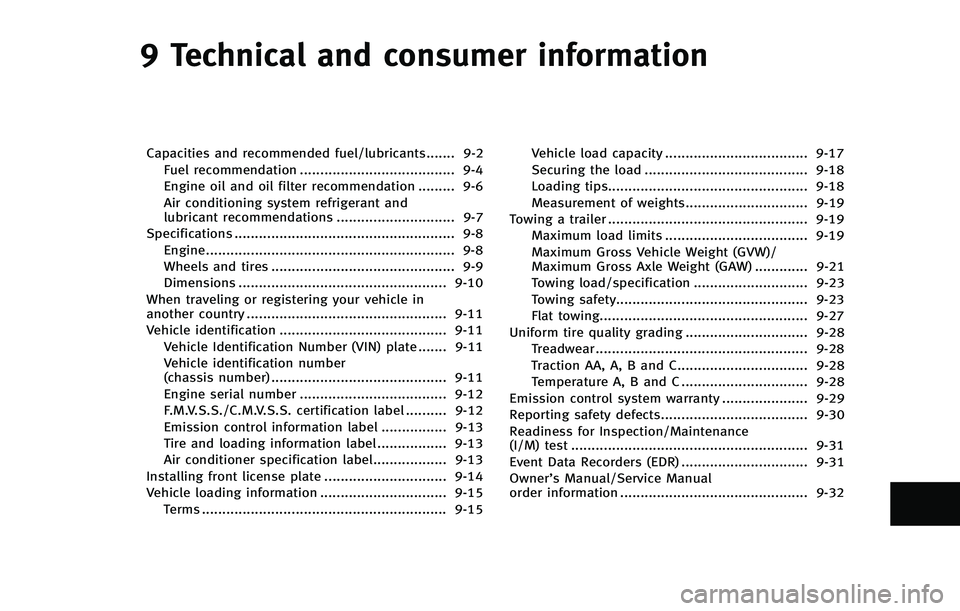
9 Technical and consumer information
Capacities and recommended fuel/lubricants....... 9-2Fuel recommendation ...................................... 9-4
Engine oil and oil filter recommendation ......... 9-6
Air conditioning system refrigerant and
lubricant recommendations ............................. 9-7
Specifications ...................................................... 9-8
Engine............................................................. 9-8Wheels and tires ............................................. 9-9
Dimensions ................................................... 9-10
When traveling or registering your vehicle in
another country ................................................. 9-11
Vehicle identification ......................................... 9-11 Vehicle Identification Number (VIN) plate ....... 9-11
Vehicle identification number
(chassis number) ........................................... 9-11
Engine serial number .................................... 9-12
F.M.V.S.S./C.M.V.S.S. certification label .......... 9-12
Emission control information label ................ 9-13
Tire and loading information label ................. 9-13
Air conditioner specification label.................. 9-13
Installing front license plate .............................. 9-14
Vehicle loading information ............................... 9-15 Terms ............................................................ 9-15 Vehicle load capacity ................................... 9-17
Securing the load ........................................ 9-18
Loading tips................................................. 9-18
Measurement of weights.............................. 9-19
Towing a trailer ................................................. 9-19 Maximum load limits ................................... 9-19
Maximum Gross Vehicle Weight (GVW)/
Maximum Gross Axle Weight (GAW) ............. 9-21
Towing load/specification ............................ 9-23
Towing safety............................................... 9-23 Flat towing................................................... 9-27
Uniform tire quality grading .............................. 9-28 Treadwear .................................................... 9-28
Traction AA, A, B and C................................ 9-28 Temperature A, B and C ............................... 9-28
Emission control system warranty ..................... 9-29
Reporting safety defects.................................... 9-30
Readiness for Inspection/Maintenance
(I/M) test .......................................................... 9-31
Event Data Recorders (EDR) ............................... 9-31
Owner’s Manual/Service Manual
order information .............................................. 9-32
Page 486 of 522
Oil which may contain foreign matter or
has been previously used should not be
used.
Oil viscosity
The engine oil viscosity or thickness
changes with temperature. Because of this,
it is important that the engine oil viscosity
be selected based on the temperatures at
which the vehicle will be operated before
the next oil change. Choosing an oil
viscosity other than that recommended
could cause serious engine damage.
Selecting the correct oil filter
Your new vehicle is equipped with a high-
quality genuine NISSAN oil filter. When
replacing, use the genuine oil filter or its
equivalent for the reason described in
change intervals.
Change intervals
The oil and oil filter change intervals for
your engine are based on the use of the
specified quality oils and filters. Oil and
filter other than the specified quality, or oil
and filter change intervals longer than
recommended could reduce engine life.
Damage to engines caused by improper
maintenance or use of incorrect oil andfilter quality and/or viscosity is not covered
by the new INFINITI vehicle limited warran-
ties.
Your engine was filled with a high quality
engine oil when it was built. You do not
have to change the oil before the first
recommended change interval. Oil and
filter change intervals depend upon how
you use your vehicle. Operation under the
following conditions may require more
frequent oil and filter changes.
.
repeated short distance driving at cold
outside temperatures,
. driving in dusty conditions,
. extensive idling,
. towing a trailer,
. stop and go “rush hour”traffic,
Refer to the “INFINITI Service and Main-
tenance Guide” for the maintenance sche-
dule.
AIR CONDITIONING SYSTEM RE-
FRIGERANT AND LUBRICANT RE-
COMMENDATIONS
The air conditioning system in your
INFINITI vehicle must be charged with the
refrigerant HFC-134a (R-134a) and the
lubricant, NISSAN A/C system oil Type S
or the exact equivalents.
CAUTION
The use of any other refrigerant or lubricant
will cause severe damage to the air con-
ditioning system and will require the repla-
cement of all air conditioner system
components.
The refrigerant HFC-134a (R-134a) in your
INFINITI vehicle will not harm the earth’s
ozone layer. Although this refrigerant does
not affect the earth’s atmosphere, certain
governmental regulations require the re-
covery and recycling of any refrigerant
during automotive air conditioning system
service. Your INFINITI retailer has the
trained technicians and equipment needed
to recover and recycle your air conditioning
system refrigerant.
Technical and consumer information9-7
Page 494 of 522
5. Insert grommets into the hole on thefascia.
6. Insert a flat-blade screwdriver into the grommet hole to add 908 turn onto the
part
*E.
7. Insert a J-nut into the license plate bracket before placing the license plate
bracket on the fascia.
8. Install the license plate bracket with screws.
9. Install the license plate with bolts that are no longer than 0.55 in (14 mm).
WARNING
.It is extremely dangerous to ride
in a cargo area inside the vehicle.
In a collision, people riding in
these areas are more likely to be
seriously injured or killed.
.Do not allow people to ride in any
area of vehicle that is not
equipped with seats and seat
belts.
.Be sure everyone in your vehicle is
in a seat and using a seat belt
properly.
TERMS
It is important to familiarize yourself
with the following terms before
loading your vehicle:
.Curb Weight (actual weight of your
vehicle) - vehicle weight includ-
ing: standard and optional equip-
ment, fluids, emergency tools,
and spare tire assembly. This weight
does not include passen-
gers and cargo.
.GVW (Gross Vehicle Weight) - curb weight plus the combined weight
of passengers and cargo.
.GVWR (Gross Vehicle Weight Rat-ing) - maximum total combined
weight of the unloaded vehicle,
passengers, luggage, hitch, trailer
tongue load and any other op-
tional equipment. This informa-
tion is located on the F.M.V.S.S./
C.M.V.S.S. label.
.GAWR (Gross Axle Weight Rating) -maximum weight (load) limit spe-
cified for the front or rear axle.
This information is located on the
F.M.V.S.S./C.M.V.S.S. label.
.GCWR (Gross Combined WeightRating) - The maximum total
weight rating of the vehicle, pas-
sengers, cargo, and trailer.
.Vehicle Capacity Weight, Loadlimit, Total load capacity - max-
imum total weight limit specified
Technical and consumer information9-15
VEHICLE LOADING INFORMATION
Page 495 of 522
9-16Technical and consumer information
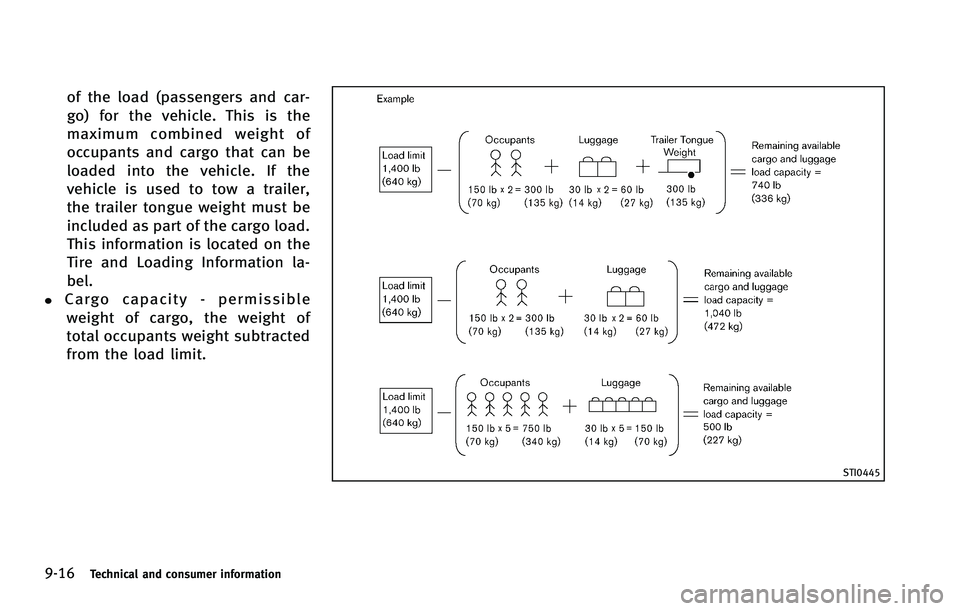
of the load (passengers and car-
go) for the vehicle. This is the
maximum combined weight of
occupants and cargo that can be
loaded into the vehicle. If the
vehicle is used to tow a trailer,
the trailer tongue weight must be
included as part of the cargo load.
This information is located on the
Tire and Loading Information la-
bel.
.Cargo capacity - permissibleweight of cargo, the weight of
total occupants weight subtracted
from the load limit.
STI0445
Page 496 of 522
VEHICLE LOAD CAPACITY
Do not exceed the load limit of your
vehicle shown as“The combined
weight of occupants and cargo” on
the Tire and Loading Information
label. Do not exceed the number of
occupants shown as “Seating Capa-
city” on the Tire and Loading In-
formation label.
To get “the combined weight of
occupants and cargo” , add the
weight of all occupants, then add
the total luggage weight. Examples
are shown in the illustration.
Steps for determining correct load
limit
1.Locate the statement “The com-
bined weight of occupants and
cargo should never exceed XXX kg
or XXX lbs” on your vehicle’ s
placard.
2.Determine the combined weight of
the driver and passengers that
will be riding in your vehicle.
3.Subtract the combined weight of
the driver and passengers from
XXX kg or XXX lbs.
4.The resulting figure equals the
available amount of cargo and
luggage load capacity. For exam-
ple, if the XXX amount equals
1400 lbs. and there will be five
150 lb. passengers in your vehi-
cle, the amount of available cargo
and luggage load capacity is 650
lbs. (1400 −750 (5 x 150) = 650
lbs) or (640 −340 (5 x 70) = 300
kg.)
5.Determine the combined weight of
luggage and cargo being loaded
on the vehicle. That weight may
not safely exceed the available
cargo and luggage load capacity
calculated in Step 4.
6.If your vehicle will be towing a
trailer, load from your trailer will
be transferred to your vehicle.
Consult this manual to determine
how this reduces the available cargo and luggage load capacity
of your vehicle.
Before driving a loaded vehicle,
confirm that you do not exceed the
Gross Vehicle Weight Rating (GVWR)
or the Gross Axle Weight Rating
(GAWR) for your vehicle. (See “Mea-
surement of weights” (P.9-19).)
Also check tires for proper inflation
pressures. See the Tire and Loading
Information label.
Technical and consumer information9-17
Page 498 of 522
serious accident and personal in-
jury. Failures caused by overload-
ing are not covered by the
vehicle’s warranty.
MEASUREMENT OF WEIGHTS
Secure loose items to prevent weight
shifts that could affect the balance of
your vehicle. When the vehicle is
loaded, drive to a scale and weigh
the front and the rear wheels sepa-
rately to determine axle loads. In-
dividual axle loads should not
exceed either of the gross axle
weight ratings (GAWR). The total of
the axle loads should not exceed the
gross vehicle weight rating (GVWR).
These ratings are given on the
vehicle certification label. If weight
ratings are exceeded, move or re-
move items to bring all weights
below the ratings.
WARNING
Overloading or improper loading of a trailer
and its cargo can adversely affect vehicle
handling, braking and performance and may
lead to accidents.
CAUTION
.Do not tow a trailer or haul a heavy load
for the first 500 miles (800 km). Your
engine, axle or other parts could be
damaged.
. For the first 500 miles (800 km) that you
tow a trailer, do not drive over 50 MPH
(80 km/h) and do not make starts at full
throttle. This helps the engine and other
parts of your vehicle wear in at the
heavier loads.
Your new vehicle was designed to be used
primarily to carry passengers and cargo.
Remember that towing a trailer places
additional loads on your vehicle’s engine,
drivetrain, steering, braking and other
systems. An INFINITI Towing Guide (U.S. only) is
available on the website at www.InfinitiU-
SA.com. This guide includes information on
trailer towing capability and the special
equipment required for proper towing.
MAXIMUM LOAD LIMITS
Maximum trailer loads
Never allow the total trailer load to exceed
the value specified in the
“Towing Load/
Specification” chart. The total trailer load
equals trailer weight plus its cargo weight.
. When towing a trailer load of 1,000 lbs
(454 kg) or more, trailers with a brake
system MUST be used.
The maximum GCWR (Gross Combined
Weight Rating) should not exceed the value
specified in the following “Towing Load/
Specification” chart.
Technical and consumer information9-19
TOWING A TRAILER
Page 499 of 522
9-20Technical and consumer information
STI0541
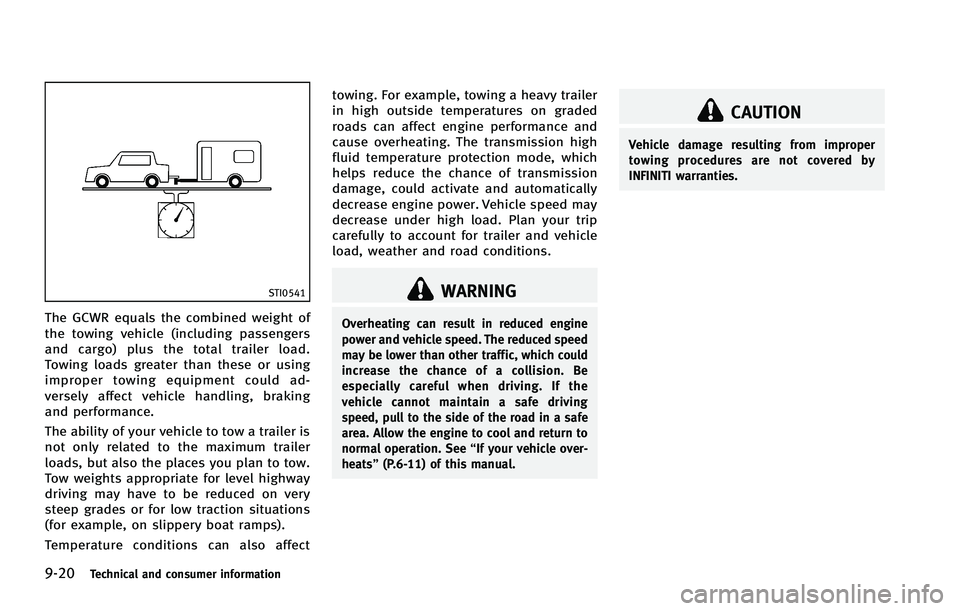
The GCWR equals the combined weight of
the towing vehicle (including passengers
and cargo) plus the total trailer load.
Towing loads greater than these or using
improper towing equipment could ad-
versely affect vehicle handling, braking
and performance.
The ability of your vehicle to tow a trailer is
not only related to the maximum trailer
loads, but also the places you plan to tow.
Tow weights appropriate for level highway
driving may have to be reduced on very
steep grades or for low traction situations
(for example, on slippery boat ramps).
Temperature conditions can also affecttowing. For example, towing a heavy trailer
in high outside temperatures on graded
roads can affect engine performance and
cause overheating. The transmission high
fluid temperature protection mode, which
helps reduce the chance of transmission
damage, could activate and automatically
decrease engine power. Vehicle speed may
decrease under high load. Plan your trip
carefully to account for trailer and vehicle
load, weather and road conditions.
WARNING
Overheating can result in reduced engine
power and vehicle speed. The reduced speed
may be lower than other traffic, which could
increase the chance of a collision. Be
especially careful when driving. If the
vehicle cannot maintain a safe driving
speed, pull to the side of the road in a safe
area. Allow the engine to cool and return to
normal operation. See
“If your vehicle over-
heats” (P.6-11) of this manual.
CAUTION
Vehicle damage resulting from improper
towing procedures are not covered by
INFINITI warranties.
Page 500 of 522
STI0542
Tongue load
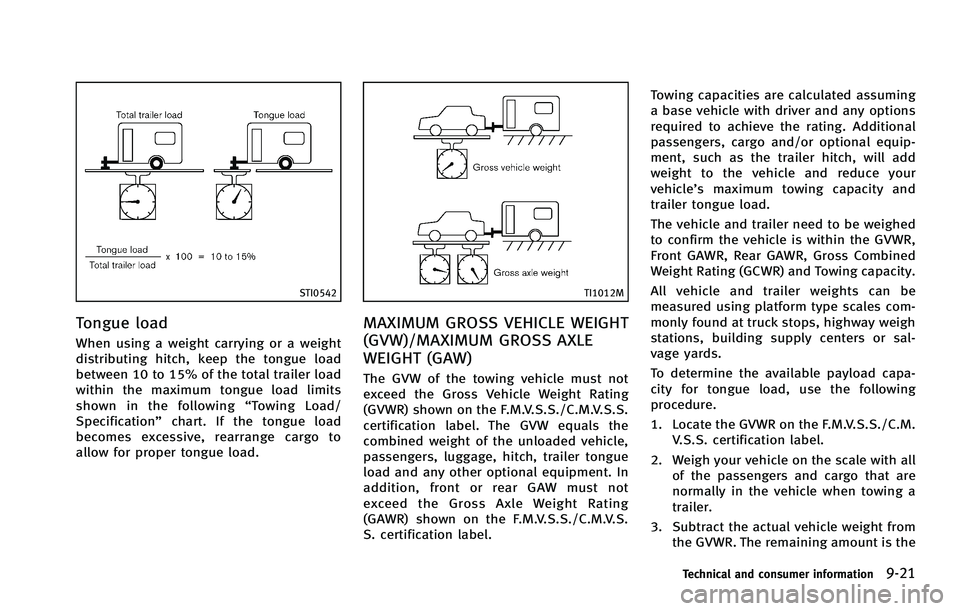
When using a weight carrying or a weight
distributing hitch, keep the tongue load
between 10 to 15% of the total trailer load
within the maximum tongue load limits
shown in the following“Towing Load/
Specification” chart. If the tongue load
becomes excessive, rearrange cargo to
allow for proper tongue load.
TI1012M
MAXIMUM GROSS VEHICLE WEIGHT
(GVW)/MAXIMUM GROSS AXLE
WEIGHT (GAW)
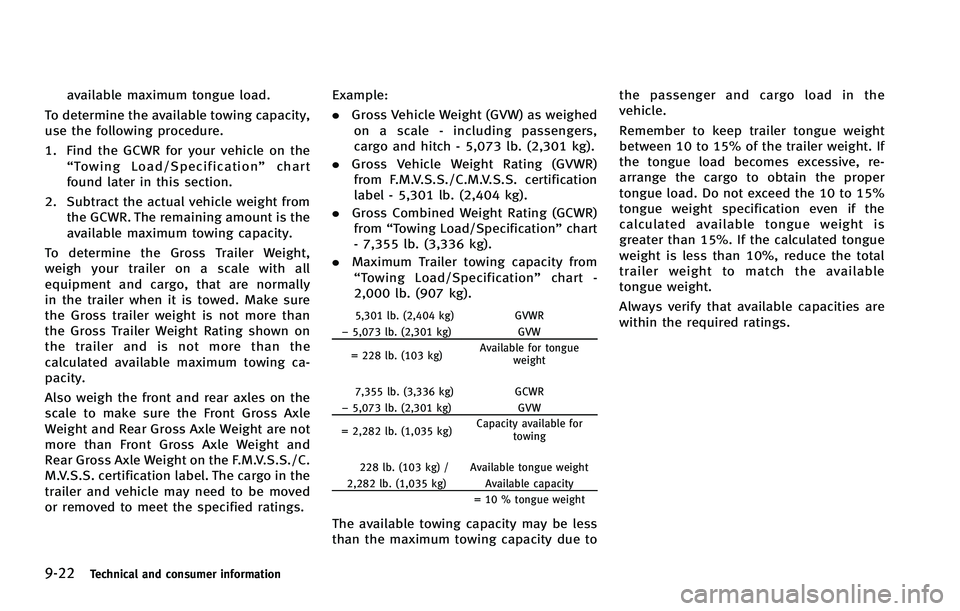
The GVW of the towing vehicle must not
exceed the Gross Vehicle Weight Rating
(GVWR) shown on the F.M.V.S.S./C.M.V.S.S.
certification label. The GVW equals the
combined weight of the unloaded vehicle,
passengers, luggage, hitch, trailer tongue
load and any other optional equipment. In
addition, front or rear GAW must not
exceed the Gross Axle Weight Rating
(GAWR) shown on the F.M.V.S.S./C.M.V.S.
S. certification label. Towing capacities are calculated assuming
a base vehicle with driver and any options
required to achieve the rating. Additional
passengers, cargo and/or optional equip-
ment, such as the trailer hitch, will add
weight to the vehicle and reduce your
vehicle’s maximum towing capacity and
trailer tongue load.
The vehicle and trailer need to be weighed
to confirm the vehicle is within the GVWR,
Front GAWR, Rear GAWR, Gross Combined
Weight Rating (GCWR) and Towing capacity.
All vehicle and trailer weights can be
measured using platform type scales com-
monly found at truck stops, highway weigh
stations, building supply centers or sal-
vage yards.
To determine the available payload capa-
city for tongue load, use the following
procedure.
1. Locate the GVWR on the F.M.V.S.S./C.M.
V.S.S. certification label.
2. Weigh your vehicle on the scale with all of the passengers and cargo that are
normally in the vehicle when towing a
trailer.
3. Subtract the actual vehicle weight from the GVWR. The remaining amount is the
Technical and consumer information9-21
Page 501 of 522
9-22Technical and consumer information
available maximum tongue load.
To determine the available towing capacity,
use the following procedure.
1. Find the GCWR for your vehicle on the “Towing Load/Specification” chart
found later in this section.
2. Subtract the actual vehicle weight from the GCWR. The remaining amount is the
available maximum towing capacity.
To determine the Gross Trailer Weight,
weigh your trailer on a scale with all
equipment and cargo, that are normally
in the trailer when it is towed. Make sure
the Gross trailer weight is not more than
the Gross Trailer Weight Rating shown on
the trailer and is not more than the
calculated available maximum towing ca-
pacity.
Also weigh the front and rear axles on the
scale to make sure the Front Gross Axle
Weight and Rear Gross Axle Weight are not
more than Front Gross Axle Weight and
Rear Gross Axle Weight on the F.M.V.S.S./C.
M.V.S.S. certification label. The cargo in the
trailer and vehicle may need to be moved
or removed to meet the specified ratings. Example:
.
Gross Vehicle Weight (GVW) as weighed
on a scale - including passengers,
cargo and hitch - 5,073 lb. (2,301 kg).
. Gross Vehicle Weight Rating (GVWR)
from F.M.V.S.S./C.M.V.S.S. certification
label - 5,301 lb. (2,404 kg).
. Gross Combined Weight Rating (GCWR)
from “Towing Load/Specification” chart
- 7,355 lb. (3,336 kg).
. Maximum Trailer towing capacity from
“ Towing Load/Specification” chart -
2,000 lb. (907 kg).
5,301 lb. (2,404 kg) GVWR
− 5,073 lb. (2,301 kg) GVW
= 228 lb. (103 kg) Available for tongue
weight
7,355 lb. (3,336 kg) GCWR
− 5,073 lb. (2,301 kg) GVW
= 2,282 lb. (1,035 kg) Capacity available for
towing
228 lb. (103 kg) / Available tongue weight
2,282 lb. (1,035 kg) Available capacity = 10 % tongue weight
The available towing capacity may be less
than the maximum towing capacity due to the passenger and cargo load in the
vehicle.
Remember to keep trailer tongue weight
between 10 to 15% of the trailer weight. If
the tongue load becomes excessive, re-
arrange the cargo to obtain the proper
tongue load. Do not exceed the 10 to 15%
tongue weight specification even if the
calculated available tongue weight is
greater than 15%. If the calculated tongue
weight is less than 10%, reduce the total
trailer weight to match the available
tongue weight.
Always verify that available capacities are
within the required ratings.