transmission INFINITI FX 2012 Owner's Manual
[x] Cancel search | Manufacturer: INFINITI, Model Year: 2012, Model line: FX, Model: INFINITI FX 2012Pages: 522, PDF Size: 3.51 MB
Page 441 of 522
8-4Maintenance and do-it-yourself
Keep the floor mat away from the pedal.
Automatic transmission P (Park) mechan-
ism:On a fairly steep hill, check that your
vehicle is held securely with the selector
lever in the P (Park) position without
applying any brakes.
Brake pedal: Check the pedal for smooth
operation. If the brake pedal suddenly
goes down further than normal, the pedal
feels spongy or the vehicle seems to take
longer to stop, see an INFINITI retailer
immediately. Keep the floor mat away from
the pedal.
Brakes: Check that the brakes do not pull
the vehicle to one side when applied.
Parking brake: Check the parking brake
operation regularly. The vehicle should be
securely held on a fairly steep hill with only
the parking brake applied. If the parking
brake needs adjusted, see an INFINITI
retailer.
Seat belts: Check that all parts of the seat
belt system (for example, buckles, an-
chors, adjuster and retractors) operate
properly and smoothly, and are installed
securely. Check the belt webbing for cuts,
fraying, wear or damage.
Seats: Check seat position controls such as seat adjusters, seatback recliner, etc. to
ensure they operate smoothly and that all
latches lock securely in every position.
Check that the head restraints move up
and down smoothly and that the locks (if
so equipped) hold securely in all latched
positions.
Steering wheel:
Check for changes in the
steering conditions, such as excessive free
play, hard steering or strange noises.
Warning lights and chimes: Make sure that
all warning lights and chimes are operating
properly.
Windshield defroster: Check that the air
comes out of the defroster outlets properly
and in sufficient quantity when operating
the heater or air conditioner.
Windshield wiper and washer*: Check that
the wipers and washer operate properly
and that the wipers do not streak.
Under the hood and vehicle
The maintenance items listed here should
be checked periodically (for example, each
time you check the engine oil or refuel).
Battery*: Check the fluid level in each cell.
It should be between the MAX and MIN
lines. Vehicles operated in high tempera- tures or under severe condition require
frequent checks of the battery fluid level.
Brake fluid level*:
Make sure that the
brake fluid level is between the MAX and
MIN lines on the reservoir.
Engine coolant level*: Check the coolant
level when the engine is cold.
Engine drive belts*: Make sure that no belt
is frayed, worn, cracked or oily.
Engine oil level*: Check the level after
parking the vehicle on a level spot and
turning off the engine. Wait more than 15
minutes for the oil to drain back into the oil
pan.
Exhaust system: Make sure there are no
loose supports, cracks or holes. If the
sound of the exhaust seems unusual or
there is a smell of exhaust fumes, im-
mediately have the exhaust system in-
spected by an INFINITI retailer. (See
“Precautions when starting and driving”
(P.5-3) section for exhaust gas (carbon
monoxide).)
Fluid leaks: Check under the vehicle for
fuel, oil, water or other fluid leaks after the
vehicle has been parked for a while. Water
dripping from the air conditioner after use
is normal. If you should notice any leaks or
Page 442 of 522
if gasoline fumes are evident, check for the
cause and have it corrected immediately.
Power steering fluid level* and lines:
Check the level when the fluid is cold,
with the engine off. Check the lines for
proper attachment, leaks, cracks, etc.
Radiator and hoses:Check the front of the
radiator and clean off any dirt, insects,
leaves, etc., that may have accumulated.
Make sure the hoses have no cracks,
deformation, rot or loose connections.
Underbody: The underbody is frequently
exposed to corrosive substances such as
those used on icy roads or to control dust.
It is very important to remove these
substances, otherwise rust will form on
the floor pan, frame, fuel lines and around
the exhaust system. At the end of winter,
the underbody should be thoroughly
flushed with plain water, being careful to
clean those areas where mud and dirt may
accumulate. For additional information,
see “Cleaning exterior” (P.7-2).
Windshield washer fluid*: Check that there
is adequate fluid in the reservoir. When performing any inspection or main-
tenance work on your vehicle, always take
care to prevent serious accidental injury to
yourself or damage to the vehicle. The
following are general precautions which
should be closely observed.
WARNING
.
Park the vehicle on a level surface, apply
the parking brake securely and block the
wheels to prevent the vehicle from
moving. Move the selector lever to P
(Park).
. Be sure the ignition switch is in the OFF
or LOCK position when performing any
parts replacement or repairs.
. Never connect or disconnect the battery
or any transistorized component while
the ignition switch is in the ON position.
. Never leave the engine or automatic
transmission related component har-
nesses disconnected while the ignition
switch is in the ON position.
. If you must work with the engine
running, keep your hands, clothing, hair
and tools away from moving fans, belts
and any other moving parts. .
It is advisable to secure or remove any
loose clothing and remove any jewelry,
such as rings, watches, etc. before
working on your vehicle.
. Always wear eye protection whenever
you work on your vehicle.
. If you must run the engine in an
enclosed space such as a garage, be
sure there is proper ventilation for
exhaust gases to escape.
. Never get under the vehicle while it is
supported only by a jack. If it is
necessary to work under the vehicle,
support it with safety stands.
. Keep smoking materials, flame and
sparks away from fuel tank and the
battery.
. Your vehicle is equipped with an auto-
matic engine cooling fan. It may come on
at any time without warning, even if the
ignition key is in the OFF position and
the engine is not running. To avoid
injury, always disconnect the negative
battery cable before working near the
fan.
. On gasoline engine models, the fuel
filter or fuel lines should be serviced by
an INFINITI retailer because the fuel lines
Maintenance and do-it-yourself8-5
MAINTENANCE PRECAUTIONS
Page 447 of 522
8-10Maintenance and do-it-yourself
CAUTION
.Never use any cooling system additives
such as radiator sealer. Additives may
clog the cooling system and cause
damage to the engine, transmission
and/or cooling system.
. When adding or replacing coolant, be
sure to use only Genuine NISSAN Long
Life Antifreeze/Coolant (blue) or equiva-
lent. Genuine NISSAN Long Life Anti-
freeze/Coolant (blue) is pre-diluted to
provide antifreeze protection to −348F
(−378C). If additional freeze protection is
needed due to weather where you
operate your vehicle, add Genuine
NISSAN Long Life Antifreeze/Coolant
(blue) concentrate following the direc-
tions on the container. If an equivalent
coolant other than Genuine NISSAN Long
Life Antifreeze/Coolant (blue) is used,
follow the coolant manufacturer’ s in-
structions to maintain minimum anti-
freeze protection to −348F(−378C). The
use of other types of coolant solutions
other than Genuine NISSAN Long Life
Antifreeze/Coolant (blue) or equivalent
may damage the engine cooling system. .
The life expectancy of the factory-fill
coolant is 105,000 miles (168,000 km)
or 7 years. Mixing any other type of
coolant other than Genuine NISSAN Long
Life Antifreeze/Coolant (blue), including
Genuine NISSAN Long Life Antifreeze/
Coolant (green), or the use of non-
distilled water will reduce the life
expectancy of the factory-fill coolant.
Refer to the INFINITI Service and Main-
tenance Guide for more details.
SDI2198
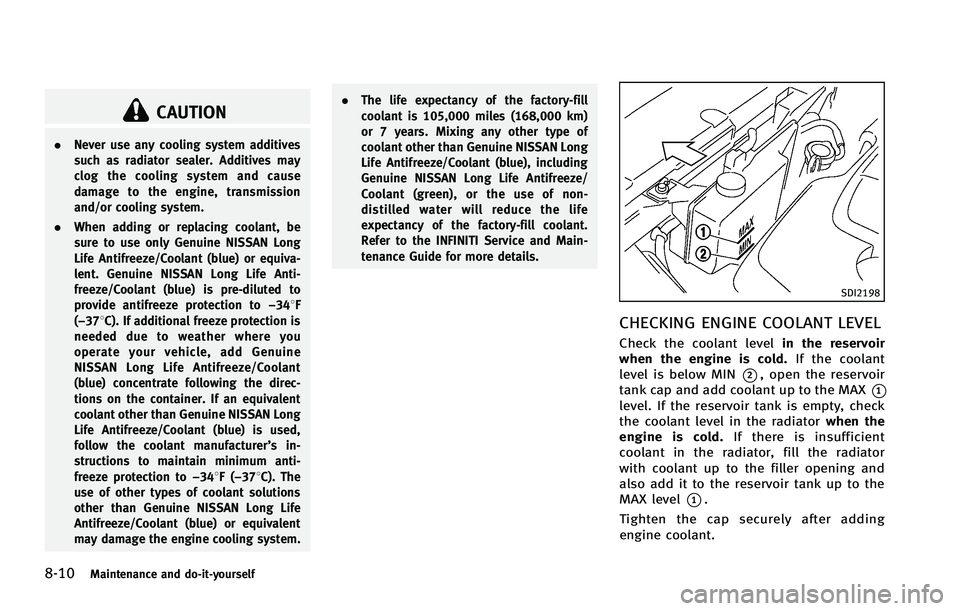
CHECKING ENGINE COOLANT LEVEL
Check the coolant level in the reservoir
when the engine is cold. If the coolant
level is below MIN
*2, open the reservoir
tank cap and add coolant up to the MAX
*1level. If the reservoir tank is empty, check
the coolant level in the radiator when the
engine is cold. If there is insufficient
coolant in the radiator, fill the radiator
with coolant up to the filler opening and
also add it to the reservoir tank up to the
MAX level
*1.
Tighten the cap securely after adding
engine coolant.
Page 452 of 522
Contact an INFINITI retailer if replacement
is required.
CAUTION
.Use only Genuine NISSAN Matic S ATF.
Do not mix with other fluids.
. Using automatic transmission fluid other
than Genuine NISSAN Matic S ATF will
cause deterioration in driveability and
automatic transmission durability, and
may damage the automatic transmis-
sion, which is not covered by the INFINITI
new vehicle limited warranty.
SDI1765A
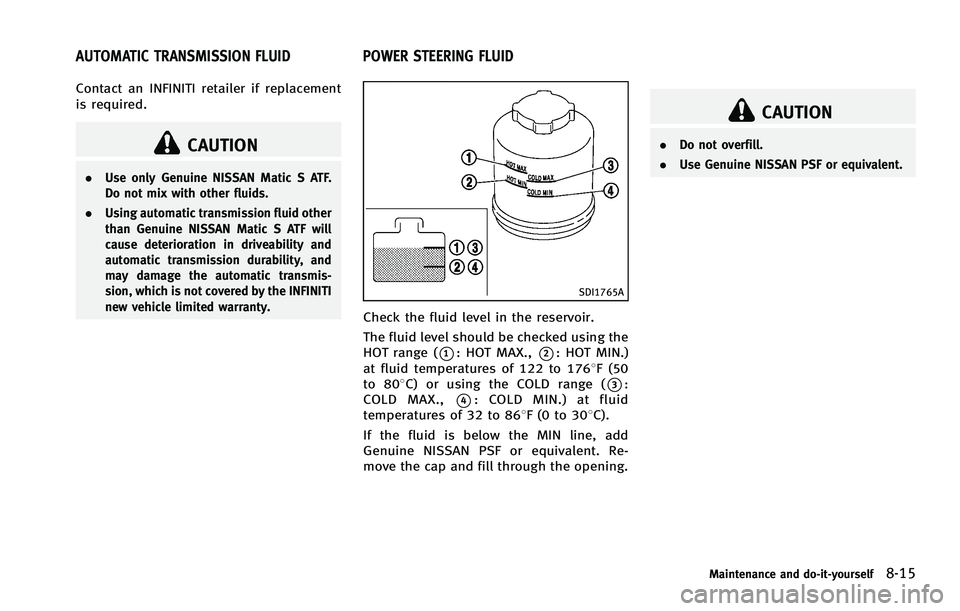
Check the fluid level in the reservoir.
The fluid level should be checked using the
HOT range (
*1: HOT MAX.,*2: HOT MIN.)
at fluid temperatures of 122 to 1768F (50
to 808C) or using the COLD range (
*3:
COLD MAX.,
*4: COLD MIN.) at fluid
temperatures of 32 to 868F(0to30 8C).
If the fluid is below the MIN line, add
Genuine NISSAN PSF or equivalent. Re-
move the cap and fill through the opening.
CAUTION
. Do not overfill.
. Use Genuine NISSAN PSF or equivalent.
Maintenance and do-it-yourself8-15
AUTOMATIC TRANSMISSION FLUID POWER STEERING FLUID
Page 478 of 522
Replacing wheels and tires
When replacing a tire, use the same size,
tread design, speed rating and load carry-
ing capacity as originally equipped. (See
“Specifications”(P.9-8) for recommended
types and sizes of tires and wheels.)
WARNING
. The use of tires other than those
recommended or the mixed use of tires
of different brands, construction (bias,
bias-belted or radial), or tread patterns
can adversely affect the ride, braking,
handling, ground clearance, body-to-tire
clearance, tire chain clearance, speed-
ometer calibration, headlight aim and
bumper height. Some of these effects
may lead to accidents and could result in
serious personal injury.
. If the wheels are changed for any
reason, always replace with wheels
which have the same off-set dimension.
Wheels of a different off-set could cause
premature tire wear, degrade vehicle
handling characteristics and/or interfer-
ence with the brake discs/drums. Such
interference can lead to decreased brak- ing efficiency and/or early brake pad/
shoe wear. See
“Wheels and tires” (P.9-
9) of this manual for wheel off-set
dimensions.
. When a spare tire is mounted or a wheel
is replaced, the TPMS will not function
and the low tire pressure warning light
will flash for approximately 1 minute.
The light will remain on after 1 minute.
Contact your INFINITI retailer as soon as
possible for tire replacement and/or
system resetting.
. Replacing tires with those not originally
specified by INFINITI could affect the
proper operation of the TPMS.
. Do not install a damaged or deformed
wheel or tire even if it has been repaired.
Such wheels or tires could have struc-
tural damage and could fail without
warning.
. The use of retread tire is not recom-
mended.
. For additional information regarding
tires, refer to “Important Tire Safety
Information” (US) or“Tire Safety Infor-
mation” (Canada) in the Warranty Infor-
mation Booklet.
All-Wheel Drive (AWD) models
CAUTION
. Always use tires of the same type, size,
brand, construction (bias, bias-belted or
radial), and tread pattern on all four
wheels. Failure to do so may result in a
circumference difference between tires
on the front and rear axles which will
cause excessive tire wear and may
damage the transmission, transfer case
and differential gears.
. ONLY use spare tires specified for the
AWD model.
If excessive tire wear is found, it is
recommended that all four tires be re-
placed with tires of the same size, brand,
construction and tread pattern. The tire
pressure and wheel alignment should also
be checked and corrected as necessary.
Contact an INFINITI retailer.
Wheel balance
Unbalanced wheels may affect vehicle
handling and tire life. Even with regular
use, wheels can get out of balance. There-
fore, they should be balanced as required.
Maintenance and do-it-yourself8-41
Page 481 of 522
9-2Technical and consumer information
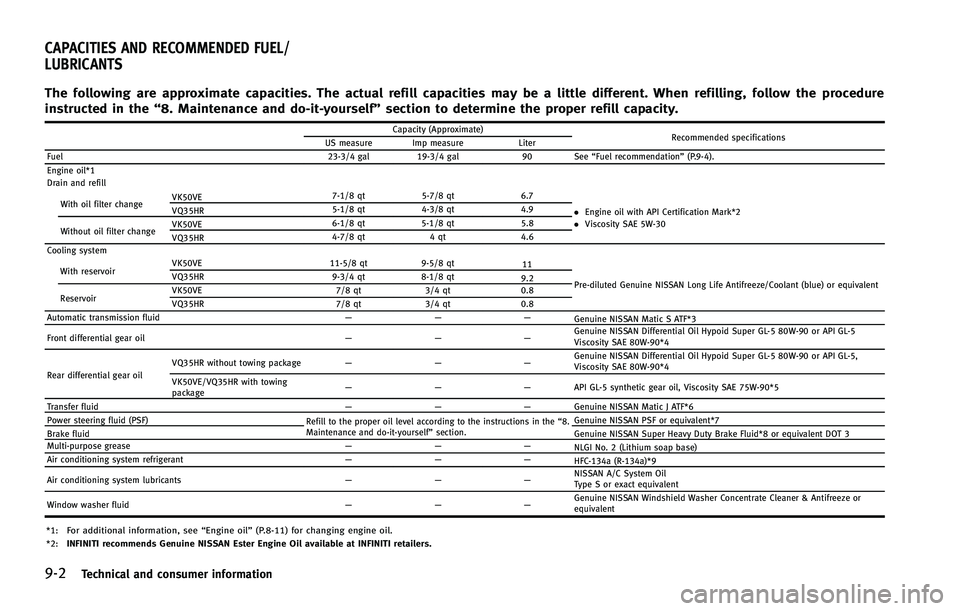
The following are approximate capacities. The actual refill capacities may be a little different. When refilling, follow the procedure
instructed in the“8. Maintenance and do-it-yourself” section to determine the proper refill capacity.
Capacity (Approximate)
Recommended specifications
US measure Imp measure Liter
Fuel 23-3/4 gal19-3/4 gal 90 See“Fuel recommendation” (P.9-4).
Engine oil*1
Drain and refill
With oil filter change VK50VE
7-1/8 qt
5-7/8 qt 6.7
.Engine oil with API Certification Mark*2
. Viscosity SAE 5W-30
VQ35HR
5-1/8 qt
4-3/8 qt 4.9
Without oil filter change VK50VE
6-1/8 qt
5-1/8 qt 5.8
VQ35HR 4-7/8 qt
4 qt4.6
Cooling system
With reservoir VK50VE
11-5/8 qt9-5/8 qt
11
Pre-diluted Genuine NISSAN Long Life Antifreeze/Coolant (blue) or equivalent
VQ35HR
9-3/4 qt8-1/8 qt
9.2
Reservoir VK50VE
7/8 qt3/4 qt 0.8
VQ35HR 7/8 qt3/4 qt 0.8
Automatic transmission fluid ———
Genuine NISSAN Matic S ATF*3
Front differential gear oil ———Genuine NISSAN Differential Oil Hypoid Super GL-5 80W-90 or API GL-5
Viscosity SAE 80W-90*4
Rear differential gear oil VQ35HR without towing package
——— Genuine NISSAN Differential Oil Hypoid Super GL-5 80W-90 or API GL-5,
Viscosity SAE 80W-90*4
VK50VE/VQ35HR with towing
package ———
API GL-5 synthetic gear oil, Viscosity SAE 75W-90*5
Transfer fluid ———Genuine NISSAN Matic J ATF*6
Power steering fluid (PSF) Refill to the proper oil level according to the instructions in the“8.
Maintenance and do-it-yourself” section. Genuine NISSAN PSF or equivalent*7
Brake fluid Genuine NISSAN Super Heavy Duty Brake Fluid*8 or equivalent DOT 3
Multi-purpose grease ———
NLGI No. 2 (Lithium soap base)
Air conditioning system refrigerant ———
HFC-134a (R-134a)*9
Air conditioning system lubricants ———NISSAN A/C System Oil
Type S or exact equivalent
Window washer fluid ———Genuine NISSAN Windshield Washer Concentrate Cleaner & Antifreeze or
equivalent
*1:
For additional information, see “Engine oil”(P.8-11) for changing engine oil.*2:INFINITI recommends Genuine NISSAN Ester Engine Oil available at INFINITI retailers.
CAPACITIES AND RECOMMENDED FUEL/
LUBRICANTS
Page 482 of 522
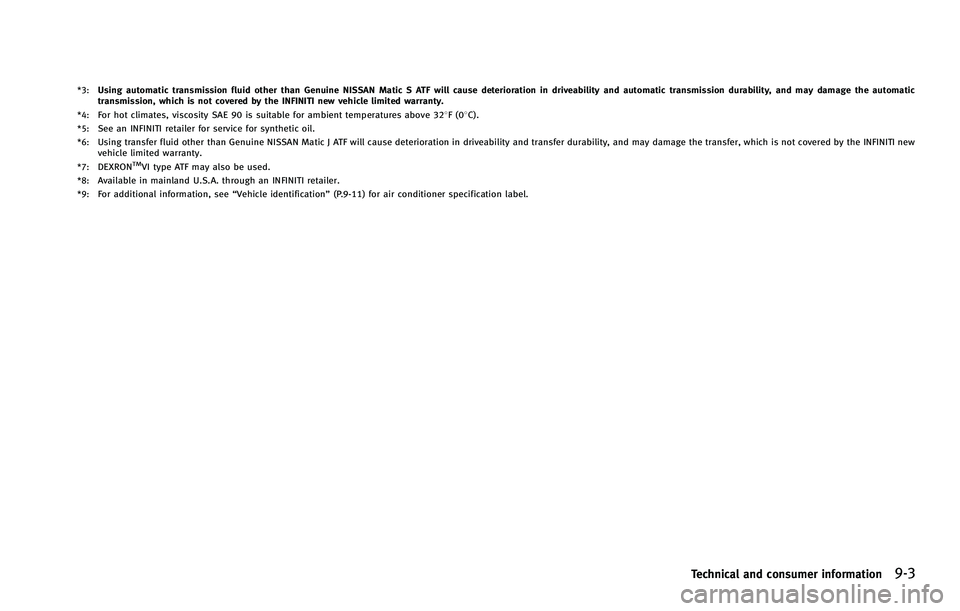
*3:Using automatic transmission fluid other than Genuine NISSAN Matic S ATF will cause deterioration in driveability and automatic transmission durability, and may damage the automatic
transmission, which is not covered by the INFINITI new vehicle limited warranty.
*4:For hot climates, viscosity SAE 90 is suitable for ambient temperatures above 328F(08C).*5:See an INFINITI retailer for service for synthetic oil.*6:Using transfer fluid other than Genuine NISSAN Matic J ATF will cause deterioration in driveability and transfer durability, and may damage the transfer, which is not covered by the INFINITI new
vehicle limited warranty.
*7:DEXRONTMVI type ATF may also be used.*8:Available in mainland U.S.A. through an INFINITI retailer.*9:For additional information, see“Vehicle identification”(P.9-11) for air conditioner specification label.
Technical and consumer information9-3
Page 499 of 522
9-20Technical and consumer information
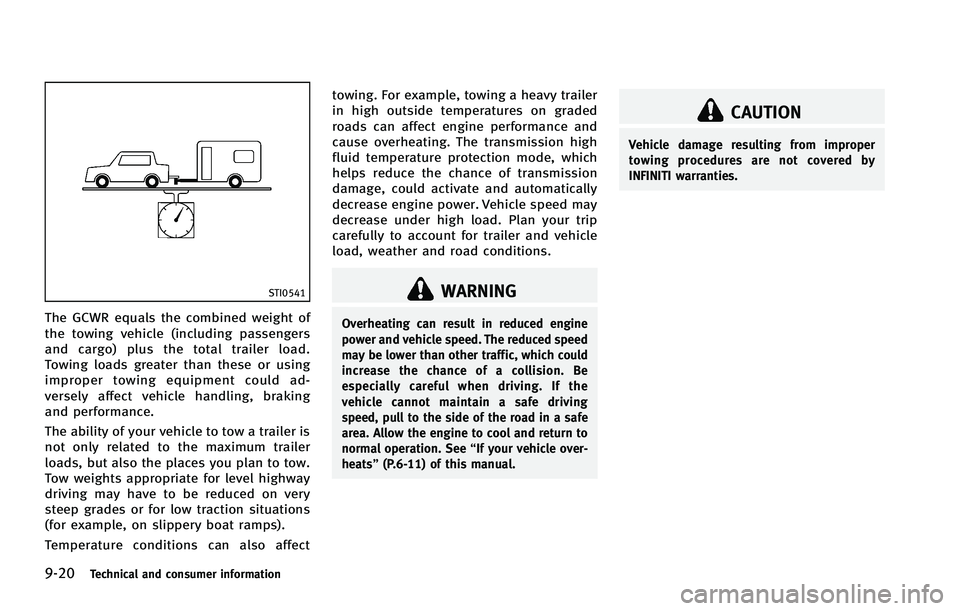
STI0541
The GCWR equals the combined weight of
the towing vehicle (including passengers
and cargo) plus the total trailer load.
Towing loads greater than these or using
improper towing equipment could ad-
versely affect vehicle handling, braking
and performance.
The ability of your vehicle to tow a trailer is
not only related to the maximum trailer
loads, but also the places you plan to tow.
Tow weights appropriate for level highway
driving may have to be reduced on very
steep grades or for low traction situations
(for example, on slippery boat ramps).
Temperature conditions can also affecttowing. For example, towing a heavy trailer
in high outside temperatures on graded
roads can affect engine performance and
cause overheating. The transmission high
fluid temperature protection mode, which
helps reduce the chance of transmission
damage, could activate and automatically
decrease engine power. Vehicle speed may
decrease under high load. Plan your trip
carefully to account for trailer and vehicle
load, weather and road conditions.
WARNING
Overheating can result in reduced engine
power and vehicle speed. The reduced speed
may be lower than other traffic, which could
increase the chance of a collision. Be
especially careful when driving. If the
vehicle cannot maintain a safe driving
speed, pull to the side of the road in a safe
area. Allow the engine to cool and return to
normal operation. See
“If your vehicle over-
heats” (P.6-11) of this manual.
CAUTION
Vehicle damage resulting from improper
towing procedures are not covered by
INFINITI warranties.
Page 505 of 522
9-26Technical and consumer information
inadvertently becoming unlatched.
. Avoid abrupt starts, acceleration or
stops.
. Avoid sharp turns or lane changes.
. Always drive your vehicle at a moderate
speed. Some states or provinces have
specific speed limits for vehicles that
are towing trailers. Obey the local
speed limits.
. When backing up, hold the bottom of
the steering wheel with one hand.
Move your hand in the direction in
which you want the trailer to go. Make
small corrections and back up slowly. If
possible, have someone guide you
when you are backing up.
Always block the wheels on both vehicle
and trailer when parking. Parking on a
slope is not recommended; however, if you
must do so:
CAUTION
If you move the shift selector lever to the P
(Park) position before blocking the wheels
and applying the parking brake, transmis-
sion damage could occur.
1. Apply and hold the brake pedal.
2. Have someone place blocks on the downhill side of the vehicle and trailer
wheels.
3. After the wheel blocks are in place, slowly release the brake pedal until the
blocks absorb the vehicle load.
4. Apply the parking brake.
5. Shift the transmission into P (Park).
6. Turn off the engine.
To drive away:
1. Apply and hold the brake pedal.
2. Start the engine.
3. Shift the transmission into gear.
4. Release the parking brake.
5. Drive slowly until the vehicle and trailer are clear from the blocks.
6. Apply and hold the brake pedal.
7. Have someone retrieve and store the blocks.
. When going down a hill, shift into a
lower gear and use the engine braking
effect. When going up a long grade,
downshift the transmission to a lower
gear and reduce speed to reduce
chances of engine overloading and/or overheating.
. If the engine coolant rises to an
extremely high temperature when the
air conditioning system is on, turn off
the air conditioner. Coolant heat can be
additionally vented by opening the
windows, switching the fan control to
high and setting the temperature con-
trol to the HOT position.
. Trailer towing requires more fuel than
normal circumstances.
. Avoid towing a trailer for the first 500
miles (800 km).
. Have your vehicle serviced more often
than at intervals specified in the
recommended maintenance schedule
in the INFINITI Service and Maintenance
Guide.
. When making a turn, your trailer wheels
will be closer to the inside of the turn
than your vehicle wheels. To compen-
sate for this, make a larger than normal
turning radius during the turn.
. Crosswinds and rough roads will ad-
versely affect vehicle/trailer handling,
possibly causing vehicle sway. When
being passed by larger vehicles, be
prepared for possible changes in cross-
winds that could affect vehicle hand-
Page 506 of 522
ling. If swaying does occur, firmly grip
the steering wheel, steer straight
ahead, and immediately (but gradually)
reduce vehicle speed. This combination
will help stabilize the vehicle. Never
increase speed.
Do the following if the trailer begins to
sway:
1. Take your foot off the accelerator pedal to allow the vehicle to coast and steer
as straight ahead as the road condi-
tions allow. This combination will help
stabilize the vehicle.
.Do not correct trailer sway by steer-ing or applying the brakes.
2. When the trailer sway stops, gently apply the brakes and pull to the side of
the road in a safe area.
3. Try to rearrange the trailer load so it is balanced as described earlier in this
section.
. Be careful when passing other vehicles.
Passing while towing a trailer requires
considerably more distance than nor-
mal passing. Remember the length of
the trailer must also pass the other
vehicle before you can safely change
lanes. .
Down shift the transmission to a lower
gear for engine braking when driving
down steep or long hills. This will help
slow the vehicle without applying the
brakes.
. Avoid holding the brake pedal down too
long or too frequently. This could cause
the brakes to overheat, resulting in
reduced braking efficiency.
. Increase your following distance to
allow for greater stopping distances
while towing a trailer. Anticipate stops
and brake gradually.
. Do not use cruise control while towing a
trailer.
. Some states or provinces have specific
regulations and speed limits for vehi-
cles that are towing trailers. Obey the
local speed limits.
. Check your hitch, trailer wiring harness
connections, and trailer wheel lug nuts
after 50 miles (80 km) of travel and at
every break.
. When stopped in traffic for long periods
of time in hot weather, put the vehicle
in the P (Park) position.
. When launching a boat, don’t allow the
water level to go over the exhaust tail
pipe or rear bumper. .
Make sure you disconnect the trailer
lights before backing the trailer into the
water or the trailer lights may burn out.
When towing a trailer, the transmission
fluid should be changed more frequently.
For additional information, see the “8.
Maintenance and do-it-yourself” section
earlier in this manual.
FLAT TOWING
Towing your vehicle with all four wheels on
the ground is sometimes called flat towing.
This method is sometimes used when
towing a vehicle behind a recreational
vehicle, such as a motor home.
CAUTION
. Failure to follow these guidelines can
result in severe transmission damage.
. Whenever flat towing your vehicle, al-
ways tow forward, never backward.
. DO NOT tow any automatic transmission
vehicle with all four wheels on the
ground (flat towing). Doing so WILL
DAMAGE internal transmission parts
due to lack of transmission lubrication.
Technical and consumer information9-27