weight INFINITI FX 2012 Owner's Manual
[x] Cancel search | Manufacturer: INFINITI, Model Year: 2012, Model line: FX, Model: INFINITI FX 2012Pages: 522, PDF Size: 3.51 MB
Page 501 of 522
9-22Technical and consumer information
available maximum tongue load.
To determine the available towing capacity,
use the following procedure.
1. Find the GCWR for your vehicle on the “Towing Load/Specification” chart
found later in this section.
2. Subtract the actual vehicle weight from the GCWR. The remaining amount is the
available maximum towing capacity.
To determine the Gross Trailer Weight,
weigh your trailer on a scale with all
equipment and cargo, that are normally
in the trailer when it is towed. Make sure
the Gross trailer weight is not more than
the Gross Trailer Weight Rating shown on
the trailer and is not more than the
calculated available maximum towing ca-
pacity.
Also weigh the front and rear axles on the
scale to make sure the Front Gross Axle
Weight and Rear Gross Axle Weight are not
more than Front Gross Axle Weight and
Rear Gross Axle Weight on the F.M.V.S.S./C.
M.V.S.S. certification label. The cargo in the
trailer and vehicle may need to be moved
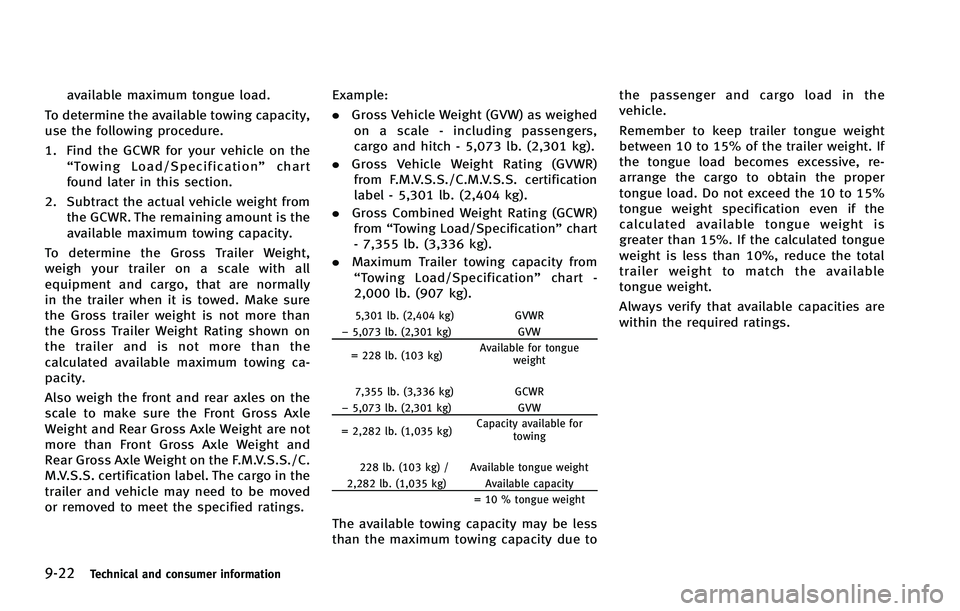
or removed to meet the specified ratings. Example:
.
Gross Vehicle Weight (GVW) as weighed
on a scale - including passengers,
cargo and hitch - 5,073 lb. (2,301 kg).
. Gross Vehicle Weight Rating (GVWR)
from F.M.V.S.S./C.M.V.S.S. certification
label - 5,301 lb. (2,404 kg).
. Gross Combined Weight Rating (GCWR)
from “Towing Load/Specification” chart
- 7,355 lb. (3,336 kg).
. Maximum Trailer towing capacity from
“ Towing Load/Specification” chart -
2,000 lb. (907 kg).
5,301 lb. (2,404 kg) GVWR
− 5,073 lb. (2,301 kg) GVW
= 228 lb. (103 kg) Available for tongue
weight
7,355 lb. (3,336 kg) GCWR
− 5,073 lb. (2,301 kg) GVW
= 2,282 lb. (1,035 kg) Capacity available for
towing
228 lb. (103 kg) / Available tongue weight
2,282 lb. (1,035 kg) Available capacity = 10 % tongue weight
The available towing capacity may be less
than the maximum towing capacity due to the passenger and cargo load in the
vehicle.
Remember to keep trailer tongue weight
between 10 to 15% of the trailer weight. If
the tongue load becomes excessive, re-
arrange the cargo to obtain the proper
tongue load. Do not exceed the 10 to 15%
tongue weight specification even if the
calculated available tongue weight is
greater than 15%. If the calculated tongue
weight is less than 10%, reduce the total
trailer weight to match the available
tongue weight.
Always verify that available capacities are
within the required ratings.
Page 502 of 522
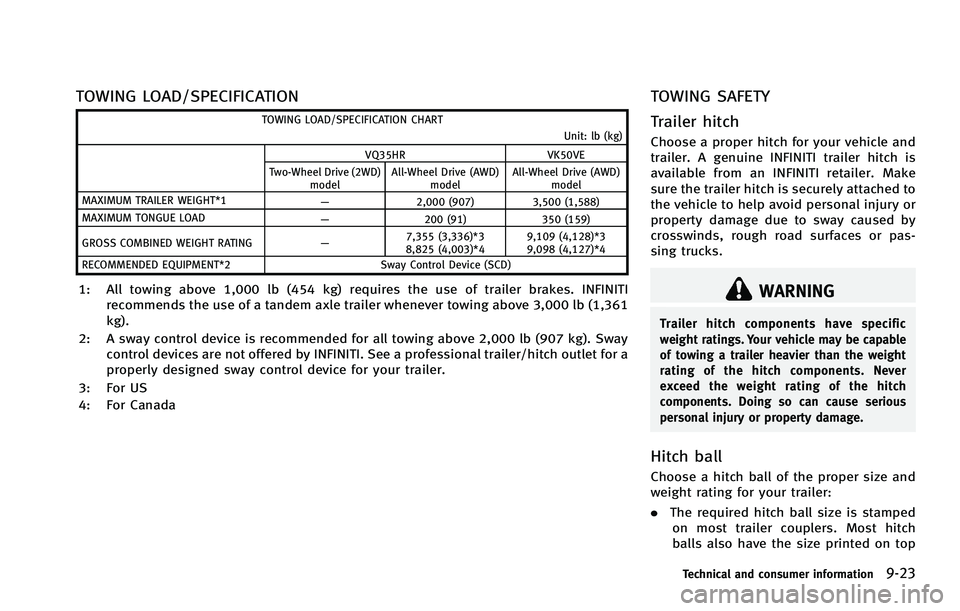
TOWING LOAD/SPECIFICATION
TOWING LOAD/SPECIFICATION CHARTUnit: lb (kg)
VQ35HR VK50VE
Two-Wheel Drive (2WD) model All-Wheel Drive (AWD)
model All-Wheel Drive (AWD)
model
MAXIMUM TRAILER WEIGHT*1 —2,000 (907) 3,500 (1,588)
MAXIMUM TONGUE LOAD —200 (91) 350 (159)
GROSS COMBINED WEIGHT RATING —7,355 (3,336)*3
8,825 (4,003)*4 9,109 (4,128)*3
9,098 (4,127)*4
RECOMMENDED EQUIPMENT*2 Sway Control Device (SCD)
1: All towing above 1,000 lb (454 kg) requires the use of trailer brakes. INFINITI
recommends the use of a tandem axle trailer whenever towing above 3,000 lb (1,361
kg).
2: A sway control device is recommended for all towing above 2,000 lb (907 kg). Sway control devices are not offered by INFINITI. See a professional trailer/hitch outlet for a
properly designed sway control device for your trailer.
3: For US
4: For Canada
TOWING SAFETY
Trailer hitch
Choose a proper hitch for your vehicle and
trailer. A genuine INFINITI trailer hitch is
available from an INFINITI retailer. Make
sure the trailer hitch is securely attached to
the vehicle to help avoid personal injury or
property damage due to sway caused by
crosswinds, rough road surfaces or pas-
sing trucks.
WARNING
Trailer hitch components have specific
weight ratings. Your vehicle may be capable
of towing a trailer heavier than the weight
rating of the hitch components. Never
exceed the weight rating of the hitch
components. Doing so can cause serious
personal injury or property damage.
Hitch ball
Choose a hitch ball of the proper size and
weight rating for your trailer:
. The required hitch ball size is stamped
on most trailer couplers. Most hitch
balls also have the size printed on top
Technical and consumer information9-23
Page 503 of 522

9-24Technical and consumer information
of the ball.
. Choose the proper class hitch ball
based on the trailer weight.
. The diameter of the threaded shank of
the hitch ball must be matched to the
ball mount hole diameter. The hitch ball
shank should be no more than 1/16
smaller than the hole in the ball mount.
. The threaded shank of the hitch ball
must be long enough to be properly
secured to the ball mount. There should
be at least 2 threads showing beyond
the lock washer and nut.
Sway control device
Sudden maneuvers, wind gusts and buffet-
ing caused by other vehicles can affect
trailer handling. Sway control devices may
be used to help control these affects. If you
choose to use one, contact a reputable
trailer hitch supplier to make sure the sway
control device will work with the vehicle,
hitch, trailer and the trailer’s brake system.
Follow the instructions provided by the
manufacturer for installing and using the
sway control device.
Class I hitch
Class I trailer hitch equipment (receiver,
ball mount and hitch ball) can be used to
tow trailers of a maximum weight of 2,000
lb (907 kg).
Class II hitch
Class II trailer hitch equipment (receiver,
ball mount and hitch ball) can be used to
tow trailers of a maximum weight of 3,500
lb (1,588 kg).
CAUTION
. Special hitches which include frame
reinforcements are required for towing
above 2,000 lb (907 kg). Suitable
genuine INFINITI hitches for pickup
trucks and sport utility vehicles are
available at an INFINITI retailer.
. The hitch should not be attached to or
affect the operation of the impact-
absorbing bumper.
. Do not use axle-mounted hitches.
. Do not modify the vehicle exhaust
system, brake system, etc. to install a
trailer hitch. .
To reduce the possibility of additional
damage if your vehicle is struck from the
rear, where practical, remove the hitch
and/or receiver when not in use. After
the hitch is removed, seal the bolt holes
to prevent exhaust fumes, water or dust
from entering the passenger compart-
ment.
. Regularly check that all trailer hitch
mounting bolts are securely mounted.
Tire pressures
.When towing a trailer, inflate the
vehicle tires to the recommended
cold tire pressure indicated on the
Tire and Loading Information la-
bel.
.Trailer tire condition, size, loadrating and proper inflation pres-
sure should be in accordance with
the trailer and tire manufacturers’
specifications.
Safety chains
Always use a suitable chain between your
vehicle and the trailer. The safety chains
should be crossed and should be attached