tires INFINITI FX 2012 Service Manual
[x] Cancel search | Manufacturer: INFINITI, Model Year: 2012, Model line: FX, Model: INFINITI FX 2012Pages: 522, PDF Size: 3.51 MB
Page 477 of 522
8-40Maintenance and do-it-yourself
The wheel nuts must be kept tigh-
tened to the specification at all
times. It is recommended that wheel
nuts be tightened to the specifica-
tion at each tire rotation interval.
WARNING
.After rotating the tires, check and
adjust the tire pressure.
. Retighten the wheel nuts when
the vehicle has been driven for
600 miles (1,000 km) (also in
cases of a flat tire, etc.).
. Do not include the T-type spare
tire or any other small size spare
tire in the tire rotation.
. For additional information regard-
ing tires, refer to “Important Tire
Safety Information ”(US) or “Tire
Safety Information ”(Canada) in
the Warranty Information Booklet.
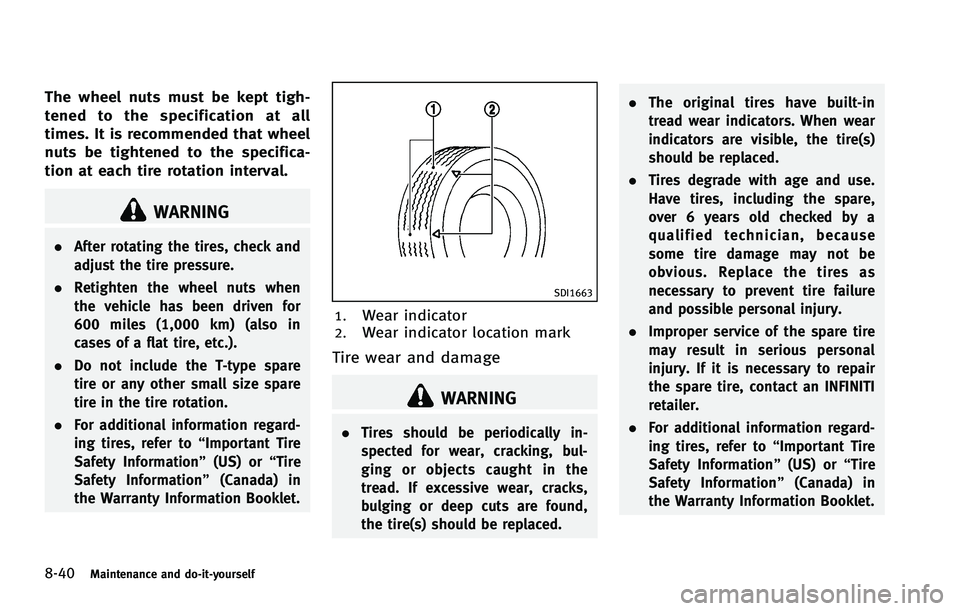
SDI1663
1.Wear indicator
2.Wear indicator location mark
Tire wear and damage
WARNING
. Tires should be periodically in-
spected for wear, cracking, bul-
ging or objects caught in the
tread. If excessive wear, cracks,
bulging or deep cuts are found,
the tire(s) should be replaced. .
The original tires have built-in
tread wear indicators. When wear
indicators are visible, the tire(s)
should be replaced.
. Tires degrade with age and use.
Have tires, including the spare,
over 6 years old checked by a
qualified technician, because
some tire damage may not be
obvious. Replace the tires as
necessary to prevent tire failure
and possible personal injury.
. Improper service of the spare tire
may result in serious personal
injury. If it is necessary to repair
the spare tire, contact an INFINITI
retailer.
. For additional information regard-
ing tires, refer to “Important Tire
Safety Information ”(US) or “Tire
Safety Information ”(Canada) in
the Warranty Information Booklet.
Page 478 of 522
Replacing wheels and tires
When replacing a tire, use the same size,
tread design, speed rating and load carry-
ing capacity as originally equipped. (See
“Specifications”(P.9-8) for recommended
types and sizes of tires and wheels.)
WARNING
. The use of tires other than those
recommended or the mixed use of tires
of different brands, construction (bias,
bias-belted or radial), or tread patterns
can adversely affect the ride, braking,
handling, ground clearance, body-to-tire
clearance, tire chain clearance, speed-
ometer calibration, headlight aim and
bumper height. Some of these effects
may lead to accidents and could result in
serious personal injury.
. If the wheels are changed for any
reason, always replace with wheels
which have the same off-set dimension.
Wheels of a different off-set could cause
premature tire wear, degrade vehicle
handling characteristics and/or interfer-
ence with the brake discs/drums. Such
interference can lead to decreased brak- ing efficiency and/or early brake pad/
shoe wear. See
“Wheels and tires” (P.9-
9) of this manual for wheel off-set
dimensions.
. When a spare tire is mounted or a wheel
is replaced, the TPMS will not function
and the low tire pressure warning light
will flash for approximately 1 minute.
The light will remain on after 1 minute.
Contact your INFINITI retailer as soon as
possible for tire replacement and/or
system resetting.
. Replacing tires with those not originally
specified by INFINITI could affect the
proper operation of the TPMS.
. Do not install a damaged or deformed
wheel or tire even if it has been repaired.
Such wheels or tires could have struc-
tural damage and could fail without
warning.
. The use of retread tire is not recom-
mended.
. For additional information regarding
tires, refer to “Important Tire Safety
Information” (US) or“Tire Safety Infor-
mation” (Canada) in the Warranty Infor-
mation Booklet.
All-Wheel Drive (AWD) models
CAUTION
. Always use tires of the same type, size,
brand, construction (bias, bias-belted or
radial), and tread pattern on all four
wheels. Failure to do so may result in a
circumference difference between tires
on the front and rear axles which will
cause excessive tire wear and may
damage the transmission, transfer case
and differential gears.
. ONLY use spare tires specified for the
AWD model.
If excessive tire wear is found, it is
recommended that all four tires be re-
placed with tires of the same size, brand,
construction and tread pattern. The tire
pressure and wheel alignment should also
be checked and corrected as necessary.
Contact an INFINITI retailer.
Wheel balance
Unbalanced wheels may affect vehicle
handling and tire life. Even with regular
use, wheels can get out of balance. There-
fore, they should be balanced as required.
Maintenance and do-it-yourself8-41
Page 479 of 522
8-42Maintenance and do-it-yourself
Wheel balance service should be per-
formed with the wheels off the vehicle.
Spin balancing the wheels on the vehicle
could lead to mechanical damage.
For additional information regarding tires,
refer to“Important Tire Safety Information”
(US) or “Tire Safety Information” (Canada)
in the INFINITI Warranty Information Book-
let.
Care of wheels
See “Cleaning exterior” (P.7-2) for details
about care of the wheels.
Spare tire (TEMPORARY USE ONLY
(T-type) spare tire)
When a spare tire is mounted (TEMPORARY
USE ONLY or conventional), the TPMS will
not function.
Observe the following precautions if the T-
type spare tire must be used, otherwise
your vehicle could be damaged or involved
in an accident.
WARNING
. The T-type spare tire should be used for
emergency use. It should be replaced
with the standard tire at the first opportunity to avoid possible tire or
differential damage.
. Drive carefully while the TEMPORARY
USE ONLY spare tire is installed. Avoid
sharp turns and abrupt braking while
driving.
. Periodically check spare tire inflation
pressure. Always keep the pressure of
the TEMPORARY USE ONLY spare tire at
60 psi (420 kPa, 4.2 bar). Always keep
the pressure of the full size spare tire (if
so equipped) at the recommended pres-
sure for standard tires, as indicated on
the Tire and Loading Information label.
For Tire and Loading Information label
location, see “Tire and Loading Informa-
tion label” in the index of this manual.
. With the TEMPORARY USE ONLY spare
tire installed do not drive your vehicle at
speeds faster than 50 MPH (80 km/h).
. When driving on roads covered with
snow or ice, the TEMPORARY USE ONLY
spare tire should be used on the front
wheels and original tire used on the rear
wheels (drive wheels). Use tire chains
only on the two rear original tires.
. Tire tread of the TEMPORARY USE ONLY
spare tire will wear at a faster rate than the standard tire. Replace the spare tire
as soon as the tread wear indicators
appear.
. Do not use the spare tire on other
vehicles.
. Do not use more than one spare tire at
the same time.
. Do not tow a trailer when the TEMPOR-
ARY USE ONLY spare tire is installed.
CAUTION
.Do not use tire chains on a TEMPORARY
USE ONLY spare tire. Tire chains will not
fit properly and may cause damage to
the vehicle.
. Because the TEMPORARY USE ONLY
spare tire is smaller than the original
tire, ground clearance is reduced. To
avoid damage to the vehicle, do not
drive over obstacles. Also do not drive
the vehicle through an automatic car
wash since it may get caught.
Page 480 of 522
9 Technical and consumer information
Capacities and recommended fuel/lubricants....... 9-2Fuel recommendation ...................................... 9-4
Engine oil and oil filter recommendation ......... 9-6
Air conditioning system refrigerant and
lubricant recommendations ............................. 9-7
Specifications ...................................................... 9-8
Engine............................................................. 9-8Wheels and tires ............................................. 9-9
Dimensions ................................................... 9-10
When traveling or registering your vehicle in
another country ................................................. 9-11
Vehicle identification ......................................... 9-11 Vehicle Identification Number (VIN) plate ....... 9-11
Vehicle identification number
(chassis number) ........................................... 9-11
Engine serial number .................................... 9-12
F.M.V.S.S./C.M.V.S.S. certification label .......... 9-12
Emission control information label ................ 9-13
Tire and loading information label ................. 9-13
Air conditioner specification label.................. 9-13
Installing front license plate .............................. 9-14
Vehicle loading information ............................... 9-15 Terms ............................................................ 9-15 Vehicle load capacity ................................... 9-17
Securing the load ........................................ 9-18
Loading tips................................................. 9-18
Measurement of weights.............................. 9-19
Towing a trailer ................................................. 9-19 Maximum load limits ................................... 9-19
Maximum Gross Vehicle Weight (GVW)/
Maximum Gross Axle Weight (GAW) ............. 9-21
Towing load/specification ............................ 9-23
Towing safety............................................... 9-23 Flat towing................................................... 9-27
Uniform tire quality grading .............................. 9-28 Treadwear .................................................... 9-28
Traction AA, A, B and C................................ 9-28 Temperature A, B and C ............................... 9-28
Emission control system warranty ..................... 9-29
Reporting safety defects.................................... 9-30
Readiness for Inspection/Maintenance
(I/M) test .......................................................... 9-31
Event Data Recorders (EDR) ............................... 9-31
Owner’s Manual/Service Manual
order information .............................................. 9-32
Page 488 of 522
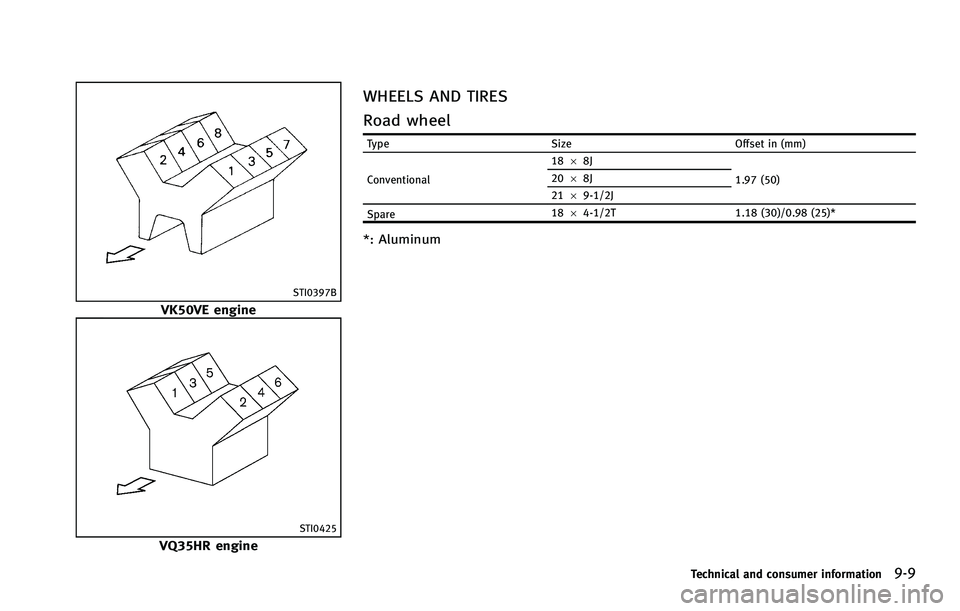
STI0397B
VK50VE engine
STI0425
VQ35HR engine
WHEELS AND TIRES
Road wheel
TypeSizeOffset in (mm)
Conventional 18
68J
1.97 (50)
20
68J
21 69-1/2J
Spare 18
64-1/2T 1.18 (30)/0.98 (25)*
*: Aluminum
Technical and consumer information9-9
Page 496 of 522
VEHICLE LOAD CAPACITY
Do not exceed the load limit of your
vehicle shown as“The combined
weight of occupants and cargo” on
the Tire and Loading Information
label. Do not exceed the number of
occupants shown as “Seating Capa-
city” on the Tire and Loading In-
formation label.
To get “the combined weight of
occupants and cargo” , add the
weight of all occupants, then add
the total luggage weight. Examples
are shown in the illustration.
Steps for determining correct load
limit
1.Locate the statement “The com-
bined weight of occupants and
cargo should never exceed XXX kg
or XXX lbs” on your vehicle’ s
placard.
2.Determine the combined weight of
the driver and passengers that
will be riding in your vehicle.
3.Subtract the combined weight of
the driver and passengers from
XXX kg or XXX lbs.
4.The resulting figure equals the
available amount of cargo and
luggage load capacity. For exam-
ple, if the XXX amount equals
1400 lbs. and there will be five
150 lb. passengers in your vehi-
cle, the amount of available cargo
and luggage load capacity is 650
lbs. (1400 −750 (5 x 150) = 650
lbs) or (640 −340 (5 x 70) = 300
kg.)
5.Determine the combined weight of
luggage and cargo being loaded
on the vehicle. That weight may
not safely exceed the available
cargo and luggage load capacity
calculated in Step 4.
6.If your vehicle will be towing a
trailer, load from your trailer will
be transferred to your vehicle.
Consult this manual to determine
how this reduces the available cargo and luggage load capacity
of your vehicle.
Before driving a loaded vehicle,
confirm that you do not exceed the
Gross Vehicle Weight Rating (GVWR)
or the Gross Axle Weight Rating
(GAWR) for your vehicle. (See “Mea-
surement of weights” (P.9-19).)
Also check tires for proper inflation
pressures. See the Tire and Loading
Information label.
Technical and consumer information9-17
Page 497 of 522
9-18Technical and consumer information
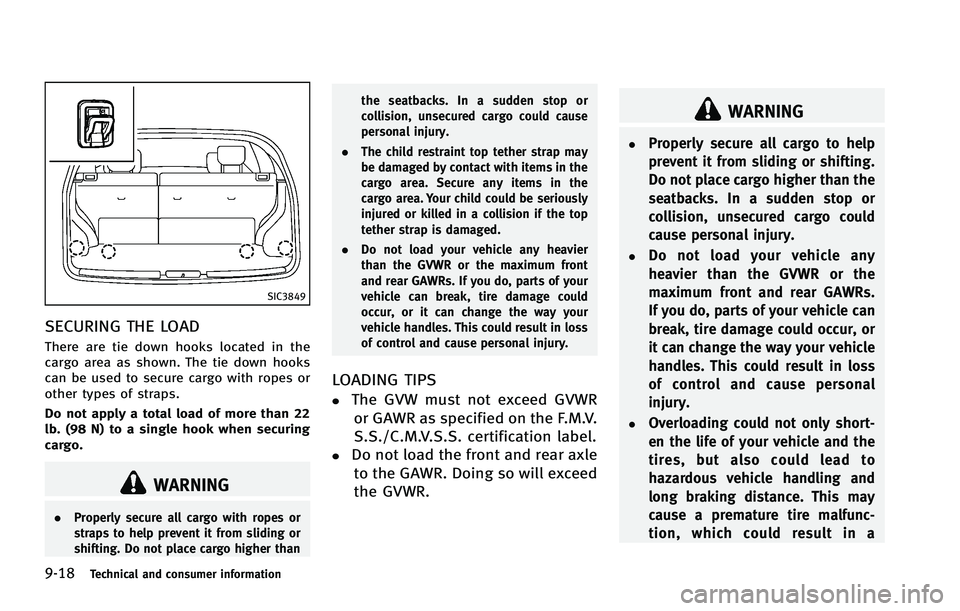
SIC3849
SECURING THE LOAD
There are tie down hooks located in the
cargo area as shown. The tie down hooks
can be used to secure cargo with ropes or
other types of straps.
Do not apply a total load of more than 22
lb. (98 N) to a single hook when securing
cargo.
WARNING
.Properly secure all cargo with ropes or
straps to help prevent it from sliding or
shifting. Do not place cargo higher than the seatbacks. In a sudden stop or
collision, unsecured cargo could cause
personal injury.
. The child restraint top tether strap may
be damaged by contact with items in the
cargo area. Secure any items in the
cargo area. Your child could be seriously
injured or killed in a collision if the top
tether strap is damaged.
. Do not load your vehicle any heavier
than the GVWR or the maximum front
and rear GAWRs. If you do, parts of your
vehicle can break, tire damage could
occur, or it can change the way your
vehicle handles. This could result in loss
of control and cause personal injury.
LOADING TIPS
.The GVW must not exceed GVWR
or GAWR as specified on the F.M.V.
S.S./C.M.V.S.S. certification label.
.Do not load the front and rear axle
to the GAWR. Doing so will exceed
the GVWR.
WARNING
.Properly secure all cargo to help
prevent it from sliding or shifting.
Do not place cargo higher than the
seatbacks. In a sudden stop or
collision, unsecured cargo could
cause personal injury.
.Do not load your vehicle any
heavier than the GVWR or the
maximum front and rear GAWRs.
If you do, parts of your vehicle can
break, tire damage could occur, or
it can change the way your vehicle
handles. This could result in loss
of control and cause personal
injury.
.Overloading could not only short-
en the life of your vehicle and the
tires, but also could lead to
hazardous vehicle handling and
long braking distance. This may
cause a premature tire malfunc-
tion, which could result in a
Page 503 of 522

9-24Technical and consumer information
of the ball.
. Choose the proper class hitch ball
based on the trailer weight.
. The diameter of the threaded shank of
the hitch ball must be matched to the
ball mount hole diameter. The hitch ball
shank should be no more than 1/16
smaller than the hole in the ball mount.
. The threaded shank of the hitch ball
must be long enough to be properly
secured to the ball mount. There should
be at least 2 threads showing beyond
the lock washer and nut.
Sway control device
Sudden maneuvers, wind gusts and buffet-
ing caused by other vehicles can affect
trailer handling. Sway control devices may
be used to help control these affects. If you
choose to use one, contact a reputable
trailer hitch supplier to make sure the sway
control device will work with the vehicle,
hitch, trailer and the trailer’s brake system.
Follow the instructions provided by the
manufacturer for installing and using the
sway control device.
Class I hitch
Class I trailer hitch equipment (receiver,
ball mount and hitch ball) can be used to
tow trailers of a maximum weight of 2,000
lb (907 kg).
Class II hitch
Class II trailer hitch equipment (receiver,
ball mount and hitch ball) can be used to
tow trailers of a maximum weight of 3,500
lb (1,588 kg).
CAUTION
. Special hitches which include frame
reinforcements are required for towing
above 2,000 lb (907 kg). Suitable
genuine INFINITI hitches for pickup
trucks and sport utility vehicles are
available at an INFINITI retailer.
. The hitch should not be attached to or
affect the operation of the impact-
absorbing bumper.
. Do not use axle-mounted hitches.
. Do not modify the vehicle exhaust
system, brake system, etc. to install a
trailer hitch. .
To reduce the possibility of additional
damage if your vehicle is struck from the
rear, where practical, remove the hitch
and/or receiver when not in use. After
the hitch is removed, seal the bolt holes
to prevent exhaust fumes, water or dust
from entering the passenger compart-
ment.
. Regularly check that all trailer hitch
mounting bolts are securely mounted.
Tire pressures
.When towing a trailer, inflate the
vehicle tires to the recommended
cold tire pressure indicated on the
Tire and Loading Information la-
bel.
.Trailer tire condition, size, loadrating and proper inflation pres-
sure should be in accordance with
the trailer and tire manufacturers’
specifications.
Safety chains
Always use a suitable chain between your
vehicle and the trailer. The safety chains
should be crossed and should be attached
Page 507 of 522
9-28Technical and consumer information
.DO NOT tow an All-Wheel Drive (AWD)
vehicle with any of the wheels on the
ground. Doing so may cause serious and
expensive damage to the powertrain.
. For emergency towing procedures refer
to“Towing recommended by INFINITI”
(P.6-13) of this manual.
Automatic transmission
All-Wheel Drive (AWD) models:
Do not tow an AWD vehicle with any of the
wheels on the ground.
Two-Wheel Drive (2WD) models:
To tow a vehicle equipped with an auto-
matic transmission, an appropriate vehicle
dolly MUST be placed under the towed
vehicle’s drive wheels. Alwaysfollow the
dolly manufacturer’ s recommendations
when using their product. DOT (Department Of Transportation) Qual-
ity Grades: All passenger car tires must
conform to federal safety requirements in
addition to these grades.
Quality grades can be found where applic-
able on the tire sidewall between tread
shoulder and maximum section width. For
example:
Treadwear 200 Traction AA Temperature ATREADWEAR
The treadwear grade is a comparative
rating based on the wear rate of the tire
when tested under controlled conditions
on a specified government test course. For
example, a tire graded 150 would wear one
and one-half (1 1/2) times as well on the
government course as a tire graded 100.
The relative performance of tires depends
upon actual conditions of their use, how-
ever, and may depart significantly from the
norm due to variations in driving habits,
service practices and differences in road
characteristics and climate.
TRACTION AA, A, B AND C
The traction grades, from highest to low-
est, are AA, A, B and C. Those grades
represent the tire’s ability to stop on wet
pavement as measured under controlled
conditions on specified government test
surfaces of asphalt and concrete. A tire
marked C may have poor traction perfor-
mance.
WARNING
The traction grade assigned to this tire is
based on straight-ahead braking traction
tests, and does not include acceleration,
cornering, hydroplaning, or peak traction
characteristics.
TEMPERATURE A, B AND C
The temperature grades A (the highest), B,
and C, representing the tire’s resistance to
the generation of heat and its ability to
dissipate heat when tested under con-
trolled conditions on a specified indoor
laboratory test wheel. Sustained high
temperature can cause the material of the
tire to degenerate and reduce tire life, and
excessive temperature can lead to sudden
UNIFORM TIRE QUALITY GRADING
Page 508 of 522
tire failure. The grade C corresponds to a
level of performance which all passenger
car tires must meet under the Federal
Motor Vehicle Safety Standard No. 109.
Grades B and A represent higher levels of
performance on the laboratory test wheel
than the minimum required by law.
WARNING
The temperature grade for this tire is
established for a tire that is properly
inflated and not overloaded. Excessive
speed, under-inflation, or excessive loading,
either separately or in combination, can
cause heat build-up and possible tire failure.
Your INFINITI is covered by the following
emission warranties.
For US:
.Emission Defects Warranty
. Emissions Performance Warranty
Details of these warranties may be found
with other vehicle warranties in your
Warranty Information Booklet that comes
with your INFINITI. If you did not receive a
Warranty Information Booklet, or it has
become lost, you may obtain a replace-
ment by writing to:
. INFINITI Division
Nissan North America, Inc.
Consumer Affairs Department
P.O. Box 685003
Franklin, TN 37068-5003
For Canada:
Emission Control System Warranty
Details of these warranties may be found
with other vehicle warranties in your
Warranty and Roadside Assistance Infor-
mation that comes with your INFINITI. If you
did not receive a Warranty and Roadside
Assistance Information, or it has become
lost, you may obtain a replacement by
writing to: .
Nissan Canada Inc.
5290 Orbitor Drive
Mississauga, Ontario,
L4W 4Z5
Technical and consumer information9-29
EMISSION CONTROL SYSTEM WARRANTY