vehicle INFINITI FX 2013 User Guide
[x] Cancel search | Manufacturer: INFINITI, Model Year: 2013, Model line: FX, Model: INFINITI FX 2013Pages: 522, PDF Size: 7.53 MB
Page 33 of 522
1-14Safety—Seats, seat belts and supplemental restraint system
WARNING
. Every person who drives or rides in this
vehicle should use a seat belt at all
times.
. Do not ride in a moving vehicle when the
seatback is reclined. This can be danger-
ous. The shoulder belt will not be
against your body. In an accident, you
could be thrown into it and receive neck
or other serious injuries. You could also
slide under the lap belt and receive
serious internal injuries. .
For the most effective protection when
the vehicle is in motion, the seat should
be upright. Always sit well back in the
seat with both feet on the floor and
adjust the seat belt properly.
. Do not allow children to play with the
seat belts. Most seating positions are
equipped with Automatic Locking Re-
tractor (ALR) mode seat belts. If the seat
belt becomes wrapped around a child’s
neck with the ALR mode activated, the
child can be seriously injured or killed if
the seat belt retracts and becomes tight.
This can occur even if the vehicle is
parked. Unbuckle the seat belt to release
the child. If the seat belt can not be
unbuckled or is already unbuckled,
release the child by cutting the seat belt
with a suitable tool (such as a knife or
scissors) to release the seat belt.
SSS0292
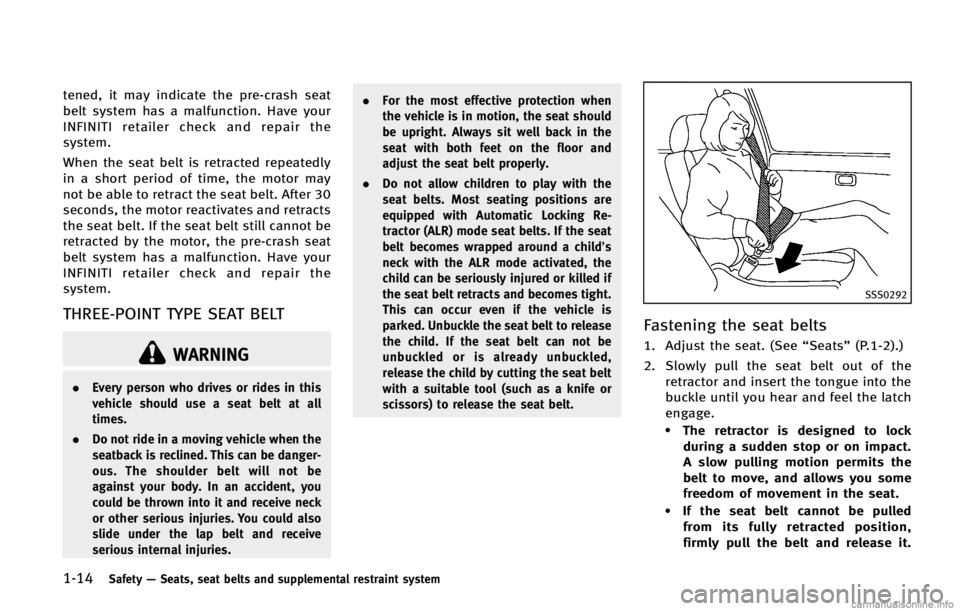
Fastening the seat beltsGUID-686CB8C1-4494-42D6-B01F-BD04C634E6F2
Page 34 of 522

SSS0290
3. Position the lap belt portionlow and
snug on the hips as shown.
4. Pull the shoulder belt portion toward the retractor to take up extra slack. Be
sure the shoulder belt is routed over
your shoulder and across your chest.
The front passenger and rear passenger
seating positions’ three-point seat belts
have two modes of operation:
. Emergency Locking Retractor (ELR)
. Automatic Locking Retractor (ALR)
The Emergency Locking Retractor (ELR)
mode allows the seat belt to extend and
retract to allow the driver and passengers some freedom of movement in the seat.
The ELR locks the seat belt when the
vehicle slows down rapidly or during
impacts.
The Automatic Locking Retractor (ALR)
mode (child restraint mode) locks the seat
belt for child restraint installation.
When the ALR mode is activated the seat
belt cannot be extended again until the
seat belt tongue is detached from the
buckle and fully retracted. The seat belt
returns to the ELR mode after the seat belt
fully retracts. For additional information,
see
“Child restraints” (P.1-20).
The ALR mode should be used only for
child restraint installation. During normal
seat belt use by a passenger, the ALR
mode should not be activated. If it is
activated, it may cause uncomfortable seat
belt tension.
WARNING
When fastening the seat belts, be certain
that seatbacks are completely secured in
the latched position. If they are not com-
pletely secured, passengers may be injured
in an accident or sudden stop.
Safety —Seats, seat belts and supplemental restraint system1-15
Page 37 of 522
1-18Safety—Seats, seat belts and supplemental restraint system
WARNING
Do not allow children to play with the seat
belts. Most seating positions are equipped
with Automatic Locking Retractor (ALR)
mode seat belts. If the seat belt becomes
wrapped around a child’s neck with the ALR
mode activated, the child can be seriously
injured or killed if the seat belt retracts and
becomes tight. This can occur even if the
vehicle is parked. Unbuckle the seat belt to
release the child. If the seat belt can not be
unbuckled or is already unbuckled, release
the child by cutting the seat belt with a
suitable tool (such as a knife or scissors) to
release the seat belt.
Children need adults to help protect them.
They need to be properly restrained.
In addition to the general information in
this manual, child safety information is
available from many other sources, includ-
ing doctors, teachers, government traffic
safety offices, and community organiza-
tions. Every child is different, so be sure to
learn the best way to transport your child.
There are three basic types of child
restraint systems: .
Rear-facing child restraint
. Forward-facing child restraint
. Booster seat
The proper restraint depends on the child’s
size. Generally, infants up to about 1 year
and less than 20 lbs (9 kg) should be
placed in rear-facing child restraints. For-
ward-facing child restraints are available
for children who outgrow rear-facing child
restraints and are at least 1 year old.
Booster seats are used to help position a
vehicle lap/shoulder belt on a child who
can no longer use a forward-facing child
restraint.
WARNING
Infants and children need special protection.
The vehicle’s seat belts may not fit them
properly. The shoulder belt may come too
close to the face or neck. The lap belt may
not fit over their small hip bones. In an
accident, an improperly fitting seat belt
could cause serious or fatal injury. Always
use appropriate child restraints.
All U.S. states and Canadian provinces or
territories require the use of approved
child restraints for infants and small
CHILD SAFETY
Page 38 of 522

children. See“Child restraints” (P.1-20).
A child restraint may be secured in the
vehicle by using either the LATCH (Lower
Anchor and Tethers for CHildren) system or
with the vehicle seat belt. See “Child
restraints” (P.1-20) for more information.
INFINITI recommends that all pre-teens
and children be restrained in the rear seat.
Studies show that children are safer when
properly restrained in the rear seat than in
the front seat.
This is especially important because your
vehicle has a supplemental restraint sys-
tem (Air bag system) for the front passen-
ger. See “Supplemental restraint system ”
(P.1-37).
INFANTSGUID-2A50A59D-9607-4421-98CF-F35931EE4085
Page 40 of 522
CAUTION
A child restraint in a closed vehicle can
become very hot. Check the seating surface
and buckles before placing a child in the
child restraint.
This vehicle is equipped with a universal
child restraint anchor system, referred to
as the LATCH (Lower Anchors and Tethers
for CHildren) system. Some child restraints
include rigid or webbing-mounted attach-
ments that can be connected to these
anchors.
For details, see“Lower Anchors and
Tethers for CHildren (LATCH) System” (P.1-
22).
If you do not have a LATCH compatible
child restraint, the vehicle seat belts can
be used.
Several manufacturers offer child restraints for infants and small children of various
sizes. When selecting any child restraint,
keep the following points in mind:
.
Choose only a restraint with a label
certifying that it complies with Federal
Motor Vehicle Safety Standard 213 or
Canadian Motor Vehicle Safety Stan-
dard 213.
. Check the child restraint in your vehicle
to be sure it is compatible with the
vehicle’s seat and seat belt system.
. If the child restraint is compatible with
your vehicle, place your child in the
child restraint and check the various
adjustments to be sure the child
restraint is compatible with your child.
Choose a child restraint that is de-
signed for your child’s height and
weight. Always follow all recommended
procedures.
All U.S. states and Canadian provinces or
territories require that infants and small
children be restrained in an approved child
restraint at all times while the vehicle is
being operated. Canadian law requires the
top tether strap on front-facing child
restraints to be secured to the designated
anchor point on the vehicle.
Safety —Seats, seat belts and supplemental restraint system1-21
Page 42 of 522
SSS0643
LATCH webbing-mounted attachment
Installing child restraint LATCH
lower anchor attachments
GUID-93E34B42-CCE2-45A9-884B-299A11E654E9
SSS0644
LATCH rigid attachment
The child restraint top tether strap must be
used when installing the child restraint
with the LATCH lower anchor attachments
or seat belts.
When installing a child restraint, carefully
read and follow the instructions in this
manual and those supplied with the child
restraint.
SSS0902
Top tether anchorGUID-C0ACE848-CD11-4901-95A2-9EBAAF867313
WARNING
. If the cargo cover (if so equipped)
contacts the top tether strap when it is
attached to the top tether anchor,
remove the cargo cover from the vehicle
or secure it on the cargo floor below its
attachment location. If the cargo cover is
not removed, it may damage the top
tether strap during a collision. Your child
could be seriously injured or killed in a
collision if the child restraint top tether
Safety —Seats, seat belts and supplemental restraint system1-23
Page 44 of 522

SSS0649
Rear-facing rigid-mounted—step 2
SSS0639
Rear-facing —step 3
3. For child restraints that are equipped
with webbing-mounted attachments,
remove any additional slack from the
anchor attachments. Press downward
and rearward firmly in the center of the
child restraint with your hand to com-
press the vehicle seat cushion and
seatback while tightening the webbing
of the anchor attachments.
SSS0650
Rear-facing —step 4
4. After attaching the child restraint, test
it before you place the child in it. Push
it from side to side while holding the
child restraint near the LATCH attach-
ment path. The child restraint should
not move more than 1 inch (25 mm),
from side to side. Try to tug it forward
and check to see if the LATCH attach-
ment holds the restraint in place. If the
restraint is not secure, tighten the
LATCH attachment as necessary, or
put the restraint in another seat and
test it again. You may need to try a
different child restraint or try installing
by using the vehicle seat belt (if
Safety —Seats, seat belts and supplemental restraint system1-25
Page 45 of 522
1-26Safety—Seats, seat belts and supplemental restraint system
SSS0100
REAR-FACING CHILD RESTRAINT IN-
STALLATION USING THE SEAT BELTS
GUID-D3F4C3D8-8360-4708-B22B-29C7AB90AB54
WARNING
The three-point seat belt with Automatic
Locking Retractor (ALR) must be used when
installing a child restraint. Failure to use the
ALR mode will result in the child restraint
not being properly secured. The restraint
could tip over or be loose and cause injury
to a child in a sudden stop or collision.
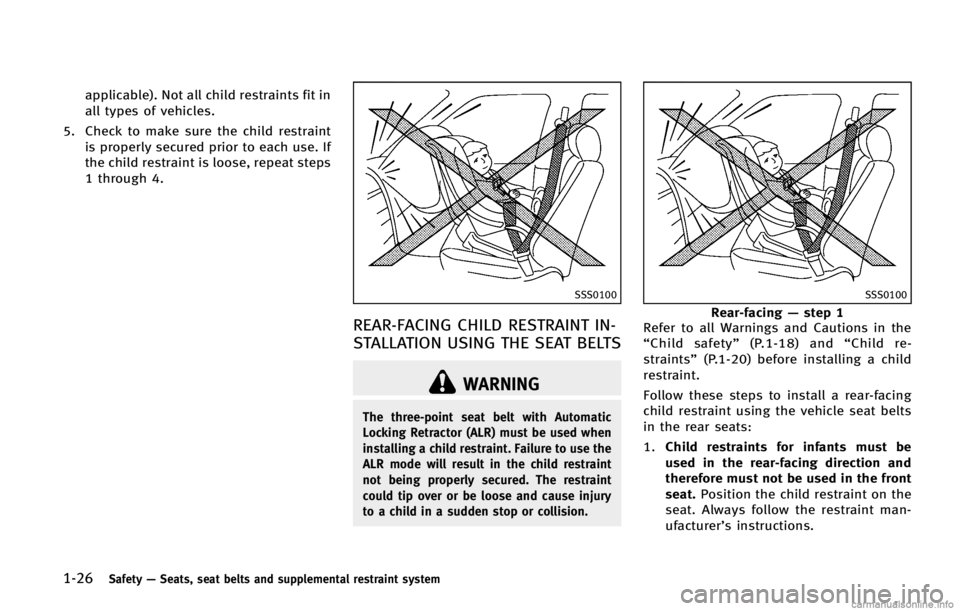
SSS0100
Rear-facing —step 1
Refer to all Warnings and Cautions in the
“Child safety” (P.1-18) and“Child re-
straints” (P.1-20) before installing a child
restraint.
Follow these steps to install a rear-facing
child restraint using the vehicle seat belts
in the rear seats:
1. Child restraints for infants must be
used in the rear-facing direction and
therefore must not be used in the front
seat. Position the child restraint on the
seat. Always follow the restraint man-
ufacturer’s instructions.
Page 47 of 522

1-28Safety—Seats, seat belts and supplemental restraint system
SSS0657
Rear-facing —step 5
5. Remove any additional slack from the
seat belt; press downward and rear-
ward firmly in the center of the child
restraint to compress the vehicle seat
cushion and seatback while pulling up
on the seat belt.
SSS0658
Rear-facing —step 6
6. After attaching the child restraint, test
it before you place the child in it. Push
it from side to side while holding the
child restraint near the seat belt path.
The child restraint should not move
more than 1 inch (25 mm), from side to
side. Try to tug it forward and check to
see if the belt holds the restraint in
place. If the restraint is not secure,
tighten the seat belt as necessary, or
put the restraint in another seat and
test it again. You may need to try a
different child restraint. Not all child
restraints fit in all types of vehicles. 7.
Check to make sure that the child
restraint is properly secured prior to
each use. If the seat belt is not locked,
repeat steps 1 through 6.
After the child restraint is removed and the
seat belt fully retracted, the ALR mode
(child restraint mode) is canceled.
FORWARD-FACING CHILD RESTRAINT
INSTALLATION USING LATCH
GUID-7EBAF34F-5817-4D99-B91E-DABAC509F683
Page 48 of 522

SSS0645
Forward-facing web-mounted—step 2
2. Secure the child restraint anchor at-
tachments to the LATCH lower anchors.
Check to make sure the LATCH attach-
ment is properly attached to the lower
anchors.
If the child restraint is equipped with a
top tether strap, route the top tether
strap and secure the tether strap to the
tether anchor point. See “Installing top
tether strap” in this section. Do not
install child restraints that require the
use of a top tether strap in seating
positions that do not have a top tether
anchor.
SSS0646
Forward-facing rigid-mounted —step 2
3. The back of the child restraint should
be secured against the vehicle seat-
back.
If necessary, adjust or remove the head
restraint to obtain the correct child
restraint fit. If the head restraint is
removed, store it in a secure place. Be
sure to reinstall the head restraint
when the child restraint is removed.
See “Head restraints” (P.1-6) for head
restraint adjustment information.
If the seating position does not have an
adjustable head restraint and it is
interfering with the proper child re- straint fit, try another seating position
or a different child restraint.
Safety
—Seats, seat belts and supplemental restraint system1-29