towing INFINITI FX 2013 Owner's Manual
[x] Cancel search | Manufacturer: INFINITI, Model Year: 2013, Model line: FX, Model: INFINITI FX 2013Pages: 522, PDF Size: 7.53 MB
Page 221 of 522
4-44Monitor, climate, audio, phone and voice recognition systems
WARNING
.Do not use the MOD system when
towing a trailer. The system may not
function properly.
. Excessive noise (for example, audio
system volume or open vehicle window)
will interfere with the chime sound, and
it may not be heard.
. The MOD system performance will be
limited according to environmental con-
ditions and surrounding objects such as:
—When there is low contrast between
background and the moving objects.
—When there is blinking source oflight.
—When strong light such as anothervehicle’s headlight or sunlight is
present.
—When camera orientation is not inits usual position, such as when
mirror is folded.
—When there is dirt, water drops orsnow on the camera lens.
—When the position of the movingobjects in the display is not changed.
. The MOD system might detect some-
thing like flowing water droplets on the
camera lens, white smoke from the
muffler, moving shadows, etc.
. The MOD system may not function
properly depending on the speed, direc-
tion, distance or shape of the moving
objects.
. If your vehicle sustains damage to the
parts where the camera is installed,
leaving it misaligned or bent, the sen-
sing zone may be altered and the MOD
system may not detect objects properly.
HOW TO ADJUST THE SCREEN VIEWGUID-A7187DDC-6FEA-465F-97D2-B9E1927DD9EB
Page 223 of 522

4-46Monitor, climate, audio, phone and voice recognition systems
JVH0269X
Moving Object Detection (MOD):
Activate or deactivate the Moving Object
Detection (MOD) system.
When this item is set to ON, the MOD is
activated. When this item is turned to OFF
(indicator turns off), the MOD system is
deactivated.“MOD”
*2will disappear on
the
*3and the icon*1will disappear
as well. When the sonar is turned OFF on
the setting menu as well, the
*3will
disappear.
Sonar:
When this item is turned ON, the front and
rear sonar is activated. When this item is turned to OFF (indicator turns off), the front
and rear sonar is deactivated. The amber
markers are displayed at the corners of the
vehicle icon and the sonar icon will
disappear on the
. When the MOD is
turned OFF on the setting menu as well, the
“MOD” will disappear. The next time the
ignition switch is placed in the “ON”
position, “Sonar is OFF” is displayed
briefly.
Towing Mode:
When this item is turned ON, only the rear
sonar is OFF. The amber markers are
displayed at the rear corners of the vehicle
icon.
Show Camera when Sonar Activate:
When this item is turned ON, the camera
view is automatically shown on the display
in the case that the distance to the objects
measured by the sonar is becoming short.
Sonar Sensitivity:
Adjust the sensitivity level of the corner
sonar higher (right) or lower (left).
JVH0270X
View malfunctionGUID-E24EA7CE-1F71-4913-BA96-12807450C48C
Page 419 of 522
6-8In case of emergency
WARNING
.Incorrect wheel nuts or improperly tigh-
tened wheel nuts can cause the wheel to
become loose or come off. This could
cause an accident.
. Do not use oil or grease on the wheel
studs or nuts. This could cause the nuts
to become loose.
. Retighten the wheel nuts when the
vehicle has been driven for 600 miles
(1,000 km) (also in cases of a flat tire,
etc.).
.As soon as possible, tighten the
wheel nuts to the specified torque
with a torque wrench.
Wheel nut tightening torque: 80 ft-lb (108 N·m)
The wheel nuts must be kept tigh-
tened to specification at all times. It is recommended that wheel nuts be
tightened to specifications at each
lubrication interval.
.Adjust tire pressure to the COLD
pressure.
COLD pressure:
After the vehicle has been parked
for three hours or more or driven
less than 1 mile (1.6 km).
COLD tire pressures are shown on
the Tire and Loading Information
label affixed to the driver side center
pillar.
After adjusting tire pressure to the COLD
tire pressure, the display of the tire
pressure information may show higher
pressure than the COLD tire pressure after
the vehicle has been driven more than 1
mile (1.6 km). This is because the tire
pressurizes as the tire temperature rises.
This does not indicate a system malfunc-
tion.
Stowing the damaged tire and toolsGUID-22CDEED7-BB58-4ECF-8D61-D99D1F675F76
WARNING
. Always make sure that the spare tire and
jacking equipment are properly secured
after use. Such items can become
dangerous projectiles in an accident or
sudden stop.
. The T-type spare tire and small size
spare tire are designed for emergency
use. See specific instructions under the
heading “Wheels and tires” (P.8-32).
Page 422 of 522
CAUTION
.Always connect positive (+) to positive
(+) and negative (−) to body ground (as
illustrated) —not to the battery.
. Make sure the jumper cables do not
touch moving parts in the engine com-
partment and that clamps do not contact
any other metal.
6. Start the engine of the booster vehicle
*Aand let it run for a few minutes.
7. Keep the engine speed of the booster vehicle
*Aat about 2,000 rpm, and
start the engine of the vehicle being
jump started
*B.
CAUTION
Do not keep the starter motor engaged for
more than 10 seconds. If the starter motor
does not start by pushing the ignition
switch, push the ignition switch to the
“OFF” position before trying again.
8.After starting your engine, carefully
disconnect the negative cable and then the positive cable (
*4?*3?*2?
*1).
9. Replace the vent caps (if so equipped). Be sure to dispose of the cloth used to
cover the vent holes as it may be
contaminated with corrosive acid.
10. Put the battery cover on.
GUID-8F734789-4805-4E0C-92FB-50388D51A3B4
CAUTION
. Automatic transmission models cannot
be push-started or tow-started. Attempt-
ing to do so may cause transmission
damage.
. Three way catalyst equipped models
should not be started by pushing since
the three way catalyst may be damaged.
. Never try to start the vehicle by towing
it; when the engine starts, the forward
surge could cause the vehicle to collide
with the tow vehicle.
In case of emergency6-11
PUSH STARTING
Page 424 of 522
GUID-1937801A-8C43-4A34-98FB-067C4D2FEE47
WARNING
.Never ride in a vehicle that is being
towed.
. Never get under your vehicle after it has
been lifted by a tow truck.
CAUTION
.When towing, make sure that the trans-
mission, axles, steering system and
powertrain are in working condition. If
any unit is damaged, dollies must be used.
. Always attach safety chains before tow-
ing.
For information about towing your vehicle
behind a recreational vehicle (RV), see
“Flat towing” (P.9-27) of this manual.
In case of emergency6-13
TOWING YOUR VEHICLE
Page 425 of 522
6-14In case of emergency
SCE0768
Two-wheel drive models
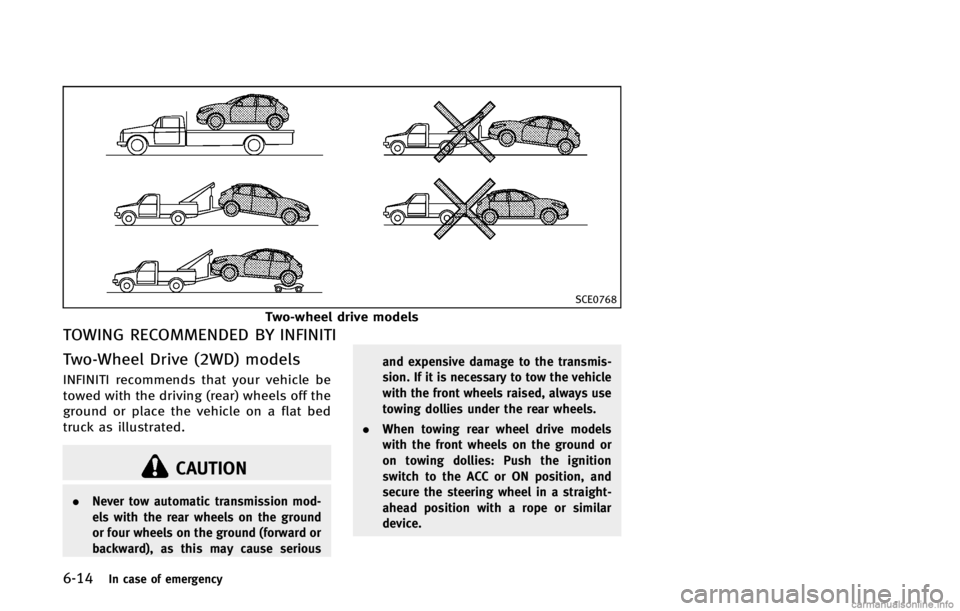
TOWING RECOMMENDED BY INFINITIGUID-34DF7332-3927-4A5F-A5CB-1643FD04A697
CAUTION
.Never tow automatic transmission mod-
els with the rear wheels on the ground
or four wheels on the ground (forward or
backward), as this may cause serious and expensive damage to the transmis-
sion. If it is necessary to tow the vehicle
with the front wheels raised, always use
towing dollies under the rear wheels.
. When towing rear wheel drive models
with the front wheels on the ground or
on towing dollies: Push the ignition
switch to the ACC or ON position, and
secure the steering wheel in a straight-
ahead position with a rope or similar
device.
Page 427 of 522
6-16In case of emergency
WARNING
.Stand clear of a stuck vehicle.
. Do not spin your tires at high speed. This
could cause them to explode and result
in serious injury. Parts of your vehicle
could also overheat and be damaged.
Pulling a stuck vehicleGUID-39E653E9-900F-47F5-885F-798EB29ECE5A
CAUTION
.Tow chains or cables must be attached
only to the vehicle recovery hooks or
main structural members of the vehicle.
Otherwise, the vehicle body will be
damaged.
. Do not use the vehicle tie downs to free
a vehicle stuck in sand, snow, mud, etc.
. Never tow a vehicle using the vehicle tie
downs or recovery hooks.
. Always pull the cable straight out from
the front of the vehicle. Never pull on the
vehicle at an angle.
. Pulling devices should be routed so they
do not touch any part of the suspension,
steering, brake or cooling systems.
. Pulling devices such as ropes or canvas
straps are not recommended for use in
vehicle towing or recovery.
Rocking a stuck vehicleGUID-05A4E020-4132-4AB9-BB26-7A547032D4A2
Page 498 of 522
WARNING
Overloading or improper loading of a trailer
and its cargo can adversely affect vehicle
handling, braking and performance and may
lead to accidents.
CAUTION
.Do not tow a trailer or haul a heavy load
for the first 500 miles (800 km). Your
engine, axle or other parts could be
damaged.
. For the first 500 miles (800 km) that you
tow a trailer, do not drive over 50 MPH
(80 km/h) and do not make starts at full
throttle. This helps the engine and other
parts of your vehicle wear in at the
heavier loads.
Your new vehicle was designed to be used
primarily to carry passengers and cargo.
Remember that towing a trailer places
additional loads on your vehicle’s engine,
drivetrain, steering, braking and other
systems. An INFINITI Towing Guide (U.S. only) is
available on the website at www.InfinitiU-
SA.com. This guide includes information on
trailer towing capability and the special
equipment required for proper towing.
MAXIMUM LOAD LIMITSGUID-9B8464D7-BFCF-4992-A6FF-2717C900F8FC
Page 499 of 522
9-20Technical and consumer information
STI0541
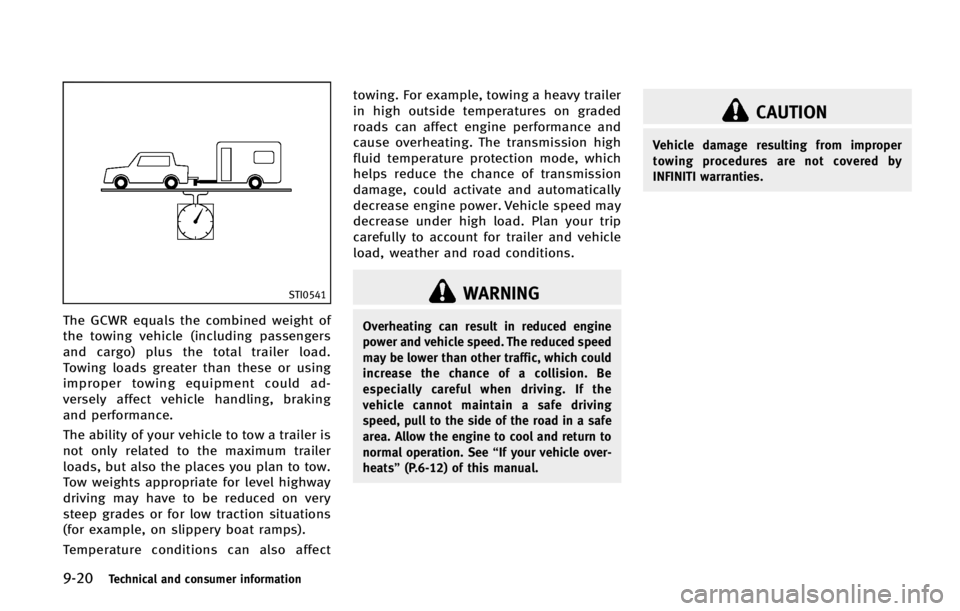
The GCWR equals the combined weight of
the towing vehicle (including passengers
and cargo) plus the total trailer load.
Towing loads greater than these or using
improper towing equipment could ad-
versely affect vehicle handling, braking
and performance.
The ability of your vehicle to tow a trailer is
not only related to the maximum trailer
loads, but also the places you plan to tow.
Tow weights appropriate for level highway
driving may have to be reduced on very
steep grades or for low traction situations
(for example, on slippery boat ramps).
Temperature conditions can also affecttowing. For example, towing a heavy trailer
in high outside temperatures on graded
roads can affect engine performance and
cause overheating. The transmission high
fluid temperature protection mode, which
helps reduce the chance of transmission
damage, could activate and automatically
decrease engine power. Vehicle speed may
decrease under high load. Plan your trip
carefully to account for trailer and vehicle
load, weather and road conditions.
WARNING
Overheating can result in reduced engine
power and vehicle speed. The reduced speed
may be lower than other traffic, which could
increase the chance of a collision. Be
especially careful when driving. If the
vehicle cannot maintain a safe driving
speed, pull to the side of the road in a safe
area. Allow the engine to cool and return to
normal operation. See
“If your vehicle over-
heats” (P.6-12) of this manual.
CAUTION
Vehicle damage resulting from improper
towing procedures are not covered by
INFINITI warranties.
Page 501 of 522

9-22Technical and consumer information
available maximum tongue load.
To determine the available towing capacity,
use the following procedure.
1. Find the GCWR for your vehicle on the “Towing Load/Specification” chart
found later in this section.
2. Subtract the actual vehicle weight from the GCWR. The remaining amount is the
available maximum towing capacity.
To determine the Gross Trailer Weight,
weigh your trailer on a scale with all
equipment and cargo, that are normally
in the trailer when it is towed. Make sure
the Gross trailer weight is not more than
the Gross Trailer Weight Rating shown on
the trailer and is not more than the
calculated available maximum towing ca-
pacity.
Also weigh the front and rear axles on the
scale to make sure the Front Gross Axle
Weight and Rear Gross Axle Weight are not
more than Front Gross Axle Weight and
Rear Gross Axle Weight on the F.M.V.S.S./C.
M.V.S.S. certification label. The cargo in the
trailer and vehicle may need to be moved
or removed to meet the specified ratings. Example:
.
Gross Vehicle Weight (GVW) as weighed
on a scale - including passengers,
cargo and hitch - 5,073 lb. (2,301 kg).
. Gross Vehicle Weight Rating (GVWR)
from F.M.V.S.S./C.M.V.S.S. certification
label - 5,301 lb. (2,404 kg).
. Gross Combined Weight Rating (GCWR)
from “Towing Load/Specification” chart
- 7,355 lb. (3,336 kg).
. Maximum Trailer towing capacity from
“Towing Load/Specification” chart -
2,000 lb. (907 kg).
5,301 lb. (2,404 kg) GVWR
− 5,073 lb. (2,301 kg) GVW
= 228 lb. (103 kg) Available for tongue
weight
7,355 lb. (3,336 kg) GCWR
− 5,073 lb. (2,301 kg) GVW
= 2,282 lb. (1,035 kg) Capacity available for
towing
228 lb. (103 kg) / Available tongue weight
2,282 lb. (1,035 kg) Available capacity = 10 % tongue weight
The available towing capacity may be less
than the maximum towing capacity due to the passenger and cargo load in the
vehicle.
Remember to keep trailer tongue weight
between 10 to 15% of the trailer weight. If
the tongue load becomes excessive, re-
arrange the cargo to obtain the proper
tongue load. Do not exceed the 10 to 15%
tongue weight specification even if the
calculated available tongue weight is
greater than 15%. If the calculated tongue
weight is less than 10%, reduce the total
trailer weight to match the available
tongue weight.
Always verify that available capacities are
within the required ratings.