flat tire INFINITI G-CONVERTIBLE 2012 Owner's Manual
[x] Cancel search | Manufacturer: INFINITI, Model Year: 2012, Model line: G-CONVERTIBLE, Model: INFINITI G-CONVERTIBLE 2012Pages: 474, PDF Size: 3.63 MB
Page 426 of 474
GUID-1FF8645E-BD26-49E1-8ACE-3D93C44CADF6If you have a flat tire, see“Flat tire”(P.6-
2).
TIRE PRESSUREGUID-BDD15B46-98E3-4A60-8D4D-2328B8986E37
Tire Pressure Monitoring System
(TPMS)
GUID-92F1DBE9-C4EF-4679-8E12-AEDD5231258DThis vehicle is equipped with the Tire
Pressure Monitoring System (TPMS). It
monitors tire pressure of all tires except
the spare. When the low tire pressure
warning light is lit and the CHECK TIRE
PRESSURE warning appears on the dot
matrix liquid crystal display, one or more
of your tires is significantly under-inflated.
The TPMS will activate only when the
vehicle is driven at speeds above 16 MPH
(25 km/h). Also, this system may not
detect a sudden drop in tire pressure (for
example a flat tire while driving).
For more details, see “Low tire pressure
warning light” (P.2-12),“Tire Pressure
Monitoring System (TPMS)” (P.5-4) and
“Tire Pressure Monitoring System (TPMS)”
(P.6-2).
Tire inflation pressureGUID-1E5BCB99-CF5B-436E-822C-36E9EA89ED84Check the pressure of the tires
(including the spare) often and al- ways prior to long distance trips. The
recommended tire pressure specifi-
cations are shown on the Tire and
Loading Information label under the
“Cold Tire Pressure”
heading. The
Tire and Loading Information label is
affixed to the driver side center pillar.
Tire pressures should be checked
regularly because:
.Most tires naturally lose air over time.
.Tires can lose air suddenly whendriven over potholes or other
objects or if the vehicle strikes a
curb while parking.
The tire pressures should be checked
when the tires are cold. The tires are
considered COLD after the vehicle
has been parked for 3 or more hours,
or driven less than 1 mile (1.6 km) at
moderate speeds.
Incorrect tire pressure, including
under inflation, may adversely affect
tire life and vehicle handling.
WARNING
. Improperly inflated tires can fail
suddenly and cause an accident.
. The Gross Vehicle Weight rating
(GVWR) is located on the F.M.V.S.
S./C.M.V.S.S. label. The vehicle
weight capacity is indicated on
the Tire and Loading Information
label. Do not load your vehicle
beyond this capacity. Overloading
your vehicle may result in reduced
tire life, unsafe operating condi-
tions due to premature tire failure,
or unfavorable handling character-
istics and could also lead to a
serious accident. Loading beyond
the specified capacity may also
result in failure of other vehicle
components.
. Before taking a long trip, or
whenever you heavily load your
vehicle, use a tire pressure gauge
to ensure that the tire pressures
Maintenance and do-it-yourself8-29
WHEELS AND TIRES
Page 427 of 474
8-30Maintenance and do-it-yourself
are at the specified level.
. For additional information regard-
ing tires, refer to “Important Tire
Safety Information ”(US) or “Tire
Safety Information ”(Canada) in
the Warranty Information Booklet.
SDI2720
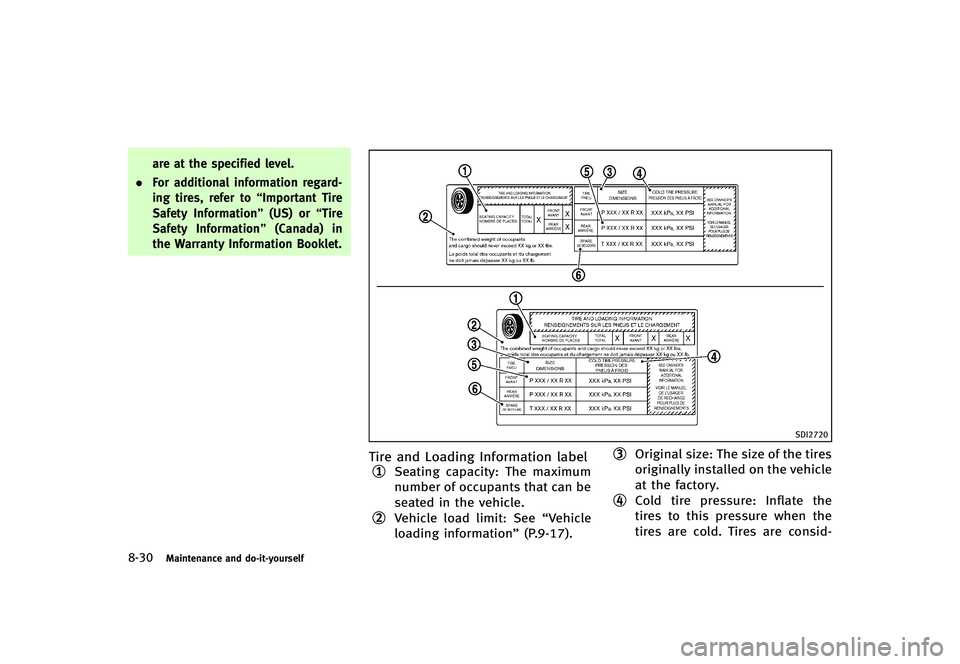
Tire and Loading Information labelGUID-0CCE6085-7E8E-4C48-ABCC-DBD2555096F8*1Seating capacity: The maximum
number of occupants that can be
seated in the vehicle.
*2Vehicle load limit: See “Vehicle
loading information” (P.9-17).
*3Original size: The size of the tires
originally installed on the vehicle
at the factory.
*4Cold tire pressure: Inflate the
tires to this pressure when the
tires are cold. Tires are consid-
Page 428 of 474
ered COLD after the vehicle has
been parked for 3 or more hours,
or driven less than 1 mile (1.6
km) at moderate speeds. The
recommended cold tire inflation
is set by the manufacturer to
provide the best balance of tire
wear, vehicle handling, driveabil-
ity, tire noise, etc., up to the
vehicle’s GVWR.
*5Tire size—see “Tire labeling”
(P.8-32).
*6Spare tire size or compact spare
tire size (if so equipped)
SDI1949
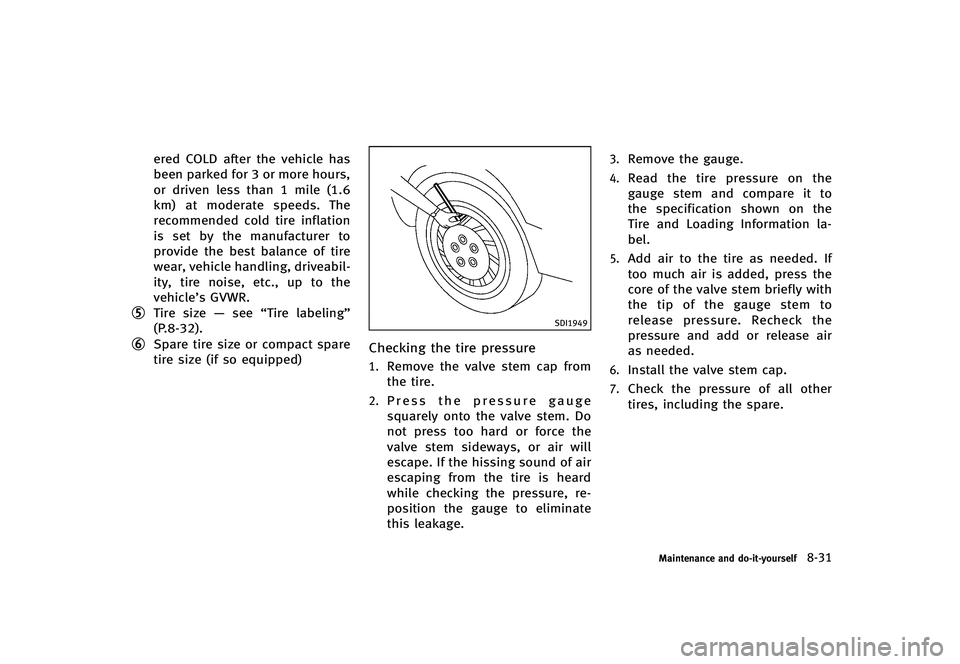
Checking the tire pressureGUID-6180484A-6593-4643-801D-6889016CD8CA1.Remove the valve stem cap from
the tire.
2.Press the pressure gauge
squarely onto the valve stem. Do
not press too hard or force the
valve stem sideways, or air will
escape. If the hissing sound of air
escaping from the tire is heard
while checking the pressure, re-
position the gauge to eliminate
this leakage.
3.Remove the gauge.
4.Read the tire pressure on the
gauge stem and compare it to
the specification shown on the
Tire and Loading Information la-
bel.
5.Add air to the tire as needed. If
too much air is added, press the
core of the valve stem briefly with
the tip of the gauge stem to
release pressure. Recheck the
pressure and add or release air
as needed.
6.Install the valve stem cap.
7.Check the pressure of all other
tires, including the spare.
Maintenance and do-it-yourself8-31
Page 429 of 474

8-32Maintenance and do-it-yourself
SIZECOLD TIRE
INFLATION
PRESSURE
FRONT
ORIGINAL TIRE 225/45R19 96W
XL
270 kPa,
39 PSI
P225/50R18 94V 260 kPa,
38 PSI
REAR ORI-
GINAL TIRE 245/40R19 98W
XL
270 kPa,
39 PSI
P245/45R18 96V 260 kPa,
38 PSI
SPARE TIRE T145/70D18
107M 420 kPa,
60PSI
SDI1575
Example
TIRE LABELINGGUID-C591E2BD-CAF2-47B8-A4FE-A6CF0FC5130AFederal law requires tire manufac-
turers to place standardized informa-
tion on the sidewall of all tires. This
information identifies and describes
the fundamental characteristics of
the tire and also provides the tire
identification number (TIN) for safety
standard certification. The TIN can be
used to identify the tire in case of a
recall.
SDI1606
Example*1Tire size (example: P215/60R16
94H)
1.P: The
“P”indicates the tire is
designed for passenger vehicles.
(Not all tires have this informa-
tion.)
2.Three-digit number (215): This
number gives the width in milli-
meters of the tire from sidewall
edge to sidewall edge.
3.Two-digit number (60): This num-
ber, known as the aspect ratio,
Page 430 of 474

gives the tire’s ratio of height to
width.
4.R: The“R”stands for radial.
5.Two-digit number (16): This num-
ber is the wheel or rim diameter in
inches.
6.Two- or three-digit number (94):
This number is the tire’s load
index. It is a measurement of
how much weight each tire can
support. You may not find this
information on all tires because it
is not required by law.
7.H: Tire speed rating. You should
not drive the vehicle faster than
the tire speed rating.
SDI1607
Example*2TIN (Tire Identification Number)
for a new tire (example: DOT XX XX
XXX XXXX)
1.DOT: Abbreviation for the “Depart-
ment of Transportation”. The sym-
bol can be placed above, below or
to the left or right of the Tire
Identification Number.
2.Two-digit code: Manufacturer’s
identification mark
3.Two-digit code: Tire size
4.Three-digit code: Tire type code
(Optional)
5.Three-digit code: Date of Manu-
facture
6.Four numbers represent the week
and year the tire was built. For
example, the numbers 3103
means the 31st week of 2003. If
these numbers are missing, then
look on the other sidewall of the
tire.
*3Tire ply composition and materi-
al
The number of layers or plies of
rubber-coated fabric in the tire.
Tire manufacturers also must
indicate the materials in the tire,
which include steel, nylon,
polyester, and others.
*4Maximum permissible inflation
pressure
This number is the greatest
amount of air pressure that
should be put in the tire. Do
not exceed the maximum per-
Maintenance and do-it-yourself8-33
Page 431 of 474
8-34Maintenance and do-it-yourself
missible inflation pressure.
*5Maximum load rating
This number indicates the max-
imum load in kilograms and
pounds that can be carried by
the tire. When replacing the tires
on the vehicle, always use a tire
that has the same load rating as
the factory installed tire.
*6Term of“tubeless” or“tube
type”
Indicates whether the tire re-
quires an inner tube (“tube
type”) or not (“tubeless”).
*7The word “radial”
The word “radial”is shown, if
the tire has radial structure.
*8Manufacturer or brand name
Manufacturer or brand name is
shown.
Other tire-related terminology:
In addition to the many terms that
are defined throughout this section,
Intended Outboard Sidewall is (1) the
sidewall that contains a whitewall, bears white lettering or bears manu-
facturer, brand and/or model name
molding that is higher or deeper than
the same molding on the other side-
wall of the tire, or (2) the outward
facing sidewall of an asymmetrical
tire that has a particular side that
must always face outward when
mounted on a vehicle.
TYPES OF TIRESGUID-0F3309CD-2C8B-4C37-9605-B2B74CF8D48F
WARNING
.
When changing or replacing tires, be
sure all four tires are of the same type
(Example: Summer, All Season or Snow)
and construction. An INFINITI retailer
may be able to help you with information
about tire type, size, speed rating and
availability.
. Replacement tires may have a lower
speed rating than the factory equipped
tires, and may not match the potential
maximum vehicle speed. Never exceed
the maximum speed rating of the tire.
. Replacing tires with those not originally specified by INFINITI could affect the
proper operation of the TPMS.
. For additional information regarding
tires, refer to “Important Tire Safety
Information” (US) or“Tire Safety Infor-
mation” (Canada) in the Warranty Infor-
mation Booklet.
All season tiresGUID-AA383A95-D373-488B-A8E8-CDBF6791B263INFINITI specifies all season tires on some
models to provide good performance all
year, including snowy and icy road condi-
tions. All Season tires are identified by ALL
SEASON and/or M&S (Mud and Snow) on
the tire sidewall. Snow tires have better
snow traction than All Season tires and
may be more appropriate in some areas.
Summer tiresGUID-B04DEE83-96EC-4740-BF40-CCAB483BBE93INFINITI specifies summer tires on some
models to provide superior performance on
dry roads. Summer tire performance is
substantially reduced in snow and ice.
Summer tires do not have the tire traction
rating M&S on the tire sidewall.
If you plan to operate your vehicle in snowy
or icy conditions, INFINITI recommends the
use of SNOW tires or ALL SEASON tires on
Page 433 of 474
8-36Maintenance and do-it-yourself
WARNING
.Retighten the wheel nuts when
the vehicle has been driven for
600 miles (1,000 km) (also in
cases of a flat tire, etc.).
. For additional information regard-
ing tires, refer to “Important Tire
Safety Information ”(US) or “Tire
Safety Information ”(Canada) in
the Warranty Information Booklet.
SDI1663
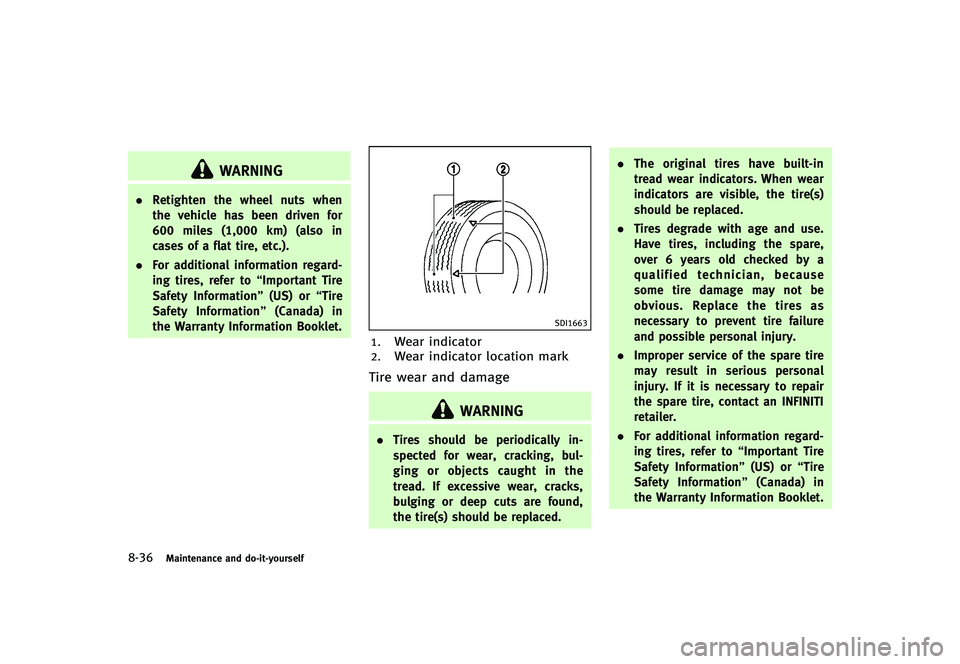
1.Wear indicator
2.Wear indicator location mark
Tire wear and damageGUID-891E5CDD-3EFD-4343-9A6A-FC7B8B88A29B
WARNING
. Tires should be periodically in-
spected for wear, cracking, bul-
ging or objects caught in the
tread. If excessive wear, cracks,
bulging or deep cuts are found,
the tire(s) should be replaced. .
The original tires have built-in
tread wear indicators. When wear
indicators are visible, the tire(s)
should be replaced.
. Tires degrade with age and use.
Have tires, including the spare,
over 6 years old checked by a
qualified technician, because
some tire damage may not be
obvious. Replace the tires as
necessary to prevent tire failure
and possible personal injury.
. Improper service of the spare tire
may result in serious personal
injury. If it is necessary to repair
the spare tire, contact an INFINITI
retailer.
. For additional information regard-
ing tires, refer to “Important Tire
Safety Information ”(US) or “Tire
Safety Information ”(Canada) in
the Warranty Information Booklet.
Page 435 of 474
8-38Maintenance and do-it-yourself
.INFINITI recommends that the road
wheels be waxed to protect against
road salt in areas where it is used
during winter.
Spare tire (TEMPORARY USE ONLY
(T-type) spare tire) (if so equipped)
GUID-B42A4A7B-879D-4F0E-A902-69FB4ABCC6B8Observe the following precautions if the T-
type spare tire must be used, otherwise
your vehicle could be damaged or involved
in an accident.
WARNING
. The T-type spare tire should be used for
emergency use. It should be replaced
with the standard tire at the first
opportunity to avoid possible tire or
differential damage.
. Drive carefully while the TEMPORARY
USE ONLY spare tire is installed. Avoid
sharp turns and abrupt braking while
driving.
. Periodically check spare tire inflation
pressure. Always keep the pressure of
the TEMPORARY USE ONLY spare tire at
60 psi (420 kPa, 4.2 bar). Always keep
the pressure of the full size spare tire (if
so equipped) at the recommended pres- sure for standard tires, as indicated on
the Tire and Loading Information label.
For Tire and Loading Information label
location, see
“Tire and Loading Informa-
tion label” in the index of this manual.
. With the TEMPORARY USE ONLY spare
tire installed do not drive your vehicle at
speeds faster than 50 MPH (80 km/h).
. When driving on roads covered with
snow or ice, the TEMPORARY USE ONLY
spare tire should be used on the front
wheels and original tire used on the rear
wheels (drive wheels). Use tire chains
only on the two rear original tires.
. Tire tread of the TEMPORARY USE ONLY
spare tire will wear at a faster rate than
the standard tire. Replace the spare tire
as soon as the tread wear indicators
appear.
. Do not use the spare tire on other
vehicles.
. Do not use more than one spare tire at
the same time.
CAUTION
.Do not use tire chains on a TEMPORARY
USE ONLY spare tire. Tire chains will not
fit properly and may cause damage to
the vehicle.
. Because the TEMPORARY USE ONLY
spare tire is smaller than the original
tire, ground clearance is reduced. To
avoid damage to the vehicle, do not
drive over obstacles. Also do not drive
the vehicle through an automatic car
wash since it may get caught.
Emergency tire puncture repair kit
(if so equipped)
GUID-FAD28AE4-EFCF-49D5-B78F-E11D9F52D1B1The emergency tire puncture repair kit
(Emergency Tire Sealant) is supplied with
the vehicle instead of a spare tire. It can be
used to temporarily repair minor tire
punctures.
If possible, have the vehicle towed to a
facility that can repair or replace the flat
tire. Using the emergency tire puncture
repair kit may cause a malfunction of the
tire pressure sensor and cause the low tire
pressure warning light to illuminate.
Page 436 of 474
See“Flat tire” (P.6-2) for more details.
Maintenance and do-it-yourself8-39
Page 438 of 474

9 Technical and consumer information
Capacities and recommended fuel/lubricants...
....... 9-2
Fuel recommendation ...
...................................... 9-4
Engine oil and oil filter recommendation ...
......... 9-6
Air conditioning system refrigerant and
lubricant recommendations ...
............................. 9-7
Specifications ...
...................................................... 9-8
Engine ...
............................................................. 9-8
Wheels and tires ...
............................................. 9-9
Dimensions ...
................................................... 9-10
When traveling or registering your vehicle in
another country ...
................................................. 9-11
Vehicle identification ...
......................................... 9-11
Vehicle Identification Number (VIN) plate ...
....... 9-11
Vehicle identification number
(chassis number) ...
........................................... 9-11
Engine serial number ...
.................................... 9-12
F.M.V.S.S./C.M.V.S.S. certification label ...
.......... 9-12
Emission control information label ...
................ 9-12
Tire and loading information label ...
................. 9-13
Air conditioner specification label ...
.................. 9-13 Installing front license plate
...
.............................. 9-13
Except for Aerodynamic Package models ...
...... 9-14
For Aerodynamic Package models ...
................ 9-16
Vehicle loading information ...
............................... 9-17
Terms ...
.......................................................... 9-17
Vehicle load capacity ...
................................... 9-18
Loading tips ...
................................................. 9-19
Measurement of weights ...
.............................. 9-20
Towing a trailer ...
................................................. 9-20
Flat towing ...
................................................... 9-20
Uniform tire quality grading ...
.............................. 9-21
Treadwear ...
.................................................... 9-21
Traction AA, A, B and C ...
................................ 9-21
Temperature A, B and C ...
............................... 9-21
Emission control system warranty ...
..................... 9-22
Reporting safety defects ...
.................................... 9-22
Readiness for Inspection/Maintenance
(I/M) test ...
.......................................................... 9-23
Event Data Recorders (EDR) ...
............................... 9-24
Owner’s manual/service manual
order information ...
.............................................. 9-24