stop start INFINITI G COUPE 2013 User Guide
[x] Cancel search | Manufacturer: INFINITI, Model Year: 2013, Model line: G COUPE, Model: INFINITI G COUPE 2013Pages: 490, PDF Size: 7.25 MB
Page 332 of 490
GUID-047D7FCF-6A67-40C6-9132-4B63D7D41A18
CAUTION
Do not operate the starter for more than 15
seconds at a time. If the engine does not
start, push the ignition switch to OFF andwait 10 seconds before cranking again,
otherwise the starter could be damaged.
4.
Warm-up
Allow the engine to idle for at least 30
seconds after starting. Do not race the
engine while warming it up. Drive at
moderate speed for a short distance
first, especially in cold weather. In cold
weather, keep the engine running for a
minimum of 2 - 3 minutes before
shutting it off. Starting and stopping
the engine over a short period of time
may make the vehicle more difficult to
start.
VQ37VHR engine: When racing the
engine up to 4,000 rpm or more under
no load condition, the engine will enter
the fuel cut mode.
5. To stop the engine, shift the selector lever to the P (Park) position (AT model)
or move the shift lever to the N
(Neutral) position (MT model), and push
the ignition switch to the OFF position.
NOTE:
Care should be taken to avoid situations
that can lead to potential battery dis-
charge and potential no-start conditions
Starting and driving5-13
STARTING THE ENGINE
Page 335 of 490

5-16Starting and driving
CAUTION
Use this position only when the vehicle is
completely stopped.
R (Reverse):GUID-D73A39BF-43C8-459F-9C24-47B7F579C407
SSD0599
Paddle shifters
Manual shift modeGUID-875ABB95-7928-4B14-8EB9-67413B7B54D8
Page 338 of 490
WARNING
.Do not downshift abruptly on slippery
roads. This may cause a loss of control.
. Do not over-rev the engine when shifting
to a lower gear. This may cause a loss of
control or engine damage.
CAUTION
.Do not rest your foot on the clutch pedal
while driving. This may damage the
clutch.
. Fully depress the clutch pedal before
shifting to help prevent transmission
damage.
. Stop your vehicle completely before
shifting into R (Reverse).
. When the vehicle is stopped for a period
of time, for example at a stop light, shift
to N (Neutral) and release the clutch pedal with the foot brake applied.
Starting and driving5-19
Page 346 of 490
WARNING
.As there is a performance limit to the
distance control function, never rely
solely on the Intelligent Cruise Control
system. This system does not correct
careless, inattentive or absent-minded
driving, or overcome poor visibility in
rain, fog, or other bad weather. Decele-
rate the vehicle speed by depressing the
brake pedal, depending on the distance
to the vehicle ahead and the surround-
ing circumstances in order to maintain a
safe distance between vehicles.
. Although the brake operation is con-
trolled by the system, the system does
not automatically stop the vehicle. If the
vehicle speed falls below approximately
20 MPH (32 km/h), the Intelligent Cruise
Control system is automatically canceled
and a warning chime sounds. (The brake
control is also canceled.) .
The system may not detect the vehicle in
front of you in certain road or weather
conditions. To avoid accidents, never use
the Intelligent Cruise Control system
under the following conditions:
—On roads where the traffic is heavy
or there are sharp curves
—On slippery road surfaces such ason ice or snow, etc.
—During bad weather (rain, fog, snow,
etc.)
When the windshield wiper is oper-
ated at the low speed (LO) or high
speed (HI) position, the Intelligent
Cruise Control system is automati-
cally canceled.
—When strong light (for example, atsunrise or sunset) is directly shining
on the front of the vehicle
—When rain, snow or dirt adhere tothe system sensor
—On steep downhill roads (the vehi-
cle may go beyond the set vehicle
speed and frequent braking may
result in overheating the brakes)
—On repeated uphill and downhill roads
—When traffic conditions make it
difficult to keep a proper distance
between vehicles because of fre-
quent acceleration or deceleration
. In some road or traffic conditions, a
vehicle or object can unexpectedly come
into the sensor detection zone and cause
automatic braking. You may need to
control the distance from other vehicles
using the accelerator pedal. Always stay
alert and avoid using the ICC system
when it is not recommended in this
section.
Starting and driving5-27
Page 357 of 490

5-38Starting and driving
SSD0613D
.The distance to the vehicle ahead will
change according to the vehicle speed.
The higher the vehicle speed, the
longer the distance.
. If the engine is stopped, the set
distance becomes “long”. (Each time
the engine is started, the initial setting becomes
“long”.)
Approach warningGUID-9DF856C8-B8D2-4947-ADDC-8B457BD4AE6E
Page 367 of 490
5-48Starting and driving
GUID-C8DF6266-360E-49F0-8414-C6DFBBF885DB
SD1006MA
WARNING
.Do not stop or park the vehicle over
flammable materials such as dry grass,
waste paper or rags. They may ignite and
cause a fire.
. Never leave the engine running while the
vehicle is unattended.
. Do not leave children unattended inside
the vehicle. They could unknowingly
activate switches or controls. Unat-
tended children could become involved
in serious accidents. .
Safe parking procedures require that
both the parking brake be applied and
the transmission placed into P (Park) for
Automatic Transmission (AT) model or in
an appropriate gear for Manual Trans-
mission (MT) model. Failure to do so
could cause the vehicle to move un-
expectedly or roll away and result in an
accident.
. Make sure the automatic transmission
selector lever has been pushed as far
forward as it can go and cannot be
moved without depressing the foot
brake pedal.
1. Firmly apply the parking brake.
2.Automatic transmission models:
Move the selector lever to the P (Park)
position.
Manual transmission models:
Place the shift lever in the R (Reverse)
gear. When parking on an uphill grade,
place the shift lever in the 1st gear.
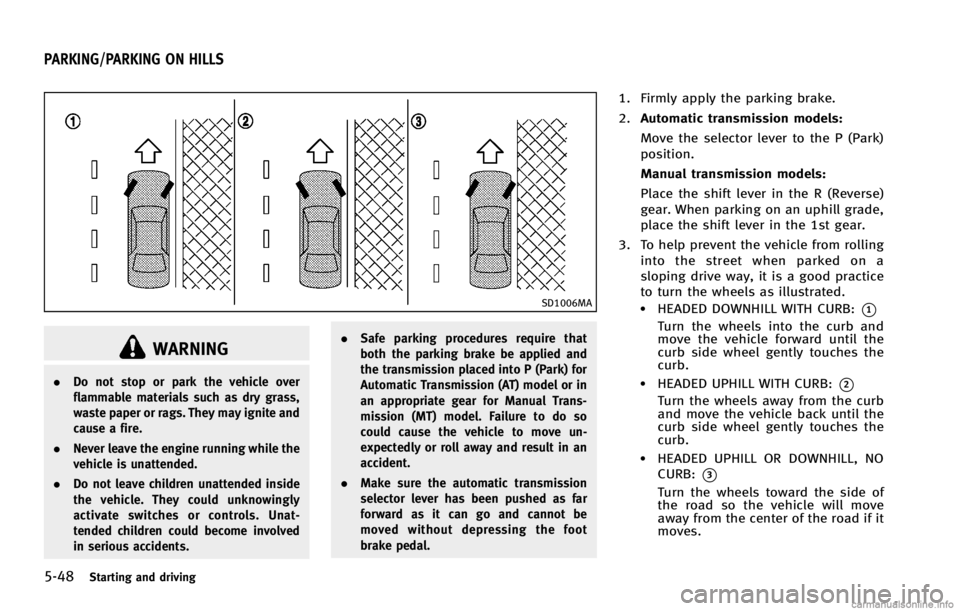
3. To help prevent the vehicle from rolling into the street when parked on a
sloping drive way, it is a good practice
to turn the wheels as illustrated.
.HEADED DOWNHILL WITH CURB:*1
Turn the wheels into the curb and
move the vehicle forward until the
curb side wheel gently touches the
curb.
.HEADED UPHILL WITH CURB:*2
Turn the wheels away from the curb
and move the vehicle back until the
curb side wheel gently touches the
curb.
.HEADED UPHILL OR DOWNHILL, NOCURB:
*3
Turn the wheels toward the side of
the road so the vehicle will move
away from the center of the road if it
moves.
PARKING/PARKING ON HILLS
Page 370 of 490

SSD0929
SONAR SYSTEM OFF SWITCHGUID-446340A3-E5C0-4566-9701-88DF98FE3774
WARNING
If the engine is not running or is turned off
while driving, the power assist for the
steering will not work. Steering will be
harder to operate.
The power assisted steering uses a hy-
draulic pump, driven by the engine, to
assist steering.
If the engine stops or the drive belt breaks,
you will still have control of the vehicle.
However, much greater steering effort is
needed, especially in sharp turns and at
low speeds.
Starting and driving5-51
POWER STEERING
Page 375 of 490

5-56Starting and driving
WARNING
Do not pump the brake pedal. Doing so may
result in increased stopping distances.
Self-test featureGUID-EC96AE96-D9F6-4F19-A5A9-937C4D6337A4
in the instrument panel
VEHICLE DYNAMIC CONTROL (VDC) SYSTEM
Page 387 of 490
6-8In case of emergency
WARNING
.Always make sure that the spare tire and
jacking equipment are properly secured
after use. Such items can become
dangerous projectiles in an accident or
sudden stop.
. The T-type spare tire and small size
spare tire are designed for emergency
use. See specific instructions under the
heading “Wheels and tires” (P.8-34).
If needed, Roadside Assistance is avail-
able. Please see your Warranty Information
Booklet or Roadside Assistance I.D. Card
for the toll-free number to call (U.S.) or
Warranty Information Booklet (Canada).
GUID-AB535234-DC9B-4E72-BAB2-7645DFBFC702
WARNING
.If done incorrectly, jump starting can
lead to a battery explosion, resulting in
severe injury or death. It could also
damage your vehicle.
. Explosive hydrogen gas is always pre-
sent in the vicinity of the battery. Keep
all sparks and flames away from the
battery.
. Do not allow battery fluid to come into
contact with eyes, skin, clothing or
painted surfaces. Battery fluid is a
corrosive sulphuric acid solution which
can cause severe burns. If the fluid
should come into contact with anything,
immediately flush the contacted area
with water.
. Keep the battery out of the reach of
children.
. The booster battery must be rated at 12
volts. Use of an improperly rated battery
can damage your vehicle. .
Whenever working on or near a battery,
always wear suitable eye protectors (for
example, goggles or industrial safety
spectacles) and remove rings, metal
bands, or any other jewelry. Do not lean
over the battery when jump starting.
. Do not attempt to jump start a frozen
battery. It could explode and cause
serious injury.
. Your vehicle has an automatic engine
cooling fan. It could come on at any time.
Keep hands and other objects away from
it.
If needed, Roadside Assistance is avail-
able. Please see your Warranty Information
Booklet or Roadside Assistance I.D. Card
for the toll-free number to call (U.S.) or
Warranty Information Booklet (Canada).
JUMP STARTING
Page 389 of 490
6-10In case of emergency
CAUTION
.Automatic transmission models cannot
be push-started or tow-started. Attempt-
ing to do so may cause transmission
damage.
. Three way catalyst equipped models
should not be started by pushing since
the three way catalyst may be damaged.
. Never try to start the vehicle by towing
it; when the engine starts, the forward
surge could cause the vehicle to collide
with the tow vehicle.
If needed, Roadside Assistance is avail-
able. Please see your Warranty Information
Booklet or Roadside Assistance I.D. Card
for the toll-free number to call (U.S.) or
Warranty & Roadside Assistance Informa-
tion Booklet (Canada).
GUID-4F097083-26E2-4D86-B572-AFD615B83F6E
CAUTION
.Do not continue to drive if your vehicle
overheats. Doing so could cause engine
damage or a vehicle fire.
. To avoid the danger of being scalded,
never remove the radiator cap while the
engine is still hot. When the radiator cap
is removed, pressurized hot water will
spurt out, possibly causing serious
injury.
. Do not open the hood if steam is coming
out.
If your vehicle is overheating (indicated by
an extremely high temperature gauge
reading), or if you feel a lack of engine
power, detect abnormal noise, etc., take
the following steps:
1. Move the vehicle safely off the road,
apply the parking brake and move the
selector lever to the P (Park) position
(Automatic transmission models). Move
the shift lever to the N (Neutral)
position (Manual transmission models).
Do not stop the engine.
2. Turn off the climate control. Open all
PUSH STARTING IF YOUR VEHICLE OVERHEATS