service INFINITI G35 2003 Owner's Manual
[x] Cancel search | Manufacturer: INFINITI, Model Year: 2003, Model line: G35, Model: INFINITI G35 2003Pages: 256, PDF Size: 3.37 MB
Page 229 of 256
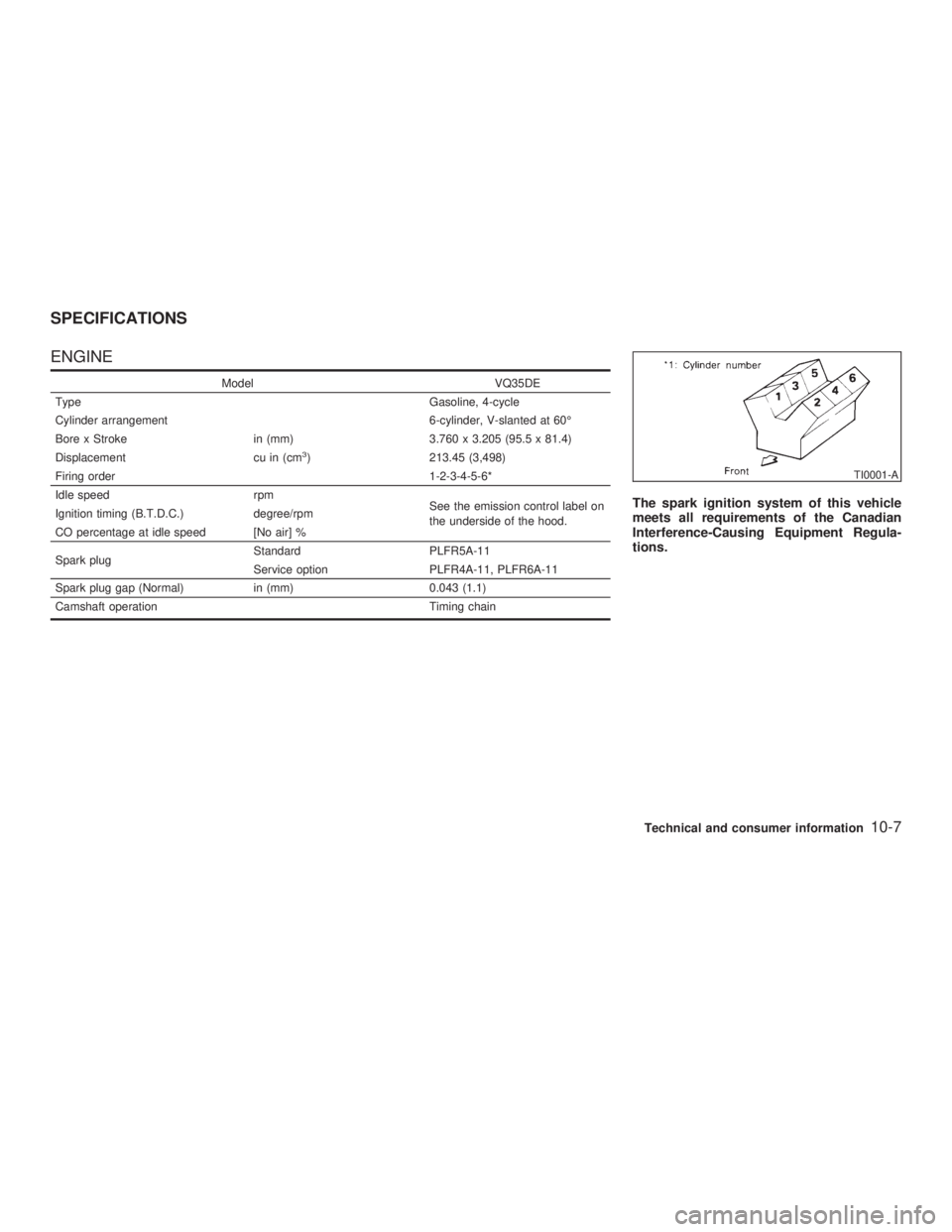
ENGINE Model VQ35DE
Type Gasoline, 4-cycle
Cylinder arrangement 6-cylinder, V-slanted at 60É
Bore x Stroke in (mm) 3.760 x 3.205 (95.5 x 81.4)
Displacement cu in (cm 3
) 213.45 (3,498)
Firing order 1-2-3-4-5-6*
Idle speed rpm
See the emission control label on
the underside of the hood.Ignition timing (B.T.D.C.) degree/rpm
CO percentage at idle speed [No air] %
Spark plug Standard PLFR5A-11
Service option PLFR4A-11, PLFR6A-11
Spark plug gap (Normal) in (mm) 0.043 (1.1)
Camshaft operation Timing chain The spark ignition system of this vehicle
meets all requirements of the Canadian
Interference-Causing Equipment Regula-
tions. TI0001-A
SPECIFICATIONS
Technical and consumer information
10-7
Z 02.7.29/V35-D/V5.0
X
Page 240 of 256

condition; check for improper tongue load,
overload, worn suspension or other pos-
sible causes of either condition.
O Always secure items in the trailer to prevent
load shifts while driving.
O Be certain your rear view mirrors conform to
all federal, state or local regulations. If not,
install any mirrors required for towing be-
fore driving the vehicle.
Trailer towing tips In order to gain skill and an understanding of
the vehicle's behavior, you should practice
turning, stopping and backing up in an area
which is free from traffic. Steering stability, and
braking performance will be somewhat differ-
ent than under normal driving conditions.
O Always secure items in the trailer to prevent
load shift while driving.
O Avoid abrupt starts, acceleration or stops.
O Avoid sharp turns or lane changes.
O Always drive your vehicle at a moderate
speed.
O Always block the wheels on both vehicle
and trailer when parking. Parking on a
slope is not recommended; however, if you
must do so, and if your vehicle is equipped with automatic transmission, first apply the
parking brake and block the wheels, and
then move the transmission selector lever
into the P (Park) position. If you move the
selector lever to the P (Park) position be-
fore blocking the wheels and applying the
parking brake, the transmission may be
damaged.
O When going down a hill, shift into a lower
gear and use the engine braking effect.
When ascending on a long grade, down-
shift the transmission to a lower gear and
reduce speed to reduce chances of engine
overloading and/or overheating.
O If the engine coolant rises to an extremely
high temperature when the air conditioning
system is on, turn off the air conditioner.
Coolant heat can be additionally vented by
opening the windows, switching the fan
control to high and setting the temperature
control to the HOT position.
O Trailer towing consumes more fuel than
normal circumstances.
O Avoid towing a trailer for the first 500 miles
(800 km).
O Have your vehicle serviced more often than
at intervals specified in the recommended
maintenance schedule. O When making a turn, your trailer wheels will
be closer to the inside of the turn than your
vehicle wheels. To compensate for this,
make a larger than normal turning radius
during the turn.
O Crosswinds and rough roads will adversely
affect vehicle/trailer handling, possibly
causing vehicle sway. When being passed
by larger vehicles, be prepared for possible
changes in crosswinds that could affect
vehicle handling. If swaying does occur,
firmly grip the steering wheel, steer straight
ahead, and immediately (but gradually) re-
duce vehicle speed. This combination will
help stabilize the vehicle. Never increase
speed.
O Be careful when passing other vehicles.
Passing while towing a trailer requires con-
siderably more distance than normal pass-
ing. Remember the length of the trailer
must also pass the other vehicle before you
can safely change lanes.
O To maintain engine braking efficiency and
electrical charging performance, do not use
sixth gear (manual transmission) or fifth
position (automatic transmission).
O Avoid holding the brake pedal down too
long or too frequently such as on long
down-hill sections of road. This could cause
10-18 Technical and consumer information
Z 02.7.29/V35-D/V5.0
X
Page 241 of 256

the brakes to overheat, resulting in reduced
braking efficiency. Shift down and use en-
gine braking.
When towing a trailer, change transmission
oil more frequently.
See ªPeriodic maintenance schedulesº in
the ª9. Maintenanceº section. Shift down
and use engine braking. DOT (Department Of Transportation) Quality
Grades: All passenger car tires must conform
to federal safety requirements in addition to
these grades.
Quality grades can be found where applicable
on the tire sidewall between tread shoulder
and maximum section width. For example:
Treadwear 200 Traction AA Temperature A
Treadwear Treadwear grade is a comparative rating
based on tire wear rate when tested under
controlled conditions on specified government
test courses. For example, a tire graded 150
would wear one and a half (1-1/2) times as well
on the government course as a tire graded
100. However, relative tire performance de-
pends on actual driving conditions, and may
vary significantly from the norm due to varia-
tions in driving habits, service practices and
differences in road characteristics and climate.
Traction AA, A, B and C The traction grades, from highest to lowest,
are AA, A, B, and C. Those grades represent
the tire's ability to stop on wet pavement as
measured under controlled conditions on
specified government test surfaces of asphalt and concrete. A tire marked C may have poor
traction performance.
WARNING The traction grade assigned to your ve-
hicle tires is based on straight-ahead
braking traction tests, and does not in-
clude acceleration, cornering, hydro-
planing, or peak traction characteristics.
Temperature A, B and C Temperature grades are A (the highest), B,
and C. They represent a tire's resistance to
heat build-up, and its ability to dissipate heat
when tested under controlled conditions on a
specified indoor laboratory test wheel. Sus-
tained high temperature can cause tire mate-
rial to degenerate, reducing tire life. Excessive
temperatures can lead to sudden tire failure.
Grade C corresponds to a performance level
which all passenger car tires must meet under
the Federal Motor Vehicle Safety Standard No.
109. Grades A and B represent higher levels of
performance on laboratory test wheels than
the minimum required by law.UNIFORM TIRE QUALITY
GRADING
Technical and consumer information
10-19
Z 02.7.29/V35-D/V5.0
X
Page 244 of 256

A genuine INFINITI Service Manual is the best
source of service and repair information for
your vehicle. Filled with wiring diagrams, illus-
trations and step-by-step diagnostic and ad-
justment procedures, this manual is the same
one used by the factory trained technicians
working at authorized INFINITI dealerships.
Also available are genuine INFINITI Owner's
Manuals, and genuine INFINITI Service and
Owner's Manuals for older INFINITI models.
In the USA:
For current pricing and availability of genuine
INFINITI Service Manuals for the 2000 model
year and later, contact:
Tweddle Litho Company
1-800-639-8841
www.nissan-techinfo.com
For current pricing and availability of genuine
INFINITI Service Manuals for the 1999 model
year and prior, see an authorized INFINITI
dealer, or contact:
DDS Distribution Services, Ltd.
20770 Westwood Road
Strongsville, OH 44136
1-800-247-5321
For current pricing and availability of genuine
INFINITI Owner's Manuals for the 2003
model year and prior, see an authorized INFINITI dealer, or contact:
DDS Distribution Services, Ltd.
20770 Westwood Road
Strongsville, OH 44136
1-800-247-5321
In Canada:
To purchase a copy of a genuine INFINITI
Service Manual or Owner's Manual please
contact your nearest INFINITI dealer. For the
phone number and location of an INFINITI
dealer in your area call the INFINITI Satisfac-
tion Center at 1-800-361-4792 and a bilingual
INFINITI representative will assist you.
Also available are genuine INFINITI Service
and Owner's Manuals for older INFINITI mod-
els.
IN THE EVENT OF A COLLISION Unfortunately, accidents do occur. In this un-
likely event, there is some important informa-
tion you should know. Many insurance compa-
nies routinely authorize the use of non-
genuine collision parts in order to cut costs,
among other reasons.
Insist on the use of Genuine Infiniti
Collision Parts! If you want your vehicle to be restored using parts made to INFINITI's original exacting
specifications Ð if you want to help it to last
and hold its resale value, the solution is
simple. Tell your insurance agent and your
repair shop to only use Genuine Infiniti
Collision Parts. INFINITI does not warrant
non-Infiniti parts, nor does Infiniti's warranty
apply to damage caused by a non-genuine
parts.
Using Genuine Infiniti Parts can help protect
your personal safety, preserve your warranty
protection and maintain the resale value of
your vehicle. And if your vehicle was leased,
using Genuine Infiniti Parts may prevent or
limit unnecessary excess wear and tear ex-
penses at the end of your lease.
INFINITI designs its hoods with crumple zones
to minimize the risk that the hood will penetrate
the windshield of your vehicle in an accident.
Non-genuine (imitation) parts may not provide
such built in safety features. Also, non-genuine
parts often show premature wear, rust and
corrosion.
Why should you take a chance? In over 40 states, the law says you must be
advised if non-genuine parts are used to repair
your vehicle. And some states/provinces have
enacted laws that restrict insurance compa-
nies from authorizing the use of non-genuineOWNER'S MANUAL/SERVICE
MANUAL ORDER INFORMATION
10-22 Technical and consumer information
Z 02.7.29/V35-D/V5.0
X
Page 247 of 256

11 Index A
ABS (Anti-lock brake system) ......................... 5-20
Air bag system, Front (See supplemental front air
bag system) .................................................... 1-17
Air bag warning labels .................................... 1-23
Air bag warning light.............................. 1-23, 2-11
Air cleaner housing filter ................................. 8-16
Air conditioner
Air conditioner operation ............................. 4-3
Air conditioner service ......................... 4-3, 4-6
Air conditioner specification label............ 10-12
Air conditioning system refrigerant and
lubricant recommendations ................ 4-6, 10-6
Dual zone button (if so equipped)............... 4-5
Economical operation (ECON) .................... 4-4
Heater and air conditioner (automatic) ....... 4-3
Microfilter ..................................................... 4-5
Alcohol, drugs and driving ................................ 5-4
Ambient temperature, Air conditioner ............... 4-5
Anchor point locations
Top tether strap ......................................... 1-42
Antenna........................................................... 4-17
Anti-lock Brake System (ABS) ........................ 5-20
Anti-lock brake warning light............................. 2-9
Appearance care
Exterior appearance care ............................ 7-2
Interior appearance care ............................. 7-3
Armrest ............................................................. 1-8 Ashtrays (See cigarette lighter and
ashtray) ........................................................... 2-24
Audible reminders ........................................... 2-13
Audio operation precautions ............................. 4-8
Audio system .................................................... 4-6
Steering audio control ............................... 4-17
Autochanger
Compact Disc (CD) ................................... 4-15
Automatic
Adjusting function (Coupe) ........................ 2-33
Anti-glare inside mirror .............................. 3-17
Automatic transmission fluid (ATF) ............. 8-9
Drive positioner ......................................... 3-19
Driving with automatic transmission .... 5-4, 5-8
Operation (For all door windows or front door
windows).................................................... 2-32
Seat positioner, seat ................................. 3-19
Sunroof ...................................................... 2-33
Transmission selector lever lock
release ....................................................... 5-12
Avoiding collision and rollover .......................... 5-3
B
Battery............................................................. 8-13
Battery saver system................................. 2-18
Battery replacement, (See remote keyless entry
system) ............................................................. 3-8
Before starting the engine ................................ 5-7 Belts (See drive belts) .................................... 8-14
Brake
Anti-lock brake system (ABS) ................... 5-20
Brake and clutch fluid................................ 8-11
Brake booster ............................................ 8-19
Brake fluid ................................................. 8-11
Brake pedal ............................................... 8-18
Brake pedal check..................................... 8-18
Brake system............................................. 5-19
Parking brake check ........................ 5-14, 8-18
Parking brake operation ............................ 5-14
Warning light ............................................... 2-9
Break-in schedule ........................................... 5-17
Bulb check/instrument panel ............................ 2-9
Bulb replacement ............................................ 8-22
C
Cabin air filter ................................................... 4-5
Capacities and recommended fuel/lubricants/
fluid ................................................................. 10-2
Car phone or CB radio ................................... 4-18
Cargo (See vehicle loading information) ........ 2-29
Cargo net ........................................................ 2-29
Cassette player (See audio system) .............. 4-14
Catalytic converter, Three way catalyst............ 5-3
CD care and cleaning ..................................... 4-16
Child restraints ................................................ 1-33
Installation on front passenger seat .......... 1-43
Z 02.7.29/V35-D/V5.0
X