transmission INFINITI G35 2006 Owner's Guide
[x] Cancel search | Manufacturer: INFINITI, Model Year: 2006, Model line: G35, Model: INFINITI G35 2006Pages: 344, PDF Size: 6.81 MB
Page 227 of 344
The full-time all-wheel drive (AWD) system
automatically changes the driving mode. ALL-WHEEL DRIVE (AWD) WARNING
LIGHT The AWD warning light is located on the
instrument panel.
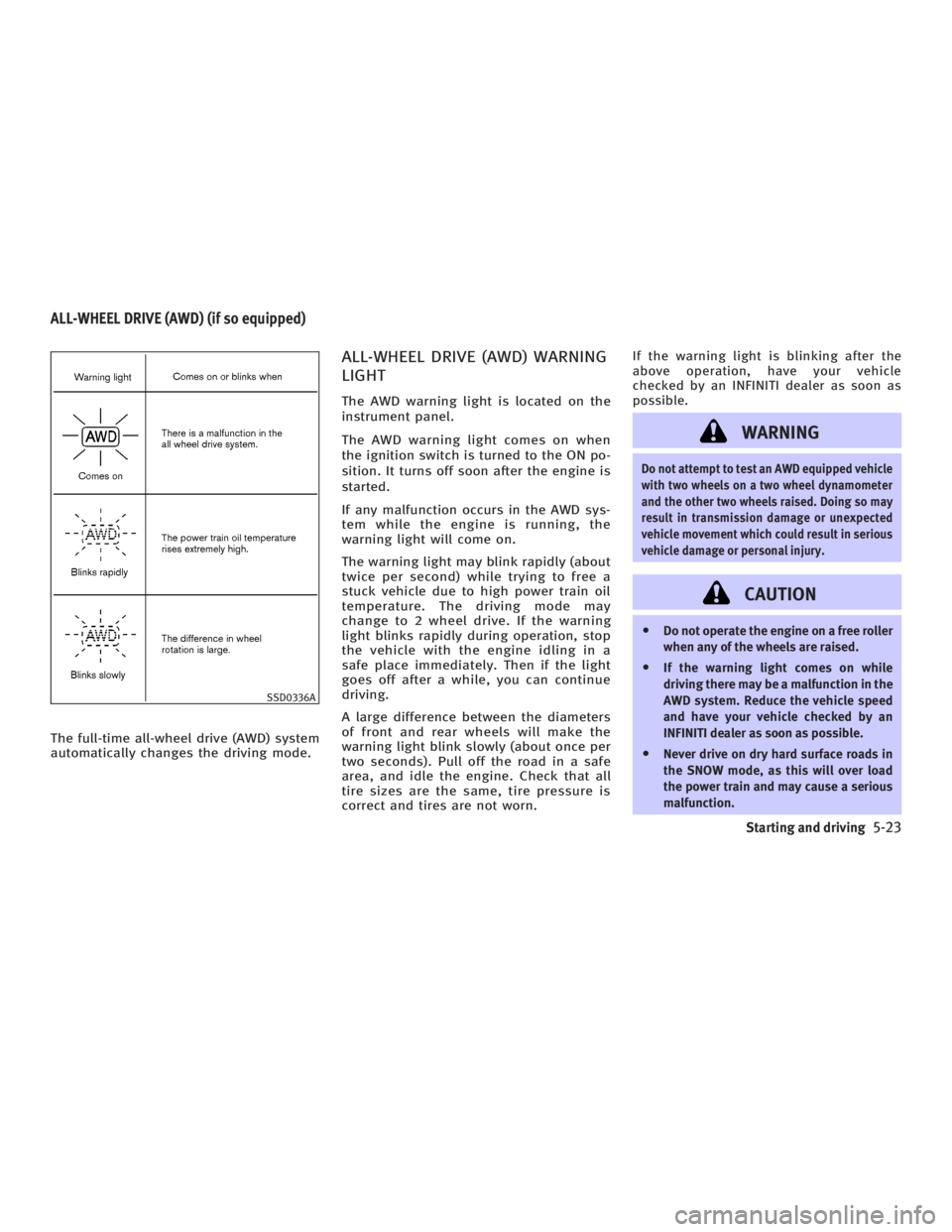
The AWD warning light comes on when
the ignition switch is turned to the ON po-
sition. It turns off soon after the engine is
started.
If any malfunction occurs in the AWD sys-
tem while the engine is running, the
warning light will come on.
The warning light may blink rapidly (about
twice per second) while trying to free a
stuck vehicle due to high power train oil
temperature. The driving mode may
change to 2 wheel drive. If the warning
light blinks rapidly during operation, stop
the vehicle with the engine idling in a
safe place immediately. Then if the light
goes off after a while, you can continue
driving.
A large difference between the diameters
of front and rear wheels will make the
warning light blink slowly (about once per
two seconds). Pull off the road in a safe
area, and idle the engine. Check that all
tire sizes are the same, tire pressure is
correct and tires are not worn. If the warning light is blinking after the
above operation, have your vehicle
checked by an INFINITI dealer as soon as
possible.
WARNING Do not attempt to test an AWD equipped vehicle
with two wheels on a two wheel dynamometer
and the other two wheels raised. Doing so may
result in transmission damage or unexpected
vehicle movement which could result in serious
vehicle damage or personal injury.
CAUTION O Do not operate the engine on a free roller
when any of the wheels are raised.
O If the warning light comes on while
driving there may be a malfunction in the
AWD system. Reduce the vehicle speed
and have your vehicle checked by an
INFINITI dealer as soon as possible.
O Never drive on dry hard surface roads in
the SNOW mode, as this will over load
the power train and may cause a serious
malfunction.SSD0336AALL-WHEEL DRIVE (AWD) (if so equipped)
Starting and driving
5-23
w 06.1.4/V35-D/V5.0
X
Page 228 of 344

O If the warning light remains on after the
above operation, have your vehicle
checked by an INFINITI dealer as soon as
possible.
O The power train may be damaged if you
continue driving with the warning light
blinking rapidly.
WARNING O Do not stop or park the vehicle over flam-
mable materials such as dry grass,
waste paper or rags. They may ignite and
cause a fire.
O Never leave the engine running while the
vehicle is unattended.
O Never leave children unattended inside
the vehicle. O Safe parking procedures require that
both the parking brake be set and the
transmission placed into P (Park).
Failure to do so could cause the vehicle
to move unexpectedly or roll away and
result in an accident.
O Make sure the shift lever has been
pushed as far forward as it can go and
cannot be moved without depressing the
button at the end of the lever. SD1006MA
PARKING/PARKING ON HILLS
5-24 Starting and driving
w 06.1.4/V35-D/V5.0
X
Page 229 of 344
1. Firmly apply the parking brake.
2. Automatic transmission models:
Move the selector lever to the P (Park)
position.
Manual transmission models:
Place the shift lever in the R (Reverse)
position. When parking on an uphill
grade, place the shift lever in the 1
(Low gear) position.
3. To help prevent the vehicle from
rolling into the street when parked on
a sloping drive way, it is a good prac-
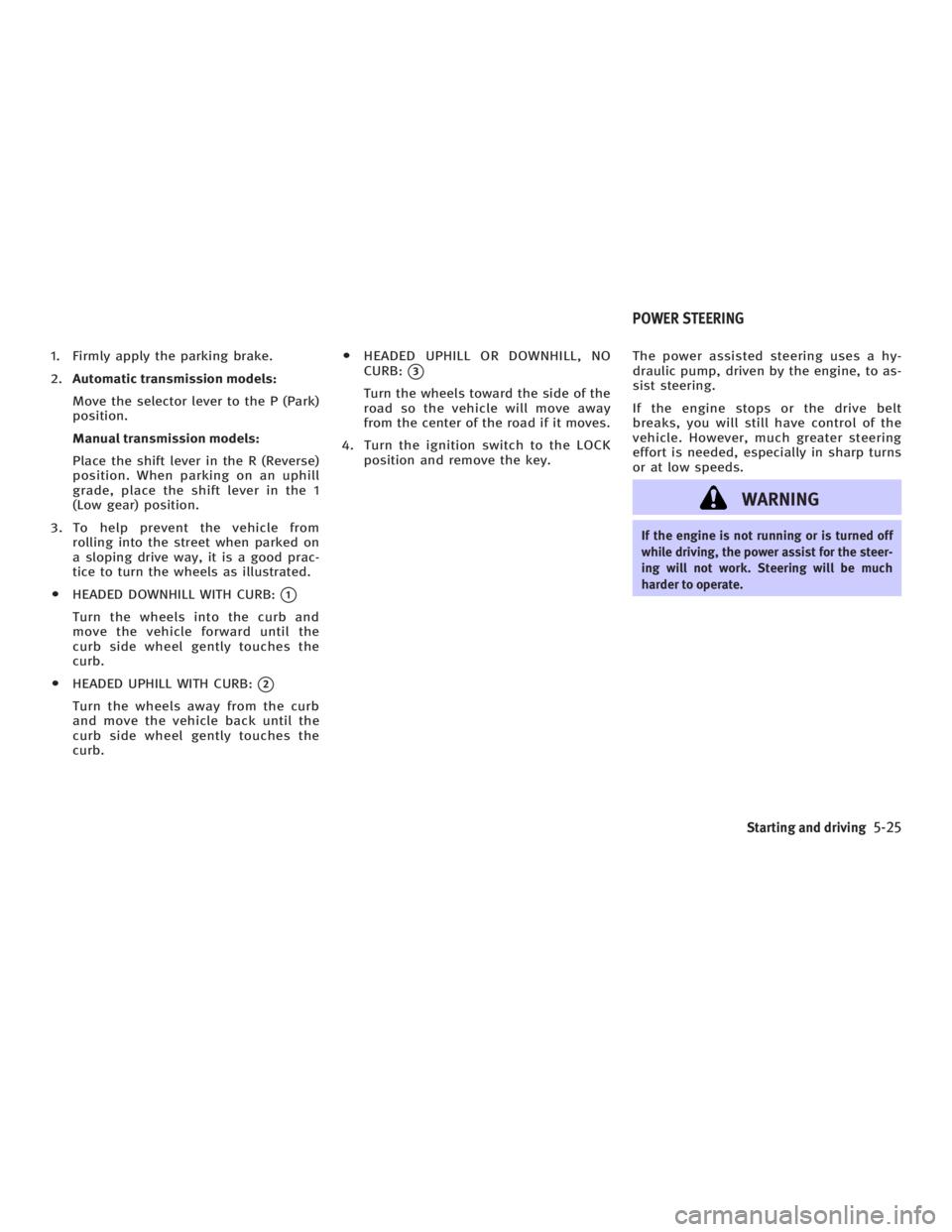
tice to turn the wheels as illustrated.
O HEADED DOWNHILL WITH CURB:
q 1
Turn the wheels into the curb and
move the vehicle forward until the
curb side wheel gently touches the
curb.
O HEADED UPHILL WITH CURB:
q 2
Turn the wheels away from the curb
and move the vehicle back until the
curb side wheel gently touches the
curb. O HEADED UPHILL OR DOWNHILL, NO
CURB:
q 3
Turn the wheels toward the side of the
road so the vehicle will move away
from the center of the road if it moves.
4. Turn the ignition switch to the LOCK
position and remove the key. The power assisted steering uses a hy-
draulic pump, driven by the engine, to as-
sist steering.
If the engine stops or the drive belt
breaks, you will still have control of the
vehicle. However, much greater steering
effort is needed, especially in sharp turns
or at low speeds.
WARNING If the engine is not running or is turned off
while driving, the power assist for the steer-
ing will not work. Steering will be much
harder to operate.POWER STEERING
Starting and driving
5-25
w 06.1.4/V35-D/V5.0
X
Page 239 of 344
Stopping the vehicle 1. Safely move the vehicle off the road
away from traffic.
2. Turn on the hazard warning flashers.
3. Park on a level surface and apply the
parking brake. Shift the manual trans-
mission into the R (Reverse) position
(automatic transmission into the P
(Park) position).
4. Turn off the engine.
5. Raise the hood to warn other traffic,
and to signal professional road assis-
tance personnel that you need assis-
tance.
6. Have all passengers get out of the ve-
hicle and stand in a safe place, away
from traffic and clear of the vehicle.
WARNINGO Make sure the parking brake is securely
applied and the manual transmission is
shifted into R (Reverse), or the automatic
transmission into P (Park). O Never change tires when the vehicle is
on a slope, ice or slippery areas. This is
hazardous.
O Never change tires if oncoming traffic is
close to your vehicle. Wait for profes-
sional road assistance.
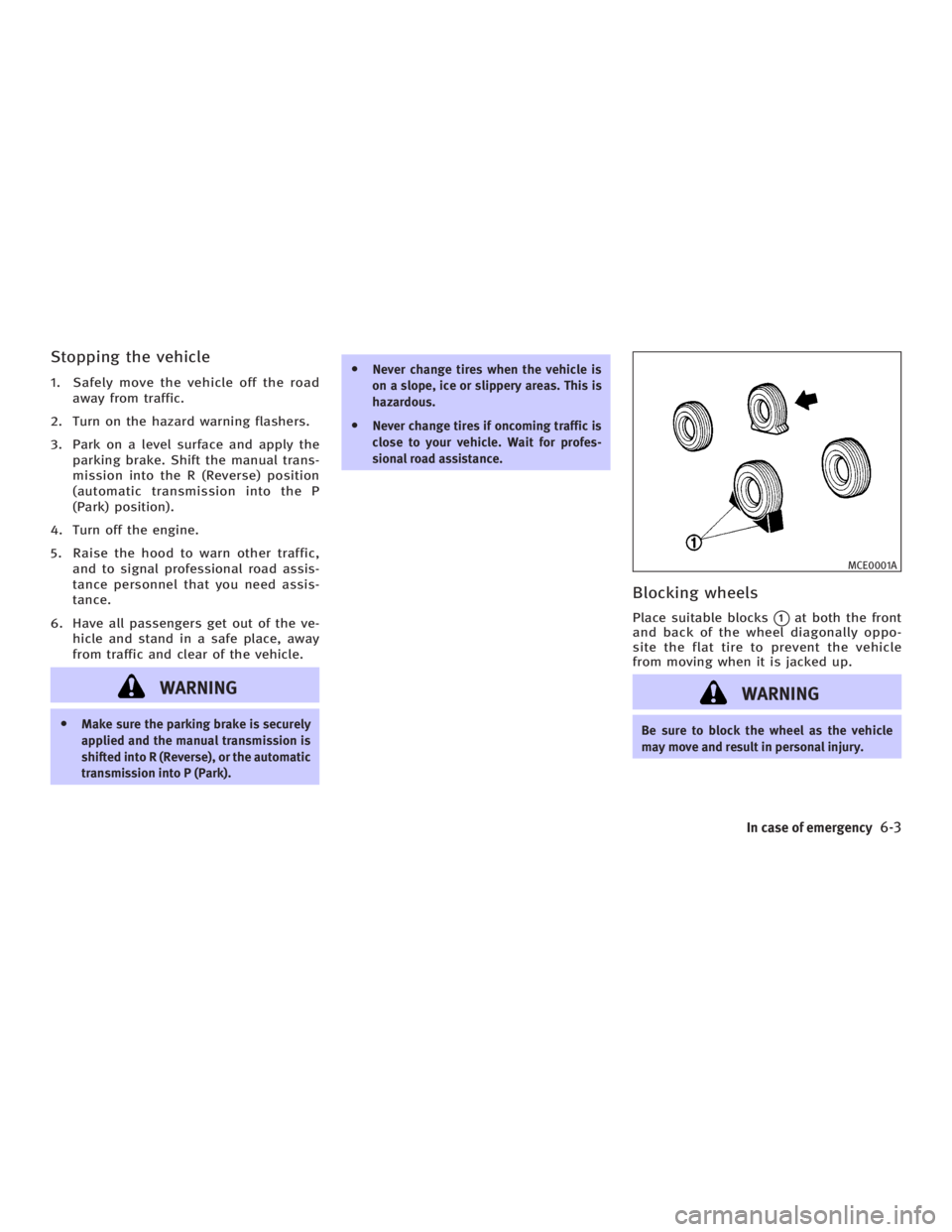
Blocking wheels Place suitable blocks
q 1
at both the front
and back of the wheel diagonally oppo-
site the flat tire to prevent the vehicle
from moving when it is jacked up.
WARNING Be sure to block the wheel as the vehicle
may move and result in personal injury. MCE0001A
In case of emergency
6-3
w 06.1.4/V35-D/V5.0
X
Page 245 of 344

O The booster battery must be rated at 12
volts. Use of an improperly rated battery
can damage your vehicle.
O Whenever working on or near a battery,
always wear suitable eye protectors (for
example, goggles or industrial safety
spectacles) and remove rings, metal
bands, or any other jewelry. Do not lean
over the battery when jump starting.
O Do not attempt to jump start a frozen
battery. It could explode and cause se-
rious injury.
If needed Roadside Assistance is available.
Please see your Warranty Information
Booklet or Roadside Assistance I.D. Card
for the toll-free number to call (U.S.) or War-
ranty Information Booklet (Canada).
WARNING Always follow the instructions below. Failure
to do so could result in damage to the charg-
ing system and cause personal injury.
1. If the booster battery is in another ve-
hicle
q B
, position the two vehicles
q A
and
q B
to bring their batteries into
close proximity to each other.
Do not allow the two vehicles to touch. 2. Apply parking brake. Move the shift
lever to the N (Neutral) position (On
automatic transmission models, move
the selector lever to the P (Park) posi-
tion). Switch off all unnecessary elec-
trical systems (light, heater, air condi-
tioner, etc.).
3. Remove vent caps on the battery (if so
equipped). Cover the battery with an
old cloth to reduce explosion hazard.
4. Connect jumper cables in the se-
quence as illustrated. SCE0539A
In case of emergency
6-9
w 06.1.4/V35-D/V5.0
X
Page 246 of 344

CAUTIONO Always connect positive (+) to positive
(+) and negative (þ) to body ground, not
to the battery.
O Make sure jumper cables do not touch
moving parts in the engine compartment
and that the cable clamps do not contact
any other metal.
5. Start the engine of the other vehicle
q B
and let it run for a few minutes.
6. Keep the engine speed of the other ve-
hicle
q B
at about 2,000 rpm, and start
your engine in the normal manner.
CAUTIONDo not keep the starter motor engaged for
more than 10 seconds. If the engine does not
start right away, turn the key off and wait 3
to 4 seconds before trying again. 7. After starting your engine, carefully
disconnect the negative cable and
then the positive cable.
8. Replace the vent caps (if so equipped).
Be sure to dispose of the cloth used to
cover the vent holes as it may be con-
taminated with corrosive acid. Do not attempt to start the engine by
pushing.
CAUTION Automatic transmission models cannot be
push started. Attempting to do so may cause
transmission damage.
If needed Roadside Assistance is avail-
able. Please see your Warranty Informa-
tion Booklet or Roadside Assistance I.D.
Card for the toll-free number to call (U.S.)
or Warranty Information Booklet (Canada).PUSH STARTING
6-10 In case of emergency
w 06.1.4/V35-D/V5.0
X
Page 247 of 344
WARNINGO Do not continue to drive if your vehicle
overheats. Doing so could cause engine
damage or a vehicle fire.
O To avoid the danger of being scalded,
never remove the radiator cap while the
engine is still hot. When the radiator cap
is removed, pressurized hot water will
spurt out, possibly causing serious in-
jury.
O Do not open the hood if steam is coming
out.
If your vehicle is overheating (indicated
by an extremely high temperature gauge
reading), or if you feel a lack of engine
power, detect abnormal noise, etc., take
the following steps:
1. Move the vehicle safely off the road,
apply the parking brake and move the
shift lever to the N (Neutral) position
(automatic transmission to the P
(Park) position).
Do not stop the engine. 2. Turn off the air conditioner. Open all
the windows, and move the tempera-
ture control to maximum hot and the
fan control to high speed.
3. If engine overheating is caused by
climbing a long hill on a hot day, run
the engine at a fast idle (approximately
1,500 rpm) until the temperature gauge
indication returns to normal.
4. Get out of the vehicle. Look and listen
for steam or coolant escaping from the
radiator before opening the hood. (If
steam or coolant is escaping, turn off
the engine.) Do not open the hood fur-
ther until no steam or coolant can be
seen.
5. Open the engine hood.
WARNING If steam or water is coming from the engine,
stand clear to prevent getting burned.
6. Visually check if the cooling fan is run-
ning. The radiator hoses and radiator
should not leak water. If coolant is
leaking or the cooling fan does not
run, stop the engine. WARNING O Be careful not to allow your hands, hair,
jewelry or clothing to come into contact
with, or to get caught in, the engine
belts or the engine cooling fan.
O The engine cooling fan can start at any
time when the coolant temperature is
high.
7. After the engine cools down, check
the coolant level in the reservoir tank
with the engine running. Add coolant
to the reservoir tank if necessary.
Have your vehicle repaired at an
INFINITI dealer.
If needed, Roadside Assistance is avail-
able. Please see your Warranty Information
Booklet or Roadside Assistance I.D. Card
for the toll-free number to call (U.S.) or War-
ranty Information Booklet (Canada).IF YOUR VEHICLE OVERHEATS
In case of emergency
6-11
w 06.1.4/V35-D/V5.0
X
Page 249 of 344

the ground or place the vehicle on a flat
bed truck as illustrated.
CAUTION O Never tow automatic transmission
models with the rear wheels on the ground or four wheels on the ground
(forward or backward) as this may cause
serious and expensive damage to the
transmission. If it is necessary to tow the
vehicle with the front wheels raised, al-
ways use towing dollies under the rear
wheels.
O When towing rear wheel drive models
with the front wheels on the ground or
on towing dollies:
Turn the ignition key to the OFF position,
and secure the steering wheel in a
straight ahead position with a rope or
similar device. Never secure the steering
wheel by turning the ignition key to the
LOCK position. This may damage the
steering lock mechanism.
O If you have to tow manual transmission
models with the rear wheels on the
ground or four wheels on the ground (if
you do not use towing dollies):
O Always release the parking brake.
O Move the transmission shift lever to
the N (Neutral) position. SCE0387A
Automatic transmission (AT) models
In case of emergency
6-13
w 06.1.4/V35-D/V5.0
X
Page 250 of 344
O Observe the following restricted towing
speeds and distances for manual trans-
mission models only:
Ð Speed: Below 60 MPH (95 km/h)
Ð Distance: Less than 500 miles (800
km)
If the speed or distance must necessarily
be greater, remove the propeller shaft be-
fore towing to prevent damage to the
transmission.
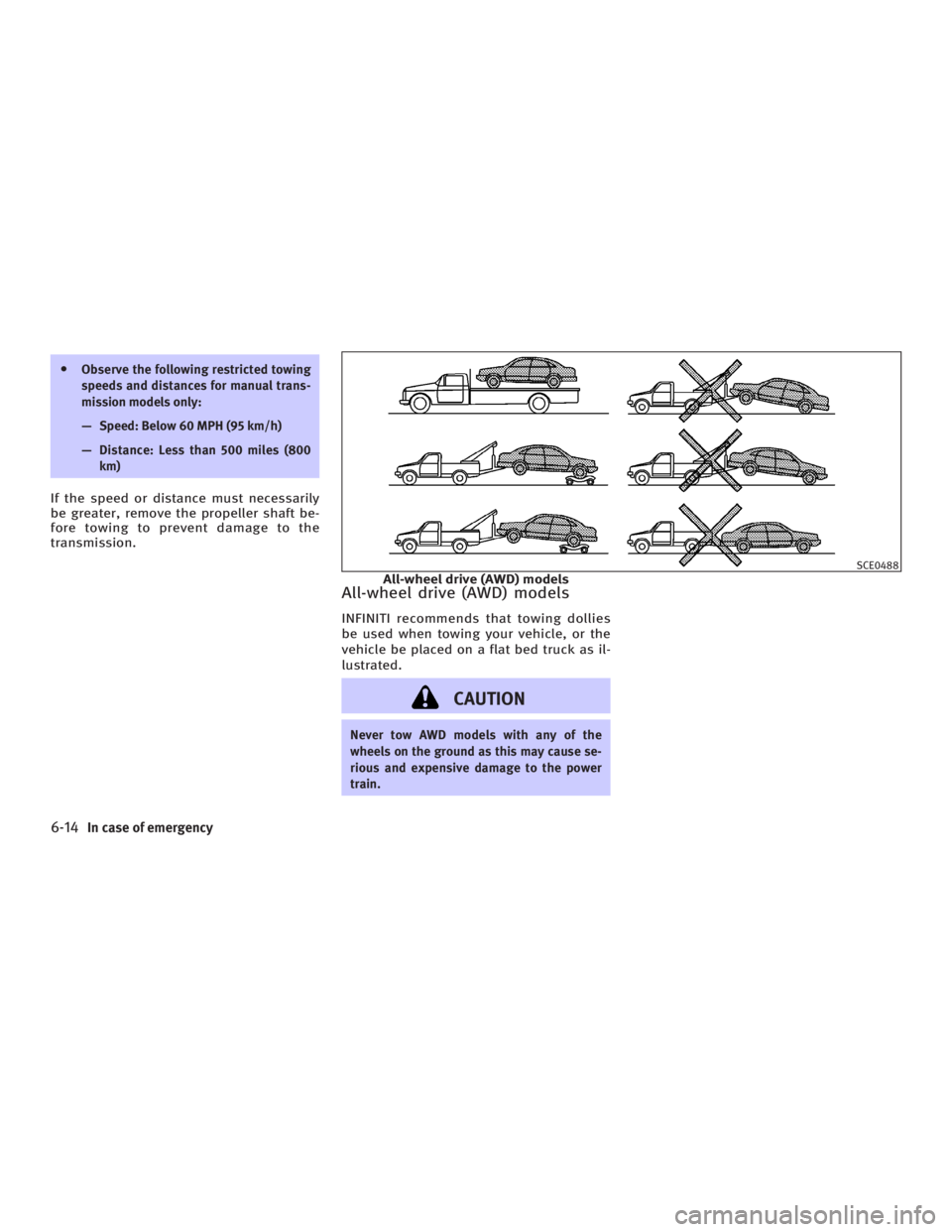
All-wheel drive (AWD) models INFINITI recommends that towing dollies
be used when towing your vehicle, or the
vehicle be placed on a flat bed truck as il-
lustrated.
CAUTION Never tow AWD models with any of the
wheels on the ground as this may cause se-
rious and expensive damage to the power
train. SCE0488
All-wheel drive (AWD) models
6-14 In case of emergency
w 06.1.4/V35-D/V5.0
X
Page 251 of 344
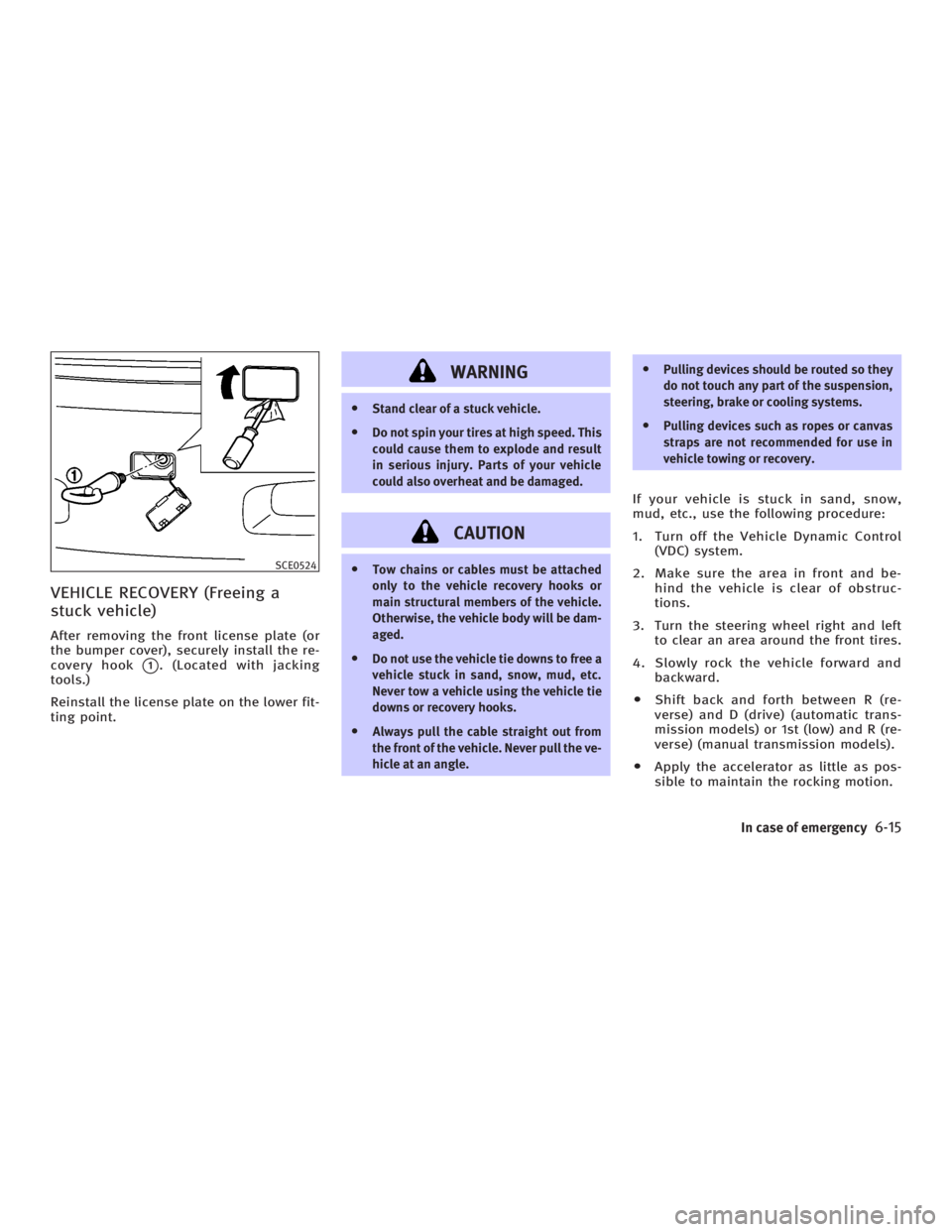
VEHICLE RECOVERY (Freeing a
stuck vehicle) After removing the front license plate (or
the bumper cover), securely install the re-
covery hook
q 1
. (Located with jacking
tools.)
Reinstall the license plate on the lower fit-
ting point. WARNING O Stand clear of a stuck vehicle.
O Do not spin your tires at high speed. This
could cause them to explode and result
in serious injury. Parts of your vehicle
could also overheat and be damaged.
CAUTION O Tow chains or cables must be attached
only to the vehicle recovery hooks or
main structural members of the vehicle.
Otherwise, the vehicle body will be dam-
aged.
O Do not use the vehicle tie downs to free a
vehicle stuck in sand, snow, mud, etc.
Never tow a vehicle using the vehicle tie
downs or recovery hooks.
O Always pull the cable straight out from
the front of the vehicle. Never pull the ve-
hicle at an angle. O Pulling devices should be routed so they
do not touch any part of the suspension,
steering, brake or cooling systems.
O Pulling devices such as ropes or canvas
straps are not recommended for use in
vehicle towing or recovery.
If your vehicle is stuck in sand, snow,
mud, etc., use the following procedure:
1. Turn off the Vehicle Dynamic Control
(VDC) system.
2. Make sure the area in front and be-
hind the vehicle is clear of obstruc-
tions.
3. Turn the steering wheel right and left
to clear an area around the front tires.
4. Slowly rock the vehicle forward and
backward.
O Shift back and forth between R (re-
verse) and D (drive) (automatic trans-
mission models) or 1st (low) and R (re-
verse) (manual transmission models).
O Apply the accelerator as little as pos-
sible to maintain the rocking motion.SCE0524
In case of emergency
6-15
w 06.1.4/V35-D/V5.0
X