ECU INFINITI G35 2006 Workshop Manual
[x] Cancel search | Manufacturer: INFINITI, Model Year: 2006, Model line: G35, Model: INFINITI G35 2006Pages: 344, PDF Size: 6.81 MB
Page 262 of 344
Inside the vehicle The maintenance items listed here should
be checked on a regular basis, such as
when performing periodic maintenance,
cleaning the vehicle, etc.
Accelerator pedal: Check the pedal for
smooth operation and make sure the
pedal does not catch or require uneven
effort. Keep the floor mat away from the
pedal.
Automatic transmission P (Park) mecha-
nism: On a fairly steep hill check that your
vehicle is held securely with the selector
lever in the P (Park) position without ap-
plying any brakes.
Brake pedal*: Check the pedal for smooth
operation and make sure it has the proper
distance under it when depressed fully.
Check the brake booster function. Be sure
to keep the floor mat away from the
pedal.
Brakes: Check that the brakes do not pull
the vehicle to one side when applied.
Parking brake*: Check that the pedal/
lever has the proper travel and confirm
that your vehicle is held securely on a
fairly steep hill with only the parking
brake applied. Seats: Check seat position controls such
as seat adjusters, seatback recliner, etc.
to ensure they operate smoothly and that
all latches lock securely in every position.
Check that the head restraints move up
and down smoothly and that the locks (if
so equipped) hold securely in all latched
positions.
Seat belts: Check that all parts of the seat
belt system (For example, buckles, an-
chors, adjusters and retractors) operate
properly and smoothly, and are installed
securely. Check the belt webbing for cuts,
fraying, wear or damage.
Steering wheel: Check for changes in the
steering conditions, such as excessive
free play, hard steering or strange noises.
Warning lights and chimes: Make sure
that all warning lights and chimes are op-
erating properly.
Windshield defroster: Check that the air
comes out of the defroster outlets prop-
erly and in sufficient quantity when oper-
ating the heater or air conditioner.
Windshield wiper and washer*: Check that
the wipers and washer operate properly
and that the wipers do not streak. Under the hood and the vehicle The maintenance items listed here should
be checked periodically (For example,
each time you check the engine oil or re-
fuel).
Battery*: Check the fluid level in each
cell. It should be between the MAX and
MIN lines. Vehicles operated in high tem-
peratures or under severe conditions re-
quire frequent checks of the battery fluid
level.
Brake and clutch fluid level*: Make sure
that the brake and clutch fluid levels are
between the MAX and MIN lines on the
reservoir.
Engine coolant level*: Check the coolant
level when the engine is cold.
Engine drive belts*: Make sure that no
belt is frayed, worn, cracked or oily.
Engine oil level*: Check the level after
parking the vehicle on a level location
and turning off the engine. (Wait at least
10 minutes for the oil to drain back into
the oil pan.)
Exhaust system: Make sure there are no
loose supports, cracks or holes. If the
sound of the exhaust seems unusual or
8-4 Maintenance and do-it-yourself
w 06.1.4/V35-D/V5.0
X
Page 263 of 344
there is a smell of exhaust fumes, imme-
diately locate the trouble and correct it.
See ªPrecautions when starting and
drivingº in the ª5. Starting and drivingº
section for exhaust gas (Carbon mon-
oxide).
Fluid leaks: Check under the vehicle for
fuel, oil, water or other fluid leaks after
the vehicle has been parked for a while.
Water dripping from the air conditioner
after use is normal. If you should notice
any leaks or if gasoline fumes are evi-
dent, check for the cause and have it cor-
rected immediately.
Power steering fluid level* and lines:
Check the level when the fluid is cold and
the engine is turned off. Check the lines
for proper attachment, leaks, cracks, etc.
Radiator and hoses: Check the front of the
radiator and clean off any dirt, insects,
leaves, etc., that may have accumulated.
Make sure the hoses have no cracks, de-
formation, deterioration or loose connec-
tions.
Underbody: The underbody is frequently
exposed to corrosive substances such as
those used on icy roads or to control
dust. It is very important to remove these
substances, otherwise rust will form on the floor pan, frame, fuel lines and
around the exhaust system. At the end of
winter, the underbody should be thor-
oughly flushed with plain water, being
careful to clean those areas where mud
and dirt may accumulate. For additional
information, see ªCleaning exteriorº in
the ª7. Appearance and careº section.
Windshield washer fluid*: Check that
there is adequate fluid in the tank. When performing any inspection or main-
tenance work on your vehicle, always take
care to prevent serious accidental injury
to yourself or damage to the vehicle. The
following are general precautions which
should be closely observed.
WARNING O Park the vehicle on a level surface, apply
the parking brake securely and block the
wheels to prevent the vehicle from
moving. For a manual transmission,
move the shift lever to N (Neutral) posi-
tion. For an automatic transmission
models, move the selector lever to P
(Park).
O Be sure the ignition key is in the OFF or
LOCK position when performing any
parts replacement or repairs.
O If you must work with the engine run-
ning, keep your hands, clothing, hair
and tools away from moving fans, belts
and any other moving parts.
O It is advisable to secure or remove any
loose clothing and remove any jewelry,MAINTENANCE PRECAUTIONS
Maintenance and do-it-yourself
8-5
w 06.1.4/V35-D/V5.0
X
Page 268 of 344
2. Close the radiator drain plug securely
after the coolant is drained.
3. Fill the radiator slowly with the proper
mixture of antifreeze solution and
demineralized water/distilled water.
Fill the reservoir tank up to the MAX
level. Then install the radiator filler
cap.
4. Start the engine and warm it up until
it reaches normal operating tempera-
ture. Then race the engine 2 or 3 times
under no load. Watch the engine cool-
ant temperature gauge for signs of
overheating.
5. Stop the engine. After it completely
cools down, refill the radiator up to
the filler opening. Fill the reservoir
tank up to the MAX level. Check the
drain plug for any sign of leakage.
6. Check the coolant level again after
driving the vehicle.
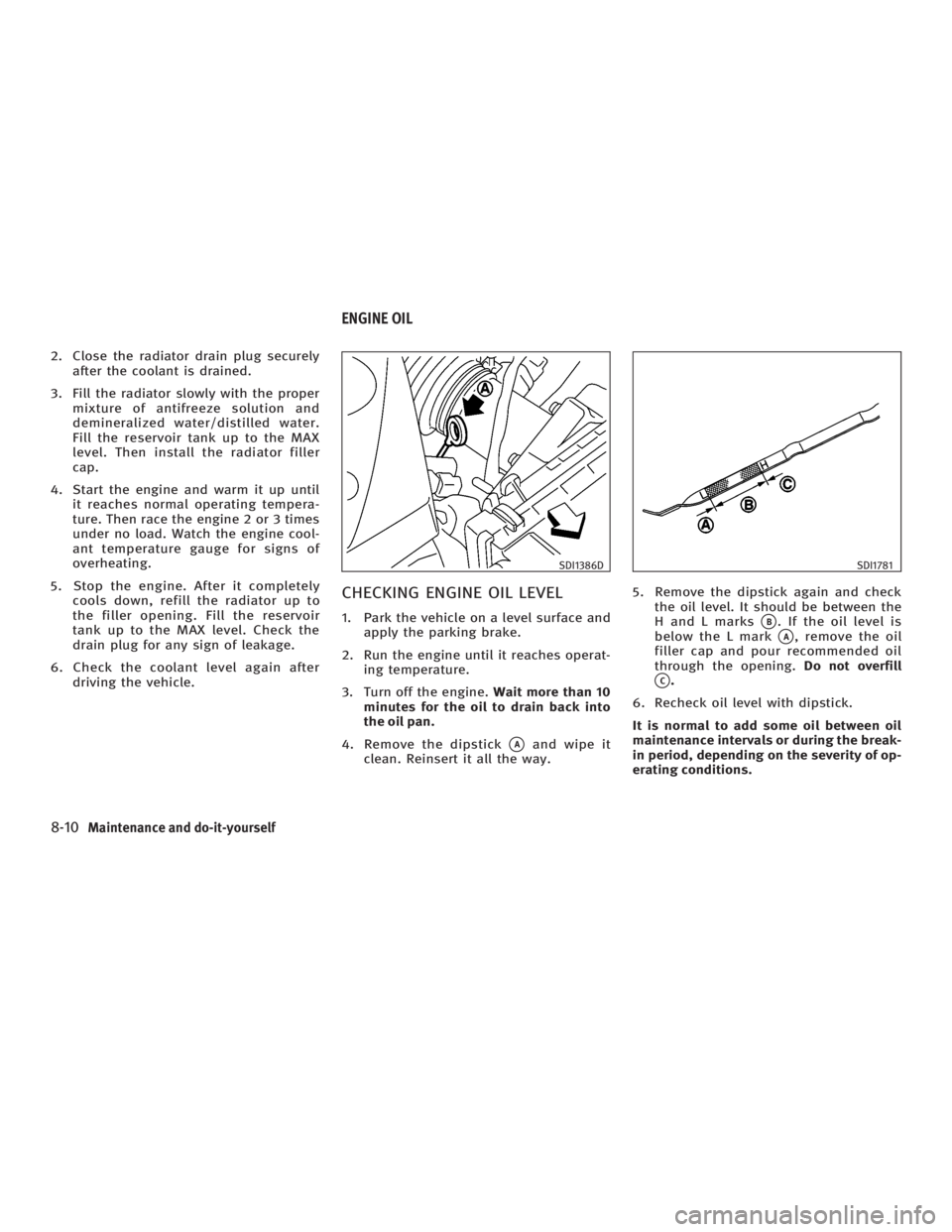
CHECKING ENGINE OIL LEVEL 1. Park the vehicle on a level surface and
apply the parking brake.
2. Run the engine until it reaches operat-
ing temperature.
3. Turn off the engine. Wait more than 10
minutes for the oil to drain back into
the oil pan.
4. Remove the dipstick
q A
and wipe it
clean. Reinsert it all the way. 5. Remove the dipstick again and check
the oil level. It should be between the
H and L marks
q B
. If the oil level is
below the L mark
q A
, remove the oil
filler cap and pour recommended oil
through the opening. Do not overfill
q C
.
6. Recheck oil level with dipstick.
It is normal to add some oil between oil
maintenance intervals or during the break-
in period, depending on the severity of op-
erating conditions. SDI1386D SDI1781
ENGINE OIL
8-10 Maintenance and do-it-yourself
w 06.1.4/V35-D/V5.0
X
Page 270 of 344
O Waste oil must be disposed of prop-
erly.
O Check your local regulations.
4. Loosen the oil filter with an oil filter
wrench
q B
. Remove the oil filter by
turning it by hand.
5. Wipe the engine oil filter mounting
surface with a clean rag.
Be sure to remove any old rubber
gasket remaining on the mounting sur-
face of the engine.
6. Coat the gasket on the new filter with
clean engine oil.
7. Screw in the oil filter clockwise until a
slight resistance is felt, then tighten
additionally more than 2/3 turn.
Oil filter tightening torque:
11 to 15 ft-lb
(14.7 to 20.5 N z m)
8. Clean and re-install the drain plug
with a new washer. Securely tighten
the drain plug with a wrench.
Drain plug tightening torque:
22 to 29 ft-lb
(29 to 39 N z m)
Do not use excessive force. 9. Refill engine with recommended oil
and install the cap securely.
CAUTION The dipstick must be inserted in place to pre-
vent oil spillage from the dipstick hole while
filling the engine with oil.
See ªCapacities and recommended
fuel/lubricantsº in the ª9. Technical
and consumer informationº section for
drain and refill capacity. The drain and
refill capacity depends on the oil tem-
perature and drain time. Use these
specifications for reference only. Al-
ways use the dipstick to determine the
proper amount of oil in the engine.
CAUTION When filling oil, do not pull out the dipstick.
10. Start the engine and check for
leakage around the drain plug and
the oil filter. Correct as required. 11. Turn the engine off and wait more
than 10 minutes. Check the oil level
with the dipstick. Add engine oil if
necessary.
After the operation 1. Install the engine undercover into po-
sition as the following steps.
a. Pull the center of the small plastic
clip out.
b. Hold the engine undercover into
position.
c. Insert the clip through the under-
cover into the hole in the frame,
then push the center of the clip in
to lock the clip in place.
d. Install the other bolts that hold the
undercover in place. Be careful not
to strip the bolts or over-tighten
them.
2. Lower the vehicle carefully to the
ground.
3. Dispose of waste oil and filter prop-
erly.
8-12 Maintenance and do-it-yourself
w 06.1.4/V35-D/V5.0
X
Page 274 of 344
WARNINGAntifreeze is poisonous and should be
stored carefully in marked containers out of
the reach of children.
CAUTIONDo not substitute engine anti-freeze coolant
for window washer solution. This may result
in damage to the paint.
O Do not fill the window washer reservoir
tank with washer fluid concentrates at
full strength. Some methyl alcohol
based washer fluid concentrates may
permanently stain the grille if spilled
while filling the window washer reser-
voir tank.
O Pre-mix washer fluid concentrates with
water to the manufacturer's recom-
mended levels before pouring the fluid
into the window washer reservoir tank. Do not use the window washer reservoir
tank to mix the washer fluid concen-
trateand water. O Keep the battery surface clean and
dry. Any corrosion should be washed
off with a solution of baking soda and
water.
O Make certain the terminal connections
are clean and securely tightened.
O If the vehicle is not to be used for 30
days or longer, disconnect the (þ)
negative battery terminal cable to pre-
vent discharging it.
Coupe
CAUTION When the battery cable is removed from the
battery terminal, do not close either of front
doors. The automatic window adjusting func-
tion will not work, and the side roof panel
may be damaged.
To disconnect the negative (þ) battery ter-
minal, perform the procedure in the follow-
ing order. Otherwise, the window and the
side roof panel may contact and be dam-
aged.
1. Close the windows.BATTERY
8-16 Maintenance and do-it-yourself
w 06.1.4/V35-D/V5.0
X
Page 275 of 344
2. Open the hood.
3. Close and lock all the doors.
4. Disconnect the negative (þ) battery ter-
minal.
5. Securely close the hood.
To connect the negative (þ) battery ter-
minal, perform the procedure in the follow-
ing order. Otherwise, the window and the
side roof panel may contact and be dam-
aged.
1. Unlock and open the driver side door.
Do not close the door.
2. Open the hood.
3. Connect the negative (þ) battery ter-
minal. Then close the hood.
4. Fully open the driver side door window.
5. Close the driver side door and the
window. Sedan and coupe
WARNING O Do not expose the battery to flames or
electrical sparks. Hydrogen gas, gener-
ated by battery fluid, is explosive. Do not
allow battery fluid to contact your skin,
eyes, fabrics, or painted surfaces. After
touching a battery or battery cap, do not
touch or rub your eyes. Thoroughly wash
your hands. If the acid contacts your
eyes, skin or clothing, immediately flush
with water for at least 15 minutes and
seek medical attention.
O Do not operate the vehicle if the fluid in
the battery is low. Low battery fluid can
cause a higher load on the battery which
can generate heat, reduce battery life,
and in some cases lead to an explosion.
O When working on or near a battery, al-
ways wear suitable eye protection and
remove all jewelry.
O Battery posts, terminals and related ac-
cessories contain lead and lead com-
pounds. Wash hands after handling. O Keep the battery out of the reach of chil-
dren.
Maintenance and do-it-yourself
8-17
w 06.1.4/V35-D/V5.0
X
Page 283 of 344
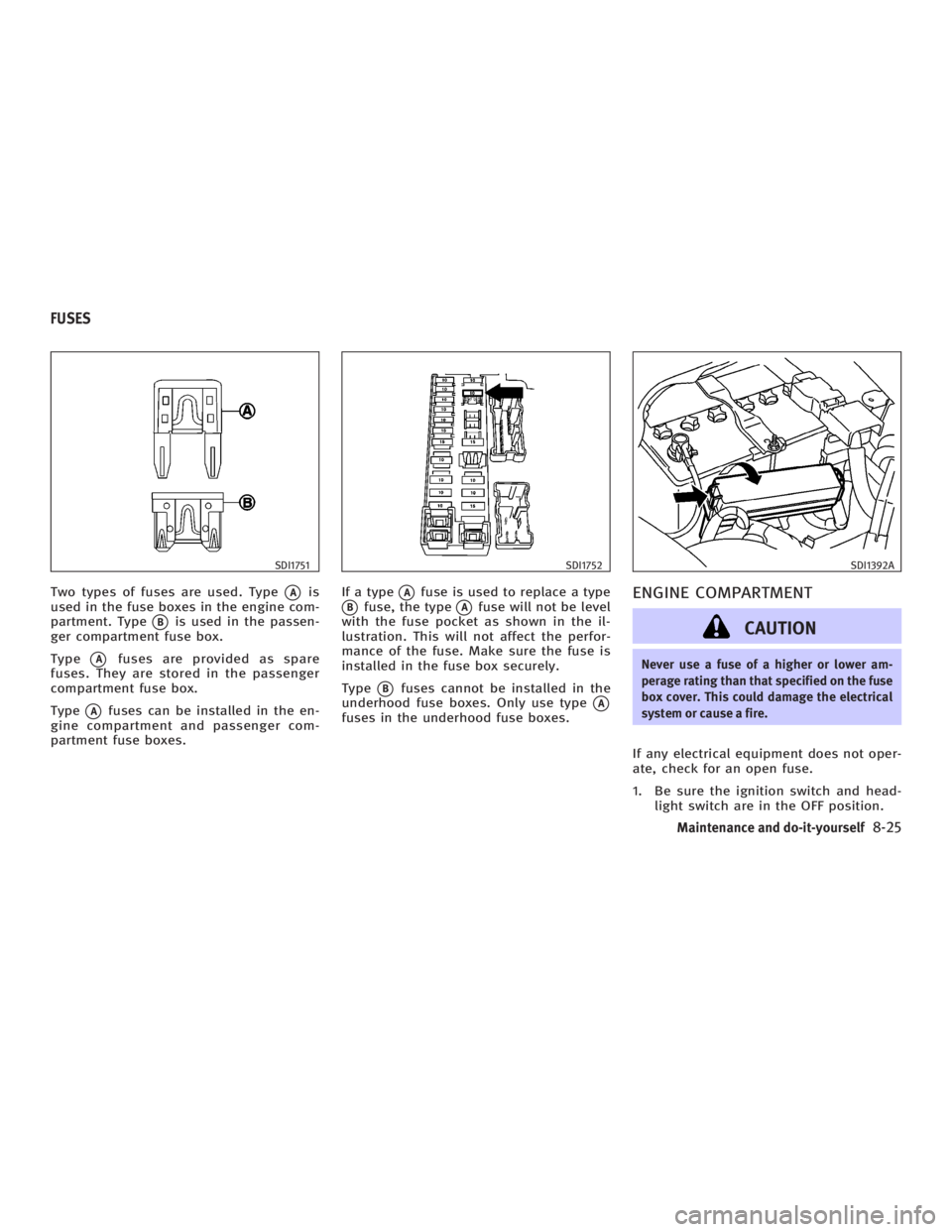
Two types of fuses are used. Type
q A
is
used in the fuse boxes in the engine com-
partment. Type
q B
is used in the passen-
ger compartment fuse box.
Type
q A
fuses are provided as spare
fuses. They are stored in the passenger
compartment fuse box.
Type
q A
fuses can be installed in the en-
gine compartment and passenger com-
partment fuse boxes. If a type
q A
fuse is used to replace a type
q B
fuse, the type
q A
fuse will not be level
with the fuse pocket as shown in the il-
lustration. This will not affect the perfor-
mance of the fuse. Make sure the fuse is
installed in the fuse box securely.
Type
q B
fuses cannot be installed in the
underhood fuse boxes. Only use type
q A
fuses in the underhood fuse boxes. ENGINE COMPARTMENT
CAUTION Never use a fuse of a higher or lower am-
perage rating than that specified on the fuse
box cover. This could damage the electrical
system or cause a fire.
If any electrical equipment does not oper-
ate, check for an open fuse.
1. Be sure the ignition switch and head-
light switch are in the OFF position.SDI1751 SDI1752 SDI1392A
FUSES
Maintenance and do-it-yourself
8-25
w 06.1.4/V35-D/V5.0
X
Page 286 of 344
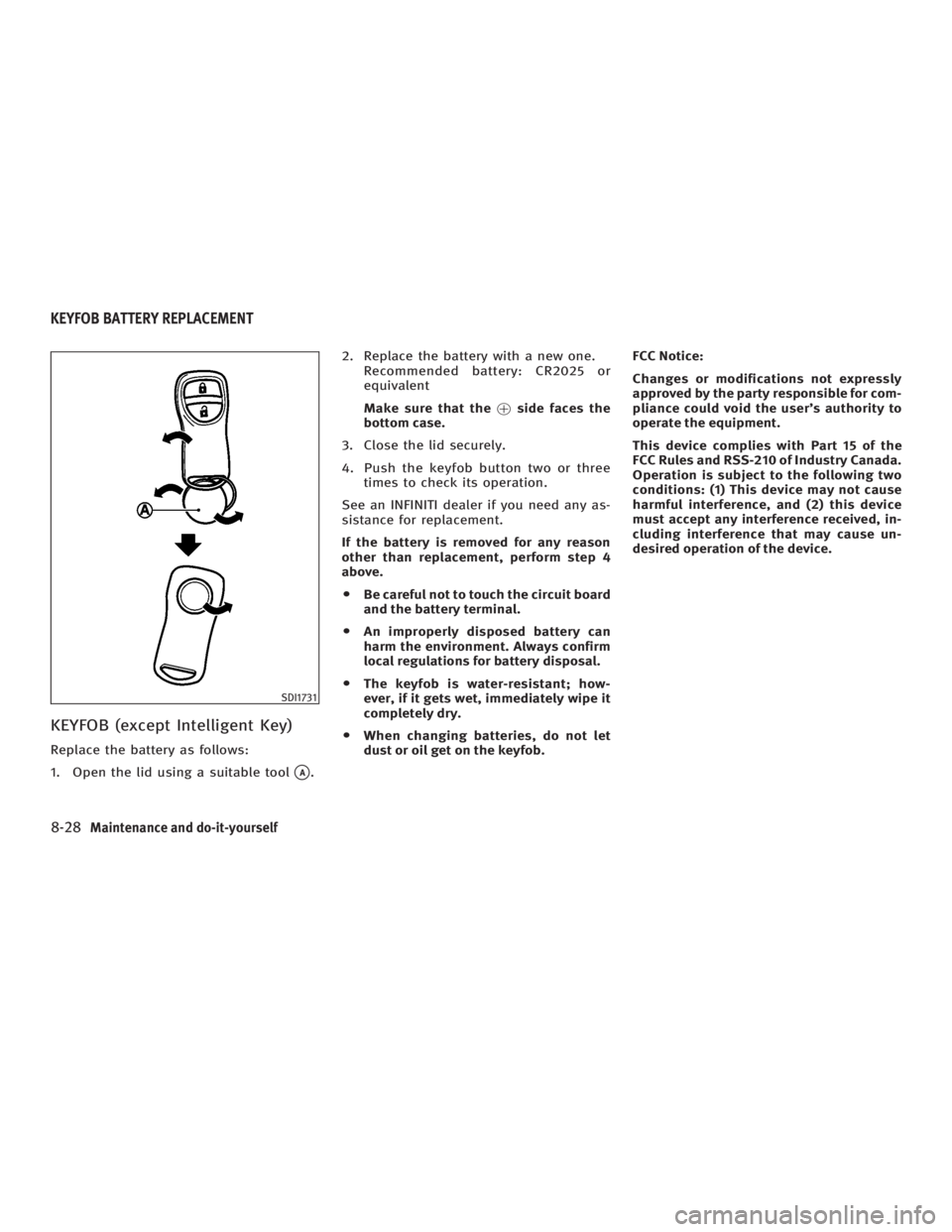
KEYFOB (except Intelligent Key) Replace the battery as follows:
1. Open the lid using a suitable tool
q A
. 2. Replace the battery with a new one.
Recommended battery: CR2025 or
equivalent
Make sure that the ! side faces the
bottom case.
3. Close the lid securely.
4. Push the keyfob button two or three
times to check its operation.
See an INFINITI dealer if you need any as-
sistance for replacement.
If the battery is removed for any reason
other than replacement, perform step 4
above.
O Be careful not to touch the circuit board
and the battery terminal.
O An improperly disposed battery can
harm the environment. Always confirm
local regulations for battery disposal.
O The keyfob is water-resistant; how-
ever, if it gets wet, immediately wipe it
completely dry.
O When changing batteries, do not let
dust or oil get on the keyfob. FCC Notice:
Changes or modifications not expressly
approved by the party responsible for com-
pliance could void the user's authority to
operate the equipment.
This device complies with Part 15 of the
FCC Rules and RSS-210 of Industry Canada.
Operation is subject to the following two
conditions: (1) This device may not cause
harmful interference, and (2) this device
must accept any interference received, in-
cluding interference that may cause un-
desired operation of the device.
SDI1731KEYFOB BATTERY REPLACEMENT
8-28 Maintenance and do-it-yourself
w 06.1.4/V35-D/V5.0
X
Page 287 of 344
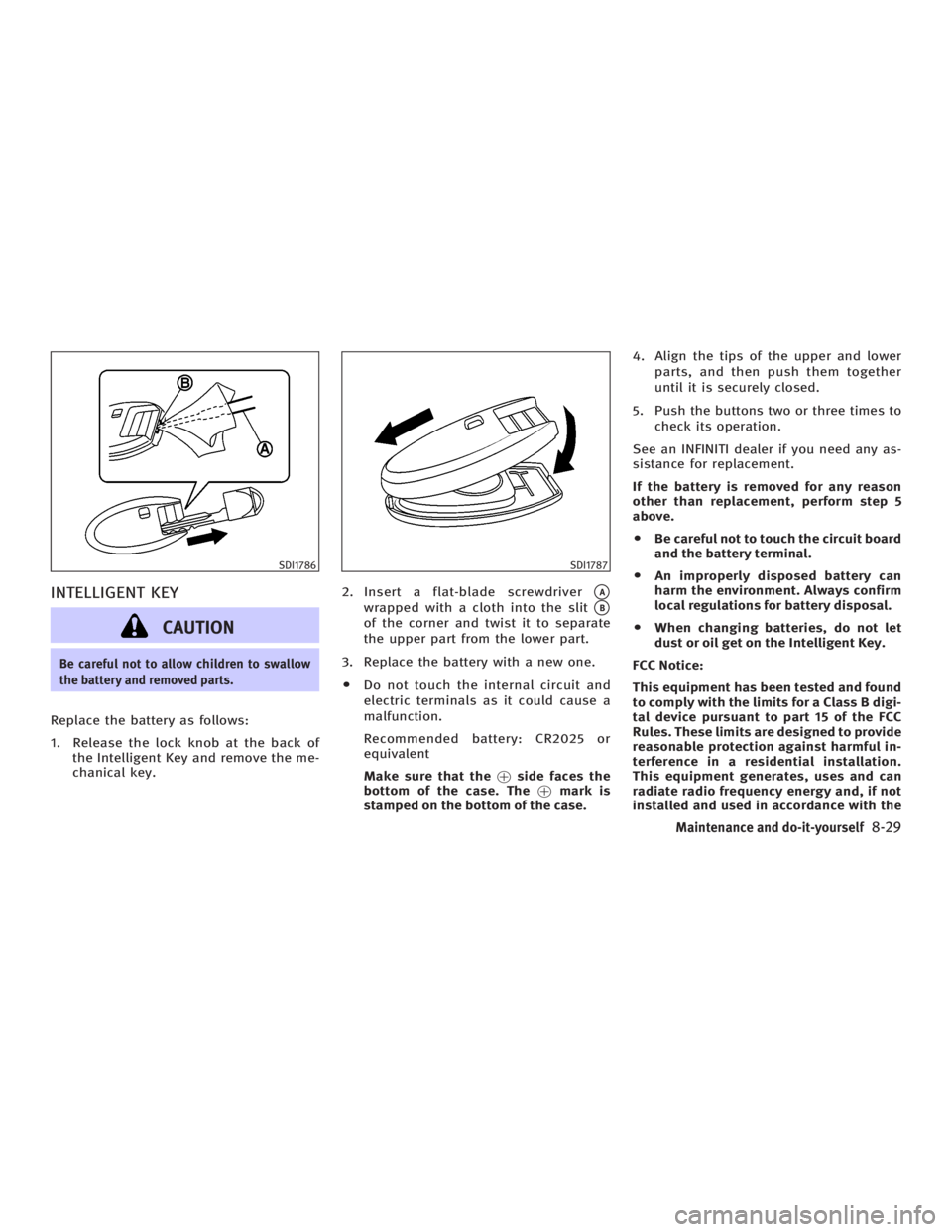
INTELLIGENT KEY
CAUTIONBe careful not to allow children to swallow
the battery and removed parts.
Replace the battery as follows:
1. Release the lock knob at the back of
the Intelligent Key and remove the me-
chanical key. 2. Insert a flat-blade screwdriver
q A
wrapped with a cloth into the slit
q B
of the corner and twist it to separate
the upper part from the lower part.
3. Replace the battery with a new one.
O Do not touch the internal circuit and
electric terminals as it could cause a
malfunction.
Recommended battery: CR2025 or
equivalent
Make sure that the ! side faces the
bottom of the case. The ! mark is
stamped on the bottom of the case. 4. Align the tips of the upper and lower
parts, and then push them together
until it is securely closed.
5. Push the buttons two or three times to
check its operation.
See an INFINITI dealer if you need any as-
sistance for replacement.
If the battery is removed for any reason
other than replacement, perform step 5
above.
O Be careful not to touch the circuit board
and the battery terminal.
O An improperly disposed battery can
harm the environment. Always confirm
local regulations for battery disposal.
O When changing batteries, do not let
dust or oil get on the Intelligent Key.
FCC Notice:
This equipment has been tested and found
to comply with the limits for a Class B digi-
tal device pursuant to part 15 of the FCC
Rules. These limits are designed to provide
reasonable protection against harmful in-
terference in a residential installation.
This equipment generates, uses and can
radiate radio frequency energy and, if not
installed and used in accordance with theSDI1786 SDI1787
Maintenance and do-it-yourself
8-29
w 06.1.4/V35-D/V5.0
X
Page 302 of 344
mends the use of SNOW or ALL SEASON
tires on all four wheels.
Snow tires If snow tires are needed, it is necessary
to select tires equivalent in size and load
rating to the original equipment tires. If
you do not, it can adversely affect the
safety and handling of your vehicle.
Generally, snow tires will have lower
speed ratings than factory equipped tires
and may not match the potential
maximum vehicle speed. Never exceed
the maximum speed rating of the tire.
If you operate your vehicle in snowy or icy
conditions, INFINITI recommends the use
of snow or all season tires on all four
wheels.
For additional traction on icy roads, stud-
ded tires may be used. However, some
provinces and states prohibit their use.
Check local, state and provincial laws be-
fore installing studded tires. Skid and
traction capabilities of studded snow
tires, on wet or dry surfaces, may be
poorer than that of non-studded snow
tires. All-wheel drive (AWD) models
CAUTION O Always use tires of the same type, size,
brand, construction (bias, bias-belted or
radial), and tread pattern on all four
wheels. Failure to do so may result in a
circumference difference between tires
on the front and rear axles which will
cause excessive tire wear and may
damage the transmission, transfer case
and differential gears.
O ONLY use spare tires specified for the
AWD model.
If excessive tire wear is found, it is recom-
mended that all four tires be replaced
with tires of the same size, brand, con-
struction and tread pattern. The tire pres-
sure and wheel alignment should also be
checked and corrected as necessary. Con-
tact an INFINITI dealer.
Tire chains must be installed only on the
rear wheels and not on the front wheels.
Do not drive with tire chains on paved
roads which are clear of snow. Driving with chains in such conditions can cause
damage to the various mechanisms of the
vehicle due to some overstress.
TIRE CHAINS Use of tire chains may be prohibited ac-
cording to location. Check the local laws
before installing tire chains. When install-
ing tire chains, make sure they are the
proper size for the tires on your vehicle
and are installed according to the chain
manufacturer's suggestions. Use only SAE
class ªSº chains. Class ªSº chains are
used on vehicles with restricted tire to ve-
hicle clearance. Vehicles that can use
Class ªSº chains are designed to meet
the minimum clearances between the tire
and the closest vehicle suspension or
body component required to accommo-
date the use of a winter traction device
(tire chains or cables). The minimum
clearances are determined using the fac-
tory equipped tires. Other types may
damage your vehicle. Use chain ten-
sioners when recommended by the tire
chain manufacturer to ensure a tight fit.
Loose end links of the tire chain must be
secured or removed to prevent the possi-
bility of whipping action damage to the
fenders or underbody. If possible, avoid
fully loading your vehicle when using tire
chains. In addition, drive at a reduced
8-44 Maintenance and do-it-yourself
w 06.1.4/V35-D/V5.0
X