suspension INFINITI G35 2006 Owners Manual
[x] Cancel search | Manufacturer: INFINITI, Model Year: 2006, Model line: G35, Model: INFINITI G35 2006Pages: 344, PDF Size: 6.81 MB
Page 232 of 344
When accelerating or driving on a slippery
surface, the tires may spin or slide. With
the Vehicle Dynamic Control (VDC)
system, sensors detect these movements
and control the braking and engine
output to help improve vehicle stability.
O When the VDC system is operating,
the ªSLIPº indicator in the instrument
panel blinks.
O When only the Traction Control System
(TCS) portion of the VDC system is op-
erating, the ªSLIPº indicator in the in-
strument panel blinks.
O If the ªSLIPº indicator blinks, the road
conditions are slippery. Be sure to ad-
just your speed and driving to these
conditions. Be sure to drive carefully.
See ªSlip indicator lightº, and ªVe-
hicle Dynamic Control (VDC) off indica-
tor lightº in the ª2. Instruments and
controlsº section.
O Indicator light
If a malfunction occurs in the system,
the ªSLIPº and ªVDC OFFº indicator
lights illuminate in the instrument
panel. As long as these indicators are
illuminated, the VDC system function
is canceled. The VDC system uses an Active Brake Lim-
ited Slip (ABLS) system to improve vehicle
traction. The ABLS system works when
one of the driving wheels is spinning on a
slippery surface. The ABLS system brakes
the spinning wheel which distributes the
driving power to the other driving wheel.
If the vehicle is operated with the VDC
system turned off, all VDC system func-
tions and TCS functions will be turned off.
The ABLS system and ABS will still op-
erate with the VDC system off. When the
ABLS system is activated, the ªSLIPº indi-
cator light will blink and you may hear a
clunk noise and/or feel a pulsation in the
brake pedal. This is normal and is not an
indication of a malfunction.
While the VDC system is operating, you
may feel a pulsation in the brake pedal and
hear a noise or feel a vibration from under
the hood. This is normal and indicates that
the VDC system is working properly.
The VDC system computer has a built in
diagnostic feature that tests the system
each time you start the engine and move
the vehicle forward or backward. When
the self-test occurs, you may hear a clunk
noise and/or feel a pulsation in the brake
pedal. This is normal and is not an indica-
tion of a malfunction. WARNING O The VDC system is designed to help im-
prove driving stability but does not pre-
vent accidents due to abrupt steering op-
eration at high speeds or due to careless
or dangerous driving. Reduce vehicle
speed and be especially careful when
driving and cornering on slippery sur-
faces and always drive carefully.
O If engine related parts such as muffler
are not standard equipment or are ex-
tremely deteriorated, the ªVDC OFFº in-
dicator or ªSLIPº indicator or both indi-
cator lights may illuminate.
O Do not modify the vehicle's suspension.
If suspension parts such as shock ab-
sorbers, struts, springs, stabilizer bars
and bushings are not INFINITI-approved
or are extremely deteriorated, the VDC
system may not operate properly. This
could adversely affect vehicle handling
performance, and the ªVDC OFFº indi-
cator or ªSLIPº indicator or both indi
cator lights may illuminate.VEHICLE DYNAMIC CONTROL (VDC)
SYSTEM
5-28 Starting and driving
w 06.1.4/V35-D/V5.0
X
Page 251 of 344
VEHICLE RECOVERY (Freeing a
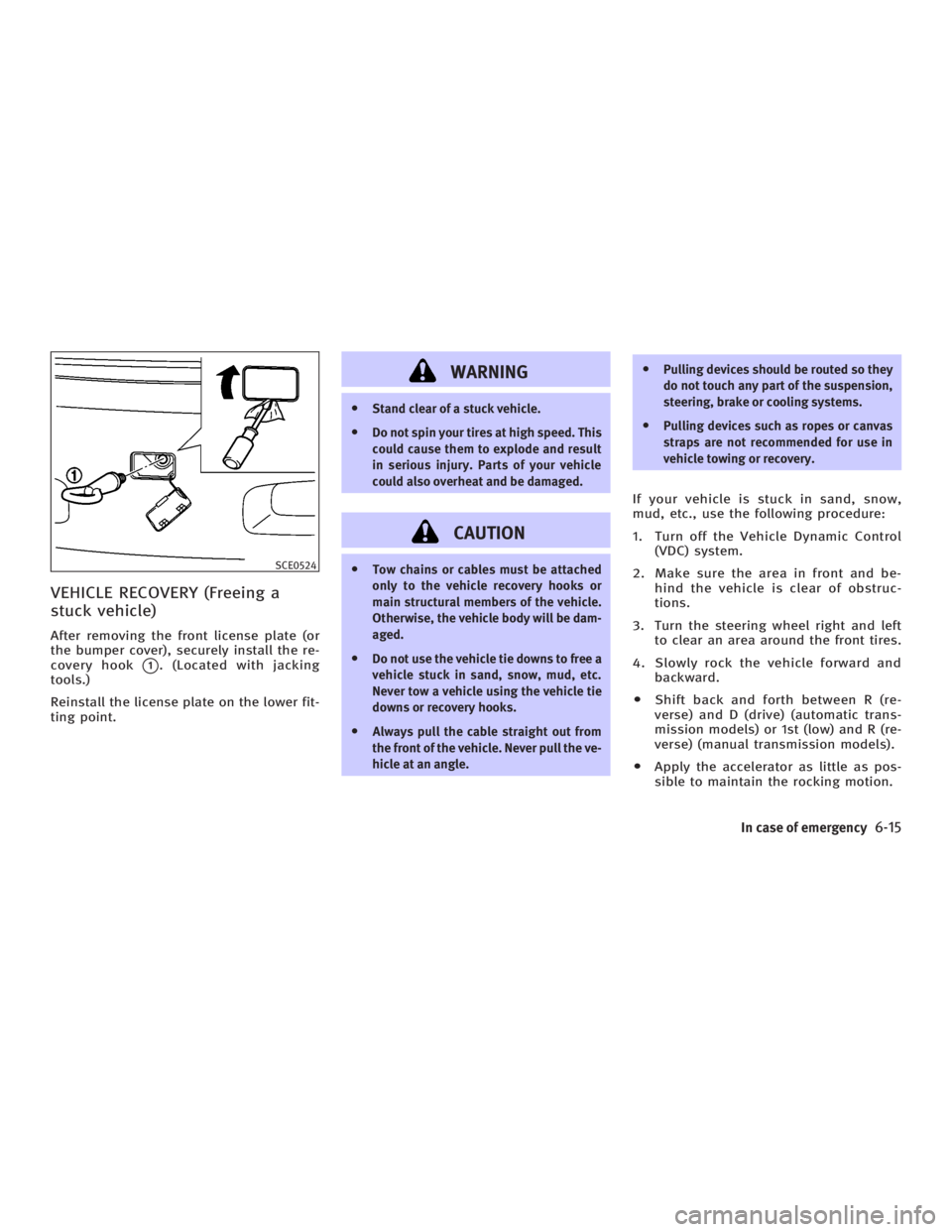
stuck vehicle) After removing the front license plate (or
the bumper cover), securely install the re-
covery hook
q 1
. (Located with jacking
tools.)
Reinstall the license plate on the lower fit-
ting point. WARNING O Stand clear of a stuck vehicle.
O Do not spin your tires at high speed. This
could cause them to explode and result
in serious injury. Parts of your vehicle
could also overheat and be damaged.
CAUTION O Tow chains or cables must be attached
only to the vehicle recovery hooks or
main structural members of the vehicle.
Otherwise, the vehicle body will be dam-
aged.
O Do not use the vehicle tie downs to free a
vehicle stuck in sand, snow, mud, etc.
Never tow a vehicle using the vehicle tie
downs or recovery hooks.
O Always pull the cable straight out from
the front of the vehicle. Never pull the ve-
hicle at an angle. O Pulling devices should be routed so they
do not touch any part of the suspension,
steering, brake or cooling systems.
O Pulling devices such as ropes or canvas
straps are not recommended for use in
vehicle towing or recovery.
If your vehicle is stuck in sand, snow,
mud, etc., use the following procedure:
1. Turn off the Vehicle Dynamic Control
(VDC) system.
2. Make sure the area in front and be-
hind the vehicle is clear of obstruc-
tions.
3. Turn the steering wheel right and left
to clear an area around the front tires.
4. Slowly rock the vehicle forward and
backward.
O Shift back and forth between R (re-
verse) and D (drive) (automatic trans-
mission models) or 1st (low) and R (re-
verse) (manual transmission models).
O Apply the accelerator as little as pos-
sible to maintain the rocking motion.SCE0524
In case of emergency
6-15
w 06.1.4/V35-D/V5.0
X
Page 255 of 344
REMOVING SPOTS Remove tar and oil spots, industrial dust,
insects, and tree sap as quickly as pos-
sible from the surface of the paint to
avoid lasting damage or staining. Special
cleaning products are available at an
INFINITI dealer or any automotive acces-
sory store.
UNDERBODY In areas where road salt is used in winter,
the underbody must be cleaned regularly.
This will prevent dirt and salt from
building up and causing underbody and
suspension corrosion. Before the winter
period and again in the spring, the under-
seal must be checked and, if necessary,
re-treated.
GLASS Use glass cleaner to remove smoke and
dust film from the glass surfaces. It is
normal for glass to become coated with a
film after the vehicle is parked in the hot
sun. Glass cleaner and a soft cloth will
easily remove this film. CAUTION When cleaning the inside of the windows, do
not use sharp-edged tools, abrasive
cleaners or chlorine-based disinfectant
cleaners. They could damage the electrical
conductors, radio antenna elements or rear
window defroster elements.
ALUMINUM ALLOY WHEELS Wash regularly, especially during winter
months in areas where road salt is used.
Salt could discolor the wheel if not re-
moved.
CHROME PARTS Clean all chrome parts regularly with a
non-abrasive chrome polish to maintain
the finish.
TIRE DRESSING INFINITI does not recommend the use of
tire dressings. Tire manufacturers apply a
coating to the tires to help reduce discol-
oration of the rubber. If a tire dressing is
applied to the tires, it may react with the
coating and form a compound. This com- pound may come off the tire while driving
and stain the vehicle paint.
If you choose to use a tire dressing, take
the following precautions:
O Use a water-based tire dressing. The
coating on the tire dissolves more
easily with an oil-based tire dressing.
O Apply a light coat of tire dressing to
help prevent it from entering the tire
tread/grooves (where it would be diffi-
cult to remove).
O Wipe off excess tire dressing using a
dry towel. Make sure the tire dressing
is completely removed from the tire
tread/grooves.
O Allow the tire dressing to dry as rec-
ommended by tire dressing manufac-
turer.
Appearance and care
7-3
w 06.1.4/V35-D/V5.0
X
Page 302 of 344
mends the use of SNOW or ALL SEASON
tires on all four wheels.
Snow tires If snow tires are needed, it is necessary
to select tires equivalent in size and load
rating to the original equipment tires. If
you do not, it can adversely affect the
safety and handling of your vehicle.
Generally, snow tires will have lower
speed ratings than factory equipped tires
and may not match the potential
maximum vehicle speed. Never exceed
the maximum speed rating of the tire.
If you operate your vehicle in snowy or icy
conditions, INFINITI recommends the use
of snow or all season tires on all four
wheels.
For additional traction on icy roads, stud-
ded tires may be used. However, some
provinces and states prohibit their use.
Check local, state and provincial laws be-
fore installing studded tires. Skid and
traction capabilities of studded snow
tires, on wet or dry surfaces, may be
poorer than that of non-studded snow
tires. All-wheel drive (AWD) models
CAUTION O Always use tires of the same type, size,
brand, construction (bias, bias-belted or
radial), and tread pattern on all four
wheels. Failure to do so may result in a
circumference difference between tires
on the front and rear axles which will
cause excessive tire wear and may
damage the transmission, transfer case
and differential gears.
O ONLY use spare tires specified for the
AWD model.
If excessive tire wear is found, it is recom-
mended that all four tires be replaced
with tires of the same size, brand, con-
struction and tread pattern. The tire pres-
sure and wheel alignment should also be
checked and corrected as necessary. Con-
tact an INFINITI dealer.
Tire chains must be installed only on the
rear wheels and not on the front wheels.
Do not drive with tire chains on paved
roads which are clear of snow. Driving with chains in such conditions can cause
damage to the various mechanisms of the
vehicle due to some overstress.
TIRE CHAINS Use of tire chains may be prohibited ac-
cording to location. Check the local laws
before installing tire chains. When install-
ing tire chains, make sure they are the
proper size for the tires on your vehicle
and are installed according to the chain
manufacturer's suggestions. Use only SAE
class ªSº chains. Class ªSº chains are
used on vehicles with restricted tire to ve-
hicle clearance. Vehicles that can use
Class ªSº chains are designed to meet
the minimum clearances between the tire
and the closest vehicle suspension or
body component required to accommo-
date the use of a winter traction device
(tire chains or cables). The minimum
clearances are determined using the fac-
tory equipped tires. Other types may
damage your vehicle. Use chain ten-
sioners when recommended by the tire
chain manufacturer to ensure a tight fit.
Loose end links of the tire chain must be
secured or removed to prevent the possi-
bility of whipping action damage to the
fenders or underbody. If possible, avoid
fully loading your vehicle when using tire
chains. In addition, drive at a reduced
8-44 Maintenance and do-it-yourself
w 06.1.4/V35-D/V5.0
X
Page 327 of 344
WARNINGNever connect a trailer brake system directly
to the vehicle brake system.
Pre-towing tips O Be certain your vehicle maintains a
level position when a loaded and/or
unloaded trailer is hitched. Do not
drive the vehicle if it has an abnormal
nose-up or nose-down condition;
check for improper tongue load, over-
load, worn suspension or other pos-
sible causes of either condition.
O Always secure items in the trailer to
prevent load shifts while driving.
O Load the trailer so approximately 60%
of the trailer load is in the front half
and 40% is in the back half.
O Check your hitch, trailer tire pressure,
vehicle tire pressure, trailer light op-
eration, and trailer wheel lug nuts
every time you attach a trailer to the
vehicle.
O Be certain your rear view mirrors con-
form to all federal, state or local regula- tions. If not, install any mirrors required
for towing before driving the vehicle.
Trailer towing tips In order to gain skill and an under-
standing of the vehicle's behavior, you
should practice turning, stopping and
backing up in an area which is free from
traffic. Steering stability, and braking per-
formance will be somewhat different than
under normal driving conditions.
O Always secure items in the trailer to
prevent load shift while driving.
O Avoid abrupt starts, acceleration or
stops.
O Avoid sharp turns or lane changes.
O Always drive your vehicle at a mod-
erate speed. Some states or provinces
have specific speed limits for vehicles
that are towing trailers. Obey the local
speed limits.
O When backing up, hold the bottom of
the steering wheel with one hand.
Move your hand in the direction in
which you want the trailer to go. Make
small corrections and back up slowly.
If possible, have someone guide you
when you are backing up. O Always block the wheels on both vehicle
and trailer when parking. Parking on a
slope is not recommended; however, if
you must do so, and if your vehicle is
equipped with automatic transmission,
first apply the parking brake and block
the wheels, and then move the transmis-
sion selector lever into the P (Park) posi-
tion. If you move the selector lever to
the P (Park) position before applying the
parking brake and blocking the wheels,
transmission damage could occur.
O When going down a hill, shift into a
lower gear and use the engine braking
effect. When going up a long grade,
downshift the transmission to a lower
gear and reduce speed to reduce
chances of engine overloading and/or
overheating.
However, for long steep grades, do
not stay in 1st or 2nd gear when
driving above 35 MPH (56 km/h).
O If the engine coolant rises to an ex-
tremely high temperature when the air
conditioning system is on, turn off the
air conditioner. Coolant heat can be
additionally vented by opening the
windows, switching the fan control to
high and setting the temperature con-
trol to the HOT position.
Technical and consumer information
9-21
w 06.1.4/V35-D/V5.0
X