Imp qt INFINITI M 2010 Owners Manual
[x] Cancel search | Manufacturer: INFINITI, Model Year: 2010, Model line: M, Model: INFINITI M 2010Pages: 445, PDF Size: 6.15 MB
Page 2 of 445
Your INFINITI represents a new way of thinking
about vehicle design. It integrates advanced
engineering and superior craftsmanship with a
simple, refined aesthetic sensitivity associated
with traditional Japanese culture.
The result is a different notion of luxury and
beauty. The car itself is important, but so is the
sense of harmony that the vehicle evokes in its
driver, and the sense of satisfaction you feel
with the INFINITI Ð from the way it looks and
drives to the high level of retailer service.
To ensure that you enjoy your INFINITI to the
fullest, we encourage you to read this Owner's
Manual immediately. It explains all of the fea-
tures, controls and performance characteristics
of your INFINITI; it also provides important
instructions and safety information.
A separate Warranty Information Booklet is in-
cluded in your Owner's literature portfolio. The
INFINITI Service and Maintenance Guide ex-
plains details about maintaining and servicing
your vehicle. Always carry it with you when you
take your vehicle to an INFINITI retailer. The War-
ranty Information Booklet contents provide
complete information about all warranties cov-
ering this vehicle, the requirements to keep the
warranties in effect as well as the INFINITI Road-
side Assistance program.Additionally, a separate Customer Care and
Lemon Law Information Booklet will explain how
to resolve any concerns you may have with your
vehicle, as well as clarify your rights under your
state's lemon law.
READ FIRST Ð THEN DRIVE SAFELY
Before driving your vehicle, read your Owner's
Manual carefully. This will ensure familiarity
with controls and maintenance requirements,
assisting you in the safe operation of your
vehicle.
WARNING
IMPORTANT SAFETY INFORMATION REMINDERS
FOR SAFETY!
Follow these important driving rules to help
ensure a safe and comfortable trip for you and
your passengers!
c
NEVER drive under the influence of alcohol or
drugs.
c ALWAYS observe posted speed limits and
never drive too fast for conditions.
c ALWAYS give your full attention to driving
and avoid using vehicle features or taking
other actions that could distract you.
c ALWAYS use your seat belts and appropriate
child restraint systems. Pre-teen children
should be seated in the rear seat.
c ALWAYS provide information about the
proper use of vehicle safety features to all
occupants of the vehicle.
c ALWAYS review this Owner's Manual for im-
portant safety information.
FOREWORD
wÐ
Ð
05/19/09Ðtbrooks
X
Page 3 of 445
MODIFICATION OF YOUR VEHICLE
This vehicle should not be modified. Modifica-
tion could affect its performance, safety or dura-
bility, and may even violate governmental regu-
lations. In addition, damage or performance
problems resulting from modification will not be
covered under the INFINITI warranties.
WHEN READING THE MANUAL
This manual includes information for all options
available on this model. Therefore, you may find
some information that does not apply to your
vehicle.
All information, specifications and illustrations
in this manual are those in effect at the time of
printing. INFINITI reserves the right to change
specifications or design at any time without
notice.
IMPORTANT INFORMATION ABOUT
THIS MANUAL
You will see various symbols in this manual.
They are used in the following ways:
WARNING
This is used to indicate the presence of a haz-
ard that could cause death or serious personal
injury. To avoid or reduce the risk, the proce-
dures must be followed precisely.
CAUTION
This is used to indicate the presence of a haz-
ard that could cause minor or moderate per-
sonal injury or damage to your vehicle. To avoid
or reduce the risk, the procedures must be fol-
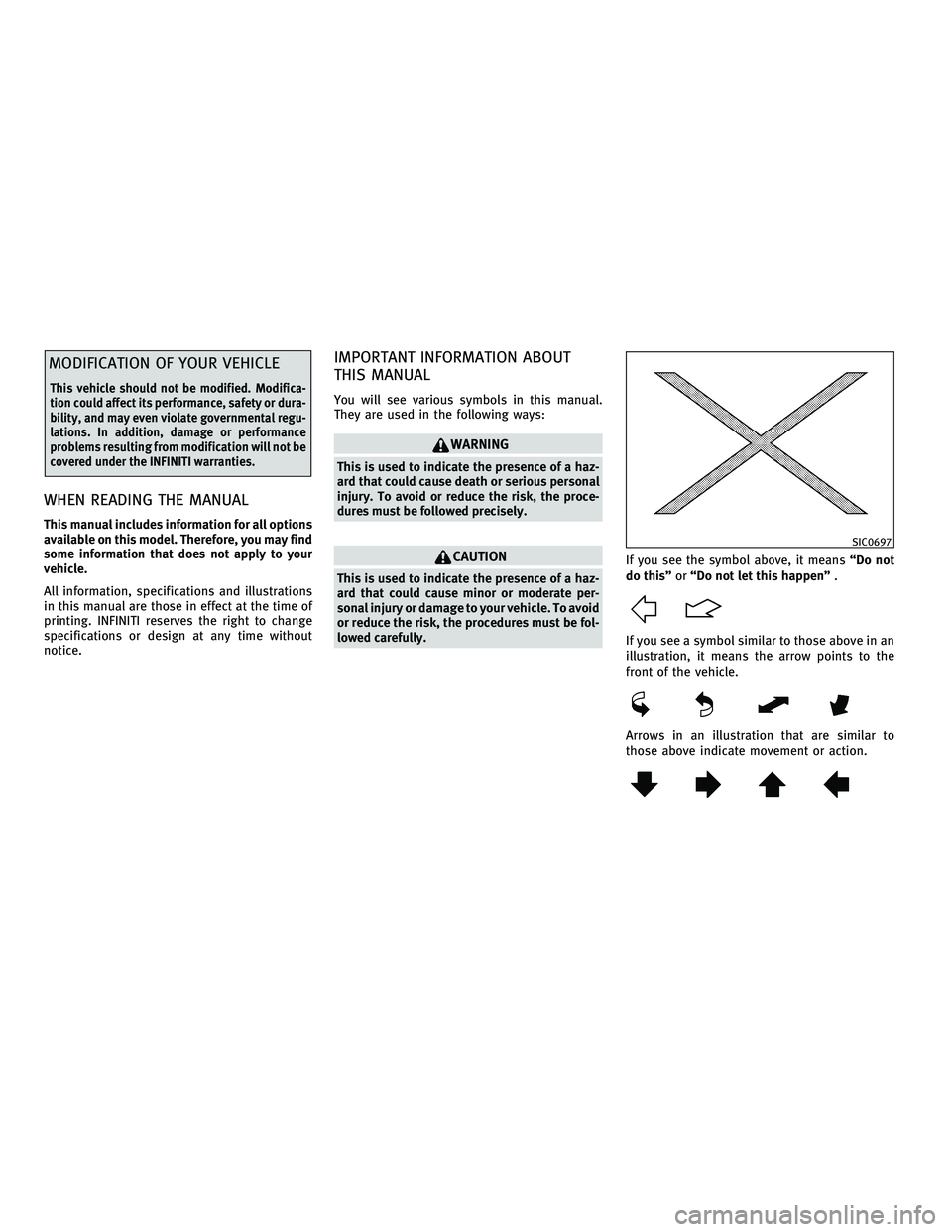
lowed carefully.If you see the symbol above, it means
ªDo not
do thisº orªDo not let this happenº .
If you see a symbol similar to those above in an
illustration, it means the arrow points to the
front of the vehicle.
Arrows in an illustration that are similar to
those above indicate movement or action.
SIC0697
wÐ
Ð
05/14/09Ðpattie
X
Page 9 of 445
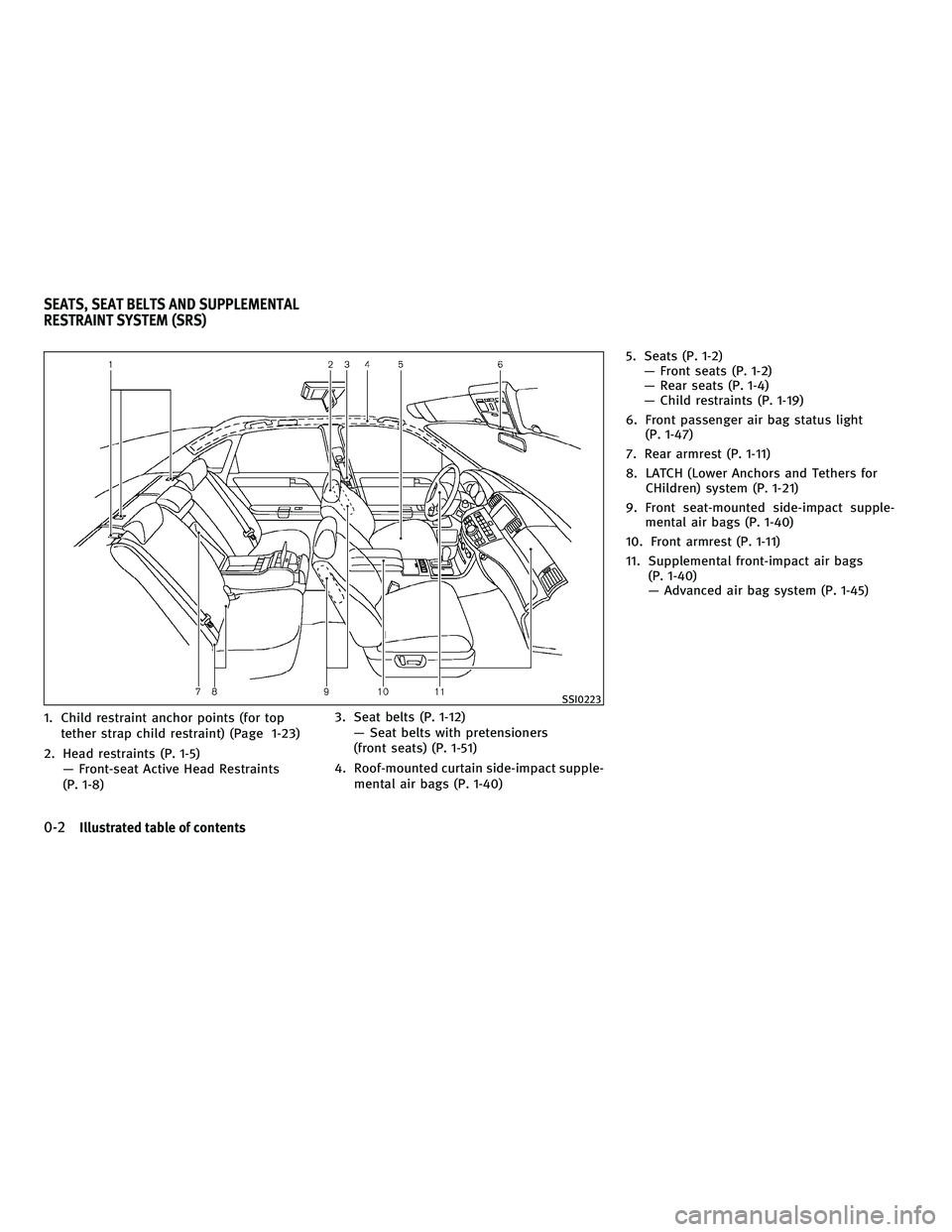
1. Child restraint anchor points (for toptether strap child restraint) (Page 1-23)
2. Head restraints (P. 1-5) Ð Front-seat Active Head Restraints
(P. 1-8) 3. Seat belts (P. 1-12)
Ð Seat belts with pretensioners
(front seats) (P. 1-51)
4. Roof-mounted curtain side-impact supple- mental air bags (P. 1-40) 5. Seats (P. 1-2)
Ð Front seats (P. 1-2)
Ð Rear seats (P. 1-4)
Ð Child restraints (P. 1-19)
6. Front passenger air bag status light (P. 1-47)
7. Rear armrest (P. 1-11)
8. LATCH (Lower Anchors and Tethers for CHildren) system (P. 1-21)
9. Front seat-mounted side-impact supple- mental air bags (P. 1-40)
10. Front armrest (P. 1-11)
11. Supplemental front-impact air bags (P. 1-40)
Ð Advanced air bag system (P. 1-45)
SSI0223
SEATS, SEAT BELTS AND SUPPLEMENTAL
RESTRAINT SYSTEM (SRS)
0-2Illustrated table of contents
wÐ
Ð
05/19/09Ðtbrooks
X
Page 22 of 445
1 Safety Ð Seats, seat belts and supplemental
restraint system
Seats.............................................1-2
Front seats .....................................1-2
Rear seats ......................................1-4
Head restraints .................................1-5
Adjustable headrests ........................... 1-8
Armrest ....................................... 1-11
Seat belts ........................................ 1-12
Precautions on seat belt usage ..................1-12
Child safety .................................... 1-14
Pregnant women ............................... 1-15
Injured persons ................................ 1-15
Pre-crash seat belts (front seats) ................1-15
Three-point type seat belt .......................1-16
Seat belt extenders ............................. 1-18
Seat belt maintenance .......................... 1-19
Child restraints ................................... 1-19
Precautions on child restraints ..................1-19
Lower Anchors and Tethers for CHildren
System (LATCH) ................................ 1-21Top tether strap child restraint
.................1-23
Child restraint installation using LATCH .........1-24
Child restraint installation using the seat
belts ......................................... 1-28
Booster seats ..................................... 1-35
Precautions on booster seats ....................1-35
Booster seat installation ........................ 1-37
Supplemental restraint system ....................1-40
Precautions on supplemental restraint
system ....................................... 1-40
INFINITI Advanced Air Bag System
(front seats) ................................... 1-45
Front seat-mounted side-impact
supplemental air bags and roof-mounted
curtain side-impact supplemental air bag
systems ...................................... 1-50
Seat belts with pretensioners (front seats) .......1-51
Supplemental air bag warning labels ............1-52
Supplemental air bag warning light ..............1-53
Repair and replacement procedure ...............1-53
wÐ
Ð
05/19/09Ðtbrooks
X
Page 35 of 445

cAll seat belt assemblies, including retractors
and attaching hardware, should be in-
spected after any collision by an INFINITI re-
tailer. INFINITI recommends that all seat belt
assemblies in use during a collision be re-
placed unless the collision was minor and
the belts show no damage and continue to
operate properly. Seat belt assemblies not
in use during a collision should also be in-
spected and replaced if either damage or
improper operation is noted.
c All child restraints and attaching hardware
should be inspected after any collision. Al-
ways follow the restraint manufacturer's in-
spection instructions and replacement rec-
ommendations. The child restraints should
be replaced if they are damaged.
CHILD SAFETY
Children need adults to help protect them. They
need to be properly restrained.
In addition to the general information in this
manual, child safety information is available
from many other sources, including doctors,
teachers, government traffic safety offices, and
community organizations. Every child is differ-
ent, so be sure to learn the best way to trans-
port your child. There are three basic types of child restraint
systems:
c
Rear-facing child restraint
c Front-facing child restraint
c Booster seat
The proper restraint depends on the child's
size. Generally, infants (up to about 1 year and
less than 20 lb (9 kg)) should be placed in
rear-facing child restraints. Front-facing child
restraints are available for children who out-
grow rear-facing child restraints and are at least
1 year old. Booster seats are used to help
position a vehicle lap/shoulder belt on a child
who can no longer use a front-facing child
restraint.
WARNING
Infants and children need special protection.
The vehicle's seat belts may not fit them prop-
erly. The shoulder belt may come too close to
the face or neck. The lap belt may not fit over
their small hip bones. In an accident, an im-
properly fitting seat belt could cause serious or
fatal injury. Always use appropriate child
restraints.
All U.S. states and Canadian provinces or terri-
tories require the use of approved child re- straints for infants and small children. (See
ªCHILD RESTRAINTSº later in this section.)
Also, there are other types of child restraints
available for larger children for additional pro-
tection.
INFINITI recommends that all pre-teens and chil-
dren be restrained in the rear seat. According to
accident statistics, children are safer when
properly restrained in the rear seat than in the
front seat.
This is especially important because your ve-
hicle has a supplemental restraint system (air
bag system) for the front passenger. (See
ªSUPPLEMENTAL RESTRAINT SYSTEMº later in
this section.)
Infants
Infants up to at least 1 year old should be
placed in a rear-facing child restraint. INFINITI
recommends that infants be placed in child
restraints that comply with Federal Motor Ve-
hicle Safety Standards or Canadian Motor Ve-
hicle Safety Standards. You should choose a
child restraint that fits your vehicle and always
follow the manufacturer's instructions for in-
stallation and use.
1-14Safety Ð Seats, seat belts and supplemental restraint system
wÐ
Ð
05/14/09Ðpattie
X
Page 37 of 445

THREE-POINT TYPE SEAT BELT
WARNING
cEvery person who drives or rides in this ve-
hicle should use a seat belt at all times.
c Do not ride in a moving vehicle when the
seatback is reclined. This can be dangerous.
The shoulder belt will not be against your
body. In an accident, you could be thrown
into it and receive neck or other serious inju-
ries. You could also slide under the lap belt
and receive serious internal injuries.
c For the most effective protection when the
vehicle is in motion, the seat should be up-
right. Always sit well back in the seat with
both feet on the floor and adjust the seat belt
properly.
Fastening the seat belts
1. Adjust the seat. (See ªSEATSº earlier in
this section.)
2. Slowly pull the seat belt out of the retrac- tor and insert the tongue into the buckle
until you hear and feel the latch engage.
cThe retractor is designed to lock during a
sudden stop or on impact. A slow pulling mo-
tion permits the belt to move, and allows you
some freedom of movement in the seat.
c If the seat belt cannot be pulled from its fully
retracted position, firmly pull the belt and
release it. Then smoothly pull the belt out of
the retractor.
3. Position the lap belt portion low and snug
on the hips as shown.
4. Pull the shoulder belt portion toward the retractor to take up extra slack. Be sure
the shoulder belt is routed over your
shoulder and across your chest.
The front passenger and the rear seating posi-
tions three-point type seat belts have two
modes of operation:
cEmergency Locking Retractor (ELR)
c Automatic Locking Retractor (ALR)
The Emergency Locking Retractor (ELR) mode
allows the seat belt to extend and retract to
allow the driver and passengers some freedom
SSS0292SSS0290
1-16Safety Ð Seats, seat belts and supplemental restraint system
wÐ
Ð
05/14/09Ðpattie
X
Page 38 of 445

of movement in the seat. The ELR locks the seat
belt when the vehicle slows down rapidly or
during certain impacts.
The Automatic Locking Retractor (ALR) mode
(child restraint mode) locks the seat belt for
child restraint installation.
When the ALR mode is activated the seat belt
cannot be extended again until the seat belt
tongue is detached from the buckle and fully
retracted. The seat belt returns to the ELR mode
after the seat belt fully retracts. For additional
information, see ªCHILD RESTRAINTSº later in
this section.
The ALR mode should be used only for child
restraint installation. During normal seat belt
use by an occupant, the ALR mode should not be
activated. If it is activated it may cause uncom-
fortable seat belt tension. It can also change the
operation of the front passenger air bag. See
ªFront passenger air bag and status lightº later
in this section.
WARNING
When fastening the seat belts, be certain that
seatbacks are completely secured in the
latched position. If they are not completely se-
cured, passengers may be injured in an acci-
dent or sudden stop.
Unfastening the seat belts
To unfasten the seat belt, push the button on
the buckle. The seat belt automatically retracts.
Checking seat belt operation
Seat belt retractors are designed to lock seat
belt movement by two separate methods:
cWhen the belt is pulled quickly from the
retractor.
c When the vehicle slows down rapidly.
To increase your confidence in the seat belts,
check the operation as follows:
c Grasp the shoulder belt and pull forward
quickly. The retractor should lock and re-
strict further belt movement.
If the retractor does not lock during this check
or if you have any question about seat belt
operation, see an INFINITI retailer.
SSS0326
Safety Ð Seats, seat belts and supplemental restraint system1-17
wÐ
Ð
05/14/09Ðpattie
X
Page 41 of 445

cINFINITI recommends that the child restraint
be installed in the rear seat. According to
accident statistics, children are safer when
properly restrained in the rear seat than in
the front seat. If you must install a front-
facing child restraint in the front seat, see
ªCHILD RESTRAINT INSTALLATION USING
THE SEAT BELTSº later in this section.
c Improper use or improper installation of a
child restraint can increase the risk or sever-
ity of injury for both the child and other oc-
cupants of the vehicle and can lead to seri-
ous injury or death in an accident.
c Follow all of the child restraint manufactur-
er's instructions for installation and use.
When purchasing a child restraint, be sure to
select one which will fit your child and ve-
hicle. It may not be possible to properly in-
stall some types of child restraints in your
vehicle.
c If the child restraint is not anchored prop-
erly, the risk of a child being injured in a
collision or a sudden stop greatly increases.
c Child restraint anchor points are designed to
withstand only those loads imposed by cor-
rectly fitted child restraints. Under no cir-
cumstances are they to be used for adult
seat belts or harnesses. c
Adjustable seatbacks should be positioned
to fit the child restraint, but as upright as
possible.
c After attaching the child restraint, test it be-
fore you place the child in it. Push it from
side to side while holding the seat near the
LATCH attachment or by the seat belt path.
The child restraint should not move more
than 1 inch (25 mm) from side to side. Try to
tug it forward and check to see if the belt
holds the restraint in place. If the restraint is
not secure, tighten the belt as necessary, or
put the restraint in another seat and test it
again. You may need to try a different child
restraint. Not all child restraints fit in all
types of vehicles.
c When your child restraint is not in use, keep
it secured with the LATCH system or a seat
belt to prevent it from being thrown around
in case of a sudden stop or accident.
CAUTION
Remember that a child restraint left in a closed
vehicle can become very hot. Check the seating
surface and buckles before placing your child in
the child restraint. This vehicle is equipped with a universal child
restraint lower anchor system, referred to as the
Lower Anchors and Tethers for CHildren System
or LATCH. Some child restraints include two
rigid or webbing-mounted attachments that can
be connected to these lower anchors. For de-
tails, see ªLower Anchors and Tethers for CHil-
dren System (LATCH)º later in this section.
If you do not have a LATCH compatible child
restraint, the vehicle seat belts can be used.
(See ªCHILD RESTRAINT INSTALLATION USING
THE SEAT BELTSº later in this section.) In gen-
eral, child restraints are also designed to be
installed with a lap/shoulder seat belt.
Several manufacturers offer child restraints for
infants and small children of various sizes.
When selecting any child restraint, keep the
following points in mind:
c
Choose only a restraint with a label certify-
ing that it complies with Federal Motor Ve-
hicle Safety Standard 213 or Canadian Motor
Vehicle Safety Standard 213.
c Check the child restraint in your vehicle to
be sure it is compatible with the vehicle's
seat and seat belt system.
c If the child restraint is compatible with your
vehicle, place your child in the child restraint
and check the various adjustments to be
1-20Safety Ð Seats, seat belts and supplemental restraint system
wÐ
Ð
05/14/09Ðpattie
X
Page 43 of 445

LATCH lower anchor point locations
The LATCH anchors are located at the rear of the
seat cushion near the seatback. A label is
attached to the seatback to help you locate the
LATCH anchors.
WARNING
cAttach LATCH system compatible child re-
straints only at the locations shown in the
illustration. If a child restraint is not secured
properly, your child could be seriously in-
jured or killed in an accident.
c Do not secure a child restraint in the center
rear seating position using the LATCH an-
chors. The child restraint will not be secured
properly.
c Child restraint anchor points are designed to
withstand only those loads imposed by cor-
rectly fitted child restraints. Under no cir-
cumstances are they to be used for adult
seat belts or harnesses.
Installing child restraint LATCH
anchor attachments
LATCH compatible child restraints include two
rigid or webbing-mounted attachments that can
be connected to two anchors located at certain
seating positions in your vehicle. With this
system, you do not have to use a vehicle seat
belt to secure the child restraint. Check your
child restraint for a label stating that it is
compatible with the LATCH system. This infor-
mation may also be in the instructions provided
by the child restraint manufacturer.
LATCH lower anchor location (Type A)
SSS0659
LATCH lower anchor location (Type B)
SSS0637
LATCH webbing-mounted attachment
SSS0643
1-22Safety Ð Seats, seat belts and supplemental restraint system
wÐ
Ð
05/14/09Ðpattie
X
Page 44 of 445

LATCH child restraints generally require the use
of a top tether strap. (See ªTOP TETHER STRAP
CHILD RESTRAINTº later in this section for in-
stallation instructions.)
When installing a child restraint, carefully read
and follow the instructions in this manual and
those supplied with the child restraint. (See
ªCHILD RESTRAINT INSTALLATION USING LATCHº
later in this section.)
TOP TETHER STRAP CHILD RESTRAINT
If the manufacturer of your child restraint re-
quires the use of a top tether strap, it must be
secured to an anchor point.
WARNING
Child restraint anchor points are designed to
withstand only those loads imposed by cor-
rectly fitted child restraints. Under no circum-
stances are they to be used for adult seat belts
or harnesses.
Top tether anchor point locations
Anchor points are located on the rear parcel
shelf.
Installing top tether strap
First secure the child restraint with the LATCH
system (rear outboard seating positions only) or
the seat belt as applicable.
1. Flip up the anchor cover from the anchorpoint which is located directly behind the
child seat.
2. Position the top tether strap over the top of the seatback.
LATCH rigid-mounted attachment
SSS0644SSS0568
Safety Ð Seats, seat belts and supplemental restraint system1-23
wÐ
Ð
05/14/09Ðpattie
X