heater INFINITI M 2012 User Guide
[x] Cancel search | Manufacturer: INFINITI, Model Year: 2012, Model line: M, Model: INFINITI M 2012Pages: 522, PDF Size: 3.8 MB
Page 315 of 522

Vehicle-to-vehicle distance control
mode operation ............................................. 5-50
Conventional (fixed speed) cruise
control mode ................................................. 5-65
Preview function (for Intelligent Cruise Control
system equipped models) ............................. 5-69
Distance Control Assist (DCA) system (if
so equipped) ..................................................... 5-69
Precautions on Distance Control
Assist system ................................................ 5-70
Distance Control Assist operation .................. 5-71
Forward Collision Warning (FCW) system (if
so equipped) ..................................................... 5-82 Precautions on FCW system ........................... 5-83
Intelligent Brake Assist (IBA) system (if
so equipped) ..................................................... 5-86 Precautions on IBA system ............................ 5-87
Break-in schedule .............................................. 5-90
Increasing fuel economy .................................... 5-90
Intelligent All-Wheel Drive (AWD) (if
so equipped) ..................................................... 5-90
Parking/parking on hills .................................... 5-92
Power steering................................................... 5-93
Brake system..................................................... 5-93
Braking precautions ...................................... 5-93
Parking brake break-in .................................. 5-93 Brake assist ...................................................... 5-94
Brake assist................................................. 5-94
Preview function (Intelligent Cruise Control
system equipped models) ............................ 5-94
Anti-lock Braking System (ABS).................... 5-96
Vehicle Dynamic Control (VDC) system .............. 5-98 Active trace control (if so equipped)............. 5-98
Rise-up and build-up ................................... 5-99
Brake force distribution ............................... 5-99
Hill Start Assist system ................................... 5-100
4 Wheel Active Steer (4WAS) system (if
so equipped)................................................... 5-100
Cold weather driving ....................................... 5-101 Freeing a frozen door lock ......................... 5-101
Antifreeze .................................................. 5-101
Battery....................................................... 5-101
Draining of coolant water........................... 5-101
Tire equipment .......................................... 5-101
Special winter equipment .......................... 5-102
Driving on snow or ice ............................... 5-102
Engine block heater (if so equipped).......... 5-102
Active noise control......................................... 5-103
Page 415 of 522
5-102Starting and driving
Skid and traction capabilities of studded
snow tires, on wet or dry surfaces, may be
poorer than that of non-studded snow
tires.
Tire chains may be used. For details, see
“Tire chains ”in the “8. Maintenance and
do-it-yourself ”section of this manual.
For all-wheel drive
If you install snow tires, they must also be
the same size, brand, construction and
tread pattern on all four wheels.
SPECIAL WINTER EQUIPMENT
It is recommended that the following items
be carried in the vehicle during winter:
. A scraper and stiff-bristled brush to
remove ice and snow from the windows
and wiper blades.
. A sturdy, flat board to be placed under
the jack to give it firm support.
. A shovel to dig the vehicle out of
snowdrifts.
. Extra window washer fluid to refill the
reservoir tank.
DRIVING ON SNOW OR ICE
WARNING
. Wet ice (328 F, 08C and freezing rain),
very cold snow or ice can be slick and
very hard to drive on. The vehicle will
have much less traction or “grip ”under
these conditions. Try to avoid driving on
wet ice until the road is salted or
sanded.
. Whatever the condition, drive with cau-
tion. Accelerate and slow down with
care. If accelerating or downshifting too
fast, the drive wheels will lose even
more traction.
. Allow more stopping distance under
these conditions. Braking should be
started sooner than on dry pavement.
. Allow greater following distances on
slippery roads.
. Watch for slippery spots (glare ice).
These may appear on an otherwise clear
road in shaded areas. If a patch of ice is
seen ahead, brake before reaching it. Try
not to brake while on the ice, and avoid
any sudden steering maneuvers. .
Do not use the cruise control on slippery
roads.
. Snow can trap dangerous exhaust gases
under your vehicle. Keep snow clear of
the exhaust pipe and from around your
vehicle.
ENGINE BLOCK HEATER (if so
equipped)
Engine block heaters are used to assist in
cold temperature starting.
The engine block heater should be used
when the outside temperature is 20 8F
( − 78C) or lower.
To use the engine block heater
1. Turn the engine off.
2. Open the hood and unwrap the engine
block heater cord.
3. Plug the engine block heater cord into a grounded 3-wire, 3-pronged extension
cord.
4. Plug the extension cord into a Ground Fault Interrupt (GFI) protected,
grounded 110-volt AC (VAC) outlet.
5. The engine block heater must be plugged in for at least 2 - 4 hours,
Page 416 of 522
depending on outside temperatures, to
properly warm the engine coolant. Use
an appropriate timer to turn the engine
block heater on.
6. Before starting the engine, unplug and properly store the cord to keep it away
from moving parts.
WARNING
. Do not use your engine block heater with
an ungrounded electrical system or a 2-
pronged adapter. You can be seriously
injured by an electrical shock if you use
an ungrounded connection.
. Disconnect and properly store the en-
gine block heater cord before starting
the engine. Damage to the cord could
result in an electrical shock and can
cause serious injury.
. Use a heavy-duty 3-wire, 3-pronged
extension cord rated for at least 10A.
Plug the extension cord into a Ground
Fault Interrupt (GFI) protected, grounded
110-VAC outlet. Failure to use the proper
extension cord or a grounded outlet can
result in a fire or electrical shock and
cause serious personal injury.
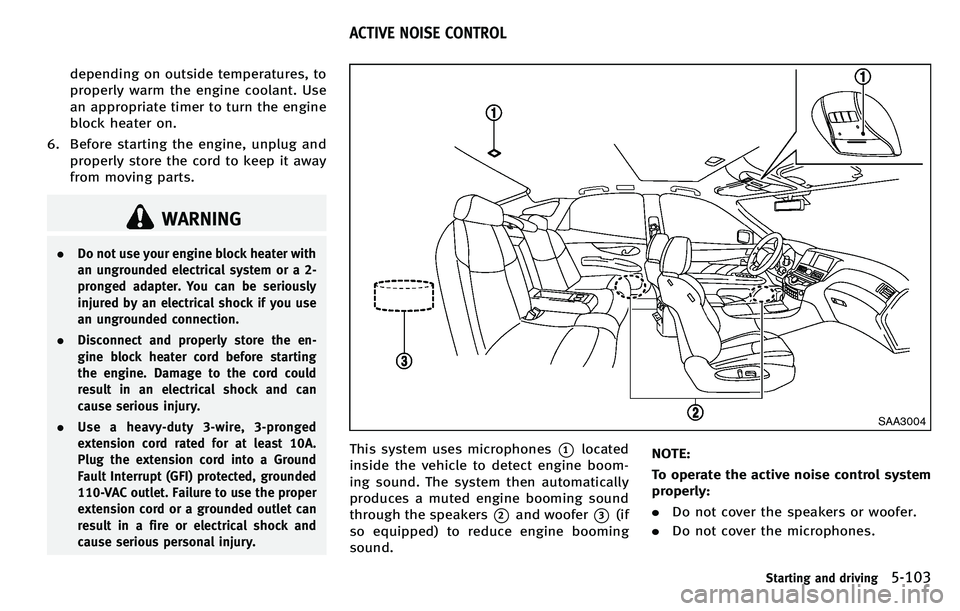
SAA3004
This system uses microphones*1located
inside the vehicle to detect engine boom-
ing sound. The system then automatically
produces a muted engine booming sound
through the speakers
*2and woofer*3(if
so equipped) to reduce engine booming
sound. NOTE:
To operate the active noise control system
properly:
.
Do not cover the speakers or woofer.
. Do not cover the microphones.
Starting and driving5-103
ACTIVE NOISE CONTROL
Page 426 of 522
SCE0886
VK56VD engine
SCE0884
VQ37VHR engine
WARNING
Always follow the instructions below. Failure
to do so could result in damage to the
charging system and cause personal injury.
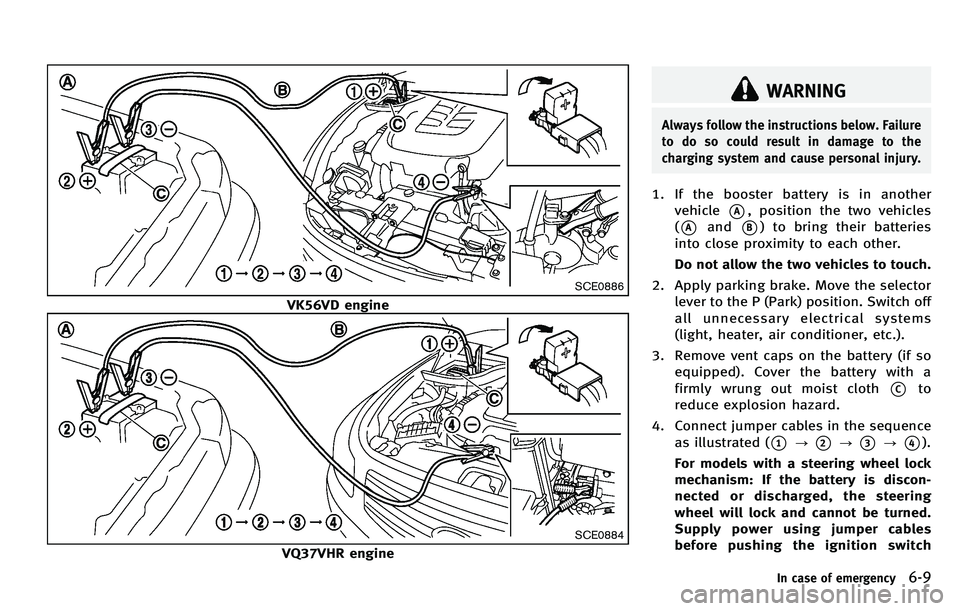
1. If the booster battery is in anothervehicle
*A, position the two vehicles
(
*Aand*B) to bring their batteries
into close proximity to each other.
Do not allow the two vehicles to touch.
2. Apply parking brake. Move the selector lever to the P (Park) position. Switch off
all unnecessary electrical systems
(light, heater, air conditioner, etc.).
3. Remove vent caps on the battery (if so equipped). Cover the battery with a
firmly wrung out moist cloth
*Cto
reduce explosion hazard.
4. Connect jumper cables in the sequence as illustrated (
*1?*2?*3?*4).
For models with a steering wheel lock
mechanism: If the battery is discon-
nected or discharged, the steering
wheel will lock and cannot be turned.
Supply power using jumper cables
before pushing the ignition switch
In case of emergency6-9
Page 428 of 522
CAUTION
.Do not continue to drive if your vehicle
overheats. Doing so could cause engine
damage or a vehicle fire.
. To avoid the danger of being scalded,
never remove the radiator cap while the
engine is still hot. When the radiator cap
is removed, pressurized hot water will
spurt out, possibly causing serious
injury.
. Do not open the hood if steam is coming
out.
If your vehicle is overheating (indicated by
an extremely high temperature gauge
reading), or if you feel a lack of engine
power, detect abnormal noise, etc., take
the following steps:
1. Move the vehicle safely off the road,
apply the parking brake and move the
selector lever to the P (Park) position.
Do not stop the engine.
2. Turn off the climate control. Open all the windows, move the heater or air
conditioner temperature control to
maximum hot and fan control to high speed.
3. If engine overheating is caused by climbing a long hill on a hot day, run
the engine at a fast idle (approximately
1,500 rpm) until the temperature gauge
indication returns to normal.
4. Get out of the vehicle. Look and listen for steam or coolant escaping from the
radiator before opening the hood. (If
steam or coolant is escaping, turn off
the engine.) Do not open the hood
further until no steam or coolant can be
seen.
5. Open the engine hood.WARNING
If steam or water is coming from the engine,
stand clear to prevent getting burned.
6. Visually check drive belts for damage or looseness. Also check if the cooling fan
is running. The radiator hoses and
radiator should not leak water. If cool-
ant is leaking or the cooling fan does
not run, stop the engine.
WARNING
Be careful not to allow your hands, hair,
jewelry or clothing to come into contact
with, or get caught in, engine belts or the
engine cooling fan. The engine cooling fan
can start at any time.
7. After the engine cools down, check thecoolant level in the reservoir tank with
the engine running. Add coolant to the
reservoir tank if necessary. Have your
vehicle repaired at the nearest INFINITI
retailer.
If needed, Roadside Assistance is avail-
able. Please see your Warranty Information
Booklet or Roadside Assistance I.D. Card
for the toll-free number to call (U.S.) or
Warranty & Roadside Assistance Informa-
tion Booklet (Canada).
In case of emergency6-11
IF YOUR VEHICLE OVERHEATS
Page 445 of 522
8-4Maintenance and do-it-yourself
Accelerator pedal:Check the pedal for
smooth operation and make sure the pedal
does not catch or require uneven effort.
Keep the floor mat away from the pedal.
Automatic transmission P (Park) mechan-
ism: On a fairly steep hill, check that your
vehicle is held securely with the selector
leverintheP(Park)positionwithout
applying any brakes.
Brake pedal: Check the pedal for smooth
operation. If the brake pedal suddenly
goes down further than normal, the pedal
feels spongy or the vehicle seems to take
longer to stop, see an INFINITI retailer
immediately. Keep the floor mat away from
the pedal.
Brakes: Check that the brakes do not pull
the vehicle to one side when applied.
Parking brake: Check the parking brake
operation regularly. The vehicle should be
securely held on a fairly steep hill with only
the parking brake applied. If the parking
brake needs adjusted, see an INFINITI
retailer.
Seat belts: Check that all parts of the seat
belt system (for example, buckles, an-
chors, adjuster and retractors) operate
properly and smoothly, and are installed securely. Check the belt webbing for cuts,
fraying, wear or damage.
Seats:
Check seat position controls such as
seat adjusters, seatback recliner, etc. to
ensure they operate smoothly and that all
latches lock securely in every position.
Check that the head restraints move up
and down smoothly and that the locks (if
so equipped) hold securely in all latched
positions.
Steering wheel: Check for changes in the
steering conditions, such as excessive free
play, hard steering or strange noises.
Warning lights and chimes: Make sure that
all warning lights and chimes are operating
properly.
Windshield defroster: Check that the air
comes out of the defroster outlets properly
and in sufficient quantity when operating
the heater or air conditioner.
Windshield wiper and washer*: Check that
the wipers and washer operate properly
and that the wipers do not streak.
Under the hood and vehicle
The maintenance items listed here should
be checked periodically (for example, each
time you check the engine oil or refuel). Battery*:
Check the fluid level in each cell.
It should be between the MAX and MIN
lines. Vehicles operated in high tempera-
tures or under severe condition require
frequent checks of the battery fluid level.
Brake fluid level*: Make sure that the
brake fluid level is between the MAX and
MIN lines on the reservoir.
Engine coolant level*: Check the coolant
level when the engine is cold.
Engine drive belts*: Make sure that no belt
is frayed, worn, cracked or oily.
Engine oil level*: Check the level after
parking the vehicle on a level spot and
turning off the engine. Wait more than 15
minutes for the oil to drain back into the oil
pan.
Exhaust system: Make sure there are no
loose supports, cracks or holes. If the
sound of the exhaust seems unusual or
there is a smell of exhaust fumes, im-
mediately have the exhaust system in-
spected by an INFINITI retailer. (See
“ Precautions when starting and driving ”
in the “5. Starting and driving ”section for
exhaust gas (Carbon monoxide).)
Fluid leaks: Check under the vehicle for
fuel, oil, water or other fluid leaks after the
Page 453 of 522
8-12Maintenance and do-it-yourself
SDI2043
CHECKING ENGINE COOLANT LEVEL
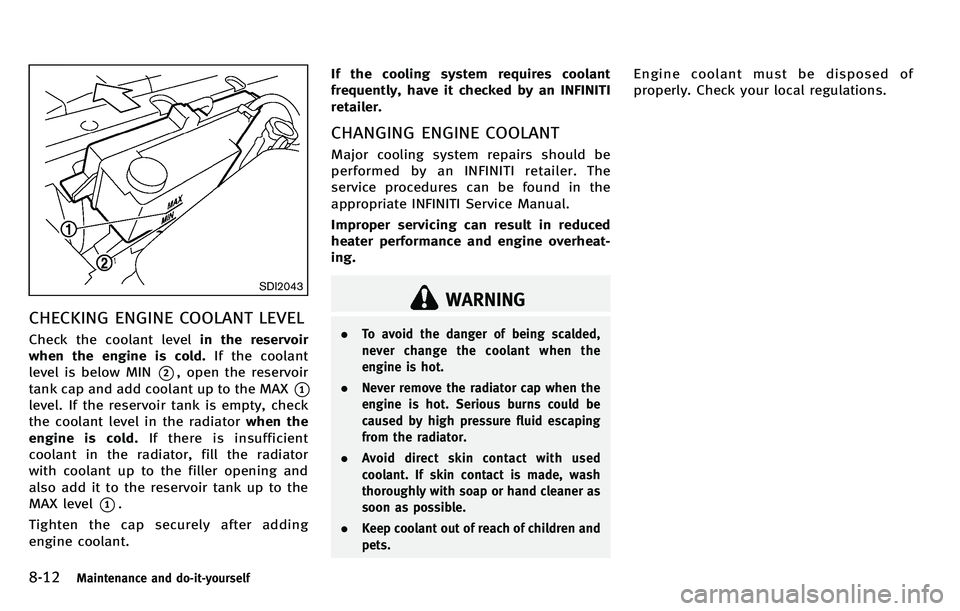
Check the coolant levelin the reservoir
when the engine is cold. If the coolant
level is below MIN
*2, open the reservoir
tank cap and add coolant up to the MAX
*1
level. If the reservoir tank is empty, check
the coolant level in the radiator when the
engine is cold. If there is insufficient
coolant in the radiator, fill the radiator
with coolant up to the filler opening and
also add it to the reservoir tank up to the
MAX level
*1.
Tighten the cap securely after adding
engine coolant. If the cooling system requires coolant
frequently, have it checked by an INFINITI
retailer.
CHANGING ENGINE COOLANT
Major cooling system repairs should be
performed by an INFINITI retailer. The
service procedures can be found in the
appropriate INFINITI Service Manual.
Improper servicing can result in reduced
heater performance and engine overheat-
ing.
WARNING
.
To avoid the danger of being scalded,
never change the coolant when the
engine is hot.
. Never remove the radiator cap when the
engine is hot. Serious burns could be
caused by high pressure fluid escaping
from the radiator.
. Avoid direct skin contact with used
coolant. If skin contact is made, wash
thoroughly with soap or hand cleaner as
soon as possible.
. Keep coolant out of reach of children and
pets.
Engine coolant must be disposed of
properly. Check your local regulations.
Page 513 of 522

10-2
CD/CF/USB memory care and cleaning ............. 4-86
Center multi-function control panel ..................... 4-4
Check tire pressure warning .............................. 2-23
Child restraints ................................................. 1-21LATCH system .............................................. 1-22
Precautions on child restraints ..................... 1-21
Child safety ...................................................... 1-19
Child safety rear door lock .................................. 3-6
Chimes Audible reminders ....................................... 2-19
Seat belt warning light and chime ............... 2-15
Cigarette lighter and ashtrays ........................... 2-47
Circuit breaker
Fusible link .................................................. 8-27
Cleaning exterior and interior ....................... 7-2, 7-4
Climate control
Automatic climate control ............................ 4-33
Clock ................................................................ 2-46
Coat hooks ....................................................... 2-52
Cockpit ........................................................ 0-6, 2-3
Cold weather driving ....................................... 5-101
Compact Disc (CD) player (See audio system) ... 4-64
Compact spare tire ........................................... 8-44
Console box ...................................................... 2-50
Controller
Center multi-function control panel ................ 4-6
Controls
Control panel button ...................................... 4-4
INFINITI Controller .......................................... 4-6 Coolant
Capacities and recommended
fuel/lubricants ............................................... 9-2
Changing engine coolant ............................. 8-12
Checking engine coolant level ...................... 8-12
Corrosion protection ........................................... 7-7
Cruise control ................................................... 5-45
Fixed speed cruise control (on ICC system) ... 5-65
Intelligent cruise control (ICC) system .......... 5-47
Cruise indicator ................................................ 2-23
Cup holders ...................................................... 2-48
Current fuel consumption .................................. 2-27
D
Daytime running light system ........................... 2-37
Defroster switch Rear window and outside mirror
defroster switch ........................................... 2-34
Dimensions ....................................................... 9-10
Display cleaning ................................................. 4-8
Display controls (See center multi-function
control panel) ..................................................... 4-4
Distance Control Assist (DCA) system ................ 5-69
Distance Control Assist (DCA) system
switch indicator ................................................ 2-24
Distance Control Assist (DCA) system
warning light .................................................... 2-12
Distance to empty ............................................. 2-27
Dot matrix liquid crystal display ....................... 2-20
Drive belts ........................................................ 8-21
Drive positioner ................................................ 3-28 Driving
Cold weather driving .................................. 5-101
Driving with automatic transmission ............ 5-14
Precautions when starting and driving ........... 5-3
DVD player operation ........................................ 4-65
E
ECO drive indicator light ................................... 2-17
ECO mode ......................................................... 5-20
ECO pedal system ............................................. 5-20
Economy Fuel ............................................................. 5-90
Elapsed time ..................................................... 2-27
Elapsed time and trip odometer ........................ 2-27
Emission control information label .................... 9-13
Emission control system warranty ..................... 9-20
Engine Before starting the engine ........................... 5-13
Break-in schedule ........................................ 5-90
Capacities and
recommended fuel/lubricants ........................ 9-2
Changing engine coolant ............................. 8-12
Changing engine oil and filter ...................... 8-13
Checking engine coolant level ...................... 8-12
Checking engine oil level ............................. 8-13
Coolant temperature gauge ............................ 2-8
Emergency engine shut off ........................... 5-12
Engine block heater ................................... 5-102
Engine compartment check locations ............. 8-7
Engine cooling system ................................. 8-11
Engine oil .................................................... 8-13
Page 514 of 522
Engine oil and oil filter recommendation ........ 9-6
Engine oil replacement indicator .................. 2-25
Engine oil viscosity ........................................ 9-6
Engine serial number ................................... 9-12
Engine specifications ..................................... 9-8
Engine start operation indicator ................... 2-22
If your vehicle overheats .............................. 6-11
Starting the engine ...................................... 5-13
Engine coolant temperature gauge ...................... 2-8
Entry/exit function
Automatic drive positioner ........................... 3-28
Event Data Recorders (EDR) ............................... 9-23
Exhaust gas (carbon monoxide) .......................... 5-3
F
F.M.V.S.S./C.M.V.S.S. certification label ............. 9-12
Filter Air cleaner housing filter .............................. 8-22
Changing engine oil and filter ...................... 8-13
Flashers (See hazard warning flasher switch) .... 2-40
Flat tire ............................................................... 6-2
Flat towing ........................................................ 9-19
Floor mat cleaning .............................................. 7-5
Floor mat positioning aid .................................... 7-6
Fluid Automatic transmission fluid (ATF) ............... 8-16
Brake fluid ................................................... 8-17
Capacities and
recommended fuel/lubricants ........................ 9-2
Engine coolant ............................................. 8-11
Engine oil .................................................... 8-13 Power steering fluid ..................................... 8-16
Window washer fluid ................................... 8-18
FM-AM-SAT radio with Compact Disc
(CD) player ........................................................ 4-61
Fog light switch ................................................ 2-39
Forest Air
TM....................................................... 4-42
Forward Collision Warning (FCW) system ........... 5-82
Front passenger air bag and status light ........... 1-46
Front power seat adjustment ............................... 1-3
Front seat
Front seat adjustment .................................... 1-3
Front-seat active head restraints ......................... 1-7
Fuel
Capacities and
recommended fuel/lubricants ........................ 9-2
Fuel economy............................................... 5-90
Fuel economy information (display) .............. 4-12
Fuel octane rating .......................................... 9-4
Fuel recommendation ..................................... 9-4
Fuel-filler cap ............................................... 3-21
Fuel-filler door ............................................. 3-21
Gauge ............................................................ 2-9
Fuses ................................................................ 8-26
Fusible links ..................................................... 8-27
G
Garage door opener HomeLink®Universal Transceiver ................. 2-61
Gas cap ............................................................ 3-21
Gauge .......................................................... 0-9, 2-6
Engine coolant temperature gauge ................. 2-8 Fuel gauge ..................................................... 2-9
Odometer....................................................... 2-6
Speedometer ................................................. 2-6
Tachometer .................................................... 2-7
Trip computer .............................................. 2-26
General maintenance .......................................... 8-3
Glove box ......................................................... 2-50
H
Hands-free phone system Bluetooth®(models with
navigation system) ....................................... 4-89
Bluetooth
®(models without
navigation system) ..................................... 4-100
Hazard warning flasher switch .......................... 2-40
Head restraints ................................................... 1-4
Headlights Aiming control (See adaptive front lighting
system (AFS)) ............................................... 2-37
Bulb replacement ......................................... 8-31
Headlight switch .......................................... 2-35
Xenon headlights ......................................... 2-34
Headrest Adjustable headrests ..................................... 1-8
Heated seats .................................................... 2-41
Heated steering wheel ...................................... 2-40
Heater Automatic climate control ............................ 4-33
Engine block heater ................................... 5-102
Hill start assist system ................................... 5-100
HomeLink
®Universal Transceiver ...................... 2-61
10-3