ECU INFINITI M 2012 Workshop Manual
[x] Cancel search | Manufacturer: INFINITI, Model Year: 2012, Model line: M, Model: INFINITI M 2012Pages: 522, PDF Size: 3.8 MB
Page 446 of 522
vehicle has been parked for a while. Water
dripping from the air conditioner after use
is normal. If you should notice any leaks or
if gasoline fumes are evident, check for the
cause and have it corrected immediately.
Power steering fluid level* and lines:
Check the level when the fluid is cold,
with the engine off. Check the lines for
proper attachment, leaks, cracks, etc.
Radiator and hoses:Check the front of the
radiator and clean off any dirt, insects,
leaves, etc., that may have accumulated.
Make sure the hoses have no cracks,
deformation, rot or loose connections.
Underbody: The underbody is frequently
exposed to corrosive substances such as
those used on icy roads or to control dust.
It is very important to remove these
substances, otherwise rust will form on
the floor pan, frame, fuel lines and around
the exhaust system. At the end of winter,
the underbody should be thoroughly
flushed with plain water, being careful to
clean those areas where mud and dirt may
accumulate. For additional information,
see “Cleaning exterior ”in the “7. Appear-
ance and care ”section.
Windshield washer fluid*: Check that there
is adequate fluid in the reservoir. When performing any inspection or main-
tenance work on your vehicle, always take
care to prevent serious accidental injury to
yourself or damage to the vehicle. The
following are general precautions which
should be closely observed.
WARNING
.
Park the vehicle on a level surface, apply
the parking brake securely and block the
wheels to prevent the vehicle from
moving. Move the selector lever to P
(Park).
. Be sure the ignition switch is in the OFF
or LOCK position when performing any
parts replacement or repairs.
. Never connect or disconnect the battery
or any transistorized component while
the ignition switch is in the ON position.
. Never leave the engine or automatic
transmission related component har-
nesses disconnected while the ignition
switch is in the ON position.
. If you must work with the engine
running, keep your hands, clothing, hair
and tools away from moving fans, belts
and any other moving parts. .
It is advisable to secure or remove any
loose clothing and remove any jewelry,
such as rings, watches, etc. before
working on your vehicle.
. Always wear eye protection whenever
you work on your vehicle.
. Ifyoumustruntheengineinan
enclosed space such as a garage, be
sure there is proper ventilation for
exhaust gases to escape.
. Never get under the vehicle while it is
supported only by a jack. If it is
necessary to work under the vehicle,
support it with safety stands.
. Keep smoking materials, flame and
sparks away from fuel tank and the
battery.
. Your vehicle is equipped with an auto-
matic engine cooling fan. It may come on
at any time without warning, even if the
ignition key is in the OFF position and
the engine is not running. To avoid
injury, always disconnect the negative
battery cable before working near the
fan.
. The fuel filter or fuel lines should be
serviced by an INFINITI retailer because
the fuel lines are under high pressure
Maintenance and do-it-yourself8-5
MAINTENANCE PRECAUTIONS
Page 453 of 522
8-12Maintenance and do-it-yourself
SDI2043
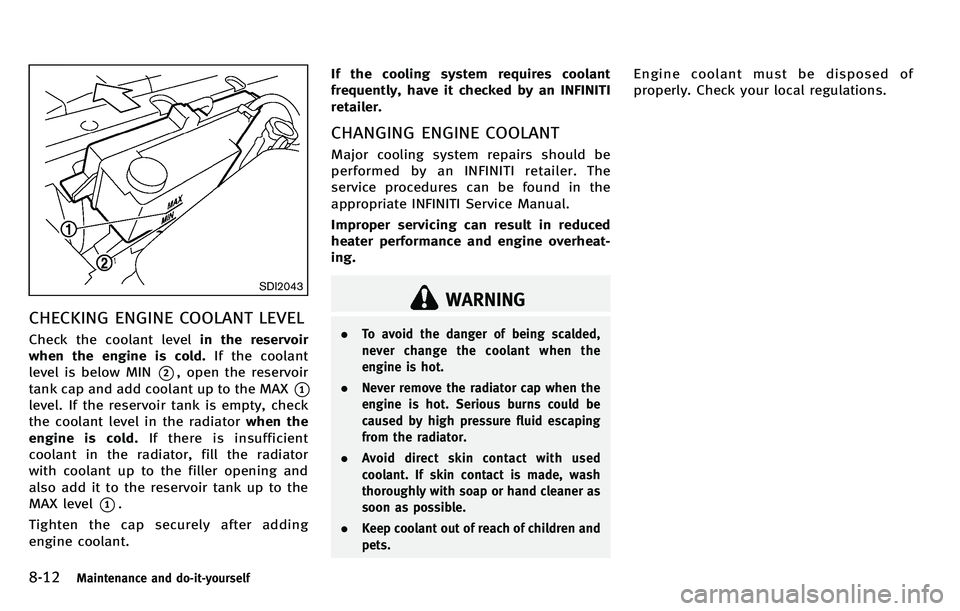
CHECKING ENGINE COOLANT LEVEL
Check the coolant levelin the reservoir
when the engine is cold. If the coolant
level is below MIN
*2, open the reservoir
tank cap and add coolant up to the MAX
*1
level. If the reservoir tank is empty, check
the coolant level in the radiator when the
engine is cold. If there is insufficient
coolant in the radiator, fill the radiator
with coolant up to the filler opening and
also add it to the reservoir tank up to the
MAX level
*1.
Tighten the cap securely after adding
engine coolant. If the cooling system requires coolant
frequently, have it checked by an INFINITI
retailer.
CHANGING ENGINE COOLANT
Major cooling system repairs should be
performed by an INFINITI retailer. The
service procedures can be found in the
appropriate INFINITI Service Manual.
Improper servicing can result in reduced
heater performance and engine overheat-
ing.
WARNING
.
To avoid the danger of being scalded,
never change the coolant when the
engine is hot.
. Never remove the radiator cap when the
engine is hot. Serious burns could be
caused by high pressure fluid escaping
from the radiator.
. Avoid direct skin contact with used
coolant. If skin contact is made, wash
thoroughly with soap or hand cleaner as
soon as possible.
. Keep coolant out of reach of children and
pets.
Engine coolant must be disposed of
properly. Check your local regulations.
Page 456 of 522

Engine oil and filter
1. Place a large drain pan under the drainplug.
2. Remove the oil filler cap.
3. Remove the drain plug
*1with a
wrench and completely drain the oil.
CAUTION
Be careful not to burn yourself, as the
engine oil is hot.
.Waste oil must be disposed of
properly.
.Check your local regulations.
4. (Perform steps 4 to 7 only when the engine oil filter change is needed.)
Loosen the oil filter
*2with an oil filter
wrench. Remove the oil filter by turning
it by hand.
5. Wipe the engine oil filter mounting surface with a clean rag.
CAUTION
Be sure to remove any old rubber gasket
remaining on the mounting surface of the engine. Failure to do so could lead to engine
damage.
6. Coat the gasket on the new filter with
clean engine oil.
7. Screw in the oil filter clockwise until a slight resistance is felt, then tighten
additionally more than 2/3 turn.
Oil filter tightening torque:11 to 15 ft-lb
(14.7 to 20.5 N·m)
8. Clean and re-install the drain plug with a new washer. Securely tighten the
drain plug with a wrench.
Drain plug tightening torque:22 to 29 ft-lb
(29 to 39 N·m)
Do not use excessive force.
9. Refill engine with recommended oil and install the oil filler cap securely.
CAUTION
The dipstick must be inserted in place to
prevent oil spillage from the dipstick hole
while filling the engine with oil.
See “Capacities and recommended
fuel/lubricants ”in the “9. Technical
and consumer information ”section for
drain and refill capacity. The drain and
refill capacity depends on the oil
temperature and drain time. Use these
specifications for reference only. Al-
ways use the dipstick to determine the
proper amount of oil in the engine.
10. Start the engine and check for leakage around the drain plug and the oil filter.
Correct as required.
11. Turn the engine off and wait more than 15 minutes. Check the oil level with the
dipstick. Add engine oil if necessary.
After the operation
1. Install the engine undercover intoposition as the following steps.
a. Pull the center of the small plasticclip out.
b. Hold the engine undercover into position.
c. Insert the clip through the under- cover into the hole in the frame, then
push the center of the clip in to lock
the clip in place.
Maintenance and do-it-yourself8-15
Page 460 of 522
.Keep the battery surface clean and dry.
Clean the battery with a solution of
baking soda and water.
. Make certain the terminal connections
are clean and securely tightened.
. If the vehicle is not to be used for 30
days or longer, disconnect the negative
( − ) battery terminal cable to prevent
discharging it.
WARNING
. Do not expose the battery to flames or
electrical sparks. Hydrogen gas gener-
ated by the battery is explosive. Do not
allow battery fluid to contact your skin,
eyes, fabrics, or painted surfaces. After
touching a battery or battery cap, do not
touch or rub your eyes. Thoroughly wash
your hands. If the acid contacts your
eyes, skin or clothing, immediately flush
with water for at least 15 minutes and
seek medical attention.
. Do not operate the vehicle if the fluid in
the battery is low. Low battery fluid can
cause a higher load on the battery which
can generate heat, reduce battery life,
and in some cases lead to an explosion. .
When working on or near a battery,
always wear suitable eye protection and
remove all jewelry.
. Battery posts, terminals and related
accessories contain lead and lead com-
pounds. Wash hands after handling.
. Keep the battery out of the reach of
children.DI0137MA
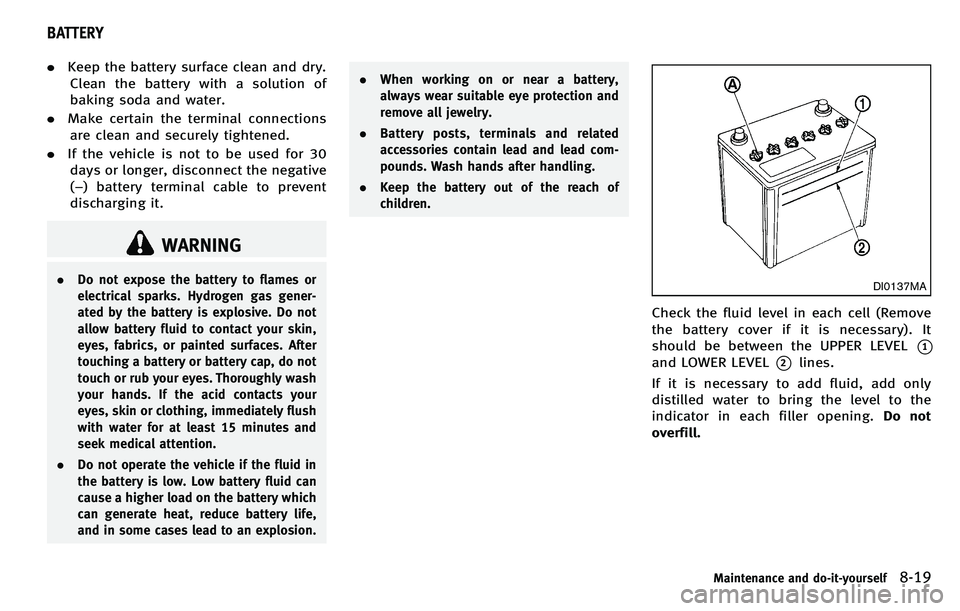
Check the fluid level in each cell (Remove
the battery cover if it is necessary). It
should be between the UPPER LEVEL
*1
and LOWER LEVEL*2lines.
If it is necessary to add fluid, add only
distilled water to bring the level to the
indicator in each filler opening. Do not
overfill.
Maintenance and do-it-yourself8-19
BATTERY
Page 462 of 522
SDI2545
VK56VD engine
SDI2119
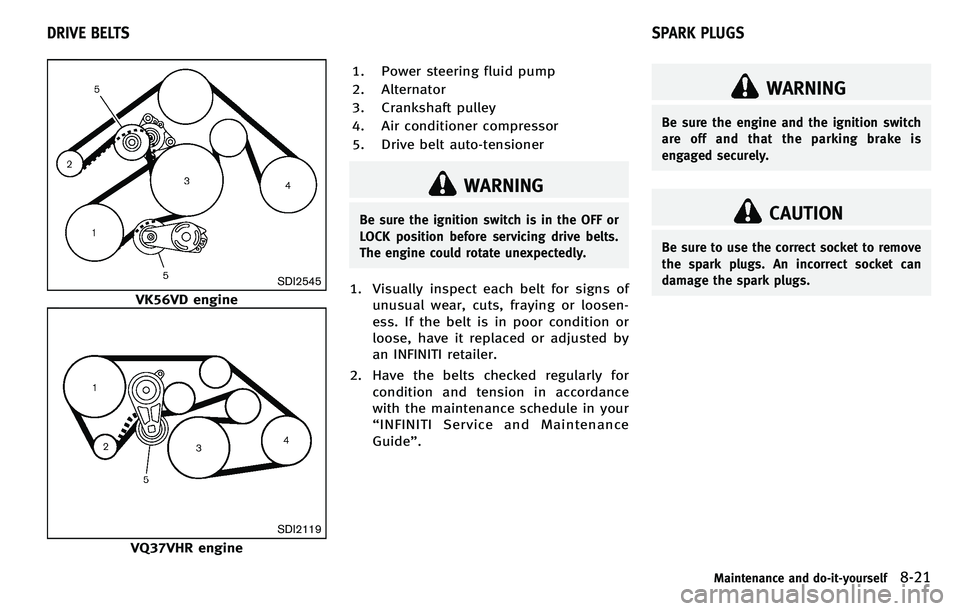
VQ37VHR engine1. Power steering fluid pump
2. Alternator
3. Crankshaft pulley
4. Air conditioner compressor
5. Drive belt auto-tensioner
WARNING
Be sure the ignition switch is in the OFF or
LOCK position before servicing drive belts.
The engine could rotate unexpectedly.
1. Visually inspect each belt for signs of
unusual wear, cuts, fraying or loosen-
ess. If the belt is in poor condition or
loose, have it replaced or adjusted by
an INFINITI retailer.
2. Have the belts checked regularly for condition and tension in accordance
with the maintenance schedule in your
“INFINITI Service and Maintenance
Guide ”.
WARNING
Be sure the engine and the ignition switch
are off and that the parking brake is
engaged securely.
CAUTION
Be sure to use the correct socket to remove
the spark plugs. An incorrect socket can
damage the spark plugs.
Maintenance and do-it-yourself8-21
DRIVE BELTS SPARK PLUGS
Page 471 of 522
8-30Maintenance and do-it-yourself
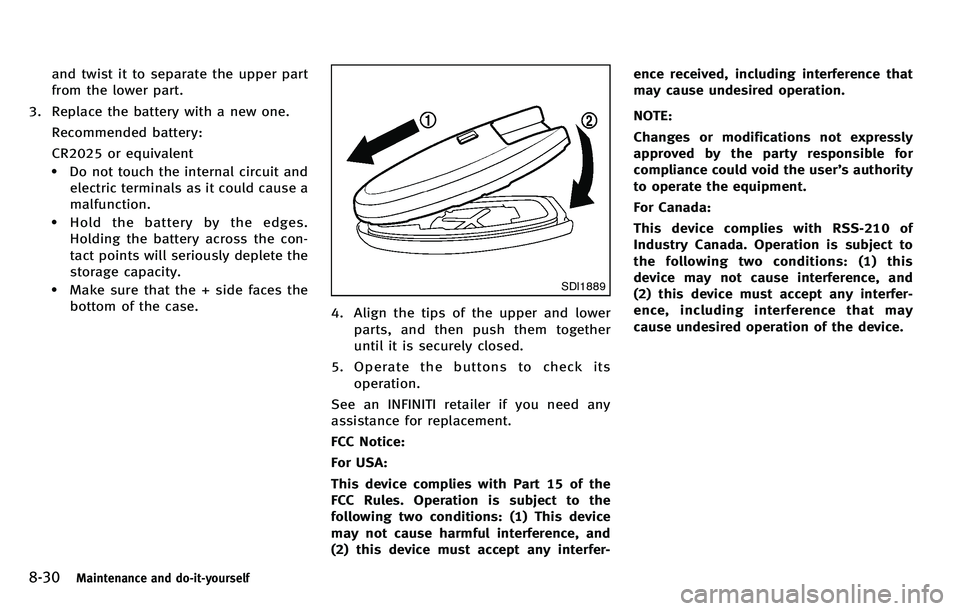
and twist it to separate the upper part
from the lower part.
3. Replace the battery with a new one. Recommended battery:
CR2025 or equivalent
.Do not touch the internal circuit andelectric terminals as it could cause a
malfunction.
.Hold the battery by the edges.
Holding the battery across the con-
tact points will seriously deplete the
storage capacity.
.Make sure that the + side faces thebottom of the case.SDI1889
4. Align the tips of the upper and lower
parts, and then push them together
until it is securely closed.
5. Operate the buttons to check its operation.
See an INFINITI retailer if you need any
assistance for replacement.
FCC Notice:
For USA:
This device complies with Part 15 of the
FCC Rules. Operation is subject to the
following two conditions: (1) This device
may not cause harmful interference, and
(2) this device must accept any interfer- ence received, including interference that
may cause undesired operation.
NOTE:
Changes or modifications not expressly
approved by the party responsible for
compliance could void the user
’s authority
to operate the equipment.
For Canada:
This device complies with RSS-210 of
Industry Canada. Operation is subject to
the following two conditions: (1) this
device may not cause interference, and
(2) this device must accept any interfer-
ence, including interference that may
cause undesired operation of the device.
Page 482 of 522
TIRE CHAINS
Use of tire chains may be prohibited
according to location. Check the local laws
before installing tire chains. When instal-
ling tire chains, make sure they are the
proper size for the tires on your vehicle and
are installed according to the chain man-
ufacturer’s suggestions. Use only SAE
Class S chains. Class“S ” chains are used
on vehicles with restricted tire to vehicle
clearance. Vehicles that can use Class “S ”
chains are designed to meet the SAE
standard minimum clearances between
the tire and the closest vehicle suspension
or body component required to accommo-
date the use of a winter traction device (tire
chains or cables). The minimum clearances
are determined using the factory equipped
tire size. Other types may damage your
vehicle. Use chain tensioners when recom-
mended by the tire chain manufacturer to
ensure a tight fit. Loose end links of the
tire chain must be secured or removed to
prevent the possibility of whipping action
damage to the fenders or underbody. If
possible, avoid fully loading your vehicle
when using tire chains. In addition, drive at
a reduced speed. Otherwise, your vehicle
may be damaged and/or vehicle handling and performance may be adversely af-
fected.
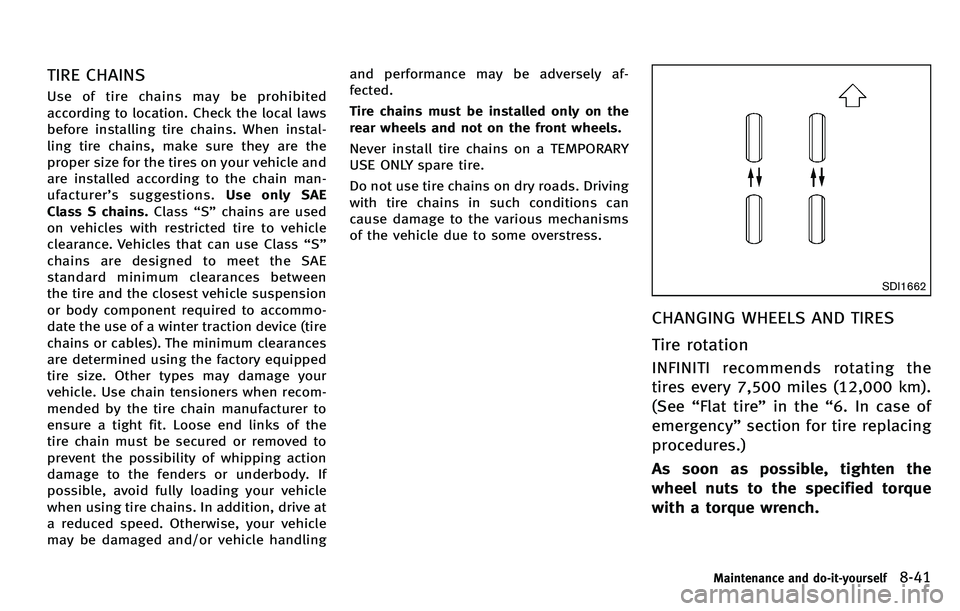
Tire chains must be installed only on the
rear wheels and not on the front wheels.
Never install tire chains on a TEMPORARY
USE ONLY spare tire.
Do not use tire chains on dry roads. Driving
with tire chains in such conditions can
cause damage to the various mechanisms
of the vehicle due to some overstress.
SDI1662
CHANGING WHEELS AND TIRES
Tire rotation
INFINITI recommends rotating the
tires every 7,500 miles (12,000 km).
(See
“Flat tire ”in the “6. In case of
emergency ”section for tire replacing
procedures.)
As soon as possible, tighten the
wheel nuts to the specified torque
with a torque wrench.
Maintenance and do-it-yourself8-41
Page 505 of 522
9-18Technical and consumer information
cargo and luggage load capacity
of your vehicle.
Before driving a loaded vehicle,
confirm that you do not exceed the
Gross Vehicle Weight Rating (GVWR)
or the Gross Axle Weight Rating
(GAWR) for your vehicle. (See “Mea-
surement of weights ”later in this
section.)
Also check tires for proper inflation
pressures. See the Tire and Loading
Information label.
LOADING TIPS
.The GVW must not exceed GVWR or GAWR as specified on the F.M.V.
S.S./C.M.V.S.S. certification label.
.Do not load the front and rear axleto the GAWR. Doing so will exceed
the GVWR.
WARNING
.Properly secure all cargo to help
prevent it from sliding or shifting. Do not place cargo higher than the
seatbacks. In a sudden stop or
collision, unsecured cargo could
cause personal injury.
.Do not load your vehicle any
heavier than the GVWR or the
maximum front and rear GAWRs.
If you do, parts of your vehicle can
break, tire damage could occur, or
it can change the way your vehicle
handles. This could result in loss
of control and cause personal
injury.
.Overloading could not only short-
en the life of your vehicle and the
tires, but also could lead to
hazardous vehicle handling and
long braking distance. This may
cause a premature tire malfunc-
tion, which could result in a
serious accident and personal in-
jury. Failures caused by overload-
ing are not covered by the
vehicle
’s warranty.
MEASUREMENT OF WEIGHTS
Secure loose items to prevent weight
shifts that could affect the balance of
your vehicle. When the vehicle is
loaded, drive to a scale and weigh
the front and the rear wheels sepa-
rately to determine axle loads. In-
dividual axle loads should not
exceed either of the gross axle
weight ratings (GAWR). The total of
the axle loads should not exceed the
gross vehicle weight rating (GVWR).
These ratings are given on the
vehicle certification label. If weight
ratings are exceeded, move or re-
move items to bring all weights
below the ratings.
Page 509 of 522
9-22Technical and consumer information
online at:
https://wwwapps.tc.gc.ca/Saf-Sec-
Sur/7/PCDB-BDPP/Index.aspx.
Additional information concerning
motor vehicle safety may be obtained
from Transport Canada’s Road Safety
Information Centre at 1-800- 333-
0371 or online at www.tc.gc.ca/
roadsafety (English speakers) or
www.tc.gc.ca/securiteroutiere
(French speakers).
To notify INFINITI of any safety con-
cerns please contact our Consumer
Information Centre toll free at 1-800-
361-4792.A vehicle equipped with Intelligent All-
Wheel Drive (AWD) should never be tested
using a two wheel dynamometer (such as
the dynamometers used by some states for
emissions testing), or similar equipment.
Make sure you inform test facility person-
nel that your vehicle is equipped with AWD
before it is placed on a dynamometer.
Using the wrong test equipment may result
in transmission damage or unexpected
vehicle movement which could result in
serious vehicle damage or personal injury.
Due to legal requirements in some states/
areas, your vehicle may be required to be
in what is called the “ready condition ”for
an Inspection/Maintenance (I/M) test of
the emission control system.
The vehicle is set to the “ready condition ”
when it is driven through certain driving
patterns. Usually, the “ready condition ”
can be obtained by ordinary usage of the
vehicle.
If a powertrain system component is
repaired or the battery is disconnected,
the vehicle may be reset to a “not ready
condition ”. Before taking the I/M test,
check the vehicle ’s inspection/mainte-
nance test readiness condition. Place the
ignition switch in the ON position without starting the engine. If the Malfunction
Indicator Light (MIL) comes on steady for
20 seconds and then blinks for 10
seconds, the I/M test condition is
“not
ready ”. If the MIL does not blink after 20
seconds, the I/M test condition is “ready ”.
Contact an INFINITI retailer to set the
“ ready condition ”or to prepare the vehicle
for testing.
READINESS FOR INSPECTION/
MAINTENANCE (I/M) TEST (US only)
Page 512 of 522
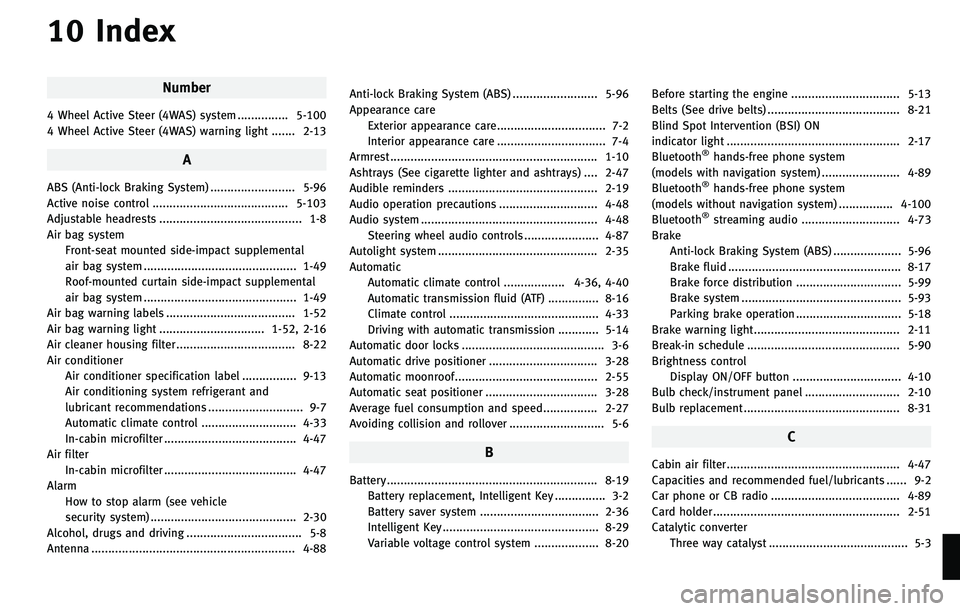
10 Index
Number
4 Wheel Active Steer (4WAS) system ............... 5-100
4 Wheel Active Steer (4WAS) warning light ....... 2-13
A
ABS (Anti-lock Braking System) ......................... 5-96
Active noise control ........................................ 5-103
Adjustable headrests .......................................... 1-8
Air bag systemFront-seat mounted side-impact supplemental
air bag system ............................................. 1-49
Roof-mounted curtain side-impact supplemental
air bag system ............................................. 1-49
Air bag warning labels ...................................... 1-52
Air bag warning light ............................... 1-52, 2-16
Air cleaner housing filter ................................... 8-22
Air conditioner Air conditioner specification label ................ 9-13
Air conditioning system refrigerant and
lubricant recommendations ............................ 9-7
Automatic climate control ............................ 4-33
In-cabin microfilter ....................................... 4-47
Air filter In-cabin microfilter ....................................... 4-47
Alarm
How to stop alarm (see vehicle
security system) ........................................... 2-30
Alcohol, drugs and driving .................................. 5-8
Antenna ............................................................ 4-88 Anti-lock Braking System (ABS) ......................... 5-96
Appearance care
Exterior appearance care................................ 7-2
Interior appearance care ................................ 7-4
Armrest ............................................................. 1-10
Ashtrays (See cigarette lighter and ashtrays) .... 2-47
Audible reminders ............................................ 2-19
Audio operation precautions ............................. 4-48
Audio system .................................................... 4-48 Steering wheel audio controls ...................... 4-87
Autolight system ............................................... 2-35
Automatic Automatic climate control .................. 4-36, 4-40
Automatic transmission fluid (ATF) ............... 8-16
Climate control ............................................ 4-33
Driving with automatic transmission ............ 5-14
Automatic door locks .......................................... 3-6
Automatic drive positioner ................................ 3-28
Automatic moonroof.......................................... 2-55
Automatic seat positioner ................................. 3-28
Average fuel consumption and speed................ 2-27
Avoiding collision and rollover ............................ 5-6
B
Battery .............................................................. 8-19
Battery replacement, Intelligent Key ............... 3-2
Battery saver system ................................... 2-36
Intelligent Key .............................................. 8-29
Variable voltage control system ................... 8-20 Before starting the engine ................................ 5-13
Belts (See drive belts) ....................................... 8-21
Blind Spot Intervention (BSI) ON
indicator light ................................................... 2-17
Bluetooth
®hands-free phone system
(models with navigation system) ....................... 4-89
Bluetooth
®hands-free phone system
(models without navigation system) ................ 4-100
Bluetooth
®streaming audio ............................. 4-73
Brake Anti-lock Braking System (ABS) .................... 5-96
Brake fluid ................................................... 8-17
Brake force distribution ............................... 5-99
Brake system ............................................... 5-93
Parking brake operation ............................... 5-18
Brake warning light........................................... 2-11
Break-in schedule ............................................. 5-90
Brightness control Display ON/OFF button ................................ 4-10
Bulb check/instrument panel ............................ 2-10
Bulb replacement .............................................. 8-31
C
Cabin air filter................................................... 4-47
Capacities and recommended fuel/lubricants ...... 9-2
Car phone or CB radio ...................................... 4-89
Card holder ....................................................... 2-51
Catalytic converter
Three way catalyst ......................................... 5-3