trailer INFINITI M 2012 Owners Manual
[x] Cancel search | Manufacturer: INFINITI, Model Year: 2012, Model line: M, Model: INFINITI M 2012Pages: 522, PDF Size: 3.8 MB
Page 161 of 522
3-22Pre-driving checks and adjustments
result in a serious malfunction and
possible injury. It could also cause the
malfunction indicator light to come on.
. Never pour fuel into the throttle body to
attempt to start your vehicle.
. Do not fill a portable fuel container in
the vehicle or trailer. Static electricity
can cause an explosion of flammable
liquid, vapor or gas in any vehicle or
trailer. To reduce the risk of serious
injury or death when filling portable fuel
containers:
—Always place the container on the
ground when filling.
—Do not use electronic devices whenfilling.
—Keep the pump nozzle in contactwith the container while you are
filling it.
—Use only approved portable fuelcontainers for flammable liquid.
CAUTION
. If fuel is spilled on the vehicle body,
flush it away with water to avoid paint damage.
. Insert the cap straight into the fuel-filler
tube, then tighten until the fuel-filler cap
clicks. Failure to tighten the fuel-filler
cap properly may cause the
mal-
function indicator light (MIL) to illumi-
nate. If the
light illuminates
because the fuel-filler cap is loose or
missing, tighten or install the cap and
continue to drive the vehicle. The
light should turn off after a few driving
trips. If the
light does not turn off
after a few driving trips, have the vehicle
inspected by an INFINITI retailer.
. The LOOSE FUEL CAP warning will appear
if the fuel-filler cap is not properly
tightened. Failure to tighten the fuel-
filler cap properly after the LOOSE FUEL
CAP warning appears may cause the
Malfunction Indicator Light (MIL) to
illuminate.
. For additional information, see “Mal-
function Indicator Light (MIL)” in the
“ 2. Instruments and controls ”section.
JVP0046X
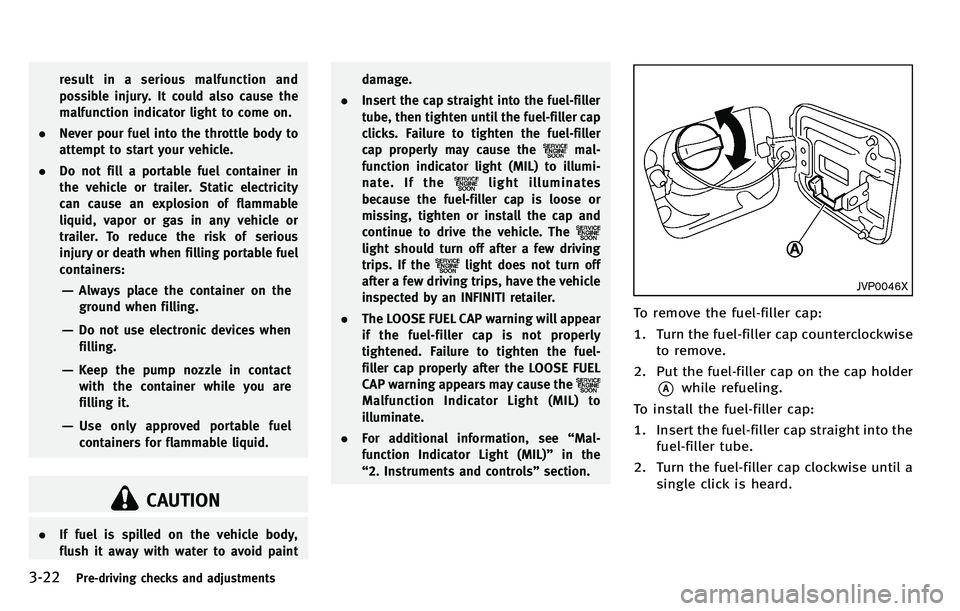
To remove the fuel-filler cap:
1. Turn the fuel-filler cap counterclockwise
to remove.
2. Put the fuel-filler cap on the cap holder
*Awhile refueling.
To install the fuel-filler cap:
1. Insert the fuel-filler cap straight into the fuel-filler tube.
2. Turn the fuel-filler cap clockwise until a single click is heard.
Page 316 of 522
WARNING
.Do not leave children or adults who
would normally require the support of
others alone in your vehicle. Pets should
not be left alone either. They could
accidentally injure themselves or others
through inadvertent operation of the
vehicle. Also, on hot, sunny days,
temperatures in a closed vehicle could
quickly become high enough to cause
severe or possibly fatal injuries to
people or animals.
. Closely supervise children when they are
around cars to prevent them from play-
ing and becoming locked in the trunk
where they could be seriously injured.
Keep the car locked, with the rear
seatback and trunk lid securely latched
when not in use, and prevent children ’s
access to car keys.
EXHAUST GAS (carbon monoxide)
WARNING
. Do not breathe exhaust gases; they
contain colorless and odorless carbon
monoxide. Carbon monoxide is danger-
ous. It can cause unconsciousness or
death.
. If you suspect that exhaust fumes are
entering the vehicle, drive with all
windows fully open, and have the
vehicle inspected immediately.
. Do not run the engine in closed spaces
such as a garage.
. Do not park the vehicle with the engine
running for any extended length of time.
. Keep the trunk lid closed while driving,
otherwise exhaust gases could be drawn
into the passenger compartment. If you
must drive with the trunk lid open,
follow these precautions:
1) Open all the windows.
2) Set the
air recirculation to off
and the fan control to high to
circulate the air. .
If electrical wiring or other cable con-
nections must pass to a trailer through
the seal on the trunk lid or the body,
follow the manufacturer’ s recommenda-
tion to prevent carbon monoxide entry
into the vehicle.
. The exhaust system and body should be
inspected by a qualified mechanic when-
ever:
—The vehicle is raised for service.
—You suspect that exhaust fumes are
entering into the passenger com-
partment.
—You notice a change in the sound of
the exhaust system.
—You have had an accident involvingdamage to the exhaust system,
underbody, or rear of the vehicle.
THREE-WAY CATALYST
The three-way catalyst is an emission
control device installed in the exhaust
system. Exhaust gases in the three-way
catalyst are burned at high temperatures to
help reduce pollutants.
Starting and driving5-3
PRECAUTIONS WHEN STARTING AND
DRIVING
Page 364 of 522
traveling ahead. The sensor generally
detects the signals returned from the
reflectors on a vehicle ahead. Therefore, if
the sensor cannot detect the reflector on
the vehicle ahead, the ICC system may not
maintain the selected distance.
The following are some conditions in which
the sensor cannot detect the signals:
.When the reflector of the vehicle ahead
is positioned high on the vehicle
(trailer, etc.)
. When the reflector on the vehicle ahead
is missing, damaged or covered
. When the reflector of the vehicle ahead
is covered with dirt, snow and road
spray
. When the snow or road spray from
traveling vehicles reduces the sensor ’s
visibility
. When dense exhaust or other smoke
(black smoke) from vehicles reduces
the sensor ’s visibility
. When excessively heavy baggage is
loaded in the rear seat or the trunk of
your vehicle
The ICC system is designed to automati-
cally check the sensor ’s operation within
the limitations of the system. When the sensor is covered with dirt or obstructs, the
system will automatically be canceled. If
the sensor is covered with ice, a transpar-
ent or translucent vinyl bag, etc., the ICC
system may not detect them. In these
instances, the vehicle-to-vehicle distance
control mode may not cancel and may not
be able to maintain the selected following
distance from the vehicle ahead. Be sure to
check and clean the sensor regularly.
The vehicle-to-vehicle distance control
mode is designed to maintain a selected
distance and reduce the speed to match
the slower vehicle ahead; the system will
decelerate the vehicle as necessary and if
the vehicle ahead comes to a stop, the
vehicle decelerates to a standstill. How-
ever, the ICC system can only apply up to
25% of the vehicles total braking power.
This system should only be used when
traffic conditions allow vehicle speeds to
remain fairly constant or when vehicle
speeds change gradually. If a vehicle
moves into the traveling lane ahead or if
a vehicle traveling ahead rapidly decele-
rates, the distance between vehicles may
become closer because the ICC system
cannot decelerate the vehicle quickly en-
ough. If this occurs, the ICC system will
sound a warning chime and blink the
system display to notify the driver to take
necessary action.
The system will cancel and a warning
chime will sound if the speed is below
approximately 15 MPH (24 km/h) and a
vehicle is not detected ahead. The system
will also disengage when the vehicle goes
above the maximum set speed.
See
“Approach warning ”later in this
section.
The following items are controlled in the
vehicle-to-vehicle distance control mode:
. When there are no vehicles traveling
ahead, the vehicle-to-vehicle distance
control mode maintains the speed set
by the driver. The set speed range is
between approximately 20 and 90 MPH
(32 and 144 km/h).
. When there is a vehicle traveling ahead,
the vehicle-to-vehicle distance control
mode adjusts the speed to maintain the
distance, selected by driver, from the
vehicle ahead. The adjusting speed
range is up to the set speed. If the
vehicle ahead comes to a stop, the
vehicle decelerates to a standstill with-
in the limitations of the system. The
system will cancel once it judges a
Starting and driving5-51
Page 384 of 522
—When rain, snow or dirt adhere tothe system sensor
—On steep downhill roads (frequentbraking may result in overheating
the brakes)
—On repeated uphill and downhill
roads
. In some road or traffic conditions, a
vehicle or object can unexpectedly come
into the sensor detection zone and cause
automatic braking. You may need to
control the distance from other vehicles
using the accelerator pedal. Always stay
alert and avoid using the DCA system
when it is not recommended in this
section.
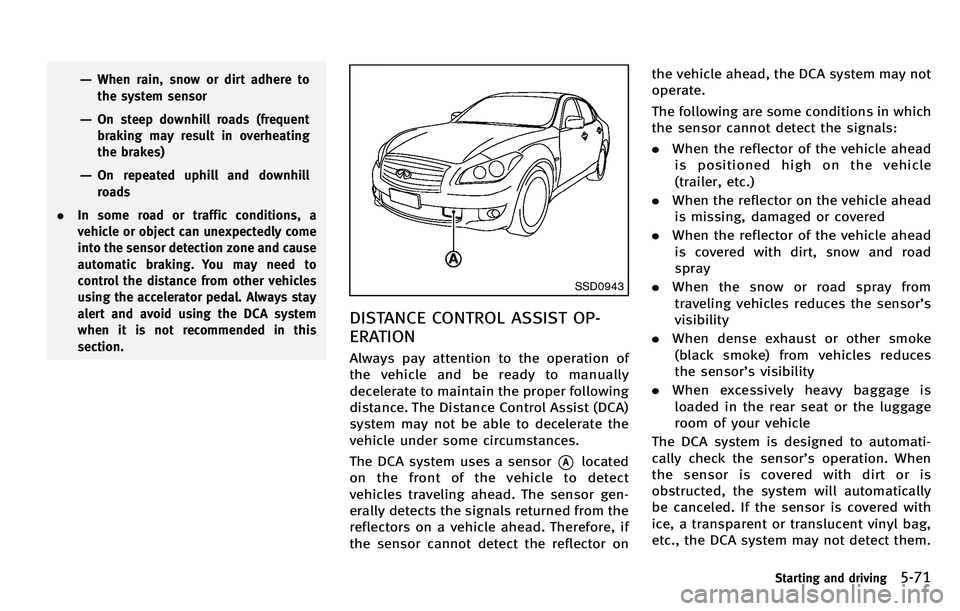
SSD0943
DISTANCE CONTROL ASSIST OP-
ERATION
Always pay attention to the operation of
the vehicle and be ready to manually
decelerate to maintain the proper following
distance. The Distance Control Assist (DCA)
system may not be able to decelerate the
vehicle under some circumstances.
The DCA system uses a sensor
*Alocated
on the front of the vehicle to detect
vehicles traveling ahead. The sensor gen-
erally detects the signals returned from the
reflectors on a vehicle ahead. Therefore, if
the sensor cannot detect the reflector on the vehicle ahead, the DCA system may not
operate.
The following are some conditions in which
the sensor cannot detect the signals:
.
When the reflector of the vehicle ahead
is positioned high on the vehicle
(trailer, etc.)
. When the reflector on the vehicle ahead
is missing, damaged or covered
. When the reflector of the vehicle ahead
is covered with dirt, snow and road
spray
. When the snow or road spray from
traveling vehicles reduces the sensor ’s
visibility
. When dense exhaust or other smoke
(black smoke) from vehicles reduces
the sensor ’s visibility
. When excessively heavy baggage is
loaded in the rear seat or the luggage
room of your vehicle
The DCA system is designed to automati-
cally check the sensor ’s operation. When
the sensor is covered with dirt or is
obstructed, the system will automatically
be canceled. If the sensor is covered with
ice, a transparent or translucent vinyl bag,
etc., the DCA system may not detect them.
Starting and driving5-71
Page 488 of 522
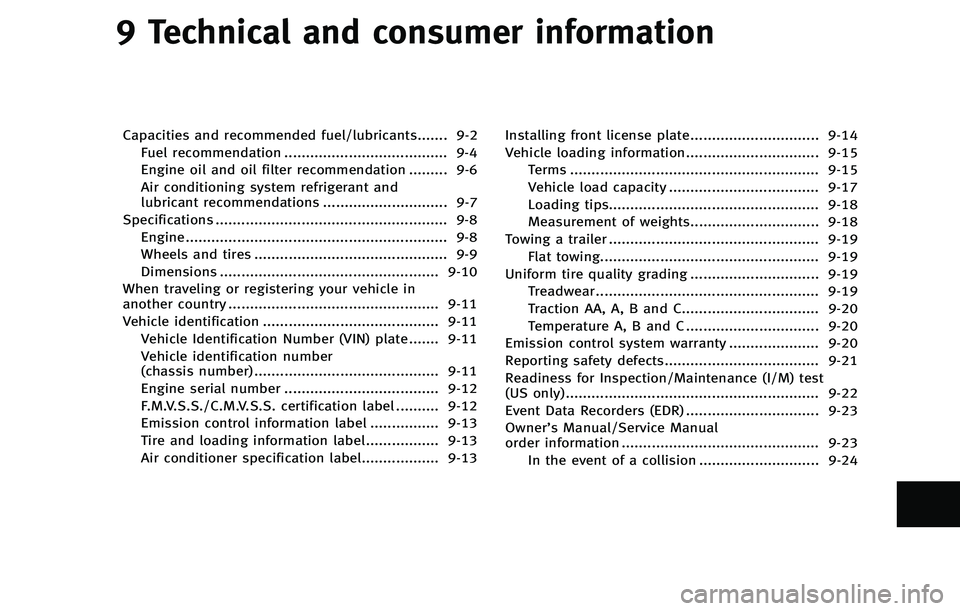
9 Technical and consumer information
Capacities and recommended fuel/lubricants....... 9-2Fuel recommendation ...................................... 9-4
Engine oil and oil filter recommendation ......... 9-6
Air conditioning system refrigerant and
lubricant recommendations ............................. 9-7
Specifications ...................................................... 9-8
Engine............................................................. 9-8
Wheels and tires ............................................. 9-9
Dimensions ................................................... 9-10
When traveling or registering your vehicle in
another country ................................................. 9-11
Vehicle identification ......................................... 9-11 Vehicle Identification Number (VIN) plate ....... 9-11
Vehicle identification number
(chassis number) ........................................... 9-11
Engine serial number .................................... 9-12
F.M.V.S.S./C.M.V.S.S. certification label .......... 9-12
Emission control information label ................ 9-13
Tire and loading information label ................. 9-13
Air conditioner specification label.................. 9-13 Installing front license plate .............................. 9-14
Vehicle loading information............................... 9-15
Terms .......................................................... 9-15
Vehicle load capacity ................................... 9-17
Loading tips................................................. 9-18
Measurement of weights.............................. 9-18
Towing a trailer ................................................. 9-19 Flat towing................................................... 9-19
Uniform tire quality grading .............................. 9-19 Treadwear .................................................... 9-19
Traction AA, A, B and C................................ 9-20
Temperature A, B and C ............................... 9-20
Emission control system warranty ..................... 9-20
Reporting safety defects.................................... 9-21
Readiness for Inspection/Maintenance (I/M) test
(US only)........................................................... 9-22
Event Data Recorders (EDR) ............................... 9-23
Owner ’s Manual/Service Manual
order information .............................................. 9-23
In the event of a collision ............................ 9-24
Page 503 of 522
9-16Technical and consumer information
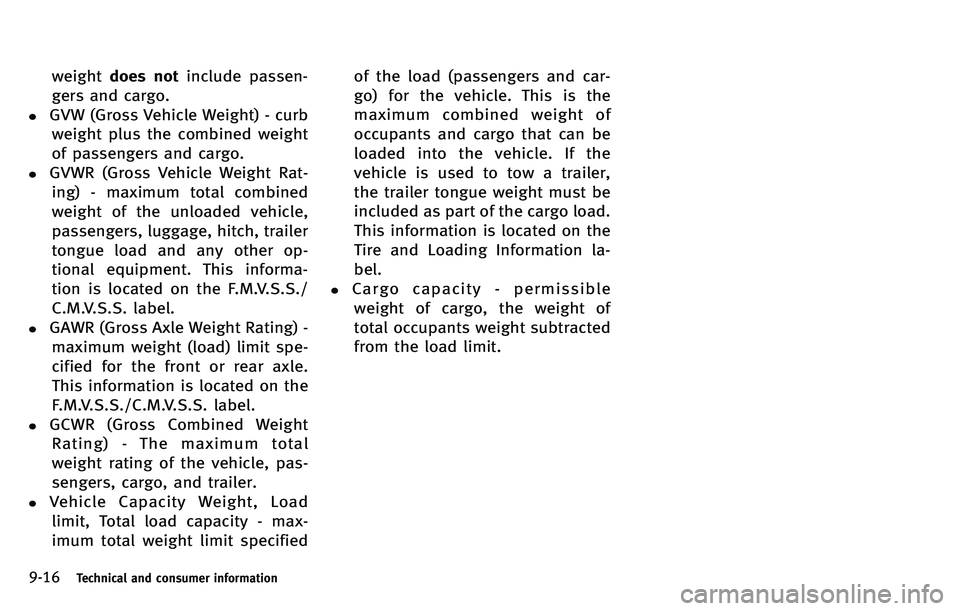
weightdoes not include passen-
gers and cargo.
.GVW (Gross Vehicle Weight) - curb weight plus the combined weight
of passengers and cargo.
.GVWR (Gross Vehicle Weight Rat-ing) - maximum total combined
weight of the unloaded vehicle,
passengers, luggage, hitch, trailer
tongue load and any other op-
tional equipment. This informa-
tion is located on the F.M.V.S.S./
C.M.V.S.S. label.
.GAWR (Gross Axle Weight Rating) -maximum weight (load) limit spe-
cified for the front or rear axle.
This information is located on the
F.M.V.S.S./C.M.V.S.S. label.
.GCWR (Gross Combined WeightRating) - The maximum total
weight rating of the vehicle, pas-
sengers, cargo, and trailer.
.Vehicle Capacity Weight, Loadlimit, Total load capacity - max-
imum total weight limit specified of the load (passengers and car-
go) for the vehicle. This is the
maximum combined weight of
occupants and cargo that can be
loaded into the vehicle. If the
vehicle is used to tow a trailer,
the trailer tongue weight must be
included as part of the cargo load.
This information is located on the
Tire and Loading Information la-
bel.
.Cargo capacity - permissible
weight of cargo, the weight of
total occupants weight subtracted
from the load limit.
Page 504 of 522
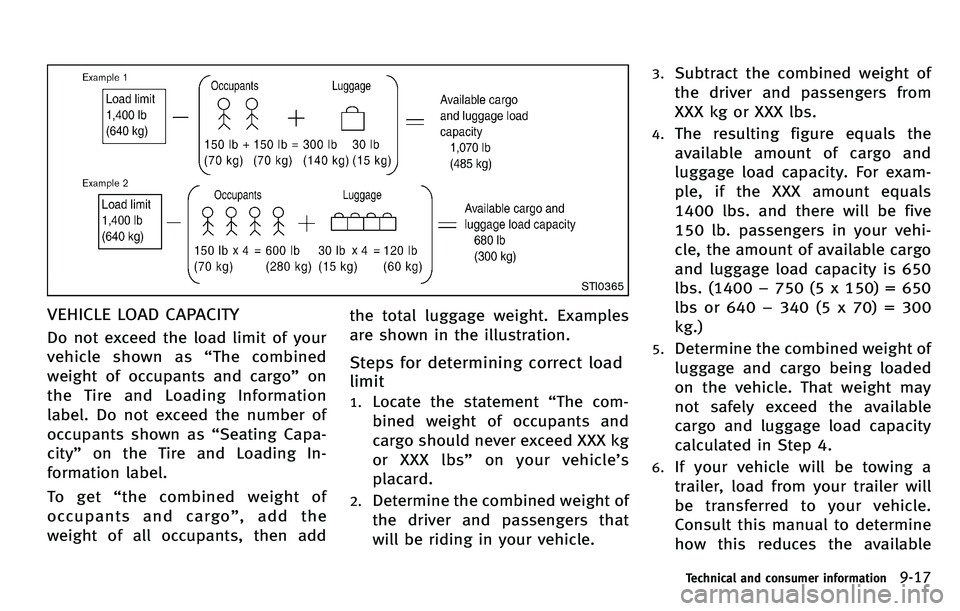
STI0365
VEHICLE LOAD CAPACITY
Do not exceed the load limit of your
vehicle shown as“The combined
weight of occupants and cargo ”on
theTireandLoadingInformation
label. Do not exceed the number of
occupants shown as “Seating Capa-
city ”on the Tire and Loading In-
formation label.
To get “the combined weight of
occupants and cargo ”,addthe
weight of all occupants, then add the total luggage weight. Examples
are shown in the illustration.
Steps for determining correct load
limit
1.Locate the statement
“The com-
bined weight of occupants and
cargo should never exceed XXX kg
or XXX lbs” on your vehicle ’s
placard.
2.Determine the combined weight of
the driver and passengers that
will be riding in your vehicle.
3.Subtract the combined weight of
the driver and passengers from
XXX kg or XXX lbs.
4.The resulting figure equals the
available amount of cargo and
luggage load capacity. For exam-
ple, if the XXX amount equals
1400 lbs. and there will be five
150 lb. passengers in your vehi-
cle, the amount of available cargo
and luggage load capacity is 650
lbs. (1400 −750 (5 x 150) = 650
lbs or 640 −340 (5 x 70) = 300
kg.)
5.Determine the combined weight of
luggage and cargo being loaded
on the vehicle. That weight may
not safely exceed the available
cargo and luggage load capacity
calculated in Step 4.
6.If your vehicle will be towing a
trailer, load from your trailer will
be transferred to your vehicle.
Consult this manual to determine
how this reduces the available
Technical and consumer information9-17
Page 506 of 522
Do not tow a trailer with your
vehicle.
FLAT TOWING
Towing your vehicle with all four wheels on
the ground is sometimes called flat towing.
This method is sometimes used when
towing a vehicle behind a recreational
vehicle, such as a motor home.
CAUTION
.Failure to follow these guidelines can
result in severe transmission damage.
. Whenever flat towing your vehicle, al-
ways tow forward, never backward.
. DO NOT tow any automatic transmission
vehicle with all four wheels on the
ground (flat towing). Doing so WILL
DAMAGE internal transmission parts
due to lack of transmission lubrication.
. For emergency towing procedures refer
to“Towing recommended by INFINITI ”in
the “6. In case of emergency ”section of
this manual.
Automatic transmission
To tow a vehicle equipped with an auto-
matic transmission, an appropriate vehicle
dolly MUST be placed under the towed
vehicle ’s drive wheels. Alwaysfollow the
dolly manufacturer ’s recommendations
when using their product. DOT (Department Of Transportation) Qual-
ity Grades: All passenger car tires must
conform to federal safety requirements in
addition to these grades.
Quality grades can be found where applic-
able on the tire sidewall between tread
shoulder and maximum section width. For
example:
Treadwear 200 Traction AA Temperature A
TREADWEAR
The treadwear grade is a comparative
rating based on the wear rate of the tire
when tested under controlled conditions
on a specified government test course. For
example, a tire graded 150 would wear one
and one-half (1 1/2) times as well on the
government course as a tire graded 100.
The relative performance of tires depends
upon actual conditions of their use, how-
ever, and may depart significantly from the
norm due to variations in driving habits,
service practices and differences in road
characteristics and climate.
Technical and consumer information9-19
TOWING A TRAILER
UNIFORM TIRE QUALITY GRADING
Page 518 of 522

Speedometer ...................................................... 2-6
SPORT mode ..................................................... 5-19
STANDARD mode ............................................... 5-19
StartingBefore starting the engine ........................... 5-13
Jump starting ............................................... 8-20
Precautions when starting and driving ........... 5-3
Push starting ............................................... 6-10
Starting the engine ...................................... 5-13
STATUS button .................................................. 4-10
Status light, Front passenger air bag ................ 1-46
Steering Heated steering wheel ................................. 2-40
Power steering fluid ..................................... 8-16
Power steering system ................................. 5-93
Steering lock release malfunction indicator
(if so equipped) ........................................... 2-22
Steering-wheel-mounted controls
for audio ...................................................... 4-87
Tilt/telescopic steering ................................. 3-23
Steering lock (if so equipped) ........................... 5-11
Storage ............................................................. 2-48
Sun visors ........................................................ 3-24
Sunglasses holder ............................................ 2-49
Sunshade (rear) ................................................ 2-57
Supplemental air bag warning labels ................ 1-52
Supplemental air bag warning light ......... 1-52, 2-16
Supplemental restraint system .......................... 1-39
Precautions on supplemental
restraint system ........................................... 1-39 Switch
Autolight switch ........................................... 2-35
Fog light switch ........................................... 2-39
Hazard warning flasher switch ..................... 2-40
Headlight switch .......................................... 2-35
Ignition switch ............................................. 5-14
Intelligent Brake Assist (IBA) OFF switch ...... 2-44
Power door lock switch .................................. 3-5
Rear window and outside mirror
defroster switch ........................................... 2-34
Turn signal switch ........................................ 2-39
Vehicle dynamic control (VDC) off switch ...... 2-45
Warning systems switch ............................... 2-44
T
Tachometer ......................................................... 2-7
Temperature gaugeEngine coolant temperature gauge ................. 2-8
Theft (INFINITI Vehicle Immobilizer System) Engine start ................................................. 2-30
Three-way catalyst .............................................. 5-3
Tilt/telescopic steering ...................................... 3-23
“ TIMER ”indicator.............................................. 2-23
Tire
Tire replacement indicator............................ 2-25
Tire rotation ................................................. 8-41
Tire pressure
Low tire pressure warning light .................... 2-14
Tires Flat tire .......................................................... 6-2
Low tire pressure warning system ... 5-4, 6-2, 8-34 Spare tire .................................................... 8-44
Tire and Loading information label ...... 8-36, 9-13
Tire chains ................................................... 8-41
Tire dressing .................................................. 7-4
Tire pressure................................................ 8-34
Tire pressure information (display) ............... 4-12
Tire pressure monitoring system
(TPMS) .......................................... 5-4, 6-2, 8-34
Types of tires ............................................... 8-40
Uniform tire quality grading ......................... 9-19
Wheel/tire size .............................................. 9-9
Wheels and tires .......................................... 8-34
Touch screen system ........................................... 4-6
Towing Flat towing ................................................... 9-19
Tow truck towing.......................................... 6-12
Towing a trailer ............................................ 9-19
TPMS Tire pressure monitoring system ... 5-4, 6-2, 8-34
Tire pressure warning system ....... 5-4, 6-2, 8-34
Trailer towing .................................................... 9-19
Transceiver
HomeLink
®Universal Transceiver ................. 2-61
Transmission Automatic transmission fluid (ATF) ............... 8-16
Driving with automatic transmission ............ 5-14
Transmission selector lever lock release ...... 5-18
Transmitter (See remote keyless entry system) ... 3-14
Traveling or registering your vehicle in
another country ................................................ 9-11
Trip computer ................................................... 2-26
10-7