indicator INFINITI Q50 2018 Owners Manual
[x] Cancel search | Manufacturer: INFINITI, Model Year: 2018, Model line: Q50, Model: INFINITI Q50 2018Pages: 458, PDF Size: 2.13 MB
Page 304 of 458

Action to take:
If the FEB warning light (orange)
comes
on, stop the vehicle in a safe place, place the
shift lever in the P (Park) position and turn
the engine off. Clean the radar cover on
lower grille with a soft cloth, and restart the
engine. If the FEB warning light (orange)
continues to illuminate, have the PFCW
system checked. It is recommended you visit
an INFINITI retailer for this service.
. When driving on roads with limited road
structures or buildings (for example, long
bridges, deserts, snow fields, driving next
to long walls)
Action to take:
When the above conditions no longer exist,
the PFCW system will resume automatically.
NOTE:
If the FEB system stops working, the PFCW
system will also stop working.
SYSTEM MALFUNCTION
If the PFCW malfunctions, it will be turned
off automatically, a chime will sound, the
FEB system warning light (orange)
and
the driver assist system forward indicator
(orange)
will illuminate, and the system
“malfunction” message will appear in the
vehicle information display.
Action to take:
If the FEB system warning light (orange)
comes on, stop the vehicle in a safe location,
turn the engine off and restart the engine. If
the warning light continues to illuminate,
have the PFCW system checked. It is
recommended you visit an INFINITI retailer
for this service.
JVS1123X
SYSTEM MAINTENANCE
The sensoris located behind the lower
grille of the front bumper.
To keep the system operating properly, be
sure to observe the following:
. Always keep the sensor area of the front
bumper clean.
. Do not strike or damage the areas around
the sensor.
. Do not cover or attach stickers or similar
objects on the front bumper near the
sensor area. This could cause failure or
malfunction.
. Do not attach metallic objects near the
sensor area (brush guard, etc.). This
Starting and driving5-121
Page 316 of 458
.You may feel a pulsation in the brake
pedal and hear a noise or vibration from
under the hood. This is normal and
indicates that the VDC system is working
properly.
. Adjust your speed and driving to the road
conditions.
See “Vehicle Dynamic Control (VDC) warn-
ing light” (P.2-15).
If a malfunction occurs in the system, the
VDC warning light
illuminates in the
instrument panel. The VDC system automa-
tically turns off.
The VDC OFF switch is used to turn off the
VDC system. The VDC off indicator light
illuminates to indicate the VDC system is off.
When the VDC switch is used to turn off the
system, the VDC system still operates to
prevent one drive wheel from slipping by
transferring power to a non slipping drive
wheel. The VDC warning light
flashes if
this occurs. All other VDC functions are off,
except for brake force distribution, and the
VDC warning light
will not flash. The
VDC system is automatically reset to on
when the ignition switch is placed in the off
position then back to the on position.
See “Vehicle Dynamic Control (VDC) warn-
ing light” (P.2-15) and “Vehicle Dynamic
Control (VDC) off indicator light” (P.2-18).
The computer has a built-in diagnostic feature that tests the system each time you
start the engine and move the vehicle
forward or in reverse at a slow speed. When
the self-test occurs, you may hear a “clunk”
noise and/or feel a pulsation in the brake
pedal. This is normal and is not an indication
of a malfunction.
VDC operation is reduced when the INFINITI
Drive Mode Selector is used to select the
SPORT+ mode (if so equipped). The VDC
system may not operate in the same circum-
stances when compared to operation in the
standard mode. To help prevent accidents
drive carefully, avoid careless or dangerous
driving techniques and be especially careful
when driving and cornering on slippery
surfaces.
BRAKE FORCE DISTRIBUTION
During braking while driving through turns,
the system optimizes the distribution of
force to each of the four wheels depending
on the radius of the turn.
WARNING
.
The VDC system is designed to help
the driver maintain stability but does
not prevent accidents due to abrupt
steering operation at high speeds or
by careless or dangerous driving techniques. Reduce vehicle speed
and be especially careful when driving
and cornering on slippery surfaces
and always drive carefully.
. The brake force distribution system
may not be effective depending on
the driving condition. Always drive
carefully and attentively.
. Do not modify the vehicle’s suspen-
sion. If suspension parts such as
shock absorbers, struts, springs, sta-
bilizer bars, bushings and wheels are
not INFINITI recommended for your
vehicle or are extremely deteriorated,
the VDC system may not operate
properly. This could adversely affect
vehicle handling performance, and
the VDC warning light
may
illuminate.
. If brake related parts such as brake
pads, rotors and calipers are not
INFINITI recommended or are extre-
mely deteriorated, the VDC system
may not operate properly and the
VDC warning light
may illumi-
nate.
. If engine control related parts are not
INFINITI recommended or are extre-
mely deteriorated, the VDC warning
light
may illuminate.
Starting and driving5-133
Page 320 of 458
The Idling Stop System activates to prevent
unnecessary fuel consumption, exhaust
emissions and noise.
.When you fully depress the brake pedal
to stop the vehicle, the engine is turned
off automatically.
. When you release the brake pedal to
begin moving again, the engine is turned
on automatically.
WARNING
The engine restarts if the vehicle moves
at approximately 1 MPH (2 km/h) or
more (on a downhill grade, etc.), while
the engine is turned off by the Idling
Stop System. Depress the brake pedal
immediately to stop the vehicle to pre-
vent an accident.
CAUTION
At the end of the journey the engine
must be stopped and ignition switch be
turned off. Lock the vehicle as normal.
Turning the ignition switch OFF will shut
down all electrical systems. Failure to do
this may result in a discharged battery. NOTE:
The Idling Stop System will not activate
under the following conditions:
.
when the engine is kept idling without
the vehicle being driven after the engine
is turned on.
. when the engine coolant temperature is
low.
. when the battery capacity is low.
. when the battery temperature is low or
extremely high.
. when the vehicle is moving.
. when a negative pressure booster de-
creases.
. when the engine hood is opened with the
engine running.
. when the engine is turned on with the
engine hood open.
. when the driver’s seat belt is not fas-
tened.
. when the driver’s door is open.
. when the steering wheel is operated.
. when the angle of steering wheel is not
straight.
. when the Idling Stop System indicator
blinks at a low speed.
. when the fan speed control is in any
position other than “OFF” (0) while the
air flow control is in the front defroster
position. .
when the front defroster switch is on.
. when the rear window defroster switch
is on.
. When the temperature inside the vehicle
is lower than approximately 68°F
(20°C).
. When the temperature inside the vehicle
is higher than approximately 86°F
(30°C). (When the air conditioner is
off, the Idling Stop System will operate.)
. When the fan speed of the air condi-
tioner is set to the maximum speed.
. when the Idling Stop OFF switch is
turned on.
. when the power consumption is large.
. when the vehicle is traveling at altitudes
higher than 8,203 ft (2,500 m).
. when the accelerator pedal is depressed.
. when the shift lever is in the R (Reverse)
position.
. when the brake pedal is not firmly
depressed.
. when stopping the vehicle on steep
sloping roads.
NOTE:
The engine will not restart even if the brake
pedal is released while the Idling Stop
System is activated when the shift lever is
in the P (Park) position.
Starting and driving5-137
IDLING STOP SYSTEM (if so equipped)
Page 321 of 458
5-138Starting and driving
NOTE:
It may take some time until the Idling Stop
System activates under the following con-
ditions:
.when the battery is discharged.
. when the outside temperature is low or
high.
. when the battery is replaced or the
battery terminal is disconnected for
extended periods and then reconnected.
NOTE:
When the Idling Stop System indicator light
illuminates, the engine starts running auto-
matically under at least one of the following
conditions:
. The brake pedal is released with the shift
lever in the D (Drive) or N (Neutral)
position.
. The shift lever is placed in the D (Drive)
or R (Reverse) position from the N
(Neutral) or P (Park) position.
. The driver’s seat belt is unfastened, or
the driver’s door is open.
. The battery voltage becomes low (due to
electrical load from other vehicle sys-
tems like headlights, heaters, etc., or
auxiliary devices connected to the 12
volt socket inside the vehicle).
. The vehicle speed is above about 1 MPH
(2 km/h). .
The front defroster is operated.
. The rear window defroster is operated.
. When the temperature inside the vehicle
is lower than approximately 68°F
(20°C).
. When the temperature inside the vehicle
is higher than approximately 86°F
(30°C). (When the air conditioner is
off, the Idling Stop System will operate.)
. When the front defroster is turned on.
(The engine may not starts depending
on the outside temperature.)
. When more than 3 minutes have elapsed
since the Idling Stop System was active.
. When the accelerator pedal is depressed.
. When the steering wheel is operated.
(The steering wheel operation may be-
come heavy, but this is not a malfunc-
tion.)
. When the battery capacity is low.
. When the power consumption is high.
. When the shift lever is placed in the R
(Reverse) position.
NOTE:
The following condition will prevent the
Idling Stop System from automatically re-
starting the engine. Starting the engine
with the ignition switch operation is then
necessary: .
The hood is open.
Use this system while waiting at stoplight,
etc. When the vehicle is stopped for long
periods of time, turn off the engine.
When the engine is stopped by the Idling
Stop System, heating, cooling and dehumi-
difying functions will be deactivated. To
avoid the air conditioning functions from
being deactivated, turn off the Idling Stop
mode by pushing the Idling Stop OFF switch.
RETROGRADE MOVEMENT
CONTROL FUNCTION
This system is designed to reduce the retro-
grade movement that occurs while the
driver’s foot changes from depressing the
brake pedal to the accelerator pedal when
moving the vehicle while the Idling Stop
System is active on a hilly road.
IDLING STOP SYSTEM DISPLAY
The status of the Idling Stop System can be
checked in the vehicle information display.
Page 324 of 458

automatically stopping during the same
journey.
. Whenever the Idling Stop System is
deactivated the indicator light
on the
Idling Stop OFF switch illuminates. In
this condition the Idling Stop System
cannot prevent unnecessary fuel con-
sumption, exhaust emissions, or noise
during your journey.
. If the Idling Stop System is malfunction-
ing, the indicator light
on the Idling
Stop OFF switch illuminates.
NOTE:
The Idling Stop System ON or OFF message
is displayed for a few seconds in the vehicle
information display when the Idling Stop
OFF switch is pushed. See “Idling Stop
System ON or OFF” (P.5-139).
FREEING A FROZEN DOOR LOCK
To prevent a door lock from freezing, apply
deicer through the key hole. If the lock
becomes frozen, heat the key before insert-
ing it into the key hole or use the Intelligent
Key system.
ANTIFREEZE
In the winter when it is anticipated that the
outside temperature will drop below 32°F
(0°C), check antifreeze to assure proper
winter protection. For additional informa-
tion, see “Engine cooling system (for
VR30DDTT engine models)” (P.8-6), “En-
gine cooling system (for 2.0L turbo gasoline
engine models)” (P.8-8) or “Intercooler cool-
ing system (for VR30DDTT engine models)”
(P.8-9).
BATTERY
If the battery is not fully charged during
extremely cold weather conditions, the bat-
tery fluid may freeze and damage the
battery. To maintain maximum efficiency,
the battery should be checked regularly. For
additional information, see “Battery” (P.8-
16).
DRAINING OF COOLANT WATER
If the vehicle is to be left outside without
antifreeze, drain the cooling system, includ-
ing the engine block. Refill before operating
the vehicle. For details, see “Engine cooling
system (for VR30DDTT engine models)”
(P.8-6) or “Engine cooling system (for 2.0L
turbo gasoline engine models)” (P.8-8).
TIRE EQUIPMENT
SUMMER tires have a tread designed to
provide superior performance on dry pave-
ment. However, the performance of these
tires will be substantially reduced in snowy
and icy conditions. If you operate your
vehicle on snowy or icy roads, INFINITI
recommends the use of MUD & SNOW or
ALL SEASON tires on all four wheels. It is
recommended you consult an INFINITI re-
tailer for the tire type, size, speed rating and
availability information.
For additional traction on icy roads, studded
tires may be used. However, some U.S.
states and Canadian provinces prohibit their
use. Check local, state and provincial laws
before installing studded tires.
Skid and traction capabilities of studded
snow tires, on wet or dry surfaces, may be
poorer than that of non-studded snow tires.
Tire chains may be used. For details, see
“Tire chains” (P.8-40) of this manual.
Starting and driving5-141
COLD WEATHER DRIVING
Page 372 of 458
JVM0599X
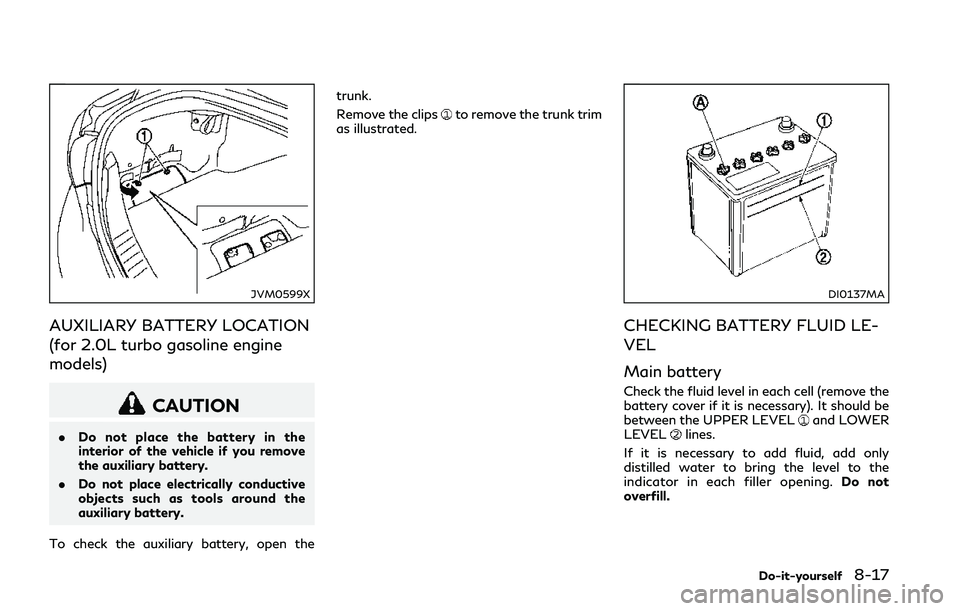
AUXILIARY BATTERY LOCATION
(for 2.0L turbo gasoline engine
models)
CAUTION
.Do not place the battery in the
interior of the vehicle if you remove
the auxiliary battery.
. Do not place electrically conductive
objects such as tools around the
auxiliary battery.
To check the auxiliary battery, open the trunk.
Remove the clips
to remove the trunk trim
as illustrated.
DI0137MA
CHECKING BATTERY FLUID LE-
VEL
Main battery
Check the fluid level in each cell (remove the
battery cover if it is necessary). It should be
between the UPPER LEVEL
and LOWER
LEVELlines.
If it is necessary to add fluid, add only
distilled water to bring the level to the
indicator in each filler opening. Do not
overfill.
Do-it-yourself8-17
Page 387 of 458

8-32Do-it-yourself
If you have a flat tire, see “Flat tire” (P.6-3).
TIRE PRESSURE
Tire Pressure Monitoring System
(TPMS)
This vehicle is equipped with the Tire
Pressure Monitoring System (TPMS). It
monitors tire pressure of all tires except the
spare. When the low tire pressure warning
light is lit and the “Tire Pressure Low - Add
Air” warning appears in the vehicle informa-
tion display, one or more of your tires is
significantly under-inflated.
The TPMS will activate only when the
vehicle is driven at speeds above 16 MPH
(25 km/h). Also, this system may not detect
a sudden drop in tire pressure (for example a
flat tire while driving).
For more details, see “Low tire pressure
warning light” (P.2-12),“Tire Pressure Mon-
itoring System (TPMS)” (P.5-5) and “Tire
Pressure Monitoring System (TPMS)” (P.6-
3).
Tire inflation pressure
Check the pressure of the tires (in-
cluding the spare) often and always
prior to long distance trips. The
recommended tire pressure specifica-
tions are shown on the Tire andLoading Information label under the
“Cold Tire Pressure” heading. The Tire
and Loading Information label is
affixed to the driver side center pillar.
Tire pressures should be checked
regularly because:
.
Most tires naturally lose air over
time.
. Tires can lose air suddenly when
driven over potholes or other ob-
jects or if the vehicle strikes a curb
while parking.
The tire pressures should be checked
when the tires are cold. The tires are
considered COLD after the vehicle
has been parked for 3 or more hours,
or driven less than 1 mile (1.6 km) at
moderate speeds.
TPMS with Tire Inflation Indicator
provides visual and audible signals
outside the vehicle for inflating the
tires to the recommended COLD tire
pressure. (See “TPMS with Tire Infla-
tion Indicator” (P.5-8) about the
TPMS with Tire Inflation Indicator.)
Incorrect tire pressure, including un-
der inflation, may adversely affect tire life and vehicle handling.
WARNING
.
Improperly inflated tires can fail
suddenly and cause an accident.
. The Gross Vehicle Weight rat-
ing (GVWR) is located on the F.
M.V.S.S./C.M.V.S.S. label. The
vehicle weight capacity is indi-
cated on the Tire and Loading
Information label. Do not load
your vehicle beyond this capa-
city. Overloading your vehicle
may result in reduced tire life,
unsafe operating conditions
due to premature tire failure,
or unfavorable handling char-
acteristics and could also lead
to a serious accident. Loading
beyond the specified capacity
may also result in failure of
other vehicle components.
. Before taking a long trip, or
whenever you heavily load your
vehicle, use a tire pressure
gauge to ensure that the tire
WHEELS AND TIRES
Page 397 of 458
8-42Do-it-yourself
tire/wheel on the front of the
vehicle. Doing so can damage
the vehicle or tire. Damage to
the tire may result in a sudden
loss of air pressure which may
cause loss of vehicle control in
some driving conditions and
cause a collision and personal
injury.
. Retighten the wheel nuts when
the vehicle has been driven for
600 miles (1,000 km) (also in
cases of a flat tire, etc.).
. For additional information re-
garding tires, refer to “Impor-
tant Tire Safety Information”
(US) or “Tire Safety Informa-
tion” (Canada) in the Warranty
Information Booklet.
After the ignition switch is placed in
the ON position, it may take a period
of time for the tire pressure to be
displayed in the vehicle information
display while the vehicle is driven.
Depending on the radio wave circum-
stance, tire pressure may not cor- rectly be displayed.
SDI1663
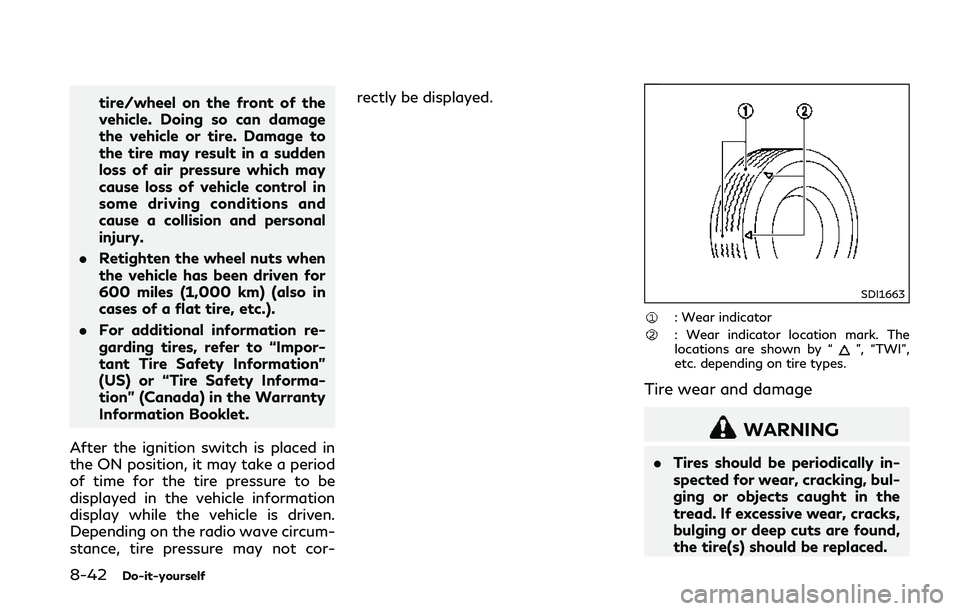
: Wear indicator
: Wear indicator location mark. The
locations are shown by “”, “TWI”,
etc. depending on tire types.
Tire wear and damage
WARNING
. Tires should be periodically in-
spected for wear, cracking, bul-
ging or objects caught in the
tread. If excessive wear, cracks,
bulging or deep cuts are found,
the tire(s) should be replaced.
Page 398 of 458

.The original tires have built-in
tread wear indicators. When
wear indicators are visible, the
tire(s) should be replaced.
. Tires degrade with age and use.
Have tires, including the spare,
over 6 years old checked by a
qualified technician, because
some tire damage may not be
obvious. Replace the tires as
necessary to prevent tire failure
and possible personal injury.
. Improper service of the spare
tire may result in serious perso-
nal injury. If it is necessary to
repair the spare tire, it is re-
commended you visit an
INFINITI retailer for this ser-
vice.
. For additional information re-
garding tires, refer to “Impor-
tant Tire Safety Information”
(US) or “Tire Safety Informa-
tion” (Canada) in the Warranty
Information Booklet.Replacing wheels and tires
When replacing a tire, use the same size,
tread design, speed rating and load carrying
capacity as originally equipped. (See “Speci-
fications” (P.10-11) for recommended types
and sizes of tires and wheels.)
After the ignition switch is placed in the ON
position, it may take a period of time for the
tire pressure to be displayed in the vehicle
information display while the vehicle is
driven. Depending on the radio wave circum-
stance, tire pressure may not correctly be
displayed.
WARNING
. The use of tires other than those
recommended or the mixed use of
tires of different brands, construc-
tion (bias, bias-belted, radial or run-
flat), or tread patterns can adversely
affect the ride, braking, handling,
ground clearance, body-to-tire clear-
ance, tire chain clearance, speed-
ometer calibration, headlight aim
and bumper height. Some of these
effects may lead to accidents and
could result in serious personal injury.
. For Two-Wheel Drive (2WD) models,
if your vehicle was originally equipped with 4 tires that were the
same size and you are only replacing
2 of the 4 tires, install the new tires
on the rear axle. Placing new tires on
the front axle may cause loss of
vehicle control in some driving condi-
tions and cause an accident and
personal injury.
. If the wheels are changed for any
reason, always replace with wheels
which have the same off-set dimen-
sion. Wheels of a different off-set
could cause premature tire wear,
degrade vehicle handling character-
istics and/or interference with the
brake discs/drums. Such interference
can lead to decreased braking effi-
ciency and/or early brake pad/shoe
wear. See “Wheels and tires” (P.10-
12) of this manual for wheel off-set
dimensions.
. Since the spare tire is not equipped
with the TPMS, when a spare tire is
mounted or a wheel is replaced, the
TPMS will not function and the low
tire pressure warning light will flash
for approximately 1 minute. The light
will remain on after 1 minute. Have
your tires replaced and/or TPMS
system reset as soon as possible. It
is recommended you visit an INFINITI
retailer for these services.
Do-it-yourself8-43
Page 400 of 458
WARNING
.The TEMPORARY USE ONLY spare
tire should be used for emergency
use. It should be replaced with the
standard tire at the first opportunity
to avoid possible tire or differential
damage.
. Drive carefully while the TEMPOR-
ARY USE ONLY spare tire is installed.
Avoid sharp turns and abrupt braking
while driving.
. Periodically check spare tire inflation
pressure. Always keep the pressure
of the TEMPORARY USE ONLY
spare tire at 60 psi (420 kPa, 4.2
bar). Always keep the pressure of the
full size spare tire (if so equipped) at
the recommended pressure for stan-
dard tires, as indicated on the Tire
and Loading Information label. For
Tire and Loading Information label
location, see “Tire and loading infor-
mation label” (P.10-16).
. With the TEMPORARY USE ONLY
spare tire installed do not drive your
vehicle at speeds faster than 50 MPH
(80 km/h).
. When driving on roads covered with
snow or ice, the TEMPORARY USE ONLY spare tire should be used on
the front wheels and original tire
used on the rear wheels (drive
wheels). Use tire chains only on the
two rear original tires.
. Tire tread of the TEMPORARY USE
ONLY spare tire will wear at a faster
rate than the standard tire. Replace
the spare tire as soon as the tread
wear indicators appear.
. Do not use the spare tire on other
vehicles.
. Do not use more than one spare tire
at the same time.
CAUTION
.Do not use tire chains on a TEM-
PORARY USE ONLY spare tire. Tire
chains will not fit properly and may
cause damage to the vehicle.
. Because the TEMPORARY USE
ONLY spare tire is smaller than the
original tire, ground clearance is re-
duced. To avoid damage to the
vehicle, do not drive over obstacles.
Also do not drive the vehicle through
an automatic car wash since it may
get caught.
Do-it-yourself8-45