check oil INFINITI Q50 2018 User Guide
[x] Cancel search | Manufacturer: INFINITI, Model Year: 2018, Model line: Q50, Model: INFINITI Q50 2018Pages: 458, PDF Size: 2.13 MB
Page 365 of 458
8-10Do-it-yourself
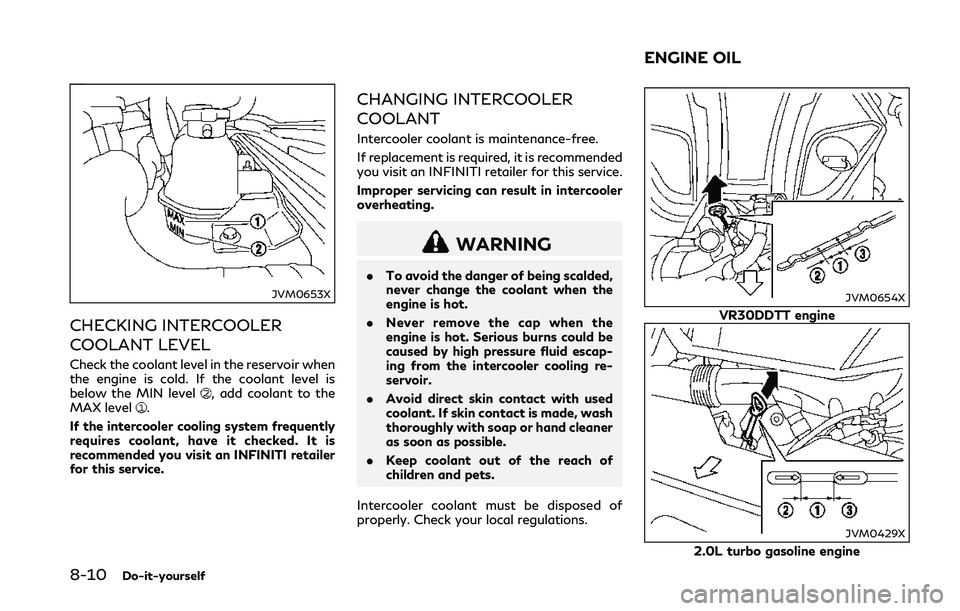
JVM0653X
CHECKING INTERCOOLER
COOLANT LEVEL
Check the coolant level in the reservoir when
the engine is cold. If the coolant level is
below the MIN level
, add coolant to the
MAX level.
If the intercooler cooling system frequently
requires coolant, have it checked. It is
recommended you visit an INFINITI retailer
for this service.
CHANGING INTERCOOLER
COOLANT
Intercooler coolant is maintenance-free.
If replacement is required, it is recommended
you visit an INFINITI retailer for this service.
Improper servicing can result in intercooler
overheating.
WARNING
. To avoid the danger of being scalded,
never change the coolant when the
engine is hot.
. Never remove the cap when the
engine is hot. Serious burns could be
caused by high pressure fluid escap-
ing from the intercooler cooling re-
servoir.
. Avoid direct skin contact with used
coolant. If skin contact is made, wash
thoroughly with soap or hand cleaner
as soon as possible.
. Keep coolant out of the reach of
children and pets.
Intercooler coolant must be disposed of
properly. Check your local regulations.
JVM0654X
VR30DDTT engine
JVM0429X
2.0L turbo gasoline engine
ENGINE OIL
Page 366 of 458
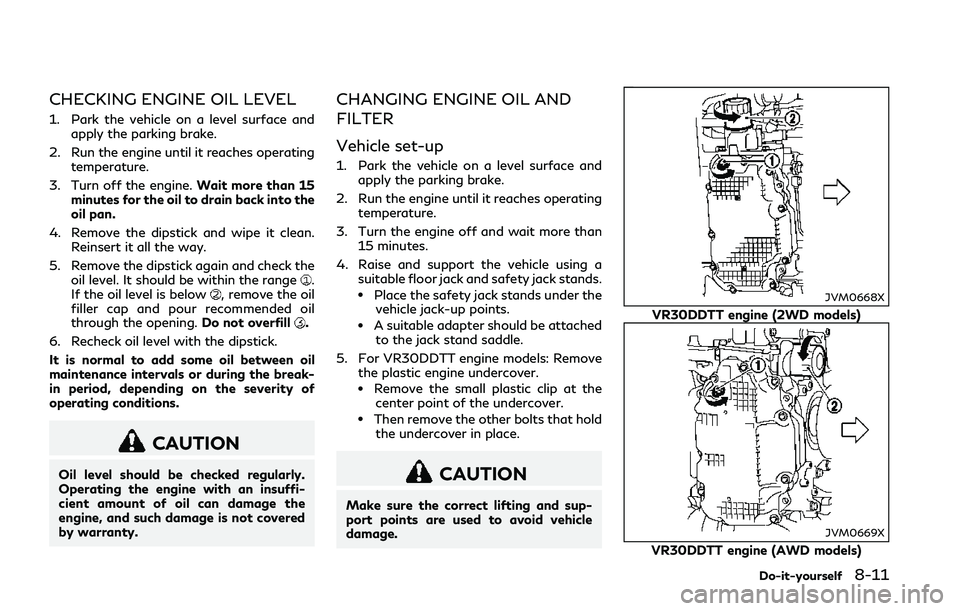
CHECKING ENGINE OIL LEVEL
1. Park the vehicle on a level surface andapply the parking brake.
2. Run the engine until it reaches operating temperature.
3. Turn off the engine. Wait more than 15
minutes for the oil to drain back into the
oil pan.
4. Remove the dipstick and wipe it clean. Reinsert it all the way.
5. Remove the dipstick again and check the oil level. It should be within the range
.
If the oil level is below, remove the oil
filler cap and pour recommended oil
through the opening. Do not overfill
.
6. Recheck oil level with the dipstick.
It is normal to add some oil between oil
maintenance intervals or during the break-
in period, depending on the severity of
operating conditions.
CAUTION
Oil level should be checked regularly.
Operating the engine with an insuffi-
cient amount of oil can damage the
engine, and such damage is not covered
by warranty.
CHANGING ENGINE OIL AND
FILTER
Vehicle set-up
1. Park the vehicle on a level surface and apply the parking brake.
2. Run the engine until it reaches operating temperature.
3. Turn the engine off and wait more than 15 minutes.
4. Raise and support the vehicle using a suitable floor jack and safety jack stands.
.Place the safety jack stands under thevehicle jack-up points.
.A suitable adapter should be attachedto the jack stand saddle.
5. For VR30DDTT engine models: Remove the plastic engine undercover.
.Remove the small plastic clip at thecenter point of the undercover.
.Then remove the other bolts that hold
the undercover in place.
CAUTION
Make sure the correct lifting and sup-
port points are used to avoid vehicle
damage.
JVM0668X
VR30DDTT engine (2WD models)
JVM0669X
VR30DDTT engine (AWD models)
Do-it-yourself8-11
Page 367 of 458
8-12Do-it-yourself
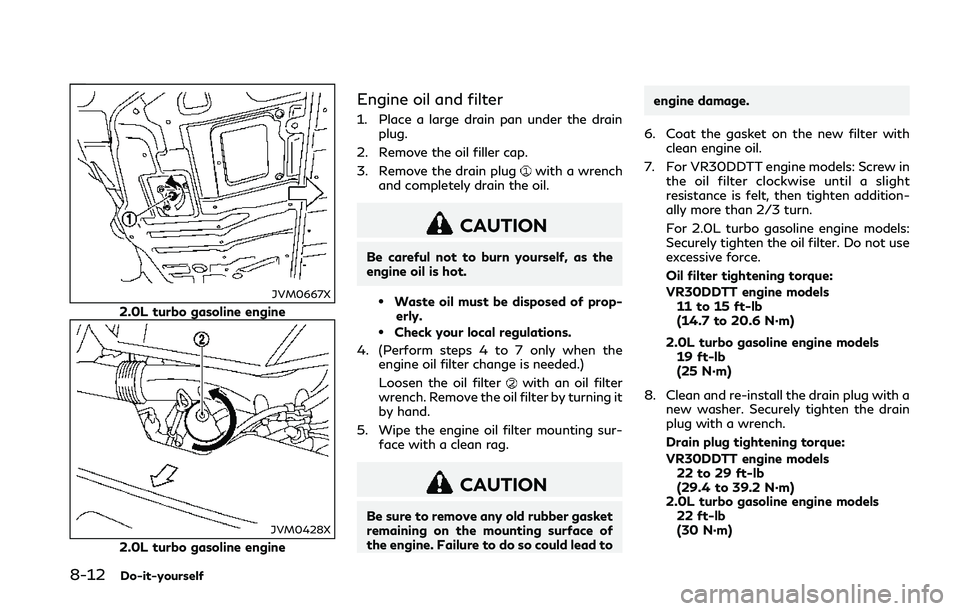
JVM0667X
2.0L turbo gasoline engine
JVM0428X
2.0L turbo gasoline engine
Engine oil and filter
1. Place a large drain pan under the drainplug.
2. Remove the oil filler cap.
3. Remove the drain plug
with a wrench
and completely drain the oil.
CAUTION
Be careful not to burn yourself, as the
engine oil is hot.
.Waste oil must be disposed of prop-
erly.
.Check your local regulations.
4. (Perform steps 4 to 7 only when the engine oil filter change is needed.)
Loosen the oil filter
with an oil filter
wrench. Remove the oil filter by turning it
by hand.
5. Wipe the engine oil filter mounting sur- face with a clean rag.
CAUTION
Be sure to remove any old rubber gasket
remaining on the mounting surface of
the engine. Failure to do so could lead to engine damage.
6. Coat the gasket on the new filter with clean engine oil.
7. For VR30DDTT engine models: Screw in the oil filter clockwise until a slight
resistance is felt, then tighten addition-
ally more than 2/3 turn.
For 2.0L turbo gasoline engine models:
Securely tighten the oil filter. Do not use
excessive force.
Oil filter tightening torque:
VR30DDTT engine models
11 to 15 ft-lb
(14.7 to 20.6 N·m)
2.0L turbo gasoline engine models 19 ft-lb
(25 N·m)
8. Clean and re-install the drain plug with a new washer. Securely tighten the drain
plug with a wrench.
Drain plug tightening torque:
VR30DDTT engine models22 to 29 ft-lb
(29.4 to 39.2 N·m)
2.0L turbo gasoline engine models 22 ft-lb
(30 N·m)
Page 368 of 458
Do not use excessive force.
9. Refill engine with recommended oil and install the oil filler cap securely.
See “Capacities and recommended
fluids/lubricants” (P.10-2) for drain and
refill capacity. The drain and refill capa-
city depends on the oil temperature and
drain time. Use these specifications for
reference only. Always use the dipstick
to determine the proper amount of oil in
the engine.
10. Start the engine and check for leakage around the drain plug and the oil filter.
Correct as required.
11. Turn the engine off and wait more than 15 minutes. Check the oil level with the
dipstick. Add engine oil if necessary.
After the operation
1. Install the engine undercover into posi-tion as the following steps.
a. Pull the center of the small plastic clip
out.
b. Hold the engine undercover into posi- tion.
c. Insert the clip through the undercover into the hole in the frame, then push
the center of the clip in to lock the clip
in place. d. Install the other bolts that hold the
undercover in place. Be careful not to
strip the bolts or over-tighten them.
2. Lower the vehicle carefully to the ground.
3. Dispose of waste oil and filter properly.
WARNING
. Prolonged and repeated contact with
used engine oil may cause skin cancer.
. Try to avoid direct skin contact with
used oil. If skin contact is made, wash
thoroughly with soap or hand cleaner
as soon as possible.
. Keep used engine oil out of reach of
children. When checking or replacement is required,
we recommend an INFINITI retailer for
servicing.
CAUTION
.
It is recommended that you use only
Genuine NISSAN Matic S ATF. Do
not mix with other fluids.
. Using automatic transmission fluid
other than Genuine NISSAN Matic S
ATF may cause deterioration in dri-
veability and automatic transmission
durability, and may damage the
automatic transmission. Damage
caused by the use of fluid other than
as recommended is not covered by
the INFINITI new vehicle limited
warranty.
Do-it-yourself8-13
AUTOMATIC TRANSMISSION
FLUID (ATF)
Page 405 of 458
9-4Maintenance and schedules
Warning lights and chimes:Make sure that
all warning lights and chimes are operating
properly.
Windshield defroster: Check that the air
comes out of the defroster outlets properly
and in sufficient quantity when operating
the heater or air conditioner.
Windshield wiper and washer*: Check that
the wipers and washer operate properly and
that the wipers do not streak.
Under the hood and vehicle
The maintenance items listed here should be
checked periodically (for example, each time
you check the engine oil or refuel).
Battery*: Check the fluid level in each cell. It
should be between the MAX and MIN lines.
Vehicles operated in high temperatures or
under severe condition require frequent
checks of the battery fluid level.
NOTE:
Care should be taken to avoid situations
that can lead to potential battery discharge
and potential no-start conditions such as:
1. Installation or extended use of electro-
nic accessories that consume battery
power when the engine is not running
(Phone chargers, GPS, DVD players,
etc.) 2.
Vehicle is not driven regularly and/or
only driven short distances.
In these cases, the battery may need to be
charged to maintain battery health.
Brake fluid level*: Make sure that the brake
fluid level is between the MAX and MIN lines
on the reservoir.
Engine coolant level*: Check the coolant
level when the engine is cold.
Intercooler coolant level*: Check the coolant
level when the engine is cold.
Engine drive belts*: Make sure that no belt is
frayed, worn, cracked or oily.
Engine oil level*: Check the level after
parking the vehicle on a level spot and
turning off the engine. Wait more than 15
minutes for the oil to drain back into the oil
pan.
Exhaust system: Make sure there are no
loose supports, cracks or holes. If the sound
of the exhaust seems unusual or there is a
smell of exhaust fumes, immediately have
the exhaust system inspected. It is recom-
mended you visit an INFINITI retailer for this
service. (See “Precautions when starting and
driving” (P.5-4).)
Fluid leaks: Check under the vehicle for fuel,
oil, water or other fluid leaks after the
vehicle has been parked for a while. Water
dripping from the air conditioner after use is normal. If you should notice any leaks or if
gasoline fumes are evident, check for the
cause and have it corrected immediately.
Power steering fluid level* and lines:
Check
the level when the fluid is cold, with the
engine off. Check the lines for proper
attachment, leaks, cracks, etc.
Radiator and hoses: Check the front of the
radiator and clean off any dirt, insects,
leaves, etc., that may have accumulated.
Make sure the hoses have no cracks, defor-
mation, rot or loose connections.
Underbody: The underbody is frequently
exposed to corrosive substances such as
those used on icy roads or to control dust. It
is very important to remove these sub-
stances, otherwise rust will form on the
floor pan, frame, fuel lines and around the
exhaust system. At the end of winter, the
underbody should be thoroughly flushed
with plain water, being careful to clean
those areas where mud and dirt may accu-
mulate. For additional information, see
“Cleaning exterior” (P.7-2).
Windshield washer fluid*: Check that there
is adequate fluid in the reservoir.
Page 406 of 458
The following descriptions are provided to
give you a better understanding of the
scheduled maintenance items that should
be regularly checked or replaced. The main-
tenance schedule indicates at which mile-
age/time intervals each item requires
service.
In addition to scheduled maintenance, your
vehicle requires that some items be checked
during normal day-to-day operation. Refer
to “General maintenance” (P.9-2).
Items marked with “*” are recommended by
INFINITI for reliable vehicle operation. You
are not required to perform maintenance on
these items in order to maintain the warran-
ties which come with your vehicle. Other
maintenance items and intervals are re-
quired.
When applicable, additional information can
be found in the “8. Do-it yourself” section of
this manual.
NOTE:
INFINITI does not advocate the use of non-
OEM approved aftermarket flushing sys-
tems and strongly advises against perform-
ing these services on an INFINITI product.
Many of the aftermarket flushing systems
use non-OEM approved chemicals or sol-
vents, the use of which has not been
validated by INFINITI.For recommended fuel, lubricants, fluids,
grease, and refrigerant, refer to “Capacities
and recommended fluids/lubricants” (P.10-
2) of this manual.
EMISSION CONTROL SYSTEM
MAINTENANCE
Drive belts*:
Check engine drive belts for wear, fraying or
cracking and for proper tension. Replace any
damaged drive belts.
Engine air filter:
Replace at specified intervals. When driving
for prolonged periods in dusty conditions,
check/replace the filter more frequently.
Engine coolant* (for VR30DDTT engine
models):
Replace coolant at the specified interval.
When adding or replacing coolant, be sure to
use only Genuine NISSAN Long Life Anti-
freeze/Coolant (blue) or equivalent with the
proper mixture. (Refer to “Engine cooling
system (for VR30DDTT engine models)”
(P.8-6) to determine the proper mixture for
your area.)
NOTE:
Mixing any other type of coolant or the use
of non-distilled water may reduce the
recommended service interval of the cool-
ant.Engine coolant* (for 2.0L turbo gasoline
engine models):
Replace coolant at the specified interval.
When adding or replacing coolant, be sure to
use only BASF Glysantin® G48® or equiva-
lent with the proper mixture. (Refer to
“Engine cooling system (for 2.0L turbo
gasoline engine models)” (P.8-8) to deter-
mine the proper mixture for your area.)
NOTE:
Mixing any other type of coolant or the use
of non-distilled water may reduce the
recommended service interval of the cool-
ant.
Intercooler coolant (for VR30DDTT engine
models):
Intercooler coolant is maintenance-free.
Engine oil and oil filter:
Replace engine oil and oil filter at the
specified intervals. For recommended oil
grade and viscosity refer to “Capacities and
recommended fluids/lubricants” (P.10-2).
Engine valve clearance*:
Inspect only if valve noise increases. Adjust
valve clearance if necessary.
Evaporative emissions control vapor lines*:
Check vapor lines for leaks or looseness.
Tighten connections or replace parts as
necessary.
Maintenance and schedules9-5
EXPLANATION OF SCHEDULED
MAINTENANCE ITEMS
Page 407 of 458
9-6Maintenance and schedules
Fuel lines*:
Check the fuel hoses, piping and connections
for leaks, looseness, or deterioration. Tight-
en connections or replace parts as necessary.
Spark plugs:
Replace at specified intervals. Install new
plugs of the type as originally equipped.
CHASSIS AND BODY MAINTE-
NANCE
Brake lines and cables:
Visually inspect for proper installation.
Check for chafing, cracks, deterioration,
and signs of leaking. Replace any deterio-
rated or damaged parts immediately.
Brake pads, rotors, drums and linings:
Check for wear, deterioration and fluid
leaks. Replace any deteriorated or damaged
parts immediately.
Exhaust system:
Visually inspect the exhaust pipes, muffler
and hangers for leaks, cracks, deterioration,
and damage. Tighten connections or replace
parts as necessary.
In-cabin microfilter:
Replace at specified intervals. When driving
for prolonged periods in dusty conditions,
replace the filter more frequently.Propeller shaft(s):
Check for damage, looseness, and grease
leakage. (4WD/AWD/RWD)
Steering gear and linkage, axle and suspen-
sion parts, drive shaft boots:
Check for damage, looseness, and leakage
of oil or grease. Under severe driving condi-
tions, inspect more frequently.
Tire rotation:
Tires should be rotated every 5,000 miles
(8,000 km) according to the instructions
under “Explanation of general maintenance
items” (P.9-2). When rotating tires, check for
damage and uneven wear. Replace if neces-
sary.
Transmission fluid/oil, differential oil and
transfer case oil:
Visually inspect for signs of leakage at
specified intervals.
To help ensure smooth, safe and economical
driving, INFINITI provides two maintenance
schedules that may be used, depending upon
the conditions in which you usually drive.
These schedules contain both distance and
time intervals, up to 120,000 miles
(192,000 km)/144 months. For most peo-
ple, the odometer reading will indicate when
service is needed. However, if you drive very
little, your vehicle should be serviced at the
regular time intervals shown in the schedule.
After 120,000 miles (192,000 km)/144
months, continue maintenance at the same
mileage/time intervals.
ADDITIONAL MAINTENANCE
ITEMS FOR SEVERE OPERATING
CONDITIONS
Additional maintenance items for severe
operating conditions;
should be performed
on vehicles that are driven under especially
demanding conditions. Additional mainte-
nance items should be performed if you
primarily operate your vehicle under the
following conditions:
. Repeated short trips of less than 5 miles
(8 km).
. Repeated short trips of less than 10 miles
(16 km) with outside temperatures re-
maining below freezing.
MAINTENANCE SCHEDULES
Page 413 of 458
9-12Maintenance and schedules
MAINTENANCE OP-
ERATION
Perform at number of
miles, kilometers or
months, whichever
comes first.Miles × 1,000
(km × 1,000) Months MAINTENANCE INTERVAL
65
(104) 78 70
(112) 84 75
(120) 90 80
(128) 96 85
(136) 102 90
(144) 108 95
(152) 114 100
(160) 120 105
(168) 126 110
(176) 132 115
(184) 138 120
(192) 144
Engine compartment See NOTE (1) II I
V-belt See NOTE (2) I*I* I*
Air cleaner filter Replace every 45,000 miles (72,000 km) or 36 months
Fuel lines I*I* I*
Fuel filter See NOTE (3)
Engine coolant* Replace every 120,000 miles (192,000 km) or 120 months
Engine oil RRRR R R
Engine oil filter RRRR R R
Spark plugs Replace every 45,000 miles (72,000 km) or 36 months
NOTE:
(1) All visible parts checked for leaks and
damage.
(2) In visible area only.
(3) Periodic maintenance is not required.
*: Maintenance items and intervals with “*”
are recommended by INFINITI for reliable
vehicle operation. The owner need not to
perform such maintenance in order to
maintain the emission warranty or manu-
facturer recall liability. Other maintenance
items and intervals are required.
Page 429 of 458
10-8Technical and consumer information
that can be harmful to the fuel system and
engine.
Octane rating tips
Using unleaded gasoline with an octane
rating lower than recommended above can
cause persistent, heavy spark knock. (Spark
knock is a metallic rapping noise.) If severe,
this can lead to engine damage. If you
detect a persistent heavy spark knock even
when using gasoline of the stated octane
rating, or if you hear steady spark knock
while holding a steady speed on level roads,
it is recommended you have an INFINITI
retailer correct the condition. Failure to
correct the condition is misuse of the
vehicle, for which INFINITI is not respon-
sible.
Incorrect ignition timing will result in knock-
ing, after-run or overheating. This in turn
may cause excessive fuel consumption or
damage to the engine. If any of the above
symptoms are encountered, have your ve-
hicle checked. It is recommended you visit an
INFINITI retailer for servicing.
However, now and then you may notice
light spark knock for a short time while
accelerating or driving up hills. This is no
cause for concern, because you get the
greatest fuel benefit when there is light
spark knock for a short time under heavy
engine load.
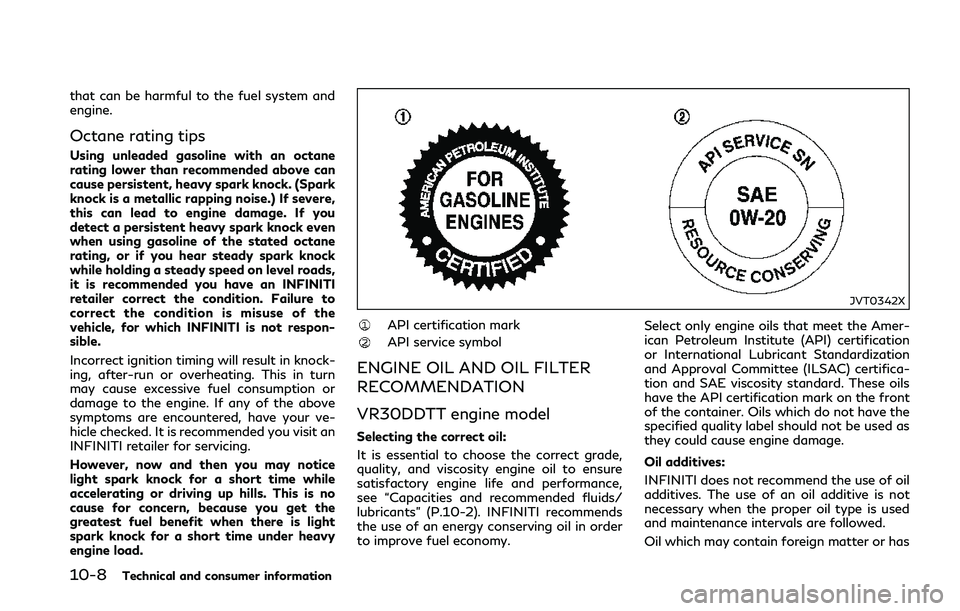
JVT0342X
API certification mark
API service symbol
ENGINE OIL AND OIL FILTER
RECOMMENDATION
VR30DDTT engine model
Selecting the correct oil:
It is essential to choose the correct grade,
quality, and viscosity engine oil to ensure
satisfactory engine life and performance,
see “Capacities and recommended fluids/
lubricants” (P.10-2). INFINITI recommends
the use of an energy conserving oil in order
to improve fuel economy.Select only engine oils that meet the Amer-
ican Petroleum Institute (API) certification
or International Lubricant Standardization
and Approval Committee (ILSAC) certifica-
tion and SAE viscosity standard. These oils
have the API certification mark on the front
of the container. Oils which do not have the
specified quality label should not be used as
they could cause engine damage.
Oil additives:
INFINITI does not recommend the use of oil
additives. The use of an oil additive is not
necessary when the proper oil type is used
and maintenance intervals are followed.
Oil which may contain foreign matter or has
Page 449 of 458

11-2
Cockpit ...................................................................... 2-3
Cold weather driving ........................................ 5-141
Compact spare tire ............................................ 8-44
Console box ........................................................... 2-48
CoolantCapacities and
recommended fluids/lubricants ................. 10-2
Changing engine coolant ...................... 8-7, 8-9
Checking engine coolant level ............. 8-7, 8-8
Corrosion protection ............................................. 7-7
Courtesy light ....................................................... 2-57
Cruise control ........................................................ 5-71 Fixed speed cruise control (on
ICC system) .................................................... 5-90
Intelligent Cruise Control (ICC) ................. 5-73
Cruise indicator .................................................... 2-23
Cup holders ........................................................... 2-46
Current fuel consumption ................................. 2-28
D
Daytime running light system .......................... 2-39
Defroster switch
Rear window and outside mirror
defroster switch ............................................. 2-35
Dimensions .......................................................... 10-13
Direct Adaptive Steering ................................. 5-128
Distance Control Assist (DCA) ........................ 5-94
Distance to empty ............................................... 2-27
Drive belts .............................................................. 8-19
Drive positioner .................................................... 3-33
Driver assist system indicator .......................... 2-24 Driving
Cold weather driving .................................. 5-141
Driving with automatic transmission ....... 5-16
Precautions when starting and driving ..... 5-4
E
ECO drive indicator light ................................... 2-16
ECO mode ............................................................. 5-23
ECO pedal system ............................................... 5-23
Economy Fuel .................................................................. 5-123
Elapsed time ......................................................... 2-27
Elapsed time and trip odometer ..................... 2-27
Emission control information label ............... 10-16
Emission control system maintenance ............ 9-8
Emission control system warranty .............. 10-23
Engine Before starting the engine .......................... 5-14
Break-in schedule ........................................ 5-122
Capacities and
recommended fluids/lubricants ................. 10-2
Changing engine coolant ...................... 8-7, 8-9
Changing engine oil and filter .................... 8-11
Checking engine coolant level ............. 8-7, 8-8
Checking engine oil level ............................. 8-11
Coolant temperature gauge ......................... 2-8
Emergency engine shut off ......................... 5-13
Engine block heater ................................... 5-142
Engine compartment check locations ........ 8-4
Engine cooling system ................................... 8-6
Engine oil ........................................................ 8-10 Engine oil and filter
replacement indicator ................................... 2-25
Engine oil and oil
filter recommendation ................................. 10-8
Engine serial number ................................. 10-15
Engine specifications .................................. 10-11
Engine start operation indicator ............... 2-21
If your vehicle overheats ............................. 6-16
Remote engine start .................................... 3-20
Remote engine start
operation indicator ........................................ 2-21
Starting the engine ....................................... 5-15
Engine coolant temperature gauge .................. 2-8
Entry/exit function Automatic drive positioner ......................... 3-33
Event Data Recorders (EDR) ........................ 10-25
Exhaust gas (carbon monoxide) ........................ 5-4
Explanation of scheduled
maintenance items ................................................. 9-5
F
F.M.V.S.S./C.M.V.S.S. certification label .... 10-15
Filter Air cleaner housing filter ............................. 8-21
Changing engine oil and filter .................... 8-11
Flashers (See hazard warning
flasher switch) ......................................................... 6-2
Flat tire ...................................................................... 6-3
Flat Tire - Visit dealer warning ....................... 2-22
Flat towing ......................................................... 10-22
Floor mat cleaning ................................................. 7-5