child lock INFINITI Q50 2018 User Guide
[x] Cancel search | Manufacturer: INFINITI, Model Year: 2018, Model line: Q50, Model: INFINITI Q50 2018Pages: 458, PDF Size: 2.13 MB
Page 54 of 458

The child restraint top tether strap must be
used when installing the child restraint with
the LATCH lower anchor attachments.
First, secure the child restraint with the
LATCH lower anchors (rear outboard seat-
ing positions only).
1. Flip up the anchor cover from the anchorpoint which is located directly behind the
child restraint.
2. If necessary, raise or remove the head restraint or headrest to position the top
tether strap over the top of the seatback.
If the head restraint or headrest is
removed, store it in a secure place. Be
sure to reinstall the head restraint or
headrest when the child restraint is
removed.
See “Head restraints/headrests” (P.1-
8) for head restraint or headrest adjust-
ment, removal and installation informa-
tion.
Position the top tether strap over the top
of the seatback.
3. Secure the tether strap to the tether anchor point on the rear parcel shelf.
4. Refer to the appropriate child restraint installation procedure steps in this sec-
tion before tightening the tether strap.
If you have any questions when installing a
top tether strap, it is recommended you visit an INFINITI retailer for this service.
FORWARD-FACING CHILD RE-
STRAINT INSTALLATION USING
THE SEAT BELTS
WARNING
.
The three-point seat belt with Auto-
matic Locking Retractor (ALR) must
be used when installing a child re-
straint. Failure to use the ALR mode
will result in the child restraint not
being properly secured. The restraint
could tip over or be loose and cause
injury to a child in a sudden stop or
collision. Also, it can change the
operation of the front passenger air
bag. See “Front passenger air bag
and status light” (P.1-50).
. When installing a child restraint sys-
tem in the rear center position, both
the center seat belt connector tongue
and buckle tongue must be secured
(for models with rear seat folding).
See “Rear center seat belt (models
with rear seat folding)” (P.1-18).
SSS0640
Forward-facing (front passenger seat) —
step 1
Refer to all Warnings and Cautions in the
“Child safety” and “Child restraints” sections
before installing a child restraint.
Do not use the lower anchors if the com-
bined weight of the child and the child
restraint exceeds 65 lbs (29.5 kg). If the
combined weight of the child and the child
restraint is greater than 65 lbs (29.5 kg), use
the vehicle’s seat belt (not the lower an-
chors) to install the child restraint. Be sure to
follow the child restraint manufacturer’s
instructions for installation.
Follow these steps to install a forward-
facing child restraint using the vehicle seat
belt in the rear seats or in the front
Safety — Seats, seat belts and supplemental restraint system1-35
Page 55 of 458

1-36Safety — Seats, seat belts and supplemental restraint system
passenger seat:
1.If you must install a child restraint in the
front seat, it should be placed in a
forward-facing direction only. Move
the seat to the rearmost position. Child
restraints for infants must be used in the
rear-facing direction and, therefore,
must not be used in the front seat.
2. Position the child restraint on the seat. Always follow the child restraint manu-
facturer’s instructions.
The back of the child restraint should be
secured against the vehicle seatback.
If necessary, adjust or remove the head
restraint or headrest to obtain the
correct child restraint fit. If the head
restraint or headrest is removed, store it
in a secure place. Be sure to reinstall the
head restraint or headrest when the
child restraint is removed. See “Head
restraints/headrests” (P.1-8) for head
restraint or headrest adjustment, re-
moval and installation information.
If the seating position does not have an
adjustable head restraint or headrest
and it is interfering with the proper child
restraint fit, try another seating position
or a different child restraint.
SSS0360B
Forward-facing — step 3
3. Route the seat belt tongue through the
child restraint and insert it into the buckle
until you hear and feel the latch engage.
Be sure to follow the child restraint
manufacturer’s instructions for belt
routing.
If the child restraint is equipped with a
top tether strap, route the top tether
strap and secure the tether strap to the
tether anchor point (rear seat installation
only). See “Installing top tether strap”
(P.1-38). Do not install child restraints
that require the use of a top tether strap
in seating positions that do not have a
top tether anchor.
SSS0651
Forward-facing — step 4
4. Pull the shoulder belt until the belt is fully
extended. At this time, the seat belt
retractor is in the Automatic Locking
Retractor (ALR) mode (child restraint
mode). It reverts to Emergency Locking
Retractor (ELR) mode when the seat belt
is fully retracted.
Page 57 of 458
1-38Safety — Seats, seat belts and supplemental restraint system
seat belt is not locked, repeat steps 2
through 8.
JVR0192X
Forward-facing — step 10
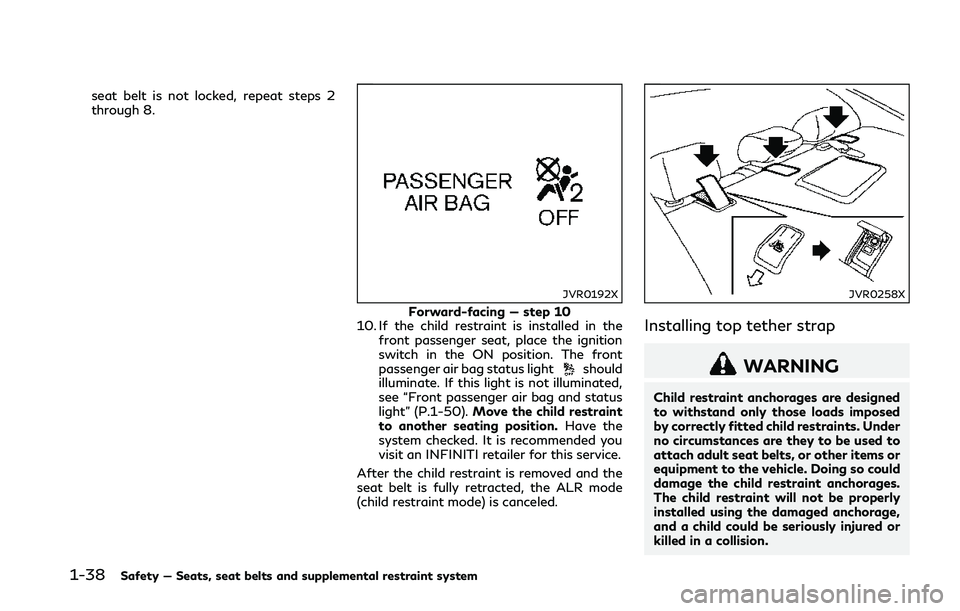
10. If the child restraint is installed in the
front passenger seat, place the ignition
switch in the ON position. The front
passenger air bag status light
should
illuminate. If this light is not illuminated,
see “Front passenger air bag and status
light” (P.1-50). Move the child restraint
to another seating position. Have the
system checked. It is recommended you
visit an INFINITI retailer for this service.
After the child restraint is removed and the
seat belt is fully retracted, the ALR mode
(child restraint mode) is canceled.
JVR0258X
Installing top tether strap
WARNING
Child restraint anchorages are designed
to withstand only those loads imposed
by correctly fitted child restraints. Under
no circumstances are they to be used to
attach adult seat belts, or other items or
equipment to the vehicle. Doing so could
damage the child restraint anchorages.
The child restraint will not be properly
installed using the damaged anchorage,
and a child could be seriously injured or
killed in a collision.
Page 59 of 458
1-40Safety — Seats, seat belts and supplemental restraint system
LRS0453
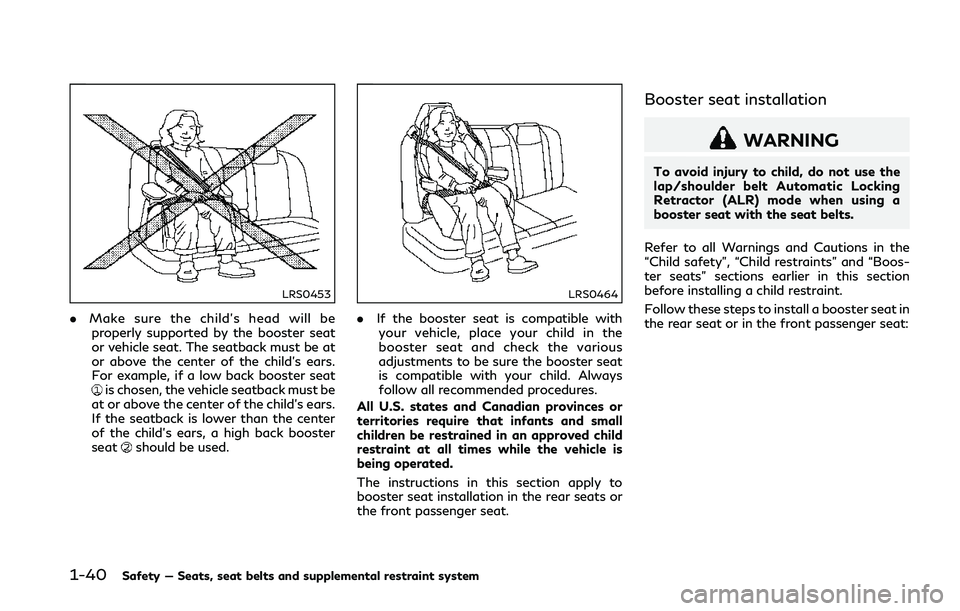
.Make sure the child’s head will be
properly supported by the booster seat
or vehicle seat. The seatback must be at
or above the center of the child’s ears.
For example, if a low back booster seat
is chosen, the vehicle seatback must be
at or above the center of the child’s ears.
If the seatback is lower than the center
of the child’s ears, a high back booster
seat
should be used.
LRS0464
. If the booster seat is compatible with
your vehicle, place your child in the
booster seat and check the various
adjustments to be sure the booster seat
is compatible with your child. Always
follow all recommended procedures.
All U.S. states and Canadian provinces or
territories require that infants and small
children be restrained in an approved child
restraint at all times while the vehicle is
being operated.
The instructions in this section apply to
booster seat installation in the rear seats or
the front passenger seat.
Booster seat installation
WARNING
To avoid injury to child, do not use the
lap/shoulder belt Automatic Locking
Retractor (ALR) mode when using a
booster seat with the seat belts.
Refer to all Warnings and Cautions in the
“Child safety”, “Child restraints” and “Boos-
ter seats” sections earlier in this section
before installing a child restraint.
Follow these steps to install a booster seat in
the rear seat or in the front passenger seat:
Page 72 of 458
restraint being used. If the front passenger
air bag status light is not illuminated (in-
dicating that the air bag might inflate in a
crash), it could be that the child restraint or
seat belt is not being used properly. Make
sure that the child restraint is installed
properly, the seat belt is used properly and
the occupant is positioned properly. If the
front passenger air bag status light is still not
illuminated, reposition the occupant or child
restraint in a rear seat.
If the front passenger air bag status light will
not illuminate even though you believe that
the child restraint, the seat belts and the
occupant are properly positioned, it is re-
commended that you take your vehicle to an
INFINITI retailer. An INFINITI retailer can
check the system status by using a special
tool. However, until you have confirmed
with your retailer that your air bag is work-
ing properly, reposition the occupant or child
restraint in a rear seat.
The INFINITI Advanced Air Bag System and
front passenger air bag status light will take
a few seconds to register a change in the
passenger seat status. This is normal system
operation and does not indicate a malfunc-
tion.
If a malfunction occurs in the front passen-
ger air bag system, the supplemental air bag
warning light
, located in the meter and
gauges area of the instrument panel, will be illuminated (blinking or steadily lit). Have the
system checked. It is recommended you visit
an INFINITI retailer for this service.
Normal operation:
In order for the occupant classification
sensor system to classify the front passen-
ger based on weight, please follow the
precautions and steps outlined below:
Precautions
. Make sure that there are no objects
weighing over 9.1 lbs (4 kg) hanging on
the seat or placed in the seatback pocket.
. Make sure that a child restraint or other
object is not pressing against the rear of
the seatback.
. Make sure that a rear passenger is not
pushing or pulling on the back of the
front passenger seat.
. Make sure that the front passenger seat
or seatback is not forced back against an
object on the seat or floor behind it.
. Make sure that there is no object placed
under the front passenger seat.
. Make sure that the front passenger seat
head restraint does not contact the roof
when adjusting the front passenger seat.
Steps
1. Adjust the seat as outlined in “Seats” (P.1-2). Sit upright, leaning against the
seatback, and centered on the seat cushion with your feet comfortably ex-
tended to the floor.
2. Make sure there are no objects on your lap.
3. Fasten the seat belt as outlined in “Seat belts” (P.1-12). Front passenger seat belt
buckle status is monitored by the occu-
pant classification sensor system, and is
used as an input to determine occupancy
status. So, it is highly recommended that
the front passenger fastens his/her seat
belt.
4. Remain in this position for 30 seconds allowing the system to classify the front
passenger before the vehicle is put into
motion.
5. Ensure proper classification by checking the front passenger air bag status light.
NOTE:
This vehicle’s occupant classification sensor
system generally keeps the classification
locked during driving, so it is important that
you confirm that the front passenger is
properly classified prior to driving. How-
ever, the occupant classification sensor may
recalculate the weight of the occupant
under some conditions (both while driving
and when stopped), so the front passenger
seat occupant should continue to remain
seated as outlined above.
Safety — Seats, seat belts and supplemental restraint system1-53
Page 133 of 458
2-50Instruments and controls
SIC4350
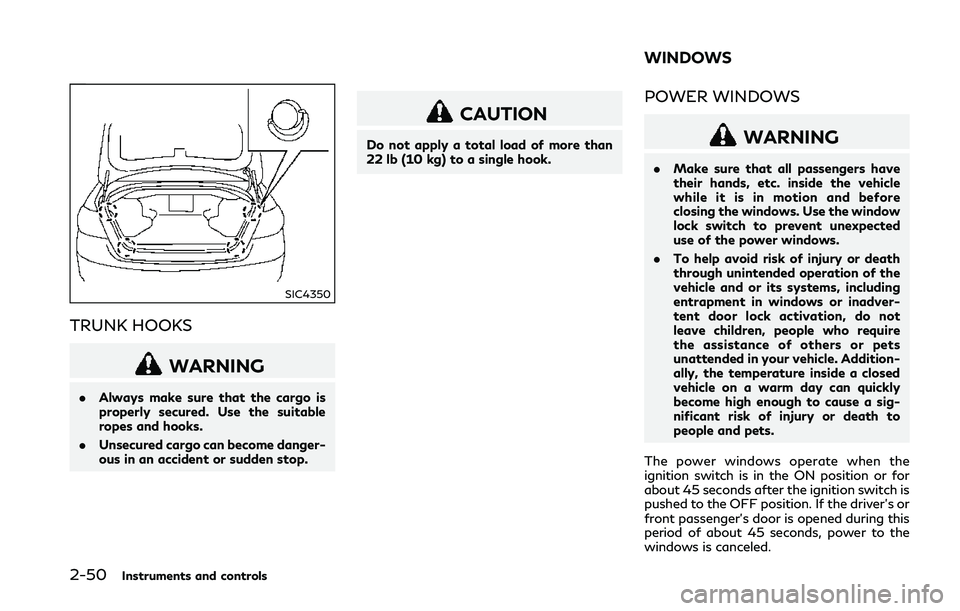
TRUNK HOOKS
WARNING
.Always make sure that the cargo is
properly secured. Use the suitable
ropes and hooks.
. Unsecured cargo can become danger-
ous in an accident or sudden stop.
CAUTION
Do not apply a total load of more than
22 lb (10 kg) to a single hook.
POWER WINDOWS
WARNING
.Make sure that all passengers have
their hands, etc. inside the vehicle
while it is in motion and before
closing the windows. Use the window
lock switch to prevent unexpected
use of the power windows.
. To help avoid risk of injury or death
through unintended operation of the
vehicle and or its systems, including
entrapment in windows or inadver-
tent door lock activation, do not
leave children, people who require
the assistance of others or pets
unattended in your vehicle. Addition-
ally, the temperature inside a closed
vehicle on a warm day can quickly
become high enough to cause a sig-
nificant risk of injury or death to
people and pets.
The power windows operate when the
ignition switch is in the ON position or for
about 45 seconds after the ignition switch is
pushed to the OFF position. If the driver’s or
front passenger’s door is opened during this
period of about 45 seconds, power to the
windows is canceled.
WINDOWS
Page 146 of 458

3 Pre-driving checks and adjustments
Keys........................................................................\
................ 3-2Intelligent Key................................................................ 3-2
Valet hand-off............................................................... 3-4
Doors ........................................................................\
............. 3-4 Locking with mechanical key .................................... 3-4
Opening and closing windows with
mechanical key .............................................................. 3-5
Locking with inside lock knob................................... 3-5
Locking with power door lock switch .................... 3-5
Automatic door locks .................................................. 3-6
Child safety rear door lock ........................................ 3-6
Intelligent Key system........................................................ 3-7 Intelligent Key operating range................................ 3-8
Door locks/unlocks precaution ............................... 3-9
Intelligent Key operation.......................................... 3-10
Battery saver system................................................. 3-13
Warning signals........................................................... 3-14
Troubleshooting guide .............................................. 3-15
Log-in function ........................................................... 3-16
Remote keyless entry system....................................... 3-16
How to use remote keyless entry system ........... 3-17
Remote engine start (if so equipped)........................ 3-20 Remote engine start operating range .................. 3-21
Remote starting the engine..................................... 3-21
Extending engine run time....................................... 3-21 Canceling a remote start........................................ 3-21
Conditions the remote start will not work ....... 3-22
Hood ........................................................................\
........... 3-23
Trunk lid ........................................................................\
..... 3-23 Trunk lid release switch.......................................... 3-24
Trunk open request switch .................................... 3-24
TRUNK button .......................................................... 3-24
Trunk release power cancel switch..................... 3-25
Interior trunk lid release ......................................... 3-25
Fuel-filler door ................................................................. 3-26
Opening the fuel-filler door................................... 3-26
Fuel-filler cap............................................................. 3-26
Tilt/telescopic steering.................................................. 3-28
Manual operation (if so equipped) ...................... 3-29
Electric operation (if so equipped)....................... 3-29
Sun visors ........................................................................\
. 3-30
Mirrors........................................................................\
....... 3-30 Inside mirror.............................................................. 3-30
Outside mirrors ......................................................... 3-31
Vanity mirror.............................................................. 3-32
Automatic drive positioner (if so equipped) ............ 3-33 Entry/exit function .................................................. 3-33
Memory storage ....................................................... 3-33
System operation ..................................................... 3-34
Page 149 of 458
3-4Pre-driving checks and adjustments
CAUTION
Always carry the mechanical key in-
stalled in the key.
VALET HAND-OFF
When you have to leave a key with a valet,
give them the Intelligent Key itself and keep
the mechanical key with you to protect your
belongings.
To prevent the glove box and the trunk from
being opened during valet hand-off, follow
the procedures below.
1. Push the trunk release power cancelswitch to the OFF (cancel) side.
2. Remove the mechanical key from the Intelligent Key.
3. Lock the glove box and the trunk pass- through with the mechanical key.
4. Hand the Intelligent Key to the valet, keeping the mechanical key in your
pocket or bag for insertion into the
Intelligent Key when you retrieve your
vehicle.
See “Trunk lid” (P.3-23), “Glove box” (P.2-
48) and “Trunk pass-through” (P.1-7).
WARNING
. Always have the doors locked while
driving. Along with the use of seat
belts, this provides greater safety in
the event of an accident by helping to
prevent persons from being thrown
from the vehicle. This also helps keep
children and others from unintention-
ally opening the doors, and will help
keep out intruders.
. Before opening any door, always look
for and avoid oncoming traffic.
. To help avoid risk of injury or death
through unintended operation of the
vehicle and or its systems, including
entrapment in windows or inadver-
tent door lock activation, do not
leave children, people who require
the assistance of others or pets
unattended in your vehicle. Addition-
ally, the temperature inside a closed
vehicle on a warm day can quickly
become high enough to cause a sig-
nificant risk of injury or death to
people and pets.
JVP0231X
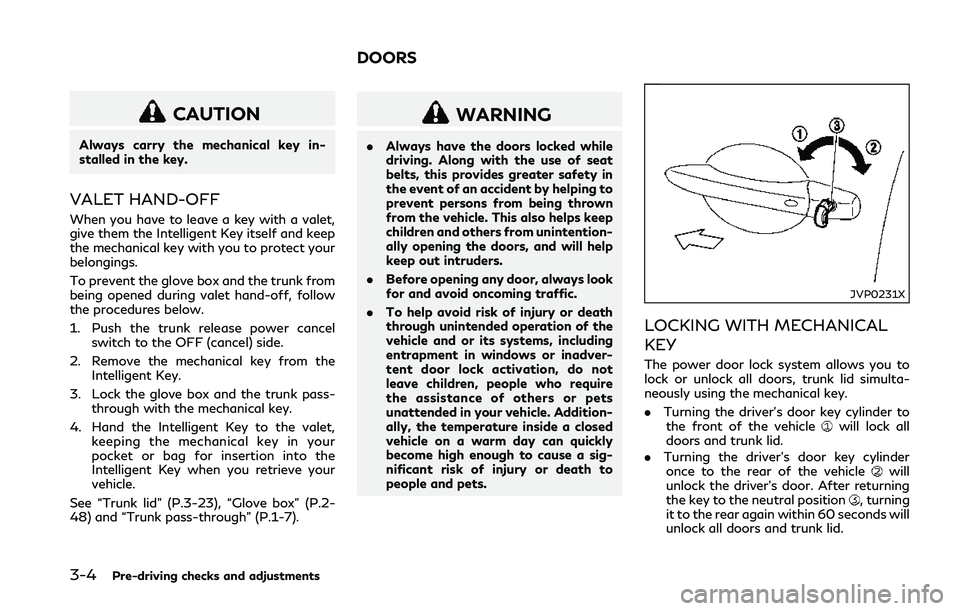
LOCKING WITH MECHANICAL
KEY
The power door lock system allows you to
lock or unlock all doors, trunk lid simulta-
neously using the mechanical key.
.Turning the driver’s door key cylinder to
the front of the vehicle
will lock all
doors and trunk lid.
. Turning the driver’s door key cylinder
once to the rear of the vehicle
will
unlock the driver’s door. After returning
the key to the neutral position
, turning
it to the rear again within 60 seconds will
unlock all doors and trunk lid.
DOORS
Page 151 of 458
3-6Pre-driving checks and adjustments
switch to the unlock position.
Lockout protection
When the power door lock switch is moved
to the lock position and any door open, all
doors will lock and unlock automatically.
With the Intelligent Key left in the vehicle
and any door open, all doors will unlock
automatically and a chime will sound after
the door is closed.
These functions help to prevent the Intelli-
gent Key from being accidentally locked
inside the vehicle.
AUTOMATIC DOOR LOCKS
.All doors and trunk lid lock automatically
when the vehicle speed reaches 15 MPH
(24 km/h).
. All doors and trunk lid unlock automati-
cally when the ignition switch is placed in
the OFF position or when the shift lever
is moved to the P (Park) position, if
selected.
The automatic unlock function can be
deactivated or activated. To deactivate or
activate the automatic door unlock system,
perform the following procedure:
1. Close all doors.
2. Place the ignition switch in the ON position. 3. Within 20 seconds of performing Step 2,
push and hold the power door lock
switch to the
position (UNLOCK)
for more than 5 seconds.
4. When activated, the hazard indicator will flash twice. When deactivated, the ha-
zard indicator will flash once.
5. The ignition switch must be placed in the OFF and ON position again between
each setting change.
When the automatic door unlock system is
deactivated, the doors do not unlock when
the ignition switch is placed in the OFF
position. To unlock the door manually, use
the inside lock knob or the power door lock
switch (driver’s or front passenger’s side).
The automatic door unlock function can be
changed on the lower display. (See the
Infiniti InTouch Owner’s Manual.)
SPA2536
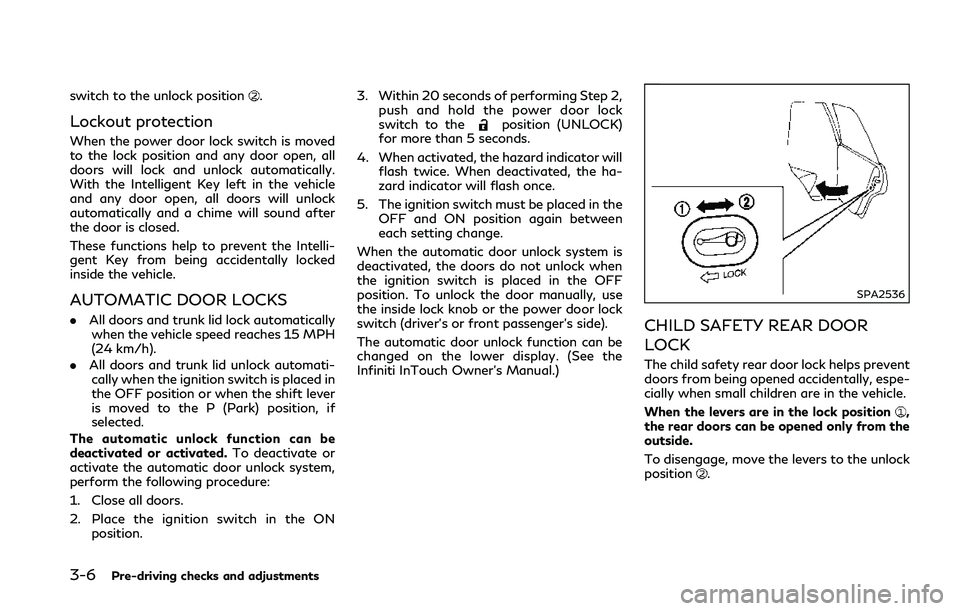
CHILD SAFETY REAR DOOR
LOCK
The child safety rear door lock helps prevent
doors from being opened accidentally, espe-
cially when small children are in the vehicle.
When the levers are in the lock position
,
the rear doors can be opened only from the
outside.
To disengage, move the levers to the unlock
position
.
Page 168 of 458

JVP0234X
1. Pull the hood lock release handlelocated below the instrument panel; the
hood will then spring up slightly.
2. Pull the lever
up at the front of the
hood with your fingertips and raise the
hood.
3. When closing the hood, slowly close the hood down to latch both the right and
left locks. Push the hood down to lock
the hood securely into place.
WARNING
.Make sure the hood is completely
closed and latched before driving.
Failure to do so could cause the hood
to fly open and result in an accident.
. If you see steam or smoke coming
from the engine compartment, to
avoid injury do not open the hood.
WARNING
.Do not drive with the trunk lid open.
This could allow dangerous exhaust
gases to be drawn into the vehicle.
See “Exhaust gas (carbon monoxide)”
(P.5-4) of this manual.
. Closely supervise children when they
are around cars to prevent them from
playing and becoming locked in the
trunk where they could be seriously
injured. Keep the car locked, with the
trunk closed, when not in use, and
prevent children’s access to Intelli-
gent Keys.
Pre-driving checks and adjustments3-23
HOOD TRUNK LID