lock INFINITI Q50-HYBRID 2018 Owners Manual
[x] Cancel search | Manufacturer: INFINITI, Model Year: 2018, Model line: Q50-HYBRID, Model: INFINITI Q50-HYBRID 2018Pages: 442, PDF Size: 2.9 MB
Page 22 of 442
JVC1103X
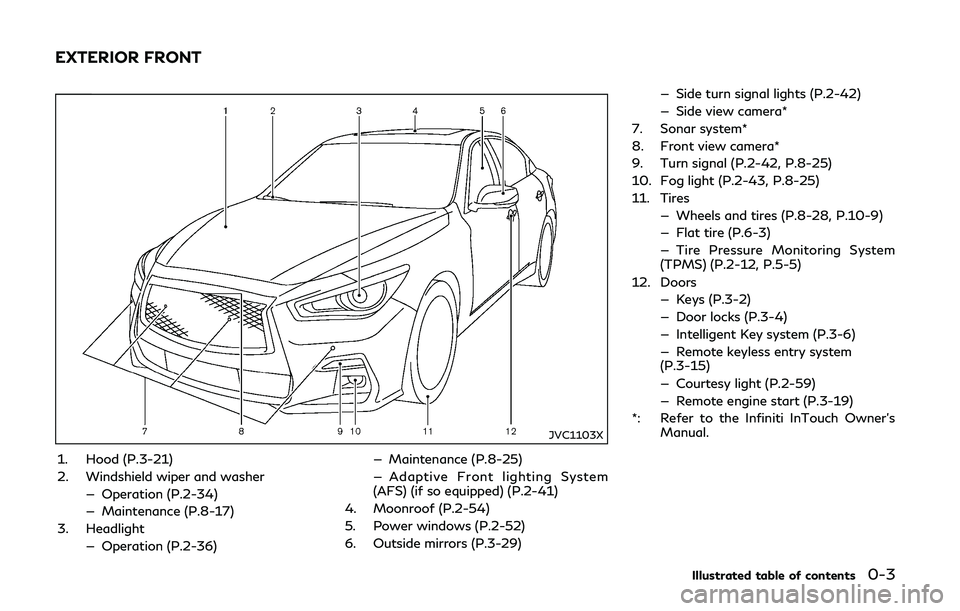
1. Hood (P.3-21)
2. Windshield wiper and washer— Operation (P.2-34)
— Maintenance (P.8-17)
3. Headlight
— Operation (P.2-36) — Maintenance (P.8-25)
— Adaptive Front lighting System
(AFS) (if so equipped) (P.2-41)
4. Moonroof (P.2-54)
5. Power windows (P.2-52)
6. Outside mirrors (P.3-29) — Side turn signal lights (P.2-42)
— Side view camera*
7. Sonar system*
8. Front view camera*
9. Turn signal (P.2-42, P.8-25)
10. Fog light (P.2-43, P.8-25)
11. Tires — Wheels and tires (P.8-28, P.10-9)
— Flat tire (P.6-3)
— Tire Pressure Monitoring System
(TPMS) (P.2-12, P.5-5)
12. Doors — Keys (P.3-2)
— Door locks (P.3-4)
— Intelligent Key system (P.3-6)
— Remote keyless entry system
(P.3-15)
— Courtesy light (P.2-59)
— Remote engine start (P.3-19)
*: Refer to the Infiniti InTouch Owner’s Manual.
Illustrated table of contents0-3
EXTERIOR FRONT
Page 23 of 442
0-4Illustrated table of contents
JVC1104X
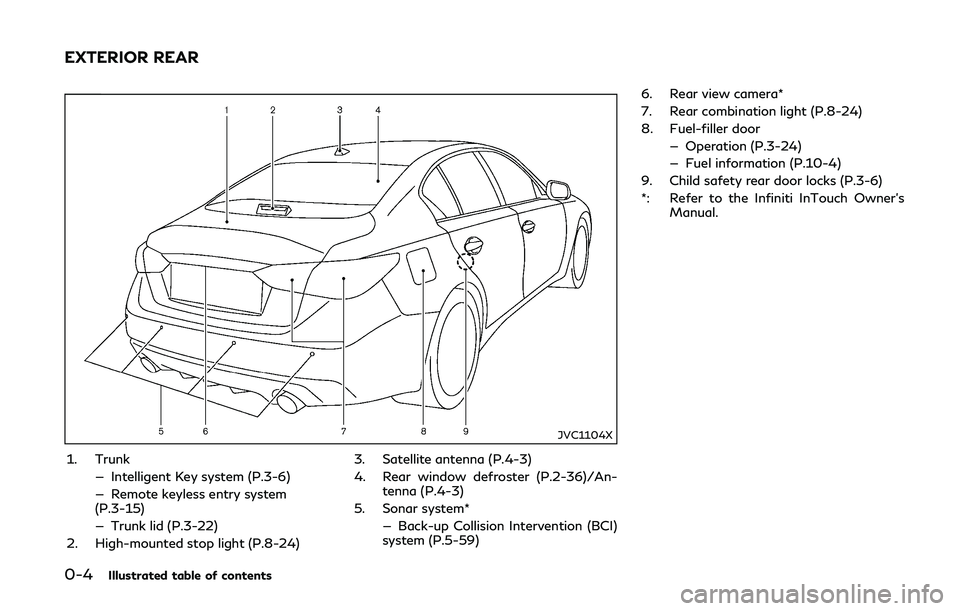
1. Trunk— Intelligent Key system (P.3-6)
— Remote keyless entry system
(P.3-15)
— Trunk lid (P.3-22)
2. High-mounted stop light (P.8-24) 3. Satellite antenna (P.4-3)
4. Rear window defroster (P.2-36)/An-
tenna (P.4-3)
5. Sonar system* — Back-up Collision Intervention (BCI)
system (P.5-59) 6. Rear view camera*
7. Rear combination light (P.8-24)
8. Fuel-filler door
— Operation (P.3-24)
— Fuel information (P.10-4)
9. Child safety rear door locks (P.3-6)
*: Refer to the Infiniti InTouch Owner’s Manual.
EXTERIOR REAR
Page 26 of 442

JVC1101X
1. Meters and gauges (P.2-5)— Clock (P.2-30)
2. Push-button ignition switch (P.5-11)
3. Center ventilator (P.4-2)
4. Automatic climate control system*
5. Upper touch screen display* (upper display) and Navigation system* (if so
equipped)
6. Lower touch screen display* (lower display)
7. Rear window and outside mirror defroster switch (P.2-36) 8. Front passenger supplemental air bag
(P.1-37)
9. Hood release handle (P.3-21)
10. Fuse box cover (P.8-20)
11. Parking brake (P.5-20)
12 Storage box (P.2-50) and power outlet (P.2-46)
13. Seat heater switch (P.2-44)
14. Audio system*
15. Trunk release power cancel switch (P.3-23)
16. Glove box (P.2-49)
*: Refer to the Infiniti InTouch Owner’s Manual.
Illustrated table of contents0-7
INSTRUMENT PANEL
Page 29 of 442

0-10Illustrated table of contents
Warninglight Name
Page
12-volt battery charge
warning light 2-9
Anti-lock Braking System
(ABS) warning light2-10
Brake system warning light
(yellow)
2-10
Brake warning light (red) 2-10
Direct Response Hybrid®
System warning light 2-11
Forward Emergency Braking
(FEB) system warning light2-11
Low fuel warning light 2-12
Low tire pressure warning
light
2-12
Master warning light 2-13
Power steering warning light 2-14
Seat belt warning light 2-14
Supplemental air bag warn-
ing light2-14
Vehicle Dynamic Control
(VDC) warning light 2-15Indicator
light Name
Page
Approaching Vehicle Sound
for Pedestrians (VSP) OFF
indicator light 2-15
ECO drive indicator light 2-15
EV indicator light
2-15
Exterior light indicator 2-16
Front fog light indicator light 2-16
Front passenger air bag sta-
tus light2-16
High beam assist indicator
light (if so equipped)
2-16
High beam indicator light 2-16
Malfunction Indicator Light
(MIL)2-16
READY to drive indicator
light 2-17
Security indicator light 2-17
Turn signal/hazard indicator
lights2-17
Vehicle Dynamic Control
(VDC) off indicator light
2-17
WARNING AND INDICATOR LIGHTS
Page 34 of 442
WARNING
Head restraints/headrests supplement
the other vehicle safety systems. They
may provide additional protection
against injury in certain rear end colli-
sions. Adjustable head restraints/head-
rests must be adjusted properly, as
specified in this section. Check the
adjustment after someone else uses the
seat. Do not attach anything to the head
restraint/headrest stalks or remove the
head restraint/headrest. Do not use the
seat if the head restraint/headrest has
been removed. If the head restraint/
headrest was removed, reinstall and
properly adjust the head restraint/
headrest before an occupant uses the
seating position. Failure to follow these
instructions can reduce the effectiveness
of the head restraints/headrests. This
may increase the risk of serious injury or
death in a collision.
JVR0089X
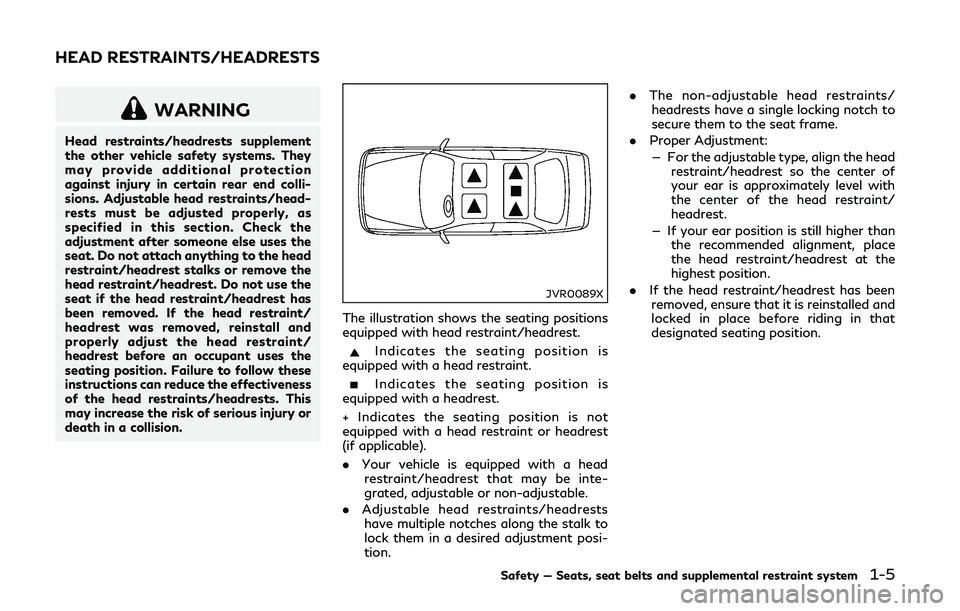
The illustration shows the seating positions
equipped with head restraint/headrest.
Indicates the seating position is
equipped with a head restraint.
Indicates the seating position is
equipped with a headrest.
+ Indicates the seating position is not
equipped with a head restraint or headrest
(if applicable).
. Your vehicle is equipped with a head
restraint/headrest that may be inte-
grated, adjustable or non-adjustable.
. Adjustable head restraints/headrests
have multiple notches along the stalk to
lock them in a desired adjustment posi-
tion. .
The non-adjustable head restraints/
headrests have a single locking notch to
secure them to the seat frame.
. Proper Adjustment:
— For the adjustable type, align the head restraint/headrest so the center of
your ear is approximately level with
the center of the head restraint/
headrest.
— If your ear position is still higher than the recommended alignment, place
the head restraint/headrest at the
highest position.
. If the head restraint/headrest has been
removed, ensure that it is reinstalled and
locked in place before riding in that
designated seating position.
Safety — Seats, seat belts and supplemental restraint system1-5
HEAD RESTRAINTS/HEADRESTS
Page 35 of 442
1-6Safety — Seats, seat belts and supplemental restraint system
SSS0992
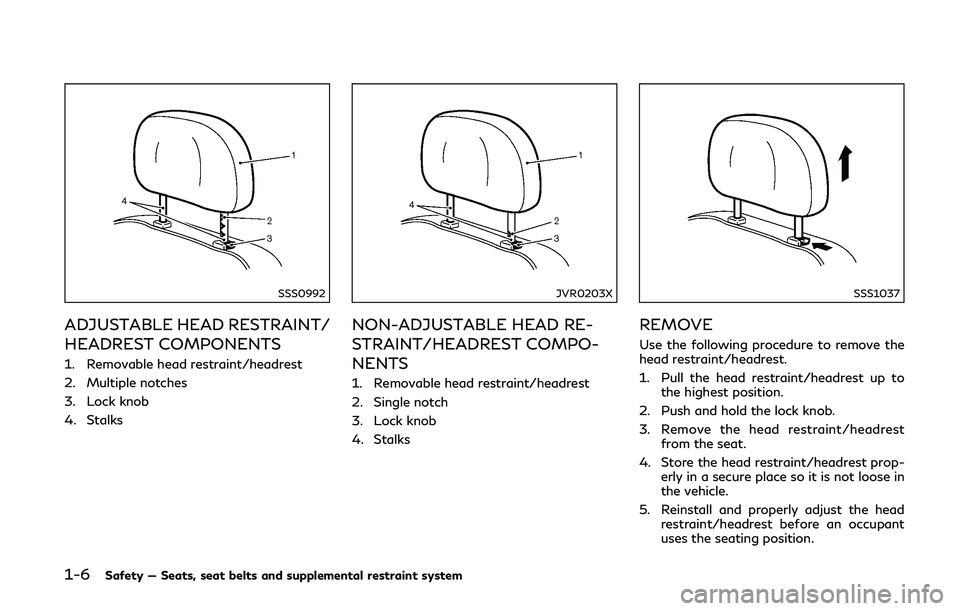
ADJUSTABLE HEAD RESTRAINT/
HEADREST COMPONENTS
1. Removable head restraint/headrest
2. Multiple notches
3. Lock knob
4. Stalks
JVR0203X
NON-ADJUSTABLE HEAD RE-
STRAINT/HEADREST COMPO-
NENTS
1. Removable head restraint/headrest
2. Single notch
3. Lock knob
4. Stalks
SSS1037
REMOVE
Use the following procedure to remove the
head restraint/headrest.
1. Pull the head restraint/headrest up tothe highest position.
2. Push and hold the lock knob.
3. Remove the head restraint/headrest from the seat.
4. Store the head restraint/headrest prop- erly in a secure place so it is not loose in
the vehicle.
5. Reinstall and properly adjust the head restraint/headrest before an occupant
uses the seating position.
Page 36 of 442
SSS1038
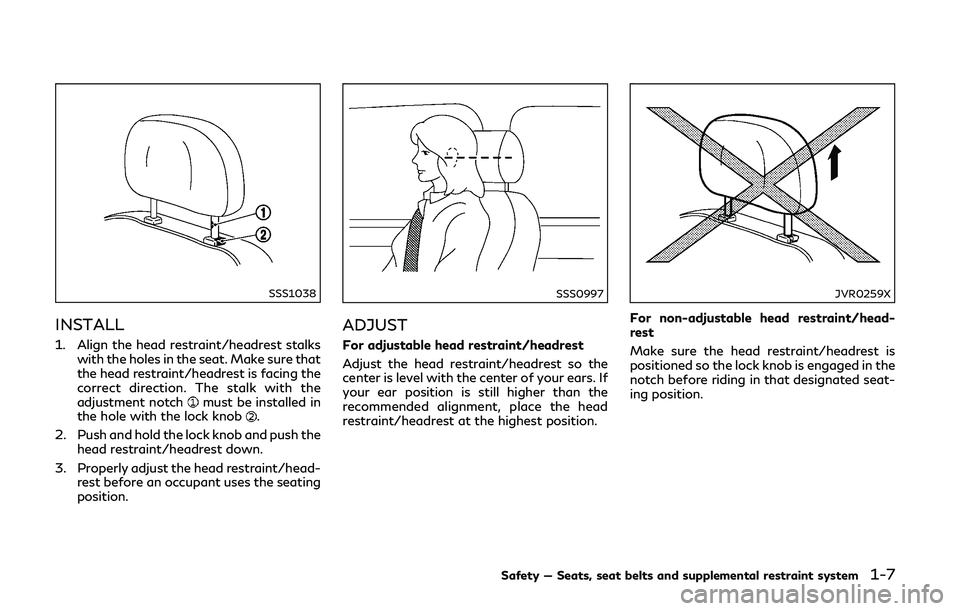
INSTALL
1. Align the head restraint/headrest stalkswith the holes in the seat. Make sure that
the head restraint/headrest is facing the
correct direction. The stalk with the
adjustment notch
must be installed in
the hole with the lock knob.
2. Push and hold the lock knob and push the head restraint/headrest down.
3. Properly adjust the head restraint/head- rest before an occupant uses the seating
position.
SSS0997
ADJUST
For adjustable head restraint/headrest
Adjust the head restraint/headrest so the
center is level with the center of your ears. If
your ear position is still higher than the
recommended alignment, place the head
restraint/headrest at the highest position.
JVR0259X
For non-adjustable head restraint/head-
rest
Make sure the head restraint/headrest is
positioned so the lock knob is engaged in the
notch before riding in that designated seat-
ing position.
Safety — Seats, seat belts and supplemental restraint system1-7
Page 37 of 442
1-8Safety — Seats, seat belts and supplemental restraint system
SSS1035
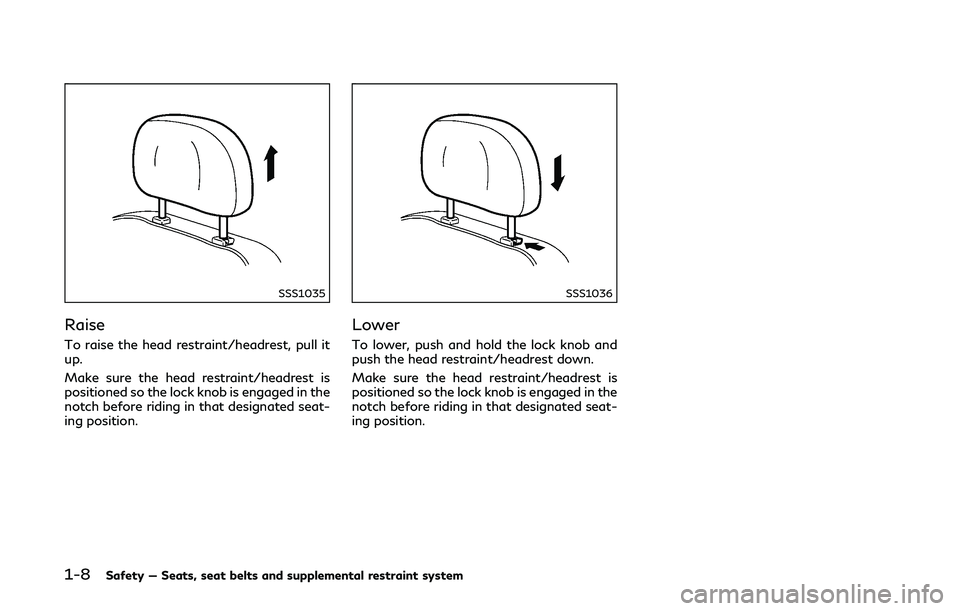
Raise
To raise the head restraint/headrest, pull it
up.
Make sure the head restraint/headrest is
positioned so the lock knob is engaged in the
notch before riding in that designated seat-
ing position.
SSS1036
Lower
To lower, push and hold the lock knob and
push the head restraint/headrest down.
Make sure the head restraint/headrest is
positioned so the lock knob is engaged in the
notch before riding in that designated seat-
ing position.
Page 41 of 442

1-12Safety — Seats, seat belts and supplemental restraint system
THREE-POINT TYPE SEAT BELT
WARNING
.Every person who drives or rides in
this vehicle should use a seat belt at
all times.
. Do not ride in a moving vehicle when
the seatback is reclined. This can be
dangerous. The shoulder belt will not
be against your body. In an accident,
you could be thrown into it and
receive neck or other serious injuries.
You could also slide under the lap belt
and receive serious internal injuries.
. For the most effective protection
when the vehicle is in motion, the
seat should be upright. Always sit
well back and upright in the seat with
both feet on the floor and adjust the
seat belt properly.
. Do not allow children to play with the
seat belts. Most seating positions are
equipped with Automatic Locking
Retractor (ALR) mode seat belts. If
the seat belt becomes wrapped
around a child’s neck with the ALR
mode activated, the child can be
seriously injured or killed if the seat
belt retracts and becomes tight. This can occur even if the vehicle is
parked. Unbuckle the seat belt to
release the child. If the seat belt can
not be unbuckled or is already un-
buckled, release the child by cutting
the seat belt with a suitable tool
(such as a knife or scissors) to release
the seat belt.
SSS0292
Fastening the seat belts
1. Adjust the seat. (See “Seats” (P.1-2).)
2. Slowly pull the seat belt out of the
retractor and insert the tongue into the
buckle until you hear and feel the latch
engage.
.The retractor is designed to lockduring a sudden stop or on impact.
A slow pulling motion permits the
belt to move, and allows you some
freedom of movement in the seat.
.If the seat belt cannot be pulled from its fully retracted position, firmly pull
the belt and release it. Then smoothly
pull the belt out of the retractor.
Page 42 of 442

SSS0290
3. Position the lap belt portionlow and
snug on the hips as shown.
4. Pull the shoulder belt portion toward the retractor to take up extra slack. Be sure
the shoulder belt is routed over your
shoulder and across your chest.
The three-point type seat belts have two
modes of operation:
. Emergency Locking Retractor (ELR)
. Automatic Locking Retractor (ALR)
The Emergency Locking Retractor (ELR)
mode allows the seat belt to extend and
retract to allow the driver and passengers
some freedom of movement in the seat. The
ELR locks the seat belt when the vehicle
slows down rapidly or during impacts. The Automatic Locking Retractor (ALR)
mode (child restraint mode) locks the seat
belt for child restraint installation.
When the ALR mode is activated the seat
belt cannot be extended again until the seat
belt tongue is detached from the buckle and
fully retracted. The seat belt returns to the
ELR mode after the seat belt fully retracts.
For additional information, see “Child re-
straints” (P.1-18).
The ALR mode should be used only for child
restraint installation. During normal seat
belt use by an occupant, the ALR mode
should not be activated. If it is activated, it
may cause uncomfortable seat belt tension.
WARNING
When fastening the seat belts, be certain
that seatbacks are completely secured in
the latched position. If they are not
completely secured, passengers may be
injured in an accident or sudden stop.
SSS0326
Unfastening the seat belts
To unfasten the seat belt, push the button
on the buckle. The seat belt automatically
retracts.
Checking seat belt operation
Seat belt retractors are designed to lock seat
belt movement by two separate methods:
.
When the belt is pulled quickly from the
retractor.
. When the vehicle slows down rapidly.
To increase your confidence in the seat belts,
check the operation as follows:
. Grasp the shoulder belt and pull forward
quickly. The retractor should lock and
Safety — Seats, seat belts and supplemental restraint system1-13