parking brake INFINITI Q60 2014 Owner's Guide
[x] Cancel search | Manufacturer: INFINITI, Model Year: 2014, Model line: Q60, Model: INFINITI Q60 2014Pages: 466, PDF Size: 3.2 MB
Page 319 of 466
![INFINITI Q60 2014 Owners Guide 5-20Starting and driving
For normal acceleration in low altitude
areas [less than 4,000 ft (1,219 m)]:
Gear changeMPH (km/h)
1st to 2nd 8 (13)
2nd to 3rd 16 (25)
3rd to 4th 25 (40)
4th to 5th 28 (45)](/img/42/41092/w960_41092-318.png "INFINITI Q60 2014 Owners Guide 5-20Starting and driving
For normal acceleration in low altitude
areas [less than 4,000 ft (1,219 m)]:
Gear changeMPH (km/h)
1st to 2nd 8 (13)
2nd to 3rd 16 (25)
3rd to 4th 25 (40)
4th to 5th 28 (45)")
5-20Starting and driving
For normal acceleration in low altitude
areas [less than 4,000 ft (1,219 m)]:
Gear changeMPH (km/h)
1st to 2nd 8 (13)
2nd to 3rd 16 (25)
3rd to 4th 25 (40)
4th to 5th 28 (45)
5th to 6th 33 (53)
For quick acceleration in low altitude areas
or in high altitude areas [over 4,000 ft
(1,219 m)]:
Gear change
MPH (km/h)
1st to 2nd 15 (24)
2nd to 3rd 25 (40)
3rd to 4th 40 (64)
4th to 5th 45 (72)
5th to 6th 50 (80)
Suggested maximum speed in each
gear
Downshift to a lower gear if the engine is
not running smoothly, or if you need to
accelerate.
Do not exceed the maximum suggested
speed (shown below) in any gear. For level
road driving, use the highest gear sug-
gested for that speed. Always observe
posted speed limits, and drive according
to the road conditions, which will ensure
safe operation. Do not over-rev the engine
when shifting to a lower gear as it may
cause engine damage or loss of vehicle
control.
Gear
MPH (km/h)
1st 37 (59)
2nd 60 (97)
3rd 86 (139)
4th —
5th —
6th —
WARNING
.
Be sure the parking brake is fully
released before driving. Failure to do so
can cause brake failure and lead to an
accident.
. Do not release the parking brake from
outside the vehicle.
. Do not use the shift lever in place of the
parking brake. When parking, be sure
the parking brake is fully engaged.
. Do not leave children unattended in a
vehicle. They could release the parking
brake and cause an accident.
PARKING BRAKE
Page 320 of 466

SPA2331
AUTOMATIC TRANSMISSION MOD-
ELS
To apply:Fully depress the parking brake
pedal
*1.
To release:
1. Firmly apply the foot brake
*2.
2. Depress the parking brake pedal
*1and the parking brake will be released.
3. Before driving, be sure the brake warning light goes out.
SPA2110
MANUAL TRANSMISSION MODELS
To apply: Pull the parking brake lever up
*1.
To release:
1. Firmly apply the foot brake.
2. While pulling up on the parking brake lever slightly, push the button
*2and
lower the lever completely
*3.
3. Before driving, be sure the brake warning light goes out.
PRECAUTIONS ON CRUISE CONTROL
.If the cruise control system malfunc-
tions, it will cancel automatically. The
SET indicator on the dot matrix crystal
display will then blink to warn the
driver.
. If the engine coolant temperature be-
comes excessively high, the cruise
control system will be canceled auto-
matically.
. If the SET indicator blinks, turn the
cruise control main switch off and have
the system checked by your INFINITI
retailer.
. The SET indicator may sometimes blink
when the cruise control main switch is
turned ON while pushing the ACCELER-
ATE/RESUME, COAST/SET or CANCEL
switch. To properly set the cruise
control system, perform the steps
below in the order indicated.
WARNING
Do not use the cruise control when driving
under the following conditions:
. when it is not possible to keep the
vehicle at a set speed
Starting and driving5-21
CRUISE CONTROL
Page 332 of 466
SSD0609
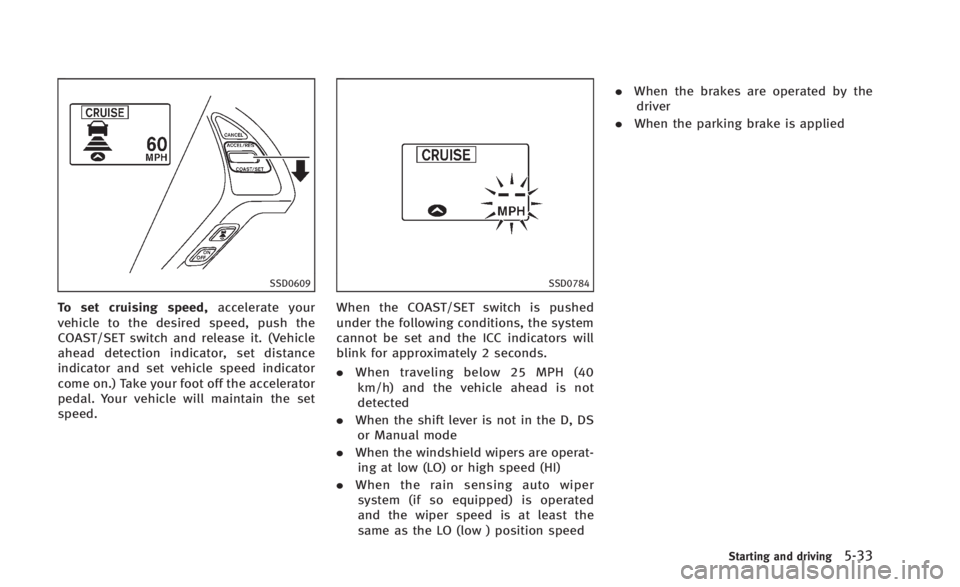
To set cruising speed,accelerate your
vehicle to the desired speed, push the
COAST/SET switch and release it. (Vehicle
ahead detection indicator, set distance
indicator and set vehicle speed indicator
come on.) Take your foot off the accelerator
pedal. Your vehicle will maintain the set
speed.
SSD0784
When the COAST/SET switch is pushed
under the following conditions, the system
cannot be set and the ICC indicators will
blink for approximately 2 seconds.
. When traveling below 25 MPH (40
km/h) and the vehicle ahead is not
detected
. When the shift lever is not in the D, DS
or Manual mode
. When the windshield wipers are operat-
ing at low (LO) or high speed (HI)
. When the rain sensing auto wiper
system (if so equipped) is operated
and the wiper speed is at least the
same as the LO (low ) position speed .
When the brakes are operated by the
driver
. When the parking brake is applied
Starting and driving5-33
Page 347 of 466
5-48Starting and driving
SD1006MA
WARNING
.Do not stop or park the vehicle over
flammable materials such as dry grass,
waste paper or rags. They may ignite and
cause a fire.
. Never leave the engine running while the
vehicle is unattended.
. Do not leave children unattended inside
the vehicle. They could unknowingly
activate switches or controls. Unat-
tended children could become involved
in serious accidents. .
Safe parking procedures require that
both the parking brake be applied and
the transmission placed into P (Park) for
Automatic Transmission (AT) model or in
an appropriate gear for Manual Trans-
mission (MT) model. Failure to do so
could cause the vehicle to move un-
expectedly or roll away and result in an
accident.
. Make sure the automatic transmission
shift lever has been pushed as far
forward as it can go and cannot be
moved without depressing the foot
brake pedal.
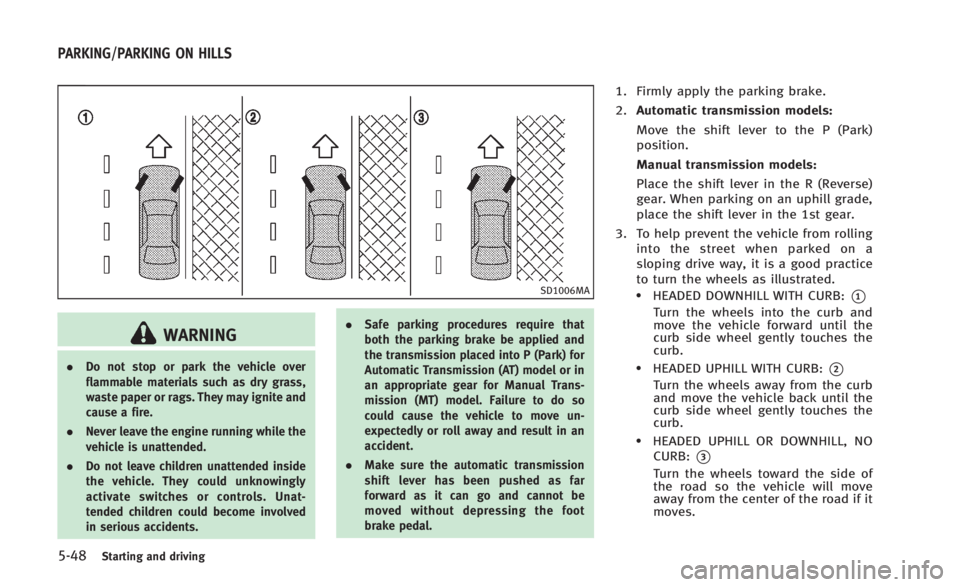
1. Firmly apply the parking brake.
2.Automatic transmission models:
Move the shift lever to the P (Park)
position.
Manual transmission models:
Place the shift lever in the R (Reverse)
gear. When parking on an uphill grade,
place the shift lever in the 1st gear.
3. To help prevent the vehicle from rolling into the street when parked on a
sloping drive way, it is a good practice
to turn the wheels as illustrated.
.HEADED DOWNHILL WITH CURB:*1
Turn the wheels into the curb and
move the vehicle forward until the
curb side wheel gently touches the
curb.
.HEADED UPHILL WITH CURB:*2
Turn the wheels away from the curb
and move the vehicle back until the
curb side wheel gently touches the
curb.
.HEADED UPHILL OR DOWNHILL, NOCURB:
*3
Turn the wheels toward the side of
the road so the vehicle will move
away from the center of the road if it
moves.
PARKING/PARKING ON HILLS
Page 351 of 466
5-52Starting and driving
BRAKING PRECAUTIONS
The brake system has two separate hy-
draulic circuits. If one circuit malfunctions,
you will still have braking at two wheels.
Vacuum assisted brakes
The brake booster aids braking by using
engine vacuum. If the engine stops, you
can stop the vehicle by depressing the
brake pedal. However, greater foot pres-
sure on the brake pedal will be required to
stop the vehicle and the stopping distance
will be longer.
When the brake pedal is depressed slowly
and firmly, you may hear a clicking noise
and feel a slight pulsation. This is normal
and indicates that the Brake Assist System
is operating.
Wet brakes
When the vehicle is washed or driven
through water, the brakes may get wet.
As a result, your braking distance will be
longer and the vehicle may pull to one side
during braking.
To dry brakes, drive the vehicle at a safe
speed while lightly tapping the brake pedal
to heat-up the brakes. Do this until the
brakes return to normal. Avoid driving thevehicle at high speeds until the brakes
function correctly.
PARKING BRAKE BREAK-IN
Break in the parking brake shoes whenever
the stopping effect of the parking brake is
weakened or whenever the parking brake
shoes and/or drums/rotors are replaced,
in order to assure the best braking
performance.
This procedure is described in the vehicle
service manual and can be performed by
an INFINITI retailer.
Using the brakes
Avoid resting your foot on the brake pedal
while driving. This will cause overheating
of the brakes, wearing out the brake and
pads faster and reduce gas mileage.
To help save the brakes and to prevent the
brakes from overheating, reduce speed
and downshift to a lower gear before going
down a slope or long grade. Overheated
brakes may reduce braking performance
and could result in loss of vehicle control.
WARNING
.
While driving on a slippery surface, be
careful when braking, accelerating or
downshifting. Abrupt braking or accel-
erating could cause the wheels to skid
and result in an accident.
. If the engine is not running or is turned
off while driving, the power assist for
the brakes will not work. Braking will be
harder.
BRAKE SYSTEM
Page 363 of 466

6-4In case of emergency
the emergency tire puncture repair kit).
. If you used the Emergency Tire Sealant
to repair a minor tire puncture, your
INFINITI retailer will also need to replace
the TPMS sensor in addition to repairing
or replacing the tire (for models
equipped with the emergency tire punc-
ture repair kit).
. INFINITI recommends using only NISSAN
Genuine Emergency Tire Sealant pro-
vided with your vehicle. Other tire
sealants may damage the valve stem
seal which can cause the tire to lose air
pressure (for models equipped with the
emergency tire puncture repair kit).
CHANGING FLAT TIRE (for models
with spare tire)
If you have a flat tire, follow the instruc-
tions below.
Stopping the vehicle
1. Safely move the vehicle off the road
and away from traffic.
2. Turn on the hazard warning flashers.
3. Park on a level surface and apply the parking brake.
4. Automatic Transmission model:
Move the shift lever to the P (Park)
position.
Manual Transmission model:
Move the shift lever to the R (Reverse)
position.
5. Turn off the engine.
6. Raise the hood to warn other traffic, and to signal professional road assis-
tance personnel that you need assis-
tance.
7. Have all passengers get out of the vehicle and stand in a safe place, away
from traffic and clear of the vehicle.
WARNING
. Make sure the parking brake is securely
applied and the manual transmission is
shifted into R (Reverse), or the automatic transmission into P (Park).
. Never change tires when the vehicle is
on a slope, ice or slippery areas. This is
hazardous.
. Never change tires if oncoming traffic is
close to your vehicle. Wait for profes-
sional road assistance.
Page 368 of 466

to repair a minor tire puncture, your
INFINITI retailer will also need to replace
the TPMS sensor in addition to repairing
or replacing the tire.
. INFINITI recommends using only NISSAN
Genuine Emergency Tire Sealant pro-
vided with your vehicle. Other tire
sealants may damage the valve stem
seal which can cause the tire to lose air
pressure.
This vehicle does not have a spare tire. The
emergency tire puncture repair kit (Emer-
gency Tire Sealant) is supplied with the
vehicle instead of a spare tire. It can be
used to temporarily repair minor tire
punctures.
If possible, have the vehicle towed to a
facility that can repair or replace the flat
tire. Using the emergency tire puncture
repair kit may cause a malfunction of the
tire pressure sensor and cause the low tire
pressure warning light to illuminate.
If you have a flat tire, follow the instruc-
tions below.
CAUTION
.To avoid the emergency tire puncture kit
being damaged during storage or use:
—Only use the emergency tire punc-
ture repair kit on your vehicle. Do not
use it on other vehicles.
—Only use the kit to inflate the tiresof your vehicle and to check the
vehicle’s tire pressure.
—Only plug the compressor into a 12VDC car power point.
—Keep the kit free of water and dirt.
—Do not disassemble or modify thekit.
—Do not drop the kit or allow hardimpacts to the kit.
. Do not use the emergency tire puncture
repair kit under the following conditions.
Contact an INFINITI retailer or profes-
sional road assistance.
—when the sealant has passed its
expiration date (shown on the label
attached to the bottle)
—when the cut or the puncture isapproximately 0.25 in (6 mm) or
longer
—when the tire sidewall is damaged
—when the vehicle has been drivenwith extremely low tire pressure
—when the tire has come off theinside or the outside of the wheel.
—when the tire wheel is damaged
—when two or more tires are flat
Stopping the vehicle
1. Safely move the vehicle off the road and away from traffic.
2. Turn on the hazard warning flashers.
3. Park on a level surface and apply the parking brake.
4. Automatic Transmission models:
Move the shift lever to the P (Park)
position.
Manual Transmission models:
Move the shift lever to the R (Reverse)
position.
5. Turn off the engine.
In case of emergency6-9
Page 369 of 466

6-10In case of emergency
6. Raise the hood to warn other traffic andto signal professional road assistance
personnel that you need assistance.
7. Have all passengers get out of the vehicle and stand in a safe place, away
from traffic and clear of the vehicle.
WARNING
. Make sure the parking brake is securely
applied and the manual transmission is
shifted into R (Reverse) or the automatic
transmission into P (Park).
. Never repair tires when the vehicle is on
a slope, ice or slippery areas. This is
hazardous.
. Never repair tires if oncoming traffic is
close to your vehicle. Wait for profes-
sional road assistance.
SCE0887
Getting emergency tire puncture
repair kit
Take out the emergency tire puncture
repair kit located under the cargo room or
in the trunk. The repair kit consists of the
following items:
*1Tire sealant bottle
*2Air compressor*
*3Speed restriction sticker
*: The compressor shape may differ
depending on the models.
NOTE:
For models with the emergency tire punc- ture repair kit, a spare tire, jack and rod
are not equipped as standard. These parts
are dealer options. Contact an INFINITI
retailer about obtaining these parts. See
“Changing flat tire (for models with spare
tire)”
(P.6-4) for usage of jacking tools and
tire replacement.
Before using emergency tire punc-
ture repair kit
. If any foreign object (for example, a
screw or nail) is embedded in the tire,
do not remove it.
. Check the expiration date of the sealant
(shown on the label attached to the
bottle). Never use a sealant whose
expiration date has passed.
Repairing tire
WARNING
Observe the following precautions when
using the tire repair compound.
. Swallowing the compound is dangerous.
Immediately drink as much water as
possible and seek prompt medical as-
sistance.
Page 374 of 466
SCE0653
WARNING
Always follow the instructions below. Failure
to do so could result in damage to the
charging system and cause personal injury.
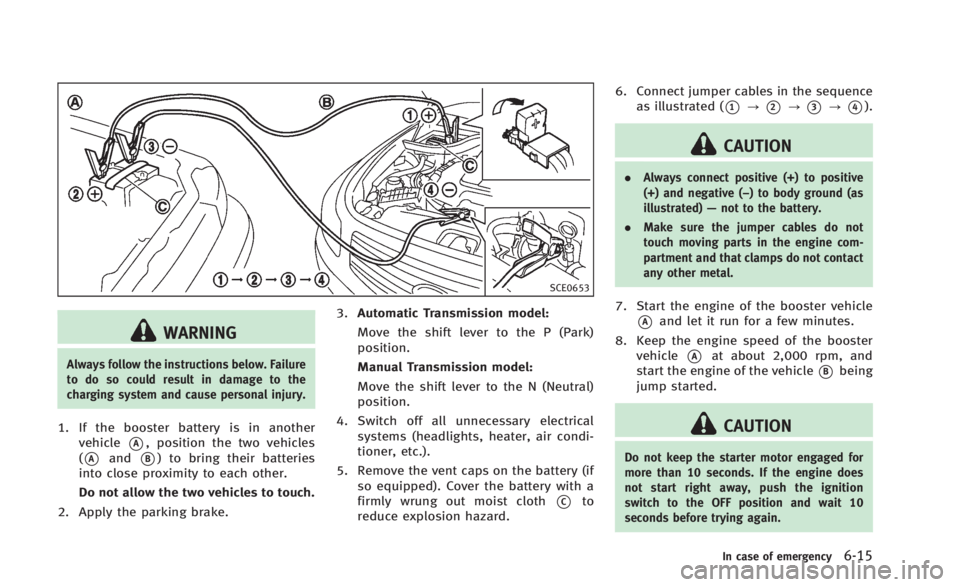
1. If the booster battery is in anothervehicle
*A, position the two vehicles
(
*Aand*B) to bring their batteries
into close proximity to each other.
Do not allow the two vehicles to touch.
2. Apply the parking brake. 3.
Automatic Transmission model:
Move the shift lever to the P (Park)
position.
Manual Transmission model:
Move the shift lever to the N (Neutral)
position.
4. Switch off all unnecessary electrical systems (headlights, heater, air condi-
tioner, etc.).
5. Remove the vent caps on the battery (if so equipped). Cover the battery with a
firmly wrung out moist cloth
*Cto
reduce explosion hazard. 6. Connect jumper cables in the sequence
as illustrated (
*1?*2?*3?*4).
CAUTION
. Always connect positive (+) to positive
(+) and negative (−) to body ground (as
illustrated) —not to the battery.
. Make sure the jumper cables do not
touch moving parts in the engine com-
partment and that clamps do not contact
any other metal.
7. Start the engine of the booster vehicle
*Aand let it run for a few minutes.
8. Keep the engine speed of the booster vehicle
*Aat about 2,000 rpm, and
start the engine of the vehicle
*Bbeing
jump started.
CAUTION
Do not keep the starter motor engaged for
more than 10 seconds. If the engine does
not start right away, push the ignition
switch to the OFF position and wait 10
seconds before trying again.
In case of emergency6-15
Page 375 of 466

6-16In case of emergency
9. After starting your engine, carefullydisconnect the negative cable and then
the positive cable (
*4?*3?*2?
*1).
10. Replace the vent caps (if so equipped). Be sure to dispose of the cloth used to
cover the vent holes as it may be
contaminated with corrosive acid. Do not attempt to start the engine by
pushing.CAUTION
.
Automatic transmission models cannot
be push-started or tow-started. Attempt-
ing to do so may cause transmission
damage.
. Three way catalyst equipped models
should not be started by pushing since
the three way catalyst may be damaged.
. Never try to start the vehicle by towing
it; when the engine starts, the forward
surge could cause the vehicle to collide
with the tow vehicle.
CAUTION
.Do not continue to drive if your vehicle
overheats. Doing so could cause engine
damage or a vehicle fire.
. To avoid the danger of being scalded,
never remove the radiator cap while the
engine is still hot. When the radiator cap
is removed, pressurized hot water will
spurt out, possibly causing serious
injury.
. Do not open the hood if steam is coming
out.
If your vehicle is overheating (indicated by
an extremely high temperature gauge
reading), or if you feel a lack of engine
power, detect abnormal noise, etc., take
the following steps:
1. Move the vehicle safely off the road,
apply the parking brake.
2. Automatic Transmission model:
Move the shift lever to the P (Park)
position.
Manual Transmission model:
Move the shift lever to the N (Neutral)
position.
PUSH STARTING IF YOUR VEHICLE OVERHEATS