lock INFINITI Q60 2014 Owners Manual
[x] Cancel search | Manufacturer: INFINITI, Model Year: 2014, Model line: Q60, Model: INFINITI Q60 2014Pages: 466, PDF Size: 3.2 MB
Page 10 of 466
SSI0833
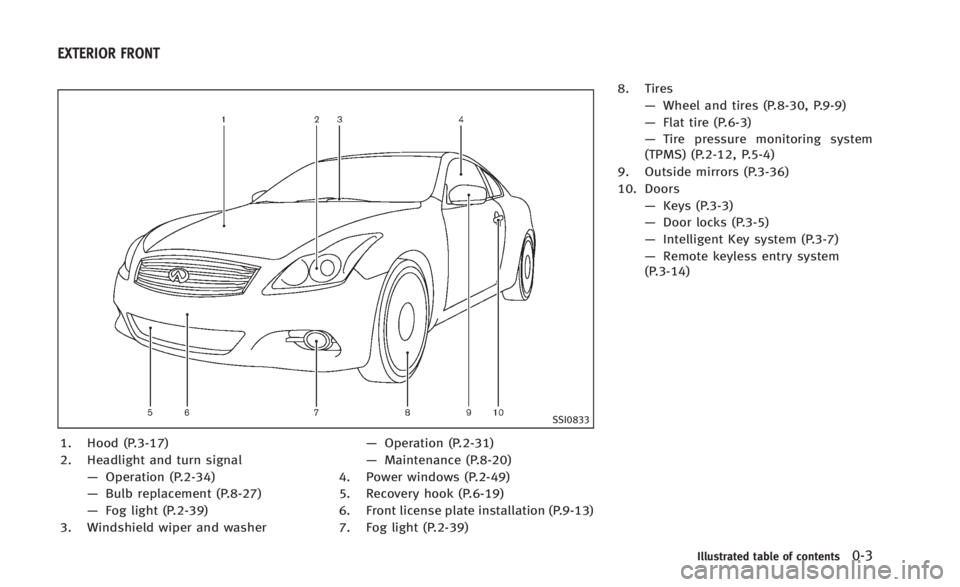
1. Hood (P.3-17)
2. Headlight and turn signal—Operation (P.2-34)
— Bulb replacement (P.8-27)
— Fog light (P.2-39)
3. Windshield wiper and washer —
Operation (P.2-31)
— Maintenance (P.8-20)
4. Power windows (P.2-49)
5. Recovery hook (P.6-19)
6. Front license plate installation (P.9-13)
7. Fog light (P.2-39) 8. Tires
—Wheel and tires (P.8-30, P.9-9)
— Flat tire (P.6-3)
— Tire pressure monitoring system
(TPMS) (P.2-12, P.5-4)
9. Outside mirrors (P.3-36)
10. Doors —Keys (P.3-3)
— Door locks (P.3-5)
— Intelligent Key system (P.3-7)
— Remote keyless entry system
(P.3-14)
Illustrated table of contents0-3
EXTERIOR FRONT
Page 15 of 466
0-8Illustrated table of contents
SSI0671
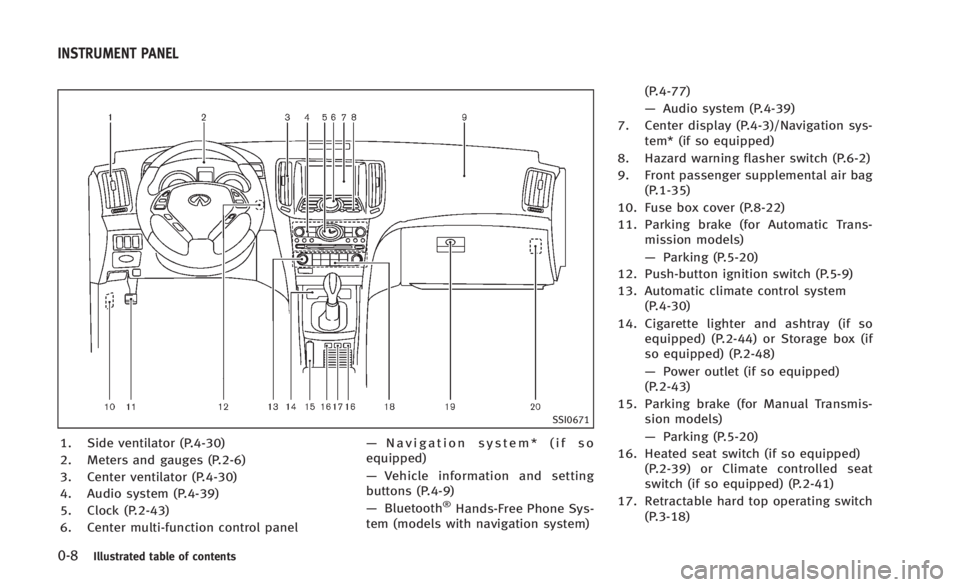
1. Side ventilator (P.4-30)
2. Meters and gauges (P.2-6)
3. Center ventilator (P.4-30)
4. Audio system (P.4-39)
5. Clock (P.2-43)
6. Center multi-function control panel—
Navigation system* (if so
equipped)
— Vehicle information and setting
buttons (P.4-9)
— Bluetooth
®Hands-Free Phone Sys-
tem (models with navigation system) (P.4-77)
—
Audio system (P.4-39)
7. Center display (P.4-3)/Navigation sys- tem* (if so equipped)
8. Hazard warning flasher switch (P.6-2)
9. Front passenger supplemental air bag (P.1-35)
10. Fuse box cover (P.8-22)
11. Parking brake (for Automatic Trans- mission models)
—Parking (P.5-20)
12. Push-button ignition switch (P.5-9)
13. Automatic climate control system (P.4-30)
14. Cigarette lighter and ashtray (if so equipped) (P.2-44) or Storage box (if
so equipped) (P.2-48)
—Power outlet (if so equipped)
(P.2-43)
15. Parking brake (for Manual Transmis- sion models)
—Parking (P.5-20)
16. Heated seat switch (if so equipped) (P.2-39) or Climate controlled seat
switch (if so equipped) (P.2-41)
17. Retractable hard top operating switch (P.3-18)
INSTRUMENT PANEL
Page 19 of 466
0-12Illustrated table of contents
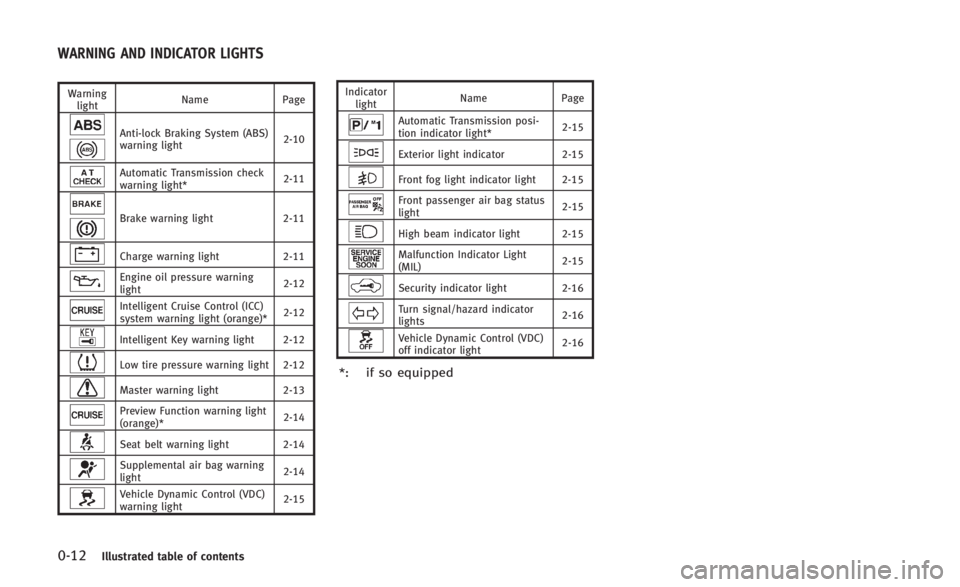
Warninglight Name
Page
Anti-lock Braking System (ABS)
warning light 2-10
Automatic Transmission check
warning light*2-11
Brake warning light
2-11
Charge warning light2-11
Engine oil pressure warning
light 2-12
Intelligent Cruise Control (ICC)
system warning light (orange)*2-12
Intelligent Key warning light 2-12
Low tire pressure warning light 2-12
Master warning light
2-13
Preview Function warning light
(orange)* 2-14
Seat belt warning light 2-14
Supplemental air bag warning
light
2-14
Vehicle Dynamic Control (VDC)
warning light2-15Indicator
light Name
Page
Automatic Transmission posi-
tion indicator light* 2-15
Exterior light indicator
2-15
Front fog light indicator light 2-15
Front passenger air bag status
light 2-15
High beam indicator light 2-15
Malfunction Indicator Light
(MIL)2-15
Security indicator light 2-16
Turn signal/hazard indicator
lights2-16
Vehicle Dynamic Control (VDC)
off indicator light2-16
*: if so equipped
WARNING AND INDICATOR LIGHTS
Page 21 of 466

1-2Safety—Seats, seat belts and supplemental restraint system
SSS0133
WARNING
. Do not ride in a moving vehicle when the
seatback is reclined. This can be danger-
ous. The shoulder belt will not be
against your body. In an accident, you
could be thrown into it and receive neck
or other serious injuries. You could also
slide under the lap belt and receive
serious internal injuries.
. For the most effective protection when
the vehicle is in motion, the seat should
be upright. Always sit well back in the seat with both feet on the floor and
adjust the seat belt properly. See
“Pre-
cautions on seat belt usage” (P.1-11).
. After adjustment, gently rock in the seat
to make sure it is securely locked.
. Do not leave children unattended inside
the vehicle. They could unknowingly
activate switches or controls. Unat-
tended children could become involved
in serious accidents.
. The seatback should not be reclined
further than necessary for comfort. Seat
belts are most effective when the pas- senger sits well back and straight up in
the seat. If the seatback is reclined, the
risk of sliding under the lap belt and
being injured is increased.
CAUTION
When adjusting the seat positions, be sure
not to contact any moving parts to avoid
possible injuries and/or damages.
SEATS
Page 25 of 466

1-6Safety—Seats, seat belts and supplemental restraint system
SSS0786
Walk-in mechanism:
This feature makes it easier to get in and
out of the rear seat. Use the following
procedure when getting in and out of the
rear seat.
If the sun visor is used, close it to the
original position before operating the walk-
in feature.
1. Pull the seatback lever upward
*1to
fold the front seatback down. Make
sure that the front seatback is comple-
tely folded down.
2. To slide the front seat forward, push the seatback switch
*2. The front seat will move forward.
3. Get in or out of the vehicle.
4. To return the front seat to its original position, raise the seatback and firmly
push the seatback switch
*2again.
. To stop the seat sliding, push the
seatback switch
*2again or push the
seat sliding switch.
. The front passenger seat will stop
returning 7.0 in (177.6 mm) from its
front-most position to retain space for
the rear passenger.
. Depending on the seat position, the
head restraint may contact the roof headlining during the walk-in opera-
tion. To prevent possible interference,
lower the seat using the seat lifter
switch.
CAUTION
.
When returning the seat to its original
position, confirm the seat and seatback
are locked properly.
. Be careful not to pinch your hand or foot
or bump your head when operating the
walk-in seat.
. Do not place any objects near the
seatback of the front seats. They may
be pinched and damaged.
. When operating the walk-in function,
always release the seat belt from the
seat belt guide. Otherwise, the seat belt
guide may be damaged.
The automatic forwarding and reversing
will not work or stop under the following
conditions:
.When the vehicle speed is above 4 MPH
(7 km/h) (driver’s seat only).
. When the seat belt is fastened.
Page 27 of 466

1-8Safety—Seats, seat belts and supplemental restraint system
SSS0992
Components
1. Head restraint
2. Adjustment notches
3. Lock knob
4. Stalks
SSS0997
Adjustment
Adjust the head restraint so the center is
level with the center of your ears.
SSS0993
To raise the head restraint, pull it up.
Page 28 of 466

SSS0994
To lower, push and hold the lock knob and
push the head restraint down.
SSS0995
Removal
Use the following procedure to remove the
adjustable head restraints.
1. Pull the head restraint up to the highestposition.
2. Push and hold the lock knob.
3. Remove the head restraint from the seat.
4. Store the head restraint properly in a secure place so it is not loose in the
vehicle.
5. Reinstall and properly adjust the head restraint before an occupant uses the seating position.
CAUTION
Models with a head restraint speaker (if so
equipped) are designed so that the head
restraint cannot be removed. The head
restraint speaker may be damaged if the
head restraint is forcibly pulled out.
Safety
—Seats, seat belts and supplemental restraint system1-9
Page 29 of 466
1-10Safety—Seats, seat belts and supplemental restraint system
SSS0996
Install
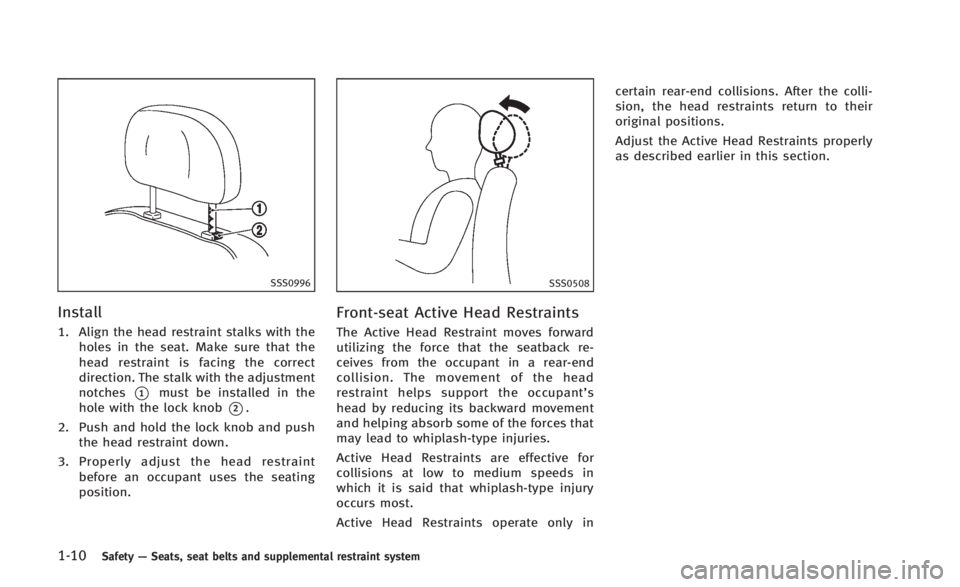
1. Align the head restraint stalks with the
holes in the seat. Make sure that the
head restraint is facing the correct
direction. The stalk with the adjustment
notches
*1must be installed in the
hole with the lock knob
*2.
2. Push and hold the lock knob and push the head restraint down.
3. Properly adjust the head restraint before an occupant uses the seating
position.
SSS0508
Front-seat Active Head Restraints
The Active Head Restraint moves forward
utilizing the force that the seatback re-
ceives from the occupant in a rear-end
collision. The movement of the head
restraint helps support the occupant’ s
head by reducing its backward movement
and helping absorb some of the forces that
may lead to whiplash-type injuries.
Active Head Restraints are effective for
collisions at low to medium speeds in
which it is said that whiplash-type injury
occurs most.
Active Head Restraints operate only in certain rear-end collisions. After the colli-
sion, the head restraints return to their
original positions.
Adjust the Active Head Restraints properly
as described earlier in this section.
Page 32 of 466
done by an INFINITI retailer.
. All seat belt assemblies, including re-
tractors and attaching hardware, should
be inspected after any collision by an
INFINITI retailer. INFINITI recommends
that all seat belt assemblies in use
during a collision be replaced unless
the collision was minor and the belts
show no damage and continue to oper-
ate properly. Seat belt assemblies not in
use during a collision should also be
inspected and replaced if either damage
or improper operation is noted.
. All child restraints and attaching hard-
ware should be inspected after any
collision. Always follow the restraint
manufacturer’ s inspection instructions
and replacement recommendations. The
child restraints should be replaced if
they are damaged.
PREGNANT WOMEN
INFINITI recommends that pregnant women
use seat belts. The seat belt should be
worn snug, and always position the lap
belt as low as possible around the hips,
not the waist, and place the shoulder belt
over your shoulder and across your chest. Never run the lap/shoulder belt over your
abdominal area. Contact your doctor for
specific recommendations.
INJURED PERSONS
INFINITI recommends that injured persons
use seat belts, depending on the injury.
Check with your doctor for specific recom-
mendations.
PRE-CRASH SEAT BELTS (front
seats) (if so equipped)
The pre-crash seat belt tightens the seat
belt to help restrain front seat occupants
under emergency braking. This can help
reduce the risk of injury when a collision
occurs.
Pre-crash seat belt will not be activated
when:
.
the brake pedal is not depressed
. the seat belt is not fastened
. the vehicle speed is under 10 MPH (15
km/h)
Always wear your seat belt correctly and sit
upright and well back.
If the seat belt warning light blinks even if
the driver’s and front passenger’s seat
belts are fastened, it may indicate the pre-
crash seat belt system has a malfunction. Have your INFINITI retailer check and repair
the system.
THREE-POINT TYPE SEAT BELT
WARNING
.
Every person who drives or rides in this
vehicle should use a seat belt at all
times.
. Do not ride in a moving vehicle when the
seatback is reclined. This can be danger-
ous. The shoulder belt will not be
against your body. In an accident, you
could be thrown into it and receive neck
or other serious injuries. You could also
slide under the lap belt and receive
serious internal injuries.
. For the most effective protection when
the vehicle is in motion, the seat should
be upright. Always sit well back in the
seat with both feet on the floor and
adjust the seat belt properly.
. Do not allow children to play with the
seat belts. Most seating positions are
equipped with Automatic Locking Re-
tractor (ALR) mode seat belts. If the seat
belt becomes wrapped around a child’s
neck with the ALR mode activated, the
Safety —Seats, seat belts and supplemental restraint system1-13
Page 33 of 466
1-14Safety—Seats, seat belts and supplemental restraint system
child can be seriously injured or killed if
the seat belt retracts and becomes tight.
This can occur even if the vehicle is
parked. Unbuckle the seat belt to release
the child. If the seat belt can not be
unbuckled or is already unbuckled,
release the child by cutting the seat belt
with a suitable tool (such as a knife or
scissors) to release the seat belt.
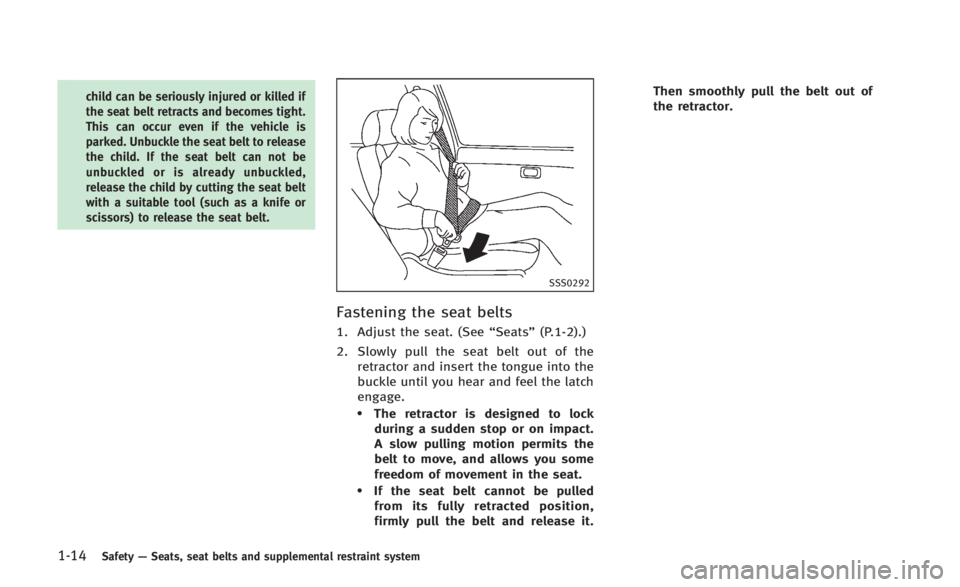
SSS0292
Fastening the seat belts
1. Adjust the seat. (See “Seats”(P.1-2).)
2. Slowly pull the seat belt out of the retractor and insert the tongue into the
buckle until you hear and feel the latch
engage.
.The retractor is designed to lockduring a sudden stop or on impact.
A slow pulling motion permits the
belt to move, and allows you some
freedom of movement in the seat.
.If the seat belt cannot be pulledfrom its fully retracted position,
firmly pull the belt and release it. Then smoothly pull the belt out of
the retractor.