trunk INFINITI Q60 2018 Owner's Guide
[x] Cancel search | Manufacturer: INFINITI, Model Year: 2018, Model line: Q60, Model: INFINITI Q60 2018Pages: 466, PDF Size: 2.47 MB
Page 162 of 466

.The ignition switch is pushed without an
Intelligent Key in the vehicle.
.The ignition switch is pushed with an
Intelligent Key in the vehicle but the
brake pedal is not depressed.
CONDITIONS THE REMOTE
START WILL NOT WORK
The remote start will not operate if any of
the following conditions are present:
.The ignition switch is placed in the ON
position.
.The hood is not securely closed.
.The hazard warning lights are on.
.The engine is still running. The engine
must be completely stopped. Wait at
least 6 seconds if the engine goes from
running to off. This is not applicable
when extending engine run time.
.The remote engine start
button is
not pushed and held for at least 2
seconds.
.The remote engine start
button is
not pushed and held within 5 seconds of
pushing LOCK
button.
.The brake pedal is depressed.
.The doors are not closed and locked.
.The trunk is open.
.The Intelligent Key warning message is
displayed in the vehicle information dis-play.
.The alarm sounds due to illegal entry into
the vehicle.
.Two remote vehicle starts, or a single
remote start with an extension, have
already been used.
.The vehicle is not in P (Park).
.The remote engine start function has
been switched to OFF in the settings
menu on the lower display. For additional
information, see the Infiniti InTouch
Owner’s Manual.
The remote engine start may display a
warning or indicator in the vehicle informa-
tion display. For an explanation of the
warning or indicator, see “Indicators for
operation” (P.2-23).
Pre-driving checks and adjustments3-21
Page 163 of 466

3-22Pre-driving checks and adjustments
JVP0452X
1. Pull the hood lock release handlelocated below the instrument panel; the
hood will then spring up slightly.
2. Pull the lever
up at the front of the
hood with your fingertips and raise the
hood.
3. When closing the hood, slowly close the
hood down to latch both the right and
left locks. Push the hood down to lock
the hood securely into place.
WARNING
.Make sure the hood is completely
closed and latched before driving.
Failure to do so could cause the hood
to fly open and result in an accident.
.If you see steam or smoke coming
from the engine compartment, to
avoid injury do not open the hood.
WARNING
.Do not drive with the trunk lid open.
This could allow dangerous exhaust
gases to be drawn into the vehicle.
See “Exhaust gas (carbon monoxide)”
(P.5-4) of this manual.
.Closely supervise children when they
are around cars to prevent them from
playing and becoming locked in the
trunk where they could be seriously
injured. Keep the car locked, with the
trunk closed, when not in use, and
prevent children’s access to Intelli-
gent Keys.
HOODTRUNK LID
Page 164 of 466
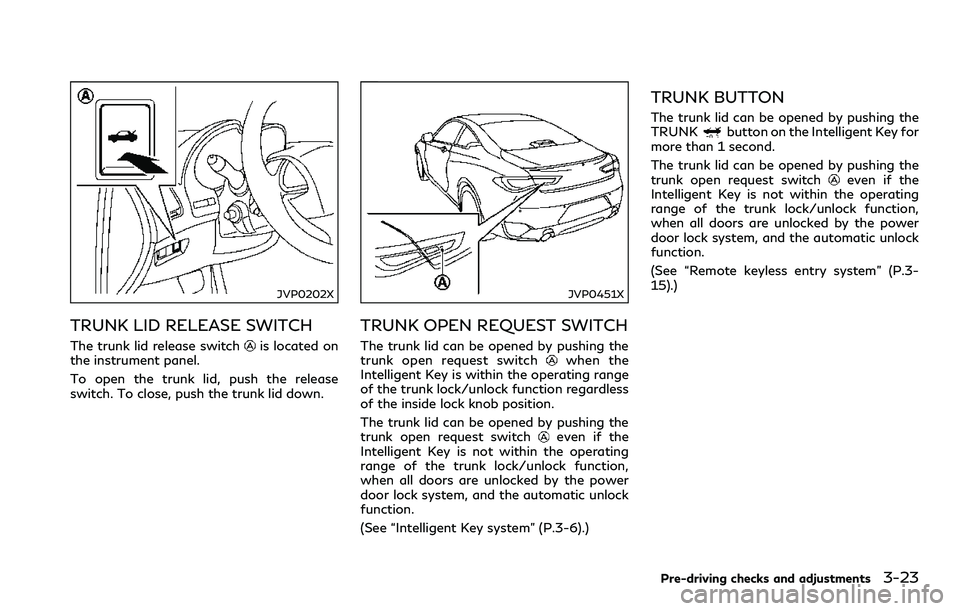
JVP0202X
TRUNK LID RELEASE SWITCH
The trunk lid release switchis located on
the instrument panel.
To open the trunk lid, push the release
switch. To close, push the trunk lid down.
JVP0451X
TRUNK OPEN REQUEST SWITCH
The trunk lid can be opened by pushing the
trunk open request switchwhen the
Intelligent Key is within the operating range
of the trunk lock/unlock function regardless
of the inside lock knob position.
The trunk lid can be opened by pushing the
trunk open request switch
even if the
Intelligent Key is not within the operating
range of the trunk lock/unlock function,
when all doors are unlocked by the power
door lock system, and the automatic unlock
function.
(See “Intelligent Key system” (P.3-6).)
TRUNK BUTTON
The trunk lid can be opened by pushing the
TRUNKbutton on the Intelligent Key for
more than 1 second.
The trunk lid can be opened by pushing the
trunk open request switch
even if the
Intelligent Key is not within the operating
range of the trunk lock/unlock function,
when all doors are unlocked by the power
door lock system, and the automatic unlock
function.
(See “Remote keyless entry system” (P.3-
15).)
Pre-driving checks and adjustments3-23
Page 165 of 466
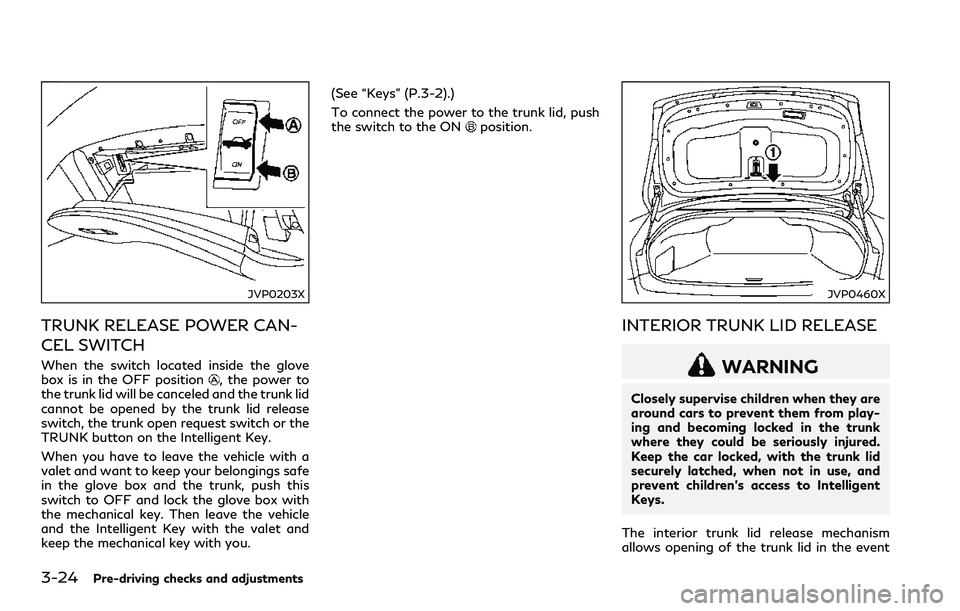
3-24Pre-driving checks and adjustments
JVP0203X
TRUNK RELEASE POWER CAN-
CEL SWITCH
When the switch located inside the glove
box is in the OFF position, the power to
the trunk lid will be canceled and the trunk lid
cannot be opened by the trunk lid release
switch, the trunk open request switch or the
TRUNK button on the Intelligent Key.
When you have to leave the vehicle with a
valet and want to keep your belongings safe
in the glove box and the trunk, push this
switch to OFF and lock the glove box with
the mechanical key. Then leave the vehicle
and the Intelligent Key with the valet and
keep the mechanical key with you.(See “Keys” (P.3-2).)
To connect the power to the trunk lid, push
the switch to the ON
position.
JVP0460X
INTERIOR TRUNK LID RELEASE
WARNING
Closely supervise children when they are
around cars to prevent them from play-
ing and becoming locked in the trunk
where they could be seriously injured.
Keep the car locked, with the trunk lid
securely latched, when not in use, and
prevent children’s access to Intelligent
Keys.
The interior trunk lid release mechanism
allows opening of the trunk lid in the event
Page 166 of 466
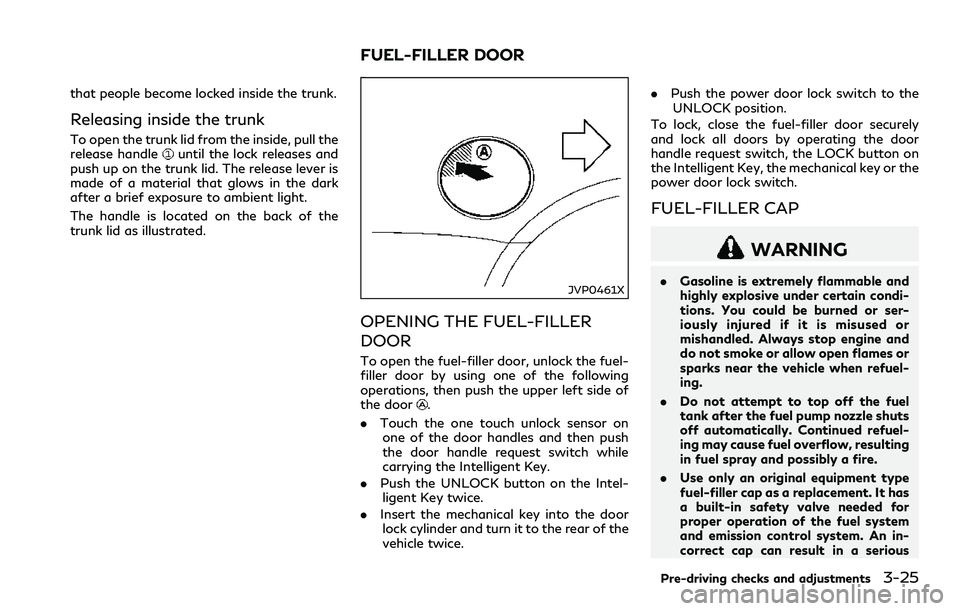
that people become locked inside the trunk.
Releasing inside the trunk
To open the trunk lid from the inside, pull the
release handleuntil the lock releases and
push up on the trunk lid. The release lever is
made of a material that glows in the dark
after a brief exposure to ambient light.
The handle is located on the back of the
trunk lid as illustrated.
JVP0461X
OPENING THE FUEL-FILLER
DOOR
To open the fuel-filler door, unlock the fuel-
filler door by using one of the following
operations, then push the upper left side of
the door
.
.Touch the one touch unlock sensor on
one of the door handles and then push
the door handle request switch while
carrying the Intelligent Key.
.Push the UNLOCK button on the Intel-
ligent Key twice.
.Insert the mechanical key into the door
lock cylinder and turn it to the rear of the
vehicle twice..Push the power door lock switch to the
UNLOCK position.
To lock, close the fuel-filler door securely
and lock all doors by operating the door
handle request switch, the LOCK button on
the Intelligent Key, the mechanical key or the
power door lock switch.
FUEL-FILLER CAP
WARNING
.Gasoline is extremely flammable and
highly explosive under certain condi-
tions. You could be burned or ser-
iously injured if it is misused or
mishandled. Always stop engine and
do not smoke or allow open flames or
sparks near the vehicle when refuel-
ing.
.Do not attempt to top off the fuel
tank after the fuel pump nozzle shuts
off automatically. Continued refuel-
ing may cause fuel overflow, resulting
in fuel spray and possibly a fire.
.Use only an original equipment type
fuel-filler cap as a replacement. It has
a built-in safety valve needed for
proper operation of the fuel system
and emission control system. An in-
correct cap can result in a serious
Pre-driving checks and adjustments3-25
FUEL-FILLER DOOR
Page 183 of 466
5-4Starting and driving
WARNING
.Do not leave children or adults who
would normally require the support
of others alone in your vehicle. Pets
should not be left alone either. They
could accidentally injure themselves
or others through inadvertent opera-
tion of the vehicle. Also, on hot,
sunny days, temperatures in a closed
vehicle could quickly become high
enough to cause severe or possibly
fatal injuries to people or animals.
.Closely supervise children when they
are around cars to prevent them from
playing and becoming locked in the
trunk where they could be seriously
injured. Keep the car locked, with the
rear seatback and trunk lid securely
latched when not in use, and prevent
children’s access to car keys.
EXHAUST GAS (carbon monoxide)
WARNING
.Do not breathe exhaust gases; they
contain colorless and odorless carbon
monoxide. Carbon monoxide is dan-
gerous. It can cause unconsciousness
or death.
.If you suspect that exhaust fumes are
entering the vehicle, drive with all
windows fully open, and have the
vehicle inspected immediately.
.Do not run the engine in closed spaces
such as a garage.
.Do not park the vehicle with the
engine running for any extended
length of time.
.Keep the trunk lid closed while driv-
ing, otherwise exhaust gases could be
drawn into the passenger compart-
ment. If you must drive with the
trunk lid open, follow these precau-
tions:
1) Open all the windows.
2) Set the air recirculation to off and
the fan control to high to circulate
the air..If electrical wiring or other cable
connections must pass to a trailer
through the seal on the trunk lid or
the body, follow the manufacturer’s
recommendation to prevent carbon
monoxide entry into the vehicle.
.The exhaust system and body should
be inspected by a qualified mechanic
whenever:
— The vehicle is raised for service.
— You suspect that exhaust fumes
are entering into the passenger
compartment.
— You notice a change in the sound
of the exhaust system.
— You have had an accident invol-
ving damage to the exhaust sys-
tem, underbody, or rear of the
vehicle.
PRECAUTIONS WHEN STARTING
AND DRIVING
Page 191 of 466
5-12Starting and driving
SSD0872
OPERATING RANGE FOR EN-
GINE START FUNCTION
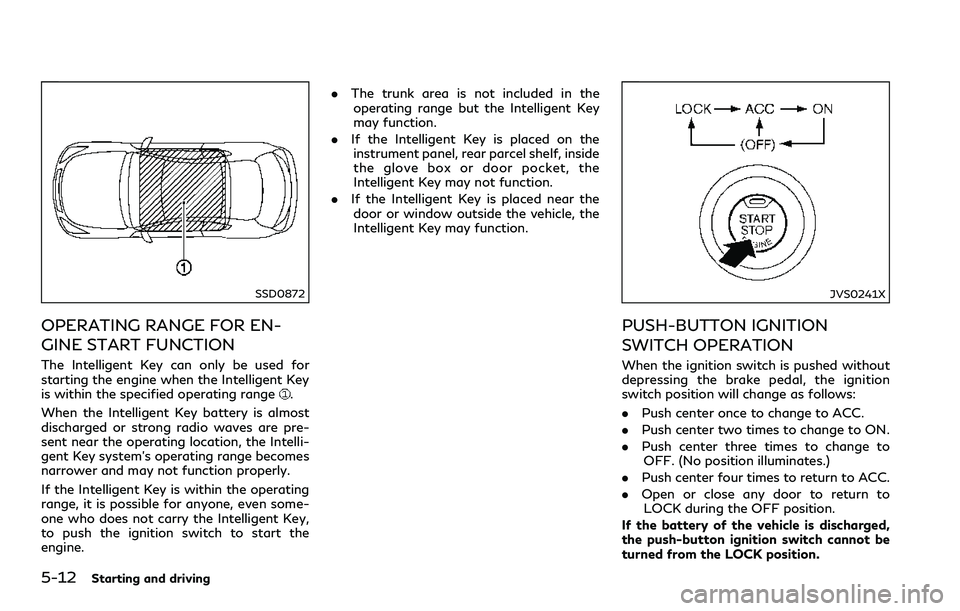
The Intelligent Key can only be used for
starting the engine when the Intelligent Key
is within the specified operating range
.
When the Intelligent Key battery is almost
discharged or strong radio waves are pre-
sent near the operating location, the Intelli-
gent Key system’s operating range becomes
narrower and may not function properly.
If the Intelligent Key is within the operating
range, it is possible for anyone, even some-
one who does not carry the Intelligent Key,
to push the ignition switch to start the
engine..The trunk area is not included in the
operating range but the Intelligent Key
may function.
.If the Intelligent Key is placed on the
instrument panel, rear parcel shelf, inside
the glove box or door pocket, the
Intelligent Key may not function.
.If the Intelligent Key is placed near the
door or window outside the vehicle, the
Intelligent Key may function.
JVS0241X
PUSH-BUTTON IGNITION
SWITCH OPERATION
When the ignition switch is pushed without
depressing the brake pedal, the ignition
switch position will change as follows:
.Push center once to change to ACC.
.Push center two times to change to ON.
.Push center three times to change to
OFF. (No position illuminates.)
.Push center four times to return to ACC.
.Open or close any door to return to
LOCK during the OFF position.
If the battery of the vehicle is discharged,
the push-button ignition switch cannot be
turned from the LOCK position.
Page 264 of 466
— On roads where the traffic is
heavy or there are sharp curves
— On slippery road surfaces such as
on ice or snow, etc.
— During bad weather (rain, fog,
snow, etc.)
— When rain, snow or dirt adhere to
the system sensor
— On steep downhill roads (the
vehicle may go beyond the set
vehicle speed and frequent brak-
ing may result in overheating the
brakes)
— On repeated uphill and downhill
roads
— When traffic conditions make it
difficult to keep a proper distance
between vehicles because of fre-
quent acceleration or deceleration
.In some road or traffic conditions, a
vehicle or object can unexpectedly
come into the sensor detection zone
and cause automatic braking. You
may need to control the distance
from other vehicles using the accel-
erator pedal. Always stay alert and
avoid using the ICC system when it is
not recommended in this section.The radar sensor will not detect the follow-
ing objects:
.Stationary and slow moving vehicles
.Pedestrians or objects in the roadway
.Oncoming vehicles in the same lane
.Motorcycles traveling offset in the travel
lane
The sensor generally detects the signals
returned from the vehicle ahead. Therefore,
if the sensor cannot detect the reflection
from the vehicle ahead, the ICC system may
not maintain the selected distance.
The following are some conditions in which
the sensor cannot detect the signals:
.When the snow or road spray from
traveling vehicles reduces the sensor’s
visibility
.When excessively heavy baggage is
loaded in the rear seat or the trunk of
your vehicle
The ICC system is designed to automatically
check the sensor’s operation within the
limitation of the system. When the sensor
is covered with dirt or is obstructed, the
system will automatically be canceled. If the
sensor is covered with ice, a transparent or
translucent vinyl bag, etc., the ICC system
may not detect them. In these instances, the
vehicle-to-vehicle distance control mode
may not cancel and may not be able to
maintain the selected following distancefrom the vehicle ahead. Be sure to check
and clean the sensor regularly.
Starting and driving5-85
Page 280 of 466
front of you.
DCA SYSTEM LIMITATIONS
WARNING
Listed below are the system limitations
of the DCA system. Failure to operate
the vehicle in accordance with these
system limitations could result in serious
injury or death.
.This system will not adapt automati-
cally to road conditions. Do not use
the system on roads with sharp
curves, or on icy roads, in heavy rain
or in fog.
.The DCA system will not apply brake
control while the driver’s foot is on
the accelerator pedal.
.As there is a performance limit to the
distance control function, never rely
solely on the DCA system. This sys-
tem does not correct careless, inat-
tentive or absent-minded driving, or
overcome poor visibility in rain, fog,
or other bad weather. Decelerate the
vehicle speed by depressing the brake
pedal, depending on the distance to
the vehicle ahead and the surround-
ing circumstances in order to main-
tain a safe distance between vehicles..The system may not detect the
vehicle in front of you in certain road
or weather conditions. To avoid ac-
cidents, never use the DCA system
under the following conditions:
— On roads with sharp curves
— On slippery road surfaces such as
on ice or snow, etc.
— During bad weather (rain, fog,
snow, etc.)
— When rain, snow or dirt adhere to
the system sensor
— On steep downhill roads (fre-
quent braking may result in over-
heating the brakes)
— On repeated uphill and downhill
roads
.In some road or traffic conditions, a
vehicle or object can unexpectedly
come into the sensor detection zone
and cause automatic braking. You
may need to control the distance
from other vehicles using the accel-
erator pedal. Always stay alert and
avoid using the DCA system when it
is not recommended in this section.The radar sensor will not detect the follow-
ing objects:
.Stationary and slow moving vehicles
.Pedestrians or objects in the roadway
.Oncoming vehicles in the same lane
.Motorcycles traveling offset in the travel
lane
The following are some conditions in which
the sensor cannot detect the signals:
.When the snow or road spray from
traveling vehicles reduces the sensor’s
visibility
.When excessively heavy baggage is
loaded in the rear seat or the trunk of
your vehicle
Starting and driving5-101
Page 289 of 466

5-110Starting and driving
cast in a shadow, making it diffi-
cult to see.
— A sudden change in brightness
occurs. (For example, when the
vehicle enters or exits a tunnel or a
shaded area or lightning flashes.)
— The poor contrast of a person to
the background, such as having
clothing color or pattern which is
similar to the background.
— The pedestrian’s profile is par-
tially obscured or unidentifiable
due to the pedestrian transport-
ing luggage, wearing bulky or very
loose-fitting clothing or acces-
sories.
.The system performance may de-
grade in the following conditions:
— The vehicle is driven on a slippery
road.
— The vehicle is driven on a slope.
— Excessively heavy baggage is
loaded in the rear seat or the
trunk of your vehicle.
.The system is designed to automati-
cally check the sensor (radar and
camera)’s functionality, within cer-
tain limitations. The system may not
detect blockage of sensor areas cov-ered by ice, snow or stickers, for
example. In these cases, the system
may not be able to warn the driver
properly. Be sure that you check,
clean and clear sensor areas regularly.
.In some road and traffic conditions,
the FEB with pedestrian detection
system may unexpectedly apply par-
tial braking. When acceleration is
necessary, depress the accelerator
pedal to override the system.
.Excessive noise will interfere with the
warning chime sound, and the chime
may not be heard.