battery INFINITI Q60 2019 Service Manual
[x] Cancel search | Manufacturer: INFINITI, Model Year: 2019, Model line: Q60, Model: INFINITI Q60 2019Pages: 468, PDF Size: 2.18 MB
Page 348 of 468
6-20In case of emergency
JVE0430X
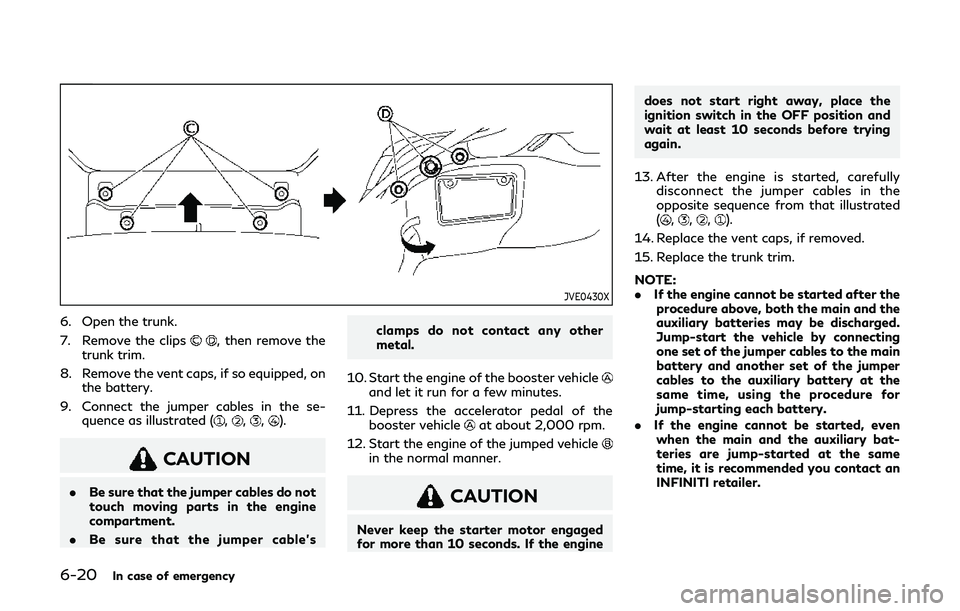
6. Open the trunk.
7. Remove the clips
, then remove the
trunk trim.
8. Remove the vent caps, if so equipped, on the battery.
9. Connect the jumper cables in the se- quence as illustrated (
,,,).
CAUTION
.Be sure that the jumper cables do not
touch moving parts in the engine
compartment.
. Be sure that the jumper cable’s clamps do not contact any other
metal.
10. Start the engine of the booster vehicle
and let it run for a few minutes.
11. Depress the accelerator pedal of the booster vehicle
at about 2,000 rpm.
12. Start the engine of the jumped vehicle
in the normal manner.
CAUTION
Never keep the starter motor engaged
for more than 10 seconds. If the engine does not start right away, place the
ignition switch in the OFF position and
wait at least 10 seconds before trying
again.
13. After the engine is started, carefully disconnect the jumper cables in the
opposite sequence from that illustrated
(
,,,).
14. Replace the vent caps, if removed.
15. Replace the trunk trim.
NOTE:
. If the engine cannot be started after the
procedure above, both the main and the
auxiliary batteries may be discharged.
Jump-start the vehicle by connecting
one set of the jumper cables to the main
battery and another set of the jumper
cables to the auxiliary battery at the
same time, using the procedure for
jump-starting each battery.
. If the engine cannot be started, even
when the main and the auxiliary bat-
teries are jump-started at the same
time, it is recommended you contact an
INFINITI retailer.
Page 363 of 468
8 Do-it-yourself
Maintenance precautions ............................................... 8-3
Engine compartment check locations ......................... 8-4VR30DDTT engine ..................................................... 8-4
2.0L turbo gasoline engine ...................................... 8-5
Engine cooling system (for VR30DDTT
engine models) ................................................................... 8-6
Checking engine coolant level ................................ 8-7
Changing engine coolant .......................................... 8-7
Engine cooling system (for 2.0L turbo gasoline
engine models) ................................................................... 8-8
Checking engine coolant level ................................. 8-8
Changing engine coolant .......................................... 8-9
Intercooler cooling system (for VR30DDTT
engine models) ................................................................... 8-9 Checking intercooler coolant level ...................... 8-10
Changing intercooler coolant ............................... 8-10
Engine oil ........................................................................\
.. 8-10 Checking engine oil level ......................................... 8-11
Changing engine oil and filter ................................ 8-11
Automatic Transmission Fluid (ATF) ........................ 8-14
Power steering fluid (models with hydraulic pump
electric power steering) ................................................ 8-14
Brake fluid ........................................................................\
. 8-15
Window washer fluid .................................................... 8-15 Battery ........................................................................\
...... 8-16
Main battery location ............................................ 8-17
Auxiliary battery location (for 2.0L turbo
gasoline engine models) ........................................ 8-18
Checking battery fluid level .................................. 8-18
Jump starting ........................................................... 8-19
Variable voltage control system ............................... 8-20
Drive belts ....................................................................... 8-20
Spark plugs ...................................................................... 8-21 Replacing spark plugs ............................................ 8-21
Air cleaner ........................................................................\
8-22
Windshield wiper blades .............................................. 8-22 Cleaning ..................................................................... 8-22
Replacing ................................................................... 8-23
Brakes ........................................................................\
........ 8-23 Self-adjusting brakes ............................................. 8-23
Brake pad wear warning ....................................... 8-23
Fuses ........................................................................\
......... 8-24 Engine compartment .............................................. 8-25
Passenger compartment ....................................... 8-26
Intelligent Key battery replacement ......................... 8-27
Lights ........................................................................\
......... 8-29 Headlights ................................................................ 8-30
Exterior and interior lights ................................... 8-30
Page 365 of 468
When performing any inspection or main-
tenance work on your vehicle, always take
care to prevent serious accidental injury to
yourself or damage to the vehicle. The
following are general precautions which
should be closely observed.
WARNING
.Park the vehicle on a level surface,
apply the parking brake securely and
block the wheels to prevent the
vehicle from moving. Move the shift
lever to P (Park).
. Be sure the ignition switch is in the
OFF or LOCK position when per-
forming any parts replacement or
repairs.
. Never connect or disconnect the
battery or any transistorized compo-
nent while the ignition switch is in the
ON position.
. Never leave the engine or automatic
transmission related component har-
nesses disconnected while the igni-
tion switch is in the ON position.
. If you must work with the engine
running, keep your hands, clothing,
hair and tools away from moving
fans, belts and any other moving parts.
. It is advisable to secure or remove
any loose clothing and remove any
jewelry, such as rings, watches, etc.
before working on your vehicle.
. Always wear eye protection when-
ever you work on your vehicle.
. If you must run the engine in an
enclosed space such as a garage, be
sure there is proper ventilation for
exhaust gases to escape.
. Never get under the vehicle while it is
supported only by a jack. If it is
necessary to work under the vehicle,
support it with safety stands.
. Keep smoking materials, flame and
sparks away from fuel tank and the
battery.
. Your vehicle is equipped with an
automatic engine cooling fan. It may
come on at any time without warn-
ing, even if the ignition key is in the
OFF position and the engine is not
running. To avoid injury, always dis-
connect the negative battery cable
before working near the fan.
. Because the fuel lines are under high
pressure even when the engine is off,
it is recommended you visit an
INFINITI retailer for service of the fuel filter or fuel lines.
CAUTION
.
Do not work under the hood while the
engine is hot. Turn the engine off and
wait until it cools down.
. Avoid direct contact with used en-
gine oil and coolant. Improperly dis-
posed engine oil, coolant, and/or
other vehicle fluids can damage the
environment. Always conform to lo-
cal regulations for disposal of vehicle
fluid.
This “8. Do-it-yourself” section gives in-
structions regarding only those items which
are relatively easy for an owner to perform.
A genuine INFINITI Service Manual is also
available. (See “Owner’s Manual/Service
Manual order information” (P.10-26).)
You should be aware that incomplete or
improper servicing may result in operating
difficulties or excessive emissions, and could
affect your warranty coverage. If in doubt
about any servicing, it is recommended you
have it done by an INFINITI retailer.
Do-it-yourself8-3
MAINTENANCE PRECAUTIONS
Page 366 of 468
8-4Do-it-yourself
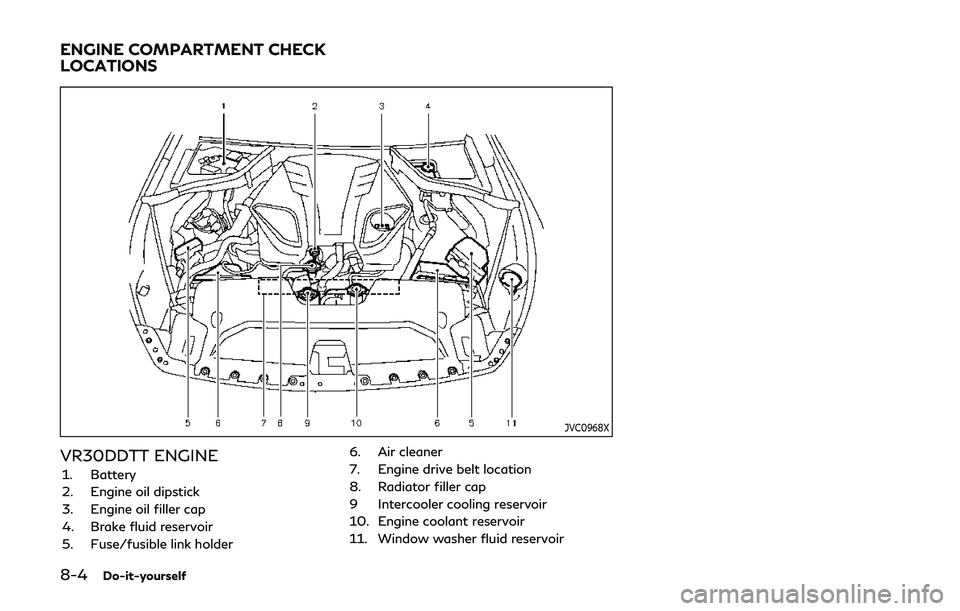
JVC0968X
VR30DDTT ENGINE
1. Battery
2. Engine oil dipstick
3. Engine oil filler cap
4. Brake fluid reservoir
5. Fuse/fusible link holder6. Air cleaner
7. Engine drive belt location
8. Radiator filler cap
9 Intercooler cooling reservoir
10. Engine coolant reservoir
11. Window washer fluid reservoir
ENGINE COMPARTMENT CHECK
LOCATIONS
Page 367 of 468
JVC0646X
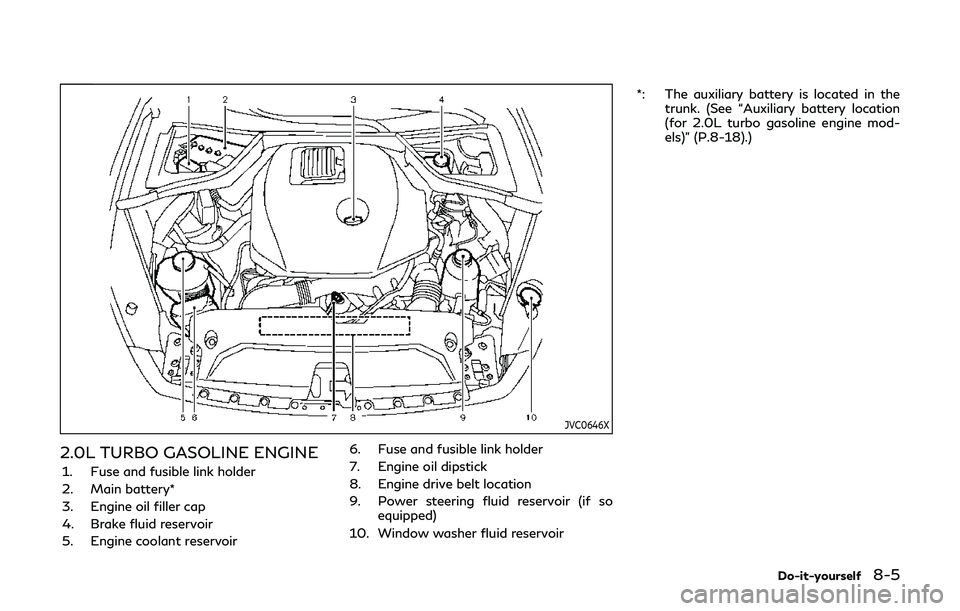
2.0L TURBO GASOLINE ENGINE
1. Fuse and fusible link holder
2. Main battery*
3. Engine oil filler cap
4. Brake fluid reservoir
5. Engine coolant reservoir6. Fuse and fusible link holder
7. Engine oil dipstick
8. Engine drive belt location
9. Power steering fluid reservoir (if so
equipped)
10. Window washer fluid reservoir *: The auxiliary battery is located in the
trunk. (See “Auxiliary battery location
(for 2.0L turbo gasoline engine mod-
els)” (P.8-18).)
Do-it-yourself8-5
Page 378 of 468

8-16Do-it-yourself
To check the window washer fluid level, use
your finger to plug the holeof the cap/
tube assembly, then remove it from the
reservoir. If there is no fluid in the tube,
add fluid.
Add a washer solvent to the washer for
better cleaning. In the winter season, add a
windshield washer antifreeze. Follow the
manufacturer’s instructions for the mixture
ratio.
Refill the reservoir more frequently when
driving conditions require an increased
amount of window washer fluid.
Recommended fluid is Genuine NISSAN
Windshield Washer Concentrate Cleaner &
Antifreeze or equivalent.
CAUTION
. Do not substitute engine anti-freeze
coolant for window washer solution.
This may result in damage to the
paint.
. Do not fill the window washer re-
servoir with washer fluid concen-
trates at full strength. Some methyl
alcohol based washer fluid concen-
trates may permanently stain the
grille if spilled while filling the win-
dow washer reservoir. .
Pre-mix washer fluid concentrates
with water to the manufacturer’s
recommended levels before pouring
the fluid into the window washer
reservoir. Do not use the window
washer reservoir to mix the washer
fluid concentrate and water.
.Keep the battery surface clean and dry.
Clean the battery with a solution of
baking soda and water.
. Make certain the terminal connections
are clean and securely tightened.
. If the vehicle is not to be used for 30 days
or longer, disconnect the negative (−)
battery terminal cable to prevent dis-
charging it.
NOTE:
Care should be taken to avoid situations
that can lead to potential battery discharge
and potential no-start conditions such as:
1. Installation or extended use of electro-
nic accessories that consume battery
power when the engine is not running
(Phone chargers, GPS, DVD players,
etc.)
2. Vehicle is not driven regularly and/or
only driven short distances.
In these cases, the battery may need to be
charged to maintain battery health.
CAUTION
When the battery cable is removed from
the battery terminal, do not close either
of front doors. The automatic window
adjusting function will not work, and the
side roof panel may be damaged.
BATTERY
Page 379 of 468
To disconnect the negative (−) battery
terminal, perform the procedure in the
following order. Otherwise, the window
and the side roof panel may contact and be
damaged.
1. Close the windows.
2. Open the hood.
3. Close and lock all the doors.
4. Disconnect the negative (−) batteryterminal.
5. Securely close the hood.
To connect the negative (−) battery terminal,
perform the procedure in the following
order. Otherwise, the window and the side
roof panel may contact and be damaged.
1. Unlock and open the driver side door. Do not close the door.
2. Open the hood.
3. Connect the negative (−) battery term- inal. Then close the hood.
4. Fully open the driver side door window.
5. Close the driver side door and the window.
WARNING
.Do not expose the battery to flames
or electrical sparks. Hydrogen gas generated by the battery is explosive.
Do not allow battery fluid to contact
your skin, eyes, fabrics, or painted
surfaces. After touching a battery or
battery cap, do not touch or rub your
eyes. Thoroughly wash your hands. If
the acid contacts your eyes, skin or
clothing, immediately flush with
water for at least 15 minutes and
seek medical attention.
. Do not operate the vehicle if the fluid
in the battery is low. Low battery
fluid can cause a higher load on the
battery which can generate heat,
reduce battery life, and in some cases
lead to an explosion.
. When working on or near a battery,
always wear suitable eye protection
and remove all jewelry.
. Battery posts, terminals and related
accessories contain lead and lead
compounds. Wash hands after hand-
ling.
. Keep the battery out of the reach of
children.
MAIN BATTERY LOCATION
See “Engine compartment check locations”
(P.8-4) for the battery location.
Do-it-yourself8-17
Page 380 of 468
8-18Do-it-yourself
JVM0722X
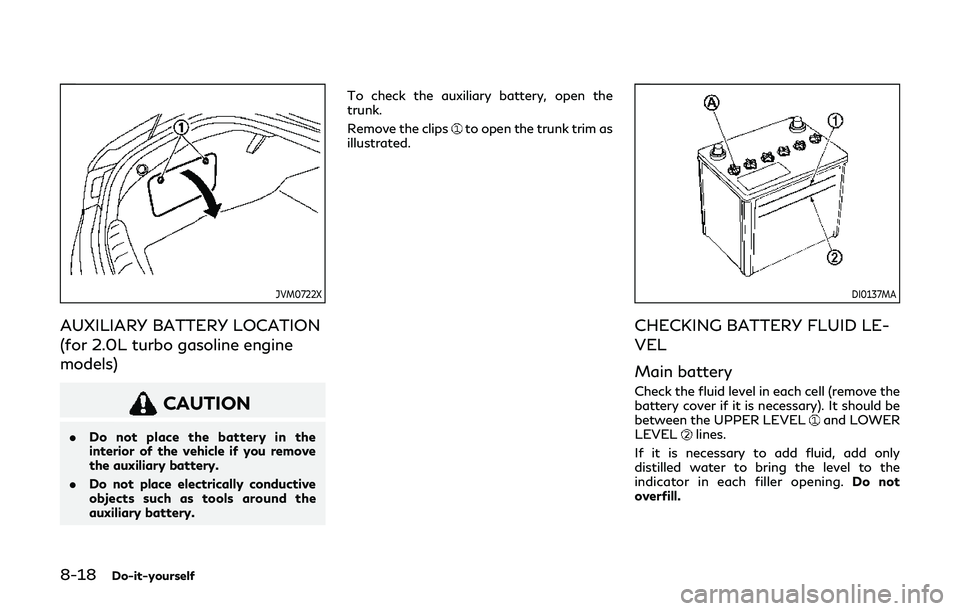
AUXILIARY BATTERY LOCATION
(for 2.0L turbo gasoline engine
models)
CAUTION
.Do not place the battery in the
interior of the vehicle if you remove
the auxiliary battery.
. Do not place electrically conductive
objects such as tools around the
auxiliary battery. To check the auxiliary battery, open the
trunk.
Remove the clips
to open the trunk trim as
illustrated.
DI0137MA
CHECKING BATTERY FLUID LE-
VEL
Main battery
Check the fluid level in each cell (remove the
battery cover if it is necessary). It should be
between the UPPER LEVEL
and LOWER
LEVELlines.
If it is necessary to add fluid, add only
distilled water to bring the level to the
indicator in each filler opening. Do not
overfill.
Page 381 of 468
SDI1480C
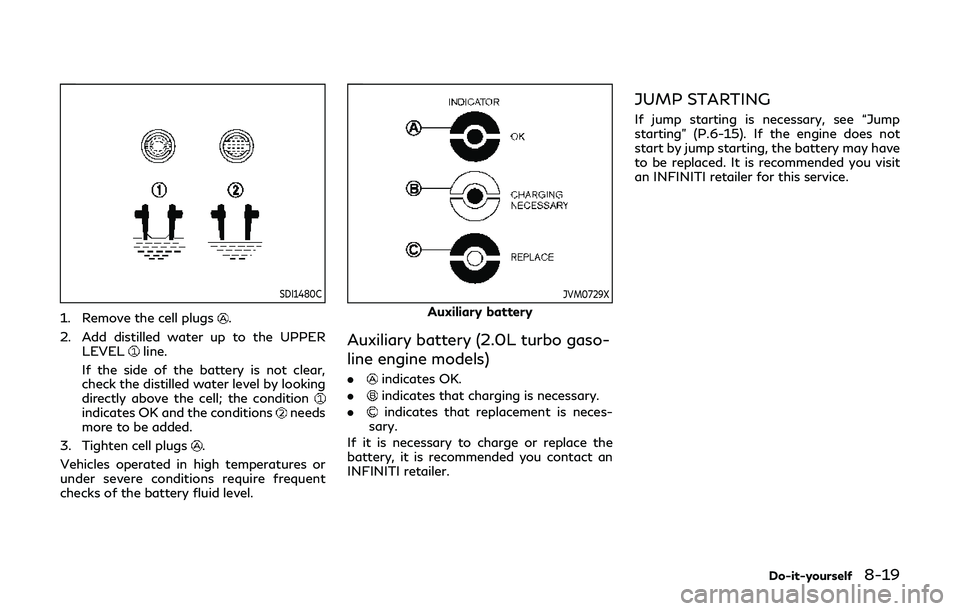
1. Remove the cell plugs.
2. Add distilled water up to the UPPER LEVEL
line.
If the side of the battery is not clear,
check the distilled water level by looking
directly above the cell; the condition
indicates OK and the conditionsneeds
more to be added.
3. Tighten cell plugs
.
Vehicles operated in high temperatures or
under severe conditions require frequent
checks of the battery fluid level.
JVM0729X
Auxiliary battery
Auxiliary battery (2.0L turbo gaso-
line engine models)
.indicates OK.
.
indicates that charging is necessary.
.
indicates that replacement is neces-
sary.
If it is necessary to charge or replace the
battery, it is recommended you contact an
INFINITI retailer.
JUMP STARTING
If jump starting is necessary, see “Jump
starting” (P.6-15). If the engine does not
start by jump starting, the battery may have
to be replaced. It is recommended you visit
an INFINITI retailer for this service.
Do-it-yourself8-19
Page 382 of 468
8-20Do-it-yourself
CAUTION
.Do not ground accessories directly to
the battery terminal. Doing so will
bypass the variable voltage control
system and the vehicle battery may
not charge completely.
. Use electrical accessories with the
engine running to avoid discharging
the vehicle battery.
The variable voltage control system mea-
sures the amount of electrical discharge
from the battery and controls voltage gen-
erated by the generator.
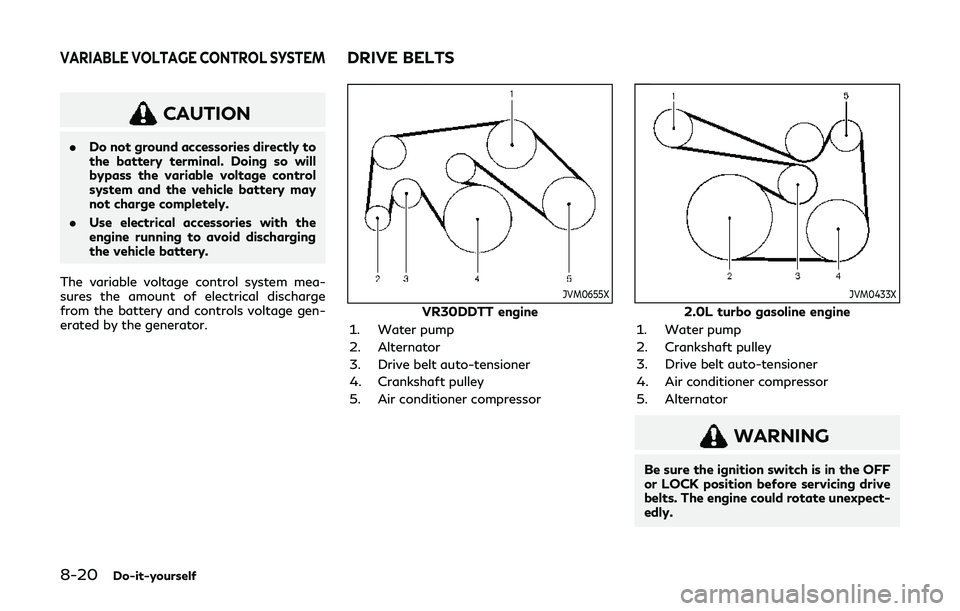
JVM0655X
VR30DDTT engine
1. Water pump
2. Alternator
3. Drive belt auto-tensioner
4. Crankshaft pulley
5. Air conditioner compressor
JVM0433X
2.0L turbo gasoline engine
1. Water pump
2. Crankshaft pulley
3. Drive belt auto-tensioner
4. Air conditioner compressor
5. Alternator
WARNING
Be sure the ignition switch is in the OFF
or LOCK position before servicing drive
belts. The engine could rotate unexpect-
edly.
VARIABLE VOLTAGE CONTROL SYSTEMDRIVE BELTS