brake light INFINITI Q60 COUPE 2021 Owner's Guide
[x] Cancel search | Manufacturer: INFINITI, Model Year: 2021, Model line: Q60 COUPE, Model: INFINITI Q60 COUPE 2021Pages: 492, PDF Size: 2.44 MB
Page 354 of 492

5-132Starting and driving
The Vehicle Dynamic Control (VDC) system
uses various sensors to monitor driver inputs
and vehicle motion. Under certain driving
conditions, the VDC system helps to perform
the following functions.
.Controls brake pressure to reduce wheel
slip on one slipping drive wheel so power
is transferred to a non slipping drive
wheel on the same axle.
.Controls brake pressure and engine out-
put to reduce drive wheel slip based on
vehicle speed (traction control function).
.Controls brake pressure at individual
wheels and engine output to help the
driver maintain control of the vehicle in
the following conditions:
— understeer (vehicle tends to not follow
the steered path despite increased
steering input)
— oversteer (vehicle tends to spin due to
certain road or driving conditions).
The VDC system can help the driver to
maintain control of the vehicle, but it cannot
prevent loss of vehicle control in all driving
situations.
When the VDC system operates, the VDC
warning light
in the instrument panel
flashes so note the following:
.The road may be slippery or the system
may determine some action is required to
help keep the vehicle on the steered path..You may feel a pulsation in the brake
pedal and hear a noise or vibration from
under the hood. This is normal and
indicates that the VDC system is working
properly.
.Adjust your speed and driving to the road
conditions.
See “Vehicle Dynamic Control (VDC) warn-
ing light” (P.2-19).
If a malfunction occurs in the system, the
VDC warning light
illuminates in the
instrument panel. The VDC system automa-
tically turns off.
The VDC OFF switch is used to turn off the
VDC system. The VDC off indicator light
illuminates to indicate the VDC system is off.
When the VDC switch is used to turn off the
system, the VDC system still operates to
prevent one drive wheel from slipping by
transferring power to a non slipping drive
wheel. The VDC warning light
flashes if
this occurs. All other VDC functions are off,
except for brake force distribution, and the
VDC warning light
will not flash. The
VDC system is automatically reset to on
when the ignition switch is placed in the OFF
position then back in the ON position.
See “Vehicle Dynamic Control (VDC) warn-
ing light” (P.2-19) and “Vehicle Dynamic
Control (VDC) off indicator light” (P.2-19).
The computer has a built-in diagnosticfeature that tests the system each time you
start the engine and move the vehicle
forward or in reverse at a slow speed. When
the self-test occurs, you may hear a “clunk”
noise and/or feel a pulsation in the brake
pedal. This is normal and is not an indication
of a malfunction.
VDC operation is reduced when the INFINITI
Drive Mode Selector is used to select the
SPORT+ mode (if so equipped). The VDC
system may not operate in the same circum-
stances when compared to operation in the
standard mode. To help prevent accidents
drive carefully, avoid careless or dangerous
driving techniques and be especially careful
when driving and cornering on slippery
surfaces.
BRAKE FORCE DISTRIBUTION
During braking while driving through turns,
the system optimizes the distribution of
force to each of the four wheels depending
on the radius of the turn.
WARNING
.The VDC system is designed to help
the driver maintain stability but does
not prevent accidents due to abrupt
steering operation at high speeds or
by careless or dangerous driving
VEHICLE DYNAMIC CONTROL
(VDC) SYSTEM
Page 355 of 492
techniques. Reduce vehicle speed and
be especially careful when driving and
cornering on slippery surfaces and
always drive carefully.
.The brake force distribution system
may not be effective depending on
the driving condition. Always drive
carefully and attentively.
.Do not modify the vehicle’s suspen-
sion. If suspension parts such as
shock absorbers, struts, springs, sta-
bilizer bars, bushings and wheels are
not INFINITI recommended for your
vehicle or are extremely deteriorated,
the VDC system may not operate
properly. This could adversely affect
vehicle handling performance, and
the VDC warning light
may
illuminate.
.If brake related parts such as brake
pads, rotors and calipers are not
INFINITI recommended or are extre-
mely deteriorated, the VDC system
may not operate properly and the
VDC warning light
may illumi-
nate.
.If engine control related parts are not
INFINITI recommended or are extre-
mely deteriorated, the VDC warning
light
may illuminate..When driving on extremely inclined
surfaces such as higher banked cor-
ners, the VDC system may not oper-
ate properly and the VDC warning
light
may illuminate. Do not drive
on these types of roads.
.When driving on an unstable surface
such as a turntable, ferry, elevator or
ramp, the VDC warning light
may
illuminate. This is not a malfunction.
Restart the engine after driving onto
a stable surface.
.If wheels or tires other than the
INFINITI recommended ones are
used, the VDC system may not oper-
ate properly and the VDC warning
light
may illuminate.
.The VDC system is not a substitute
for winter tires or tire chains on a
snow covered road.This system senses driving based on the
driver’s steering and acceleration/braking
patterns, and controls brake pressure at
individual wheels to help smooth vehicle
response.
When the SPORT mode is selected by the
INFINITI Drive Mode Selector, the amount
of brake control provided by the active trace
control is reduced.
When the PERSONAL mode is selected, the
active trace control can be set to ON
(enabled) or OFF (disabled). See “INFINITI
Drive Mode Selector” (P.5-21).
When the VDC OFF switch is used to turn
off the VDC system, the active trace control
is also turned off.
Starting and driving5-133
ACTIVE TRACE CONTROL
Page 376 of 492
6-12In case of emergency
CAUTION
.Do not allow the two vehicles to
touch.
2. Apply parking brake. Move the shift lever
to the P (Park) position. Switch off all
unnecessary electrical systems (light,
heater, air conditioner, etc.).
3. Remove vent caps on the battery (if so
equipped). Cover the battery with a
firmly wrung out moist cloth
to reduce
explosion hazard.
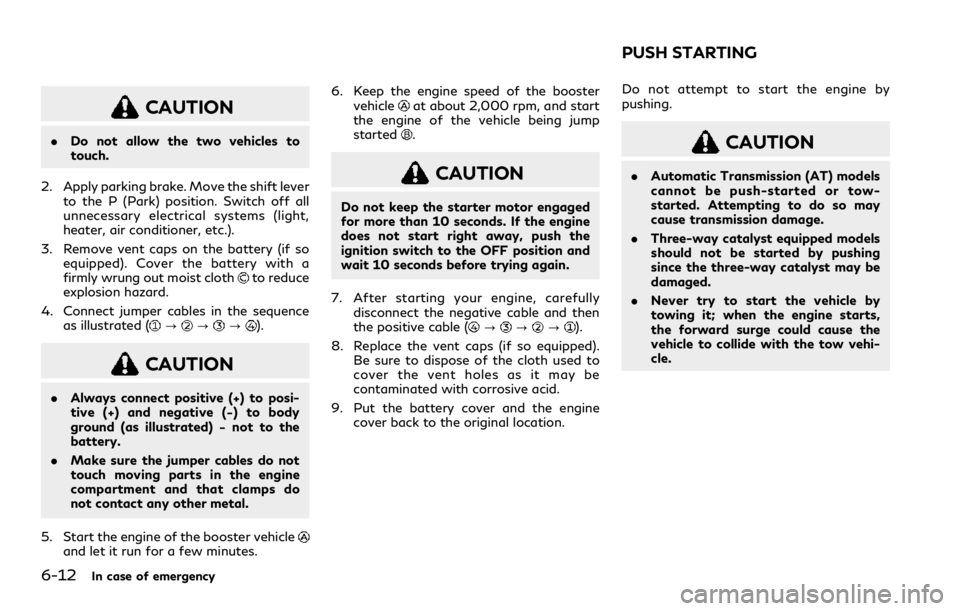
4. Connect jumper cables in the sequence
as illustrated (
???).
CAUTION
.Always connect positive (+) to posi-
tive (+) and negative (−) to body
ground (as illustrated) − not to the
battery.
.Make sure the jumper cables do not
touch moving parts in the engine
compartment and that clamps do
not contact any other metal.
5. Start the engine of the booster vehicle
and let it run for a few minutes.6. Keep the engine speed of the booster
vehicle
at about 2,000 rpm, and start
the engine of the vehicle being jump
started
.
CAUTION
Do not keep the starter motor engaged
for more than 10 seconds. If the engine
does not start right away, push the
ignition switch to the OFF position and
wait 10 seconds before trying again.
7. After starting your engine, carefully
disconnect the negative cable and then
the positive cable (
???).
8. Replace the vent caps (if so equipped).
Be sure to dispose of the cloth used to
cover the vent holes as it may be
contaminated with corrosive acid.
9. Put the battery cover and the engine
cover back to the original location.Do not attempt to start the engine by
pushing.
CAUTION
.Automatic Transmission (AT) models
cannot be push-started or tow-
started. Attempting to do so may
cause transmission damage.
.Three-way catalyst equipped models
should not be started by pushing
since the three-way catalyst may be
damaged.
.Never try to start the vehicle by
towing it; when the engine starts,
the forward surge could cause the
vehicle to collide with the tow vehi-
cle.
PUSH STARTING
Page 391 of 492

8 Do-it-yourself
Maintenance precautions ............................................... 8-2
Engine compartment check locations ......................... 8-3
VR30DDTT engine ..................................................... 8-3
Engine cooling system ..................................................... 8-3
Checking engine coolant level ................................ 8-4
Changing engine coolant .......................................... 8-5
Intercooler cooling system ............................................. 8-5
Checking intercooler coolant level ......................... 8-6
Engine oil ............................................................................. 8-6
Checking engine oil level ........................................... 8-6
Changing engine oil and filter .................................. 8-7
Automatic Transmission Fluid (ATF) .......................... 8-9
Brake fluid ........................................................................... 8-9
Window washer fluid ................................................... 8-10
Battery ............................................................................... 8-11
Checking battery fluid level .................................... 8-12
Jump starting ............................................................. 8-13
Variable voltage control system ................................. 8-13
Drive belts ......................................................................... 8-13
Spark plugs ....................................................................... 8-14
Replacing spark plugs .............................................. 8-14Air cleaner ........................................................................ 8-15
Windshield wiper blades .............................................. 8-15
Cleaning ..................................................................... 8-15
Replacing ................................................................... 8-16
Brakes ................................................................................ 8-16
Self-adjusting brakes ............................................. 8-16
Brake pad wear warning ....................................... 8-16
Fuses .................................................................................. 8-17
Engine compartment .............................................. 8-17
Passenger compartment ....................................... 8-18
Intelligent Key battery replacement ......................... 8-19
Lights ................................................................................. 8-22
Headlights ................................................................. 8-23
Exterior and interior lights .................................... 8-23
Wheels and tires ............................................................. 8-25
Tire pressure ............................................................. 8-25
Tire labeling ............................................................. 8-30
Types of tires ........................................................... 8-32
Tire chains ................................................................ 8-34
Changing wheels and tires .................................. 8-34
Jacking up the vehicle and replacing tires ...... 8-38
Page 400 of 492
8-10Do-it-yourself
JVM0731X
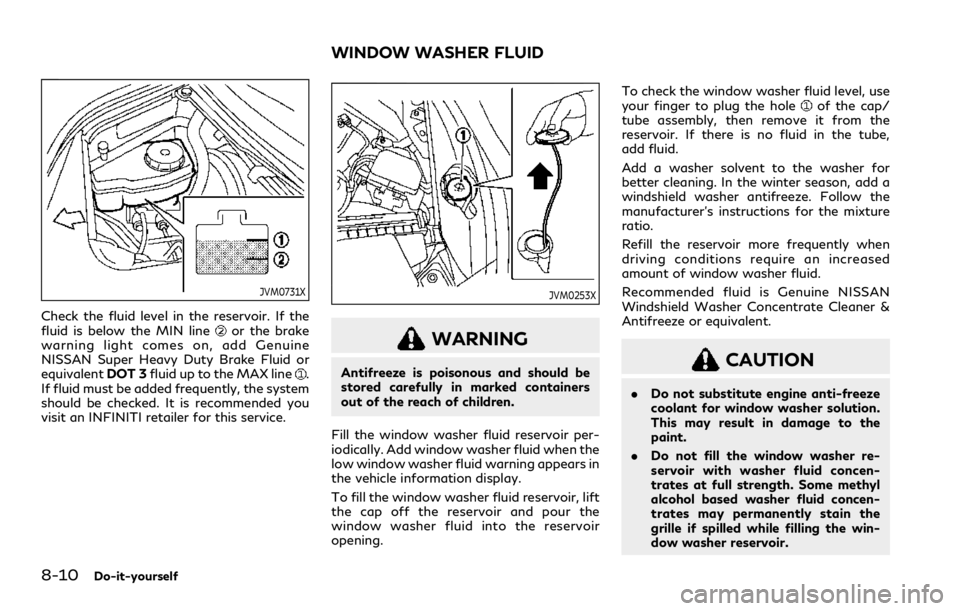
Check the fluid level in the reservoir. If the
fluid is below the MIN lineor the brake
warning light comes on, add Genuine
NISSAN Super Heavy Duty Brake Fluid or
equivalentDOT 3fluid up to the MAX line
.
If fluid must be added frequently, the system
should be checked. It is recommended you
visit an INFINITI retailer for this service.
JVM0253X
WARNING
Antifreeze is poisonous and should be
stored carefully in marked containers
out of the reach of children.
Fill the window washer fluid reservoir per-
iodically. Add window washer fluid when the
low window washer fluid warning appears in
the vehicle information display.
To fill the window washer fluid reservoir, lift
the cap off the reservoir and pour the
window washer fluid into the reservoir
opening.To check the window washer fluid level, use
your finger to plug the hole
of the cap/
tube assembly, then remove it from the
reservoir. If there is no fluid in the tube,
add fluid.
Add a washer solvent to the washer for
better cleaning. In the winter season, add a
windshield washer antifreeze. Follow the
manufacturer’s instructions for the mixture
ratio.
Refill the reservoir more frequently when
driving conditions require an increased
amount of window washer fluid.
Recommended fluid is Genuine NISSAN
Windshield Washer Concentrate Cleaner &
Antifreeze or equivalent.
CAUTION
.Do not substitute engine anti-freeze
coolant for window washer solution.
This may result in damage to the
paint.
.Do not fill the window washer re-
servoir with washer fluid concen-
trates at full strength. Some methyl
alcohol based washer fluid concen-
trates may permanently stain the
grille if spilled while filling the win-
dow washer reservoir.
WINDOW WASHER FLUID
Page 407 of 492

Under some driving or climate conditions,
occasional brake squeak, squeal or other
noise may be heard. Occasional brake noise
during light to moderate stops is normal and
does not affect the function or performance
of the brake system.
Proper brake inspection intervals should be
followed.For additional information, see the
maintenance schedule shown in the “9.
Maintenance and schedules” section.
JVM0255X
JVM0734X
ENGINE COMPARTMENT
WARNING
Never use a fuse of a higher or lower
amperage rating than that specified on
the fuse box cover. This could damage
the electrical system or electronic con-
trol units or cause a fire.
If any electrical equipment does not operate,
check for an open fuse.
1. Be sure the ignition switch is placed in
the OFF or LOCK position and the
headlight switch is turned to OFF.
2. Open the engine hood.
3. Remove the fuse/fusible link holder
cover.
4. Remove the fuse with the fuse puller.
Do-it-yourself8-17
FUSES
Page 427 of 492
same size and you are only replacing
2 of the 4 tires, install the new tires
on the rear axle. Placing new tires on
the front axle may cause loss of
vehicle control in some driving condi-
tions and cause an accident and
personal injury.
.If the wheels are changed for any
reason, always replace with wheels
which have the same off-set dimen-
sion. Wheels of a different off-set
could cause premature tire wear,
degrade vehicle handling character-
istics and/or interference with the
brake discs/drums. Such interference
can lead to decreased braking effi-
ciency and/or early brake pad/shoe
wear. See “Wheels and tires” (P.10-
9) of this manual for wheel off-set
dimensions.
.Since the spare tire is not equipped
with the TPMS, when a spare tire is
mounted or a wheel is replaced, the
TPMS will not function and the low
tire pressure warning light will flash
for approximately 1 minute. The light
will remain on after 1 minute. Have
your tires replaced and/or TPMS
system reset as soon as possible. It
is recommended you visit an INFINITI
retailer for these services..Replacing tires with those not origin-
ally specified by INFINITI could affect
the proper operation of the TPMS.
.The TPMS sensor may be damaged if
it is not handled correctly. Be careful
when handling the TPMS sensor.
.When replacing the TPMS sensor, the
ID registration may be required. It is
recommended you contact an
INFINITI retailer for ID registration.
.Do not use a valve stem cap that is
not specified by INFINITI. The valve
stem cap may become stuck.
.Be sure that the valve stem caps are
correctly fitted. Otherwise the valve
may be clogged up with dirt and
cause a malfunction or loss of pres-
sure.
.Do not install a damaged or deformed
wheel or tire even if it has been
repaired. Such wheels or tires could
have structural damage and could fail
without warning.
.The use of retread tire is not recom-
mended.
.For additional information regarding
tires, refer to “Important Tire Safety
Information” (US) or “Tire Safety
Information” (Canada) in the War-ranty Information Booklet.
Intelligent All-Wheel Drive (AWD)
models
CAUTION
.Always use tires of the same type,
size, brand, construction (bias, bias-
belted or radial), and tread pattern
on all four wheels. Failure to do so
may result in a circumference differ-
ence between tires on the front and
rear axles which will cause excessive
tire wear and may damage the trans-
mission, transfer case and differential
gears.
.ONLY use spare tires specified for
the Intelligent AWD model.
If excessive tire wear is found, it is recom-
mended that all four tires be replaced with
tires of the same size, brand, construction
and tread pattern. The tire pressure and
wheel alignment should also be checked and
corrected as necessary. It is recommended
you visit an INFINITI retailer for this service.
Do-it-yourself8-37
Page 428 of 492
8-38Do-it-yourself
Wheel balance
Unbalanced wheels may affect vehicle hand-
ling and tire life. Even with regular use,
wheels can get out of balance. Therefore,
they should be balanced as required.
Wheel balance service should be performed
with the wheels off the vehicle. Spin
balancing the wheels on the vehicle could
lead to mechanical damage.
For additional information regarding tires,
refer to “Important Tire Safety Information”
(US) or “Tire Safety Information” (Canada) in
the INFINITI Warranty Information Booklet.
Care of wheels
See “Cleaning exterior” (P.7-2) for details
about care of the wheels.
Emergency tire puncture repair kit
(if so equipped)
The emergency tire puncture repair kit
(Emergency Tire Sealant) is supplied with
the vehicle instead of a spare tire. It can be
used to temporarily repair minor tire punc-
tures. If possible, have the vehicle towed to a
facility that can repair or replace the flat tire.
Using the emergency tire puncture repair kit
may cause a malfunction of the tire pressure
sensor and cause the low tire pressure
warning light to illuminate.See “Flat tire” (P.6-3) for more details.
JACKING UP THE VEHICLE AND
REPLACING TIRES
This section contains the information about
the vehicle jack-up procedures and the tire
replacement.
NOTE:
Jacking tools are not equipped as standard
with this vehicle. It is recommended you
contact an INFINITI retailer about acquiring
the tools.
For models with run-flat tires, you can
continue driving to a safe location even if
they are punctured. (See “Run-flat tires”
(P.6-4) and “Run-flat tires” (P.8-32).)
For models with the emergency tire punc-
ture repair kit, you can temporarily fix a
minor tire puncture using it. (See “Repairing
a flat tire (for models with emergency tire
puncture repair kit)” (P.6-5).)
WARNING
.Make sure the parking brake is
securely applied and the transmission
into the P (Park) position.
.Never change tires when the vehicle
is on a slope, ice or slippery areas.This is hazardous.
.Never change tires if oncoming traf-
fic is close to your vehicle. Wait for
professional road assistance.
Page 433 of 492

other corrosive materials, check lubrication
frequently.
Lights*:Clean the headlights on a regular
basis. Make sure that the headlights, stop
lights, tail lights, turn signal lights, and other
lights are all operating properly and installed
securely. Also check headlight aim.
Road wheel nuts (lug nuts)*:When checking
the tires, make sure no wheel nuts are
missing, and check for any loose wheel nuts.
Tighten if necessary.
Tire rotation*:Rotate tires at the specified
interval shown in the maintenance schedule.
If your vehicle is equipped with different
sized tires in the front and rear, tires cannot
be rotated.
Tires*:Check the pressure with a gauge
often and always prior to long distance trips.
If necessary, adjust the pressure in all tires,
including the spare, to the pressure speci-
fied. Check carefully for damage, cuts or
excessive wear.
Tire Pressure Monitoring System (TPMS)
transmitter components:Replace the TPMS
transmitter grommet seal, valve core and
cap when the tires are replaced due to wear
or age.
Wheel alignment and balance:If the vehicle
should pull to either side while driving on a
straight and level road, or if you detect
uneven or abnormal tire wear, there may bea need for wheel alignment.
If the steering wheel or seat vibrates at
normal highway speeds, wheel balancing
may be needed.
For additional information regarding tires,
refer to “Important Tire Safety Information”
(US) or “Tire Safety Information” (Canada) in
the INFINITI Warranty Information Booklet.
Windshield:Clean the windshield on a
regular basis. Check the windshield at least
every six months for cracks or other damage.
Have a damaged windshield repaired by a
qualified repair facility. It is recommended
that you have a damaged windshield re-
paired by an INFINITI retailer, or an INFINITI
Certified Collision Center. To locate a colli-
sion center in your area, refer to http://
collision.infinitiusa.com.
Windshield wiper blades*:Check for cracks
or wear if they do not wipe properly.
Inside the vehicle
The maintenance items listed here should be
checked on a regular basis, such as when
performing scheduled maintenance, cleaning
the vehicle, etc.
Accelerator pedal:Check the pedal for
smooth operation and make sure the pedal
does not catch or require uneven effort.
Keep the floor mat away from the pedal.Automatic transmission P (Park) mechan-
ism:On a fairly steep hill, check that your
vehicle is held securely with the shift lever in
the P (Park) position without applying any
brakes.
Brake pedal:Check the pedal for smooth
operation. If the brake pedal suddenly goes
down further than normal, the pedal feels
spongy or the vehicle seems to take longer to
stop, have your vehicle checked immediately.
It is recommended you visit an INFINITI
retailer for this service. Keep the floor mat
away from the pedal.
Brakes:Check that the brakes do not pull the
vehicle to one side when applied.
Parking brake:Check the parking brake
operation regularly. The vehicle should be
securely held on a fairly steep hill with only
the parking brake applied. If the parking
brake needs adjusted, it is recommended you
visit an INFINITI retailer for this service.
Seats:Check seat position controls such as
seat adjusters, seatback recliner, etc. to
ensure they operate smoothly and that all
latches lock securely in every position. Check
that the head restraints move up and down
smoothly and that the locks (if so equipped)
hold securely in all latched positions.
Seat belts:Check that all parts of the seat
belt system (for example, buckles, anchors,
adjuster and retractors) operate properly
Maintenance and schedules9-3
Page 434 of 492

9-4Maintenance and schedules
and smoothly, and are installed securely.
Check the belt webbing for cuts, fraying,
wear or damage.
Steering wheel:Check for changes in the
steering conditions, such as excessive free
play, hard steering or strange noises.
Warning lights and chimes:Make sure that
all warning lights and chimes are operating
properly.
Windshield defroster:Check that the air
comes out of the defroster outlets properly
and in sufficient quantity when operating
the heater or air conditioner.
Windshield wiper and washer*:Check that
the wipers and washer operate properly and
that the wipers do not streak.
Under the hood and vehicle
The maintenance items listed here should be
checked periodically (for example, each time
you check the engine oil or refuel).
Battery*:Check the fluid level in each cell. It
should be between the MAX and MIN lines.
Vehicles operated in high temperatures or
under severe condition require frequent
checks of the battery fluid level.
NOTE:
Care should be taken to avoid situations
that can lead to potential battery discharge
and potential no-start conditions such as:1.Installation or extended use of electro-
nic accessories that consume battery
power when the engine is not running
(Phone chargers, GPS, DVD players,
etc.)
2.Vehicle is not driven regularly and/or
only driven short distances.
In these cases, the battery may need to be
charged to maintain battery health.
Brake fluid level*:Make sure that the brake
fluid level is between the MAX and MIN lines
on the reservoir.
Engine coolant level*:Check the coolant
level when the engine is cold.
Intercooler coolant level*:Check the coolant
level when the engine is cold.
Engine drive belts*:Make sure that no belt is
frayed, worn, cracked or oily.
Engine oil level*:Check the level after
parking the vehicle on a level spot and
turning off the engine. Wait more than 15
minutes for the oil to drain back into the oil
pan.
Exhaust system:Make sure there are no
loose supports, cracks or holes. If the sound
of the exhaust seems unusual or there is a
smell of exhaust fumes, immediately have
the exhaust system inspected. It is recom-
mended you visit an INFINITI retailer for this
service. (See “Precautions when starting anddriving” (P.5-4).)
Fluid leaks:Check under the vehicle for fuel,
oil, water or other fluid leaks after the
vehicle has been parked for a while. Water
dripping from the air conditioner after use is
normal. If you should notice any leaks or if
gasoline fumes are evident, check for the
cause and have it corrected immediately.
Radiator and hoses:Check the front of the
radiator and clean off any dirt, insects,
leaves, etc., that may have accumulated.
Make sure the hoses have no cracks, defor-
mation, rot or loose connections.
Underbody:The underbody is frequently
exposed to corrosive substances such as
those used on icy roads or to control dust. It
is very important to remove these sub-
stances, otherwise rust will form on the
floor pan, frame, fuel lines and around the
exhaust system. At the end of winter, the
underbody should be thoroughly flushed
with plain water, being careful to clean
those areas where mud and dirt may accu-
mulate. For additional information, see
“Cleaning exterior” (P.7-2).
Windshield washer fluid*:Check that there
is adequate fluid in the reservoir.