lights INFINITI Q60 COUPE 2021 Service Manual
[x] Cancel search | Manufacturer: INFINITI, Model Year: 2021, Model line: Q60 COUPE, Model: INFINITI Q60 COUPE 2021Pages: 492, PDF Size: 2.44 MB
Page 327 of 492
trian detection system will provide a warning
to the driver by flashing the FEB system
emergency warning indicator (red)
, pro-
vides an audible alert and the system will
apply partial braking. If the driver applies the
brakes quickly and forcefully but the FEB
with pedestrian detection system detects
that there is still the possibility of a forward
impact with a pedestrian, the system will
automatically increase the braking force. If
the risk of collision becomes imminent and
the driver does not take action, the FEB with
pedestrian detection system automatically
applies harder braking.
NOTE:
The vehicle’s stop lights come on when any
braking is performed by the FEB with
pedestrian detection system.
Depending on vehicle speed and distance to
the vehicle or pedestrian ahead, as well as
driving and roadway conditions, the system
may help the driver avoid a forward collision
or may help mitigate the consequences of a
collision should one be unavoidable. If the
driver is handling the steering wheel, accel-
erating or braking, the FEB with pedestrian
detection system will function later or will
not function.
The automatic braking will cease under the
following conditions:.When the steering wheel is turned to
avoid a collision.
.When the accelerator pedal is depressed.
.When there is no longer a vehicle or a
pedestrian detected ahead.
If the FEB with pedestrian detection system
has stopped the vehicle, the vehicle will
remain at a standstill for approximately 2
seconds before the brakes are released.
Starting and driving5-105
Page 330 of 492
5-108Starting and driving
cast in a shadow, making it diffi-
cult to see.
— A sudden change in brightness
occurs. (For example, when the
vehicle enters or exits a tunnel or a
shaded area or lightning flashes.)
— The poor contrast of a person to
the background, such as having
clothing color or pattern which is
similar to the background.
— The pedestrian’s profile is par-
tially obscured or unidentifiable
due to the pedestrian transport-
ing luggage, wearing bulky or very
loose-fitting clothing or acces-
sories.
.The system performance may de-
grade in the following conditions:
— The vehicle is driven on a slippery
road.
— The vehicle is driven on a slope.
— Excessively heavy baggage is
loaded in the rear seat or the
trunk of your vehicle.
.The system is designed to automati-
cally check the sensor (radar and
camera)’s functionality, within cer-
tain limitations. The system may not
detect blockage of sensor areas cov-ered by ice, snow or stickers, for
example. In these cases, the system
may not be able to warn the driver
properly. Be sure that you check,
clean and clear sensor areas regularly.
.In some road and traffic conditions,
the FEB with pedestrian detection
system may unexpectedly apply par-
tial braking. When acceleration is
necessary, depress the accelerator
pedal to override the system.
.The FEB with pedestrian detection
system may operate when the fol-
lowing are similar to the outlines of
vehicles or pedestrians, or if they are
the same size and position as a
vehicle’s tail lights.
— Paint or a pattern on the road or
a wall (including faded and unu-
sual road markings).
— A shape formed by road struc-
tures ahead (such as tunnels,
viaducts, traffic signs, reflectors
installed on the side of vehicles,
reflection sheets, and guardrails).
.The FEB with pedestrian detection
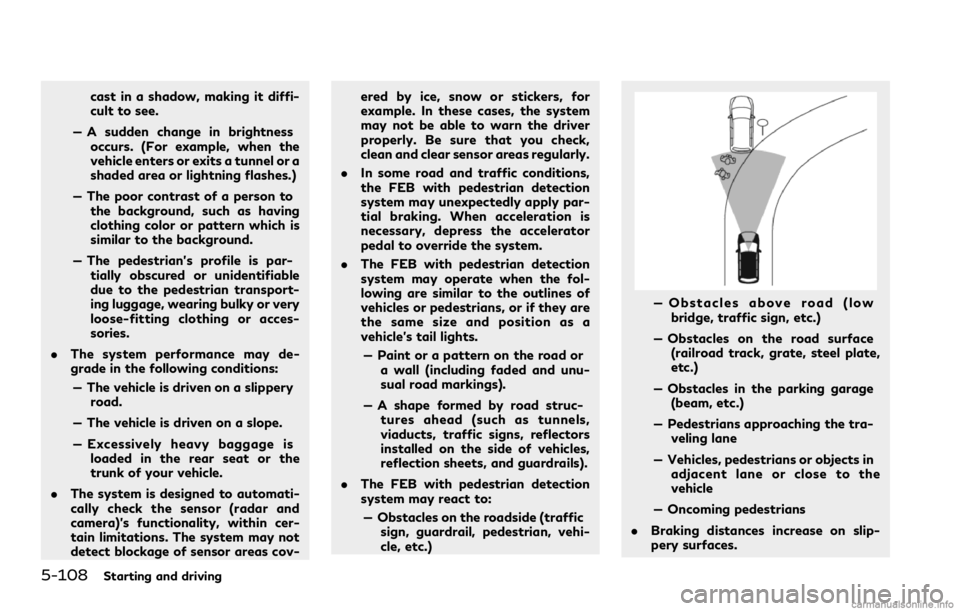
system may react to:
— Obstacles on the roadside (traffic
sign, guardrail, pedestrian, vehi-
cle, etc.)
— Obstacles above road (low
bridge, traffic sign, etc.)
— Obstacles on the road surface
(railroad track, grate, steel plate,
etc.)
— Obstacles in the parking garage
(beam, etc.)
— Pedestrians approaching the tra-
veling lane
— Vehicles, pedestrians or objects in
adjacent lane or close to the
vehicle
— Oncoming pedestrians
.Braking distances increase on slip-
pery surfaces.
Page 344 of 492
5-122Starting and driving
could cause failure or malfunction.
.Do not alter, remove or paint the front
bumper. It is recommended you contact
an INFINITI retailer before customizing
or restoring the front bumper.
FCC Notice:
For USA:
This device complies with Part 15 of the
FCC Rules. Operation is subject to the
following two conditions:
1.This device may not cause harmful
interference, and
2.This device must accept any interfer-
ence received, including interference
that may cause undesired operation.
FCC Warning
Changes or modification not expressly ap-
proved by the party responsible for com-
pliance could void the user’s authority to
operate the equipment.
For Canada:
This device complies with Industry Canada
licence-exempt RSS standard(s). Operation
is subject to the following two conditions:
1.This device may not cause interference,
and
2.This device must accept any interfer-
ence, including interference that may
cause undesired operation of the device.
CAUTION
During the first 1,200 miles (2,000 km),
follow these recommendations to obtain
maximum engine performance and en-
sure the future reliability and economy
of your new vehicle.
Failure to follow these recommendations
may result in shortened engine life and
reduced engine performance.
.Avoid driving for long periods at constant
speed, either fast or slow. Do not run the
engine over 4,000 rpm.
.Do not accelerate at full throttle in any
gear.
.Avoid quick starts.
.Avoid hard braking as much as possible.Follow these easy-to-use Fuel Efficient
Driving Tips to help you achieve the most
fuel economy from your vehicle.
1. Use smooth accelerator and brake pedal
application.
.Avoid rapid starts and stops..Use smooth, gentle accelerator and
brake application whenever possible.
.Maintain constant speed while com-
muting and coast whenever possible.
2. Maintain constant speed.
.Look ahead to try and anticipate and
minimize stops.
.Synchronizing your speed with traffic
lights allows you to reduce your
number of stops.
.Maintaining a steady speed can mini-
mize red light stops and improve fuel
efficiency.
3. Use air conditioning (A/C) at higher
vehicle speeds.
.Below 40 MPH (64 km/h), it is more
efficient to open windows to cool the
vehicle due to reduced engine load.
.Above 40 MPH (64 km/h), it is more
efficient to use A/C to cool the
vehicle due to increased aerodynamic
drag.
.Recirculating the cool air in the cabin
when the A/C is on reduces cooling
load.
BREAK-IN SCHEDULE FUEL EFFICIENT DRIVING TIPS
Page 366 of 492
6-2In case of emergency
SIC2574
Push the switch on to warn other drivers
when you must stop or park under emer-
gency conditions. All turn signal lights will
flash.
WARNING
.If stopping for an emergency, be sure
to move the vehicle well off the road.
.Do not use the hazard warning
flashers while moving on the highway
unless unusual circumstances force
you to drive so slowly that your
vehicle might become a hazard to
other traffic..Turn signals do not work when the
hazard warning flasher lights are on.
The flasher can be actuated with the ignition
switch in any position.
When an impact that could activate the
supplemental air bags is detected, the
hazard warning flasher lights blink automa-
tically. If the hazard warning flasher switch is
pushed, the hazard warning flashers will turn
off.
WARNING
Do not turn the hazard warning flasher
switch to off until you can make sure
that it is safe to do so. Also, the hazard
flasher warning may not blink automa-
tically depending on the force of impact.
Some state laws may prohibit the use of the
hazard warning flasher switch while driving.In the event of a roadside emergency,
Roadside Assistance Service is available to
you. Please refer to your Warranty Informa-
tion Booklet (U.S.) or Warranty & Roadside
Assistance Information Booklet (Canada) for
details.
HAZARD WARNING FLASHER SWITCHROADSIDE ASSISTANCE PROGRAM
Page 367 of 492
To shut off the engine in an emergency
situation while driving, perform the follow-
ing procedure:
.Rapidly push the push-button ignition
switch 3 consecutive times in less than
1.5 seconds, or
.Push and hold the push-button ignition
switch for more than 2 seconds.If you have a flat tire, follow the instructions
in this section.
For models with run-flat tires, you can
continue driving to a safe location even if
they are punctured. (See “Run-flat tires”
(P.6-4) and “Run-flat tires” (P.8-32).)
TIRE PRESSURE MONITORING
SYSTEM (TPMS)
This vehicle is equipped with the Tire
Pressure Monitoring System (TPMS). It
monitors tire pressure of all tires except the
spare. When the low tire pressure warning
light is lit and the “Tire Pressure Low - Add
Air” warning appears in the vehicle informa-
tion display, one or more of your tires is
significantly under-inflated. If the vehicle is
being driven with low tire pressure, the
TPMS will activate and warn you of it by
the low tire pressure warning light. This
system will activate only when the vehicle is
driven at speeds above 16 MPH (25 km/h).
For more details, see “Warning lights, in-
dicator lights and audible reminders” (P.2-
12) and “Tire Pressure Monitoring System
(TPMS)” (P.5-5).
WARNING
.Radio waves could adversely affect
electric medical equipment. Thosewho use a pacemaker should contact
the electric medical equipment man-
ufacturer for the possible influences
before use.
.If the low tire pressure warning light
illuminates while driving, avoid sud-
den steering maneuvers or abrupt
braking, reduce vehicle speed, pull
off the road to a safe location and
stop the vehicle as soon as possible.
Driving with under-inflated tires may
permanently damage the tires and
increase the likelihood of tire failure.
Serious vehicle damage could occur
and may lead to an accident and
could result in serious personal injury.
Check the tire pressure for all four
tires. Adjust the tire pressure to the
recommended COLD tire pressure
shown on the Tire and Loading
Information label to turn the low tire
pressure warning light OFF. If the
light still illuminates while driving
after adjusting the tire pressure, a
tire may be flat. If you have a flat tire,
replace it with a spare tire (if so
equipped) or repair it with the emer-
gency tire puncture repair kit (if so
equipped) as soon as possible. If no
tire is flat and all tires are properly
inflated, it is recommended you con-
sult an INFINITI retailer.
In case of emergency6-3
EMERGENCY ENGINE SHUT OFF FLAT TIRE
Page 391 of 492
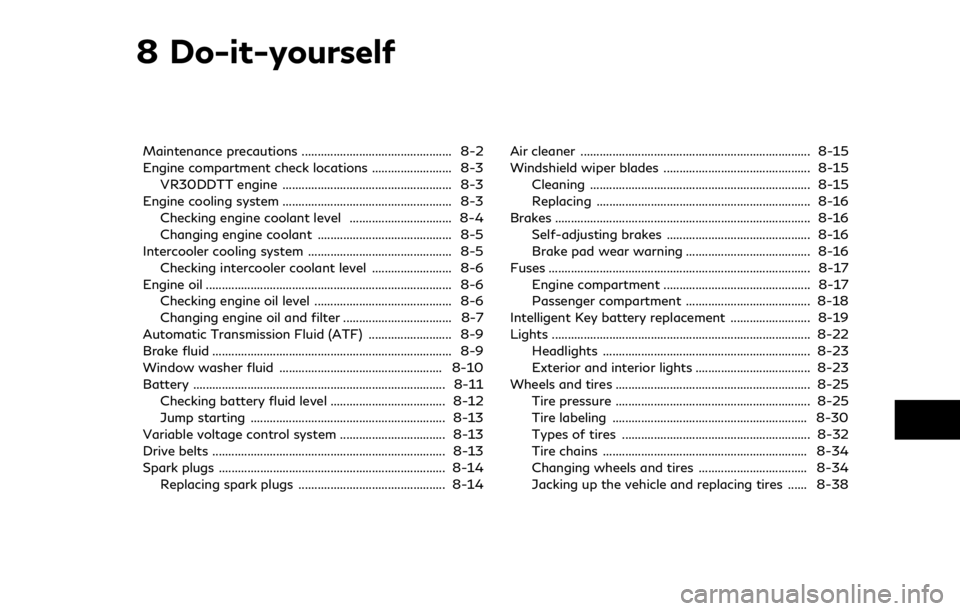
8 Do-it-yourself
Maintenance precautions ............................................... 8-2
Engine compartment check locations ......................... 8-3
VR30DDTT engine ..................................................... 8-3
Engine cooling system ..................................................... 8-3
Checking engine coolant level ................................ 8-4
Changing engine coolant .......................................... 8-5
Intercooler cooling system ............................................. 8-5
Checking intercooler coolant level ......................... 8-6
Engine oil ............................................................................. 8-6
Checking engine oil level ........................................... 8-6
Changing engine oil and filter .................................. 8-7
Automatic Transmission Fluid (ATF) .......................... 8-9
Brake fluid ........................................................................... 8-9
Window washer fluid ................................................... 8-10
Battery ............................................................................... 8-11
Checking battery fluid level .................................... 8-12
Jump starting ............................................................. 8-13
Variable voltage control system ................................. 8-13
Drive belts ......................................................................... 8-13
Spark plugs ....................................................................... 8-14
Replacing spark plugs .............................................. 8-14Air cleaner ........................................................................ 8-15
Windshield wiper blades .............................................. 8-15
Cleaning ..................................................................... 8-15
Replacing ................................................................... 8-16
Brakes ................................................................................ 8-16
Self-adjusting brakes ............................................. 8-16
Brake pad wear warning ....................................... 8-16
Fuses .................................................................................. 8-17
Engine compartment .............................................. 8-17
Passenger compartment ....................................... 8-18
Intelligent Key battery replacement ......................... 8-19
Lights ................................................................................. 8-22
Headlights ................................................................. 8-23
Exterior and interior lights .................................... 8-23
Wheels and tires ............................................................. 8-25
Tire pressure ............................................................. 8-25
Tire labeling ............................................................. 8-30
Types of tires ........................................................... 8-32
Tire chains ................................................................ 8-34
Changing wheels and tires .................................. 8-34
Jacking up the vehicle and replacing tires ...... 8-38
Page 412 of 492
8-22Do-it-yourself
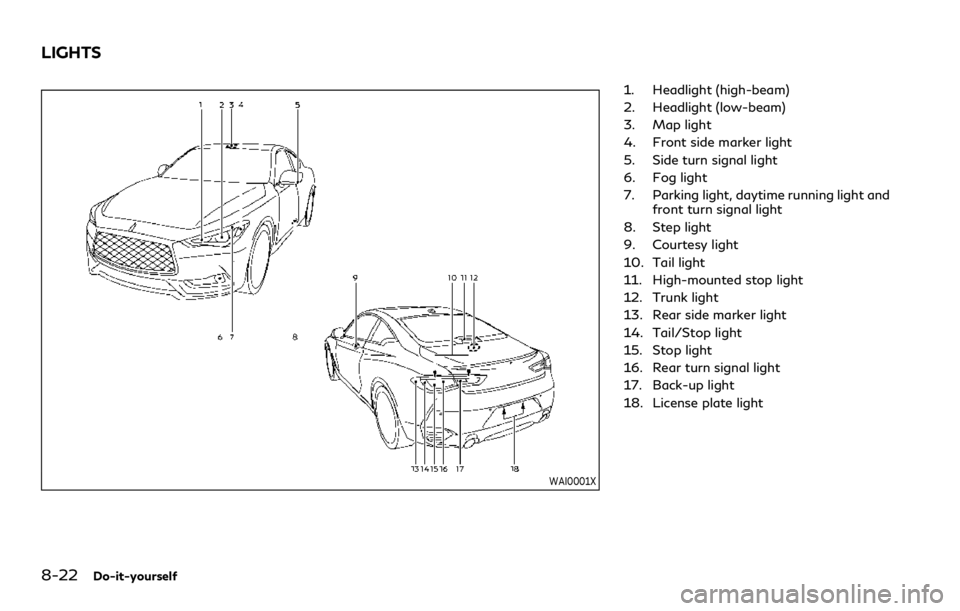
WAI0001X
1. Headlight (high-beam)
2. Headlight (low-beam)
3. Map light
4. Front side marker light
5. Side turn signal light
6. Fog light
7. Parking light, daytime running light and
front turn signal light
8. Step light
9. Courtesy light
10. Tail light
11. High-mounted stop light
12. Trunk light
13. Rear side marker light
14. Tail/Stop light
15. Stop light
16. Rear turn signal light
17. Back-up light
18. License plate light
LIGHTS
Page 413 of 492
HEADLIGHTS
If replacement is required, it is recommended
you visit an INFINITI retailer for this service.
Fog may temporarily form inside the lens of
the exterior lights in the rain or in a car wash.
A temperature difference between the inside
and the outside of the lens causes the fog.
This is not a malfunction. If large drops of
water collect inside the lens, it is recom-
mended you visit an INFINITI retailer for this
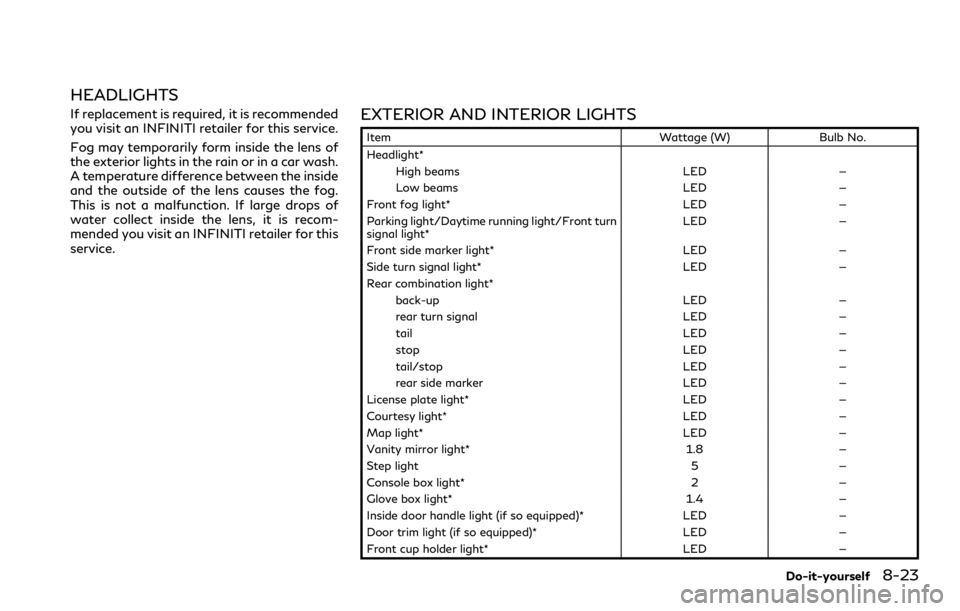
service.EXTERIOR AND INTERIOR LIGHTS
Item Wattage (W) Bulb No.
Headlight*
High beams LED —
Low beams LED —
Front fog light* LED —
Parking light/Daytime running light/Front turn
signal light*LED —
Front side marker light* LED —
Side turn signal light* LED —
Rear combination light*
back-up LED —
rear turn signal LED —
tail LED —
stop LED —
tail/stop LED —
rear side marker LED —
License plate light* LED —
Courtesy light* LED —
Map light* LED —
Vanity mirror light* 1.8 —
Step light 5 —
Console box light* 2 —
Glove box light* 1.4 —
Inside door handle light (if so equipped)* LED —
Door trim light (if so equipped)* LED —
Front cup holder light* LED —
Do-it-yourself8-23
Page 414 of 492
8-24Do-it-yourself
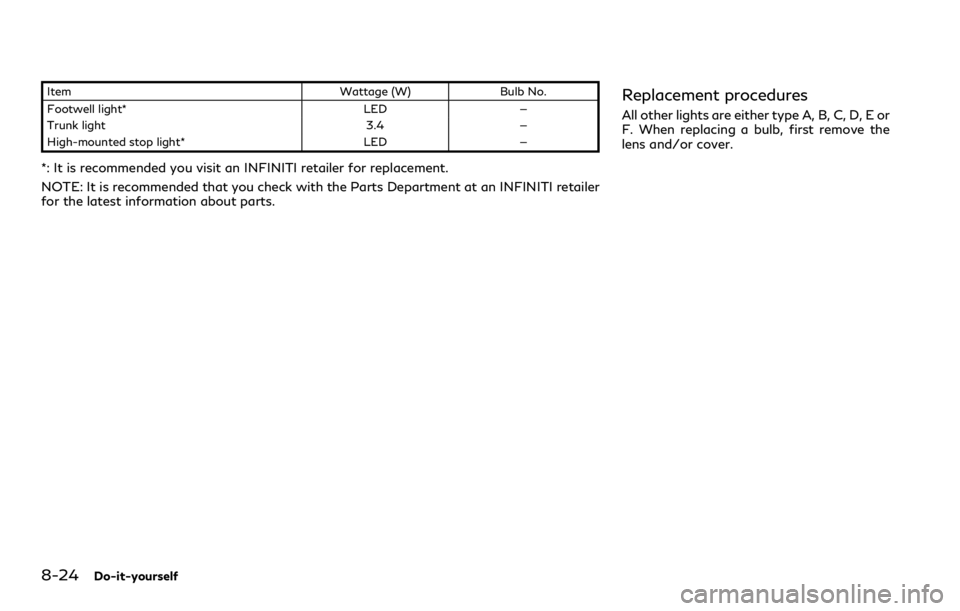
Item Wattage (W) Bulb No.
Footwell light* LED —
Trunk light 3.4 —
High-mounted stop light* LED —
*: It is recommended you visit an INFINITI retailer for replacement.
NOTE: It is recommended that you check with the Parts Department at an INFINITI retailer
for the latest information about parts.
Replacement procedures
All other lights are either type A, B, C, D, E or
F. When replacing a bulb, first remove the
lens and/or cover.
Page 433 of 492
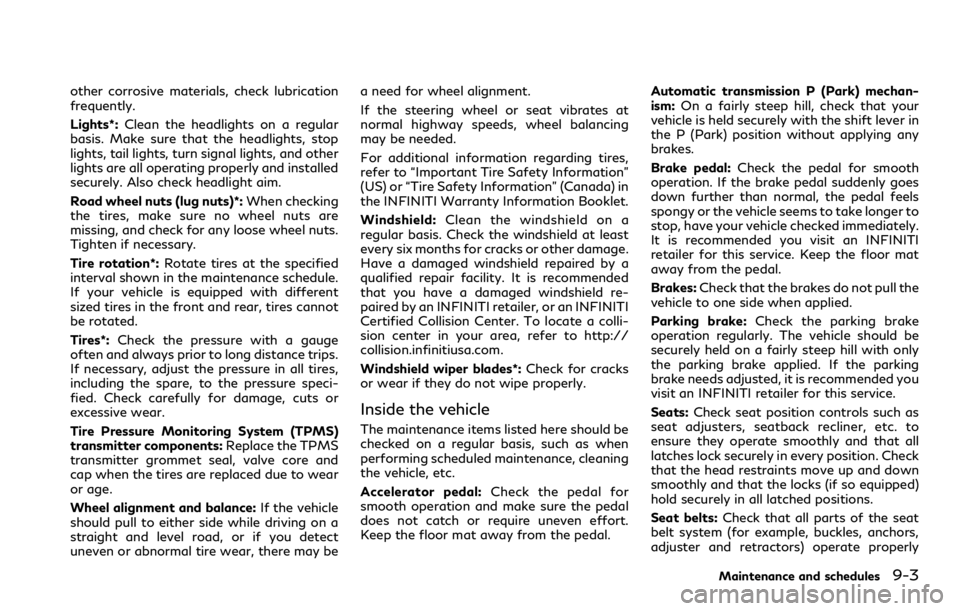
other corrosive materials, check lubrication
frequently.
Lights*:Clean the headlights on a regular
basis. Make sure that the headlights, stop
lights, tail lights, turn signal lights, and other
lights are all operating properly and installed
securely. Also check headlight aim.
Road wheel nuts (lug nuts)*:When checking
the tires, make sure no wheel nuts are
missing, and check for any loose wheel nuts.
Tighten if necessary.
Tire rotation*:Rotate tires at the specified
interval shown in the maintenance schedule.
If your vehicle is equipped with different
sized tires in the front and rear, tires cannot
be rotated.
Tires*:Check the pressure with a gauge
often and always prior to long distance trips.
If necessary, adjust the pressure in all tires,
including the spare, to the pressure speci-
fied. Check carefully for damage, cuts or
excessive wear.
Tire Pressure Monitoring System (TPMS)
transmitter components:Replace the TPMS
transmitter grommet seal, valve core and
cap when the tires are replaced due to wear
or age.
Wheel alignment and balance:If the vehicle
should pull to either side while driving on a
straight and level road, or if you detect
uneven or abnormal tire wear, there may bea need for wheel alignment.
If the steering wheel or seat vibrates at
normal highway speeds, wheel balancing
may be needed.
For additional information regarding tires,
refer to “Important Tire Safety Information”
(US) or “Tire Safety Information” (Canada) in
the INFINITI Warranty Information Booklet.
Windshield:Clean the windshield on a
regular basis. Check the windshield at least
every six months for cracks or other damage.
Have a damaged windshield repaired by a
qualified repair facility. It is recommended
that you have a damaged windshield re-
paired by an INFINITI retailer, or an INFINITI
Certified Collision Center. To locate a colli-
sion center in your area, refer to http://
collision.infinitiusa.com.
Windshield wiper blades*:Check for cracks
or wear if they do not wipe properly.
Inside the vehicle
The maintenance items listed here should be
checked on a regular basis, such as when
performing scheduled maintenance, cleaning
the vehicle, etc.
Accelerator pedal:Check the pedal for
smooth operation and make sure the pedal
does not catch or require uneven effort.
Keep the floor mat away from the pedal.Automatic transmission P (Park) mechan-
ism:On a fairly steep hill, check that your
vehicle is held securely with the shift lever in
the P (Park) position without applying any
brakes.
Brake pedal:Check the pedal for smooth
operation. If the brake pedal suddenly goes
down further than normal, the pedal feels
spongy or the vehicle seems to take longer to
stop, have your vehicle checked immediately.
It is recommended you visit an INFINITI
retailer for this service. Keep the floor mat
away from the pedal.
Brakes:Check that the brakes do not pull the
vehicle to one side when applied.
Parking brake:Check the parking brake
operation regularly. The vehicle should be
securely held on a fairly steep hill with only
the parking brake applied. If the parking
brake needs adjusted, it is recommended you
visit an INFINITI retailer for this service.
Seats:Check seat position controls such as
seat adjusters, seatback recliner, etc. to
ensure they operate smoothly and that all
latches lock securely in every position. Check
that the head restraints move up and down
smoothly and that the locks (if so equipped)
hold securely in all latched positions.
Seat belts:Check that all parts of the seat
belt system (for example, buckles, anchors,
adjuster and retractors) operate properly
Maintenance and schedules9-3