recommended oil INFINITI Q70 2019 Owners Manual
[x] Cancel search | Manufacturer: INFINITI, Model Year: 2019, Model line: Q70, Model: INFINITI Q70 2019Pages: 458, PDF Size: 3.25 MB
Page 88 of 458
Charge warning light
If the light comes on while the engine is
running, it may indicate the charging system
is not functioning properly. Turn the engine
off and check the alternator belt. If the belt is
loose, broken, missing or if the light remains
on, have your vehicle serviced immediately. It
is recommended you visit an INFINITI re-
tailer for this service.
CAUTION
Do not continue driving if the alternator
belt is loose, broken or missing.
Distance Control Assist (DCA)
system warning light (orange; if so
equipped)
This light comes on if there is a malfunction
in the Distance Control Assist (DCA) system.
If the warning light illuminates, park the
vehicle in a safe place. Turn the engine off,
restart the engine, resume driving and turn
on the DCA system again.
If it is not possible to turn on the system or
the warning light stays on, it may indicate
that the system is malfunctioning. Although the vehicle is still driveable under normal
conditions, have the vehicle checked. It is
recommended you visit an INFINITI retailer
for this service.
Engine oil pressure warning
light
This light warns of low engine oil pressure. If
the light flickers or comes on during normal
driving, pull off the road in a safe area, stop
the engine immediately and call an INFINITI
retailer or other authorized repair shop.
The engine oil pressure warning light is not
designed to indicate a low oil level. Use the
dipstick to check the oil level. (See “Engine
oil” (P.8-10).)
CAUTION
Running the engine with the engine oil
pressure warning light on could cause
serious damage to the engine almost
immediately. Such damage is not cov-
ered by warranty. Turn off the engine as
soon as it is safe to do so.
Forward Emergency Braking
(FEB) system warning light (if so
equipped)
Thiswarning light comes on when the
ignition switch is placed in the ON position.
It turns off after the engine is started.
This light illuminates when the Forward
Emergency Braking (FEB) system is set to
OFF on the center display.
If the light illuminates when the FEB system
is ON, it may indicate that the system is
unavailable. See “Forward Emergency Brak-
ing (FEB)” (P.5-101) for more details.
This light will also illuminates if the Active
Trace Control is malfunctioning. Although
the vehicle is still driveable under normal
conditions, have the vehicle checked. It is
recommended you visit an INFINITI retailer
for this service. (See “Vehicle Dynamic Con-
trol (VDC) system” (P.5-123).)
Intelligent Cruise Control (ICC)
system warning light (orange; if so
equipped)
This light comes on if there is a malfunction
in the Intelligent Cruise Control (ICC) sys-
tem.
If the warning light comes on, park the
Instruments and controls2-13
Page 324 of 458
4. Drive at economical speeds and dis-tances.
.Observing the speed limit and notexceeding 60 MPH (97 km/h) (where
legally allowed) can improve fuel
efficiency due to reduced aerody-
namic drag.
.Maintaining a safe following distance
behind other vehicles reduces unne-
cessary braking.
.Safely monitoring traffic to anticipatechanges in speed permits reduced
braking and smooth acceleration
changes.
.Select a gear range suitable to roadconditions.
5. Use cruise control.
.Using cruise control during highway driving helps maintain a steady speed.
.Cruise control is particularly effectivein providing fuel savings when driving
on flat terrains.
6. Plan for the shortest route.
.Utilize a map or navigation system to determine the best route to save time.
7. Avoid idling.
.Shutting off your engine when safe for stops exceeding 30-60 seconds
saves fuel and reduces emissions. 8. Buy an automated pass for toll roads.
.Automated passes permit drivers to
use special lanes to maintain cruising
speed through the toll and avoid
stopping and starting.
9. Winter warm up.
.Limit idling time to minimize impact to fuel economy.
.Vehicles typically need no more than30 seconds of idling at start-up to
effectively circulate the engine oil
before driving.
.Your vehicle will reach its ideal oper-ating temperature more quickly while
driving versus idling.
10. Keeping your vehicle cool.
.Park your vehicle in a covered parking area or in the shade whenever possi-
ble.
.When entering a hot vehicle, openingthe windows will help to reduce the
inside temperature faster, resulting in
reduced demand on your A/C system. .
Keep your engine tuned up.
. Follow the recommended scheduled
maintenance.
. Keep the tires inflated to the correct
pressure. Low tire pressure increases tire
wear and lowers fuel economy.
. Keep the wheels in correct alignment.
Improper alignment increases tire wear
and lowers fuel economy.
. Use the recommended viscosity engine
oil. (See “Engine oil and oil filter recom-
mendation” (P.10-9).)
Starting and driving5-117
INCREASING FUEL ECONOMY
Page 325 of 458
5-118Starting and driving
SSD0336
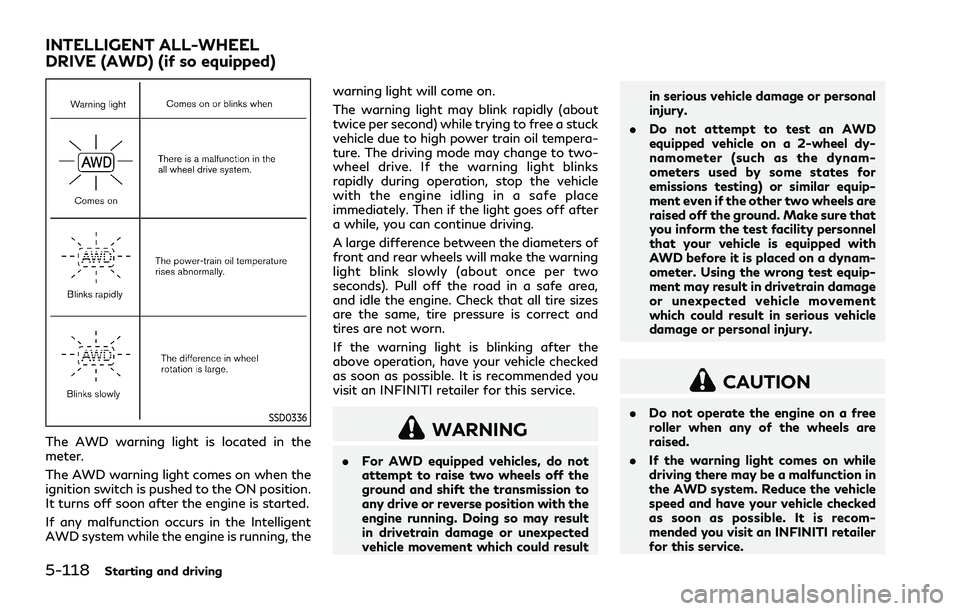
The AWD warning light is located in the
meter.
The AWD warning light comes on when the
ignition switch is pushed to the ON position.
It turns off soon after the engine is started.
If any malfunction occurs in the Intelligent
AWD system while the engine is running, thewarning light will come on.
The warning light may blink rapidly (about
twice per second) while trying to free a stuck
vehicle due to high power train oil tempera-
ture. The driving mode may change to two-
wheel drive. If the warning light blinks
rapidly during operation, stop the vehicle
with the engine idling in a safe place
immediately. Then if the light goes off after
a while, you can continue driving.
A large difference between the diameters of
front and rear wheels will make the warning
light blink slowly (about once per two
seconds). Pull off the road in a safe area,
and idle the engine. Check that all tire sizes
are the same, tire pressure is correct and
tires are not worn.
If the warning light is blinking after the
above operation, have your vehicle checked
as soon as possible. It is recommended you
visit an INFINITI retailer for this service.WARNING
.
For AWD equipped vehicles, do not
attempt to raise two wheels off the
ground and shift the transmission to
any drive or reverse position with the
engine running. Doing so may result
in drivetrain damage or unexpected
vehicle movement which could result in serious vehicle damage or personal
injury.
. Do not attempt to test an AWD
equipped vehicle on a 2-wheel dy-
namometer (such as the dynam-
ometers used by some states for
emissions testing) or similar equip-
ment even if the other two wheels are
raised off the ground. Make sure that
you inform the test facility personnel
that your vehicle is equipped with
AWD before it is placed on a dynam-
ometer. Using the wrong test equip-
ment may result in drivetrain damage
or unexpected vehicle movement
which could result in serious vehicle
damage or personal injury.
CAUTION
.Do not operate the engine on a free
roller when any of the wheels are
raised.
. If the warning light comes on while
driving there may be a malfunction in
the AWD system. Reduce the vehicle
speed and have your vehicle checked
as soon as possible. It is recom-
mended you visit an INFINITI retailer
for this service.
INTELLIGENT ALL-WHEEL
DRIVE (AWD) (if so equipped)
Page 343 of 458

6-8In case of emergency
wheel nut wrench, tighten the wheel
nuts securely in the sequence illustrated.
Lower the vehicle completely.
WARNING
.Incorrect wheel nuts or improperly
tightened wheel nuts can cause the
wheel to become loose or come off.
This could cause an accident.
. Do not use oil or grease on the wheel
studs or nuts. This could cause the
nuts to become loose.
. Retighten the wheel nuts when the
vehicle has been driven for 600 miles
(1,000 km) (also in cases of a flat tire,
etc.).
.As soon as possible, tighten the wheel
nuts to the specified torque with a
torque wrench.
Wheel nut tightening torque: 80 ft-lb (108 N·m)
The wheel nuts must be kept tigh-
tened to specification at all times. It
is recommended that wheel nuts be
tightened to specifications at each
lubrication interval.
.Adjust tire pressure to the COLD pressure. COLD pressure:
After the vehicle has been parked for
three hours or more or driven less
than 1 mile (1.6 km).
COLD tire pressures are shown on
the Tire and Loading Information
label affixed to the driver side center
pillar.
SCE0883
5. Securely store the flat tire and jacking
equipment in the vehicle.
6. Place the spare tire cover and the trunk floor carpeting over the damaged tire.
7. Close the trunk.
WARNING
. Always make sure that the spare tire
and jacking equipment are properly
secured after use. Such items can
become dangerous projectiles in an
accident or sudden stop.
. The T-type spare tire and small size
spare tire are designed for emergency
Page 361 of 458
8-2Do-it-yourself
When performing any inspection or main-
tenance work on your vehicle, always take
care to prevent serious accidental injury to
yourself or damage to the vehicle. The
following are general precautions which
should be closely observed.
WARNING
.Park the vehicle on a level surface,
apply the parking brake securely and
block the wheels to prevent the
vehicle from moving. Move the shift
lever to P (Park).
. Be sure the ignition switch is in the
OFF or LOCK position when per-
forming any parts replacement or
repairs.
. Never connect or disconnect the
battery or any transistorized compo-
nent while the ignition switch is in the
ON position.
. Never leave the engine or automatic
transmission related component har-
nesses disconnected while the igni-
tion switch is in the ON position.
. If you must work with the engine
running, keep your hands, clothing,
hair and tools away from moving
fans, belts and any other moving parts.
. It is advisable to secure or remove
any loose clothing and remove any
jewelry, such as rings, watches, etc.
before working on your vehicle.
. Always wear eye protection when-
ever you work on your vehicle.
. If you must run the engine in an
enclosed space such as a garage, be
sure there is proper ventilation for
exhaust gases to escape.
. Never get under the vehicle while it is
supported only by a jack. If it is
necessary to work under the vehicle,
support it with safety stands.
. Keep smoking materials, flame and
sparks away from fuel tank and the
battery.
. Your vehicle is equipped with an
automatic engine cooling fan. It may
come on at any time without warn-
ing, even if the ignition key is in the
OFF position and the engine is not
running. To avoid injury, always dis-
connect the negative battery cable
before working near the fan.
. Because the fuel lines are under high
pressure even when the engine is off,
it is recommended you visit an
INFINITI retailer for service of the fuel filter or fuel lines.
CAUTION
.
Do not work under the hood while the
engine is hot. Turn the engine off and
wait until it cools down.
. Avoid direct contact with used en-
gine oil and coolant. Improperly dis-
posed engine oil, coolant, and/or
other vehicle fluids can damage the
environment. Always conform to lo-
cal regulations for disposal of vehicle
fluid.
This “8. Do-it yourself” section gives instruc-
tions regarding only those items which are
relatively easy for an owner to perform.
A genuine INFINITI Service Manual is also
available. (See “Owner’s Manual/Service
Manual order information” (P.10-26).)
You should be aware that incomplete or
improper servicing may result in operating
difficulties or excessive emissions, and could
affect your warranty coverage. If in doubt
about any servicing, it is recommended you
have it done by an INFINITI retailer.
MAINTENANCE PRECAUTIONS
Page 369 of 458
8-10Do-it-yourself
until it reaches normal operating tempera-
ture. Add coolant up to the MAX level.
Tighten the cap securely after adding engine
coolant.
If the cooling system requires coolant fre-
quently, have it checked. It is recommended
you visit an INFINITI retailer for this
service.
CHANGING ENGINE COOLANT
It is recommended that major cooling system
repairs be performed by an INFINITI retailer.
The service procedures can be found in the
appropriate INFINITI Service Manual.
Improper servicing can result in reduced
heater performance and engine overheat-
ing.
WARNING
. To avoid the danger of being scalded,
never change the coolant when the
engine is hot.
. Never remove the radiator cap when
the engine is hot. Serious burns could
be caused by high pressure fluid
escaping from the radiator.
. Avoid direct skin contact with used
coolant. If skin contact is made, wash
thoroughly with soap or hand cleaner as soon as possible.
. Keep coolant out of reach of children
and pets.
Engine coolant must be disposed of prop-
erly. Check your local regulations.
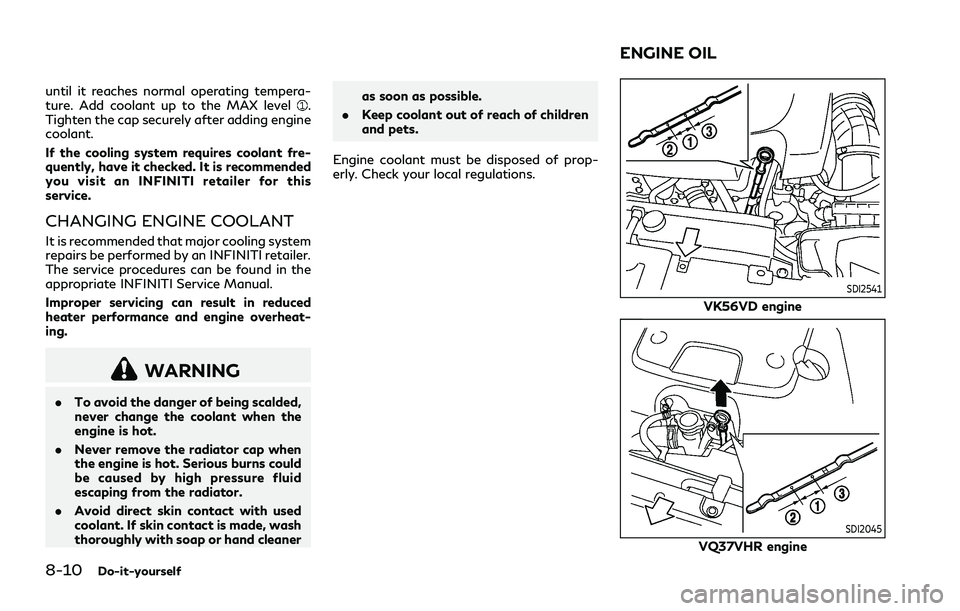
SDI2541
VK56VD engine
SDI2045
VQ37VHR engine
ENGINE OIL
Page 370 of 458

CHECKING ENGINE OIL LEVEL
1. Park the vehicle on a level surface andapply the parking brake.
2. Run the engine until it reaches operating temperature.
3. Turn off the engine. Wait more than 15
minutes for the oil to drain back into the
oil pan.
4. Remove the dipstick and wipe it clean. Reinsert it all the way.
5. Remove the dipstick again and check the oil level. It should be within the range
.
If the oil level is below, remove the oil
filler cap and pour recommended oil
through the opening. Do not overfill
.
6. Recheck oil level with the dipstick.
It is normal to add some oil between oil
maintenance intervals or during the break-
in period, depending on the severity of
operating conditions.
CAUTION
Oil level should be checked regularly.
Operating the engine with an insuffi-
cient amount of oil can damage the
engine, and such damage is not covered
by warranty.
CHANGING ENGINE OIL AND
FILTER
Vehicle set-up
1. Park the vehicle on a level surface and apply the parking brake.
2. Run the engine until it reaches operating temperature.
3. Turn the engine off and wait more than 15 minutes.
4. Raise and support the vehicle using a suitable floor jack and safety jack stands.
.Place the safety jack stands under thevehicle jack-up points.
.A suitable adapter should be attachedto the jack stand saddle.
5. Remove the plastic engine undercover.
.Remove the small plastic clip at the center point of the undercover.
.Then remove the other bolts that holdthe undercover in place.
CAUTION
Make sure the correct lifting and sup-
port points are used to avoid vehicle
damage.
SDI2543
VK56VD engine — 2WD models
SDI2335
VQ37VHR engine — 2WD models
Do-it-yourself8-11
Page 371 of 458
8-12Do-it-yourself
SDI2320
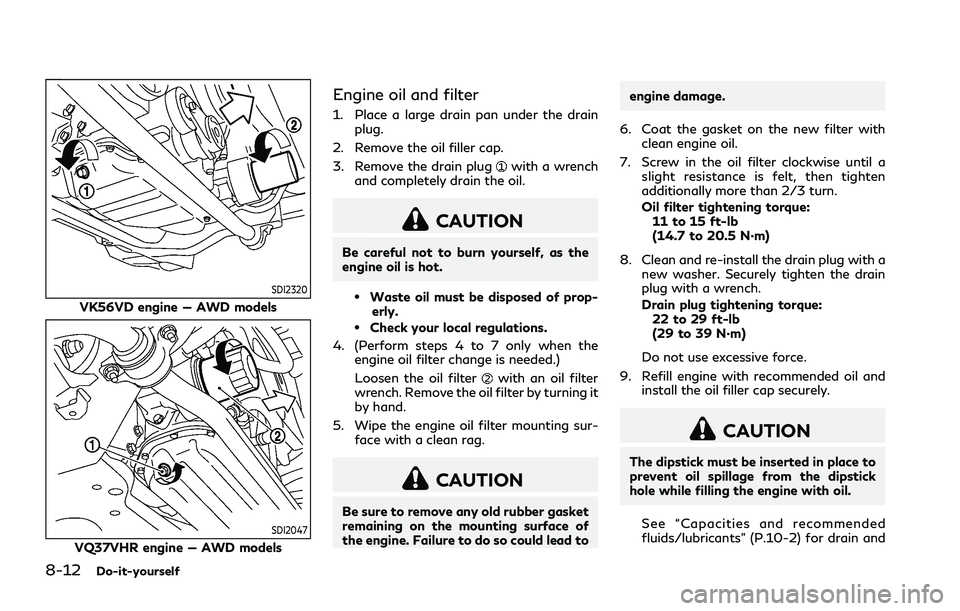
VK56VD engine — AWD models
SDI2047
VQ37VHR engine — AWD models
Engine oil and filter
1. Place a large drain pan under the drainplug.
2. Remove the oil filler cap.
3. Remove the drain plug
with a wrench
and completely drain the oil.
CAUTION
Be careful not to burn yourself, as the
engine oil is hot.
.Waste oil must be disposed of prop-
erly.
.Check your local regulations.
4. (Perform steps 4 to 7 only when the engine oil filter change is needed.)
Loosen the oil filter
with an oil filter
wrench. Remove the oil filter by turning it
by hand.
5. Wipe the engine oil filter mounting sur- face with a clean rag.
CAUTION
Be sure to remove any old rubber gasket
remaining on the mounting surface of
the engine. Failure to do so could lead to engine damage.
6. Coat the gasket on the new filter with clean engine oil.
7. Screw in the oil filter clockwise until a slight resistance is felt, then tighten
additionally more than 2/3 turn.
Oil filter tightening torque:11 to 15 ft-lb
(14.7 to 20.5 N·m)
8. Clean and re-install the drain plug with a new washer. Securely tighten the drain
plug with a wrench.
Drain plug tightening torque:
22 to 29 ft-lb
(29 to 39 N·m)
Do not use excessive force.
9. Refill engine with recommended oil and install the oil filler cap securely.
CAUTION
The dipstick must be inserted in place to
prevent oil spillage from the dipstick
hole while filling the engine with oil.
See “Capacities and recommended
fluids/lubricants” (P.10-2) for drain and
Page 372 of 458

refill capacity. The drain and refill capa-
city depends on the oil temperature and
drain time. Use these specifications for
reference only. Always use the dipstick
to determine the proper amount of oil in
the engine.
10. Start the engine and check for leakage around the drain plug and the oil filter.
Correct as required.
11. Turn the engine off and wait more than 15 minutes. Check the oil level with the
dipstick. Add engine oil if necessary.
After the operation
1. Install the engine undercover into posi-
tion as the following steps.
a. Pull the center of the small plastic clipout.
b. Hold the engine undercover into posi- tion.
c. Insert the clip through the undercover into the hole in the frame, then push
the center of the clip in to lock the clip
in place.
d. Install the other bolts that hold the undercover in place. Be careful not to
strip the bolts or over-tighten them.
2. Lower the vehicle carefully to the ground. 3. Dispose of waste oil and filter properly.
WARNING
.
Prolonged and repeated contact with
used engine oil may cause skin cancer.
. Try to avoid direct skin contact with
used oil. If skin contact is made, wash
thoroughly with soap or hand cleaner
as soon as possible.
. Keep used engine oil out of reach of
children. When checking or replacement is required,
we recommend an INFINITI retailer for
servicing.CAUTION
.
It is recommended that you use only
Genuine NISSAN Matic S ATF. Do
not mix with other fluids.
. Using automatic transmission fluid
(ATF) other than Genuine NISSAN
Matic S ATF may cause deterioration
in driveability and automatic trans-
mission durability, and may damage
the automatic transmission. Damage
caused by use of fluids other than as
recommended is not covered by the
INFINITI new vehicle limited war-
ranty.
Do-it-yourself8-13
AUTOMATIC TRANSMISSION
FLUID (ATF)
Page 404 of 458
The following descriptions are provided to
give you a better understanding of the
scheduled maintenance items that should
be regularly checked or replaced. The main-
tenance schedule indicates at which mile-
age/time intervals each item requires
service.
In addition to scheduled maintenance, your
vehicle requires that some items be checked
during normal day-to-day operation. Refer
to “General maintenance” (P.9-2).
Items marked with “*” are recommended by
INFINITI for reliable vehicle operation. You
are not required to perform maintenance on
these items in order to maintain the warran-
ties which come with your vehicle. Other
maintenance items and intervals are re-
quired.
When applicable, additional information can
be found in the “8. Do-it yourself” section of
this manual.
NOTE:
INFINITI does not advocate the use of non-
OEM approved aftermarket flushing sys-
tems and strongly advises against perform-
ing these services on an INFINITI product.
Many of the aftermarket flushing systems
use non-OEM approved chemicals or sol-
vents, the use of which has not been
validated by INFINITI.
For recommended fuel, lubricants, fluids,grease, and refrigerant, refer to “Capacities
and recommended fluids/lubricants” (P.10-
2) of this manual.
EMISSION CONTROL SYSTEM
MAINTENANCE
Drive belts*:
Check engine drive belts for wear, fraying or
cracking and for proper tension. Replace any
damaged drive belts.
Engine air filter:
Replace at specified intervals. When driving
for prolonged periods in dusty conditions,
check/replace the filter more frequently.
Engine coolant*:
Replace coolant at the specified interval.
When adding or replacing coolant, be sure to
use only Genuine NISSAN Long Life Anti-
freeze/Coolant (blue) or equivalent with the
proper mixture. (Refer to “Engine cooling
system” (P.8-8) to determine the proper
mixture for your area.)
NOTE:
Mixing any other type of coolant or the use
of non-distilled water may reduce the
recommended service interval of the cool-
ant.
Engine oil and oil filter:
Replace engine oil and oil filter at the
specified intervals. For recommended oil
grade and viscosity refer to “Capacities and
recommended fluids/lubricants” (P.10-2).
Engine valve clearance*:
Inspect only if valve noise increases. Adjust
valve clearance if necessary.
Evaporative emissions control vapor lines*:
Check vapor lines for leaks or looseness.
Tighten connections or replace parts as
necessary.
Fuel lines*:
Check the fuel hoses, piping and connections
for leaks, looseness, or deterioration. Tight-
en connections or replace parts as necessary.
Spark plugs:
Replace at specified intervals. Install new
plugs of the type as originally equipped.
CHASSIS AND BODY MAINTE-
NANCE
Brake lines and cables:
Visually inspect for proper installation.
Check for chafing, cracks, deterioration,
and signs of leaking. Replace any deterio-
rated or damaged parts immediately.
Maintenance and schedules9-5
EXPLANATION OF SCHEDULED
MAINTENANCE ITEMS