spare tire INFINITI QX 2013 User Guide
[x] Cancel search | Manufacturer: INFINITI, Model Year: 2013, Model line: QX, Model: INFINITI QX 2013Pages: 578, PDF Size: 3.92 MB
Page 454 of 578

SSD0471
Warning light and display
When the Preview Function is not operating
properly, the chime sounds and the system
warning light (orange) will come on.
Action to take:
If the warning light comes on, park the
vehicle in a safe place. Turn the engine off,
restart the engine and resume driving.
If the indicator stays on, it may indicate
that the Preview Function is malfunction-
ing (the brake is operative). Although the
Vehicle is still driveable under normal
conditions, have the vehicle checked at
an INFINITI retailer.
How to handle the sensor
The sensor for the Preview Function is
common with Intelligent Cruise Control and
is located below the front bumper.
To keep the Preview Function operating
properly, be sure to observe the following:
.Always keep the sensor clean. Wipe
with a soft cloth carefully so as not to
damage the sensor.
. Do not strike or damage the areas
around the sensor. Do not touch or
remove the screw located on the
sensor. Doing so could cause failure
or malfunction. If the sensor is da-
maged due to an accident, contact an
INFINITI retailer.
. Do not attach a sticker (including
transparent material) or install an
accessory near the sensor. This could
cause failure or malfunction.
ANTI-LOCK BRAKING SYSTEM (ABS)
WARNING
. The Anti-lock Braking System (ABS) is a
sophisticated device, but it cannot pre-
vent accidents resulting from careless or
dangerous driving techniques. It can
help maintain vehicle control during
braking on slippery surfaces. Remember
that stopping distances on slippery
surfaces will be longer than on normal
surfaces even with ABS. Stopping dis-
tances may also be longer on rough,
gravel or snow covered roads, or if you
are using tire chains. Always maintain a
safe distance from the vehicle in front of
you. Ultimately, the driver is responsible
for safety.
. Tire type and condition may also affect
braking effectiveness.
—When replacing tires, install the
specified size of tires on all four
wheels.
—When installing a spare tire, make
sure that it is the proper size and
type as specified on the Tire and
Loading Information label. See “Tire
Starting and driving5-113
Page 464 of 578
To shut off the engine in an emergency
situation while driving, perform the follow-
ing procedure:
.Rapidly push the push-button ignition
switch 3 consecutive times in less than
1.5 seconds, or
. Push and hold the push-button ignition
switch for more than 2 seconds.TIRE PRESSURE MONITORING SYS-
TEM (TPMS)
This vehicle is equipped with the Tire
Pressure Monitoring System (TPMS). It
monitors tire pressure of all tires except
the spare. When the low tire pressure
warning light is lit and the CHECK TIRE
PRESSURE warning appears in the dot
matrix liquid crystal display, one or more
of your tires is significantly under-inflated.
If the vehicle is being driven with low tire
pressure, the TPMS will activate and warn
you of it by the low tire pressure warning
light. This system will activate only when
the vehicle is driven at speeds above 16
MPH (25 km/h). For more details, see
“Warning/indicator lights and audible re-
minders” in the“2. Instruments and
controls” section,“TIRE PRESSURE infor-
mation” in the“4. Monitor, climate, audio,
phone and voice recognition systems”
section and “Tire Pressure Monitoring
System (TPMS)” in the“5. Starting and
driving” section.
WARNING
.If the low tire pressure warning light
illuminates or LOW PRESSURE informa- tion is displayed on the monitor screen
while driving, avoid sudden steering
maneuvers or abrupt braking, reduce
vehicle speed, pull off the road to a safe
location and stop the vehicle as soon as
possible. Driving with under-inflated
tires may permanently damage the tires
and increase the likelihood of tire fail-
ure. Serious vehicle damage could occur
and may lead to an accident and could
result in serious personal injury. Check
the tire pressure for all four tires. Adjust
the tire pressure to the recommended
COLD tire pressure shown on the Tire
and Loading Information label to turn
the low tire pressure warning light OFF. If
the light still illuminates while driving
after adjusting the tire pressure, a tire
may be flat. If you have a flat tire,
replace it with a spare tire as soon as
possible.
. When a spare tire is mounted or a wheel
is replaced, the TPMS will not function
and the low tire pressure warning light
will flash for approximately 1 minute.
The light will remain on after 1 minute.
Contact your INFINITI retailer as soon as
possible for tire replacement and/or
system resetting.
In case of emergency6-3
EMERGENCY ENGINE SHUT OFF FLAT TIRE
Page 466 of 578

JVE0023X
Getting the spare tire and tools
1. Open the lift gate.
2. Raise the cargo floor board using thehandle
*A.
JVE0091X
WARNING
When removing jacking tools, be sure the
rubber sound suppressor*1, used to
control jack stand from rattling against
metal, is not attached to the jacking tool. If rubber sound suppressor remains on jack
when vehicle is being jacked up, the vehicle
will be unstable and may fall off jack stand
causing serious injury of death.
3. Remove the cargo floor cover.
4. Remove the jacking tools.
In case of emergency6-5
Page 468 of 578
SCE0377
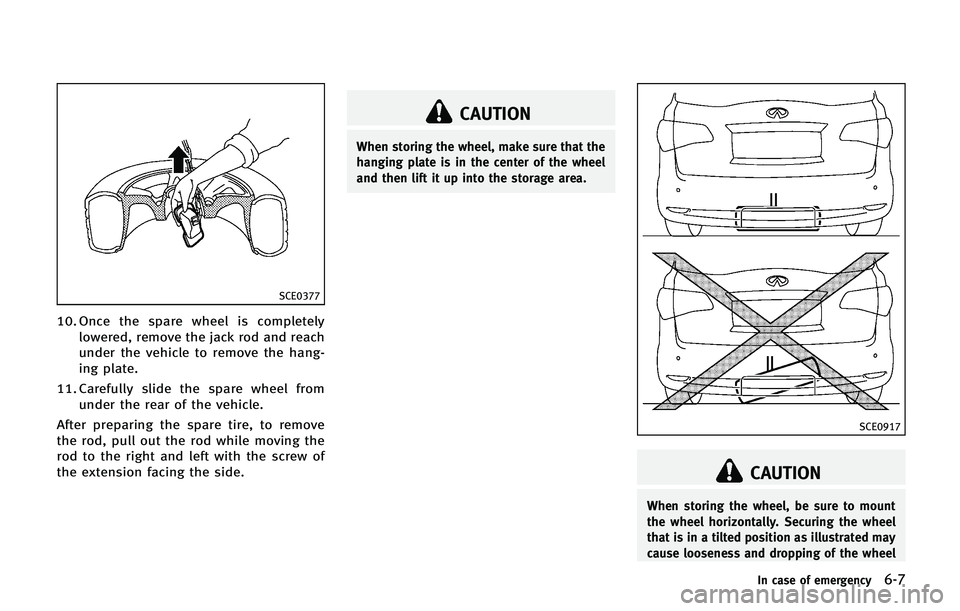
10. Once the spare wheel is completelylowered, remove the jack rod and reach
under the vehicle to remove the hang-
ing plate.
11. Carefully slide the spare wheel from under the rear of the vehicle.
After preparing the spare tire, to remove
the rod, pull out the rod while moving the
rod to the right and left with the screw of
the extension facing the side.
CAUTION
When storing the wheel, make sure that the
hanging plate is in the center of the wheel
and then lift it up into the storage area.
SCE0917
CAUTION
When storing the wheel, be sure to mount
the wheel horizontally. Securing the wheel
that is in a tilted position as illustrated may
cause looseness and dropping of the wheel
In case of emergency6-7
Page 471 of 578
6-10In case of emergency
seconds. To reset the auto-leveling sus-
pension, cycle the ignition switch ON/OFF
one time.
SCE0910
Installing the spare tire
The full-size temporary use only spare tire
(if so equipped) is designed for emergency
use. (See specific instructions under the
heading“Wheels and tires” in the“8.
Maintenance and do-it-yourself” section.)
1. Clean any mud or dirt from the surface between the wheel and hub.
2. Carefully put the spare tire on and tighten the wheel nuts finger tight.
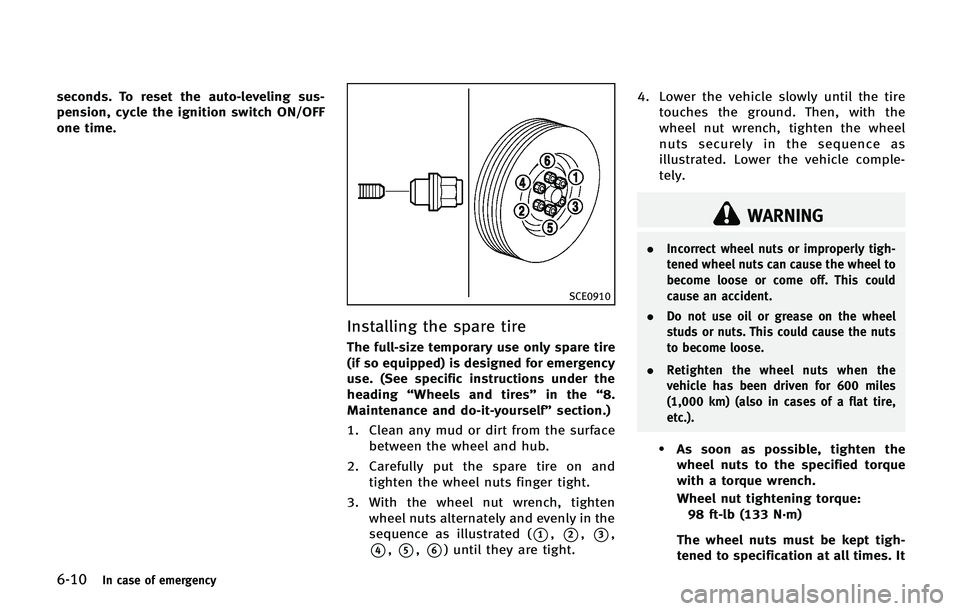
3. With the wheel nut wrench, tighten wheel nuts alternately and evenly in the
sequence as illustrated (
*1,*2,*3,
*4,*5,*6) until they are tight. 4. Lower the vehicle slowly until the tire
touches the ground. Then, with the
wheel nut wrench, tighten the wheel
nuts securely in the sequence as
illustrated. Lower the vehicle comple-
tely.
WARNING
. Incorrect wheel nuts or improperly tigh-
tened wheel nuts can cause the wheel to
become loose or come off. This could
cause an accident.
. Do not use oil or grease on the wheel
studs or nuts. This could cause the nuts
to become loose.
. Retighten the wheel nuts when the
vehicle has been driven for 600 miles
(1,000 km) (also in cases of a flat tire,
etc.).
.As soon as possible, tighten the
wheel nuts to the specified torque
with a torque wrench.
Wheel nut tightening torque: 98 ft-lb (133 N·m)
The wheel nuts must be kept tigh-
tened to specification at all times. It
Page 472 of 578

is recommended that wheel nuts be
tightened to specifications at each
lubrication interval.
.Adjust tire pressure to the COLDpressure.
COLD pressure:
After the vehicle has been parked
for three hours or more or driven
less than 1 mile (1.6 km).
COLD tire pressures are shown on
the Tire and Loading Information
label affixed to the driver side center
pillar.
After adjusting tire pressure to the COLD
tire pressure, the display of the tire
pressure information may show higher
pressure than the COLD tire pressure after
the vehicle has been driven more than 1
mile (1.6 km). This is because the tire
pressurizes as the tire temperature rises.
This does not indicate a system malfunc-
tion.
Stowing the damaged tire and tools
1. Securely store the damaged tire, jack and tools in the storage area.
2. Close the cargo floor cover.
3. Replace the cargo floor board.
4. Close the lift gate.
WARNING
. Always make sure that the spare tire and
jacking equipment are properly secured
after use. Such items can become
dangerous projectiles in an accident or
sudden stop.
. The full-size temporary use only spare
tire (if so equipped) is designed for
emergency use. (See specific instruc-
tions under the heading “Wheels and
tires” in the “8. Maintenance and do-it-
yourself” section.)
To start your engine with a booster battery,
the instructions and precautions below
must be followed.
WARNING
.If done incorrectly, jump starting can
lead to a battery explosion, resulting in
severe injury or death. It could also
damage your vehicle.
. Explosive hydrogen gas is always pre-
sent in the vicinity of the battery. Keep
all sparks and flames away from the
battery.
. Do not allow battery fluid to come into
contact with eyes, skin, clothing or
painted surfaces. Battery fluid is a
corrosive sulphuric acid solution which
can cause severe burns. If the fluid
should come into contact with anything,
immediately flush the contacted area
with water.
. Keep the battery out of the reach of
children.
. The booster battery must be rated at 12
volts. Use of an improperly rated battery
can damage your vehicle.
In case of emergency6-11
JUMP STARTING
Page 492 of 578

is released.
When driving in areas using road salt or
other corrosive materials, check lubrication
frequently.
Lights*:Clean the headlights on a regular
basis. Make sure that the headlights, stop
lights, tail lights, turn signal lights, and
other lights are all operating properly and
installed securely. Also check headlight
aim.
Road wheel nuts (lug nuts)*: When check-
ing the tires, make sure no wheel nuts are
missing, and check for any loose wheel
nuts. Tighten if necessary.
Tire rotation*: Tires should be rotated in
accordance with the maintenance log
shown in the “INFINITI Service and Main-
tenance Guide”.
Tires*: Check the pressure with a gauge
often and always prior to long distance
trips. If necessary, adjust the pressure in
all tires, including the spare, to the
pressure specified. Check carefully for
damage, cuts or excessive wear.
Tire Pressure Monitoring System (TPMS)
transmitter components: Replace the TPMS
transmitter grommet seal, valve core and
cap when the tires are replaced due to wear or age.
Tire, wheel alignment and balance:
If the
vehicle should pull to either side while
driving on a straight and level road, or if
you detect uneven or abnormal tire wear,
there may be a need for wheel alignment.
If the steering wheel or seat vibrates at
normal highway speeds, wheel balancing
may be needed.
For additional information regarding tires,
refer to “Important Tire Safety Information”
(US) or “Tire Safety Information” (Canada)
in the INFINITI Warranty Information Book-
let.
Windshield: Clean the windshield on a
regular basis. Check the windshield at
least every six months for cracks or other
damage. Have a damaged windshield
repaired by a qualified repair facility.
Windshield wiper blades*: Check for
cracks or wear if they do not wipe properly.
Inside the vehicle
The maintenance items listed here should
be checked on a regular basis, such as
when performing periodic maintenance,
cleaning the vehicle, etc.
Accelerator pedal: Check the pedal for smooth operation and make sure the pedal
does not catch or require uneven effort.
Keep the floor mat away from the pedal.
Automatic transmission P (Park) mechan-
ism:
On a fairly steep hill, check that your
vehicle is held securely with the shift lever
in the P (Park) position without applying
any brakes.
Brake pedal: Check the pedal for smooth
operation. If the brake pedal suddenly
goes down further than normal, the pedal
feels spongy or the vehicle seems to take
longer to stop, see an INFINITI retailer
immediately. Keep the floor mat away from
the pedal.
Brakes: Check that the brakes do not pull
the vehicle to one side when applied.
Parking brake: Check the parking brake
operation regularly. The vehicle should be
securely held on a fairly steep hill with only
the parking brake applied. If the parking
brake needs adjusted, see an INFINITI
retailer.
Seat belts: Check that all parts of the seat
belt system (for example, buckles, an-
chors, adjuster and retractors) operate
properly and smoothly, and are installed
securely. Check the belt webbing for cuts,
Maintenance and do-it-yourself8-3
Page 520 of 578
SDI1729
Cargo light
SDI2032
Vanity mirror lightIf you have a flat tire, see
“Flat tire”in the
“6. In case of emergency” section.
TIRE PRESSURE
Tire Pressure Monitoring System
(TPMS)
This vehicle is equipped with the Tire
Pressure Monitoring System (TPMS). It
monitors tire pressure of all tires except
the spare. When the low tire pressure
warning light is lit and the CHECK TIRE
PRESSURE warning appears in the dot
matrix liquid crystal display, one or more
of your tires is significantly under-inflated.
The TPMS will activate only when the
vehicle is driven at speeds above 16 MPH
(25 km/h). Also, this system may not
detect a sudden drop in tire pressure (for
example, a flat tire while driving).
For more details, see“Low tire pressure
warning light” in the“2. Instruments and
controls” section,“Tire Pressure Monitor-
ing System (TPMS)” in the“5. Starting and
driving” section and “Tire Pressure Mon-
itoring System (TPMS) ”in the “6. In case
of emergency” section.
Tire inflation pressure
Check the pressure of the tires
(including the spare) often and al-
ways prior to long distance trips. The
recommended tire pressure specifi-
cations are shown on the Tire and
Loading Information label under the
“Cold Tire Pressure” heading. The
Tire and Loading Information label is
affixed to the driver side center pillar.
Tire pressures should be checked
regularly because:
.Most tires naturally lose air over time.
.Tires can lose air suddenly whendriven over potholes or other
objects or if the vehicle strikes a
curb while parking.
The tire pressures should be checked
when the tires are cold. The tires are
considered COLD after the vehicle
has been parked for 3 or more hours,
or driven less than 1 mile (1.6 km) at
moderate speeds.
Maintenance and do-it-yourself8-31
WHEELS AND TIRES
Page 522 of 578
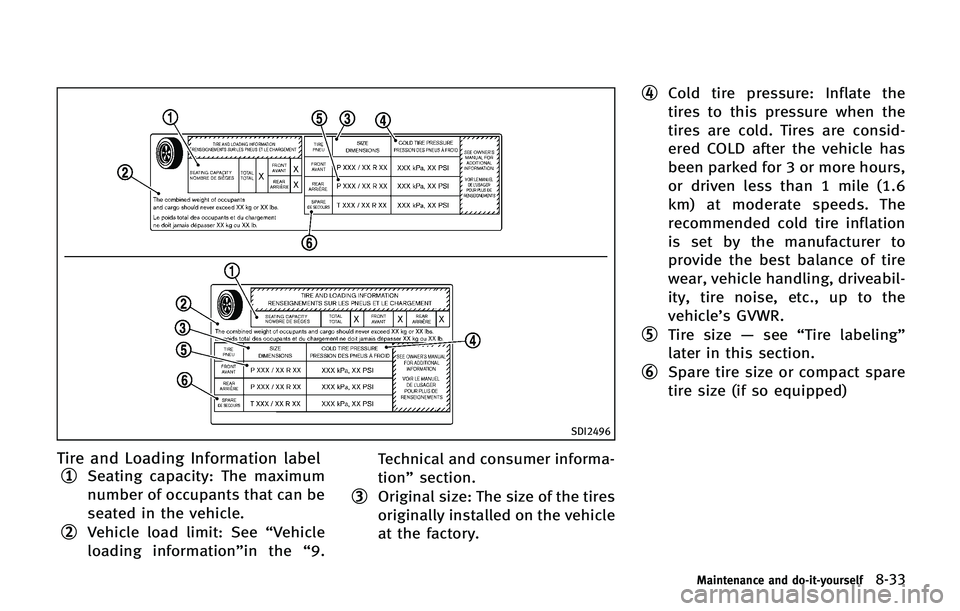
SDI2496
Tire and Loading Information label
*1Seating capacity: The maximum
number of occupants that can be
seated in the vehicle.
*2Vehicle load limit: See“Vehicle
loading information”in the “9.Technical and consumer informa-
tion”
section.
*3Original size: The size of the tires
originally installed on the vehicle
at the factory.
*4Cold tire pressure: Inflate the
tires to this pressure when the
tires are cold. Tires are consid-
ered COLD after the vehicle has
been parked for 3 or more hours,
or driven less than 1 mile (1.6
km) at moderate speeds. The
recommended cold tire inflation
is set by the manufacturer to
provide the best balance of tire
wear, vehicle handling, driveabil-
ity, tire noise, etc., up to the
vehicle’s GVWR.
*5Tire size —see “Tire labeling”
later in this section.
*6Spare tire size or compact spare
tire size (if so equipped)
Maintenance and do-it-yourself8-33
Page 523 of 578
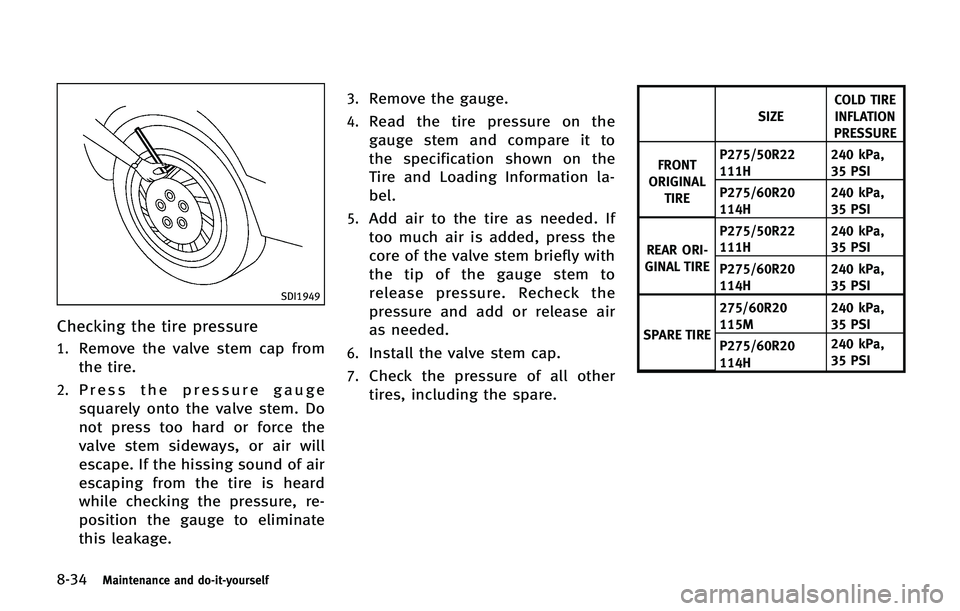
8-34Maintenance and do-it-yourself
SDI1949
Checking the tire pressure
1.Remove the valve stem cap from
the tire.
2.Press the pressure gauge
squarely onto the valve stem. Do
not press too hard or force the
valve stem sideways, or air will
escape. If the hissing sound of air
escaping from the tire is heard
while checking the pressure, re-
position the gauge to eliminate
this leakage.
3.Remove the gauge.
4.Read the tire pressure on the
gauge stem and compare it to
the specification shown on the
Tire and Loading Information la-
bel.
5.Add air to the tire as needed. If
too much air is added, press the
core of the valve stem briefly with
the tip of the gauge stem to
release pressure. Recheck the
pressure and add or release air
as needed.
6.Install the valve stem cap.
7.Check the pressure of all other
tires, including the spare.
SIZECOLD TIRE
INFLATION
PRESSURE
FRONT
ORIGINAL TIRE P275/50R22
111H
240 kPa,
35 PSI
P275/60R20
114H 240 kPa,
35 PSI
REAR ORI-
GINAL TIRE P275/50R22
111H
240 kPa,
35 PSI
P275/60R20
114H 240 kPa,
35 PSI
SPARE TIRE 275/60R20
115M
240 kPa,
35 PSI
P275/60R20
114H 240 kPa,
35 PSI